434
P13–2, Concluded
7.
A
B
C
1
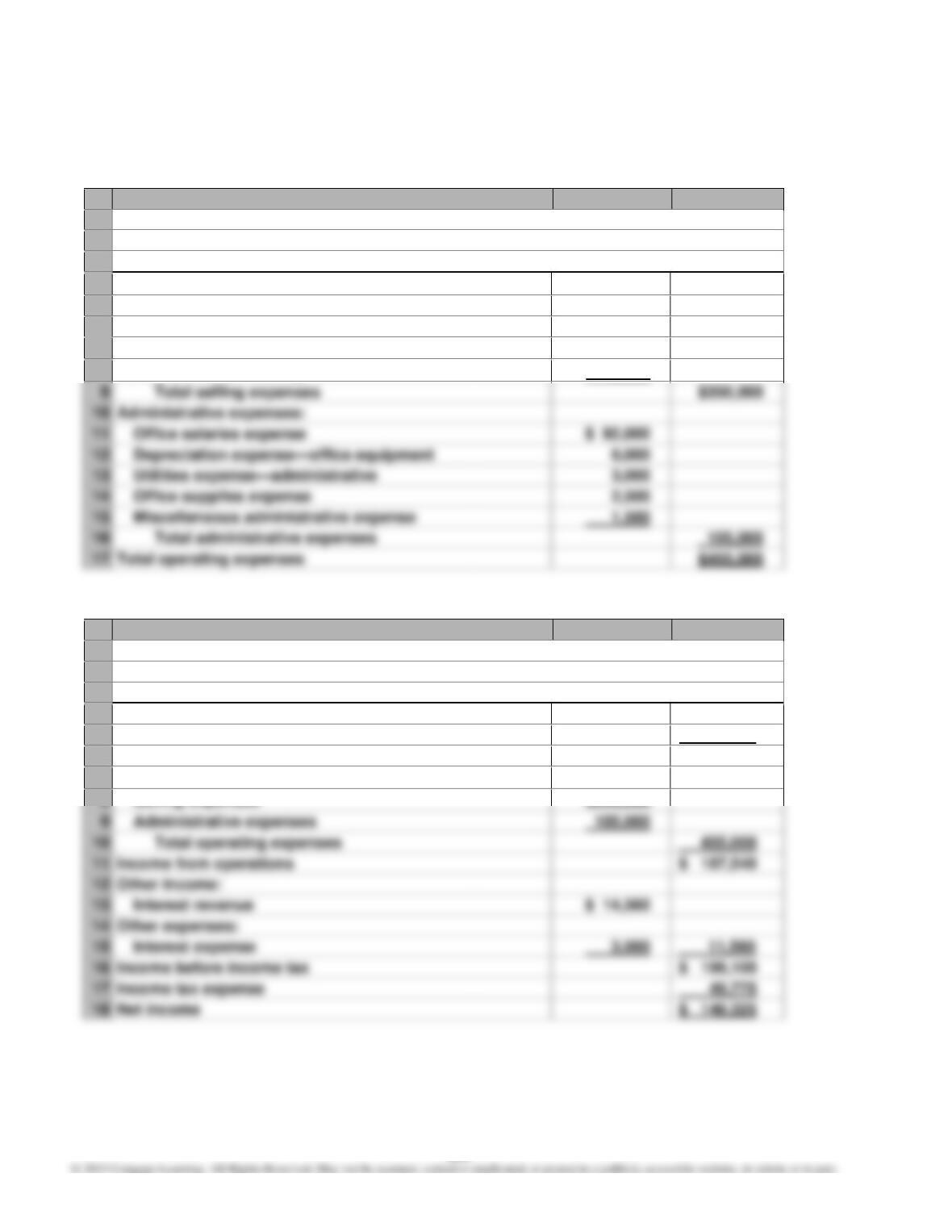
JUPITER HELMETS INC.
2
Selling and Administrative Expenses Budget
3
For the Month Ending May 31
4
Selling expenses:
5
Sales salaries expense
$175,000
6
Advertising expense
120,000
7
Travel expense—selling
50,000
8
Miscellaneous—selling
5,000
9
Total selling expenses
10
Administrative expenses:
11
Office salaries expense
$ 92,000
12
Depreciation expense—office equipment
13
Utilities expense—administrative
14
Office supplies expense
15
Miscellaneous administrative expense
1,500
16
Total administrative expenses
17
Total operating expenses
8.
A
B
C
1
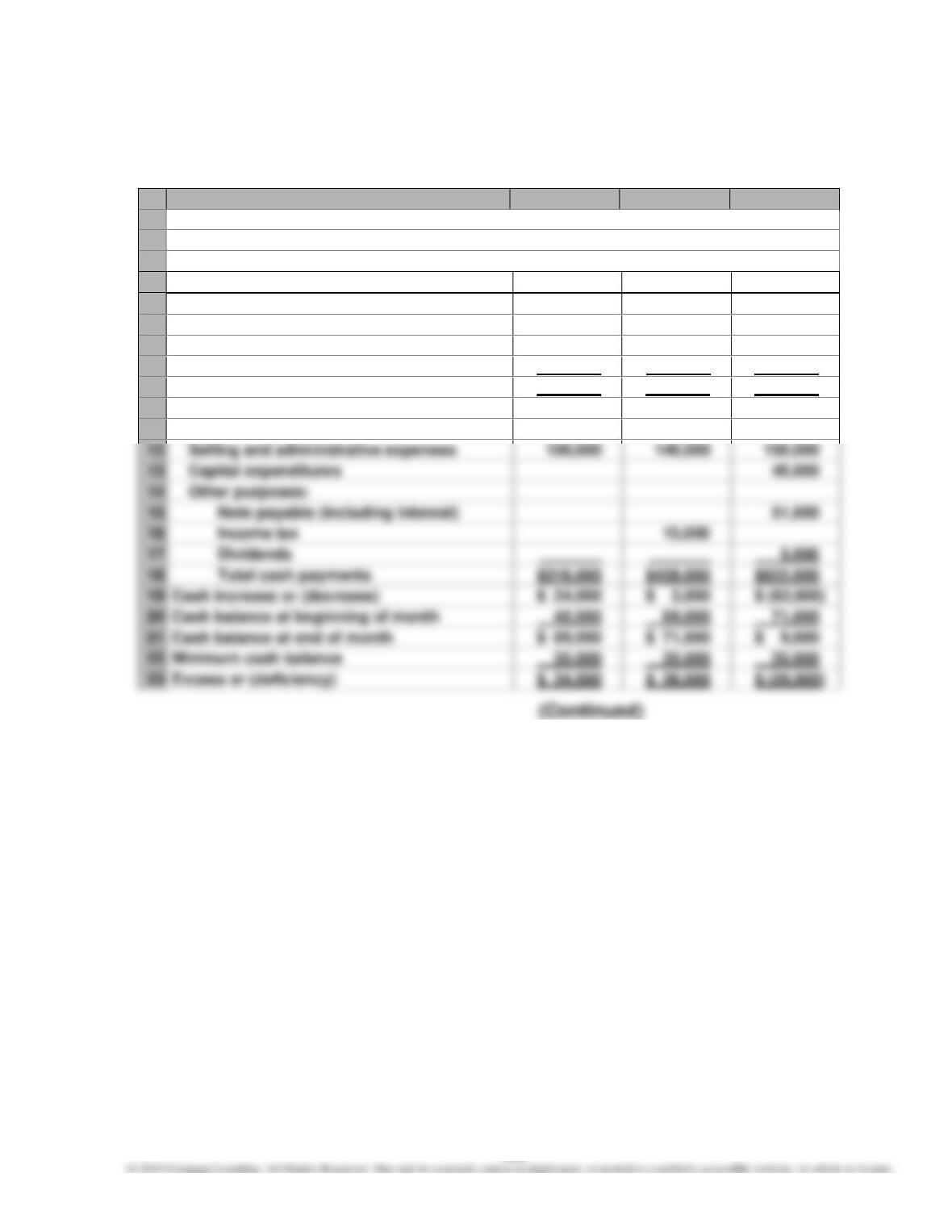
JUPITER HELMETS INC.
2
Budgeted Income Statement
3
For the Month Ending May 31
4
Revenue from sales
$1,055,000
5
Cost of goods sold
412,460
6
Gross profit
$ 642,540
7
Operating expenses:
8
Selling expenses
9
Administrative expenses
105,000
10
Total operating expenses
455,000
11
Income from operations
$ 187,540
12
Other income:
14
Other expenses:
15
Interest expense
3,000
16
Income before income tax
$ 199,100
17
Income tax expense
49,775
18
Net income
$ 149,325
435
P13–3
1.
A
B
C
D
1
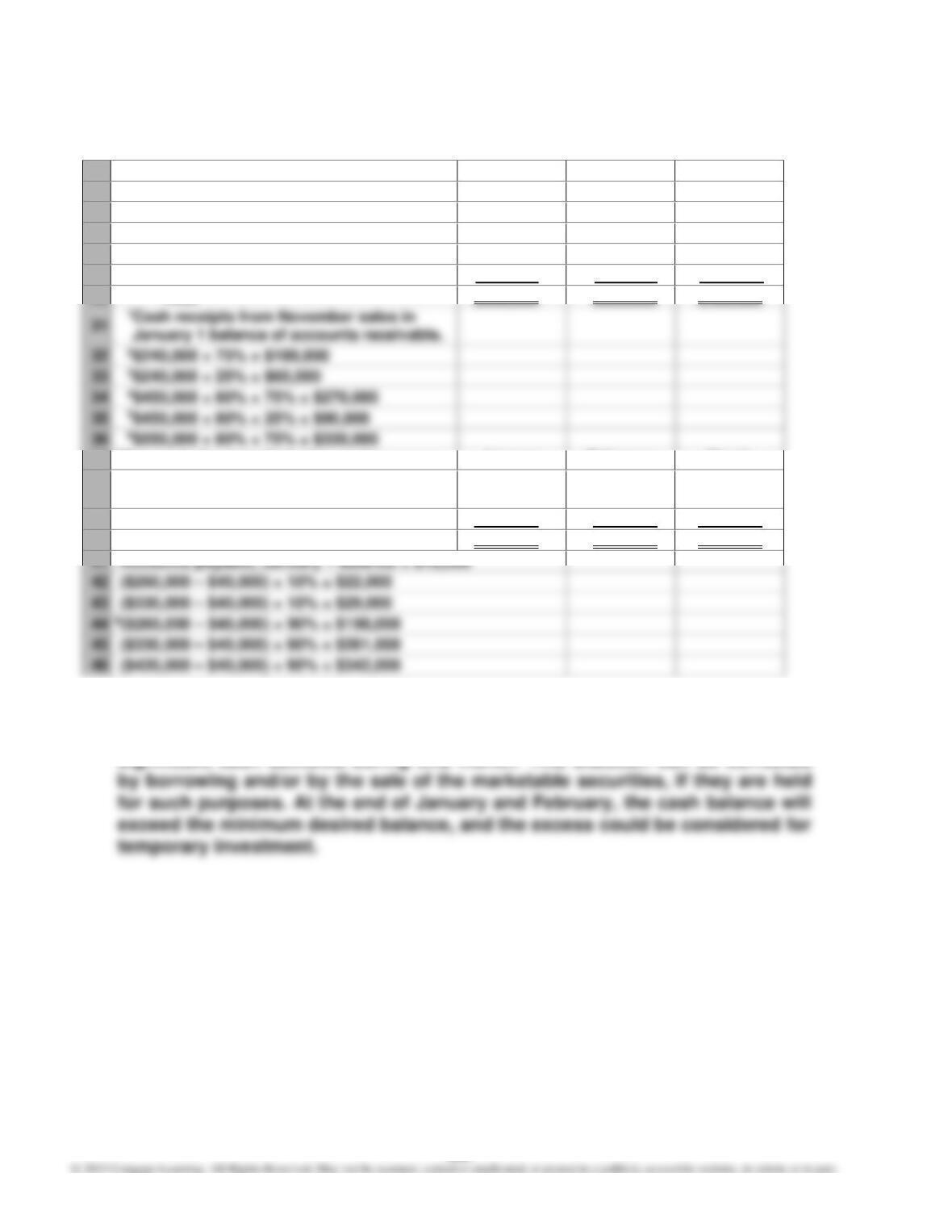
SHOE MART INC.
2
Cash Budget
3
For the Three Months Ending March 31
4
January
February
March
5
Estimated cash receipts from:
6
Cash sales
$ 90,000
$110,000
$140,000
7
Collection of accounts receivablea
230,000
330,000
420,000
8
Dividends
20,000
_______
9
Total cash receipts
$340,000
$440,000
$560,000
10
Estimated cash payments for:
11
Manufacturing costsb
$216,000
$283,000
$371,000
12
Selling and administrative expenses
100,000
150,000
13
Capital expenditures
14
Other purposes:
15
Note payable (including interest)
16
Income tax
17
Dividends
5,000
18
Total cash payments
$316,000
$438,000
$622,000
19
Cash increase or (decrease)
$ 24,000
$ 2,000
20
Cash balance at beginning of month
45,000
69,000
71,000
21
Cash balance at end of month
$ 69,000
$ 71,000
$ 9,000
22
Minimum cash balance
35,000
35,000
35,000
23
Excess or (deficiency)
$ 34,000
$ 36,000
436
P13–3, Concluded
24
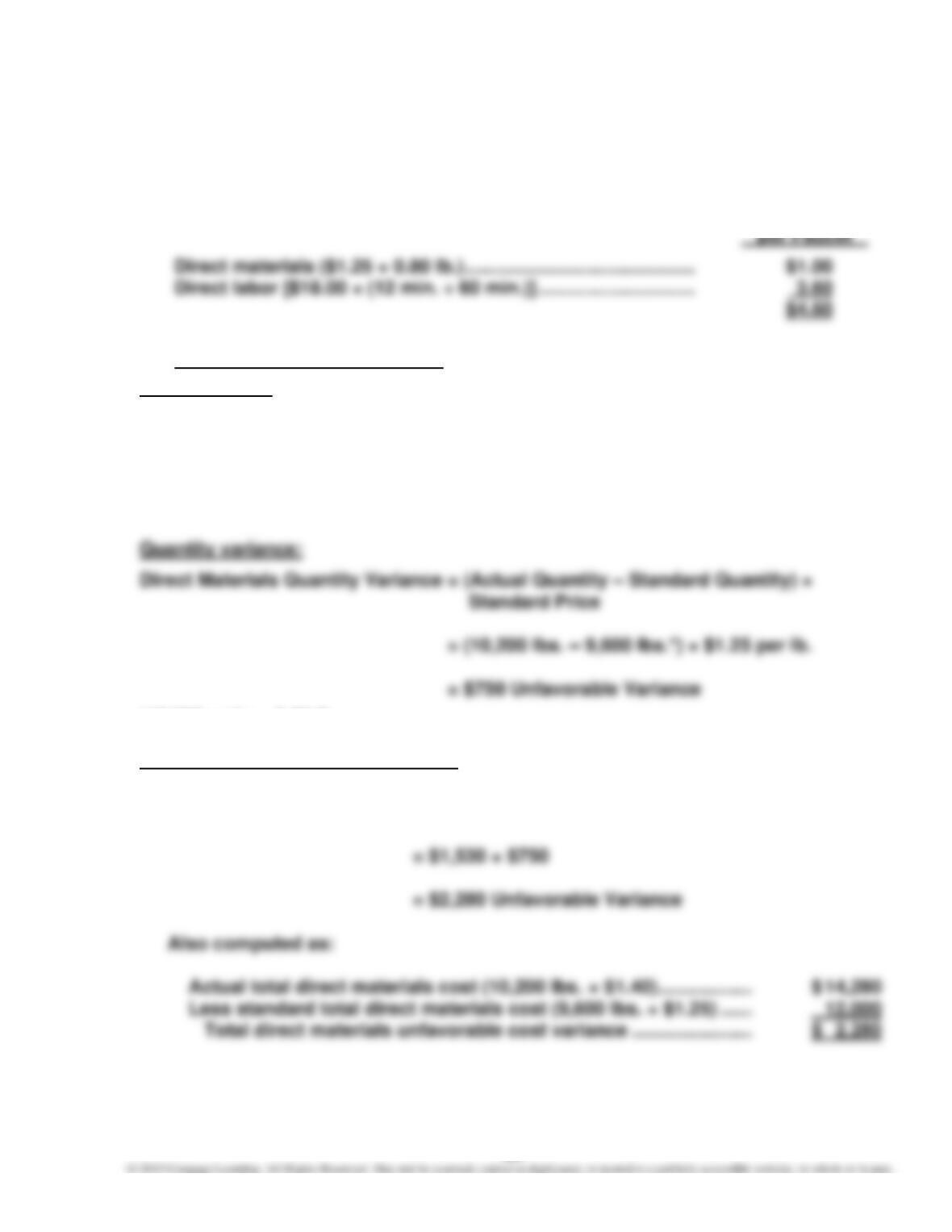
Computations:
25
aCollections of accounts receivable:
January
February
March
26
November sales
$ 50,0001
27
December sales
180,0002
$ 60,0003
28
January sales
270,0004
$ 90,0005
29
February sales
330,0006
30
Total
$230,000
$330,000
$420,000
31
32
33
34
35
36
37
bPayments for manufacturing costs:
January
February
March
38
Payment of accounts payable, beginning
of month balancec
$ 18,000
$ 22,000
$ 29,000
39
Payment of current month’s costd
198,000
261,000
342,000
40
Total
$216,000
$283,000
$371,000
41
42
($260,000 – $40,000) × 10% = $22,000
43
($330,000 – $40,000) × 10% = $29,000
44
d($260,000 – $40,000) × 90% = $198,000
46
($420,000 – $40,000) × 90% = $342,000
cAccounts payable, January 1 balance = $18,000
2. The budget indicates that the minimum cash balance will not be maintained in
March. This is due to the capital expenditures and note repayment requiring
significant cash outflows during this month. This situation can be corrected
437
P13–4
a. Standard
Materials and
Labor Cost
b. Direct Materials Cost Variance
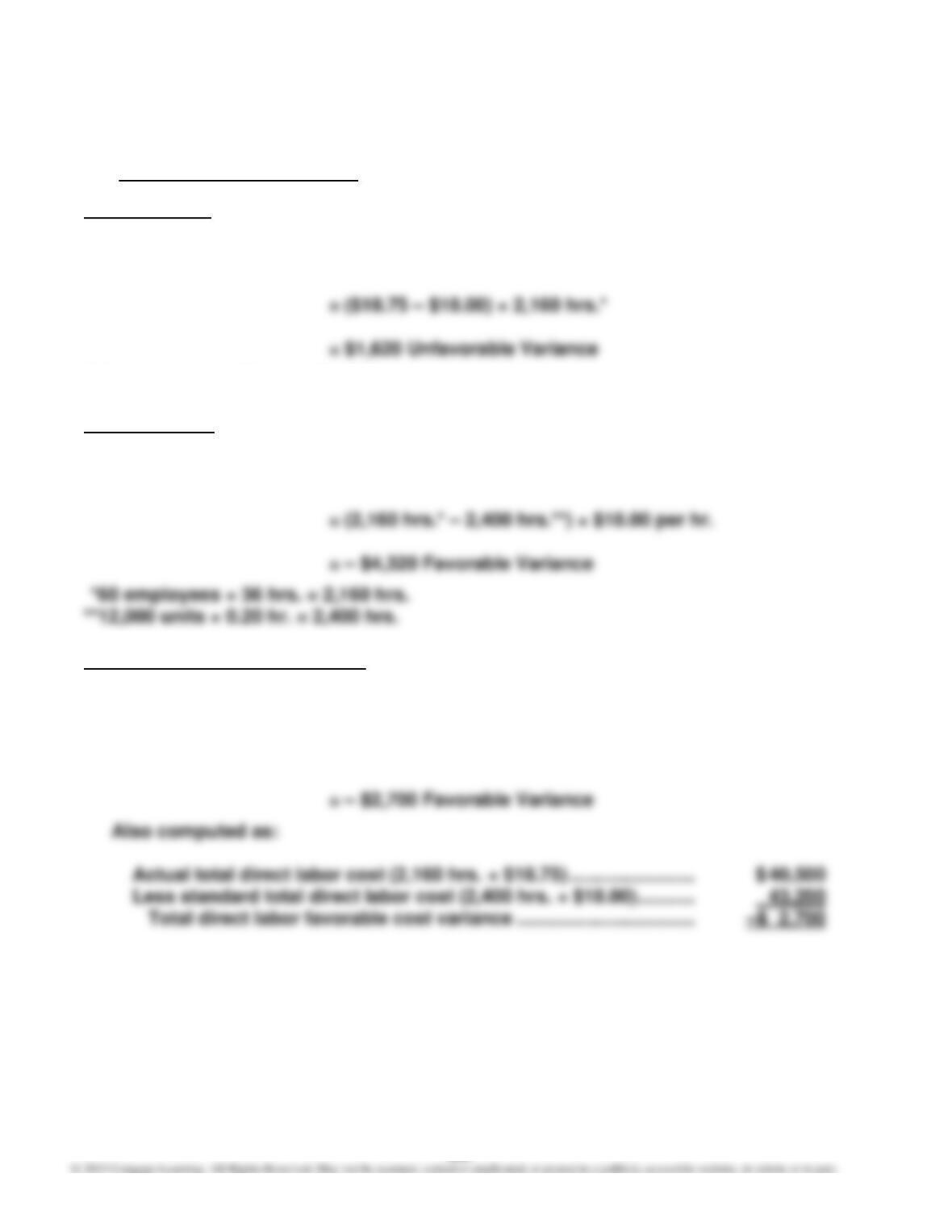
Price variance:
Direct Materials Price Variance = (Actual Price – Standard Price) × Actual Quantity
= ($1.40 per lb. – $1.25 per lb.) × 10,200 lbs.
= $1,530 Unfavorable Variance
*12,000 units × 0.80 lb.
Total direct materials cost variance:
Direct Materials Cost Variance = Direct Materials Price Variance + Direct
Materials Quantity Variance
438
P13–4, Concluded
c. Direct Labor Cost Variance
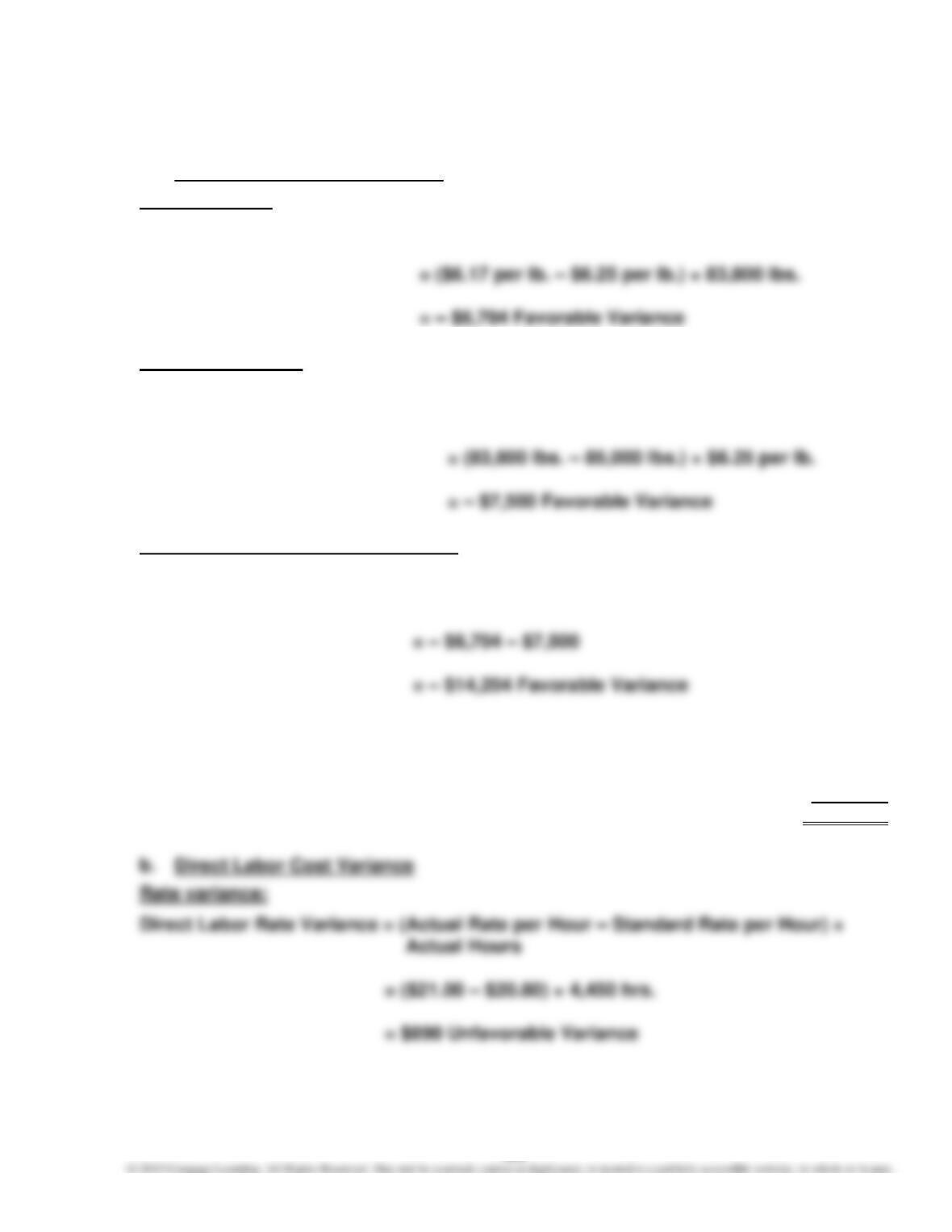
Rate variance:
Direct Labor Rate Variance = (Actual Rate per Hour – Standard Rate per Hour) ×
Actual Hours
*60 employees × 36 hrs. = 2,160 hrs.
Time variance:
Direct Labor Time Variance = (Actual Direct Labor Hours – Standard Direct Labor
Hours) × Standard Rate per Hour
Total direct labor cost variance:
Direct Labor Cost Variance = Direct Labor Rate Variance + Direct Labor Time
Variance
= $1,620 – $4,320
439
P13–5
a. Direct Materials Cost Variance
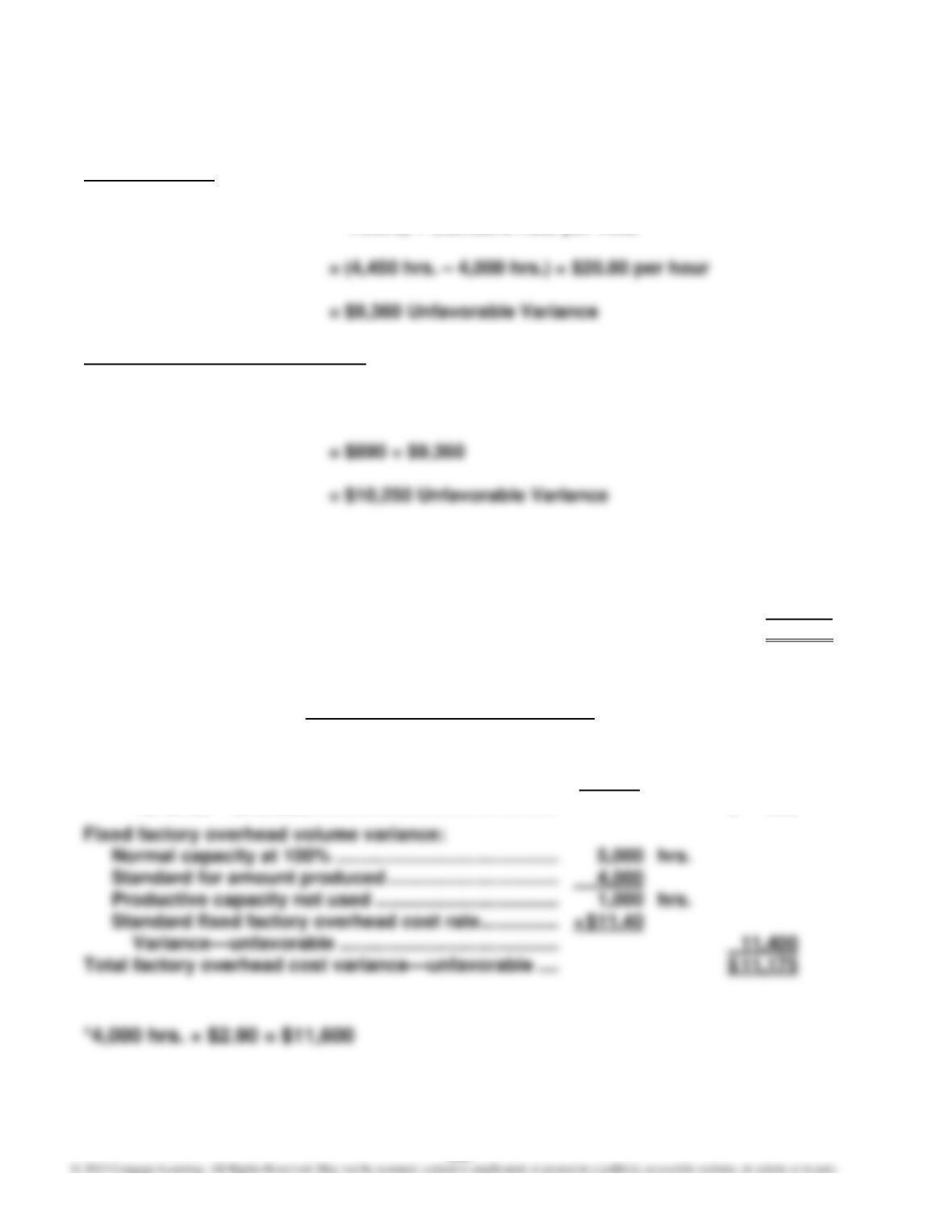
Price variance:
Direct Materials Price Variance = (Actual Price – Standard Price) × Actual Quantity
Quantity variance:
Direct Materials Quantity Variance = (Actual Quantity – Standard Quantity) ×
Standard Price
Total direct materials cost variance:
Direct Materials Cost Variance = Direct Materials Price Variance + Direct
Materials Quantity Variance
Also computed as:
Actual total direct materials cost (83,800 lbs. × $6.17) ……………… $517,046
Less standard total direct materials cost (85,000 lbs. × $6.25) …. 531,250
Total direct materials favorable cost variance ………………………. –$ 14,204
440
P13–5, Continued
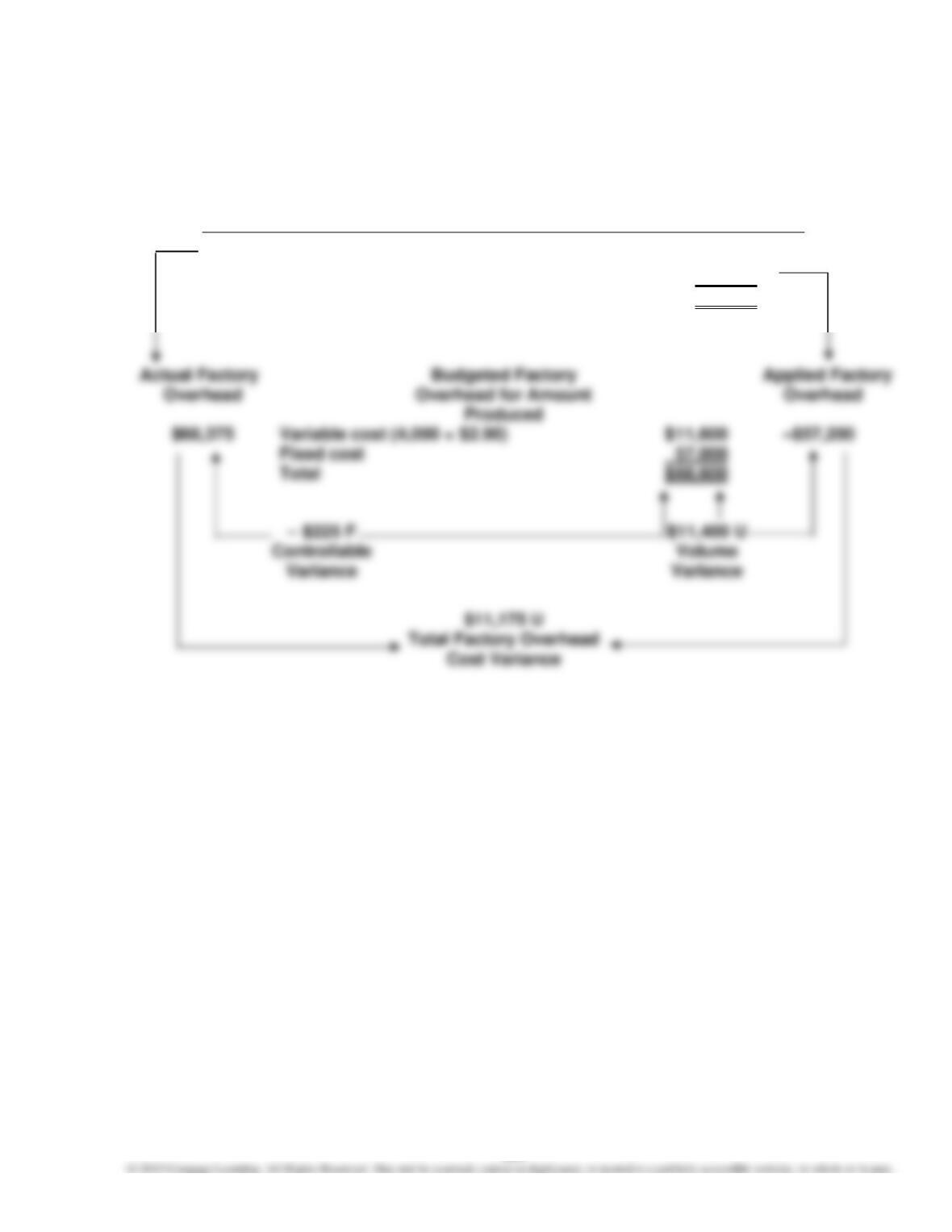
Time variance:
Direct Labor Time Variance = (Actual Direct Labor Hours – Standard Direct Labor
Hours) × Standard Rate per Hour
Total direct labor cost variance:
Direct Labor Cost Variance = Direct Labor Rate Variance + Direct Labor Time
Variance
Also computed as:
Actual total direct labor cost (4,450 hrs. × $21.00) …………………… $93,450
Less standard total direct labor cost (4,000 hrs. × $20.80) ……….. 83,200
Total direct labor unfavorable cost variance ………………………… $10,250
c. Appendix: Factory Overhead Cost Variance
Variable factory overhead controllable variance:
Actual variable factory overhead cost incurred …… $11,375
Budgeted variable factory overhead for 4,000 hrs. 11,600*
Variance—favorable ……………………………………….. $ – 225
441
P13–5, Concluded
Alternative Computation of Overhead Variances
Factory Overhead
Actual costs ($11,375 + $57,000)
$68,375
Applied costs [4,000 × ($2.90 + $11.40)]
–57,200
Balance, underapplied factory overhead
$11,175
442
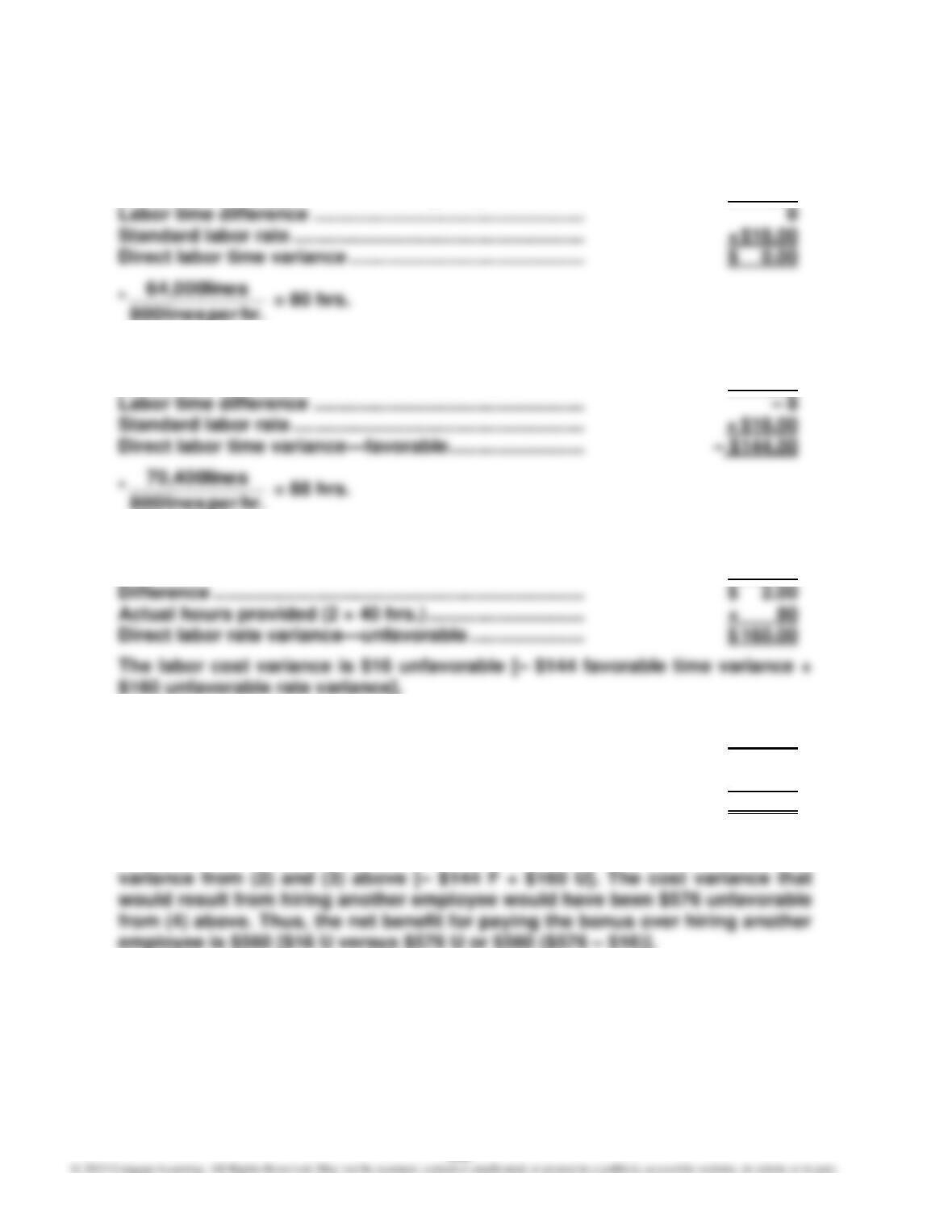
P13–6
1. Actual hours provided (2 × 40 hrs.) ………………………… 80
Standard hours required for the original plan …………. 80*
2. Actual hours provided (2 × 40 hrs.) ………………………… 80
Standard hours required for the actual results ……….. 88*
3. Actual labor rate ……………………………………………………. $ 20.00
Standard labor rate ……………………………………………….. 18.00
4. Actual hours provided (3 × 40 hrs.) ………………………… 120
Standard hours required for the actual results ……….. 88
Labor time difference ……………………………………………. 32
Standard labor rate ……………………………………………….. × $18.00
Direct labor time variance—unfavorable ………………… $ 576.00
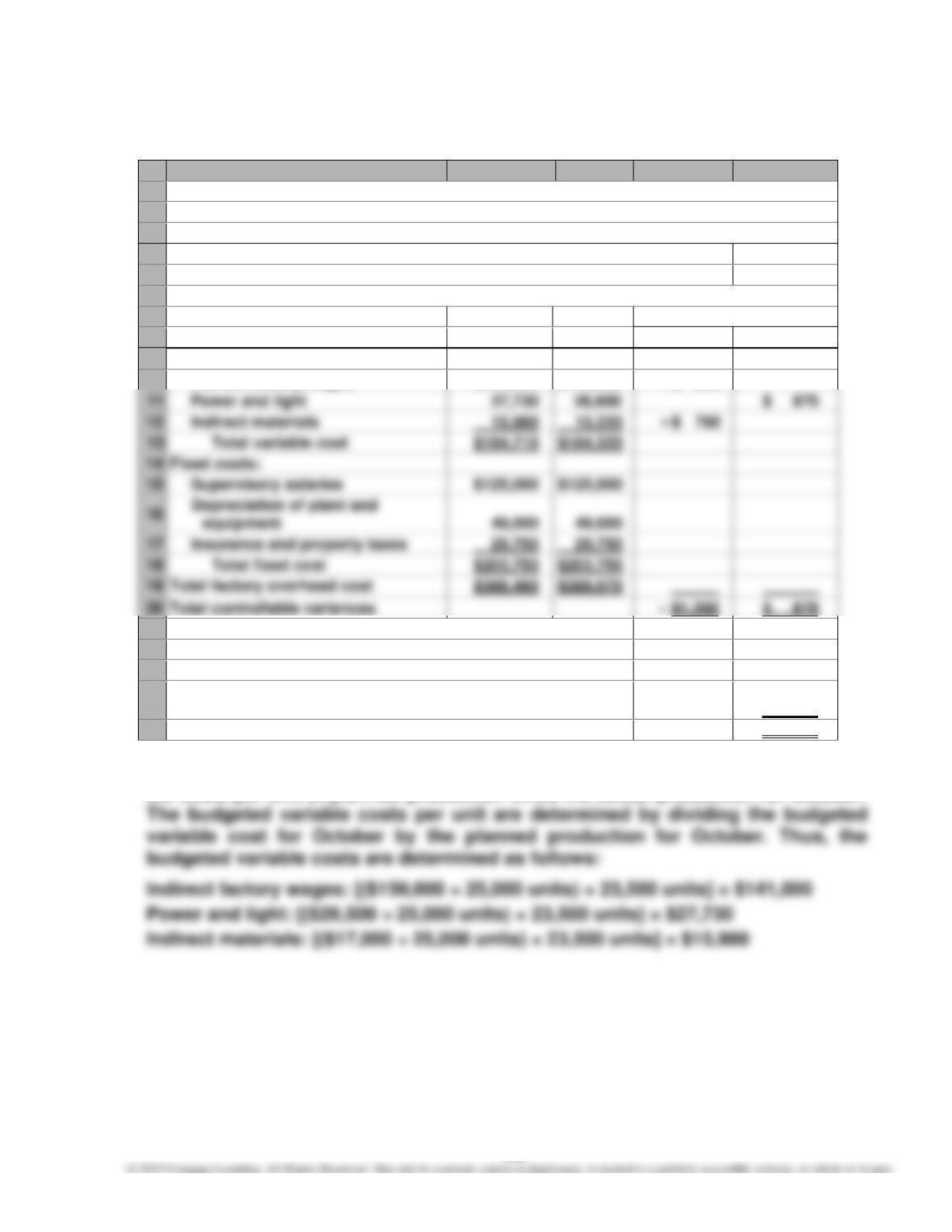
5. The bonus is the better approach by $560. The cost variance for paying the
bonus was $16 unfavorable, which is the sum of the time variance and rate
6. The labor rate and time variances fail to consider the number of errors in the
report from typist fatigue. A report that has many errors will require signifi-
cant time for correction at a later date. In addition, report errors can cause
doctors to draw incorrect conclusions from the test analyses. Thus, manag-
ers should consider not only the efficiency of doing the work but also the
quality of the work.
443
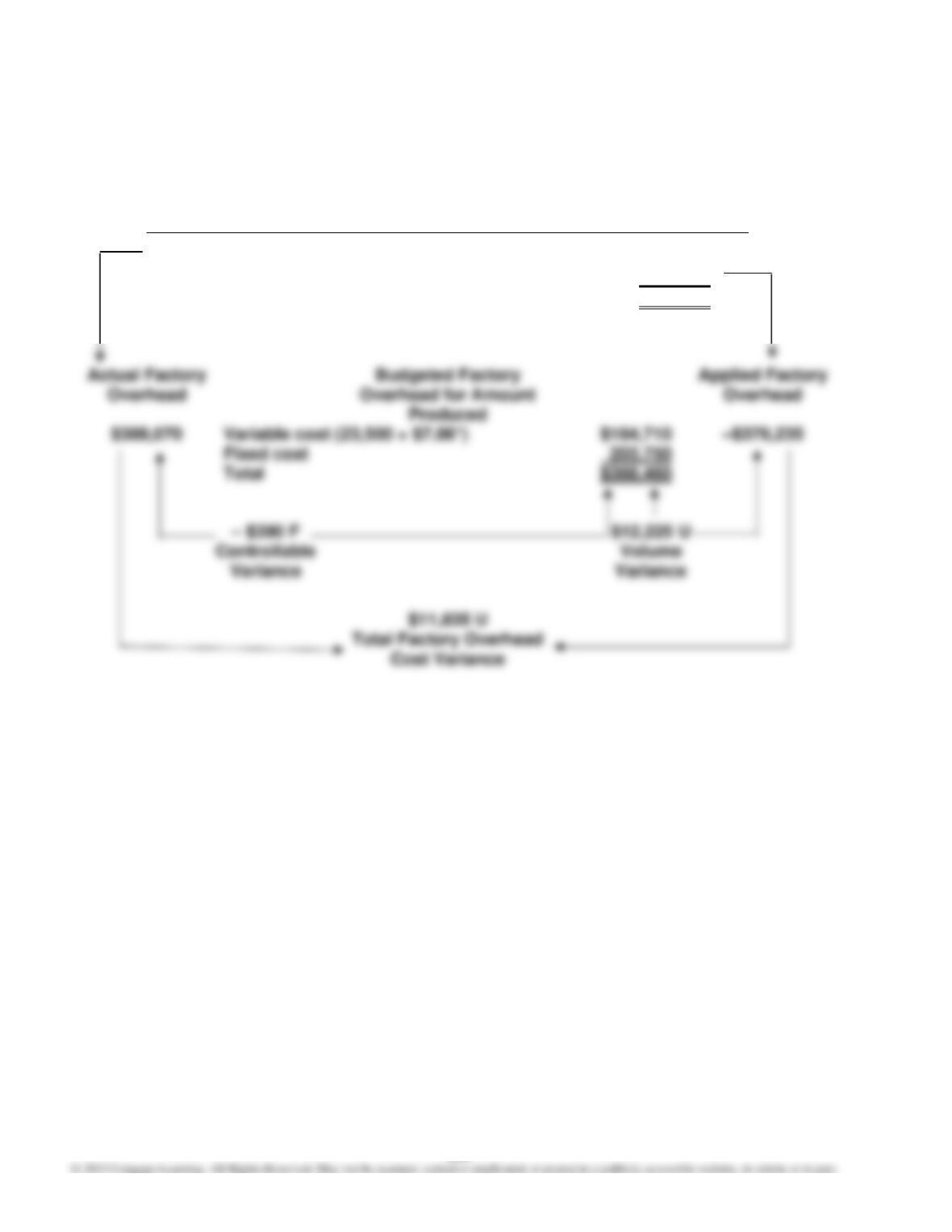
Appendix: P13–7
A
B
C
D
E
1
SEABURY, INC.
2
Factory Overhead Cost Variance Report—Assembly Department
3
For the Month Ended October 31
4
Normal capacity for the month
25,000 hrs.
5
Actual production for the month
23,500 hrs.
6
7
Variances
8
Budget*
Actual
Favorable
Unfavorable
9
Variable costs:
10
Indirect factory wages
$141,000
$140,500
– $ 500
11
Power and light
$ 870
12
Indirect materials
13
Total variable cost
14
Fixed costs:
15
Supervisory salaries
16
17
Insurance and property taxes
18
Total fixed cost
20
Total controllable variances
21
22
Net controllable variance—favorable
– $ 390
23
Volume variance—unfavorable:
24
Idle hours at the standard rate for fixed factory overhead—
(25,000 hrs. – 23,500 hrs.) × $8.15**
12,225
25
Total factory overhead cost variance—unfavorable
$11,835
*The budgeted variable costs are determined by multiplying the budgeted varia-
ble costs per unit at planned production times the actual production for October.
**$203,750 ÷ 25,000 hrs. = $8.15
444
Appendix: P13–7, Concluded
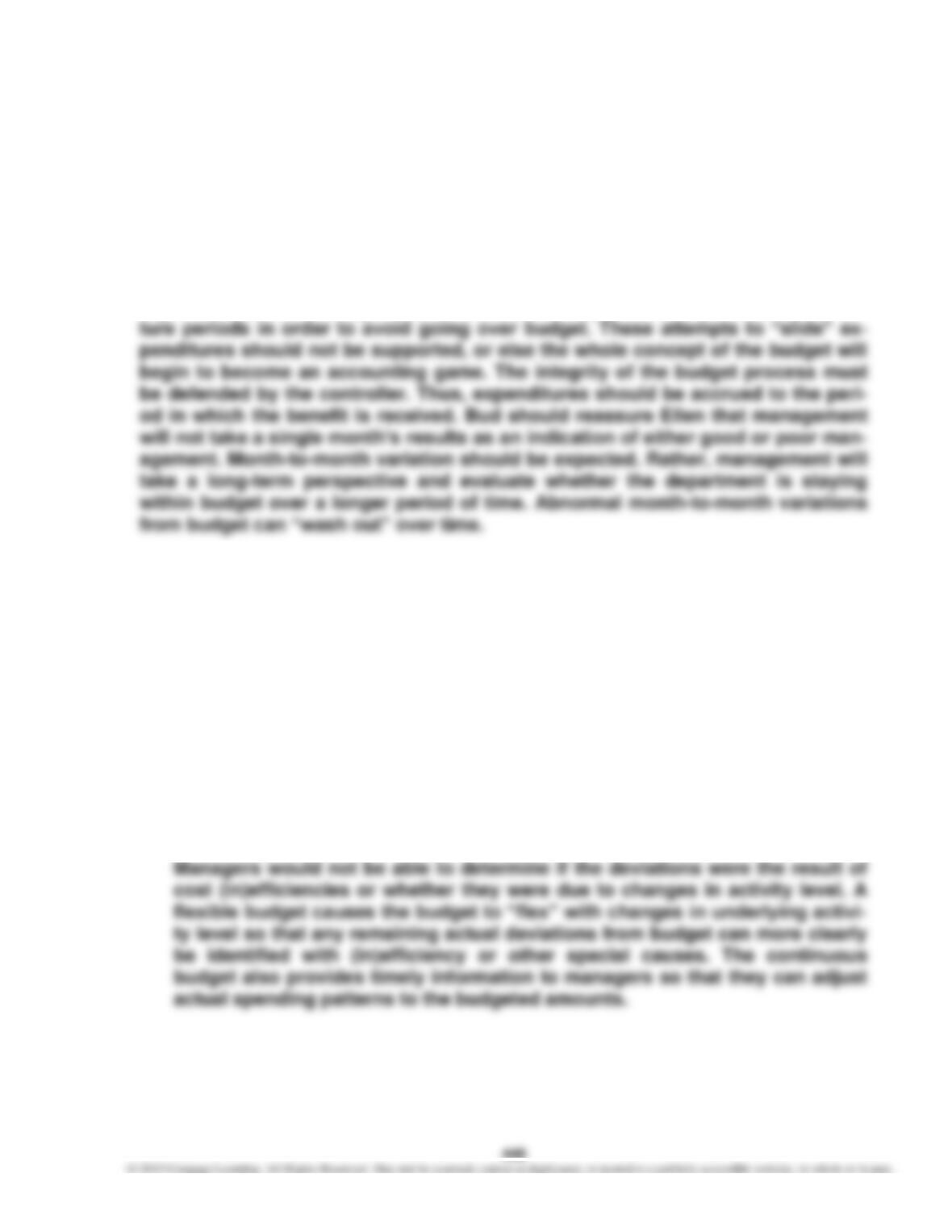
Alternative Computation of Overhead Variances
Factory Overhead
Actual costs
$388,070
Applied costs [23,500 hrs. × ($7.86* + $8.15)]
–376,235
Balance, underapplied factory overhead
$ 11,835
*$196,500 ÷ 25,000 hrs. = $7.86 per hour variable overhead rate
CASES
Case 13–1
Bud should reject Ellen’s request to charge the convention-related costs against
February’s budget. This is just one example of many attempts to slide expenses
into different budget periods than when actually incurred. This is a common issue
that controllers face. Often, operating managers will attempt to accelerate future
expenditures into low-expenditure months or delay present expenditures into fu-
Case 13–2
1. The hospital’s new budget method is clearly an example of a flexible budget.
The budget changes with changes in underlying activity, such as patient–
days. Patient-days are the number of patients multiplied by the number of
days in the hospital. As the number of patient-days changes, it would be rea-
sonable to expect that the hospital’s variable costs should also change. In
addition, the last quote suggests that the new budget approach is a monthly
continuous budget. The budget helps the managers plan month-by-month
expenditures.
2. The advantage of a flexible budget is to accurately plan variable costs of the
hospital with changes in the underlying activity base. Using a static budget
would create actual deviations from budget that would be difficult to interpret.
446
Case 13–3
1. The budget information indicates that the actual expenditures by the Opera-
tions Department exceeded what was planned by $20,000 ($435,000 –
2. The bank manager does not know if the actual resources consumed by the
Operations Department are the right amount of resources for doing the right
things. In other words, this budget doesn’t say anything about the actual
work of the Operations Department and how much cost this work consumes.
The bank manager doesn’t have a good sense if there is waste in the depart-
ment or not. The $20,000 excess expenditure over budget raises several ques-
tions. If the department did twice as much work as planned, then the $20,000
is a bargain. If, on the other hand, the department did much less work than
planned, then the $20,000 understates how poorly the department used re-
sources. Again, how much work the department actually did is unknown, so
these questions cannot be answered. A flexible budget would provide more
information about the work of the department. Examples of the kind of work
447
Case 13–4
Domino’s could use a master budget to plan operations consistent with the sales
forecast. The sales forecast could be used to develop the production budget for
pizzas. The sales and production budgets would be identical since there would be
no finished goods inventory for cooked pizzas. The sales (production) budget
would be used to develop a direct materials purchases budget. For example, the
The budget process could be used to direct and coordinate all the various restau-
rants. In this way, all the managers would be operating under the same set of as-
sumptions. The actual performance of the company and the individual stores could
be compared with the budget in order to provide all levels of the organization ap-
propriate feedback and control. This feedback can be used to adjust operations to
448
Case 13–5
1. The amount of actual expenditures was less than budget for the first 10
months of the budget year. As the end of the budget year-end neared, the
manager spent the remaining excess budget and, as a result, went over the
budget for May and June. The amount spent for the year was equal to the to-
2. The budget system encourages this type of wasteful behavior. The budget
could be redesigned in a number of ways. The budget could be designed to
flex with underlying activity and adjusted monthly. Thus, the manager would
always have budgeted resources for changes in underlying activity. For ex-
ample, if the number of prisoners in the jail increased, then the budget would
increase proportionately. A manager with the flexible budget would be less
likely to “reserve” the budget during the year, since an activity change would
be automatically reflected in the monthly budget. That is, the inherent slack in
the static budget could be reduced, knowing that activity changes are auto-
matically accommodated by the flexible budget. The budget system might al-
so allow a manager to make a request for additional funds after the budget
Case 13–6
The use of ideal standards is a legitimate concern for Everett. It is likely that such
standards are too tight and do not include the necessary fatigue factors that are
likely in this type of operation. It seems as though Everett is arguing for practical
Case 13–7
Although the Trinity Industries’ performance measurement system uses both fi-
nancial and nonfinancial measures, there may still be some serious performance
omissions. The financial measures are good measures of financial performance.
450
Case 13–8
1. The scrap is measured in sales dollars rather than cost in order to communi-
cate the total value of potential lost sales. If an item is scrapped and not sold,
2. The “orders past due” is a common measure of the aggregate sales value of
orders past due. The “buyer’s misery index” measures how many customers
are waiting for orders to be filled. It is a more pure measure of customer satis-
Sales Value of Buyer’s
Scenario Orders Past Due Misery Index
1 $810,000 1
2 810,000 16
In the first scenario, 18% ($810,000 ÷ $4,500,000) of sales are past due to a
single customer. The single customer is probably very upset, but all the other
customers are being satisfied. Apparently, one large order was not delivered
to the customer. This could be an isolated problem.
451
Case 13–9
The plant manager is placing pressure on the controller because the controllable
variance is very unfavorable. The claim is that these costs are not really variable
at all. This is a very difficult claim to accept. This is a small company, so it pur-
chases its power from the outside. The power and light bill is variable to the
The indirect wages may not be completely variable. However, the variance is
$28,800, or 40% ($28,800 ÷ $72,000) higher than the standard. This is much great-
er than the 25% difference between the existing production volume and full ca-
pacity. In other words, even granting the plant manager’s position on the indirect
wages still does not explain the overall size of the variance. The expenditure of
$100,800 on indirect wages is more than the $96,000 ($72,000 ÷ 75%) that would
have been budgeted for 100% of production. Something appears amiss.