Wild, Shaw, Chiappetta, FAP 23e Solutions Manual: Chapter 13
Chapter 13
Accounting for Corporations
QUESTIONS
1. Organization expenses (costs) are incurred in creating a corporation. Examples include:
2. Organization expenses (costs) are reported as expenses when incurred—as part of
3. The board of directors of a corporation is responsible for directing the corporation’s
affairs. The directors are elected by the corporation’s stockholders.
4. Authorized shares represent the maximum number of shares that a corporation’s charter
5. The preemptive right of common stockholders is the right to maintain their relative
6. The general rights of common stockholders include: (1) the right to vote in
stockholders’ meetings, (2) the right to sell or otherwise dispose of stock, (3) the
7. The market value per share of stock is the price at which a share of stock is bought or
8. The three important dates governing dividends are:
a. date of declaration⎯the date the directors vote to pay a dividend.
9. Cash dividends debited against paid-in capital accounts are called liquidating dividends
10. Declaring a stock dividend has no effect on assets, liabilities, or total equity. Also, the
11. A stock dividend results in a distribution of additional shares to stockholders and the
capitalization of retained earnings. A stock split calls in the old shares and replaces
13. A treasury stock purchase reduces total assets and total equity by equal amounts.
14. Treasury stock purchases affect the corporate assets and stockholders’ equity just like a
15. With a simple capital structure, earnings per share is calculated by first subtracting any
16. When a corporation has no preferred stock, book value per share is calculated by
17. Apple discloses on its fiscal 2015 balance sheet that it has 12,600,000 common shares
18. The par value for Google’s preferred stock is reported to be $0.001. A low par value can
19. From a review of its statement of cash flows, Samsung reported a cash outlay of
Wild, Shaw, Chiappetta, FAP 23e Solutions Manual: Chapter 13
761
QUICK STUDIES
Quick Study 13-2 (5 minutes)
a.
Cash ………………………………………………………………..
375,000
b.
Cash* ……………………………………………………………….
450,000
Quick Study 13-3 (5 minutes)
a.
Cash* ……………………………………………………………….
648,000
b.
Cash* ……………………………………………………………….
648,000
Common Stock …………………………………………
127,500
(b) Apr. 1
Common Stock, No-Par Value ………………………
(c) Apr. 6
Machinery ……………………………………………………….
145,000
Note Payable ……………………………………………….
Common Stock, $25 Par Value ……………………..
Quick Study 13-4 (5 minutes)
a.
Cash …………………………………………………………………………
1,827,000
Common Stock, No-Par Value …………………………..
1,827,000
1,827,000
Common Stock, No-Par Value …………………………..
1,827,000
Quick Study 13-5 (15 minutes)
(a) Mar. 1
Cash ………………………………………………………………..
297,500
Common Stock, $4 Par Value ……………………….
170,000
Paid-In Capital in Excess of Par Value,
763
Quick Study 13-6 (10 minutes)
Quick Study 13-7 (10 minutes)
Jun Company
Stockholders’ Equity
April 2 (after stock dividend)
Supporting work
Apr. 2
Retained Earnings …………………………………………………
400,000
Common Stock** ……………………………………………
764
Quick Study 13-8 (10 minutes)
Quick Study 13-9 (5 minutes)
1.
Cash* ………………………………………………………………………..
510,000
2. Preferred dividend =
Quick Study 13-10 (10 minutes)
Quick Study 13-11 (10 minutes)
May 3
Treasury Stock (4,000 shares) …………………………..
36,000
Quick Study 13-12 (10 minutes)
Quick Study 13-13 (10 minutes)
1. This material error should be reported on the statement of retained
earnings (and/or the statement of stockholders’ equity) as a prior
2. This change in the expected useful life is a change in an accounting
estimate—affecting current and future accounting periods. Therefore,
766
Quick Study 13-14 (10 minutes)
Quick Study 13-15 (10 minutes)
Quick Study 13-16 (10 minutes)
Quick Study 13-17 (10 minutes)
Market value per share
Net income – Preferred dividends
Net income – Preferred dividends
$20.54
Quick Study 13-18 (10 minutes)
Total stockholders’ equity ……………………………………………………….
$1,850,000
$1,650,000
Quick Study 13-19 (10 minutes)
Mar. 31
Cash ………………………………………………………………..
3,271
Wild, Shaw, Chiappetta, FAP 23e Solutions Manual: Chapter 13
EXERCISES
Exercise 13-1 (15 minutes)
Characteristic
Corporations
2.
Ease of formation ………………………………….
a. Requires government approval
3.
Transferability of ownership ………………….
4.
Ability to raise large capital amounts ……….
f. High ability
5.
6.
Owner liability ……………………………………….
h. Limited
7.
c. Separate legal entity
8.
Tax status of income …………………………..
b. Corporate income is taxed
Exercise 13-2 (15 minutes)
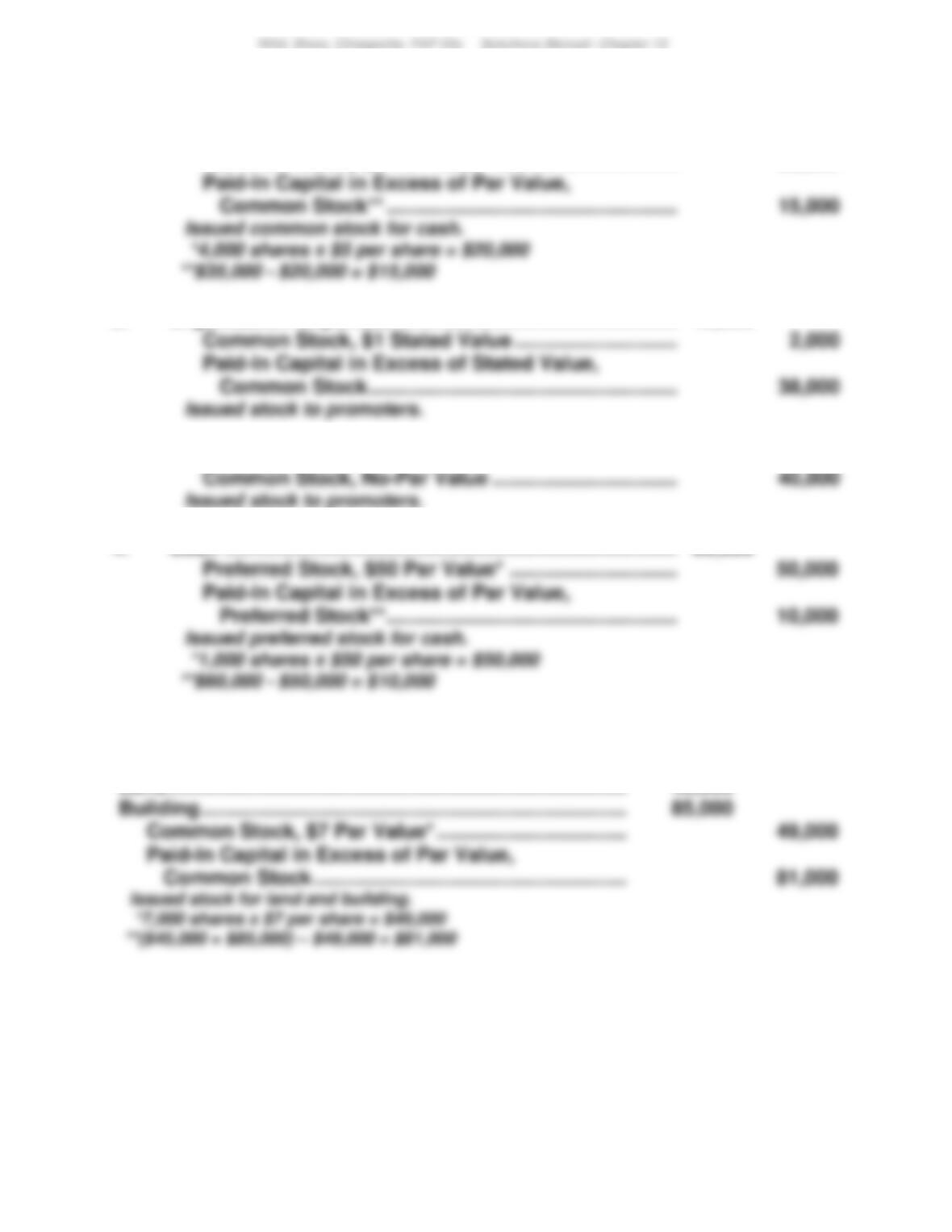
1.
Feb. 20
Cash ………………………………………………………………..
152,000
Common Stock, $2 Par Value* …………………….
38,000
**$152,000 – $38,000 = $114,000
2.
Feb. 20
Cash ………………………………………………………………..
152,000
Common Stock, No-Par Value ……………………..
3.
Feb. 20
Cash ………………………………………………………………..
152,000
Common Stock, $5 Stated Value* ………………..
95,000
**$152,000 – $95,000 = $57,000
769
Exercise 13-3 (15 minutes)
1.
Cash ……………………………………………………………………….
35,000
Common Stock, $5 Par Value* …………………………….
20,000
2.
Organization Expenses ……………………………………………
40,000
Common Stock, $1 Stated Value …………………………
3.
Organization Expenses ……………………………………………
40,000
Common Stock, No-Par Value …………………………….
40,000
4.
Cash ………………………………………………………………………..
60,000
Preferred Stock, $50 Par Value* …………………………..
50,000
Preferred Stock**………………………………………………
10,000
Exercise 13-4 (15 minutes)
Land ……………………………………………………………………….
45,000
85,000
1.
a. Retained earnings
b. Total stockholders’ equity
Common stock⎯$10 par value, 120,000 shares
c. Number of outstanding shares
Outstanding shares before the dividend ………………………..
50,000
25,000
2.
a. Retained earnings (no change)
b. Total stockholders’ equity
Common stock⎯$6.67 (rounded) par value, 180,000 shares
c. Number of outstanding shares
Outstanding shares before the split…………………………………
50,000
3. From a stockholder’s point of view, there is no practical difference
between the stock dividend and the stock split. The number of
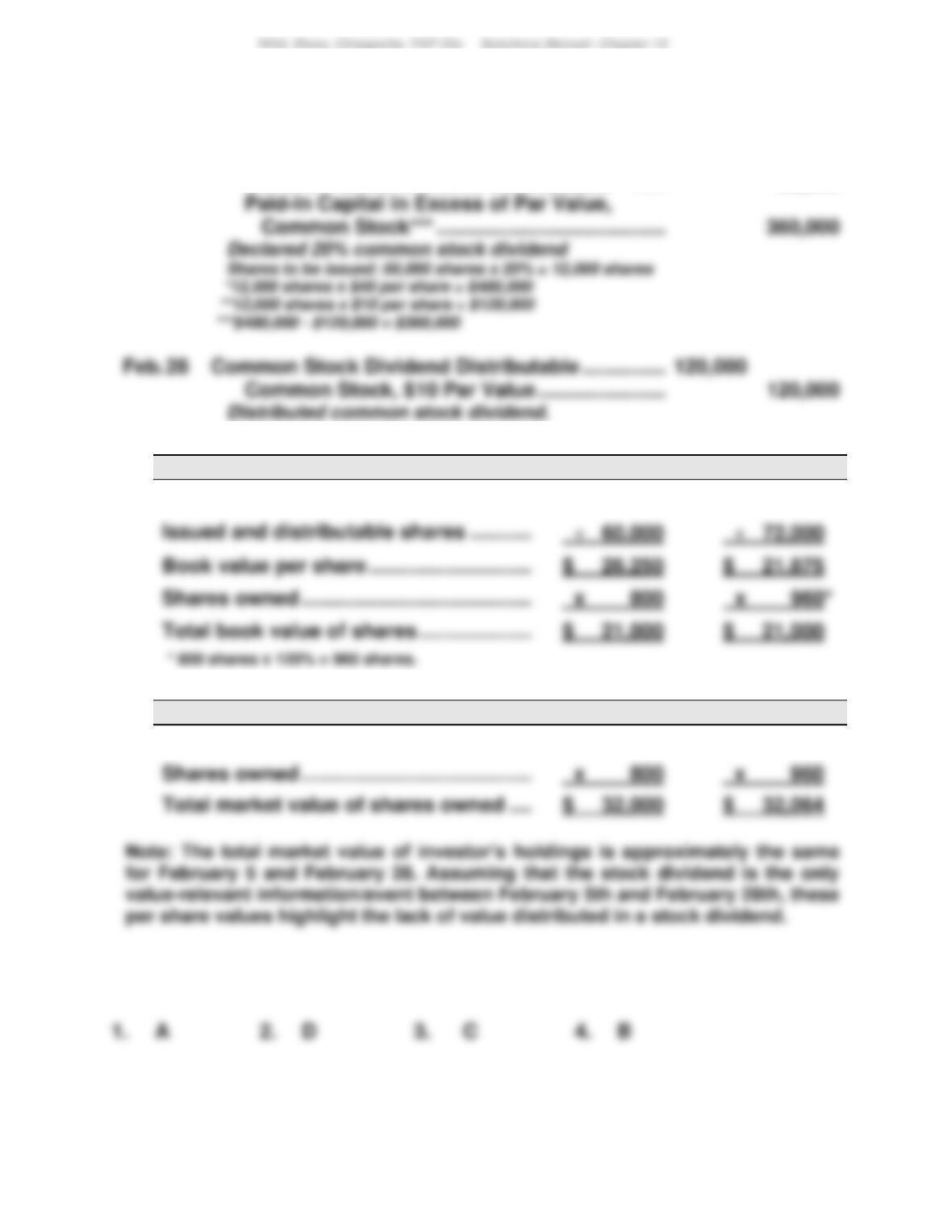
771
Exercise 13-6 (25 minutes)
1.
Feb. 5
Retained Earnings* ………………………………………………..
480,000
Common Stock Dividend Distributable** …………..
120,000
Feb. 28
Common Stock Dividend Distributable …………………..
120,000
Common Stock, $10 Par Value ………………………….
120,000
2.
Before
After
Total stockholders’ equity ……………………
$1,575,000
$1,575,000
Total book value of shares …………………..
$ 21,000
$ 21,000
3.
February 5
February 28
Market value per share ………………………..
$ 40
$ 33.40
Shares owned ……………………………………..
Total market value of shares owned …….
$ 32,000
$ 32,064
Exercise 13-7 (10 minutes)
A
D
C
B
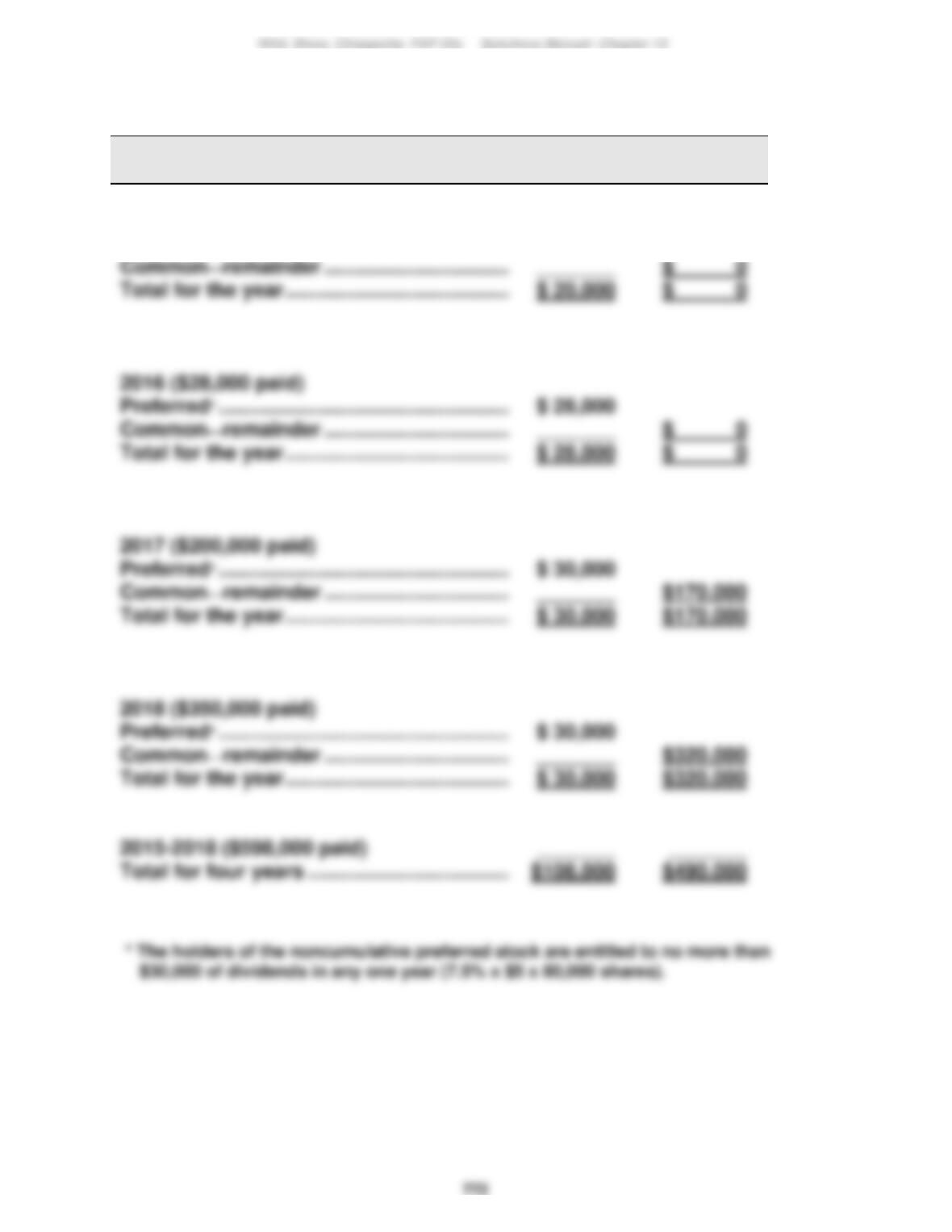
Common⎯remainder ……………………………..
_______
$ 20,000
Preferred* ………………………………………………
$ 28,000
Common⎯remainder ……………………………..
_______
$ 28,000
2017 ($200,000 paid)
Preferred* ………………………………………………
$ 30,000
Common⎯remainder ……………………………..
_______
$170,000
$ 30,000
$170,000
2018 ($350,000 paid)
Preferred* ………………………………………………
$ 30,000
Common⎯remainder ……………………………..
_______
$320,000
$ 30,000
$320,000
2015-2018 ($598,000 paid)
_______
Exercise 13-8 (30 minutes)
Non-Cumulative
Preferred
Common
2015 ($20,000 paid)
Preferred* ………………………………………………
$ 20,000
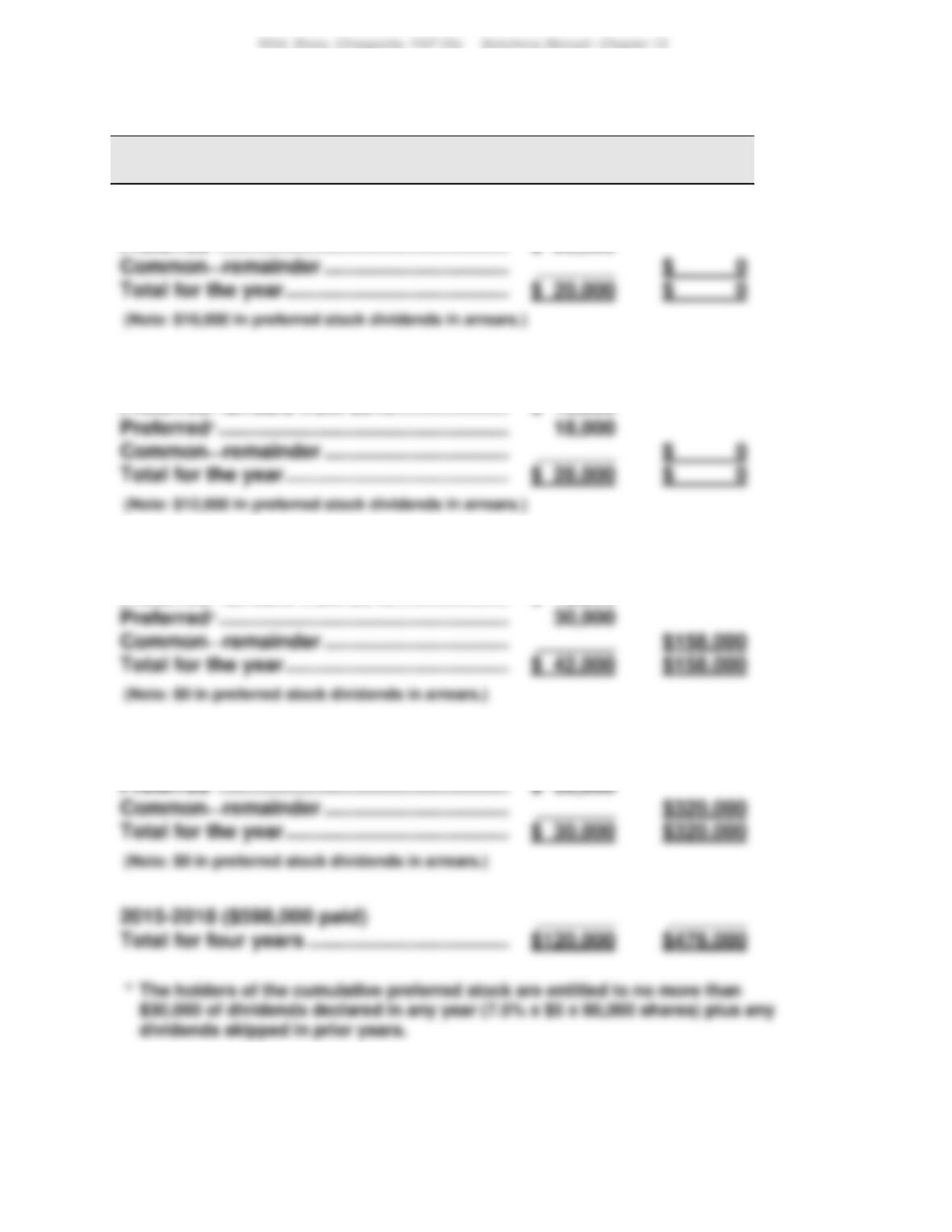
773
Exercise 13-9 (25 minutes)
Cumulative
Preferred
Common
2015 ($20,000 paid)
Preferred* ………………………………………………
$ 20,000
$ 20,000
2016 ($28,000 paid)
Preferred⎯arrears from 2015 ………………….
$ 10,000
Preferred* ………………………………………………
$ 28,000
2017 ($200,000 paid)
Preferred⎯arrears from 2016 ………………….
$ 12,000
Preferred* ………………………………………………
$ 42,000
2018 ($350,000 paid)
Preferred* ………………………………………………
$ 30,000
$ 30,000
2015-2018 ($598,000 paid)
774
Exercise 13-10 (25 minutes)
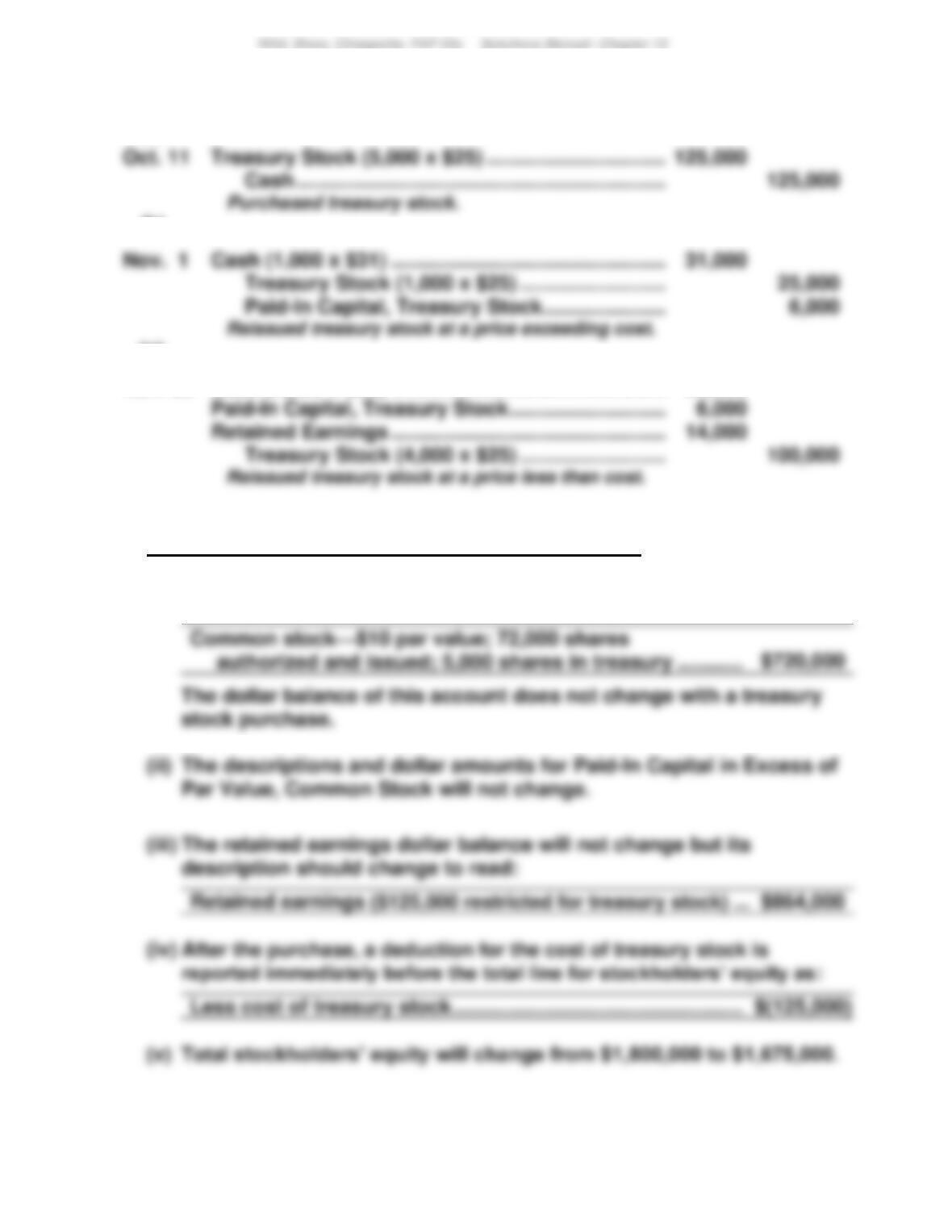
1. (a)
(b)
Cash (1,000 x $31) …………………………………………………
31,000
(c)
Nov. 25
Cash (4,000 x $20) …………………………………………………
80,000
14,000
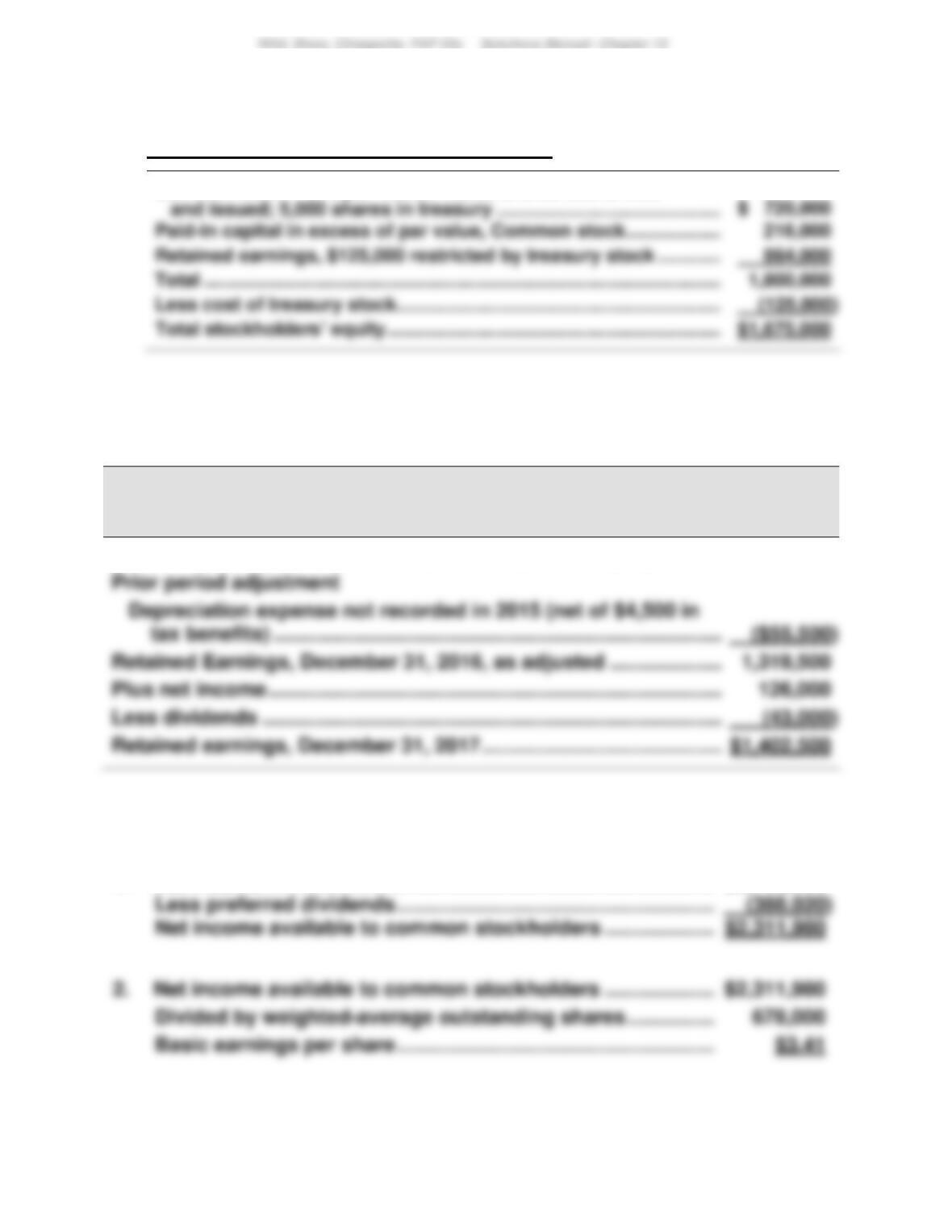
2. Changes to the equity section include the following
(i) The common stock account description line will change. After the
treasury stock purchase, it should read:
775
Exercise 13-10 (Concluded)
Revised equity section appears as follows
Common stock⎯$10 par value; 72,000 shares authorized
Exercise 13-11 (15 minutes)
Amos Company
Statement of Retained Earnings
For Year Ended December 31, 2017
Retained earnings, December 31, 2016, as previously reported …
$1,375,000
Retained Earnings, December 31, 2016, as adjusted …………………
Less dividends ………………………………………………………………………..
Exercise 13-12 (25 minutes)
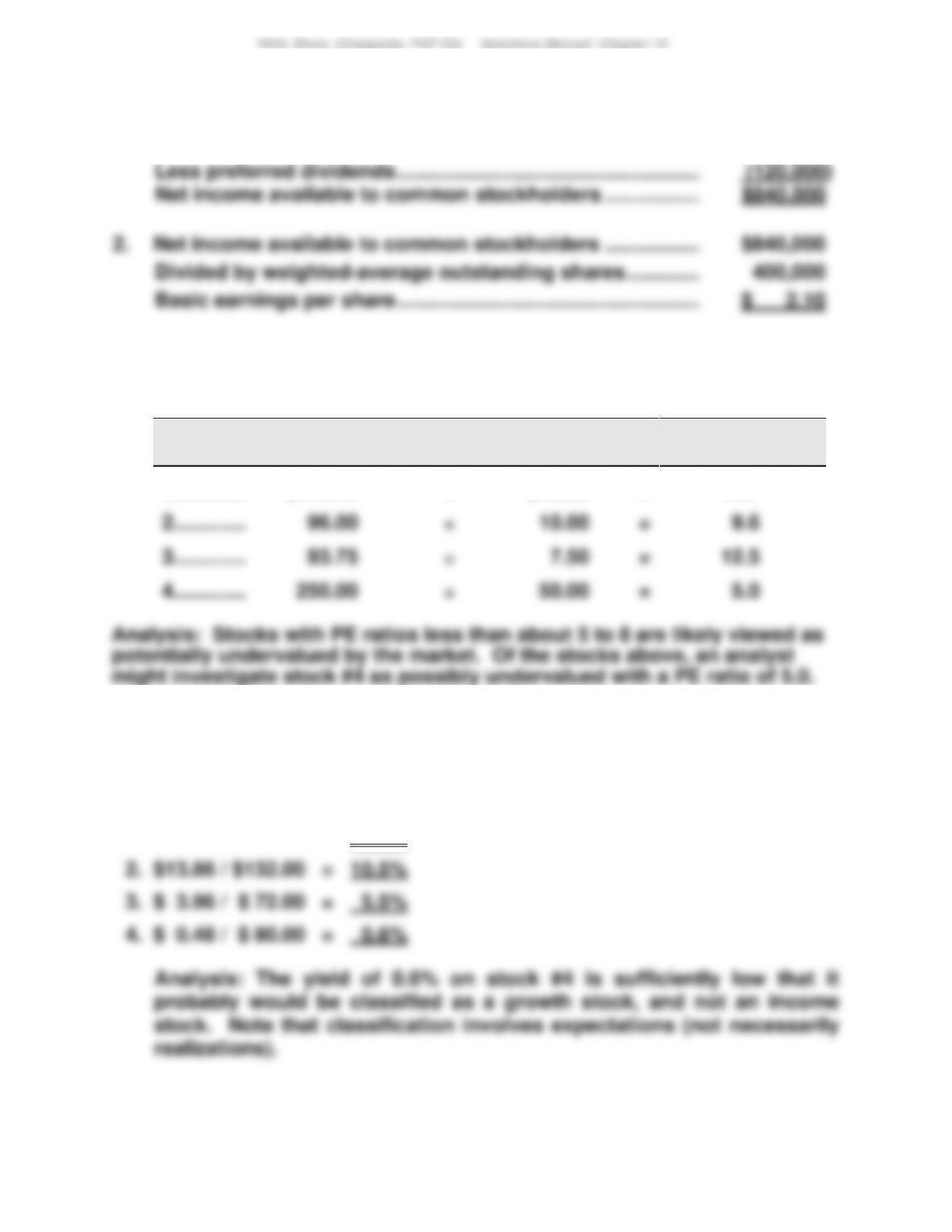
1. Net income ………………………………………………………………………….
$2,700,000
Less preferred dividends ……………………………………………………
2. Net income available to common stockholders …………………..
776
Exercise 13-13 (30 minutes)
1. Net income …………………………………………………………………………..
$960,000
2. Net income available to common stockholders ………………..
Exercise 13-14 (15 minutes)
Stock
Market Value
per Share
Divided
by
Earnings
per Share
Price-Earnings
Ratio
1…………..
$176.40
$12.00
=
14.7
2…………..
96.00
=
3…………..
=
12.5
4…………..
=
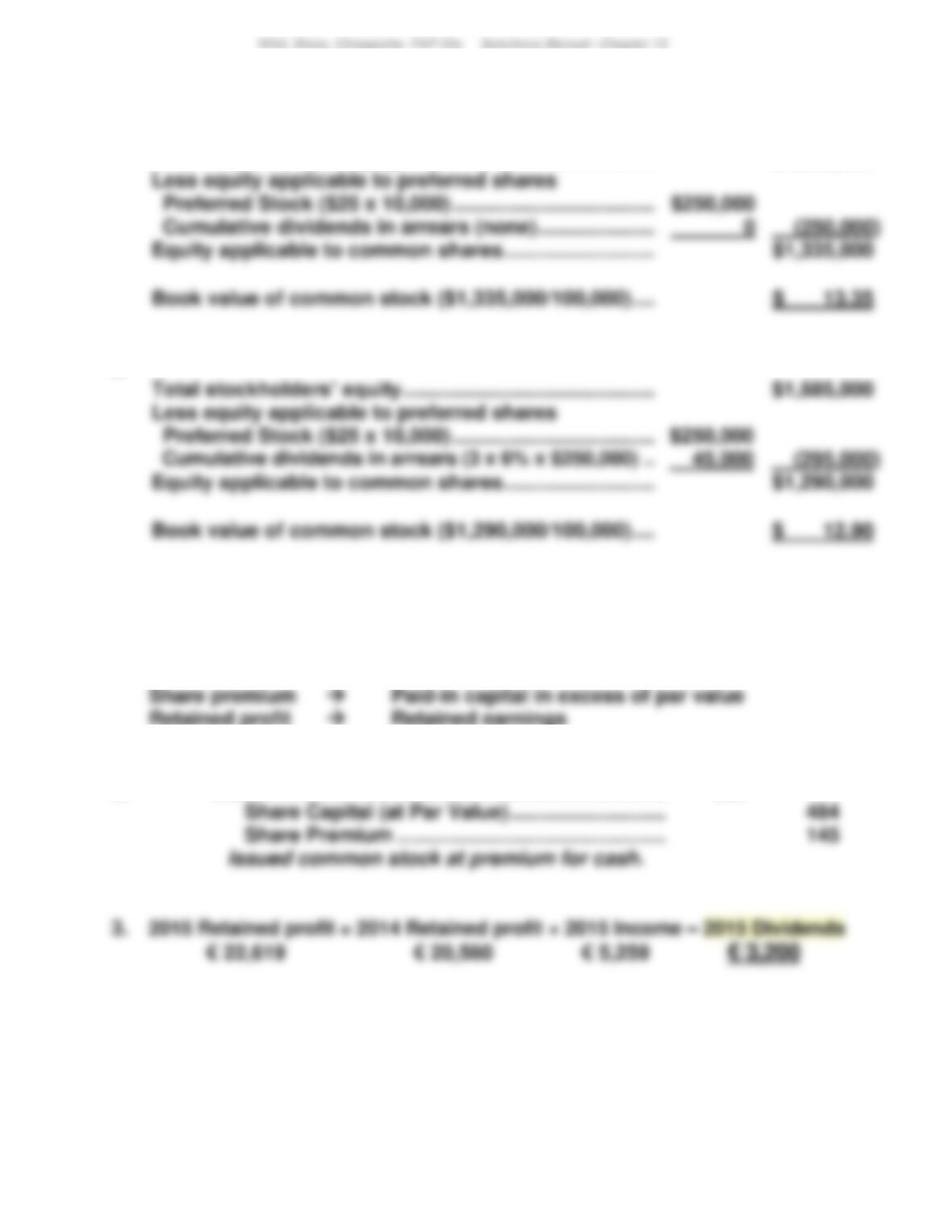
Exercise 13-15 (15 minutes)
Dividend yield
1. $16.06 / $220.00 = 7.3%
777
Exercise 13-16 (20 minutes)
1.
Total stockholders’ equity ………………………………………
$1,585,000
2.
Total stockholders’ equity ………………………………………
Exercise 13-17 (20 minutes)
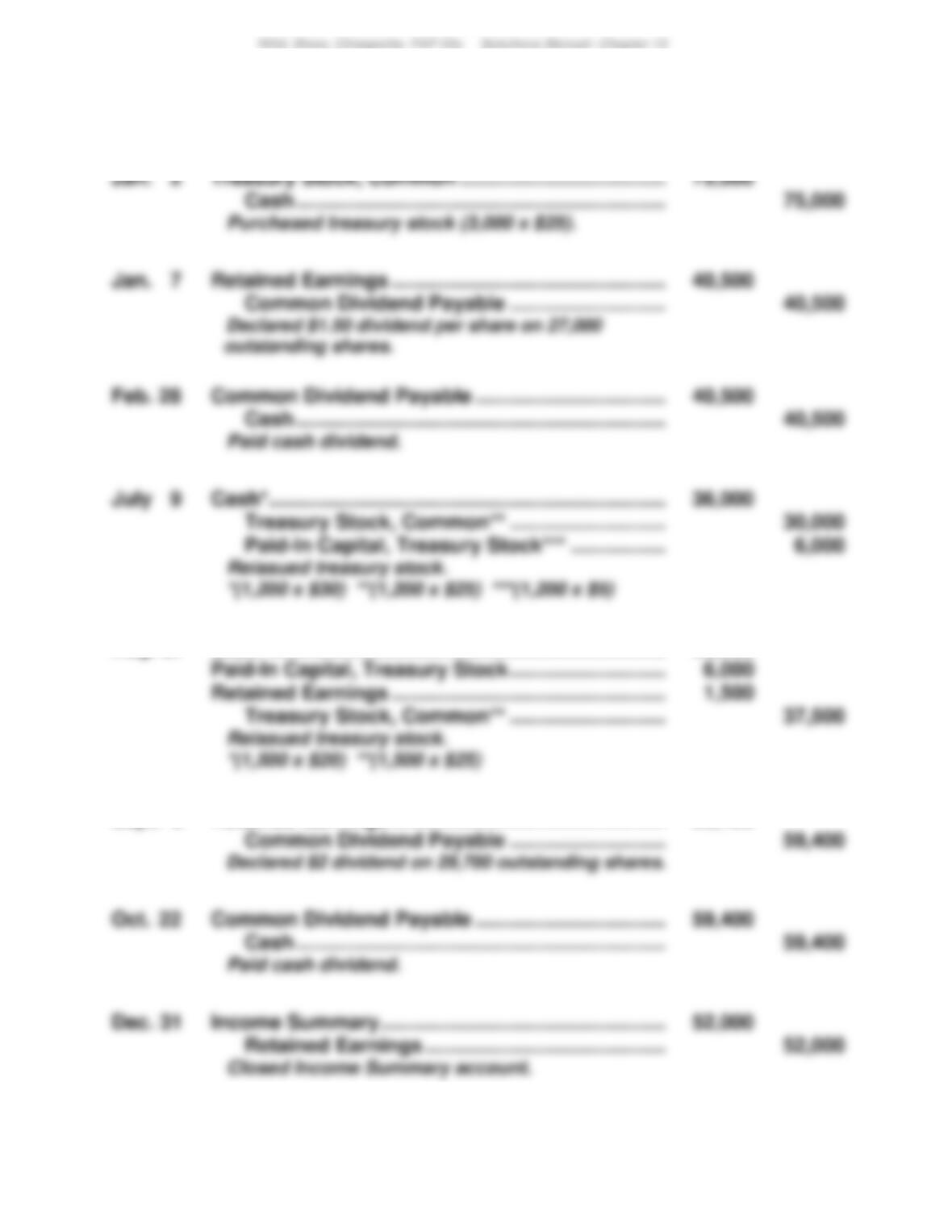
1. Share capital → Common stock
2.
Cash ………………………………………………………………..
629
778
Exercise 13-18 (40 minutes)
Part 1
Treasury Stock, Common ………………………………………
75,000
Retained Earnings …………………………………………………
40,500
Common Dividend Payable ……………………………………
40,500
Cash* …………………………………………………………………….
36,000
Aug. 27
Cash* …………………………………………………………………….
30,000
Retained Earnings …………………………………………………
Sept. 9
Retained Earnings …………………………………………………
59,400
Common Dividend Payable ……………………………………
59,400
Dec. 31
Income Summary …………………………………………………..
52,000