Chapter 13 – Statement of Cash Flows
Chapter 13
Statement of Cash Flows
ANSWERS TO QUESTIONS
1. The income statement reports revenues earned and expenses incurred during a
period of time. It is prepared on an accrual basis. The balance sheet reports the
2. The statement of cash flows reports cash receipts and cash payments from three
broad categories of business activities: operating, investing, and financing. While
the income statement reports operating activities, it reports them on the accrual
basis: revenues when earned, and expenses when incurred, regardless of the
3. Cash equivalents are short-term, highly liquid investments that are purchased
within three months of the maturity date. The statement of cash flows does not
4. The major categories of business activities reported on the statement of cash flows
are operating, investing, and financing activities. Operating activities of a business
Chapter 13 – Statement of Cash Flows
13-2
5. Cash inflows from operating activities include cash sales, collections on accounts,
and notes receivable arising from sales, dividends on investments, and interest on
6. Depreciation expense is added to net income to adjust for the effects of a noncash
7. Cash expenditures for purchases and salaries are not reported on the statement of
8. The $50,000 increase in inventory must be used in the statement of cash flows
calculations because it increases the outflow of cash all other things equal. It is
9. The two methods of reporting cash flows from operating activities are the direct
method and the indirect method. The direct method reports the gross amounts of
cash receipts and cash payments arising from the revenues and expenses reported
10. Cash inflows from investing activities include cash received from sale of operational
assets, sale of investments, maturity value of bond investments, and principal
11. Cash inflows from financing activities include cash received from issuing stock, the
Chapter 13 – Statement of Cash Flows
13-3
12. Noncash investing and financing activities are activities that would normally be
classified as investing or financing activities, except no cash was received or paid.
13. When equipment is sold, it is considered an investing activity, and any cash
received is reported as a cash inflow from investing activities. When using the
ANSWERS TO MULTIPLE CHOICE
Chapter 13 – Statement of Cash Flows
13-4
Authors’ Recommended Solution Time
(Time in minutes)
Mini-exercises
Exercises
Problems
Alternate
Problems
Cases and
Projects
No.
Time
No.
Time
No.
Time
No.
Time
No.
Time
1
5
1
10
1
35
1
35
1
20
8
20
9
20
10
10
11
15
12
10
13
20
14
25
15
20
16
25
17
25
18
15
19
15
20
20
21
35
22
* Due to the nature of these cases and projects, it is very difficult to estimate the amount
of time students will need to complete the assignment. As with any open-ended project,
it is possible for students to devote a large amount of time to these assignments. While
students often benefit from the extra effort, we find that some become frustrated by the
perceived difficulty of the task. You can reduce student frustration and anxiety by
making your expectations clear. For example, when our goal is to sharpen research
2
5
2
10
2
35
2
35
2
15
3
5
3
15
3
35
3
35
3
25
4
5
4
15
4
40
4
45
5
5
5
15
5
40
5
35
6
5
6
15
6
45
6
35
7
5
7
20
7
Chapter 13 – Statement of Cash Flows
MINI–EXERCISES
M13–1.
F
1.
Purchase of stock. (This involves repurchase of its own stock.)
F
2.
Principal payment on long-term debt.
3.
Proceeds from sale of properties.
O
4.
Inventories (decrease).
O
5.
Accounts payable (decrease).
O
6.
Depreciation, depletion, and amortization.
M13–2.
+
1.
Accrued expenses (increase).
2.
Inventories (increase).
+
3.
Accounts receivable (decrease).
4.
Accounts payable (decrease).
+
5.
Depreciation, depletion, and amortization.
M13–3.
O
1.
Receipts from customers.
F
2.
Dividends paid.
F
3.
Payment for share buy-back.
4.
Proceeds from sale of property, plant and equipment.
F
5.
Repayments of borrowings (bank debt).
O
6.
Net interest paid.
M13–4.
M13–5.
Investing Activities
M13–6.
Financing Activities
Chapter 13 – Statement of Cash Flows
13-6
M13–7.
Yes
Purchase of building with mortgage payable
EXERCISES
E13–1.
F
1. Dividends paid
F
2. Repayments of long-term debt
O
3. Depreciation and amortization
O
5. [Change in] Accounts payable and accrued expenses
6. Cash collections from customers
F
7. Net repayments of notes payable to banks
O
8. Net income
I
9. Payments to acquire property and equipment
O
10. [Change in] Inventory
E13–2.
I
1. Proceeds from sale of property, plant and equipment
O
2. Interest received
F
3. Repayments of loans
O
4. Income taxes paid
F
5. Proceeds from ordinary share [stock] issues
F
6. Dividends paid
O
7. Payments in the course of operations
O
8. Receipts from customers
I
9. Payments for property, plant and equipment
10. Net income
Dividends paid in cash
Chapter 13 – Statement of Cash Flows
13-7
E13–3.
1. NE Salaries expense
Accrued salaries payable
2. – NCFI Plant and equipment
Cash
7. – NCFO Prepaid expenses (rent)
Cash
8. – NCFF Short-term debt
Chapter 13 – Statement of Cash Flows
E13–4.
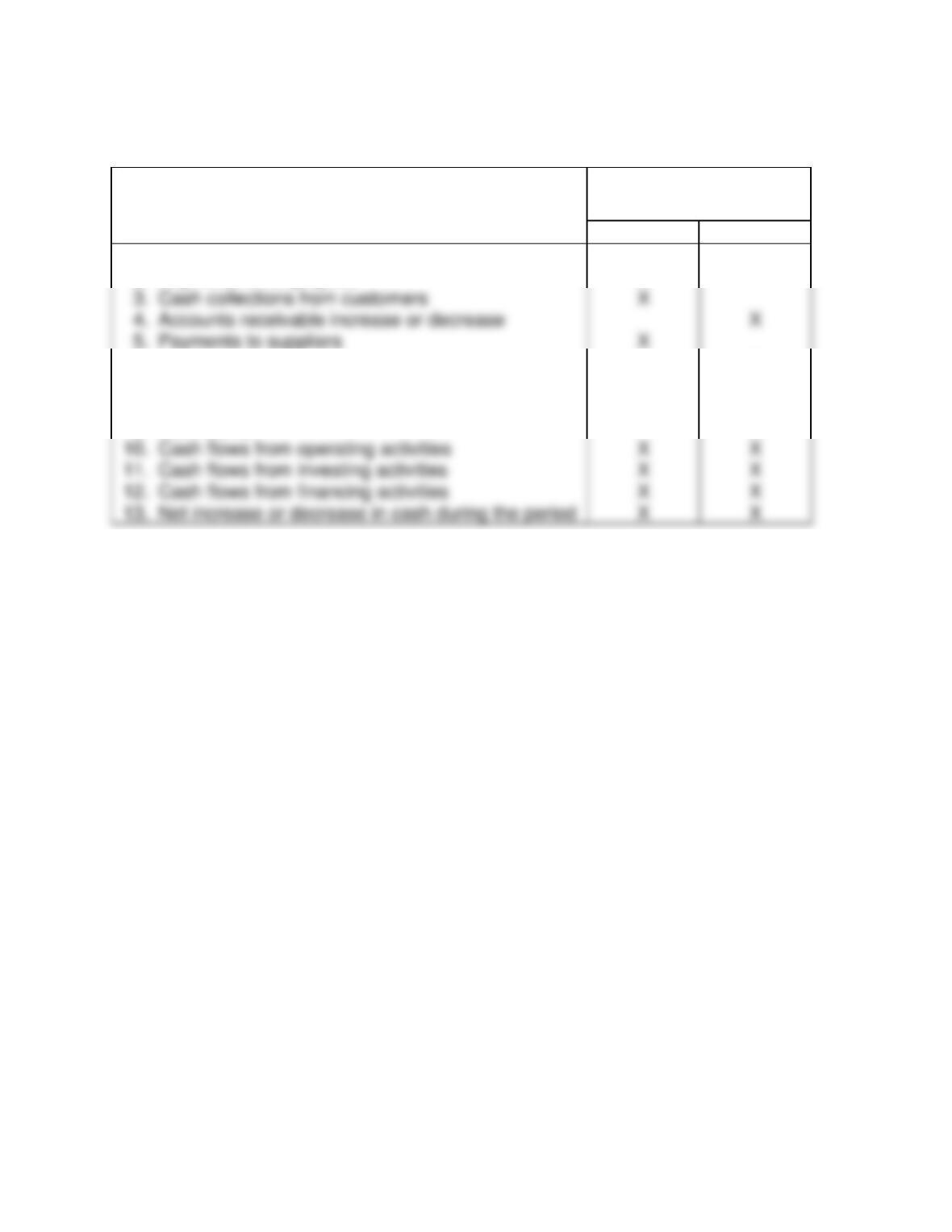
1. NE Inventory
Accounts payable
5. – NCFO Income tax expense
Cash
6. – NCFI Investment securities
Cash
7. + NCFF Cash
Chapter 13 – Statement of Cash Flows
13-9
E13–5.
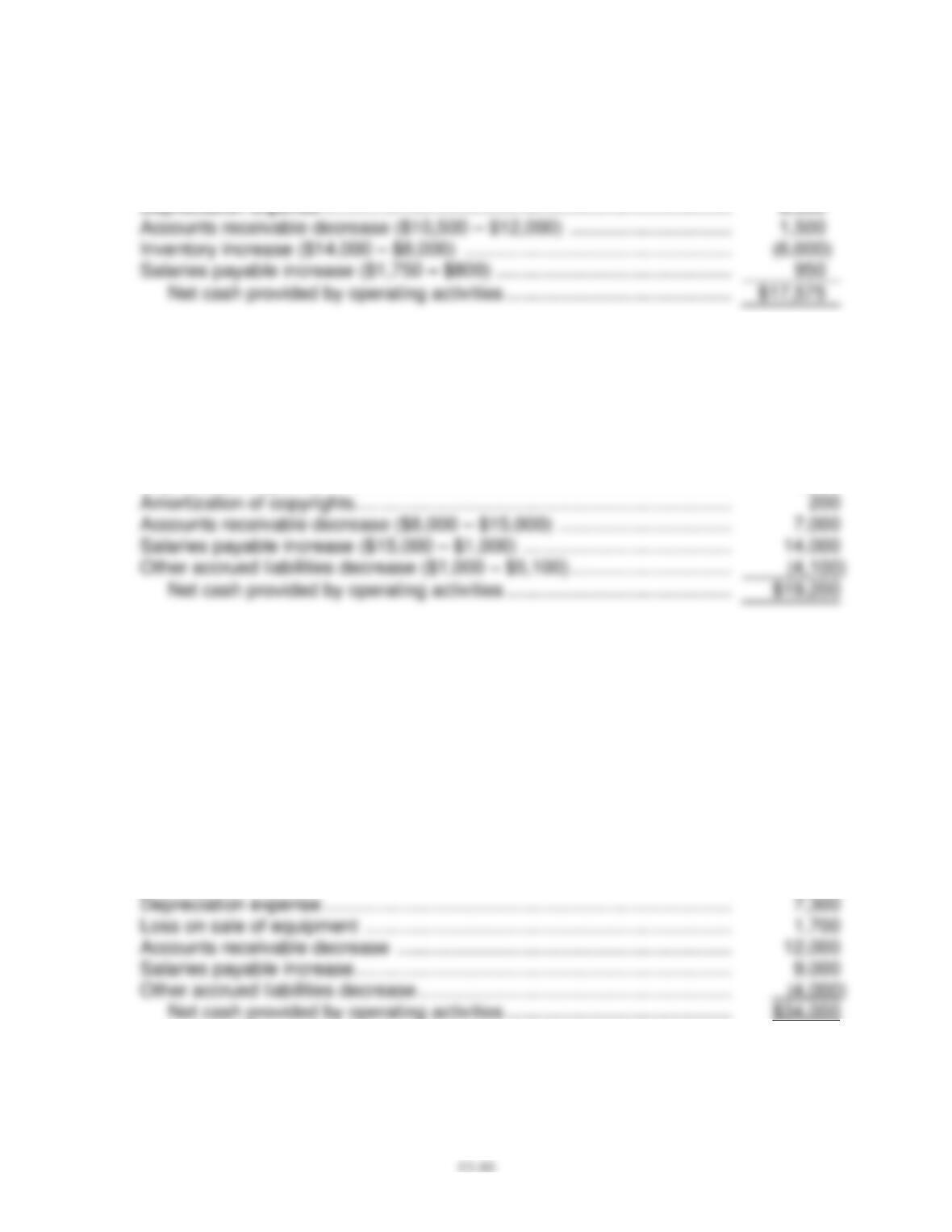
Comparison of Statement of Cash Flows—direct and indirect reporting
Cash Flows
Statement of Cash Flows
Method
(and related changes)
Direct
Indirect
1.
Accounts payable increase or decrease
X
2.
Payments to employees
X
6.
Inventory increase or decrease
X
7.
Wages payable, increase or decrease
X
8.
Depreciation expense
X
9.
Net income
X
Cash flows from operating activities
X
X
Cash flows from investing activities
X
X
Cash flows from financing activities
X
X
Net increase or decrease in cash during the period
X
X
The direct method reports cash flows from operating activities individually for each
major revenue and expense. In contrast, the indirect method reports a reconciliation of
net income to cash flow from operating activities. The two methods report the investing
and financing activities in exactly the same way.
3.
Cash collections from customers
X
4.
Accounts receivable increase or decrease
X
5.
Payments to suppliers
X
Chapter 13 – Statement of Cash Flows
E13–6.
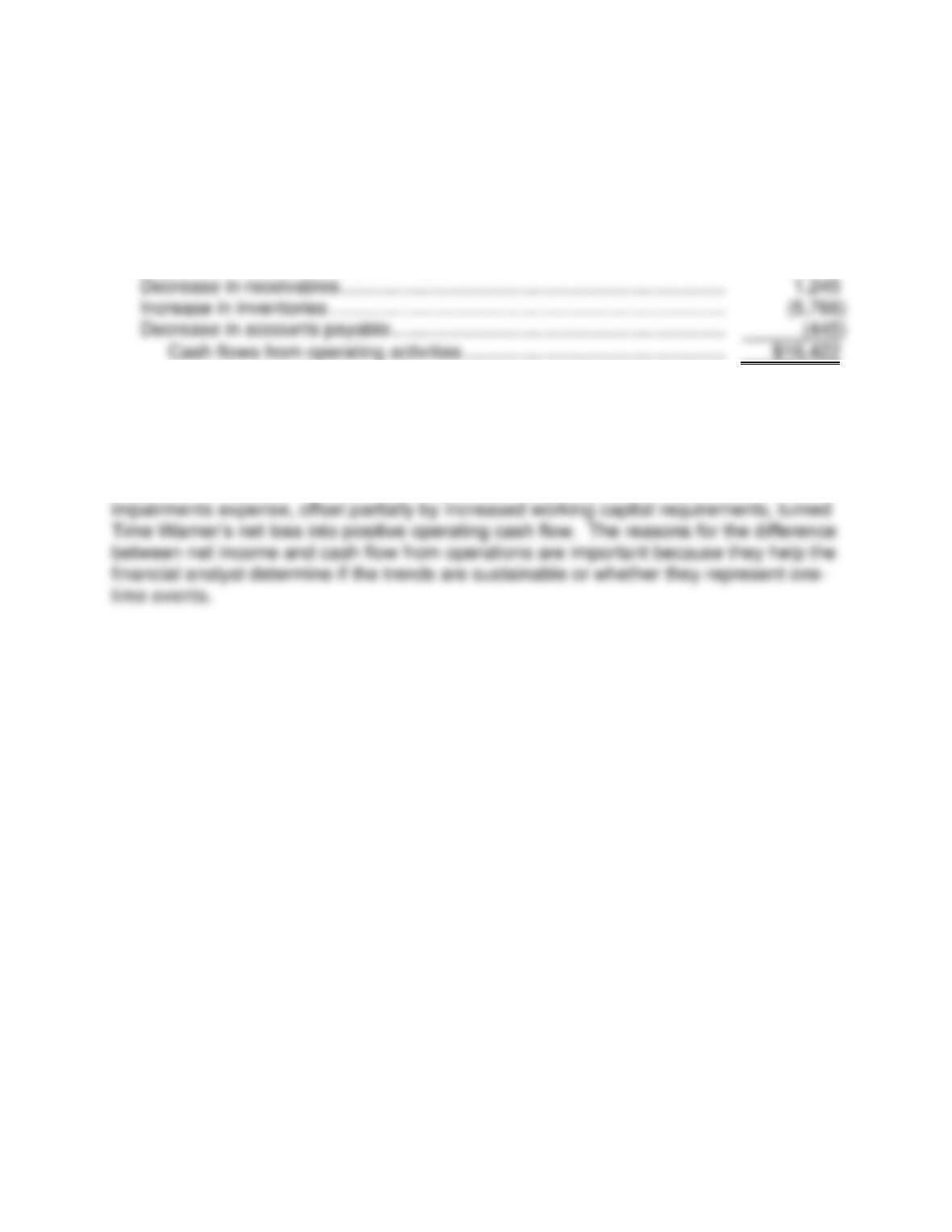
Cash flows from operating activities—indirect method
Net income …………………………………………………………………………………..
$12,625
Depreciation expense ……………………………………………………………………
Accounts receivable decrease ($10,500 – $12,000) ………………………….
Inventory increase ($14,000 – $8,000) ……………………………………………
Salaries payable increase ($1,750 – $800) ………………………………………
$17,575
E13–7.
Req. 1
Cash flows from operating activities—indirect method
Net loss …………………………..…………………………………………………………..
($4,900
)
Depreciation expense ……………………………………………………………………
7,000
Amortization of copyrights ………………………………………………………………
Accounts receivable decrease ($8,000 – $15,000) …………………………...
7,000
Salaries payable increase ($15,000 – $1,000) ………………………………….
Other accrued liabilities decrease ($1,000 – $5,100) ………………………….
)
Req. 2
The first reason for the net loss was the depreciation expense. This is a non-cash
expense. Depreciation expense, along with decreased working capital requirements
(current assets – current liabilities), turned the net loss into positive operating cash flow
from operations. The reasons for the difference between net income and cash flow are
important because they help the financial analyst determine if the trends are sustainable
or whether they represent one-time events.
E13–8.
Cash flows from operating activities—indirect method
Net income …………………………………………………………………………………..
$ 8,000
Accounts receivable decrease ……………………………………………………….
Salaries payable increase ………………………………………………………………
9,000
Other accrued liabilities decrease ……………………………………………………
)
Chapter 13 – Statement of Cash Flows
13–11
E13–9.
Req. 1
Cash flows from operating activities—indirect method
Net loss …………………………..………………………………………………………….
($13,402
)
Depreciation, amortization, and impairments ……………………………………
34,790
Note: The additions to equipment do not affect cash flows from operating activities.
Req. 2
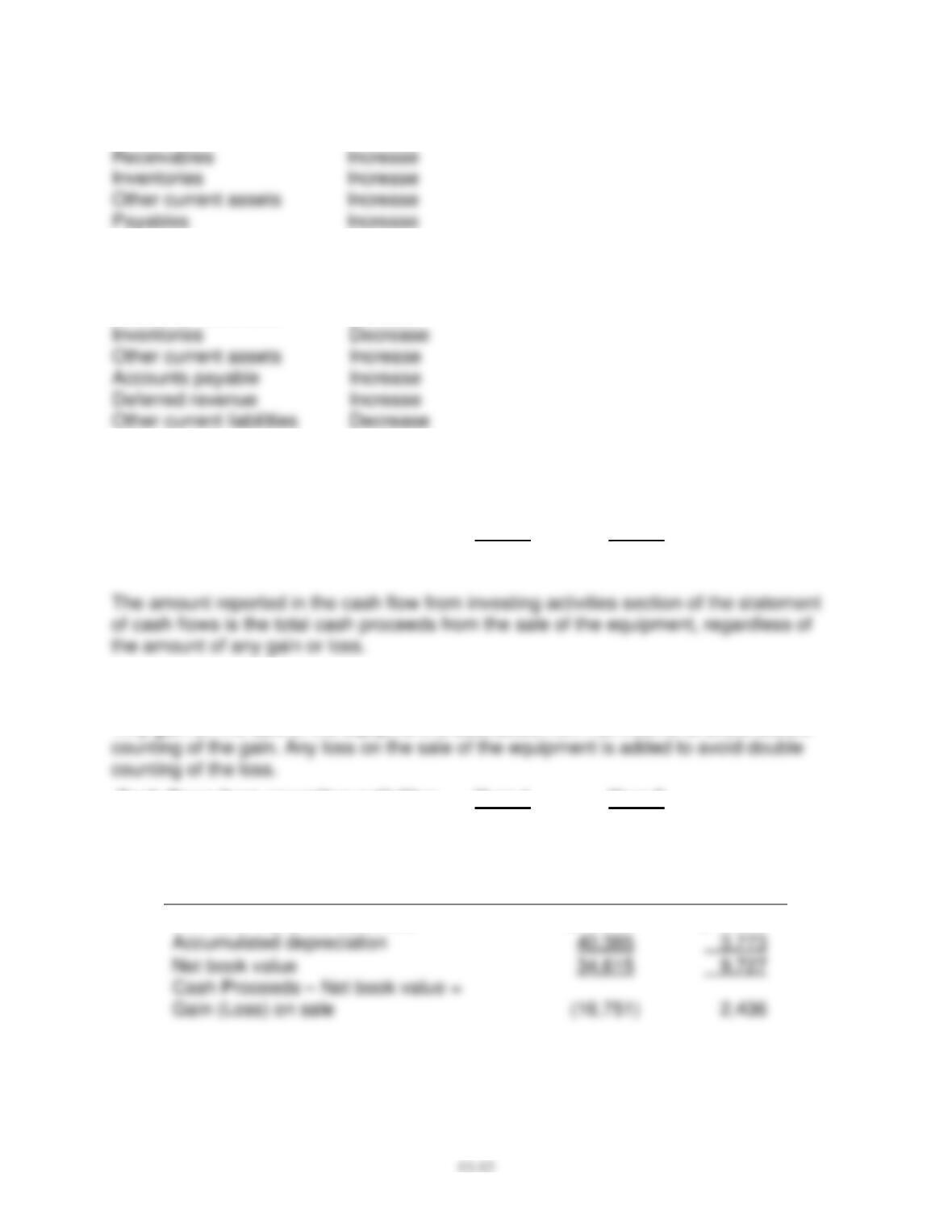
The primary reason for the net loss was the depreciation, amortization, and impairments
expense. These represent non-cash expenses. Large depreciation, amortization, and
Increase in inventories ………………………………………………………………….
)
)
Chapter 13 – Statement of Cash Flows
E13–10.
Account
Change
Receivables
Increase
Inventories
Increase
Other current assets
Increase
Payables
Increase
E13–11.
Account
Change
Accounts receivable
Increase
Inventories
Decrease
Other current assets
Accounts payable
Increase
Deferred revenue
Increase
Other current liabilities
E13–12.
Req. 1
Cash flows from investing activities
Year 1
Year 2
Proceeds from sale of equipment ……..
$17,864
$12,163
Req. 2
Any gain on the sale of the equipment is subtracted from net income to avoid double
Cash flows from operating activities
Year 1
Year 2
Loss (Gain) on sale of equipment ……..
$16,751
$(2,436)
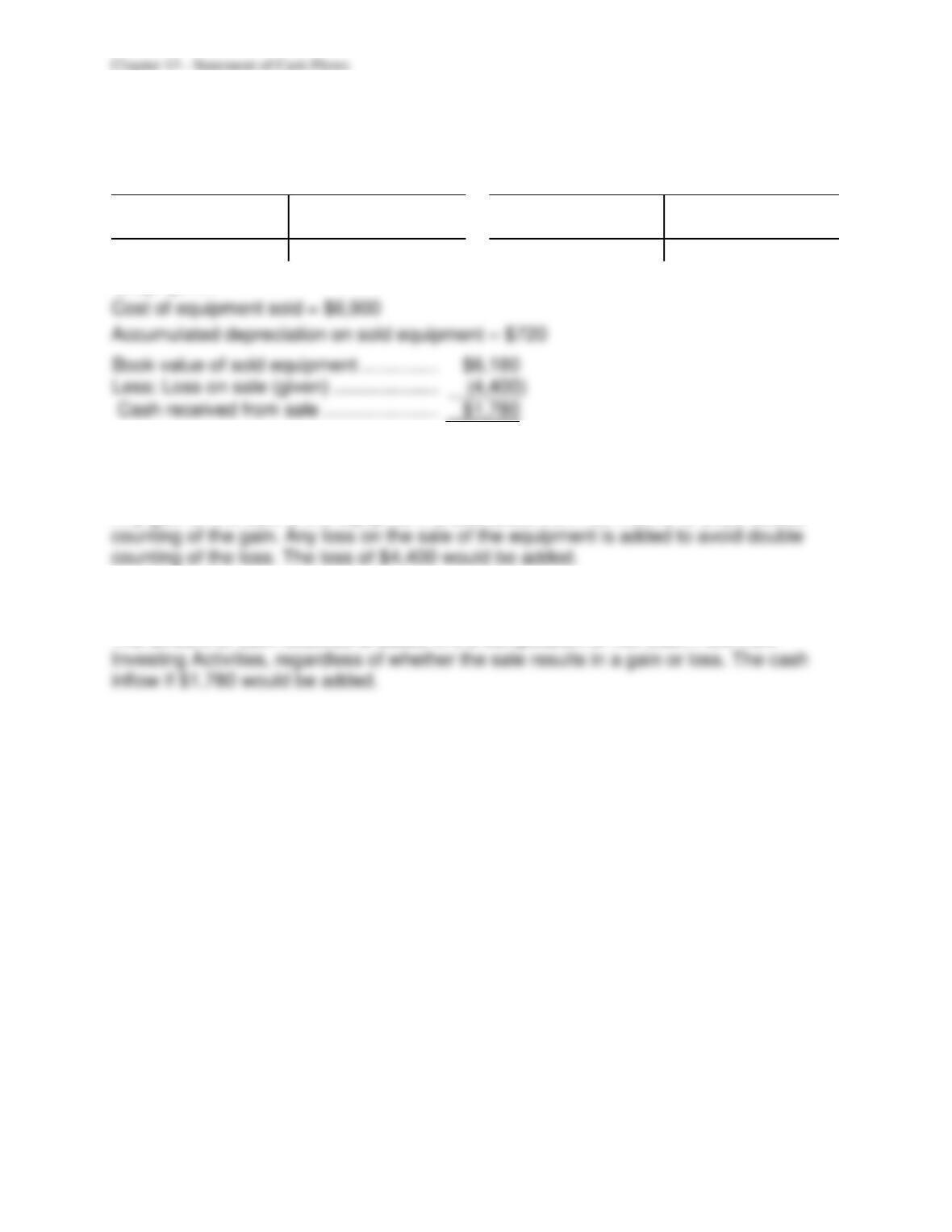
Computations:
Year 1
Year 2
Plant and equipment (at cost)
$75,000
$13,500
Accumulated depreciation
Net book value
Gain (Loss) on sale
13–13
E13–13.
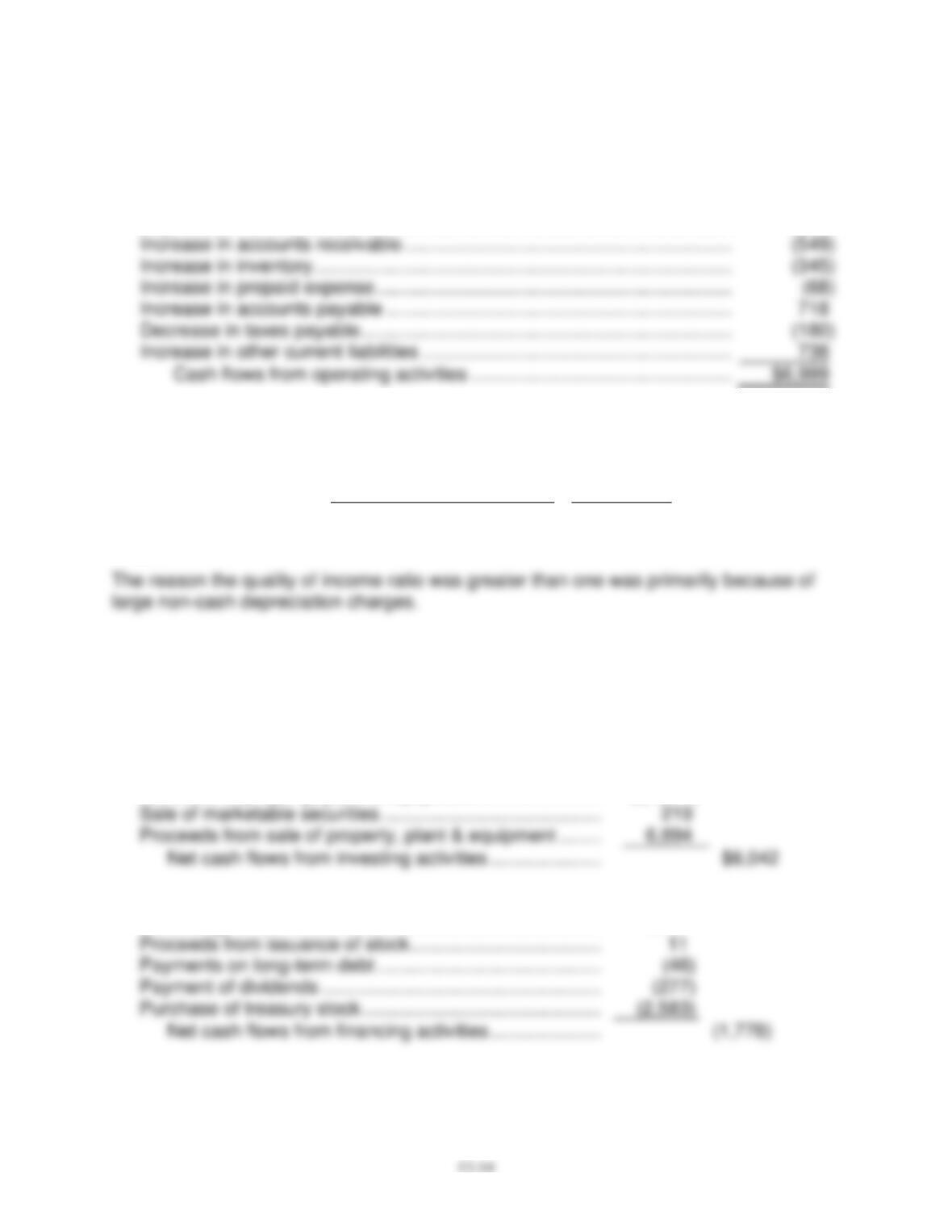
Req. 1
Equipment
Accumulated Depreciation
Beg. Bal.
19,000
1,800
Beg. Bal.
6,900*
Sold
Sold
720*
820
Dep. Exp.
End. Bal.
12,100
1,900
End. Bal.
*plug figures
Book value of sold equipment ……………
Less: Loss on sale (given) ………………..
)
Cash received from sale ………………….
Req. 2
Any gain on the sale of the equipment is subtracted from net income to avoid double
Req. 3
The amount of cash received is added in the computation of Net Cash Flow from
Chapter 13 – Statement of Cash Flows
E13–14.
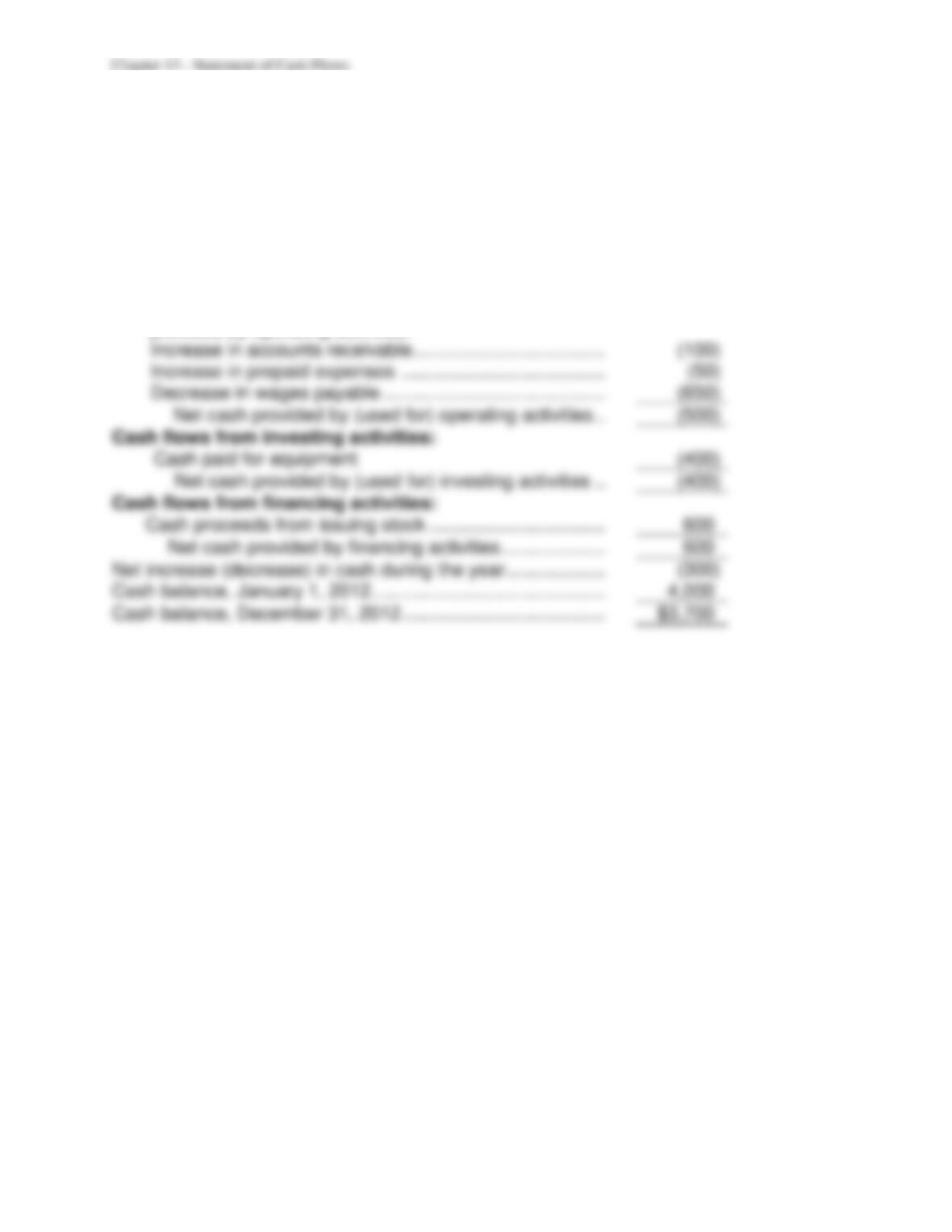
Req. 1
Cash flows from operating activities—indirect method
Net income …………………………………………………………………………………..
$5,142
Depreciation and amortization ………………………………………………………..
1,543
Increase in accounts receivable ………………………………………………………
)
Increase in inventory ……………………………………………………………………..
)
Increase in prepaid expense …………………………………………………………..
)
Increase in accounts payable …………………………………………………………
Decrease in taxes payable ……………………………………………………………..
)
$6,999
Note: The cash dividends paid and treasury stock purchased are not related to
operating activities and do not affect cash flows from operating activities.
Req. 2
Quality of income ratio
=
Cash flow from operations
=
$6,999
=
1.36
Net income
$5,142
Req. 3
E13–15.
The investing and financing sections of the statement of cash flows for Oering’s
Furniture:
Cash flows from investing activities:
Purchase of property, plant & equipment ………………………
$(1,071)
Sale of marketable securities ………………………………………..
219
Proceeds from sale of property, plant & equipment ………
6,894
$6,042
Cash flows from financing activities:
Borrowings under line of credit ……………………………………..
1,117
Proceeds from issuance of stock …………………………………..
11
Payments on long-term debt …………………………………………
(46)
Payment of dividends ……………………………………………………
(277)
Purchase of treasury stock ……………………………………………
(2,583)
(1,778)
13–15
E13–16.
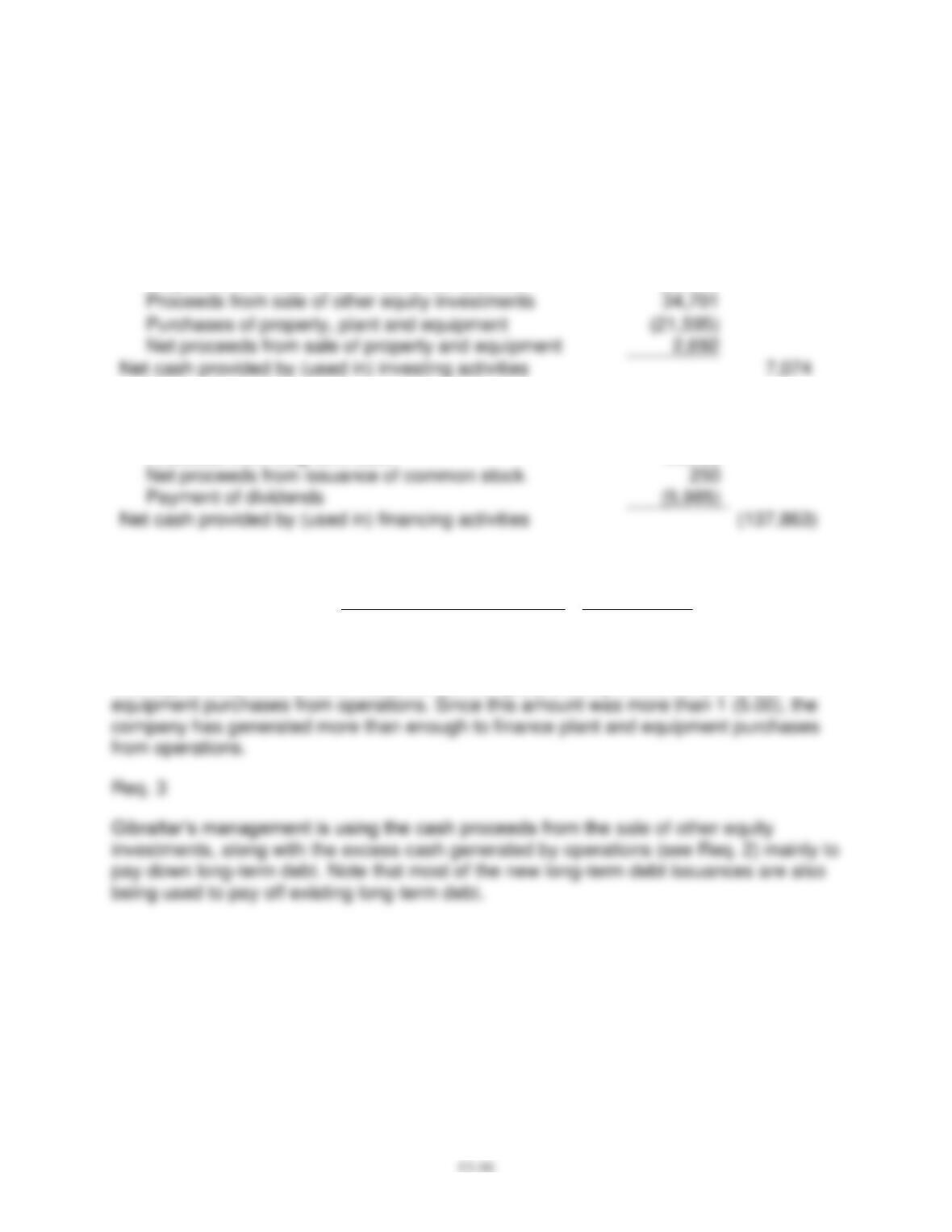
DEEP WATERS COMPANY
Statement of Cash Flows
For the Year Ended December 31, 2012
Cash flows from operating activities:
Net income …………………………………………………………….
$ 300
Adjustments to reconcile net income to net cash
provided by operating activities:
Increase in accounts receivable ……………………………….
Increase in prepaid expenses …………………………………
Decrease in wages payable …………………………………….
Cash flows from investing activities:
Cash flows from financing activities:
Cash proceeds from issuing stock …………………………….
Chapter 13 – Statement of Cash Flows
E13–17.
Req. 1
The investing and financing sections of the statement of cash flows for Gibraltar
Industries:
Cash flows from investing activities:
Acquisitions (investments in other companies)
(8,724)
Proceeds from sale of other equity investments
Purchases of property, plant and equipment
Net proceeds from sale of property and equipment
Net cash provided by (used in) investing activities
Cash flows from financing activities:
Long-term debt reduction
(185,567)
Proceeds from long-term debt
53,439
Net proceeds from issuance of common stock
Payment of dividends
Net cash provided by (used in) financing activities
(137,863)
Req. 2
Capital acquisitions ratio
=
Cash flow from operations
=
$107,874
=
5.00
Cash paid for plant &
equipment
$21,595
The capital acquisitions ratio measures the company’s ability to finance plant and
Chapter 13 – Statement of Cash Flows
13–17
E13–18.
Req. 1
Both of these transactions are considered noncash investing and financing activities,
and are not reported on the statement of cash flows. The transactions must be
Req. 2
The capital acquisitions ratio measures the company’s ability to finance plant and
equipment purchases from operations. Since neither of these transactions enters the
Chapter 13 – Statement of Cash Flows
13–18
E13–19.
Cash flows from operating activities—direct method
Cash collected from customers1
$86,500
1. Cash collected from customers = Sales revenue + Decrease in Accounts receivable
$85,000 + $1,500 = $86,500
E13–20.
Req. 1
Cash flows from operating activities—direct method
Cash collected from customers1
$60,000
Cash payments to employees2
)
Cash paid for other expenses3
)
1. Cash collected from customers = Sales revenue + Decrease in Accounts receivable
$53,000 + $7,000 = $60,000
Req. 2
The first reason for the net loss was the depreciation expense. This is a non-cash
expense. Depreciation expense, along with decreased working capital requirements
Cash payments to suppliers of inventory2
)
Cash payments to employees 3
)
Chapter 13 – Statement of Cash Flows
E13–21.
Req. 1
Cash flows from operating activities—direct method
Cash collected from customers1
$146,670
Cash payments to employees
(56,835)
Cash payments to suppliers2
(52,575)
Cash payments for other expenses3
Cash payments for income tax4
Net cash provided by operating activities
$27,396
1. Cash collected from customers = Revenues + Decrease in Accounts receivable
$146,500 + $170 = $146,670
2. Cash payments to suppliers: Cost of sales – Decrease in Inventories
– Increase in Accounts payable
$55,500 – $643 – $2,282 = $52,575
Req. 2
The primary reason for the net loss was the depreciation and amortization expense.
These represent non-cash expenses. Large depreciation and amortization expense,
Chapter 13 – Statement of Cash Flows
13–20
E13–22.
Balances
Analysis
Balances
Item
12/31/2012
Debit
Credit
12/31/2013
Cash
20,500
l
1,700
18,800
Noncash accounts:
Accounts receivable (net) …………
22,000
22,000
Wages payable ………………………
2,500
f
1,000
1,500
Income taxes payable ……………..
3,000
g
1,500
4,500
Bonds payable ……………………….
54,000
54,000
j
3,600
Common stock, no par …………….
100,000
b
19,000
122,600
Retained earnings …………………..
16,500
k
10,000
a
18,200
24,700
Total …………………………………….
225,000
243,300
Net income
Depreciation expense
c
5,000
Accounts payable decrease
e
3,000
Wages payable decrease
f
1,000
Income taxes payable increase
1,500
Inventory increase
h
7,000
13,700
Cash flows from investing activities:
Long-term investment purchased
d
15,000
Statement of Cash Flows
Inflows
Outflows
Sale of equipment
i
6,000
(9,000
)
Cash flows from financing activities:
Sale of capital stock
j
3,600
Dividends paid
k
10,000
(6,400
)
Net increase (decrease) in cash
l
1,700
Totals
(1,700
)
Merchandise inventory …………….
68,000
7,000
75,000
Investments, long-term …………….
15,000
15,000
Equipment …………………………..…
114,500
19,000
i
21,000
112,500
Total …………………………………….
225,000
243,300
Accumulated depreciation ………..
32,000
i
15,000
c
5,000
22,000
Accounts payable ……………………
17,000
3,000
14,000