CHAPTER 13
STATEMENT OF CASH FLOWS
LEARNING OBJECTIVES
1. DISCUSS THE USEFULNESS AND FORMAT OF THE
STATEMENT OF CASH FLOWS.
2. PREPARE A STATEMENT OF CASH FLOWS USING
THE INDIRECT METHOD.
3. ANALYZE THE STATEMENT OF CASH FLOWS.
*4. PREPARE A STATEMENT OF CASH FLOWS USING
THE DIRECT METHOD.
*5. USE THE T-ACCOUNT APPROACH TO PREPARE A
STATEMENT OF CASH FLOWS.
CHAPTER REVIEW
Usefulness of the Statement of Cash Flows
1. (L.O. 1) The fourth basic financial statement is the statement of cash flows. The primary purpose
of the statement is to provide information about an entity’s cash receipts and cash payments
during a period.
2. The information in the statement of cash flows should help investors to assess the
a. entity’s ability to generate future cash flows.
Classification of Cash Flows
3. The statement of cash flows classifies cash receipts and cash payments by:
a. Operating activities which include cash effects of transactions that create revenues and
expenses and thus enter into the determination of net income.
b. Investing activities which include (1) acquiring and disposing of investments and (2) lending
Format of the Statement of Cash Flows
5. The three classes of activities constitute the general format of the statement with the operating
activities section appearing first, followed by the investing activities and financing activities sections.
a. The net cash provided or used by each activity is totaled to show the net increase (decrease)
in cash for the period.
Preparing the Statement of Cash Flows
6. (L.O. 2) The statement of cash flows is not prepared from the adjusted trial balance. The
information to prepare this statement usually comes from three sources: (a) comparative balance
sheets, (b) the current income statement, and (c) additional information.
The Major Steps
7. The major steps in preparing the statement are:
Step 1: Determine net cash provided/used by operating activities. This step involves analyzing
not only the current year’s income statement, but also comparative balance sheets and
selected additional data.
Step 2: Analyze changes in noncurrent asset and liability accounts and record as investing and
8. In performing step 1, the operating activities section must be converted from an accrual basis to
a cash basis. This may be done by either the indirect method or the direct method.
a. Both methods arrive at the same total amount for “net cash provided by operating activities”
The Indirect Method
9. The following points 10 through 15 explain and illustrate the indirect method.
Step 1: Operating Activities
10. The first step is to determine net cash provided/used by operating activities.
a. Under generally accepted accounting principles the accrual basis of accounting is used
which results in recording revenues when recognized and expenses when incurred.
b. In order to determine net cash provided from operating activities it is necessary to report
revenues and expenses on a cash basis. This is determined by adjusting net income for
items that did not affect cash.
11. The operating section of the statement of cash flows should (a) begin with net income, (b) add
(or deduct) items not affecting cash, and (c) show net cash provided by operating activities.
12. In determining net cash provided by operating activities,
a. increases in specific current assets other than cash are deducted from net income, and
Step 2: Investing and Financing Activities
13. The second step, analyze changes in noncurrent asset/liability accounts and record as investing
and financing activities is generally determined from changes in noncurrent accounts reported in
comparative balance sheets and selected additional data.
a. If the account, Land, increases $50,000 and the transaction data indicates that land was
purchased for cash, a cash outflow from an investment activity has occurred.
Step 3: Net Change in Cash
15. The third step is to determine the net change in Cash on the statement of cash flows with the
change in the Cash account reported on the balance sheet to make sure the amounts agree.
Analysis of the Statement of Cash Flows
16. (L.O. 3) Free cash flow describes the net cash provided by operating activities after adjustment
for capital expenditures and dividends. The formula for free cash flow is:
Free Cash Flow = Net Cash Provided by Operating Activities – Capital Expenditures – Cash
Dividends.
Preparing the Statement of Cash Flows—
The Direct Method
*17. (L.O. 4) The following points 18 through 23 explain and illustrate the direct method.
Step 1: Operating Activities
*18. The first step is to determine net cash provided/used by operating activities by adjusting each item
in the income statement from the accrual basis to the cash basis.
a. If the income statement shows sales revenue of $120,000 and accounts receivable (net)
*19. In the operating activities section, only major classes of cash receipts and cash payments are reported
as follows:
a. Cash receipts from (1) sales of goods and services to customers and (2) interest and
*20. The formula for computing cash receipts from customers is:
Sales
Revenue
+
–
Decrease in Accounts Receivable
or
Increase in Accounts Receivable
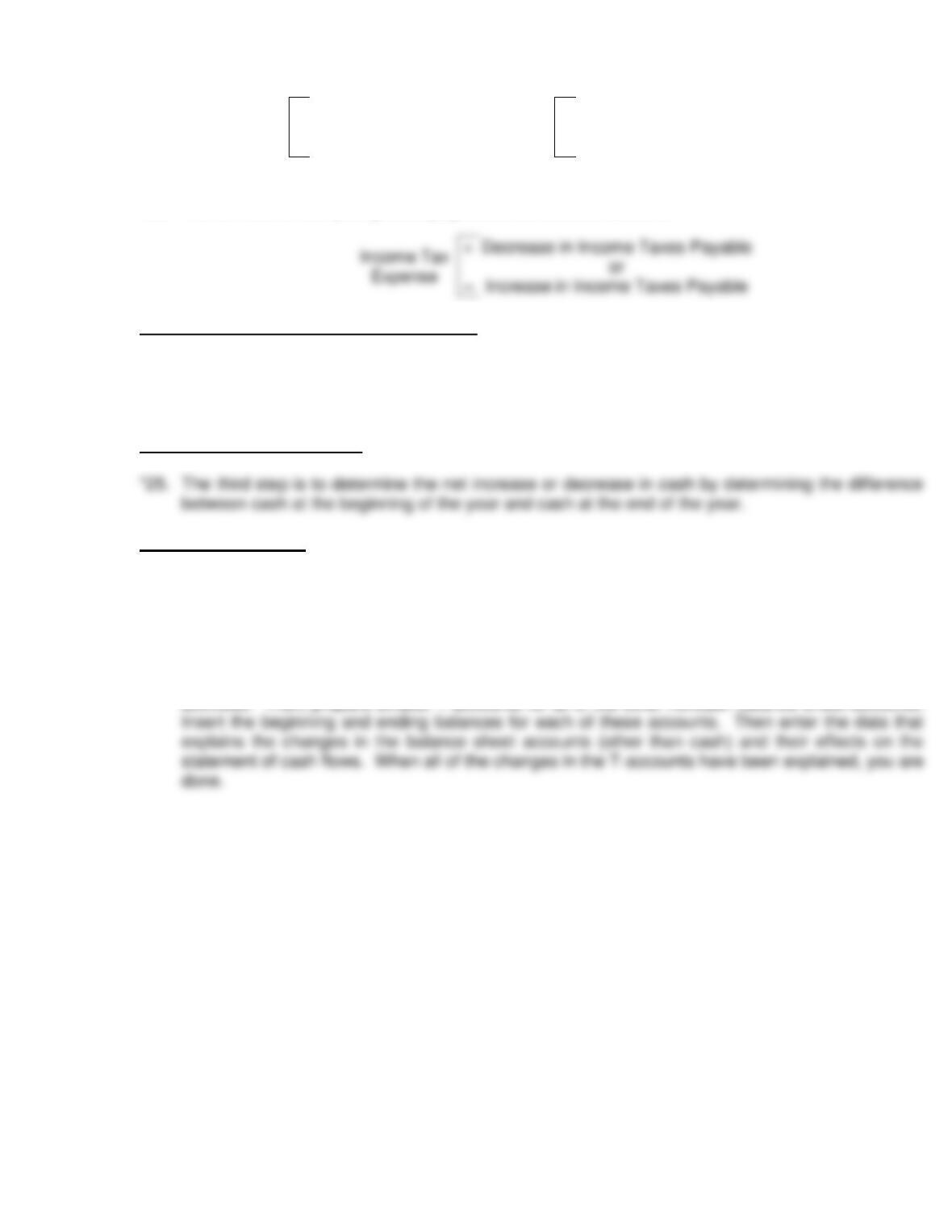
*21. The formula for computing cash payments to suppliers is:
*22. The formula for computing cash payments for operating expenses is:
Operating
Expenses
+
–
Increase in Prepaid Expenses
or
Decrease in Prepaid Expenses
+
–
Decrease in Accrued Expenses Payable
or
Increase in Accrued Expenses Payable
*23. The formula for computing cash payments for income taxes is:
Step 2: Investing and Financing Activities
*24. The second step, analyze changes in noncurrent asset/liability accounts and record as investing
and financing activities is generally determined from changes in noncurrent accounts reported in
comparative balance sheets and selected additional data.
Step 3: Net Change in Cash
T-account Approach
*26. (L.O. 5) The T-account approach is based on the following equation:
∆ Cash = ∆ Liabilities + ∆ Equity – ∆ Noncash Assets
*27. First prepare a large Cash T-account with sections for operating, investing, and financing
activities. Then, prepare smaller T-accounts for all of the other noncash balance sheet accounts.
–
Increase in Income Taxes Payable
LECTURE OUTLINE
A. Usefulness of the Statement of Cash Flows.
1. The statement of cash flows reports the cash receipts, cash payments, and
net change in cash resulting from operating, investing, and financing
activities during a period.
2. The information in a statement of cash flows should help investors,
creditors, and others assess:
a. The entity’s ability to generate future cash flows.
B. Classification of Cash Flows.
1. The statement of cash flows classifies cash receipts and cash payments
as operating, investing, and financing activities.
a. Operating activities include the cash effects of transactions that create
revenues and expenses. They enter into the determination of net
income.
2. Note that (1) operating activities involve income statement items, (2) invest-
ing activities involve cash flows resulting from changes in investments
and long-term asset items, and (3) financing activities involve cash flows
resulting from changes in long-term liability and stockholders’ equity
items.
C. Significant Noncash Activities.
1. Companies do not report in the body of the statement of cash flows
significant financing and investing activities that do not affect cash.
2. They report these activities in either a separate schedule at the bottom
of the statement of cash flows or in a separate note or supplementary
schedule to the financial statements.
3. Examples of significant noncash activities are:
ACCOUNTING ACROSS THE ORGANIZATION
Net income is not the same as net cash provided by operating activities. Net cash
provided by operating activities is usually significantly larger than net income.
In general, why do differences exist between net income and net cash provided
by operating activities?
Answer: The differences are explained by differences in the timing of the reporting
of revenues and expenses under accrual accounting versus cash.
Under accrual accounting, companies report revenues when earned,
even if cash hasn’t been received, and they report expenses when
incurred, even if cash hasn’t been paid.
D. Format of the Statement of Cash Flows.
1. The cash flows from operating activities section always appears first,
followed by the investing activities and then the financing activities
sections.
E. Preparing the Statement of Cash Flows.
1. Companies prepare the statement of cash flows differently from the three
other basic financial statements. It is not prepared from an adjusted trial
balance because the trial balance will not provide the necessary data.
The information to prepare the statement of cash flows usually comes
from three sources:
a. Comparative balance sheets.
b. Current income statement.
c. Additional information.
2. Preparing the statement of cash flows from these data sources involves
three major steps:
a. Determine net cash provided/used by operating activities by con–
verting net income from an accrual basis to a cash basis. Determining
b. Analyze changes in noncurrent asset and liability accounts and
record as investing and financing activities, or disclose as noncash
transactions. This step involves analyzing comparative balance sheet
data and selected additional information for their effects on cash.
F. Preparing the Statement of Cash Flows—Indirect Method.
1. Step 1: Determine net cash provided/used by operating activities by
converting net income from an accrual basis to a cash basis.
a. Under the accrual basis of accounting, net income is not the same
as net cash provided by operating activities.
c. Noncash charges (depreciation expense, amortization, depletion)
and losses in the income statement are added back to net income and
gains are deducted which results in net cash provided by operating
activities.
e. Deduct from net income increases in current asset accounts, and
add to net income decreases in current asset accounts, to arrive at
net cash provided by operating activities.
(1) When the Accounts Receivable balance increases, cash receipts
are lower than revenue recognized under the accrual basis. The
f. Increases in current liability accounts are added to net income, and
decreases in current liability accounts are deducted from net income,
to arrive at net cash provided by operating activities.
(1) When the Accounts Payable balance increases, operating ex–
penses on an accrual basis are higher than they are on a cash
2. Step 2: Analyze changes in noncurrent asset and liability accounts and
record as investing and financing activities, or as noncash investing and
financing activities.
a. Increases in any noncurrent asset (Land, Buildings, Equipment and
Long-Term Investments) represent outflows of cash from investing
activities. Decreases represent inflows of cash from investing activities.
b. Increases in long-term debt (Bonds Payable) or paid-in capital
3. Step 3: Compare the net change in cash on the statement of cash flows
with the change in the Cash account reported on the balance sheet to
make sure the amounts agree.
G. Using Cash Flows to Evaluate a Company.
1. In the statement of cash flows, net cash provided by operating activities
is intended to indicate the cash-generating capability of the company.
2. Net cash provided by operating activities fails to take into account that a
company must invest in new fixed assets just to maintain its current level
of operations.
*H. Statement of Cash Flows—Direct Method.
1. Step 1: Determine the net cash provided/used by operating activities by
converting net income from an accrual basis to a cash basis.
a. Companies compute net cash provided by operating activities by
adjusting each item in the income statement from the accrual basis
to the cash basis.
(1) Increase in accounts receivable: when accounts receivable
increase during the year, sales revenue on an accrual basis is
higher than cash receipts from customers.
b. Companies report only major classes of operating cash receipts
and cash payments; the difference between cash receipts and cash
payments is the net cash provided by operating activities.
2. Step 2: Analyze changes in noncurrent asset and liability accounts and
record as investing and financing activities, or as significant noncash
activities.
a. Increases in any noncurrent assets (Land, Buildings, Equipment
and Long-Term Investments) represent outflows of cash from
investing activities. Decreases represent inflows of cash from investing
activities.
3. Step 3: Compare the net change in cash on the statement of cash flows
with the change in the Cash account reported on the balance sheet to
make sure the amounts agree.
*I. T-account Approach
The steps in preparing a statement of cash flows using the T-account
approach are:
a. Prepare a large cash T-account with sections for operating, investing,
and financing activities.
20 MINUTE QUIZ
Circle the correct answer.
True/False
1. Inflows and outflows from investing and financing activities should be reported separately on the
statement of cash flows.
True False
2. In addition to the adjusted trial balance, information for the statement of cash flows is taken from
comparative balance sheets and the current income statement.
True False
3. The purchase of inventory and investments in property, plant, and equipment are considered cash
outflows from operations.
True False
4. An increase in equipment will increase net cash provided by operating activities.
True False
5. When accounts receivable increases during the year, revenues on a cash basis are higher than
revenues on an accrual basis.
True False
6. Cash outflows to purchase property, plant, and equipment would be reported in the investing section
of the statement of cash flows.
True False
7. A statement of cash flows starts with net income and adds (or deducts) items that did not affect
cash to arrive at net cash provided by operating activities if the indirect method is used.
True False
8. The only use of a statement of cash flows is to help investors, creditors, and others assess the
reasons for the difference between net income and net cash provided by operating activities.
True False
9. The amortization of a patent is added back to net income to arrive at net cash provided by
operating activities.
True False
10. The issuance of shares of stock for plant assets is a significant noncash transaction.
True False
Multiple Choice
1. A company has credit sales of $900,000 and cash sales of $540,000 during the same
year that the Accounts Receivable account decreased by $120,000. What was the total
of cash receipts from sales?
a. $1,320,000.
b. $1,560,000.
c. $1,020,000.
d. $780,000.
2. Cash inflows from investing activities include
a. sale of common stock.
b. purchase of equipment.
c. sale of land.
d. issuance of long-term debt.
3. Operating activities do not include cash
a. inflows from revenue.
b. inflows from sale of equipment.
c. outflows for income taxes.
d. outflows for wages.
4. Which of the following would decrease net cash provided by operating activities?
a. Decrease in short-term notes payable.
b. Depreciation expense.
c. Decrease in inventory.
d. Loss on disposal of equipment.
5. Noncash investing and financing activities
a. may represent significant investing and financing activities.
b. do not involve cash receipts or cash payments.
c. are disclosed on a separate schedule.
d. All of the answer choices are correct.

ANSWERS TO QUIZ
True/False
1. True 6. True
Multiple Choice
1. b.