Chapter 13: Statement of Cash Flows Instructor Manual
Accounting Theory (9
th
edition) Page 1 of 16
CHAPTER HIGHLIGHTS
Even though SFAS No. 95 replaced the statement of change in financial position with the cash
flow statement, Chapter 13 begins with a discussion of funds flow reporting and the statement of
change in financial position. There are two reasons for retaining this historical literature in the
text. First, the rationale for funds reporting is very similar to that for cash flow reporting—a
concern that accrual accounting masks the firm’s operating flows. Therefore, funds reporting was
viewed as a supplement to accrual-based statements, and the reporting of more basic funds flow
data thus reverses—at least to some extent—the effects of arbitrary allocations and other
conventions of historical costing. Second, the cash flow statement can be viewed as a statement
of change in financial position, with “funds” defined as cash. While there are some differences in
format, the point remains that SFAS No. 95 can be characterized as amending APB Opinion No.
19 by requiring rigid uniformity in the definition of funds as cash plus cash equivalents.
While the SCFP used a very general sources and uses framework, focusing mechanically on the
narrow accounting debit-credit relation, the SCF classifies cash receipts and payments into more
meaningful categories relating to operating, financing, and investing activities. Cash is defined as
literal cash on hand or on demand deposits, plus cash equivalents.
There have been questions raised, however, relative to the classification of interest and dividends
under SFAS No. 95. In fact, three of the seven members of the FASB dissented from the
statement, arguing that interest and dividends received arise from investing activities rather than
from operating activities, and that interest paid is an element of financing activities rather than an
operating cost.
Chapter 13: Statement of Cash Flows Instructor Manual
Accounting Theory (9
th
edition) Page 2 of 16
FASB requires that if the direct method is used, a separate schedule shall reconcile net operating
cash flow with net income. Thus, the indirect or reconciliation method must be used either alone
or as a supplement to the direct method. The great bulk of American firms use the indirect
method. From a user perspective, this is backwards. The authors suggest the direct method be
required; it provides users with easier to understand cash flows.
The three-part structure of the SCF—operating, financing, investing, is generally in accordance
with the finance literature. However, SCF classifies interest and dividend receipts as operating
inflows, and interest payments as operating outflows. While this classification might be
appropriate for the banking industry, it does not appear to be appropriate for the vast majority of
firms.
Free cash flow is a recent and increasingly popular cash flow metric. It focuses on the ongoing
operations of the firm, including its investing activities. Unlike cash flow from operating
activities, free cash flow treats interest expense as a financing item.
QUESTIONS
Q-1 How did the all-inclusive or all-resources approach to the SCFP with funds defined as
working capital differ from the older funds flow statement?
The all-resources approach to the SCFP was a broader statement than the older funds flow
Chapter 13: Statement of Cash Flows Instructor Manual
Accounting Theory (9
th
edition) Page 3 of 16
Q-2 SFAS No. 95 allows a choice between the direct and the indirect method for calculating
the operations section of the SCF. Do you think this is a case of flexibility? Explain.
We do not consider this to be a case of flexibility because direct and indirect methods are
Q-3 What is the “fineness” issue raised by Nurnberg and Largay relative to accounting for
hedging transactions in SFAS No. 104?
“Fineness” relates to a comparative situation where one method provides more information—
Q-4 Does the “fineness” issue arise relative to the handling of capitalized interest costs
(SFAS No. 34) relative to the treatment of this item in SFAS No. 95? Explain.
Presumably it does. SFAS No. 34 presumably results in a fuller presentation of the costs of self
Q-5 What advantages do you see for classifying interest expense as an investing cash flow
rather than an operating cash flow? What is the advantage of classifying it as an
operating cash flow? What is the advantage of classifying it as a financing cash flow?
It is more consistent to classify the interest cost, along with changes in principal, as an investing
rather than a distribution to a particular set of capital providers.
Q-6 Explain how cash flow data complement the income statement and balance sheet.
Q-7 What is the “quality of income” concept, and how does cash flow reporting relate to it?
This refers to the concern about the impact of accruals on accounting income and how accruals
Chapter 13: Statement of Cash Flows Instructor Manual
Accounting Theory (9
th
edition) Page 4 of 16
Q-8 What attribute is being measured in the SCF and how well is representational
faithfulness achieved? Compare this to when funds are defined as working capital.
Since it “undoes” the effect of accrual accounting, cash flow reporting quite literally removes the
Q-9 Why is the three-way classification system in the SCF more informative than the two-
way source/use classification?
In an abstract sense, what is being measured is an indicator of the firm’s operating liquidity, as
Q-10 How does the source/use classification reflect the structure of double-entry
accounting?
Q-11 What is the purpose of reporting noncash items in the SCF?
Q-12 Why is the SCF called a derivative statement?
Q-13 What do research findings indicate concerning the relevance of cash and funds flow
data?
It is derivative in the sense that it is based on the same set of transactions as are reported in the
Q-14 What does it mean to classify a cash flow according to the basic nature or function of
the event as opposed to the ultimate purpose of the transaction? Which method do you
prefer?
Chapter 13: Statement of Cash Flows Instructor Manual
Accounting Theory (9
th
edition) Page 5 of 16
Q-15 Reexamine Exhibit 13.11. Explain the purpose of each performance measure. As a
manager, which performance measure would you want to use. Which measure would
you want used to evaluate you? Why? How would your decision change if your firm
was experiencing a boom? A recession? How would your decision change if your
firm’s plant and equipment needed to be replaced? What if plant and equipment were
new?
Q-16 Should a CEO be evaluated based on one year’s cash flows? Why or why not? (Your
answer might be affected by your definition of cash flow.)
Probably not. The value of the firm is equal to the present value of the expected future cash
flows. A given year’s free cash flow can be increased by deferring investment, probably to the
Q-17 The value of the firm is equal to the discounted value of the firm‘s free cash flows. Is it
possible to forecast distant free cash flows? If not, what is the alternative?
Accurate forecasting of future free cash flows is not easy. It involves a great degree of
uncertainty. Unfortunately, there is no easy, simple, or more accurate alternative. Using simple
relative valuation alternatives such as price-to-cash flow or price-to-earnings ratios largely
Q-18 Comment on the following statement: Cash flow from operating activities is the most
important section of the SCF. Hence, analysis should be focused on this section.
Cash flow from operating activities is an important section of the SCF, but not the most
Chapter 13: Statement of Cash Flows Instructor Manual
Accounting Theory (9
th
edition) Page 6 of 16
Q-19 Does the statement of cash flows obviate the possible need for exit price financial
statements?
The SCF provides useful information about an entity’s activities in generating cash through
operations. It helps to assess factors such as the entity’s liquidity, financial flexibility,
profitability, and risk. Moreover, cash flow data provide feedback on actual cash flows, as well
as provide help in predicting future cash flows. There is little ambiguity about cash.
Q-20 What are the benefits of evaluating a CEO based on the sum of earnings and cash flow
divided by two? What is the downside to this metric? Make sure you clearly identify
which cash flow and earnings you use in your calculation.
In the 1970s Teledyne used a similar formula to measure entity performance (based on one
CASES, PROBLEMS, AND WRITING ASSIGNMENTS
1. Presented in the exhibit for Case 1 (see text) is a graph of accounting income, cash
flows from operations, and working capital flows from operations for W. T. Grant
Company, a retailer that filed for bankruptcy in 1976. As late as 1973, the company’s
stock was selling for 20 times earnings. What does the chart indicate concerning the
usefulness of income, cash, and funds flows? What could explain the significant
differences between working capital flows and cash flows?
This graph provides a classic illustration of how accrual income and working capital funds flow
can mask underlying cash flow trends. It is only in 1974 that accrual income and working capital
Chapter 13: Statement of Cash Flows Instructor Manual
Accounting Theory (9
th
edition) Page 7 of 16
2. This case is adapted from Appendix B of the exposure draft leading up to the FASB’s
standard on cash flow reporting. Prepare in good form an SCF. Use the direct format.
(Please see the text for background material. Due to its length, we have not repeated it
here.)
Illustration 1. Cash flow from operating activities is reported directly. Noncash transactions are
reported in a separate schedule.
Cash flows from operating activities:
Cash flows from investing activities:
Purchases of property, plant, equipment (4,000)
Proceeds from disposals of property, plant, equipment 2,500
Acquisition of Company ABC (900)
Purchases of investment securities (4,700)
Proceeds from sales of investment securities 5,000
Loans made (7,500)
Collections on loans 5,800
Net cash used by investing activities ($3,800)
Cash flows from financing activities:
Effect of exchange rate changes on cash
100
Net increase (decrease) in cash $1,300
Chapter 13: Statement of Cash Flows Instructor Manual
Accounting Theory (9
th
edition) Page 8 of 16
Schedule reconciling earnings to net cash flow from operating activities:
Net income $ 3,000
Noncash expenses, revenues, losses, and gains included in income:
Depreciation and amortization 1,500
Deferred taxes 150
Net increase in receivables, inventory, and payables (850)
Increase in interest earned but not received (350)
Increase in interest accrued but not paid 100
Gain on sale of property (600)
Net cash flow from operating activities $ 2,950
Chapter 13: Statement of Cash Flows Instructor Manual
Accounting Theory (9
th
edition) Page 9 of 16
3. Due to the length of this case, we have not repeated the background material. Please
see the text for details. For N-M Company:
a. Do a conventional SCF in accord with SFAS No. 95. (Use the indirect method.)
b. Do a second SCF in accordance with the modifications suggested in the section
of the chapter entitled “Classification Problems of SFAS No. 95.”
c. Discuss the underlying reason for the two approaches.
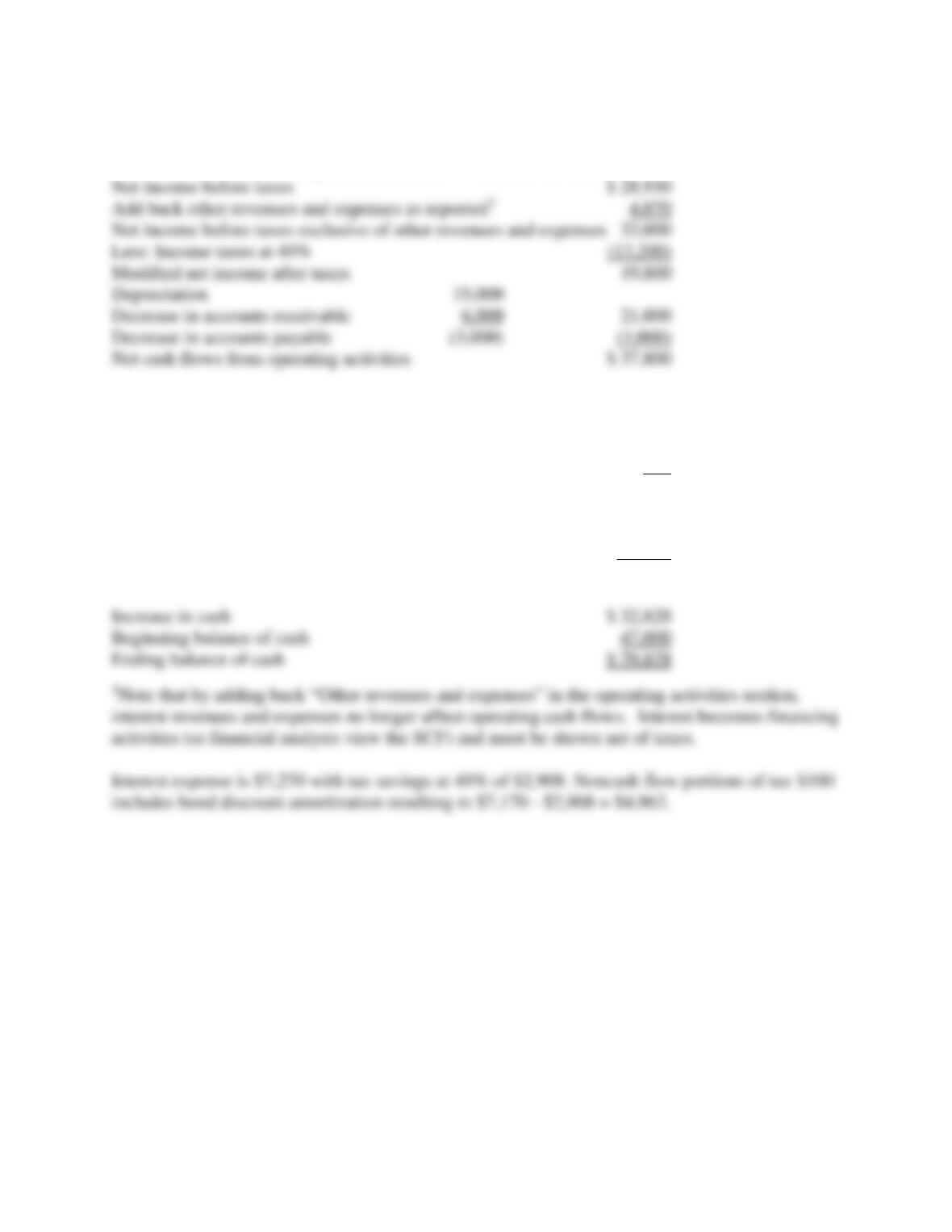
a.
Cash flows from operating activities (indirect method)
Investing activities
Lease payments (excluding interest)
2
$ (6,830)
Sale of fixed asset
1
14,200 7,370
Financing activities
Dividend payments (7,800) (7,800)
Increase in cash $ 32,828
Chapter 13: Statement of Cash Flows Instructor Manual
Accounting Theory (9
th
edition) Page 10 of 16
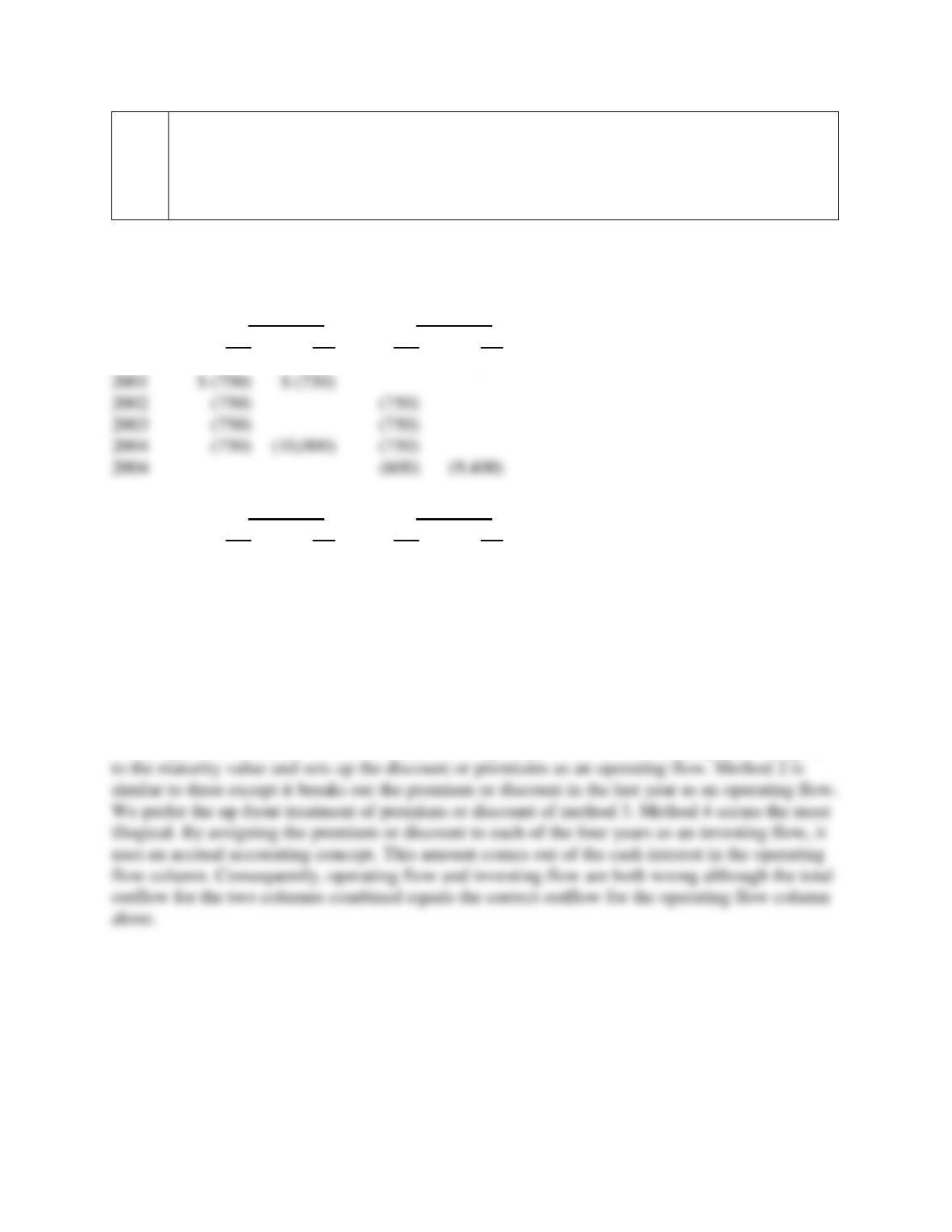
b.
Cash flows from operating activities (indirect method modified)
Investing activities
Lease payment $ (6,830)
Sale of fixed asset less tax on gain ($14,200 – $880) 13,320
Interest revenue net of tax 600
7,090
Financing activities
Dividends $ (7,800)
Interest expense net of tax
3
(4,262)
(12,062)
c.
The SFAS No. 95 approach conforms to the current format of the U.S. income statement, making
it easier to compare cash flows from operating activities to the income statement. The second
statement provides a better functional orientation to operating, investing, and financing activities,
but at the cost of a closer alignment with the income statement. As a side note, “approach b” is
how financial analysts revise the accounting SCF when examining a company’s financials.
Chapter 13: Statement of Cash Flows Instructor Manual
Accounting Theory (9
th
edition) Page 11 of 16
4. Ventius Company issued $10,000 of four-year bonds on December 31, 2000. The
coupon rate on the bonds is 7½%. The bonds were sold for $9,400.
a. Show four possible ways that the interest, principal, and discount can be distributed
(allocated) between operating and financing cash flows for the years 2000–2004.
b. Discuss these four approaches and state your preferences.
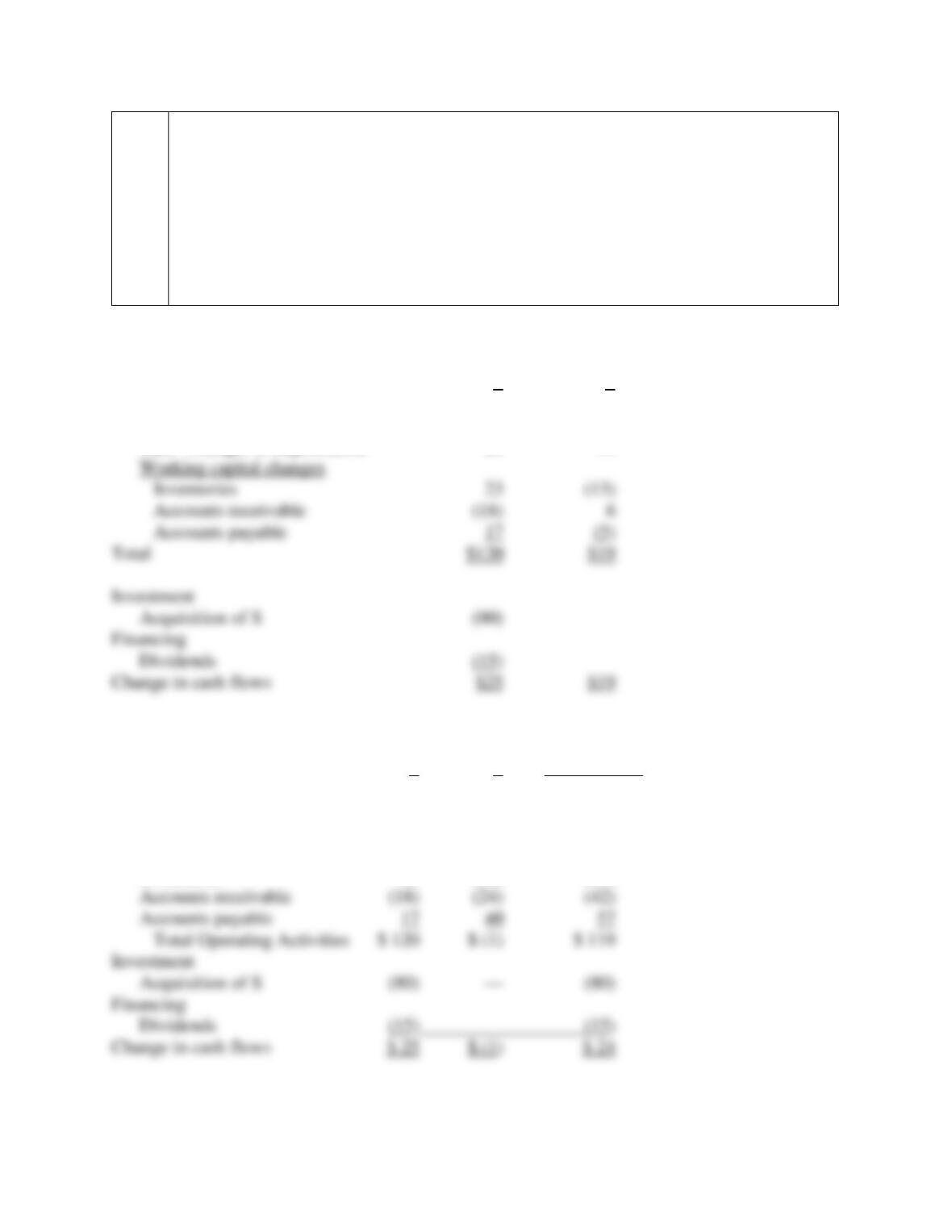
a.
OF=Operating Flow; FF= Financing Flow
Method 1 Method 2
OF FF OF FF
2000 $ 9,400 $ 9,400
Method 3 Method 4
OF FF OF FF
2000 $ (600) $ 10,000 $ 9,400
2001 (750) $ (600) (150)
2002 (750) (600) (150)
2003 (750) (600) (150)
2004 (750) (10,000) (600) (150)
2004 (10,000)
b.
We believe Method 1 is the clearest and simplest method to follow. Method 3 may have a slight
advantage over Method 1 because it breaks the original proceeds into a financing portion equal
Chapter 13: Statement of Cash Flows Instructor Manual
Accounting Theory (9
th
edition) Page 12 of 16
5. Please see the text for the balance sheets and income statements for both P Company
and S Company. Due to the length of this case, we have not repeated them here.
a. Show separate SCFs for P and S for the year 2006 (for S it will be from July 1,
2006 to December 31, 2006) using the indirect method.
b. Show a consolidated SCF for 2006 (from January 1, 2006 to December 31,
2006). Hint: Your cash flow will not show the correct cash increase for 2006.
c. Where does the discrepancy in b. lie and what is it an example of? How might
the situation be remedied? d. In b., show how you think the SCF would be done
in actual practice.
5. (a) Separate cash flow statements (S will be from July 1, 2000) for 2000 using the indirect
method:
P S
Operations
Income as reported $78 $21
5 (b) Consolidated cash flow statements for P and S for 2000 using the indirect method:
P S Consolidated
Operations
Income as reported $ 78 $ 21 $ 99
Add: Changes in depreciation 20 10 30
Working capital changes
Inventories 23 (48) (25)
Chapter 13: Statement of Cash Flows Instructor Manual
Accounting Theory (9
th
edition) Page 13 of 16
5 (c) Notice that the total consolidated increase in cash flows for P and S is $44 made up of P’s
increase of $25 (ending balance of cash $225 less beginning balance of $200) and S’s increase of
6. Select a publicly traded company (your instructor may do this for you). Over a 10-year
period trace the following elements:
a. Net income with depreciation and amortization added back to make it more
b. comparable to cash flows.
c. Cash flows from operations (from the SCF).
d. Cash flows from investing activities.
e. Cash flows from financing activities.
Required:
Assess how closely the company adheres to the Ingram-Lee model in absolute and
relative terms: If income increases, does cash flow increase at a lesser rate? Does
investing have net outflows and financing have net cash inflows?
This should be a fascinating problem. If different companies are assigned to different
7. WorldCom, Inc. improperly capitalized $3.8 billion dollars of expense from January 1,
2001 through the first quarter of 2002 ($3.04 billion occurred in 2001). Selected
balances from its balance sheets are given in the text.
a. What effect did WorldCom’s misclassification have on cash flows (a) in total
and (b) by classification?
b. Why is it difficult to accept the effects on cash flow from operations of the
working capital items listed above?
c. WorldCom’s long-term debt went up by approximately $13 billion during
2001. Is it possible that some of WorldCom’s current liabilities were
reclassified as long-term during 2001?
Bear in mind that we are dealing with fraudulent financial statements and answers are extremely
difficult to obtain.
7 (a) Because of the fraudulent overstatement of income for 2001, WorldCom’s cash flows would
be overstated by $3.04 billion during 2001, less any extra depreciation taken on the $3.04 billion.
All of this would appear in the first section of the SCF, cash flow from operations.
Chapter 13: Statement of Cash Flows Instructor Manual
Accounting Theory (9
th
edition) Page 14 of 16
Effect of BS Reported Effect on
Change on Cash On SCF Reported Cash
Other current assets $ 223 D $164 D $ 59 I
7 (c) Yes. Reclassifying current liabilities as long-term might provide a good way to cover the
cash flow shortage because declines in current liabilities would indicate an outflow of cash.
Whether any of the $453 million dollar “excess” outflow from current liabilities went that route
cannot be discerned from these numbers, but it is certainly possible.
CRITICAL THINKING AND ANALYSIS
1. Do you think that the indirect method of reporting cash flows from operations should
be eliminated, allowing only the direct method in the SCFs? Discuss.
The present system should probably be eliminated. There really is no choice, since if the direct
method is presented, the indirect also must be shown as a supplementary schedule hence the cost
of preparing information is lower if one simply presents the indirect method. This one
explanation as to why the indirect method is used much more frequently than the direct method.
2. What is cash flow? In your answer, be sure to reference the use to which it is put.
The term “cash flow” is a term that is frequently used indiscriminately and ambiguously. To be
Chapter 13: Statement of Cash Flows Instructor Manual
Accounting Theory (9
th
edition) Page 15 of 16
clear and unambiguous, users need to be more precise in the use of their terms. The choice of
“definition” depends on time, resources, and its intended use.
3. Why is the use of free cash flows increasing?
The use of free cash flows is probably growing as a reaction to numerous accounting problems
4. Broome (2004) recommends that the FASB should provide more guidance on
classification of cash flows for the three sections. What guidance would you suggest?
Broome, O. Whitfield (March/April 2004). “Statement of Cash Flows: Time for Change!”
Financial Analysts Journal, 16–22.
There are many possible answers for this question. In fact, this type of question would make for
good classroom discussion or an extended essay. Below, we provide a few suggestions.
Chapter 13: Statement of Cash Flows Instructor Manual
Accounting Theory (9
th
edition) Page 16 of 16
In its present form, the adjustments required by the indirect method are sometimes hard for the
user to understand. Moreover, more often than not, the working capital adjustments in the
operating section of the SCF do not match the changes in their respective balance sheet accounts.
It would be helpful if firms provided a schedule reconciling the working capital adjustments in
the operating section with the balance sheet changes. Disclosing the effects of reclassifications
would be particularly interesting.
5. Monsen (2001) proposes using cameral accounting to reduce the difficulties in
preparing the Statement of Cash Flows using the direct method. Evaluate Monsen’s
proposal from an implementation perspective.
Monsen, Norvald (2001). “Cameral Accounting and Cash Flow Reporting: Some Implications
for Use of the Direct or Indirect Method,” European Accounting Review, 705—724.
6. Ohlson and Aier (2009) propose a framework of Modified Cash Accounting (MCA)
rather than the current SCF. Evaluate their proposal.
Ohlson, James A. and Jagadison K. Aier (Winter 2009). “On the Analysis of Firms’ Cash Flows,”
Contemporary Accounting Research, 1091–1114.