415
E13–23
a. Rate variance:
Direct Labor Rate Variance = (Actual Rate per Hour – Standard Rate per Hour)
× Actual Hours
Time variance:
Direct Labor Time Variance = (Actual Direct Labor Hours – Standard Direct
Labor Hours) × Standard Rate per Hour
= (4,200 hrs. – 4,260 hrs.) × $16.75 per hour
= – $1,005 Favorable Variance
Also computed as:
Actual total direct labor cost ………………. $72,240
Less standard total direct labor cost …… 71,355
Total direct labor cost variance ………… $ 885 Unfavorable Variance
b. The employees may have been more experienced or better trained, thereby
416
E13–24
Rate variance:
Direct Labor Rate Variance = (Actual Rate per Hour – Standard Rate per Hour)
× Actual Hours
= ($18.50 – $19.00) × 1,100 hrs.
= – $550 Favorable Variance
Total direct labor cost variance:
Direct Labor Cost Variance = Direct Labor Rate Variance + Direct Labor Time
Variance
= – $550 + $950
417
E13–25
Step 1: Determine the standard direct materials and direct labor per unit.
Standard direct materials quantity per unit:
Direct materials lbs. budgeted for August:
lb. per $0.40
$15,000
= 37,500 lbs.
units 30,000
Step 2: Using the standard quantity and time rates in Step 1, determine the
standard costs for the actual August production.
Step 3: Determine the direct materials quantity and direct labor time variances,
assuming no direct materials price or direct labor rate variances.
Actual direct materials used in production …………………………………. $13,320
Standard direct materials (Step 2) ……………………………………………… 12,250
Direct materials quantity variance—unfavorable ………………………… $ 1,070*
*(33,300 lbs. – 30,625 lbs.) × $0.40 = $1,070 U
$13,320 ÷ $0.40 = 33,300 lbs.
$12,250 ÷ $0.40 = 30,625 lbs. or 24,500 books × 1.25 lbs. = 30,625 lbs.
418
E13–25, Concluded
Step 4: Determine the total variance, assuming no direct materials price or direct
labor rate variances.
E13–26
a. Actual weekly expenditure: 2 people × $21 per hr. × 36 hrs. per week = $1,512
b. Standard time used for the volume of admissions:
Unscheduled Scheduled Total
or
80 hrs.
c. Actual minutes available (2 employees × 36 hrs. × 60 min.) … 4,320
Less standard minutes used at actual volume ……………………. 4,800
Favorable time difference from standard……………………………. – 480
Standard rate per minute…………………………………………………… × $0.35*
Direct labor time (efficiency) variance—favorable ………………. $ – 168
E13–27
a. Possible Input Measures
Registration staffing per student
Technology investment per period for registration process
Training hours per registration personnel
student
Number of times a replacement course was used by a student
Number of registration errors
Student satisfaction score with the registration process
Number of student complaints about registration process
420
E13–28
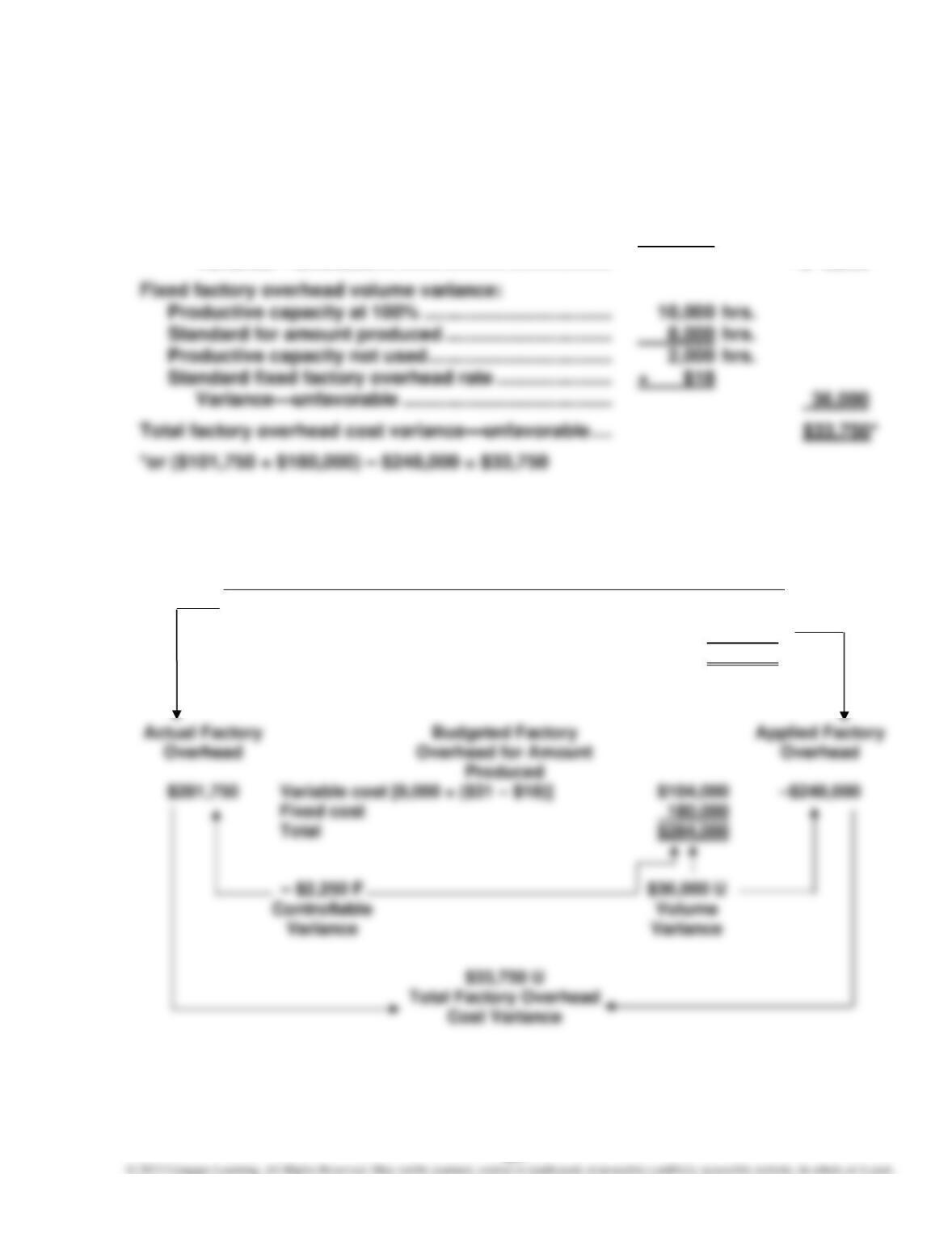
a. and b.
Input
Measure
Output
Measure
Explanation
lose customers.
Dollar amount of returned
X
An important measure of customer satis-
faction with the final product that was or-
dered.
Elapsed time between
customer order and prod–
uct delivery
An important overall measure of process
responsiveness. If the company is too slow
in providing product, we may lose custom-
ers.
Average computer
response time to custom-
X
A measure of the speed of the ordering
process. If the speed is too slow, we may
Maintenance dollars
divided by hardware
investment
X
across time.
Number of customer
complaints divided by the
number of orders
X
An extreme measure of customer dissatis-
faction with the ordering process.
Number of orders per
warehouse employee
This measure is related to the capacity of
the warehouse relative to the demands
placed upon it. This relationship will impact
the delivery cycle time.
A driver of the ordering system’s reliability
and downtime. The maintenance dollars
should be scaled to the amount of hard-
ware in order to facilitate comparison
Number of page faults or
errors due to software
programming errors
X
The page errors will negatively impact the
customer’s ordering experience. It’s a
measure of process output quality.
Number of software fixes
per week
X
Software bugs reduce the effectiveness of
the order fulfillment system; thus, fixes are
an input that will improve the performance
of the order fulfillment system.
Server (computer) down–
time
A measure of computer system reliability.
Training dollars per pro-
grammer
Trained programmers should enhance the
421
Appendix: E13–29
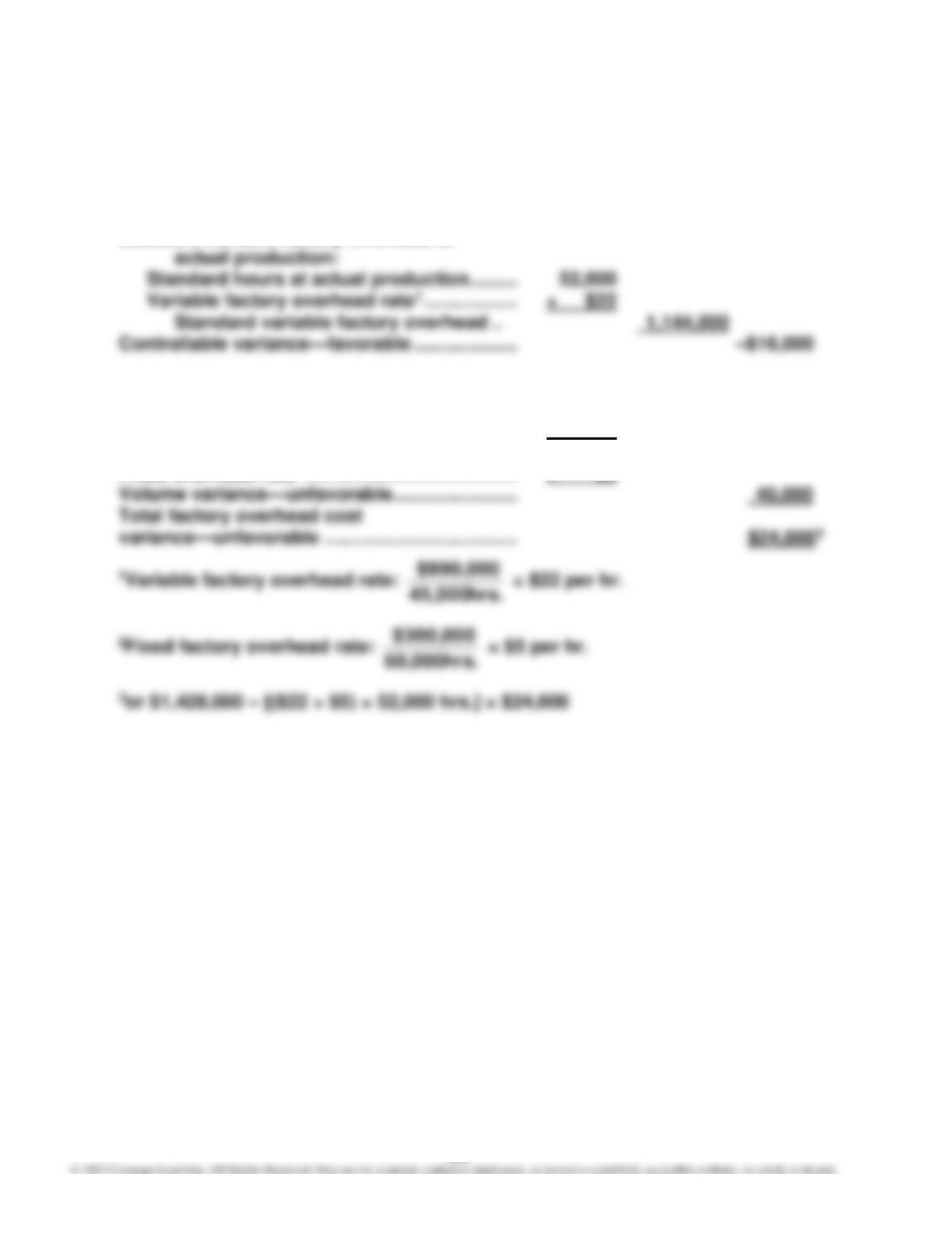
Variable factory overhead controllable variance:
Actual variable factory overhead cost incurred …… $101,750
Budgeted variable factory overhead for 8,000 hrs.
[8,000 × ($31 – $18)] ……………………………………… 104,000
Variance—favorable ……………………………………… –$ 2,250
Alternative Computation of Overhead Variances
Factory Overhead
Actual costs ($101,750 + $180,000)
$281,750
Applied costs (8,000 hrs. × $31)
–248,000
Balance, underapplied factory overhead
$ 33,750
422
Appendix: E13–30
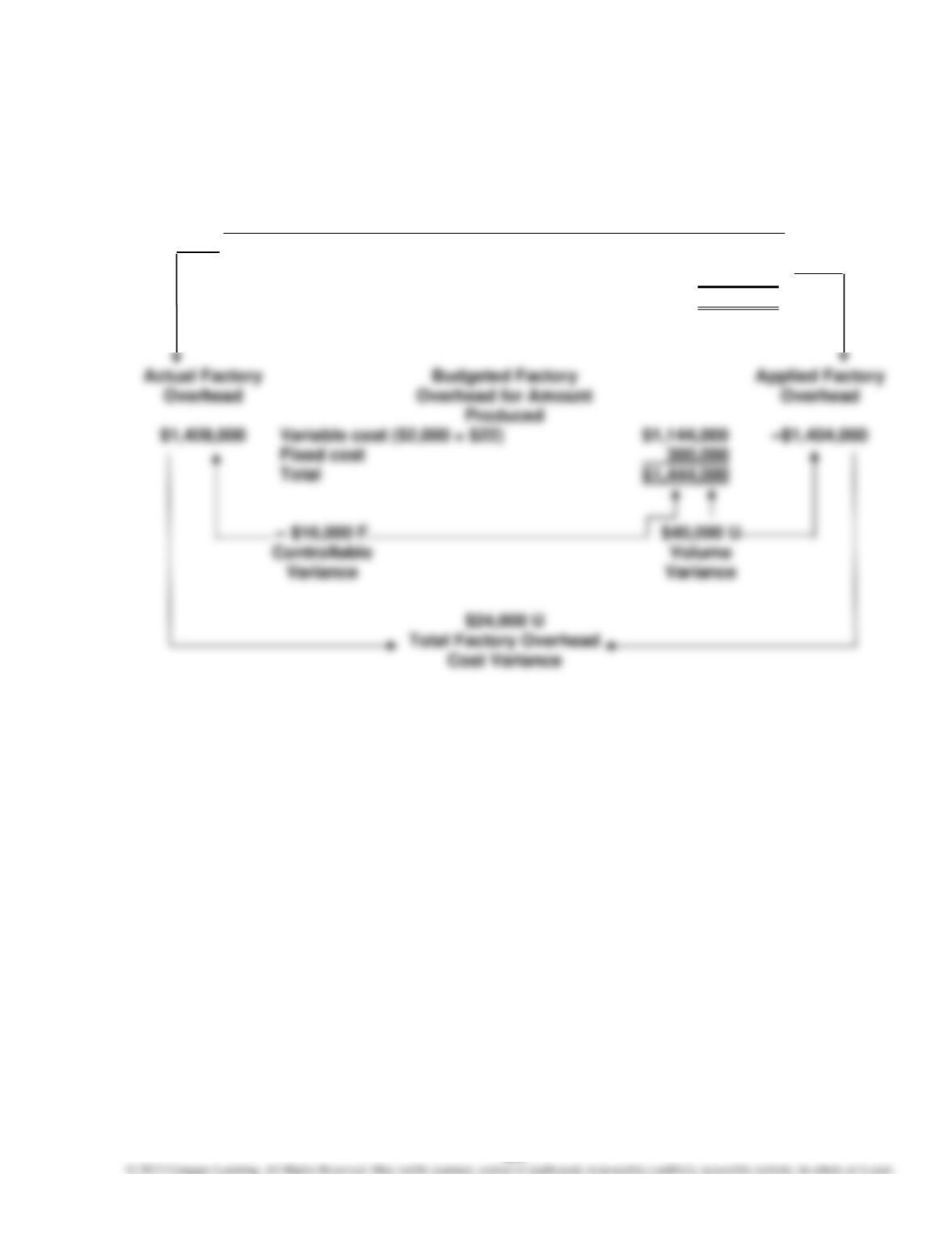
a. Controllable variance:
Actual variable factory overhead
($1,428,000 – $300,000) …………………….. $1,128,000
Standard variable factory overhead at
b. Volume variance:
Volume at 100% of normal capacity ……………. 60,000
Less standard hours ………………………………….. 52,000
Idle capacity ……………………………………………… 8,000
Fixed overhead rate2 ………………………………….. × $5
423
Appendix: E13–30, Concluded
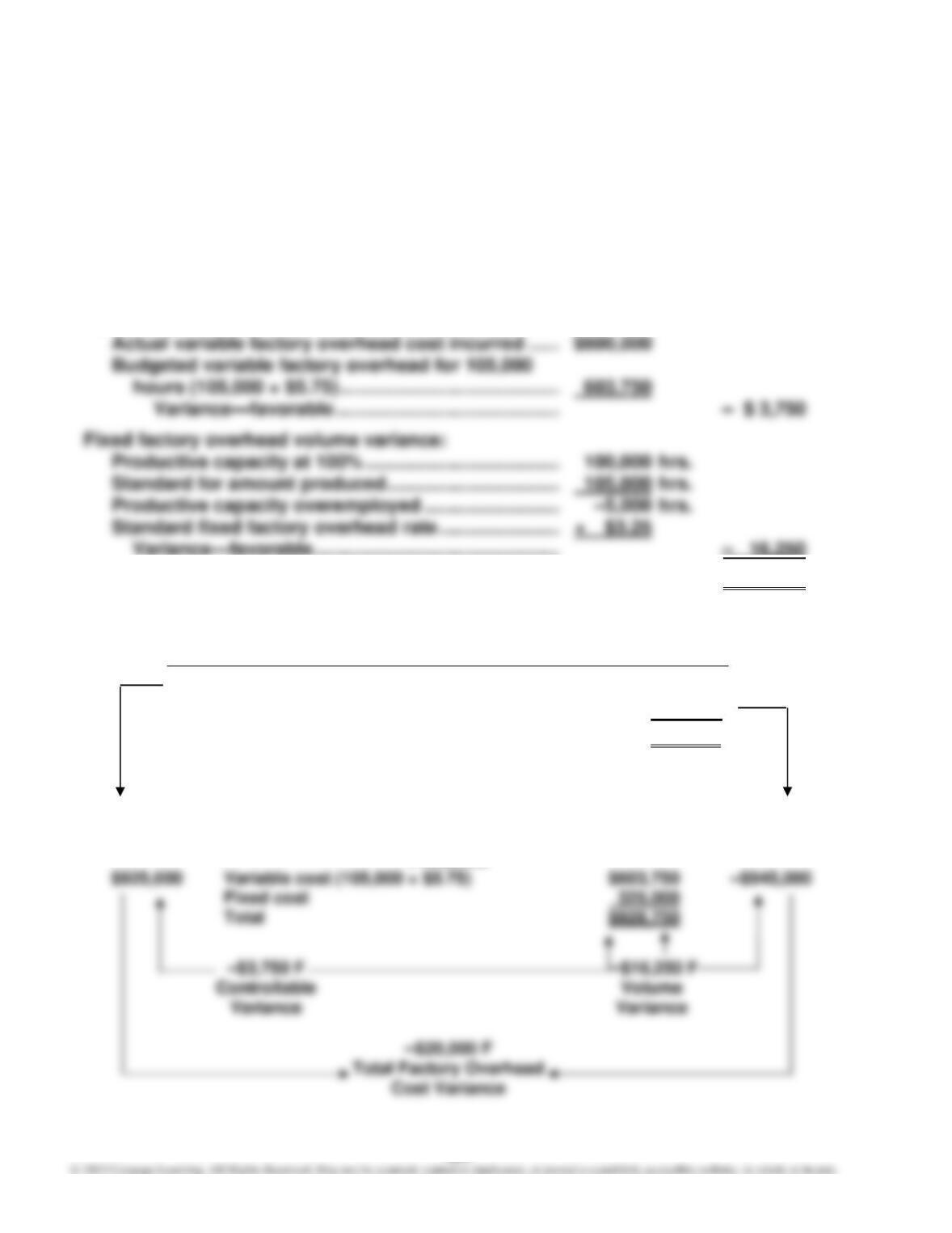
Alternative Computation of Overhead Variances
Factory Overhead
Actual costs
$1,428,000
Applied costs ($27 × 52,000 hrs.)
1,404,000
Balance, underapplied factory overhead
$ 24,000
424
Appendix: E13–31
In determining the volume variance, the productive capacity overemployed (5,000
hours) should be multiplied by the standard fixed factory overhead rate of $3.25
($9.00 – $5.75) to yield a favorable variance of $16,250. The variance analysis pro-
vided by the chief cost accountant incorrectly multiplied the 5,000 hours by the
total factory overhead rate of $9.00 per hour and reported it as unfavorable.
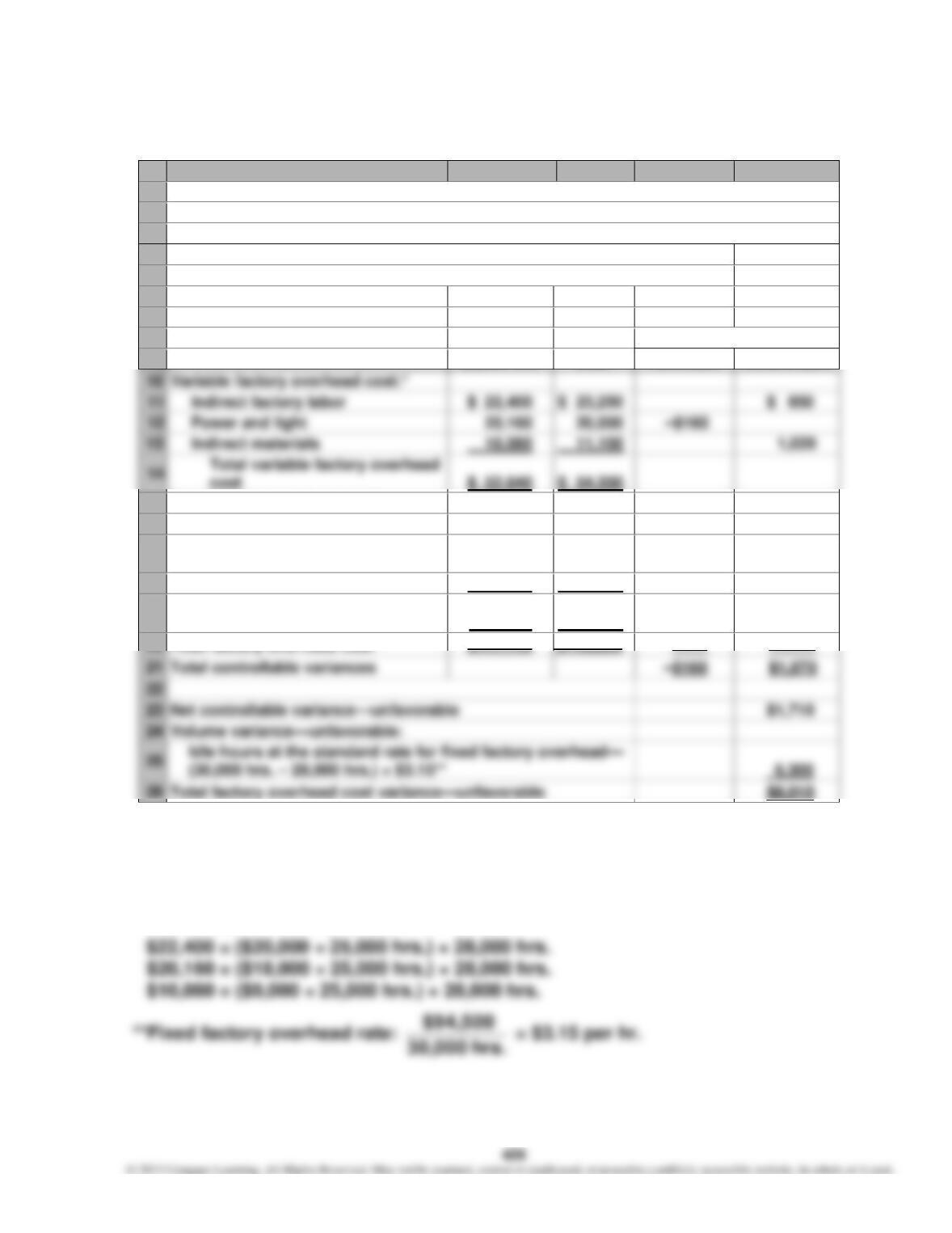
A correct determination of the factory overhead cost variances is as follows:
Variable factory overhead controllable variance:
Total factory overhead cost variance—favorable ……… – $20,000
Alternative Computation of Overhead Variances
Factory Overhead
Actual costs ($600,000 + $325,000)
$925,000
Applied costs (105,000 hrs. × $9.00)
–945,000
Balance, overapplied factory overhead
–$ 20,000
Actual Factory Budgeted Factory Applied Factory
Overhead Overhead for Amount Overhead
Produced
Appendix: E13–32
A
B
C
D
E
1
TOPEKA PLASTICS INC.
2
Factory Overhead Cost Variance Report—Trim Department
3
For the Month Ended July 31
4
Productive capacity for the month
30,000 hrs.
5
Actual productive capacity used for the month
28,000 hrs.
6
Budget
7
at actual
8
production of
Actual
Variances
9
28,000 hrs.
Cost
Favorable
Unfavorable
10
Variable factory overhead cost:*
$ 22,400
$ 850
20,160
13
Indirect materials
10,080
11,100
Total variable factory overhead
$ 52,640
$ 54,350
15
Fixed factory overhead cost:
16
Supervisory salaries
$ 50,000
$ 50,000
17
Depreciation of plant and
equipment
33,100
33,100
18
Insurance and property taxes
11,400
11,400
19
Total fixed factory overhead
cost
$ 94,500
$ 94,500
20
Total factory overhead cost
$147,140
$148,850
22
23
Net controllable variance—unfavorable
$1,710
24
Volume variance—unfavorable:
25
Idle hours at the standard rate for fixed factory overhead—
6,300
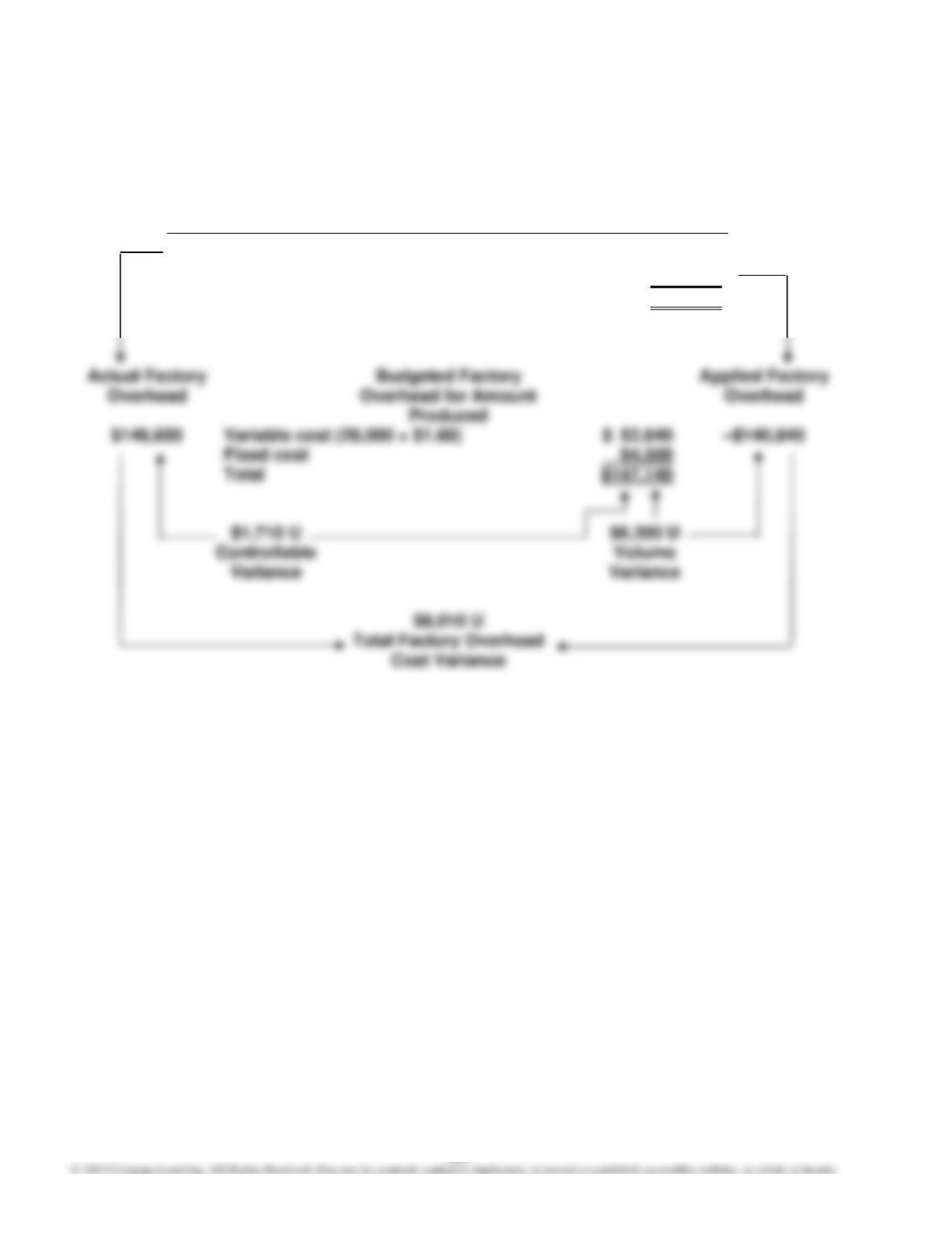
*The budgeted variable factory overhead costs are determined by multiplying
28,000 hours by the variable factory overhead cost rate for each variable cost
category. These rates are determined by dividing each budgeted amount (esti-
mated at the beginning of the month) by the planned (budgeted) volume of
25,000 hours as shown below.
426
Appendix: E13–32, Concluded
Alternative Computation of Overhead Variances
Factory Overhead
Actual costs
$148,850
Applied costs [28,000 × ($1.88* + $3.15)]
140,840
Balance, underapplied factory overhead
$ 8,010
*$47,000 ÷ 25,000 hours budgeted at the beginning of the month
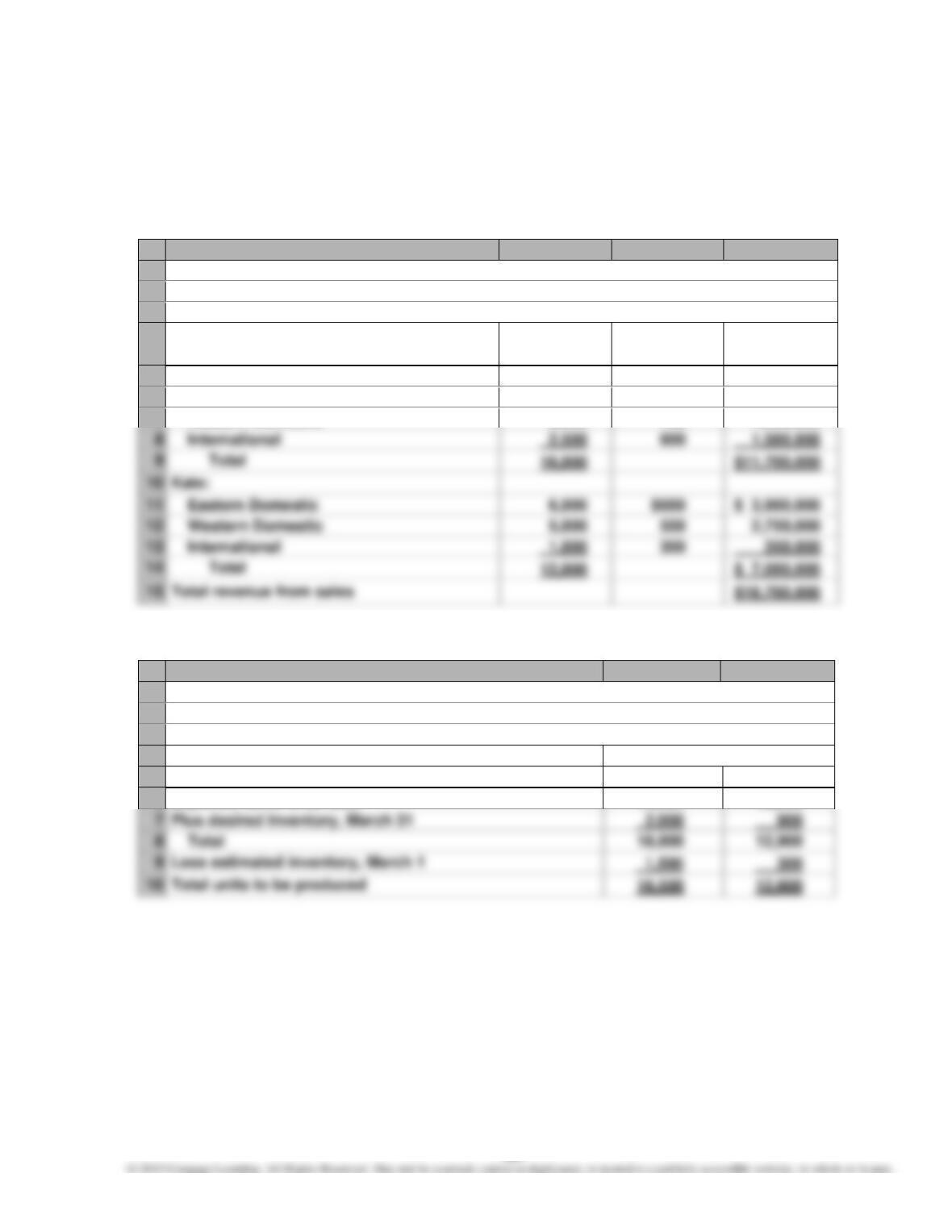
427
PROBLEMS
P13–1
1.
A
B
C
D
1
ROYAL BRITISH FURNITURE COMPANY
2
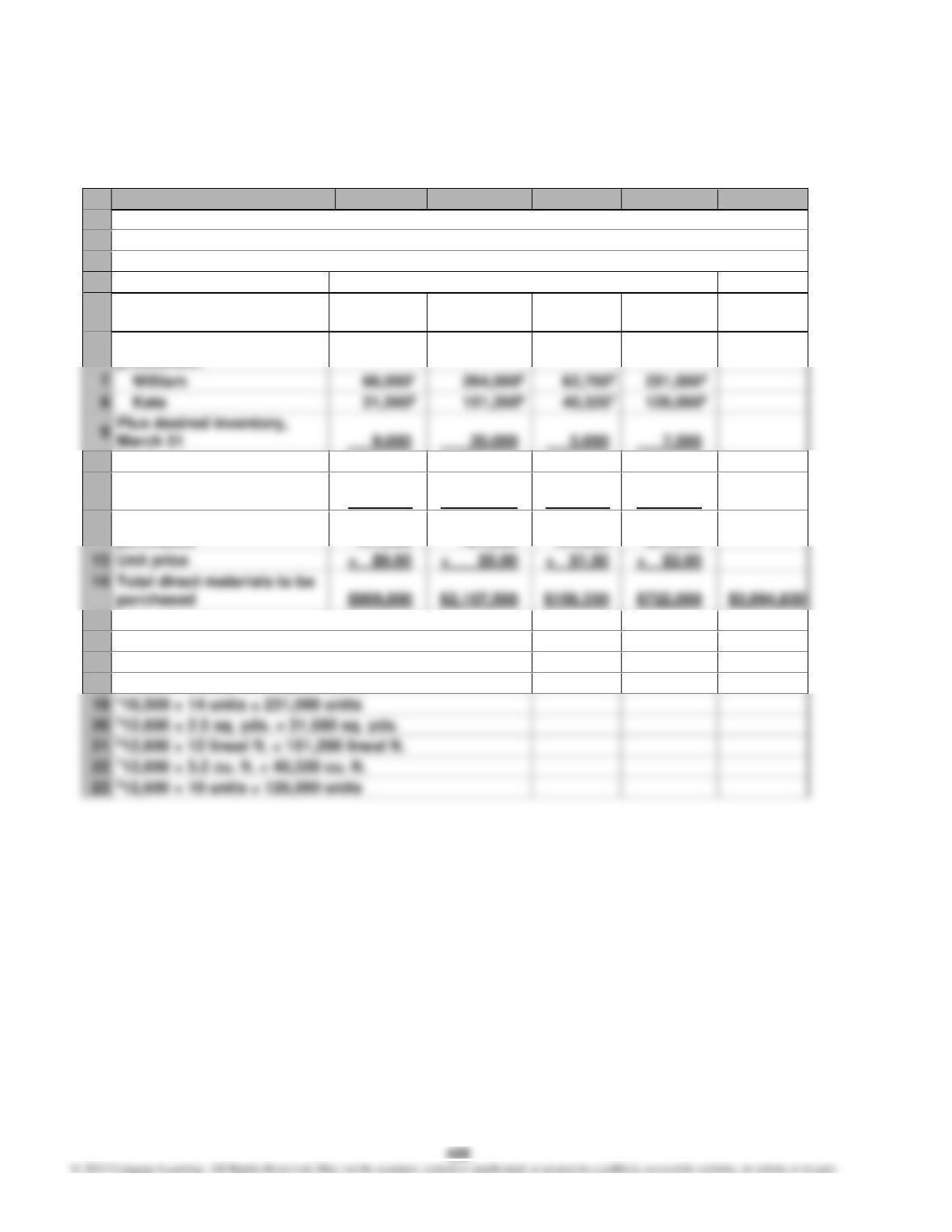
Sales Budget
3
For the Month Ending March 31
Unit Sales
Unit Selling
4
Product and Area
Volume
Price
Total Sales
5
William:
6
Eastern Domestic
7,500
$800
$ 6,000,000
7
Western Domestic
6,000
700
4,200,000
8
International
600
Eastern Domestic
$650
$ 3,900,000
Western Domestic
5,000
550
International
350
$ 7,000,000
2.
A
B
C
1
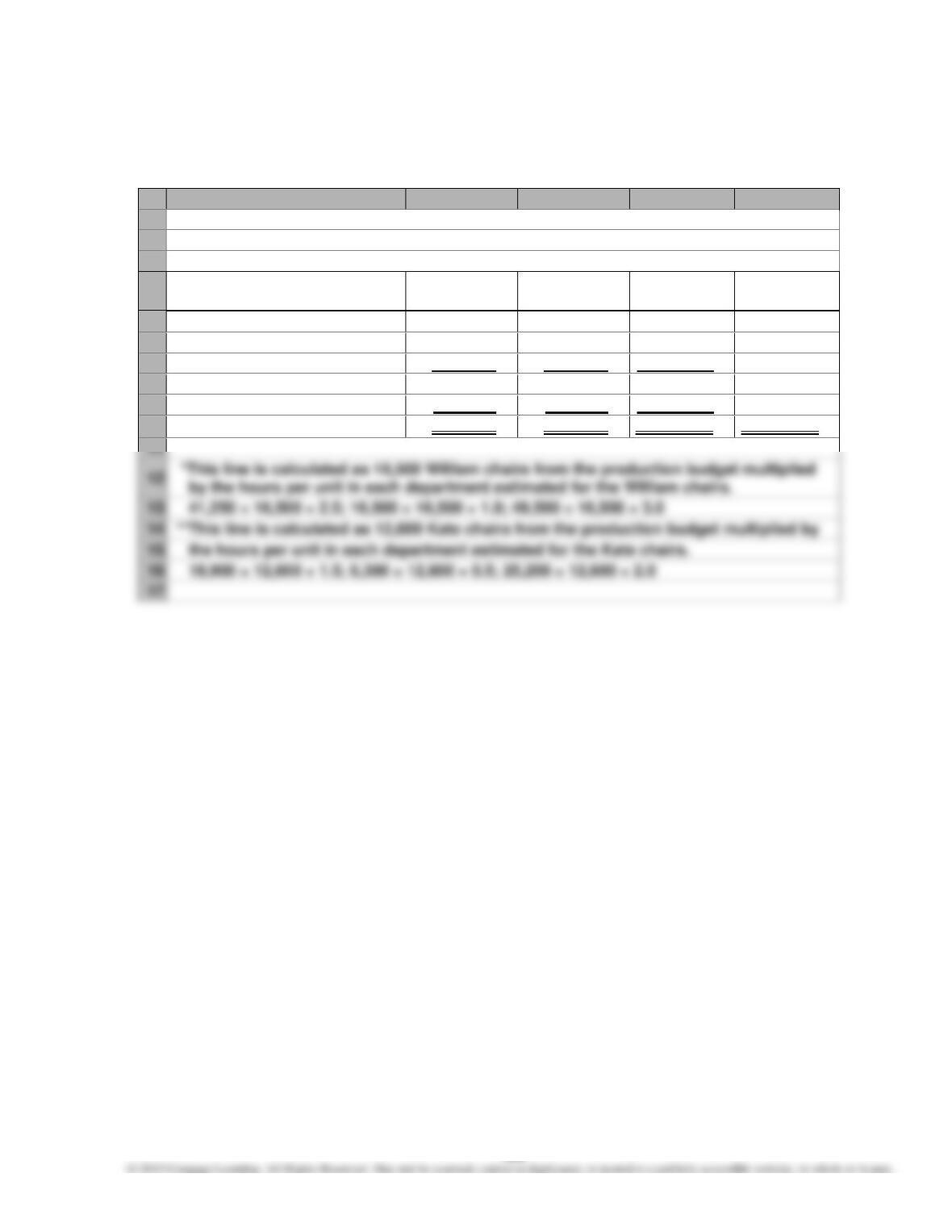
ROYAL BRITISH FURNITURE COMPANY
2
Production Budget
3
For the Month Ending March 31
4
Units
5
William
Kate
6
Expected units to be sold
16,000
12,000
7
Plus desired inventory, March 31
8
Total
18,000
P13–1, Continued
3.
A
B
C
D
E
F
1
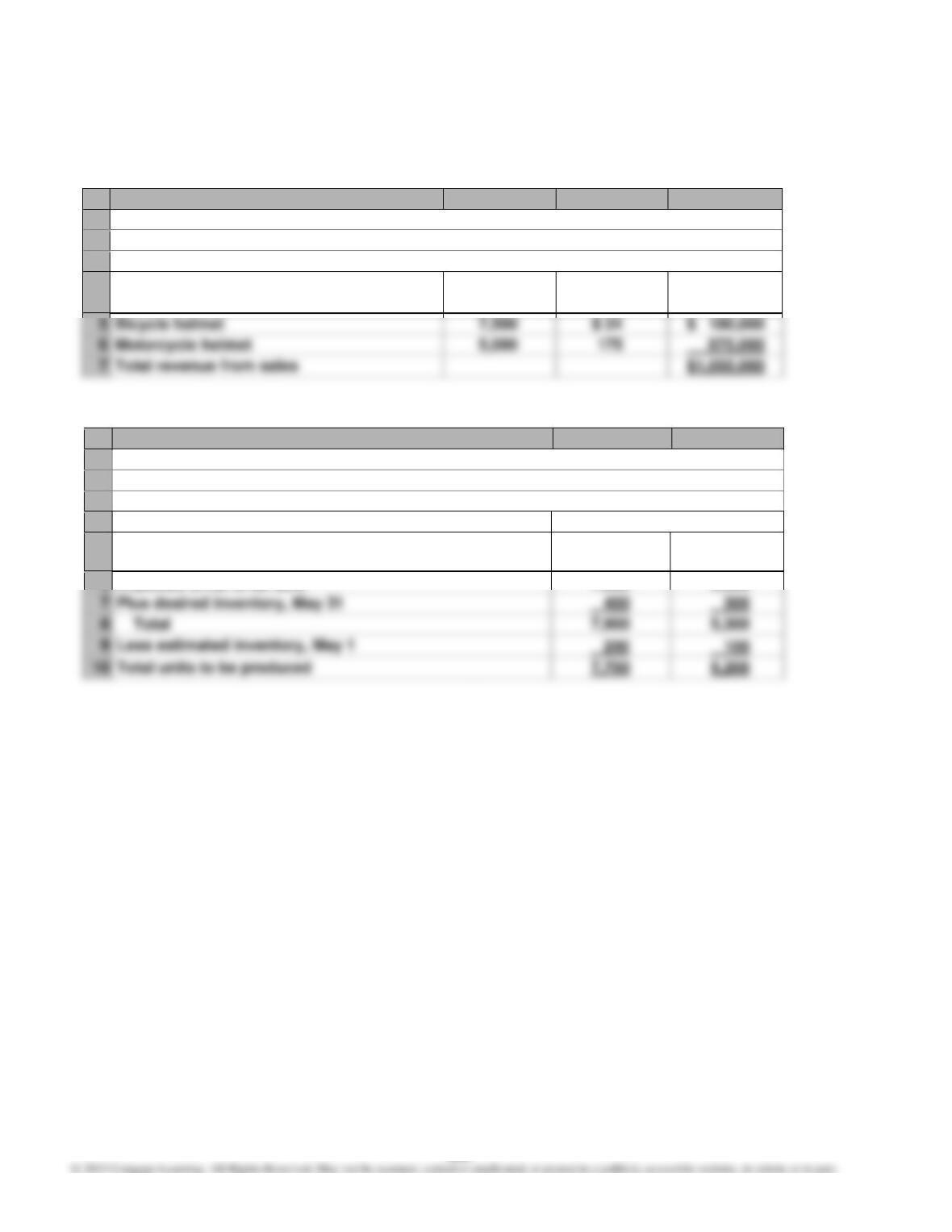
ROYAL BRITISH FURNITURE COMPANY
2
Direct Materials Purchases Budget
3
For the Month Ending March 31
4
Direct Materials
5
Fabric
(sq. yds.)
Wood
(lineal ft.)
Filler
(cu. ft.)
Springs
(units)
Total
6
Required units for
production:
William
66,0001
264,0002
62,7003
231,0004
Kate
31,5005
151,2006
40,3207
126,0008
Plus desired inventory,
March 31
9,000
20,000
5,000
10
Total
106,500
435,200
108,020
364,500
11
Less estimated inventory,
March 1
5,500
13,700
3,800
3,500
12
Total units to be
purchased
101,000
421,500
104,220
361,000
13
Unit price
× $9.00
× $5.00
× $1.50
× $2.00
15
16
116,500 × 4.0 yds. = 66,000 sq. yds.
17
216,500 × 16 lineal ft. = 264,000 lineal ft.
18
316,500 × 3.8 cu. ft. = 62,700 cu. ft.
19
416,500 × 14 units = 231,000 units
20
512,600 × 2.5 sq. yds. = 31,500 sq. yds.
21
612,600 × 12 lineal ft. = 151,200 lineal ft.
22
712,600 × 3.2 cu. ft. = 40,320 cu. ft.
23
812,600 × 10 units = 126,000 units
429
P13–1, Concluded
4.
A
B
C
D
E
1
ROYAL BRITISH FURNITURE COMPANY
2
Direct Labor Cost Budget
3
For the Month Ending March 31
4
Framing
Department
Cutting
Department
Upholstery
Department
Total
5
Hours required for production:
6
William*
41,250
16,500
49,500
7
Kate**
18,900
6,300
25,200
8
Total
60,150
22,800
74,700
9
Hourly rate
× $15.00
× $12.00
× $16.00
10
Total direct labor cost
$902,250
$273,600
$1,195,200
$2,371,050
41,250 = 16,500 × 2.5; 16,500 = 16,500 × 1.0; 49,500 = 16,500 × 3.0
the hours per unit in each department estimated for the Kate chairs.
18,900 = 12,600 × 1.5; 6,300 = 12,600 × 0.5; 25,200 = 12,600 × 2.0
430
P13–2
1.
A
B
C
D
1
JUPITER HELMETS INC.
2
Sales Budget
3
For the Month Ending May 31
4
Unit Sales
Unit Selling
Volume
Price
Total Sales
5
Bicycle helmet
6
Motorcycle helmet
2.
A
B
C
1
JUPITER HELMETS INC.
2
Production Budget
3
For the Month Ending May 31
4
Units
5
Bicycle
Helmet
Motorcycle
Helmet
6
Expected units to be sold
7,500
5,000
7
Plus desired inventory, May 31
8
Total
431
P13–2, Continued
3.
A
B
C
D
1
JUPITER HELMETS INC.
2
Direct Materials Purchases Budget
3
For the Month Ending May 31
4
Plastic
Foam Lining
Total
5
Units required for production:
6
Bicycle helmet
6,9301
1,5402
7
Motorcycle helmet
18,2003
7,2804
8
Plus desired units of inventory,
May 31
2,000
800
9
Total
27,130
9,620
Total units to be purchased
9,100
Unit price
× $4.40
× $0.90
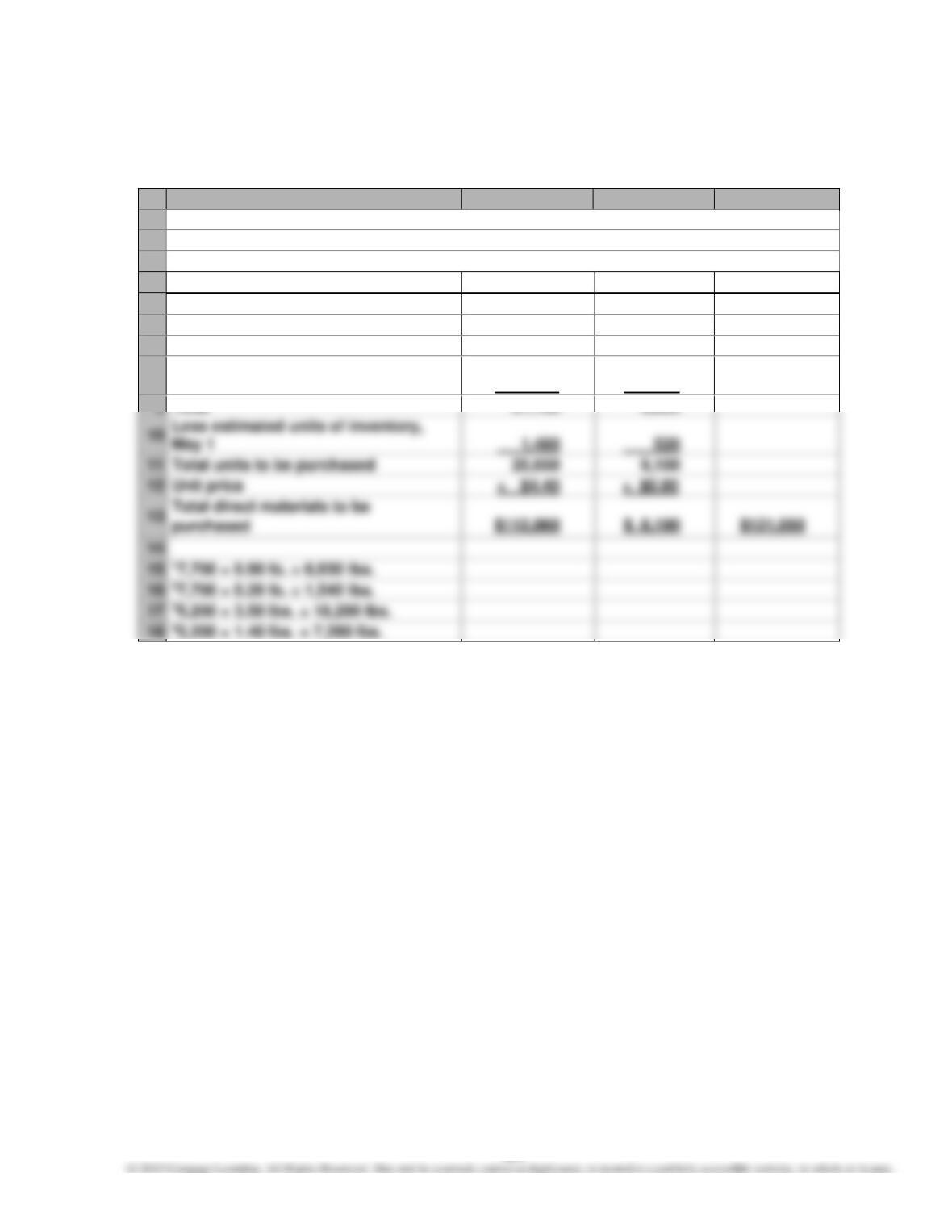
17,700 × 0.90 lb. = 6,930 lbs.
27,700 × 0.20 lb. = 1,540 lbs.
35,200 × 3.50 lbs. = 18,200 lbs.
45,200 × 1.40 lbs. = 7,280 lbs.
432
P13–2, Continued
4.
A
B
C
D
1
JUPITER HELMETS INC.
2
Direct Labor Cost Budget
3
For the Month Ending May 31
4
Molding
Department
Assembly
Department
Total
5
Hours required for production:
6
Bicycle helmet
2,3101
7702
7
Motorcycle helmet
2,6003
2,0804
8
Total
4,910
2,850
9
Hourly rate
× $15
× $14
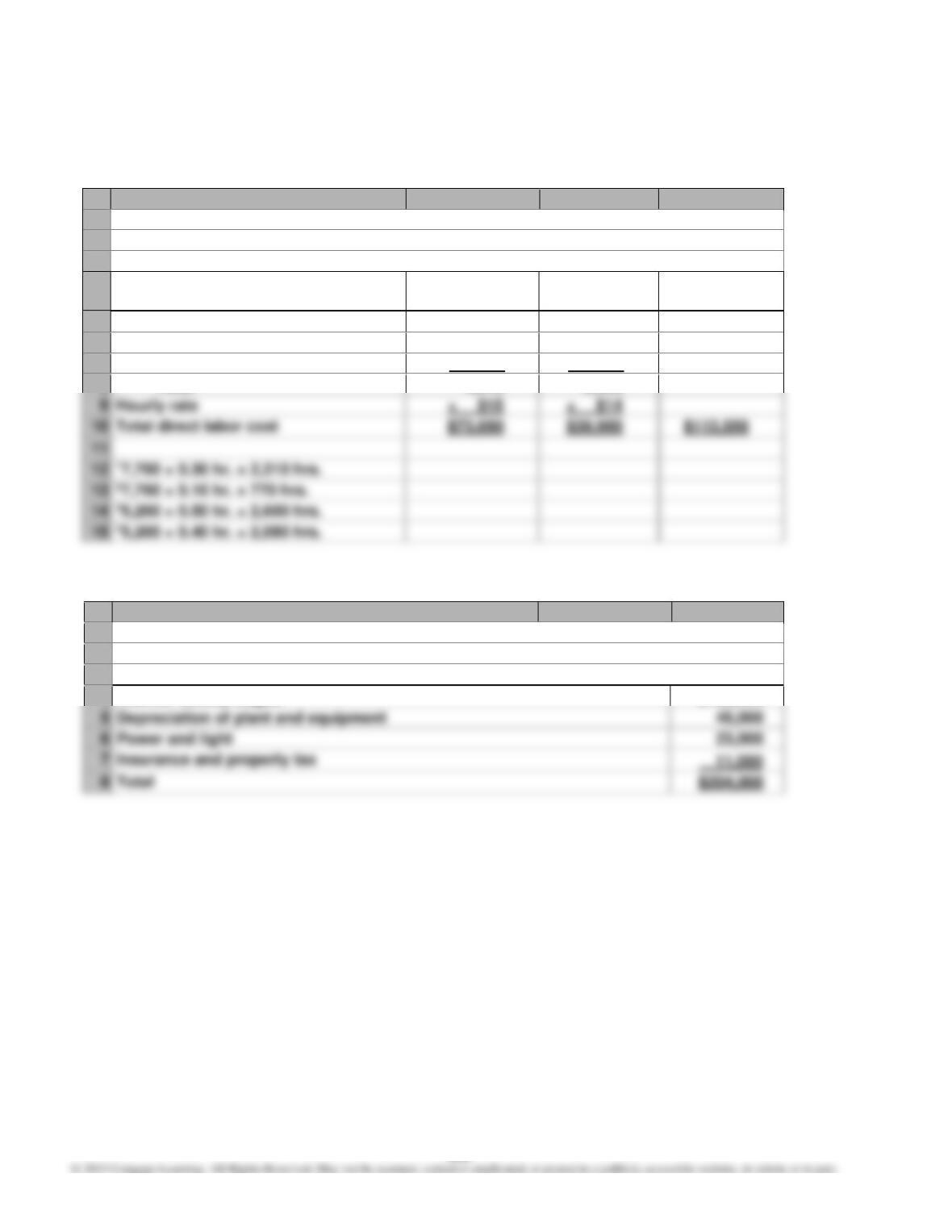
17,700 × 0.30 hr. = 2,310 hrs.
27,700 × 0.10 hr. = 770 hrs.
35,200 × 0.50 hr. = 2,600 hrs.
45,200 × 0.40 hr. = 2,080 hrs.
5.
A
B
C
1
JUPITER HELMETS INC.
2
Factory Overhead Cost Budget
3
For the Month Ending May 31
4
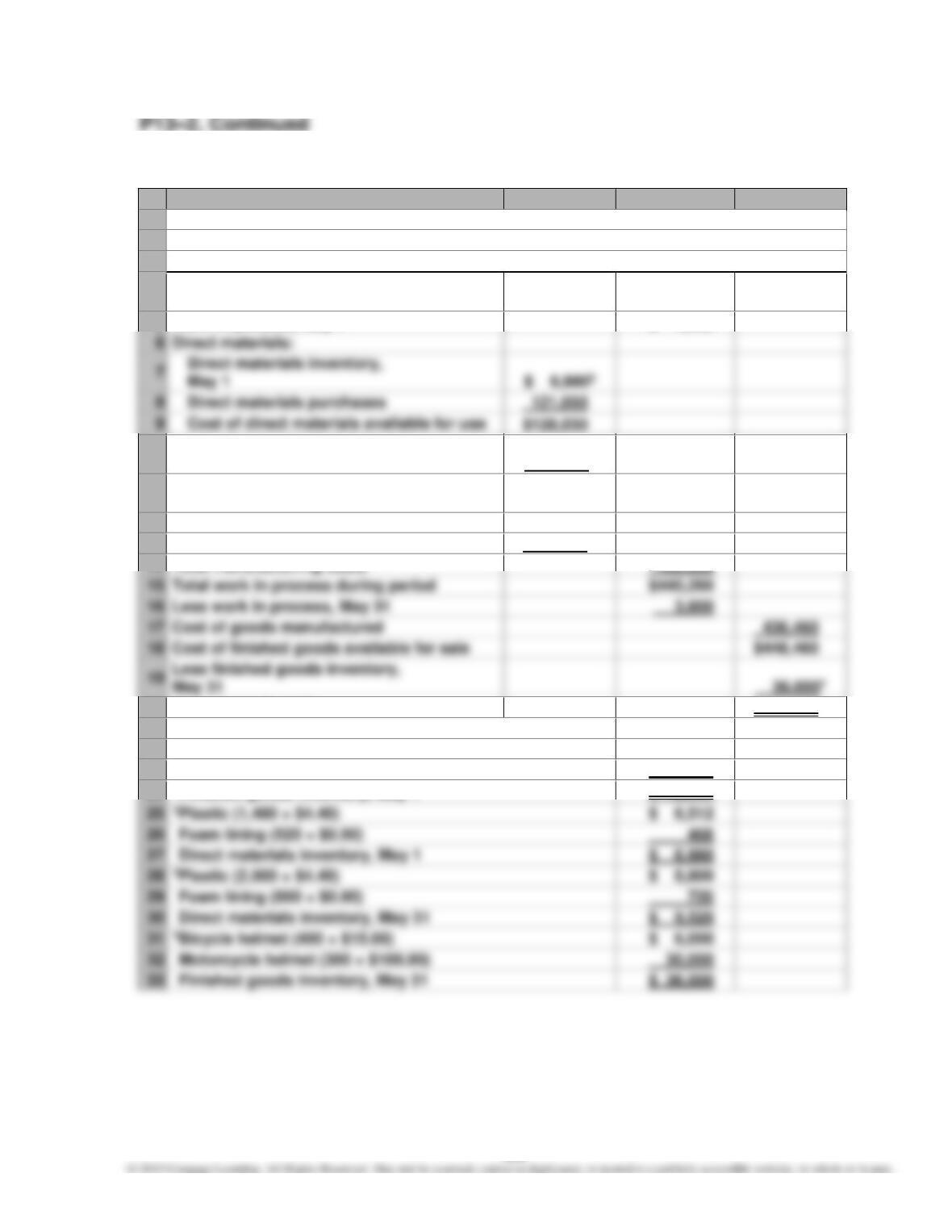
Indirect factory wages
$125,000
5
Depreciation of plant and equipment
6
Power and light
433
6.
A
B
C
D
1
JUPITER HELMETS INC.
2
Cost of Goods Sold Budget
3
For the Month Ending May 31
4
Finished goods inventory,
May 1
$ 12,0001
5
Work in process, May 1
$ 4,200
6
7
Direct materials inventory,
May 1
$ 6,9802
8
Direct materials purchases
121,050
Cost of direct materials available for use
$128,030
10
Less direct materials inventory,
May 31
9,5203
11
Cost of direct materials placed in
production
$118,510
12
Direct labor
113,550
13
Factory overhead
204,000
14
Total manufacturing costs
436,060
15
Total work in process during period
$440,260
16
Less work in process, May 31
17
Cost of goods manufactured
436,460
18
Cost of finished goods available for sale
$448,460
19
Less finished goods inventory,
20
Cost of goods sold
$412,460
21
22
1Bicycle helmet (200 × $15.00)
$ 3,000
23
Motorcycle helmet (100 × $90.00)
9,000
24
Finished goods inventory, May 1
$ 12,000
25
2Plastic (1,480 × $4.40)
$ 6,512
26
Foam lining (520 × $0.90)
468
27
Direct materials inventory, May 1
$ 6,980
28
3Plastic (2,000 × $4.40)
$ 8,800
29
Foam lining (800 × $0.90)
720
30
Direct materials inventory, May 31
$ 9,520
31
4Bicycle helmet (400 × $15.00)
$ 6,000
32
Motorcycle helmet (300 × $100.00)
30,000
33
Finished goods inventory, May 31
$ 36,000