Exercise 13A-5 (30 minutes)
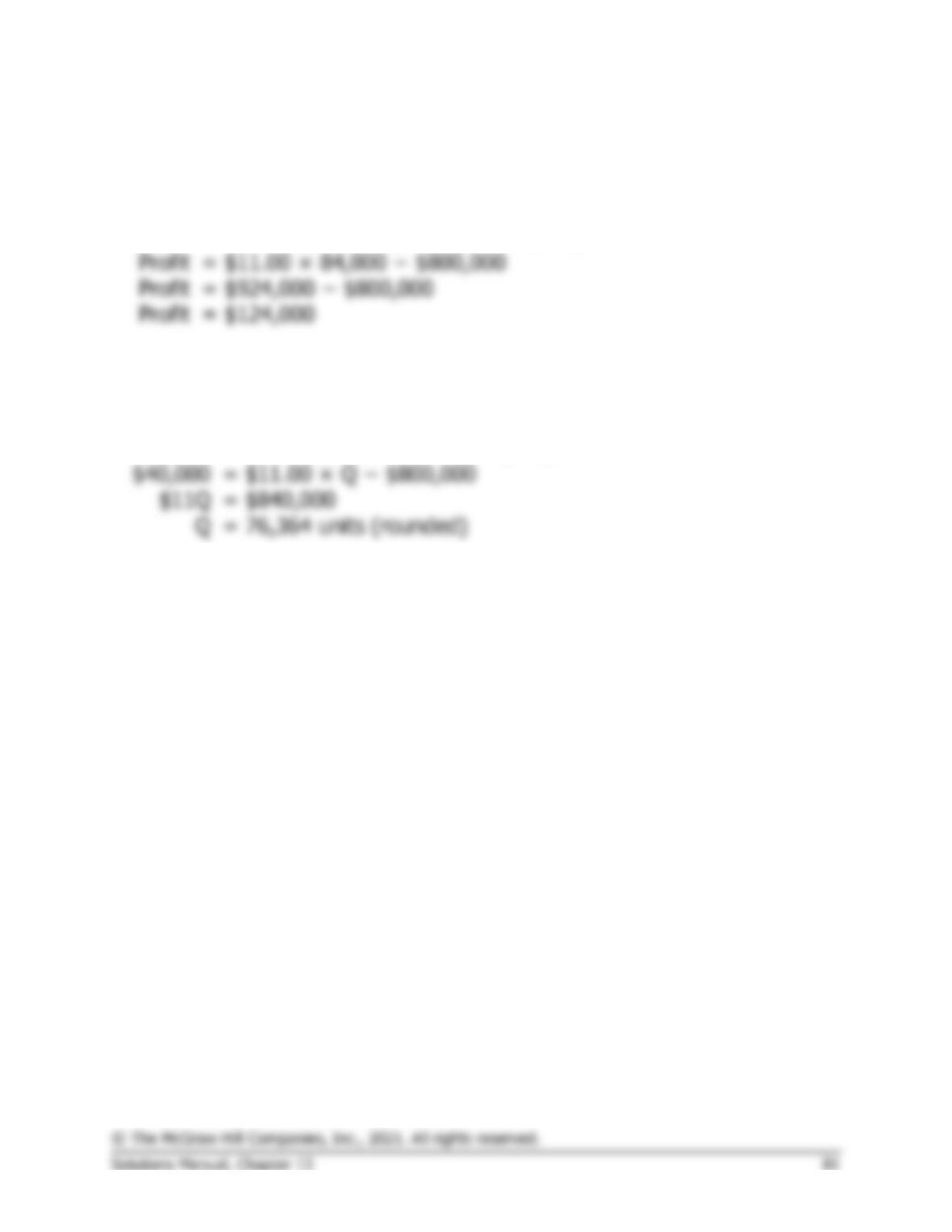
1. The profit at a price of $24.00 is computed as follows:
Profit
= (P – V) × Q − Fixed expenses
Profit
= ($24.00 − $13.00) × 84,000 − $800,000
= $11.00 × 84,000 − $800,000
= $924,000 − $800,000
= $124,000
2. Northport would need to sell 76,364 units computed as follows:
Profit
= (P – V) × Q − Fixed expenses
$40,000
= ($24.00 − $13.00) × Q − $800,000
$40,000
= $11.00 × Q − $800,000
= 76,364 units (rounded)
3. The percentage decrease is computed as follows:
(120,000 units – 76,364 units) ÷ 120,000 units = 36.4% (rounded)
Exercise 13A-5 (continued)
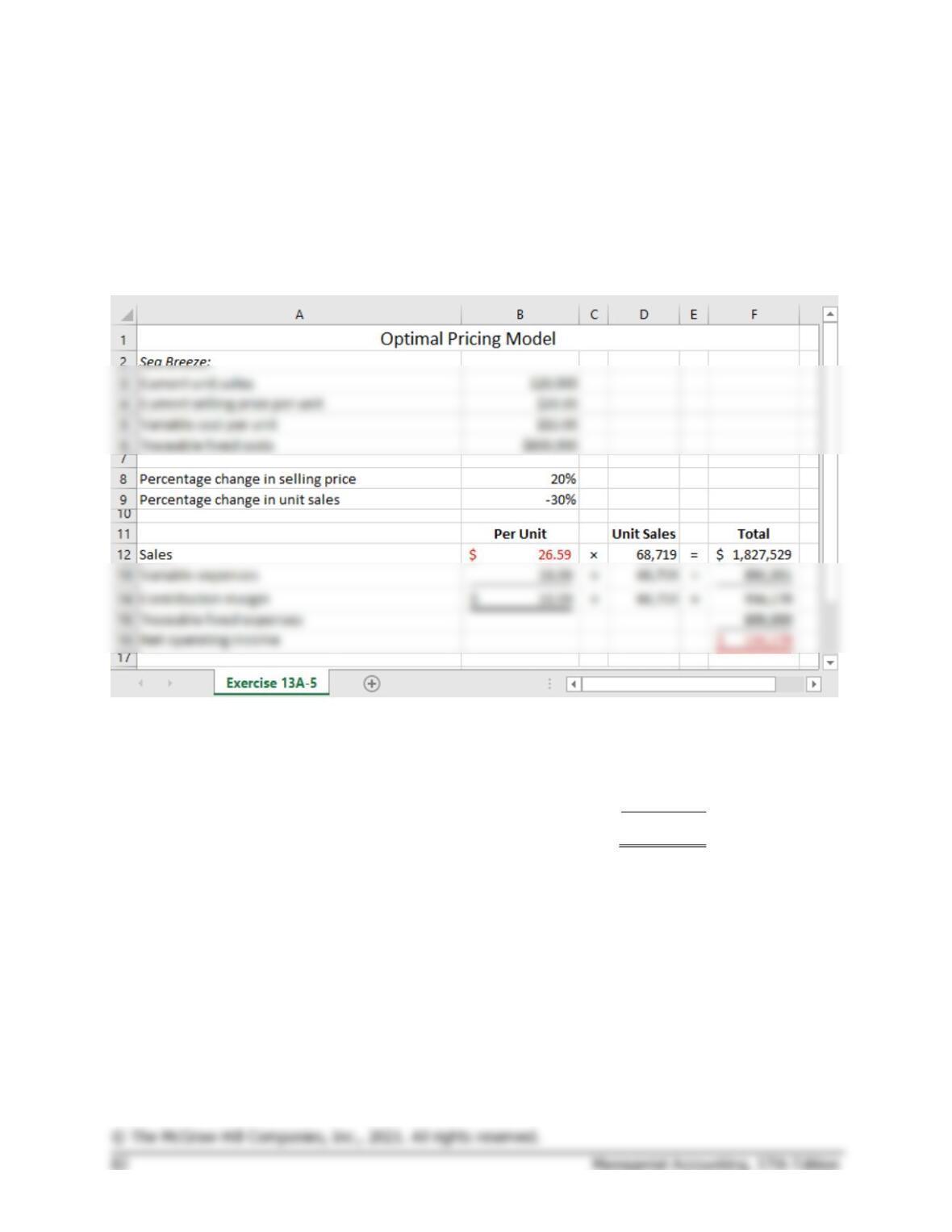
4a and 4b.
The optimal selling price ($26.59) and the optimal profit ($134,178) are as
shown below:
4c. The additional profit is computed as follows:
Net operating income at a price of $26.59 …….
$134,178
Net operating income at a price of $24.00 …….
124,000
Increase in net operating income ………………..
$ 10,178
Exercise 13A-5 (continued)
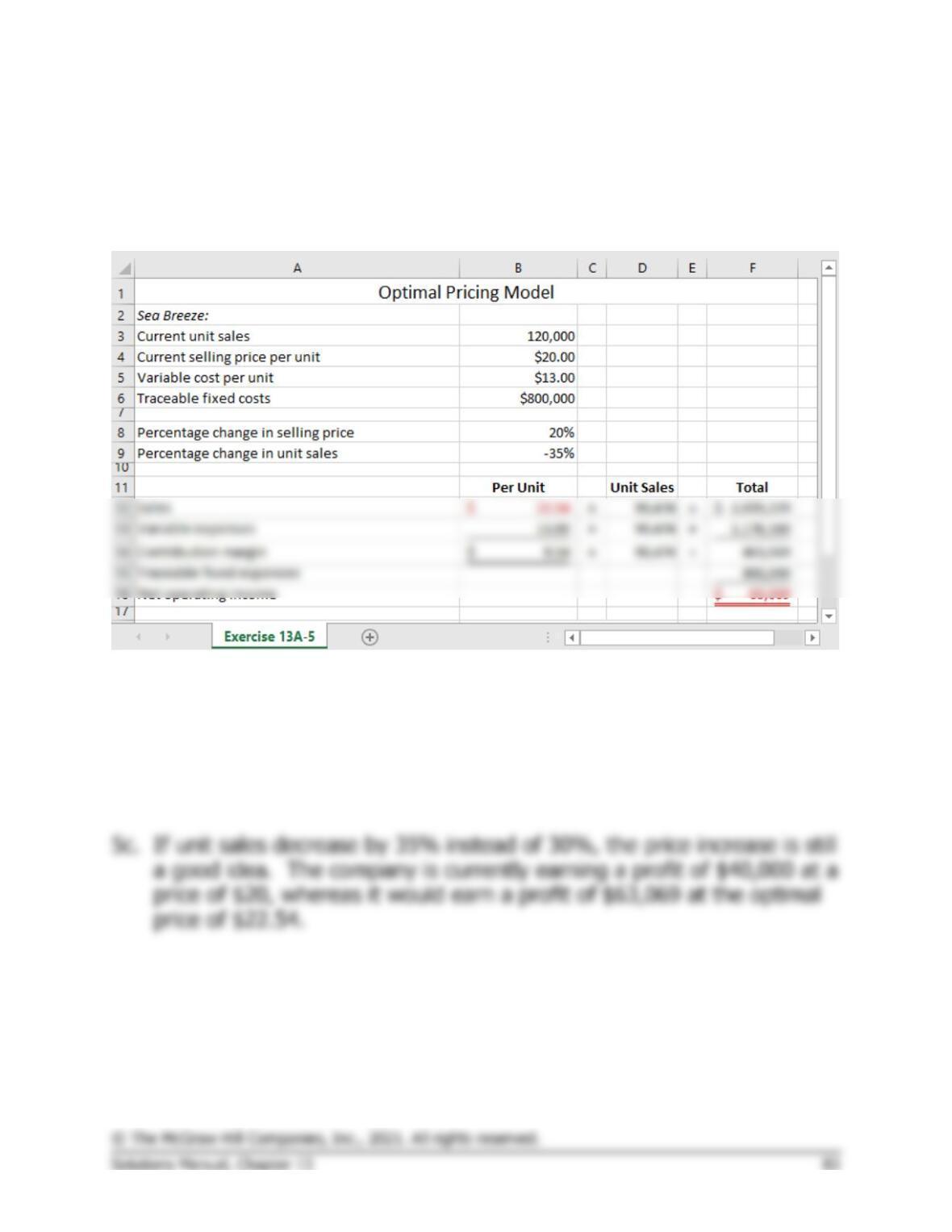
5a. The optimal selling price ($22.54) and optimal profit ($63,069) are as
shown below:
5b. The optimal price in requirement 5a is lower than the price in
requirement 4a because the customers are more sensitive to the price
increase (35% vs. 30%). Generally speaking, when customers are
more sensitive to price increases (i.e. demand is elastic) it leads to
lower prices.
Exercise 13A-6 (30 minutes)
1. The absorption cost-plus price of $15,540 is computed as follows:
Unit product cost……………
$ 8,400
Markup (85% × $8,400) ….
7,140
Selling price per unit ………
$15,540
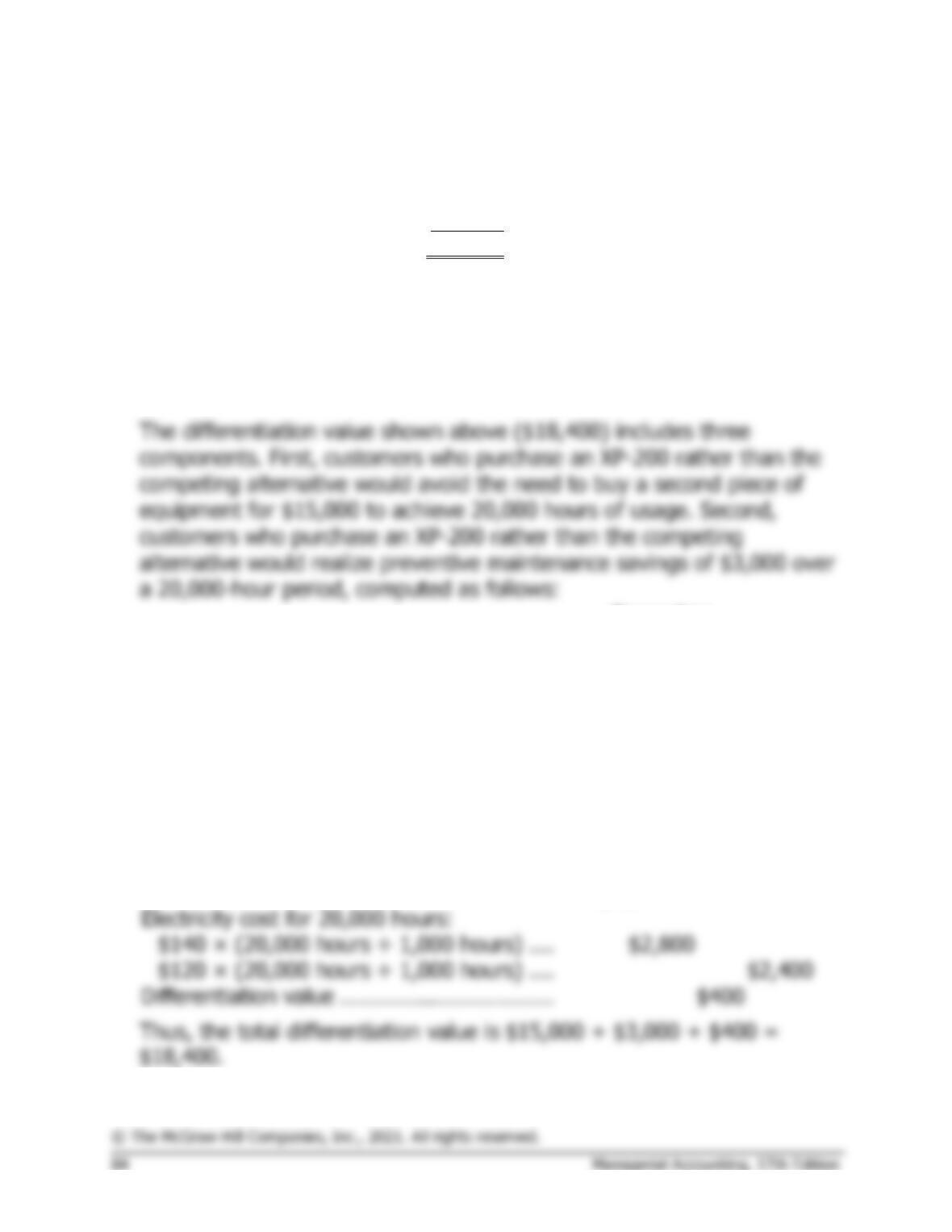
2. The economic value to the customer (EVC) is computed as follows:
EVC = Reference value + Differentiation value
EVC = $15,000 + $18,400
EVC = $33,400
Competing
Equipment
XP–200
Preventive maintenance cost for 20,000 hours:
$2,000 × (20,000 hours ÷ 10,000 hours) ……
$4,000
$1,000 × (20,000 hours ÷ 20,000 hours) ……
$1,000
Differentiation value …………………………………
$3,000
Third, customers who purchase an XP-200 rather than the competing
alternative would realize electricity savings of $400 over a 20,000-hour
period, computed as follows:
Competing
Equipment
XP–200
Electricity cost for 20,000 hours:
Differentiation value …………………………...
Exercise 13A-6 (continued)
3. The range of possible prices is as follows:
Reference value ≤ Value–based price ≤ EVC
$15,000 ≤ Value–based price ≤ $33,400
4. The absorption approach to cost-plus pricing ignores the value that XP-200
offers customers relative to the best available alternative. It is quite possible
Exercise 13A-7 (30 minutes)
1. The postal service’s contribution margin (CM) at a price of $8.00 is
computed as follows:
CM
= (P – V) × Q
CM
= ($8.00 − $0.80) × 80,000
CM
= $7.20 × 80,000
CM
= $576,000
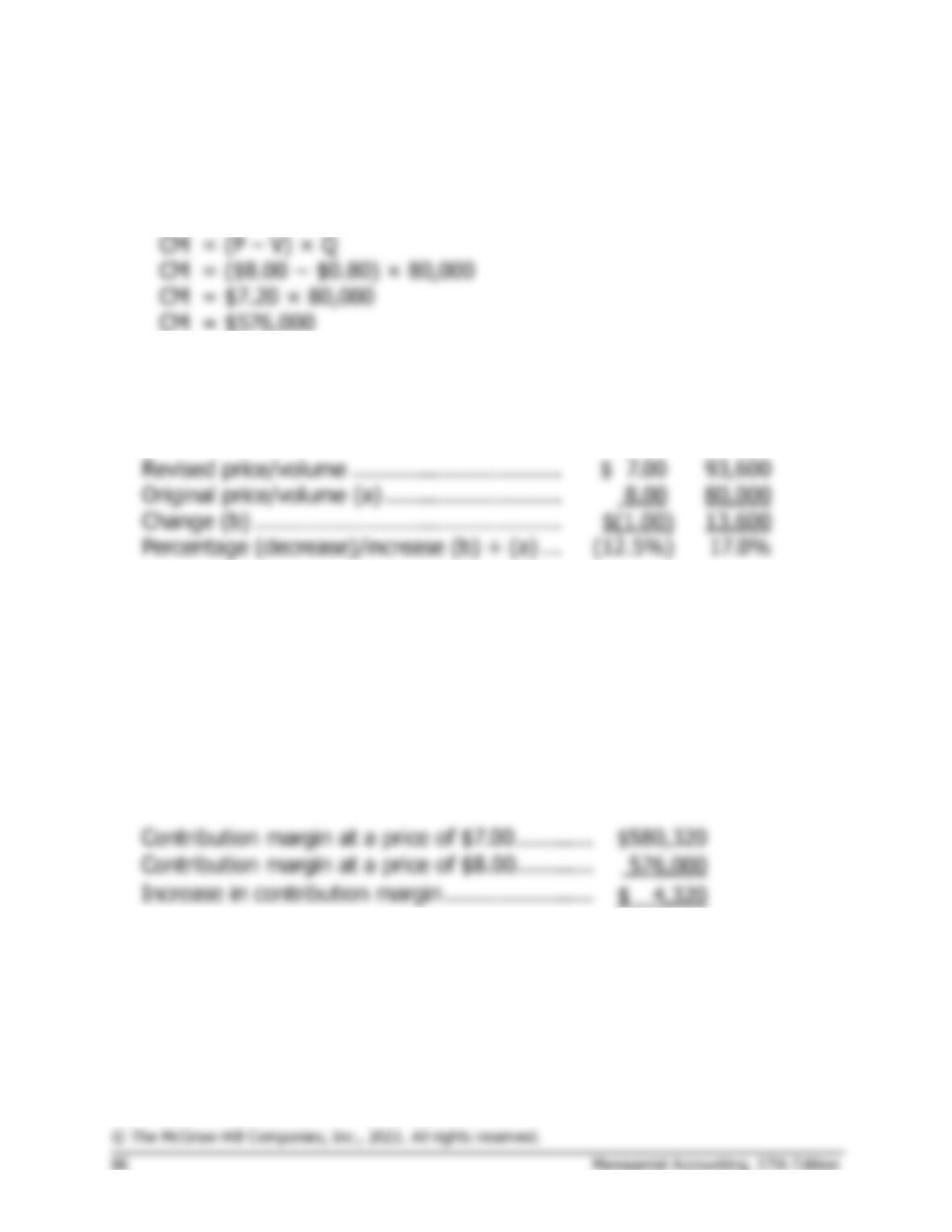
2. The percentage decrease in the selling price and the percentage
increase in unit sales are computed as follows:
Price
Volume
Change (b) ………………………………………..
Percentage (decrease)/increase (b) ÷ (a) …
3. The postal service’s contribution margin at a price of $7.00 is computed
as follows:
CM
= (P – V) × Q
CM
= ($7.00 − $0.80) × 93,600
CM
= $6.20 × 93,600
CM
= $580,320
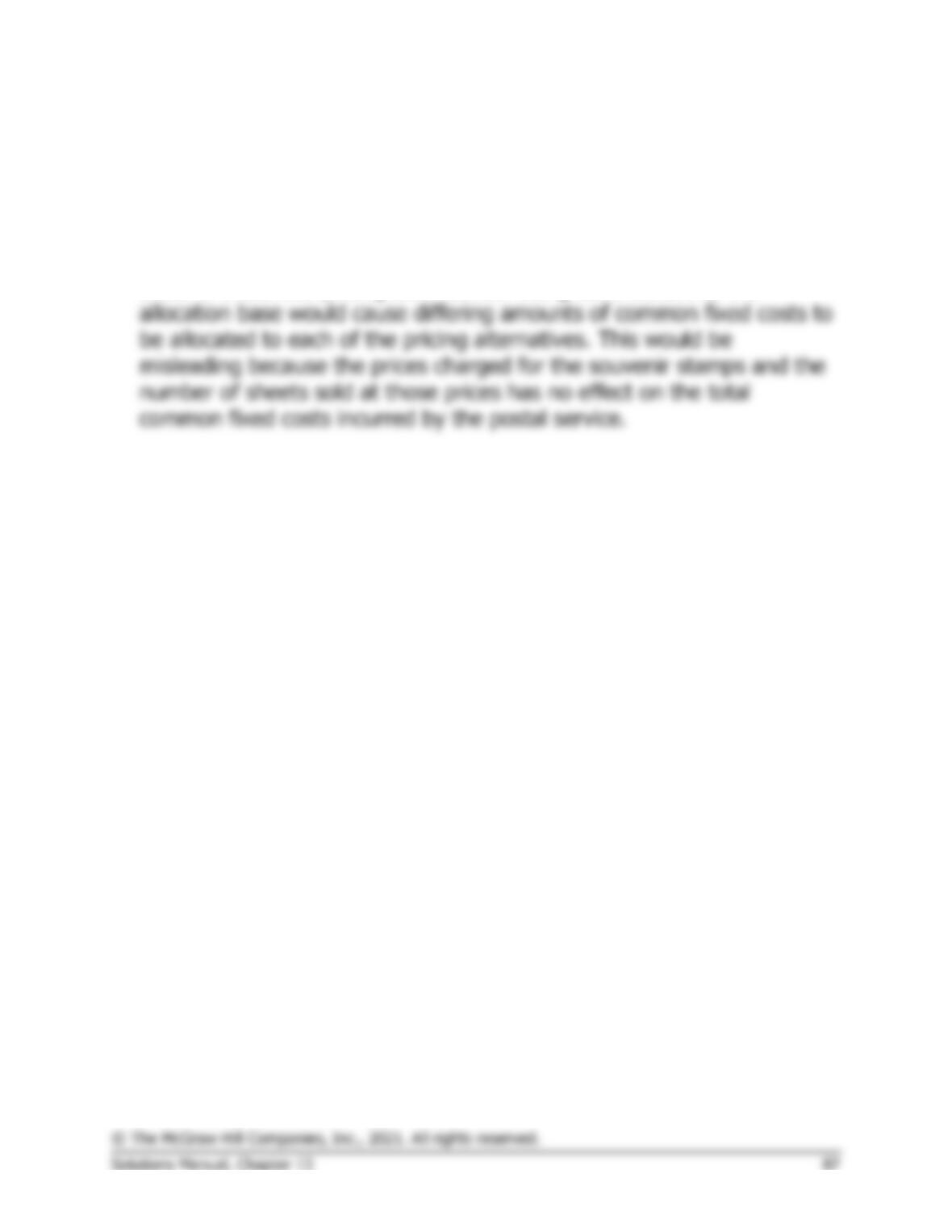
4. The increase in contribution margin is computed as follows:
Contribution margin at a price of $7.00 …………
5. The postal service would have to sell 92,904 sheets computed as
follows:
CM
= (P – V) × Q
$576,000
= ($7.00 − $0.80) × Q
$576,000
= $6.20 × Q
Q
= 92,904 sheets (rounded)
Exercise 13A-7 (continued)
6. The percentage increase is computed as follows:
(92,904 units – 80,000 units) ÷ 80,000 units = 16.2%
7. The postal service should not allocate a portion of its common fixed
costs to these two pricing alternatives. Using sales dollars as the
Problem 13A-8 (45 minutes)
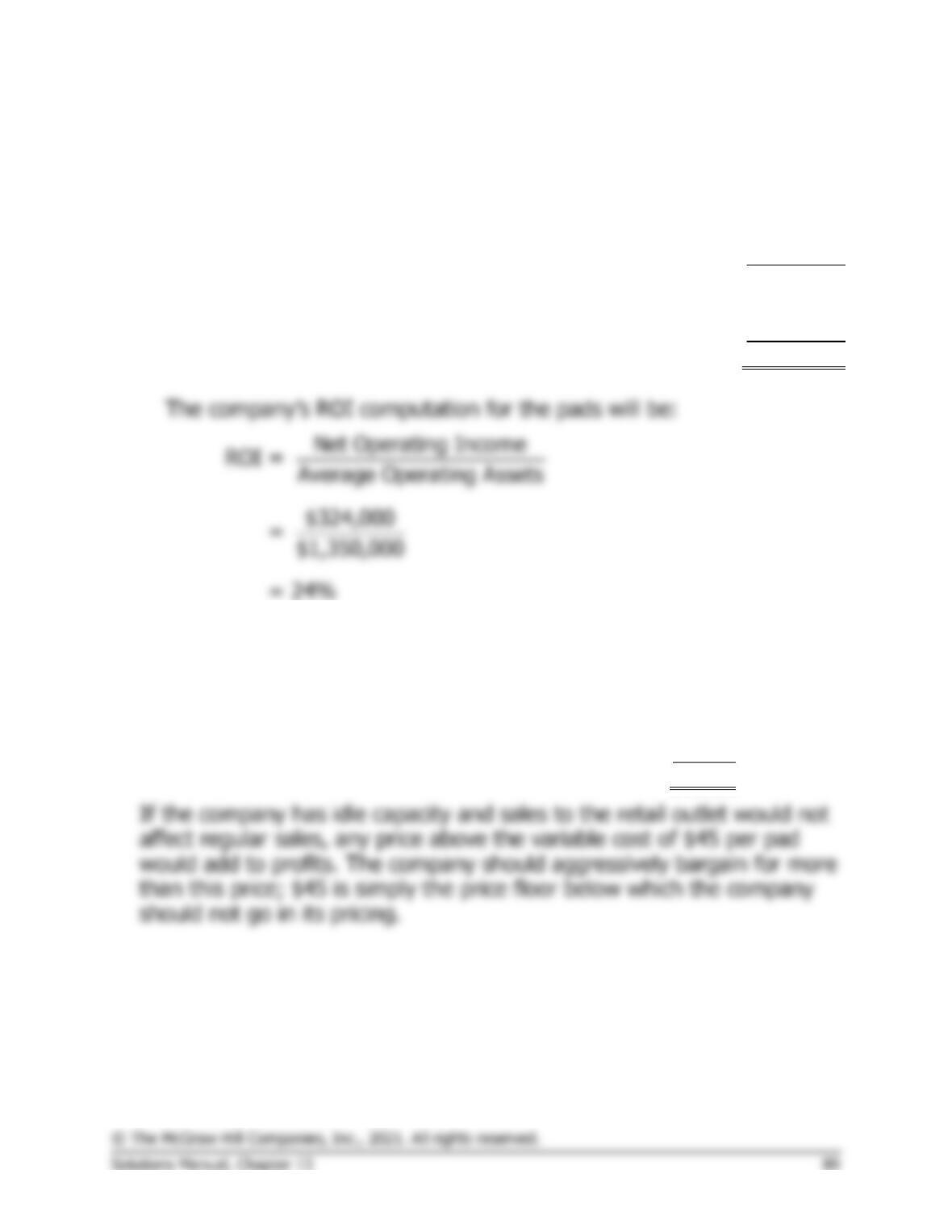
1. a. Number of pads manufactured each year:
38,400 labor-hours ÷ 2.4 labor-hours per pad = 16,000 pads.
Selling and administrative expenses:
Variable (16,000 pads × $9 per pad) …..
$144,000
Fixed ……………………………………………
732,000
Total …………………………………………….
$876,000
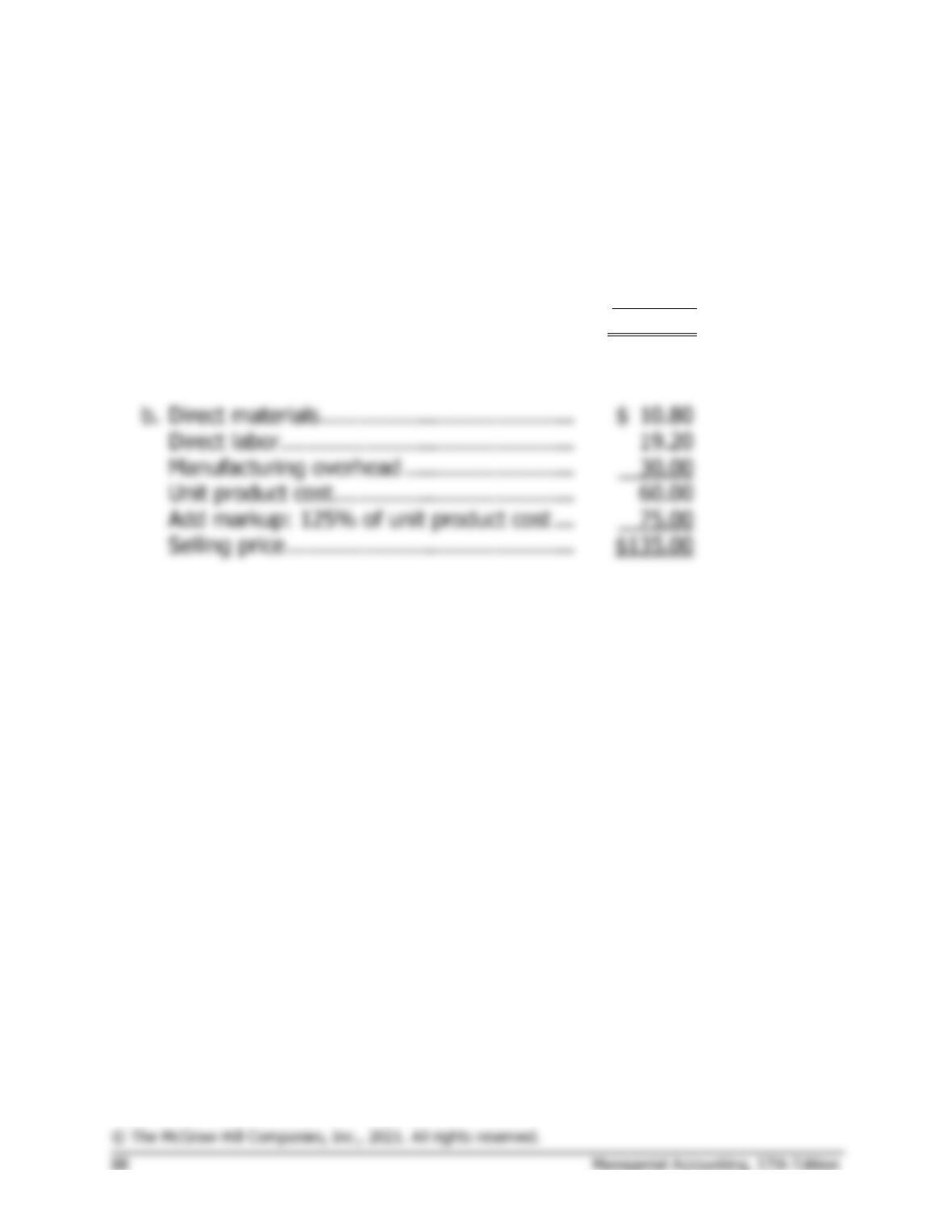
Direct materials …………………………………
Direct labor ………………………………………
Manufacturing overhead ……………………..
Selling price ……………………………………..
Problem 13A-8 (continued)
c. The income statement is:
Sales (16,000 pads × $135 per pad) …………..
$2,160,000
Cost of goods sold
(16,000 pads × $60 per pad) ………………….
960,000
Gross margin …………………………………………
1,200,000
Selling and administrative expenses (16,000
pads × $9 per pad + $732,000) ………………
876,000
Net operating income ………………………………
$ 324,000
2. Variable cost per unit:
Direct materials ……………………………………….
$10.80
Direct labor …………………………………………….
19.20
Variable manufacturing overhead (1/5 × $30) ..
6.00
Sales commissions ……………………………………
9.00
Total ……………………………………………………..
$45.00
Problem 13A-9 (10 minutes)
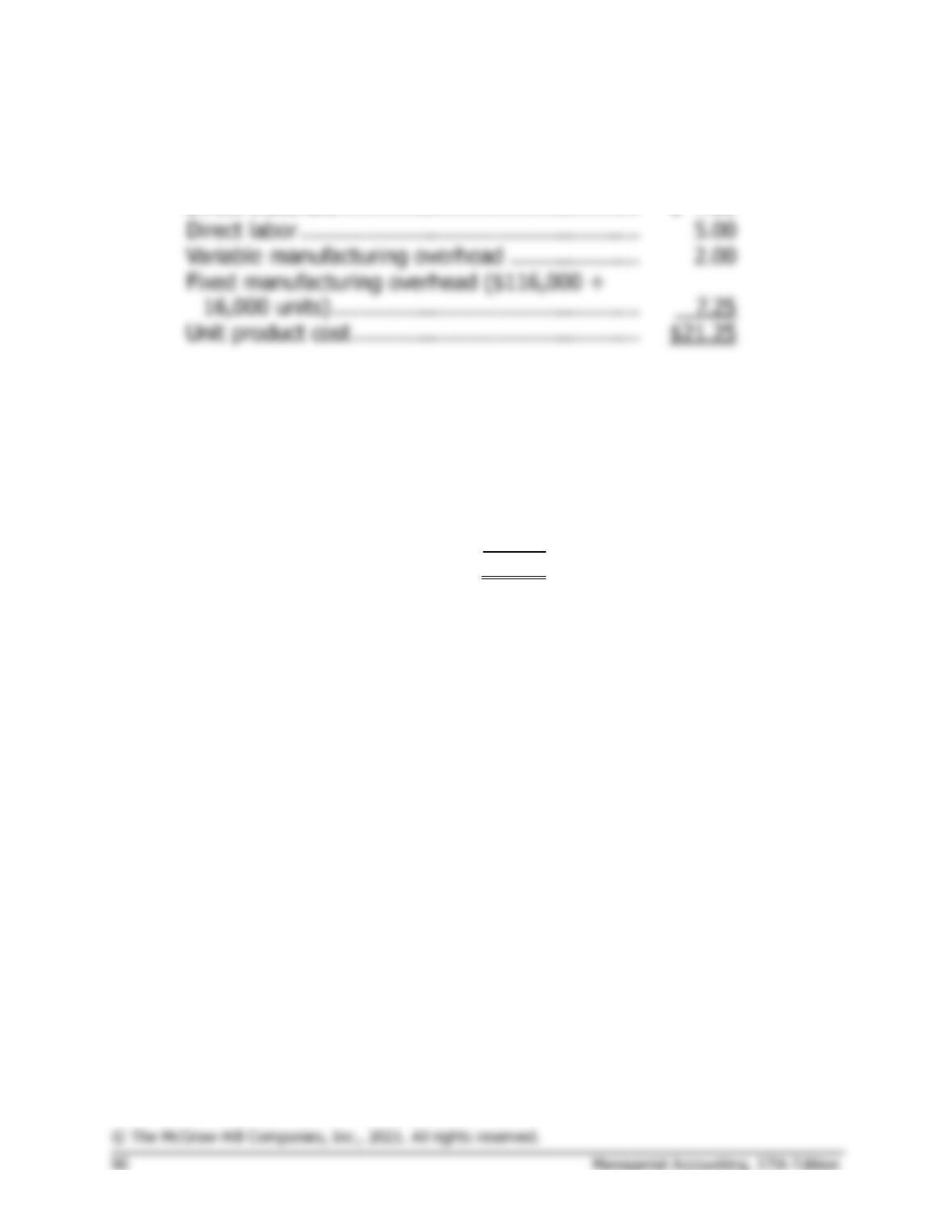
1. The unit product cost is computed as follows:
Direct materials ……………………………………….
Direct labor …………………………………………….
Unit product cost ……………………………………..
2. The markup percentage is computed as follows:
3. The selling price is computed as follows:
Unit product cost………………….
$21.25
Markup (30% × $21.25) ………..
6.38
Selling price per unit (rounded) .
$27.63
Problem 13A-10 (45 minutes)
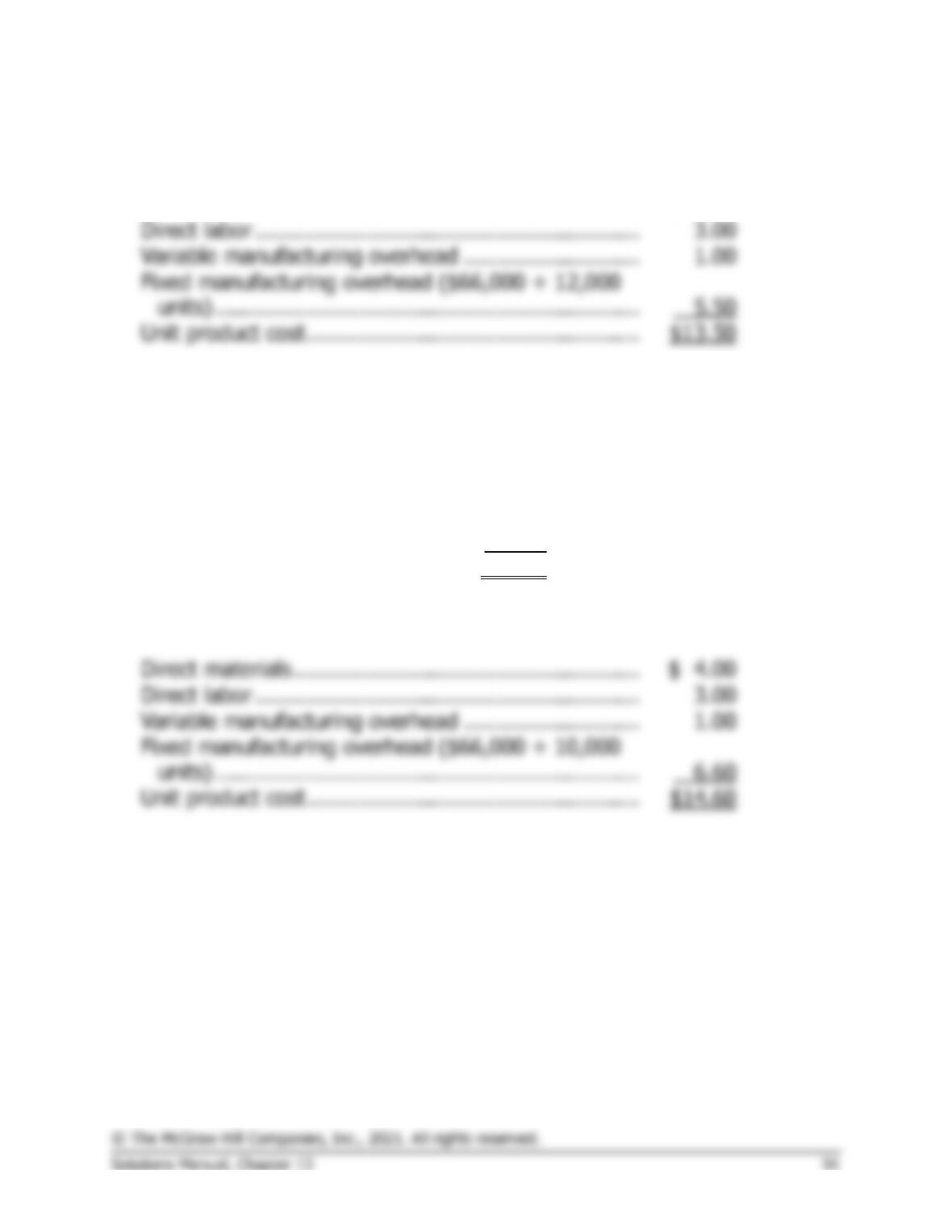
1. The unit product cost is computed as follows:
Direct materials …………………………..…………………
$ 4.00
Direct labor …………………………………………………..
Unit product cost ……………………………………………
2. The markup percentage is computed as follows:
3. The selling price is computed as follows:
Unit product cost………………….
$13.50
Markup (50% × $13.50) ………..
6.75
Selling price per unit …………….
$20.25
4. The revised unit product cost is computed as follows:
Direct materials …………………………..…………………
$ 4.00
Direct labor …………………………………………………..
Unit product cost ……………………………………………