13-21
13-22
13-24 (25 min.) Considerations other than cost in pricing decisions.
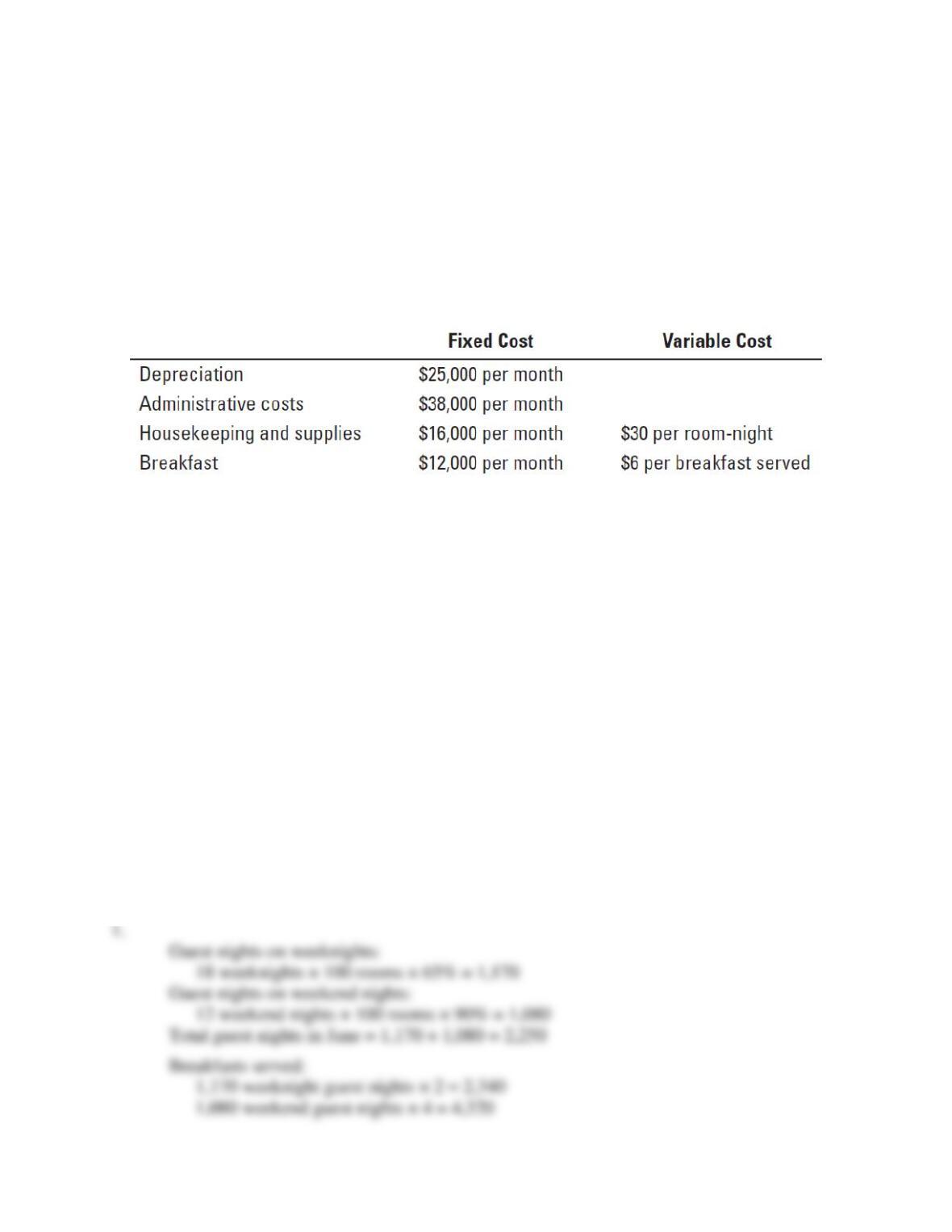
Fun Stay Express operates a 100-room hotel near a busy amusement park. During June, a 30-day
month, Fun Stay Express experienced a 65% occupancy rate from Monday evening through
Thursday evening (weeknights). On Friday through Sunday evenings (weekend nights),
however, occupancy increases to 90%. (There were 18 weeknights and 12 weekend nights in
June.) Fun Stay Express charges $85 per night for a suite. The company recently hired Gina
Johnson to manage the hotel to increase the hotel’s profitability. The following information
relates to Fun Stay Express’ costs:
Fun Stay Express offers free breakfast to guests. In June, there were an average of two breakfasts
served per room-night on weeknights and 4 breakfasts served per room-night on weekend nights.
Required:
1. Calculate the average cost per room-night for June. What was Fun Stay Express’ operating
income or loss for the month?
2. Gina Johnson estimates that if Fun Stay Express decreases the nightly rates to $75,
weeknight occupancy will increase to 75%. She also estimates that if the hotel increases the
nightly rate on weekend nights to $105, occupancy on those nights will remain at 90%.
Would this be a good move for Fun Stay Express? Show your calculations.
3. Why would the guests tolerate a $30 price difference between weeknights and weekend
nights?
4. A discount travel clearinghouse has approached Fun Stay Express with a proposal to offer
last-minute deals on empty rooms on both weeknights and weekend nights. Assuming that
there will be an average of three breakfasts served per night per room, what is the minimum
price that Fun Stay Express could accept on the last-minute rooms?
SOLUTION
13-23
13-24
13-25 (25 min.) Cost-plus, target pricing, working backward.
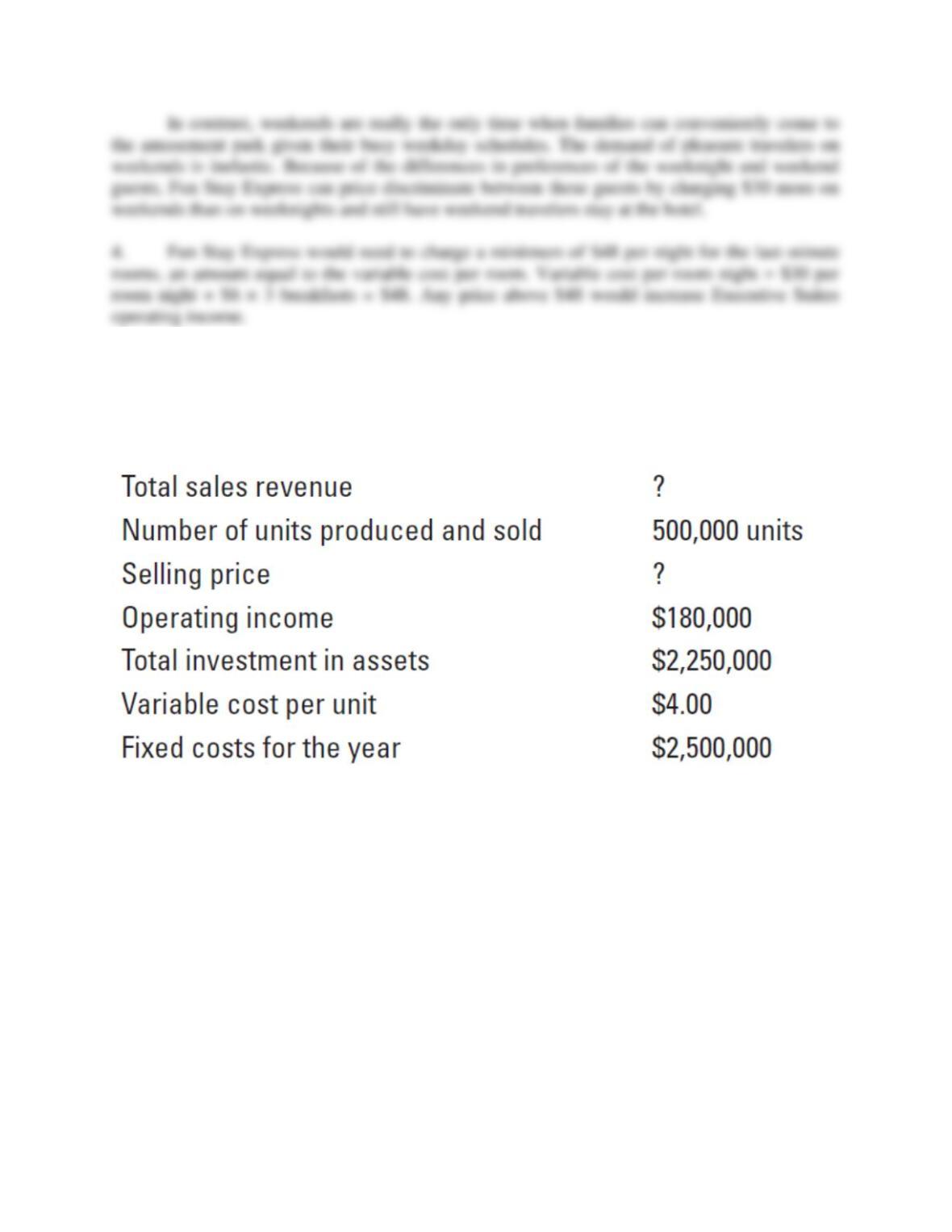
The new CEO of Rusty Manufacturing has asked for a variety of information about the
operations of the firm from last year. The CEO is given the following information, but with some
data missing:
Required:
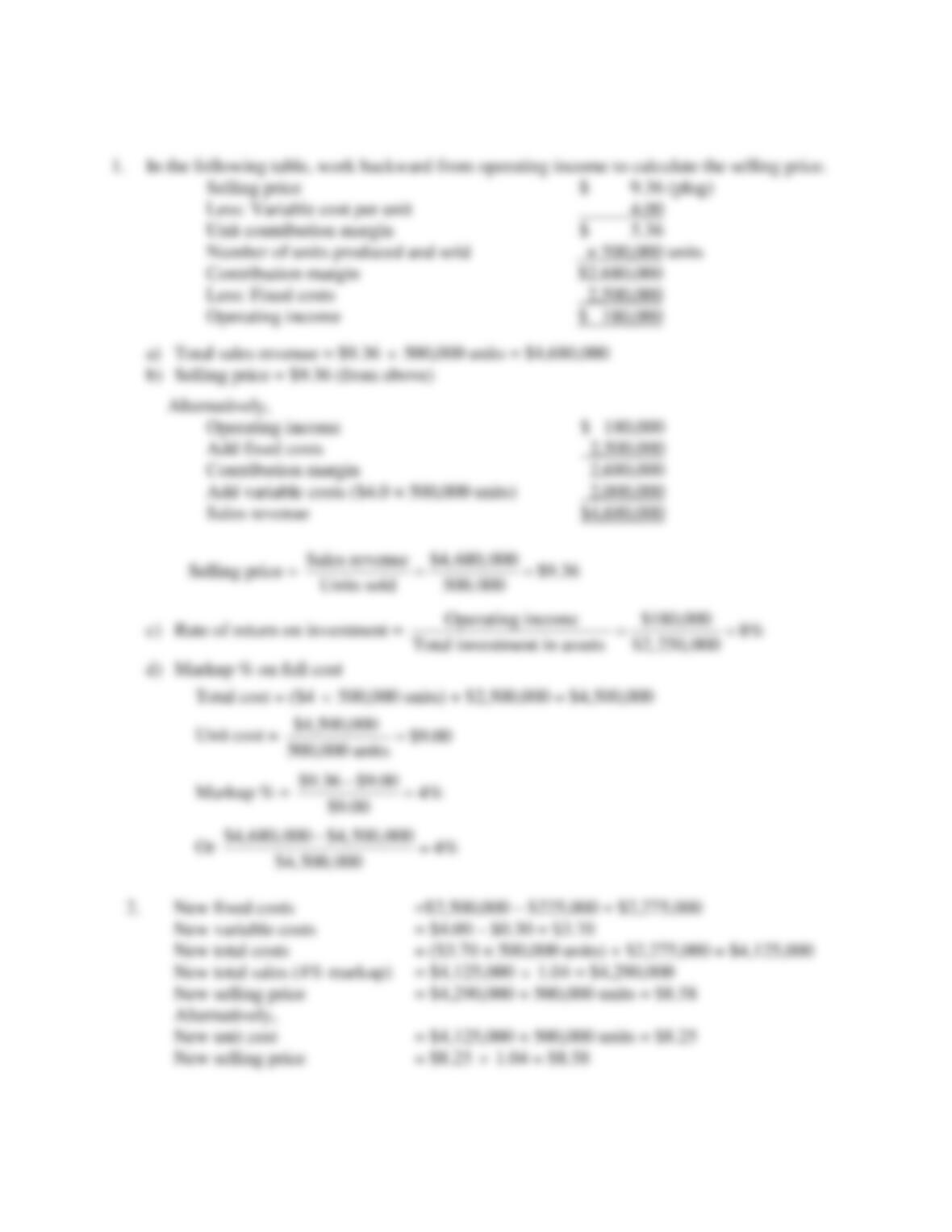
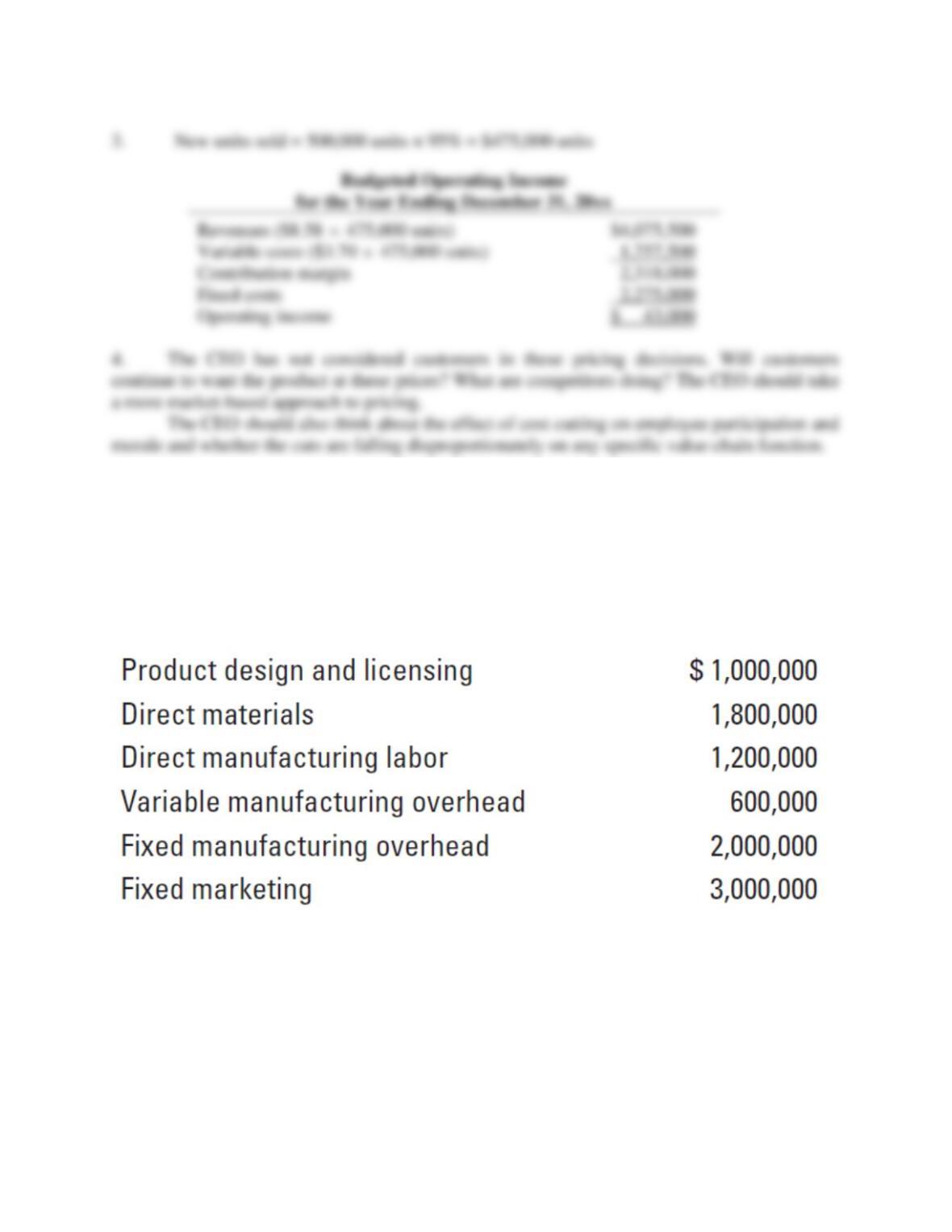
1. Find (a) total sales revenue, (b) selling price, (c) rate of return on investment, and (d) markup
percentage on full cost for this product.
2. The new CEO has a plan to reduce fixed costs by $225,000 and variable costs by $0.30 per
unit while continuing to produce and sell 500,000 units. Using the same markup percentage
as in requirement 1, calculate the new selling price.
3. Assume the CEO institutes the changes in requirement 2 including the new selling price.
However, the reduction in variable cost has resulted in lower product quality resulting in 5%
fewer units being sold compared with before the change. Calculate operating income (loss).
4. What concerns, if any, other than the quality problem described in requirement 3, do you see
in implementing the CEO’s plan? Explain briefly.
13-25
SOLUTION
13-26
13-26 (30 min.) Value engineering, target pricing, and target costs.
Tiffany Cosmetics manufactures, and sells a variety of makeup and beauty products. The
company has come up with its own patented formula for a new anti-aging cream The company
president wants to make sure the product is priced competitively because its purchase will also
likely increase sales of other products. The company anticipates that it will sell 400,000 units of
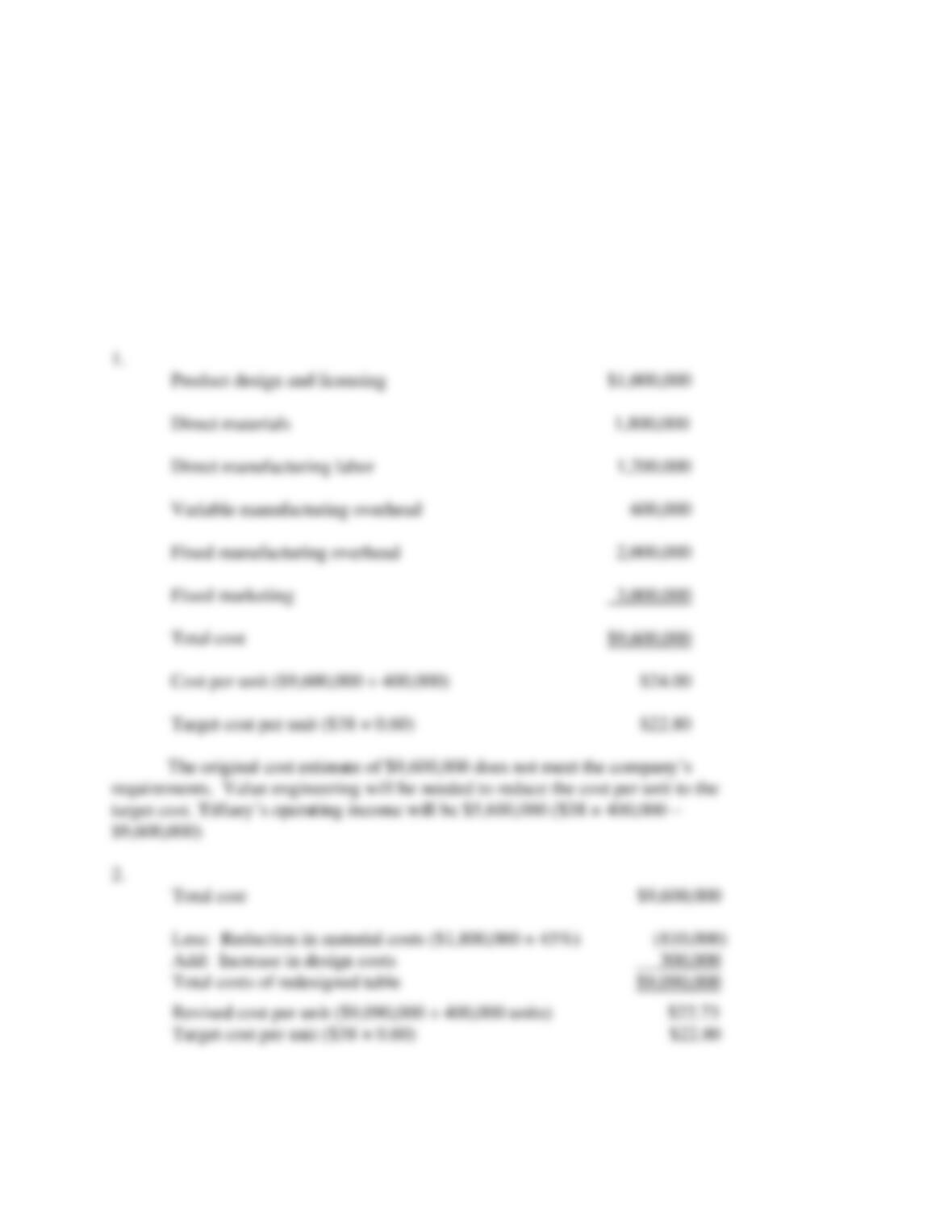
the product in the first year with the following estimated costs:
Required:
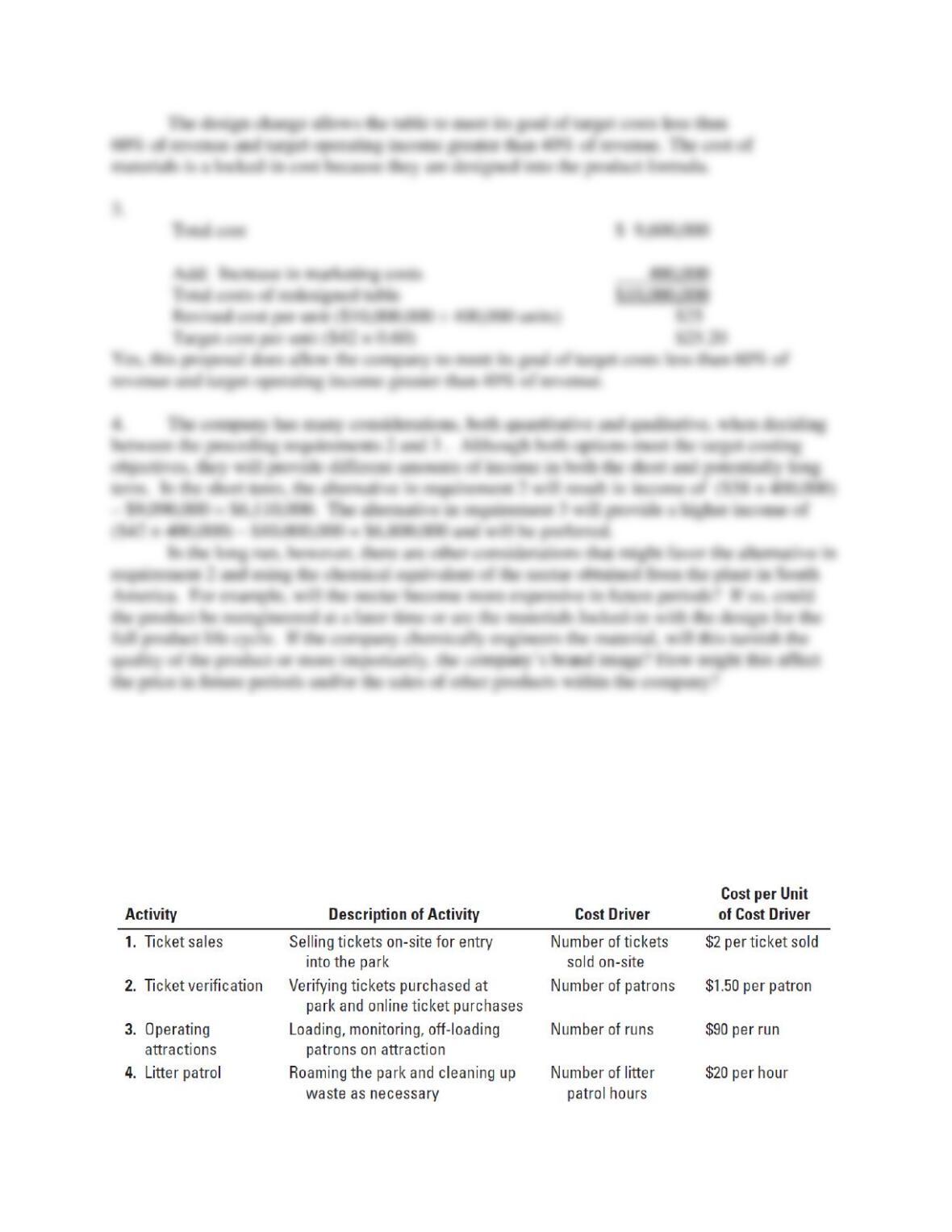
1. The company believes that it can successfully sell the product for $38 a bottle. The
company’s target operating income is 40% of revenue. Calculate the target full cost of
producing the 400,000 units. Does the cost estimate meet the company’s requirements? Is
value engineering needed?
2. A component of the direct materials cost requires the nectar of a specific plant in South
America. If the company could eliminate this special ingredient, the materials cost would
drop by 45%. However, this would require design changes of $300,000 to engineer a
13-27
chemical equivalent of the ingredient. Will this design change allow the product to meet its
target cost?
3. The company president does not believe that the formula should be altered for fear it will
tarnish the company’s brand. She prefers that the company spend more on marketing and
increase the price. The company’s accountants believe that if marketing costs are increase by
$400,000 then the company can achieve a selling price of $42 per bottle without losing any
sales. At this price, will the company achieve its target operating income of 40% of revenue?
4. What are the advantages and disadvantages of pursuing alternative 2 and alternative 3 above?
SOLUTION
13-28
13-27 (30 min.) Target service costs, value engineering, activity-based costing.
Lagoon is an amusement park that offers family-friendly entertainment and attractions. The park
boasts more than 25 acres of fun. The admission price to enter the park, which includes access to
all attractions, is $35. At this entrance price, Lagoon’s target profit is 35% of revenues. Lagoon’s
managers have identified the major activities that drive the cost of operating the park. The
activity cost pools, the cost driver for each activity, and the cost per unit of the cost driver for
each pool are:

13-29
The following additional information describes the existing operations:
a. The park operating hours are 10:00 a.m.–8:00 p.m., 7 days a week. The average number of
patrons per week is 55,000.
b. Lagoon maintains an online Web site for advance ticket purchases. This site is maintained by
an outside company that charges $1 per ticket sold. Only 15% of the tickets are purchased
online.
c. Once the ticket is purchased, another park employee checks the ticket and stamps the patron
for potential exit and reentry.
d. The park has 27 attractions. A run is the complete cycle of loading, monitoring, and off-
loading of patrons. On average, the attractions can make 6 runs an hour. The cost of
operating the attractions includes wages of operator, maintenance, and depreciation of
equipment.
e. Cleaning crew members are assigned to 1-acre areas. One person can cover approximately 1
acre per hour. Each acre is covered continuously. The cost of litter patrol includes the wages
of the employee and cleaning supplies.
In response to competitive pressures and to continue to attract 55,000 patrons per week, Lagoon
has decided to lower ticket prices to $33 per patron. To maintain the same level of profits as
before, Lagoon is looking to make the following improvements to reduce operating costs:
a. Spend $1,000 per week on advertising to promote awareness of the available online ticket
purchase. Lagoon’s managers expect that this advertising will increase online purchases to
40% of total ticket sales. At this volume, the cost per online ticket sold will decrease to
$0.75.
b. Reduce the operating hours for eight of the attractions that are not very popular from 10
hours per day to 7 hours per day.
c. Increase the number of refuse containers in the park at an additional cost of $250 per week.
Litter patrol employees will be able to cover 1.25 acres per hour.
The cost per unit of cost driver for all other activities will remain the same.
Required:
1. Does Lagoon currently achieve its target profit of 35% of sales?
2. Will the new changes and improvements allow Lagoon to achieve the same target profit in
dollars? Show your calculations.
3. What challenges might managers at Lagoon encounter in achieving the target cost? How
might they overcome these challenges?
SOLUTION
13-30
13-31
13-28 (25 min.) Cost-plus, target return on investment pricing.
Zoom-o-licious makes candy bars for vending machines and sells them to vendors in cases of 30
bars. Although Zoom-o-licious makes a variety of candy, the cost differences are insignificant,
and the cases all sell for the same price.
Zoom-o-licious has a total capital investment of $15,000,000. It expects to produce and sell
300,000 cases of candy next year. Zoom-o-licious requires a 10% target return on investment.
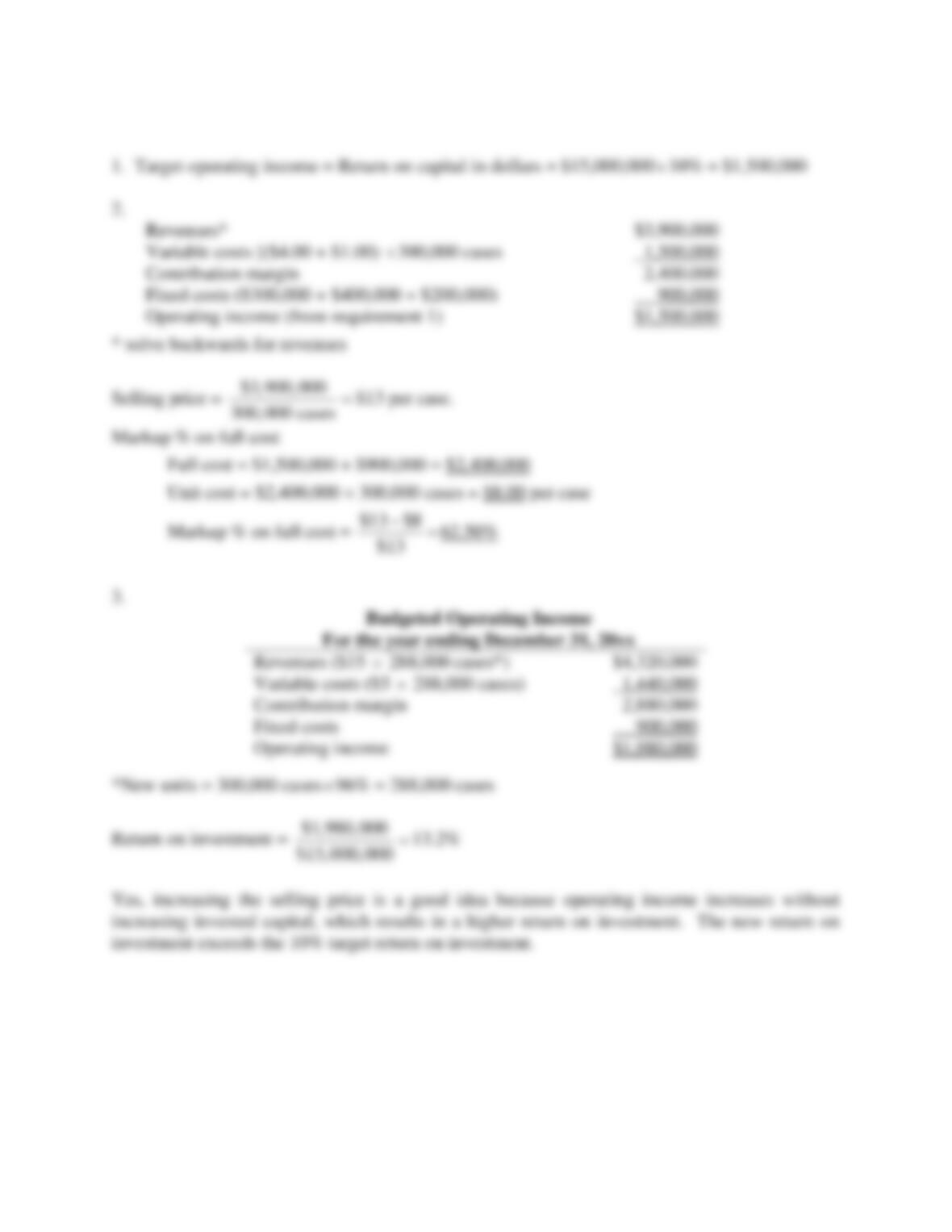
Expected costs for next year are:
Zoom-o-licious prices the cases of candy at full cost plus markup to generate profits equal to the
target return on capital.
Required:
1. What is the target operating income?
2. What is the selling price Zoom-o-licious needs to charge to earn the target operating income?
Calculate the markup percentage on full cost.
3. Zoom-o-licious’s closest competitor has just increased its candy case price to $16, although it
sells 36 candy bars per case. Zoom-o-licious is considering increasing its selling price to $15
per case. Assuming production and sales decrease by 4%, calculate Zoom-o-licious’ return
on investment. Is increasing the selling price a good idea?
13-32
SOLUTION
13-33
13-29 (20 min.) Cost-plus, time and materials, ethics.
A & L Mechanical sells and services plumbing, heating, and air-conditioning systems. A & L’s
cost accounting system tracks two cost categories: direct labor and direct materials. A & L uses a
time-and-materials pricing system, with direct labor marked up 80% and direct materials marked
up 60% to recover indirect costs of support staff, support materials, and shared equipment and
tools and to earn a profit.
During a hot summer day, the central air conditioning in Michelle Lowry’s home stops
working. A & L technician Tony Dickenson arrives at Lowry’s home and inspects the air
conditioner. He considers two options: replace the compressor or repair it. The cost information
available to Dickenson follows:
Required:
1. If Dickenson presents Lowry with the replace or repair options, what price would he quote
for each?
2. If the two options were equally effective for the 3 years that Lowry intends to live in the
home, which option would she choose?
3. If Dickenson’s objective is to maximize profits, which option would he recommend to
Lowry? What would be the ethical course of action?
SOLUTION
13-34
13-30 (25 min.) Cost-plus and market-based pricing.
Georgia Temps, a large labor contractor, supplies contract labor to building-construction
companies. For 2014, Georgia Temps has budgeted to supply 84,000 hours of contract labor. Its
variable costs are $13 per hour, and its fixed costs are $168,000. Roger Mason, the general
manager, has proposed a cost-plus approach for pricing labor at full cost plus 20%.
Required:
1. Calculate the price per hour that Georgia Temps should charge based on Mason’s proposal.
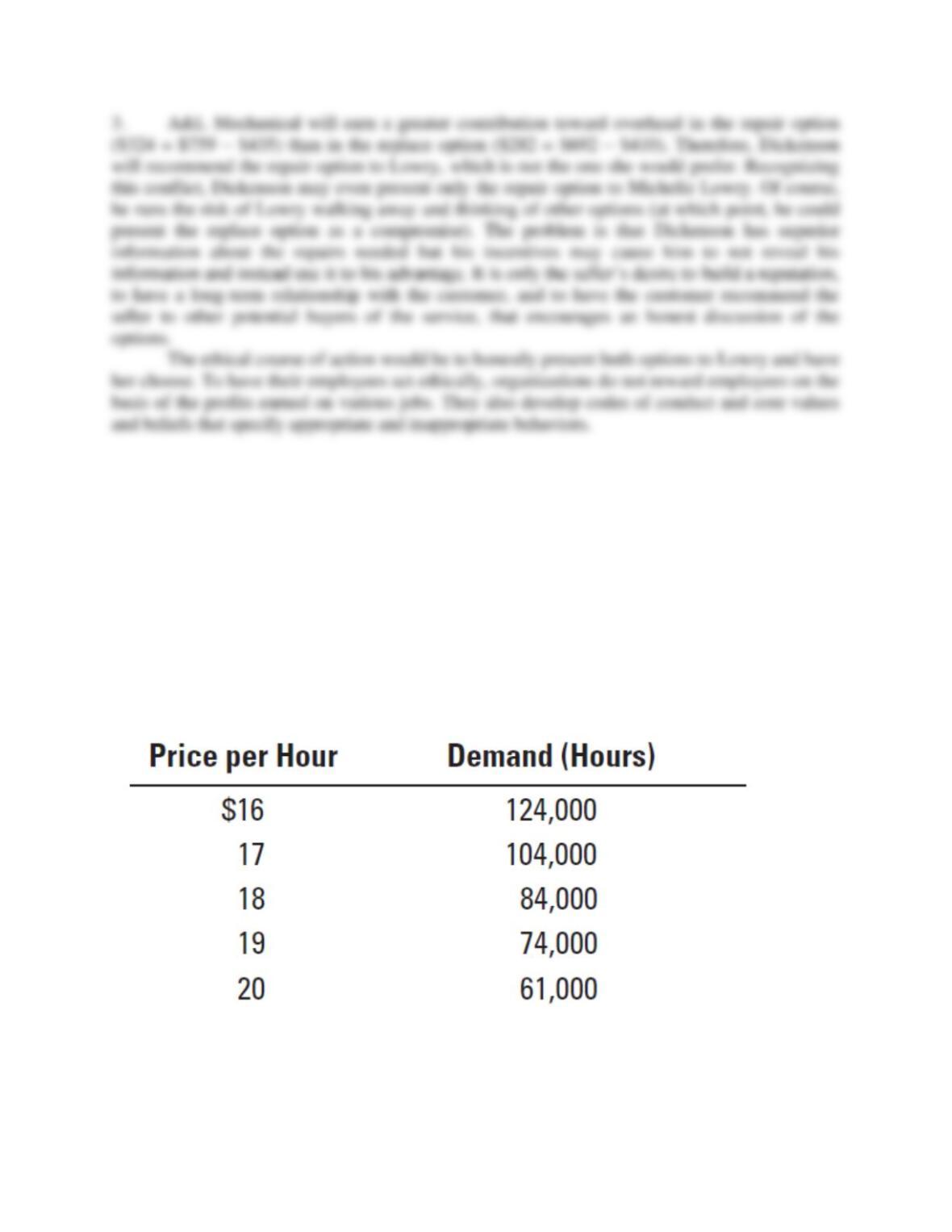
2. The marketing manager supplies the following information on demand levels at different
prices:
Georgia Temps can meet any of these demand levels. Fixed costs will remain unchanged for all
the demand levels. On the basis of this additional information, calculate the price per hour that
Georgia Temps should charge to maximize operating income.