13–12
13-16. Note: Answers to Case 13-16 are based on Internet access dated 1/14/2020 and may
differ slightly at the time the case is assigned.
a. The World Resources Institute received an A+ rating. The rating is assigned based
on the following criteria:
• Program expense efficiency (program expenses / total expenses) — to receive
such a high rating, the World Resources Institute would need to have a ratio of
80 percent or greater. This is due to the fact CharityWatch averages the grade
from the cost to raise $100 and the grade given to the program expense
efficiency. In order to receive at least an A on program expense efficiency, the
World Resources Institute would need to report program expense efficiency of
at least 80%.
• A reasonable level of available assets. Too many available assets will result in
a lower rating. The World Resources Institute would need to have available
assets of less than three years to receive such a high rating. Available assets is
the amount of assets (including investments designated by the board) available
to cover the current year’s budget.
The A+ grade received by the World Resources Institute indicates that
CharityWatch believes the World Resources Institute is performing at a high level
in allocating resources to program services without incurring excessive fund-
raising costs.
b. Yes, the World Resources Institute does meet the BBB’s standards for charity
accountability. To do so it must meet all 20 standards on which the BBB rates
charities.
d. Yes, based on the limited analysis conducted, it appears the World Resources
Institute is performing quite well. Program expense efficiency percentages and the
fund-raising efficiency percentages are very good based on the criteria provided
Chapter 13 – Not-for-Profit Organizations—Regulatory, Taxation, and Performance Issues
13–13
Ch. 13, Solutions, Case 13-16, d. (Cont’d)
by both CharityWatch and the BBB. BBB data indicate that in addition to only
spending 2 percent on fund-raising, only 6 percent is spent on management and
general costs. The CharityWatch criteria also indicate that the World Resources
Institute is using its available assets for its mission rather than holding assets in
investments.
13-17. Answers for a and b were accessed on 1/14/2020 from the “How Do We Rate Charities’
Accountability and Transparency?” portion of the Charity Navigator website. The answer
for c was accessed on 1/14/2020 from the “Accountability and Transparency Ratings
Tables” portion of the Charity Navigator website.
a. The seventeen categories are as follows: independent board, no material diversion of
assets, audited financials prepared by independent accountant with an audit oversight
b. The first twelve categories are measured from information provided on the Form 990.
The last five categories are measured based on a review of the charity’s website.
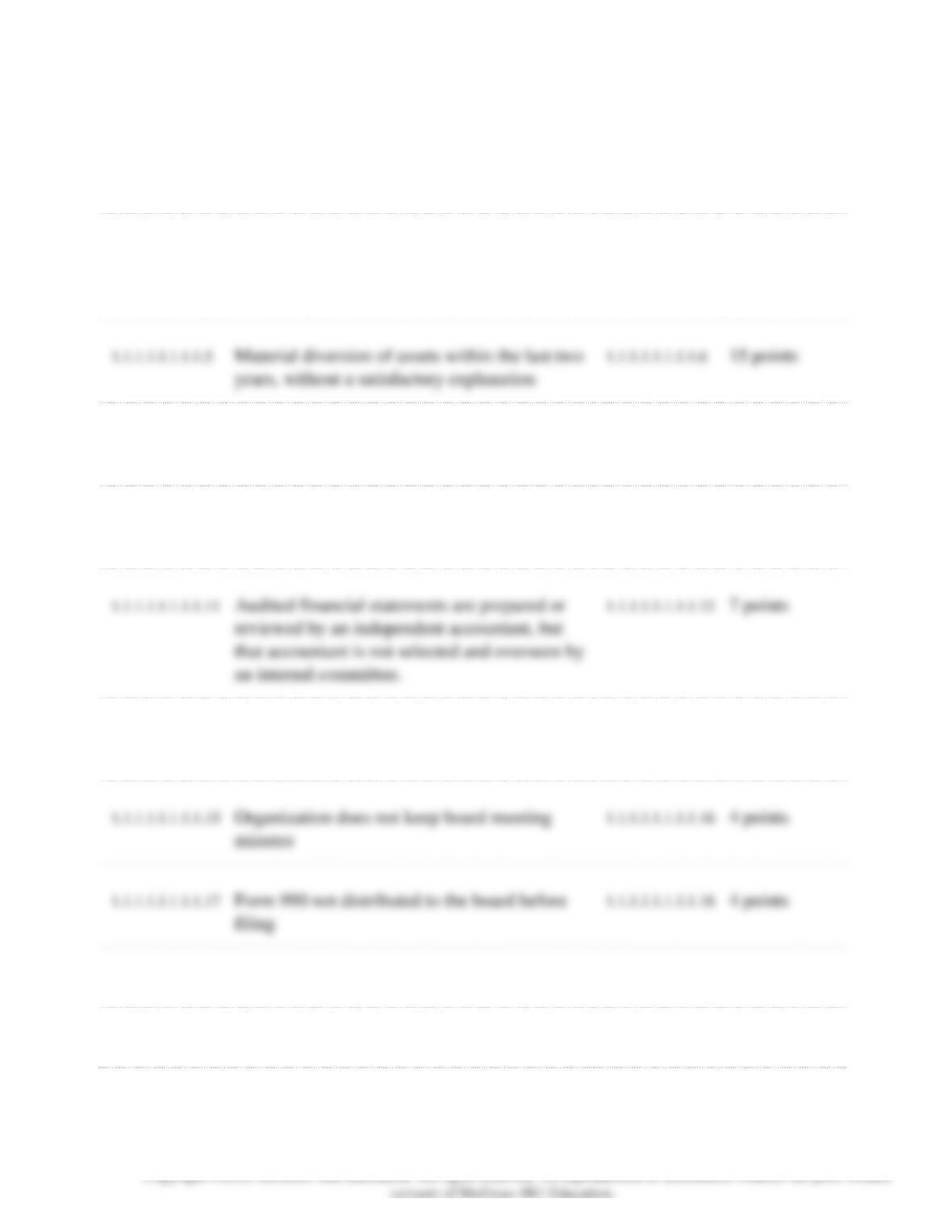
c. Charities begin with a 100-point score for Accountability and Transparency. They
then lose points as follows:
Chapter 13 – Not-for-Profit Organizations—Regulatory, Taxation, and Performance Issues
13–14
Ch. 13, Solutions, Case 13-17, c. (Cont’d)
1.1.1.1.1.1.1.1.1 Performance Metric
1.1.1.1.1.1.1.1.2 Deductions
from Score
1.1.1.1.1.1.1.1.3 Less than 5 independent voting members of
the board; or independent members do not
constitute a voting majority.
1.1.1.1.1.1.1.1.4 15 points
1.1.1.1.1.1.1.1.7 Material diversion of assets within the last
year, with a satisfactory explanation
1.1.1.1.1.1.1.1.8 7 points
1.1.1.1.1.1.1.1.9 Audited financial statements are not prepared
or reviewed by an independent accountant
1.1.1.1.1.1.1.1.10 15 points
1.1.1.1.1.1.1.1.13 Loans to or from officers or other interested
parties
1.1.1.1.1.1.1.1.14 4 points
1.1.1.1.1.1.1.1.15 Organization does not keep board meeting
minutes
1.1.1.1.1.1.1.1.16 4 points
1.1.1.1.1.1.1.1.19 No conflict of interest policy
1.1.1.1.1.1.1.1.20 4 points
1.1.1.1.1.1.1.1.21 No whistleblower policy
1.1.1.1.1.1.1.1.22 4 points

Chapter 13 – Not-for-Profit Organizations—Regulatory, Taxation, and Performance Issues
Ch. 13, Solutions, Case 13-17, c. (Cont’d)
1.1.1.1.1.1.1.1.23 No records retention and destruction policy
1.1.1.1.1.1.1.1.24 4 points
1.1.1.1.1.1.1.1.25 Does not properly report CEO compensation
on Form 990
1.1.1.1.1.1.1.1.26 4 points
1.1.1.1.1.1.1.1.29 Fails to report board members and
compensation fully on the Form 990, or
reports that board members are compensated
for their participation
1.1.1.1.1.1.1.1.30 4 points
1.1.1.1.1.1.1.1.31 Does not publish board members on website
1.1.1.1.1.1.1.1.32 4 points
Does not publish latest audited financial statements on website
4 points
Does not publish latest Form 990 on website
3 points
No donor privacy policy
4 points
Opt-out donor privacy policy
3 points
Once a charity is scored out of 100, they are assigned a star rating as follows:
Ch. 13, Solutions, Case 13-17, c. (Cont’d)

13–16
Accountabilit
y &
Transparenc
y Rating:
1.1.1.1.1.1.1.1.35
1.1.1.1.1.1.1.1.36
1.1.1.1.1.1.1.1.37
1.1.1.1.1.1.1.1.38
1.1.1.1.1.1.1.1.39
A four-star rating is the best rating a charity can receive on the accountability and
transparency metric, while a zero star is the worst.
d. The answer will depend on the charity chosen by the student. Students should be
encouraged to discuss the relative importance of each category, as well as the
strengths and weaknesses of the scoring methodology.
General Problem Information: accountability and transparency evaluation of a NFP
Topic: Federal Regulation; Governance; Benchmarking and Performance Measures
Bloom’s Taxonomy: Evaluate
Accreditation Skills tag: AACSB: Analytical Thinking, AICPA: FN: Decision Making
Level of Difficulty: Hard
Solutions to Exercises and Problems
13-18. 1. b. 6. d. 11. c.
3. c. 8. b.
5. a. 10. d.
General Problem Information: Various
Learning Objective: 13-1
Learning Objective: 13-2
Learning Objective: 13-3
Ch. 13, Solutions, Exercise 13–18 (Cont’d)
Chapter 13 – Not-for-Profit Organizations—Regulatory, Taxation, and Performance Issues
13–17
Learning Objective: 13-5
Topic: Various Chapter Topics
Bloom’s Taxonomy: Analyze
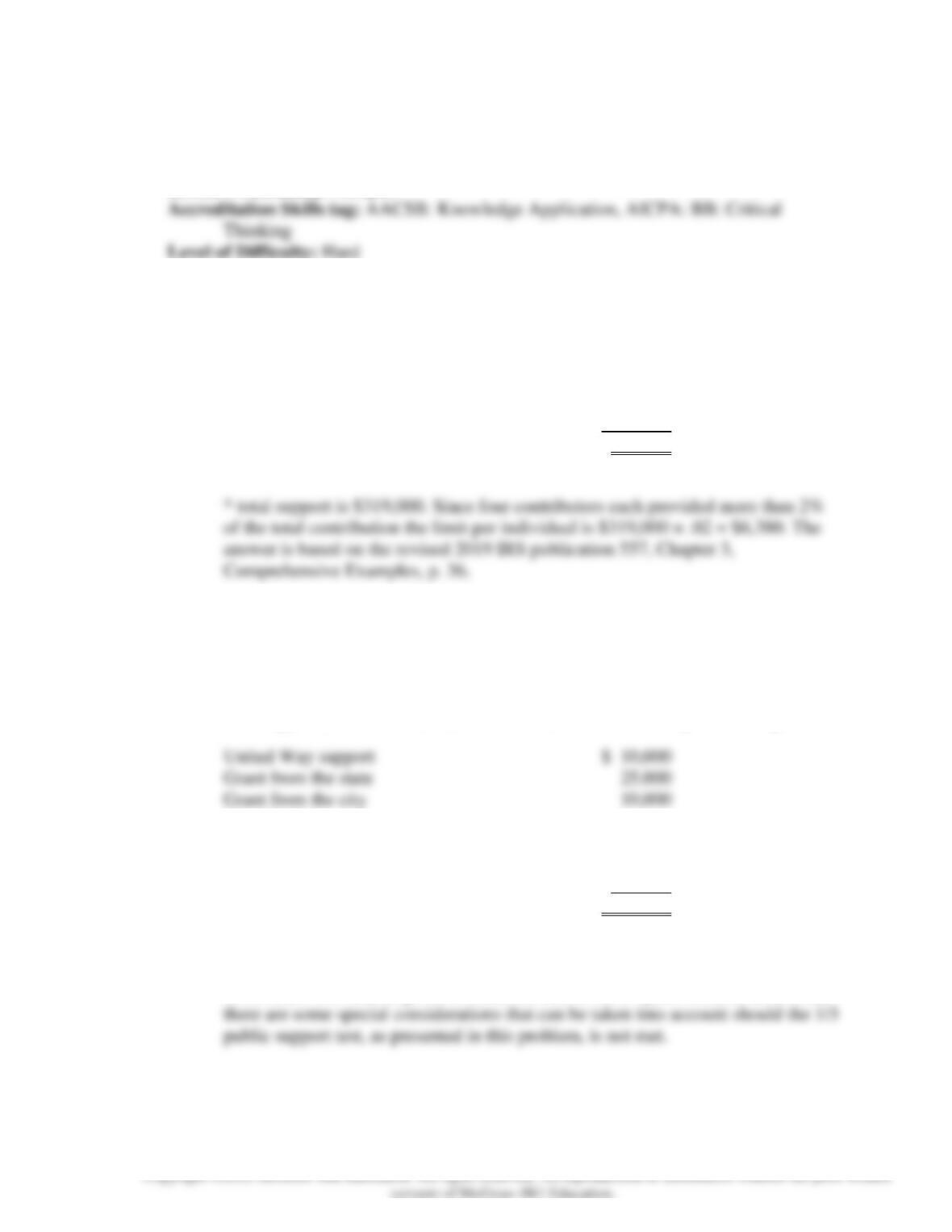
13-19. a. United Way support $ 10,000
Grant from the state 25,000
Grant from the city 10,000
Contributions:
small contributions: 21,000
large contributions:
4 gifts @ $6,380 (the limit)* 25,520
Public Support $91,520
b. The organization is not a public charity because it does not pass the public support
test. Less than 1/3 of its revenue comes from the public at large ($91,520 /
$319,000 = 28.7%).
c. No. Now the organization meets the public support test because more than 1/3 of
total support ($112,380 / $319,000 = 35.2%) comes from the public at large.
Contributions:
small contributions: 61,000
large contributions:
1 gift @ $6,380 (the limit) 6,380
Public Support $112,380
Note that a tax-exempt entity in its first five years will not have to prove that it
meets the public support test if there is a reasonable expectation it will be met;
however, it will need to prove it meets the test in the 6th year. Also, be aware that
Ch. 13, Solutions, Exercise 13-19 (Cont’d)
Chapter 13 – Not-for-Profit Organizations—Regulatory, Taxation, and Performance Issues
13–18
General Problem Information: Public Charity
Leaning Objective: 13-3
Topic: Tax-Exempt Categories
13-20.
2. IRC Sec. 501(c)(6)
3. IRC Sec. 501(c)(19)
4. IRC Sec. 501(k)
6. IRC Sec. 501(c)(3)
8. IRC Sec. 527
General Problem Information: Tax-exempt categories
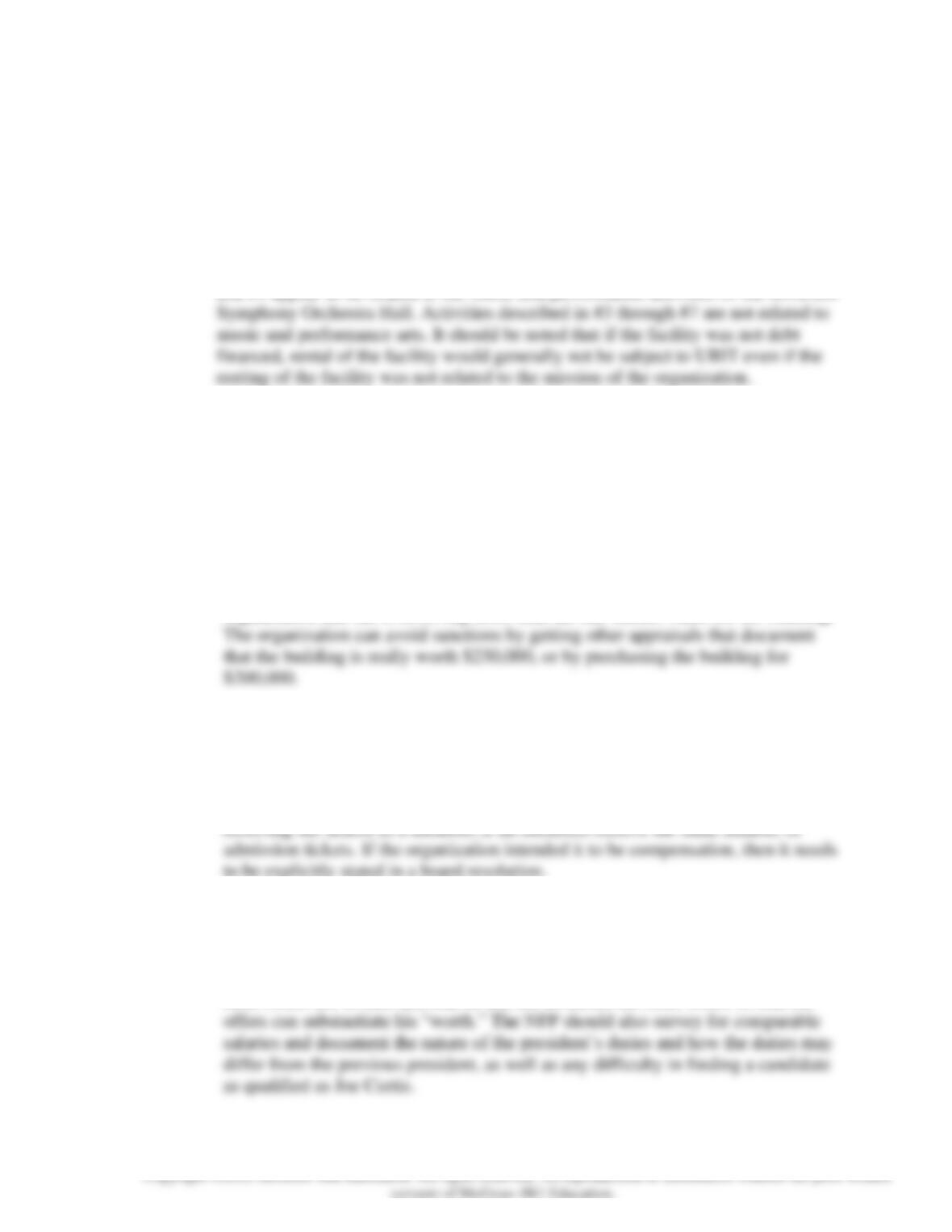
13-21.
Yes – subject to
UBIT
No – not unrelated
business income
1.
Sale of Silverton Symphony
Orchestra Concert CDs in the
2.
Rental of the facility to the high
school drama club.
X
3.
Rental of two apartments in the
facility to the symphony.
X
5.
Rental of the facility to the state
CPA association for continuing
professional education events.
X
Chapter 13 – Not-for-Profit Organizations—Regulatory, Taxation, and Performance Issues
13–19
Ch. 13, Solutions, Exercise 13–21 (Cont’d)
7.
Lease of the facility’s parking lot
to the local university on football
game days.
X
Note: From the information provided, we can infer that activities described in #1
General Problem Information: UBIT
Leaning Objective: 13-3
Topic: Federal Regulation
Bloom’s Taxonomy: Categorize
Accreditation Skills tag: AACSB: Knowledge Application, AICPA: BB: Legal
Level of Difficulty: Medium
13-22. 1. Yes. This is a classic example of excess economic benefit transactions. Jane is a
disqualified person because she is an officer with substantial influence over the
2. Yes. However, the risk only occurs when the excess benefit is paid. The
organization could avoid a problem by putting a limitation on the amount of
compensation the president could receive.
3. No. However, the law is silent on this particular example. She is probably
4. Possibly. If the incoming president’s duties are similar to the outgoing president
and comparable organizations, then the compensation may be unreasonable. If the
duties are similar, however, Joe Curtis is able to perform them more efficiently
then the higher salary may be reasonable. The organization should be sure his
Chapter 13 – Not-for-Profit Organizations—Regulatory, Taxation, and Performance Issues
13–20
Ch. 13, Solutions, Exercise 13–22 (Cont’d)
General Problem Information: Intermediate sanctions
Leaning Objective: 13-3
Topic: Federal Regulation
13-23.
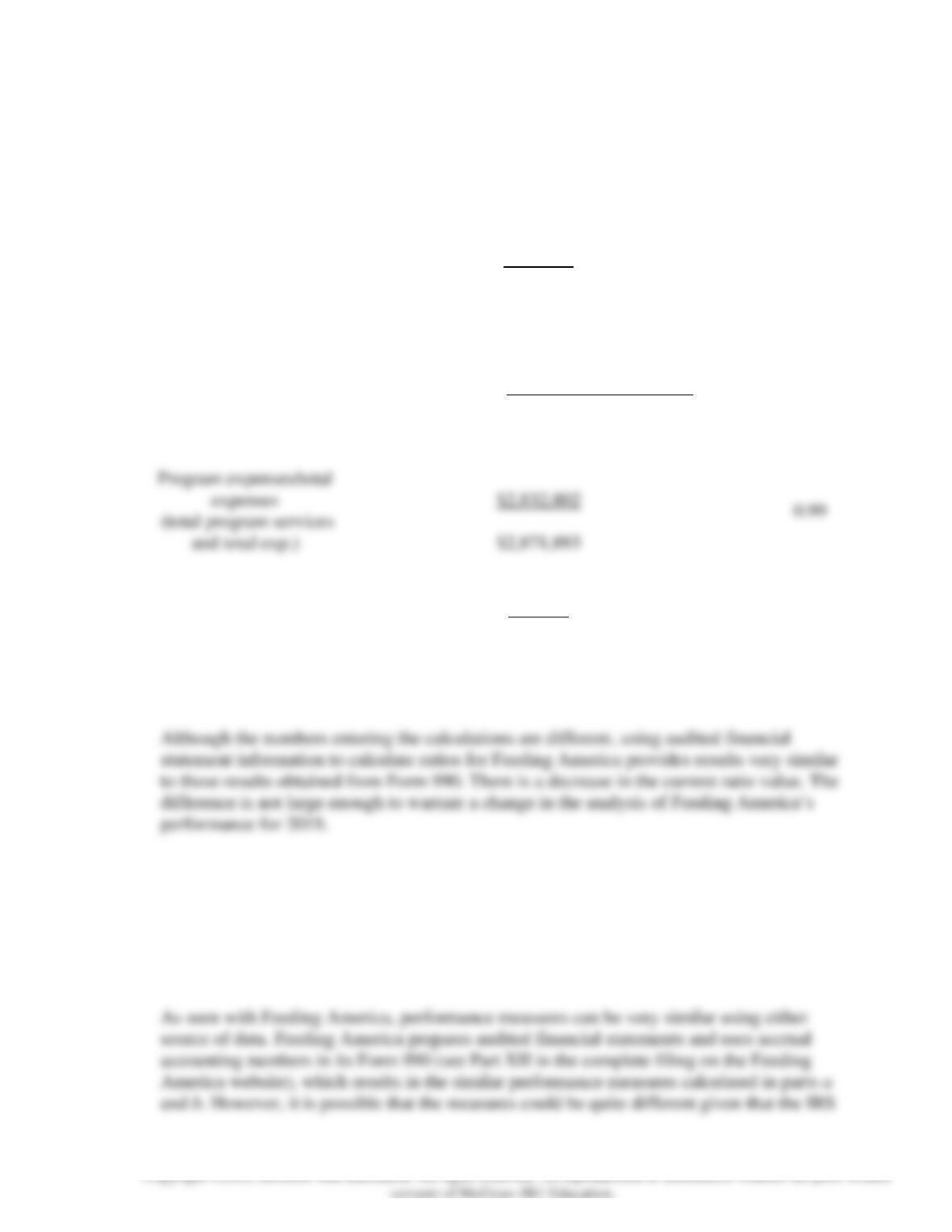
a.
Ratios Based on the 2018 Form 990
Measure
Calculation (amounts in 000s)
Ratio
Current ratio
$70,483+$29,111+$6,592+$769
7.05
(part X, col. B, lines 1-9, 17-19)
$7,013+$5,176+$2,982
$2,823,973
Program expenses/total expenses
$2,785,029
0.99
(part IX, line 25)
$2,823,973
(part IX, line 25, & part VIII, line 1h)
$2,756,780
The current ratio indicates that Feeding America is liquid, covering its current
liabilities over seven times. It is also able to cover its current expenses
with the revenue received in the period, indicating no going-concern issues
relative to this indicator. Feeding America appears to be highly effective with 99
Chapter 13 – Not-for-Profit Organizations—Regulatory, Taxation, and Performance Issues
13–21
Ch. 13, Solutions, Exercise 13-23 (Cont’d)
c. As a general rule, audited financial statements that conform to generally accepted
accounting principles should be preferred to Form 990 information tax return data because
of the assurance role that an independent auditor provides. However, the Form 990 has
more narrative and qualitative information than does the audited annual financial
statements. There is valuable information in each, and a sophisticated reader of financial
statements will want to have both on hand.
b.
Ratios Based on the 2019 Audited Financial Statements
Measure
Calculation (amounts in 000s)
Ratio
Current ratio
$104,216
1.1.1.1.1.1.1.1.45 6.60
$15,801
1.1.1.1.1.1.1.1.46 (Revenues-
expenses)/
expenses
1.1.1.1.1.1.1.1.47 ($2,876,283-$2,871,893)
1.1.1.1.1.1.1.1.48 0.002
(total support & revenue,
and total exp.)
$2,871,893
$2,832,802
and total exp.)
$2,871,893
Fund-raising
expenses/public support
$29,160
0.01
(fund development & total
public support)
$2,804,595

Chapter 13 – Not-for-Profit Organizations—Regulatory, Taxation, and Performance Issues
Ch. 13, Solutions, Exercise 13-23, c. (Cont’d)
does not require that accrual accounting or audited financial statements be used in
preparing Form 990.
General Problem Information: Performance measures
Leaning Objective: 13-5
Topic: Benchmarking and Performance Measures