
Chapter 13
Planning and Budgeting
Learning Objectives
1. Understand the role of budgets in overall organization plans.
2. Understand the importance of people in the budgeting process.
3. Estimate sales.
4. Develop production and cost budgets.
5. Estimate cash flows.
6. Develop budgeted financial statements.
7. Explain budgeting in merchandising and service organizations.
8. Explain why ethical issues arise in budgeting.
9. Explain how to use sensitivity analysis to budget under uncertainty.
Chapter Overview
I. HOW STRATEGIC PLANNING INCREASES COMPETITIVENESS
II. OVERALL PLAN
III. HUMAN ELEMENT IN BUDGETING
• Value of Employee Participation
IV. DEVELOPING THE MASTER BUDGET: WHERE TO START?
• Sales Forecasting
o Sales Staff
o Market Researchers
o Delphi Technique
o Trend Analysis
o Econometric Model
V. COMPREHENSIVE ILLUSTRATION
VI. MARKETING AND ADMINISTRATIVE BUDGET
VII. PULLING IT TOGETHER INTO THE INCOME STATEMENT
VIII. KEY RELATIONSHIPS: THE SALES CYCLE
IX. USING CASH FLOW BUDGETS TO ESTIMATE CASH NEEDS
• Multiperiod Cash Flows
Chapter Overview, continued
XII. BUDGETING IN RETAIL AND WHOLESALE ORGANIZATIONS
XIII. BUDGETING IN SERVICE ORGANIZATIONS
Chapter Outline
LO 13-1 Understand the role of budgets in overall organization plans.
• The budget is a financial plan of the resources needed to carry out activities and meet
financial goals.
HOW STRATEGIC PLANNING INCREASES COMPETITIVENESS
• Critical success factors are strengths of a company that enable it to outperform competitors.
o By identifying critical success factors and ensuring that they are incorporated into the
strategic plan, companies are able to maintain an edge over competitors.
o Important critical success factors can be exploited to improve the company’s overall
competitiveness.
OVERALL PLAN
• A master budget is made up of three components:
• Organization Goals
o Organization goals are a company’s broad objectives established by management that
employees work to achieve.
• Strategic Long-Range Profit Plan
• Master Budget (Tactical Short-Range Profit Plan): Tying the Strategic Plan to the Operating
Plan
o The master budget (also known as the static budget, the budget plan, or the planning
budget) is the financial plan of an organization for the coming year or other planning
period.
▪ The profit plan is the income statement portion of the master budget.
▪ The master budget indicates the sales levels, production and cost levels, income, and
cash flows anticipated for the coming year. In addition, these budget data are used to
construct a budgeted balance sheet.
o Benchmarking is the continuous process of measuring products, services, or activities
against competitors’ performance.
▪ Competitive intelligence can be part of a benchmarking activity in which some
companies gather information by speaking to their competitors, customers, and
suppliers.
LO 13-2 Understand the importance of people in the budgeting process.
HUMAN ELEMENT IN BUDGETING
• Although budgets are often viewed in purely quantitative, technical terms, managers’
• Value of Employee Participation
o Participative budgeting (also called grass roots budgeting) is the use of input from
lower- and middle-management employees for budget preparation.
▪ Participative budgeting is time consuming, yet it enhances employee motivation and
acceptance of goals, and provides information that enables employees to associate
rewards and penalties with performance. It also serves a training or development role
for managers.
▪ Studies have found that managers often provide inaccurate data when asked to give
budget estimates. Managers who believe that the budget will be used as a norm for
evaluating their performance could provide an estimate that will not be too hard to
achieve.
▪ Ideally, the budget will motivate people and facilitate their activities so that the
organization can achieve its goals.
DEVELOPING THE MASTER BUDGET: WHERE TO START?
• All budgeting processes share some common elements.
LO 13-3 Estimate sales.
• Sales Forecasting
o Beginning with a sales forecast, the firm can plan the activities over which it has more
control. As better information about sales becomes available, it is reasonably easy to
adjust the rest of the budget.
o Sales Staff
▪ Salespeople are in the unique position of being close to the customers, and they may
possess the best information and the best local knowledge in the company about
customers’ immediate and near-term needs.
▪ Salespeople realize that they will be evaluated based, in part, on the budget. As a
result, they have an incentive to bias their sales forecasts.
• Incentive compensation plans can be designed to motivate different behaviors,
each with their own strengths and weaknesses.
o Market Researchers
o Delphi Technique
▪ The Delphi technique is a forecasting method in which individual forecasts of group
members are submitted anonymously and evaluated by the group as a whole.
• Each group member obtains a copy of all forecasts but is unaware of their sources.
▪ Differences among individual forecasts can be addressed and reconciled without
involving the personality or position of individual forecasters.
• After the differences are discussed, the process is repeated until the forecasts
converge on a single best estimate of the coming year’s sales level.
o Trend Analysis
▪ Trend analysis is a forecasting method that ranges from simple visual extrapolation
of points on a graph to highly sophisticated computerized time series analysis.
o Econometric Model
▪ Econometric models are statistical methods of forecasting economic data using
regression models.
COMPREHENSIVE ILLUSTRATION
• To illustrate the discussion of the budgeting process, the budget for Rainy Day Umbrellas, a
manufacturer, is developed.
o A manufacturing example because it includes most aspects of a firm’s operations.
o The methods we discuss also apply to nonmanufacturing and not-for-profit organizations.
LO 13-4 Develop production and cost budgets.
• Forecasting Production
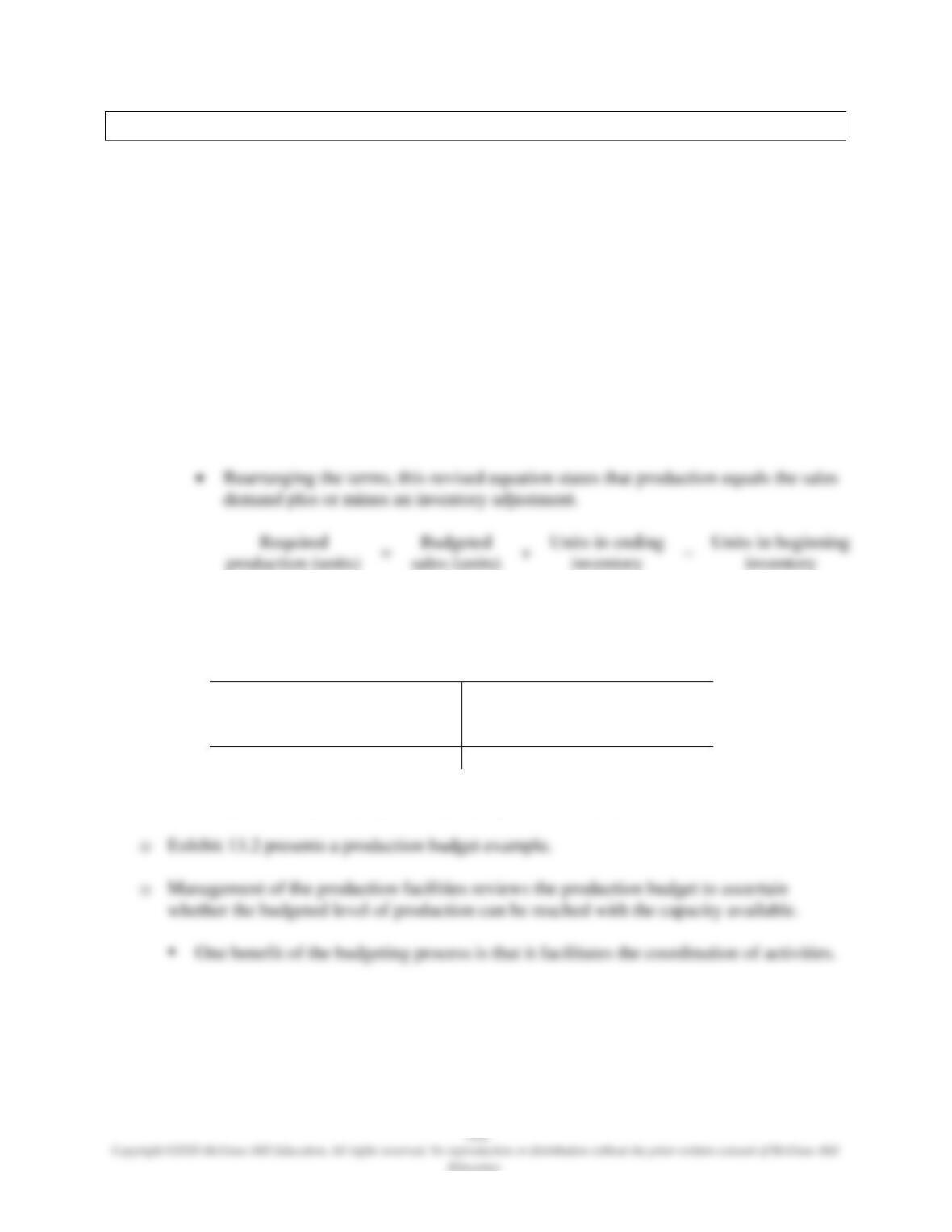
o The production budget is the production plan of resources needed to meet current sales
demand and ensure that inventory levels are sufficient for future sales.
o It is necessary to determine the required inventory level for the beginning and end of the
budget period.
▪ The basic cost flow equation (also known as the basic inventory formula) can be
adapted for inventories, production, and sales to solve for the required production.
Recall from Chapter 6 the inventory equation:
Beginning balance (BB) + Transfer in (TI) – Transfer out (TO) = Ending balance (EB)
Units in ending
Units in beginning
• Another way to solve the required production is to go through the following T–
account:
Finished Goods Inventory
Units in beginning inventory
Budgeted sales
(from sales forecast)
Required production (?)
Units in ending inventory
▪ Production and inventory are stated in equivalent finished units.
SEE DEMONSTRATION PROBLEM #1
• Forecasting Production Costs
o Direct Materials
▪ Once the sales and production budgets have been developed and the efforts of the
sales and production groups have been coordinated, the next step is to estimate costs
of direct materials, direct labor, and manufacturing overhead at budgeted levels of
production so the budgeted cost of goods sold can be prepared.
• Another way to solve the required materials purchases is to go through the
following T-account:
Materials Inventory
Estimated beginning inventory
Required usage
(converted from production
budget)
Required purchases (?)
Estimated ending inventory
SEE DEMONSTRATION PROBLEM #2
o Direct Labor
▪ Estimates of direct labor costs often are obtained from engineering and production
management.
o Overhead
▪ Overhead is composed of many different types of costs with varying cost behaviors.
▪ Exhibit 13.5 presents a sample schedule of budgeted manufacturing overhead.
o The total manufacturing costs can be determined by adding materials, labor, and
overhead together. Exhibit 13.6 shows the calculation for the budgeted statement of cost
of goods sold.
▪ In most companies, estimates of work-in-process inventories are omitted from the
budget because they have a minimal impact on the budget.
• Completing the Budgeted Cost of Goods Sold
o The calculation of the cost of goods sold follows the equation:
=
beginning finished
+
o Another way to determine the estimated cost of goods sold is to go through the finished
goods T-account:
Finished goods Inventory
Beginning inventory
Cost of goods sold (?)
Cost of goods manufactured
Ending inventory
• Revising the Initial Budget
o The budget usually undergoes a good deal of coordinating and revising before it is
considered final.
▪ Not part of the budget is really formally adopted until the board of directors finally
approves the master budget.
MARKETING AND ADMINISTRATIVE BUDGET
• Budgeting marketing and administrative costs is very difficult because managers have
discretion about how much money is spent and the timing of the expenditures.
o Exhibit 13.7 shows a schedule of budgeted marketing and administrative costs.
▪ Variable marketing costs vary with sales.
▪ Fixed marketing costs are usually those that can be changed at management’s
discretion.
PULLING IT TOGETHER INTO THE INCOME STATEMENT
KEY RELATIONSHIPS: THE SALES CYCLE
• The master budget is rooted in some key relations among sales, accounts receivable, and cash
flows in the sales cycle. That is,
Sales
Accounts receivable
Cash
BB
BB
Budgeted
sales
Budgeted
sales
Collection
Collection on
account
Disbursements
Other receipts
LO 13-5 Estimate cash flows.
USING CASH FLOW BUDGETS TO ESTIMATE CASH NEEDS
• The cash budget refers to a statement of cash on hand at the start of the budget period,
expected cash receipts, expected cash disbursements, and the resulting cash balance at the
end of the budget period.
o Cash budgeting is important to ensure company solvency, maximize interest earned on
cash balances, and determine whether the company is generating enough cash for present
and future operations.
o Preparing a cash budget requires that all revenues, costs, and other transactions be
examined in terms of their effects on cash.
• Multiperiod Cash Flows
o A more detailed analysis looks at multiperiod cash receipts (Exhibit 13.10) and cash
disbursements (Exhibit 13.11) to ensure that the company will not run out of cash during
the year. (See Business Application box “The Curse of Growth.”)
SEE DEMONSTRATION PROBLEM #4
LO 13-6 Develop budgeted financial statements.
PLANNING FOR THE ASSETS AND LIABILITIES ON THE BUDGETED BALANCE
SHEETS
• Budgeted balance sheets are statements of budgeted financial position.
o Budgeted balance sheets combine an estimate of financial position at the beginning of the
budget period with the estimated results of operations for the period and estimated
changes in assets and liabilities.
▪ Decision making in these areas is, for the most part, the treasurer’s function.
o Exhibit 13.12 presents budgeted balance sheets at the beginning and end of the budget
period.
BIG PICTURE: HOW IT ALL FITS TOGETHER
LO 13-7 Explain budgeting in merchandising and service organizations.
BUDGETING IN SERVICE ORGANIZATIONS
• Budgeting is used extensively in different types of organizations.
o As in manufacturing, the sales budget in retail and wholesale (often called merchandising)
businesses drives the rest of the budgeted income statement.
▪ Because of the critical importance of timing and seasonality in merchandising, special
attention is usually given to short-term budgets. The budget helps formalize an
ongoing process of coordinating buying and selling.
• A key difference in the master budget of a service enterprise is the absence of
product or material inventories. Neither a production budget (for manufacturing
firms) nor a merchandise purchases budget (for merchandising firms) is needed.
• Service businesses need to carefully coordinate sales with the necessary labor.
Managers must ensure that personnel with the right skills are available at the right
times.
o In governmental organizations, the budget serves as an expression of the legislature’s
desires and is a legally binding authorization. (See Business Application box “Budget Is
the Law in Government.”)
LO 13-8 Explain why ethical issues arise in budgeting.
ETHICAL PROBLEMS IN BUDGETING
• Budgeting creates serious ethical issues for many people.
• Managers and employees provide much of the information for the budget. Their performance
then is compared with the budget they help develop.
o Part of the problem is the form of the merit pay schedule that creates strong incentives
right around the target.