13-1
CHAPTER 13
PRICING DECISIONS AND COST MANAGEMENT
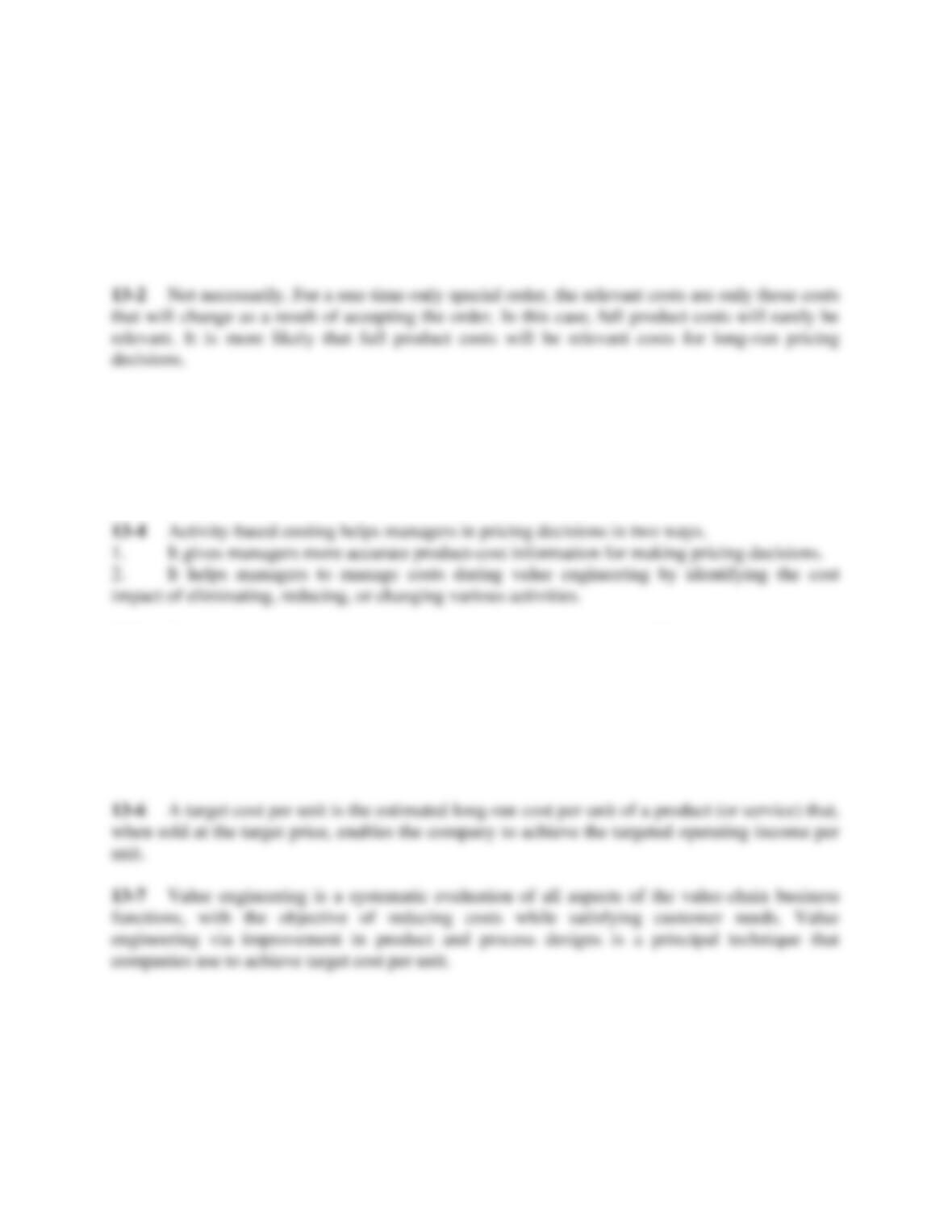
13-1 The three major influences on pricing decisions are
1. Customers
2. Competitors
3. Costs
13-3 Four purposes of cost allocation are as follows:
1. To provide information for economic decisions
2. To motivate managers and other employees
3. To justify costs or compute reimbursement amounts
4. To measure income and assets
13-5 Two alternative approaches to long-run pricing decisions are the following:
1. Market-based pricing, an important form of which is target pricing. The market-based
approach asks, “Given what our customers want and how our competitors will react to what we
do, what price should we charge?”
2. Cost-based pricing which asks, “What does it cost us to make this product and, hence,
what price should we charge that will recoup our costs and achieve a target return on
investment?”
13-8 A value-added cost is a cost that customers perceive as adding value, or utility, to a
product or service. Examples are costs of materials, direct labor, tools, and machinery. A
nonvalue-added cost is a cost that customers do not perceive as adding value, or utility, to a
product or service. Examples of nonvalue-added costs are costs of rework, scrap, expediting, and
breakdown maintenance.
13-2
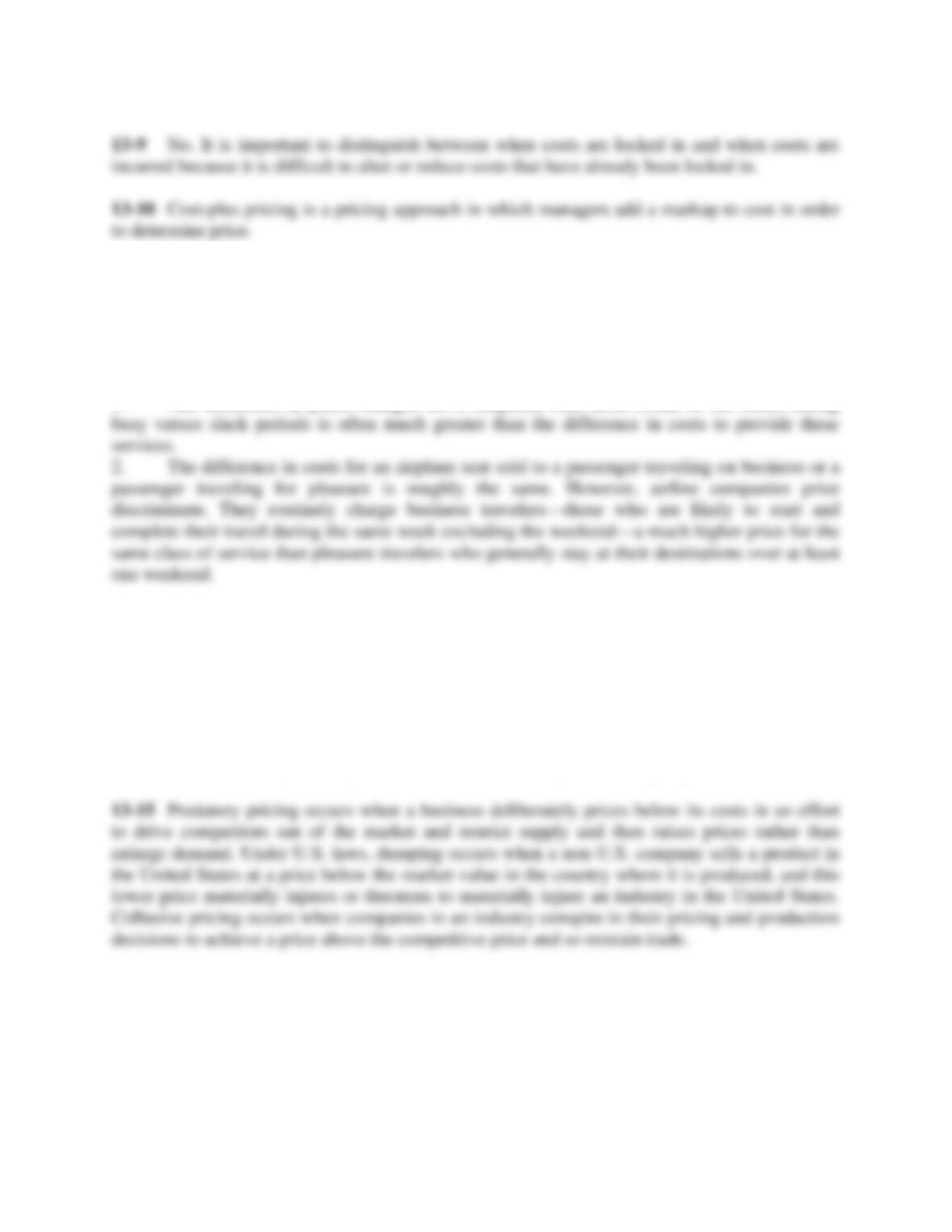
13-11 Cost-plus pricing methods vary depending on the bases used to calculate prices.
Examples are (a) variable manufacturing costs; (b) manufacturing function costs; (c) variable
product costs; and (d) full product costs.
13-12 Two examples where the difference in the costs of two products or services is much
smaller than the differences in their prices are:
1. The difference in prices charged for a telephone call, hotel room, or car rental during
13-13 Life-cycle budgeting is an estimate of the revenues and costs attributable to each product
from its initial R&D to its final customer servicing and support.
13-14 Three benefits of using a product life-cycle reporting format are the following:
1. The full set of revenues and costs associated with each product becomes more visible.
2. Differences among products in the percentage of total costs committed at early stages in
the life cycle are highlighted.
3. Interrelationships among business function cost categories are highlighted.
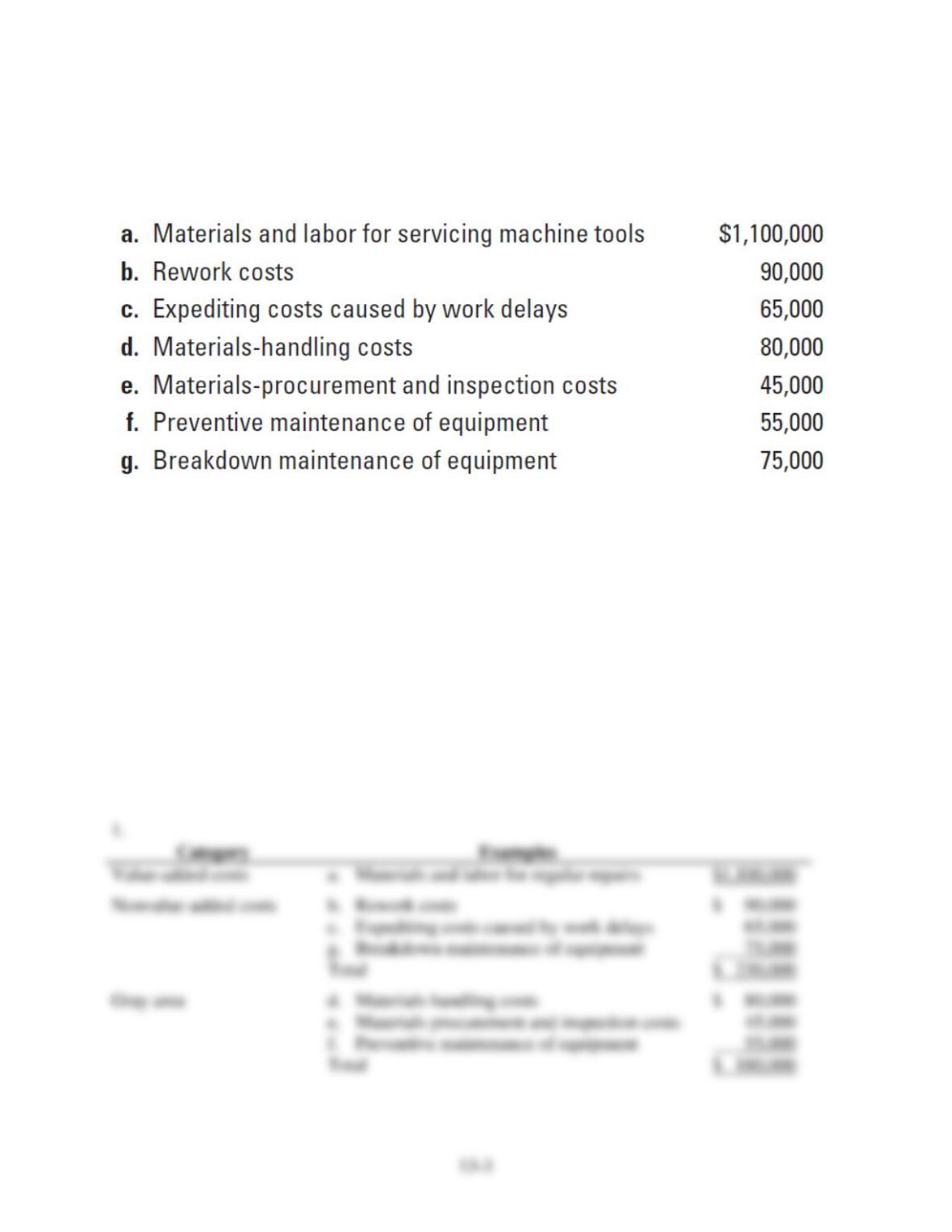
13-16 (25–30 min.) Value-added, nonvalue-added costs.
The Magill Repair Shop repairs and services machine tools. A summary of its costs (by activity)
for 2013 is as follows:
Required:
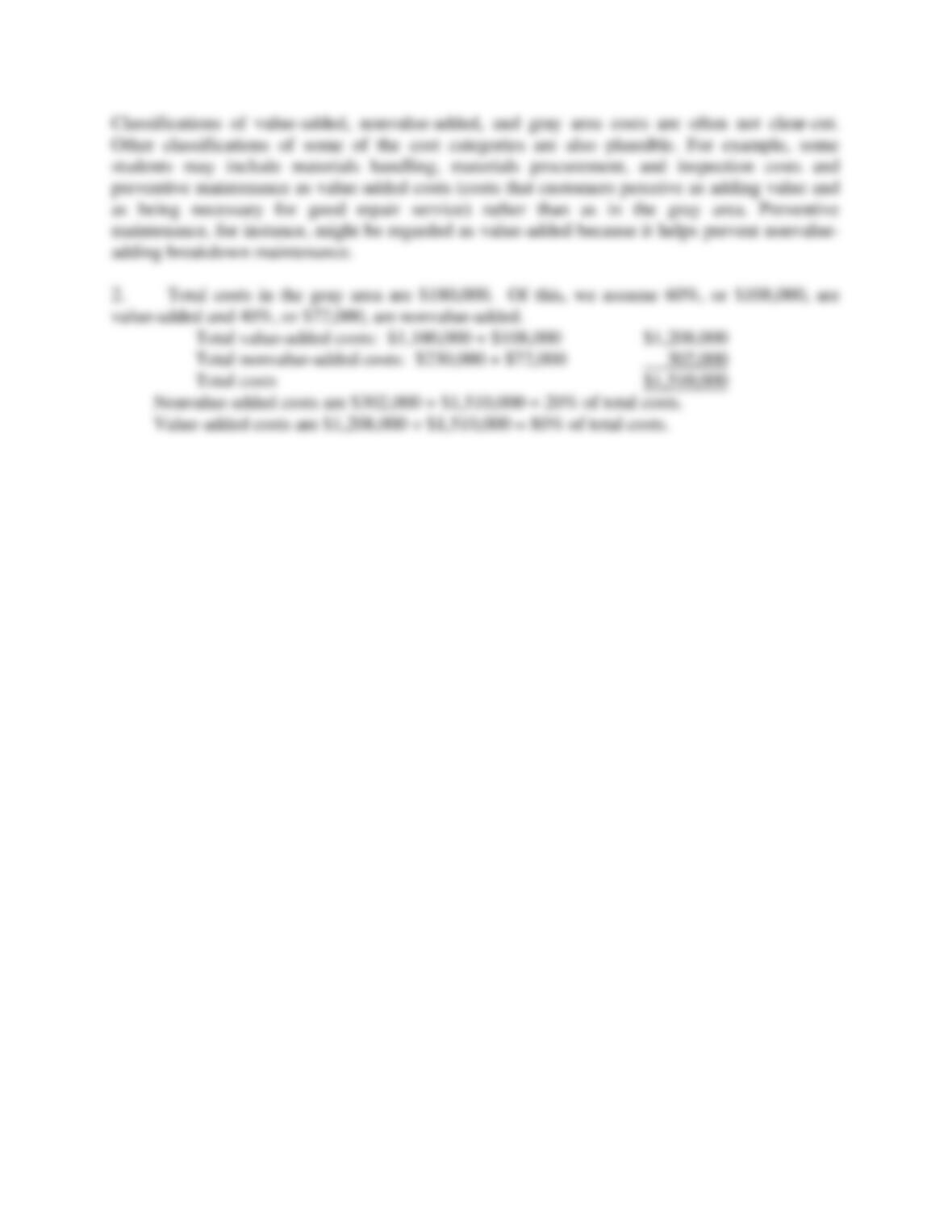
1. Classify each cost as value-added, non-value-added, or in the gray area between.
2. For any cost classified in the gray area, assume 60% is value-added and 40% is non-value-
added. How much of the total of all seven costs is value-added and how much is non-value-
added?
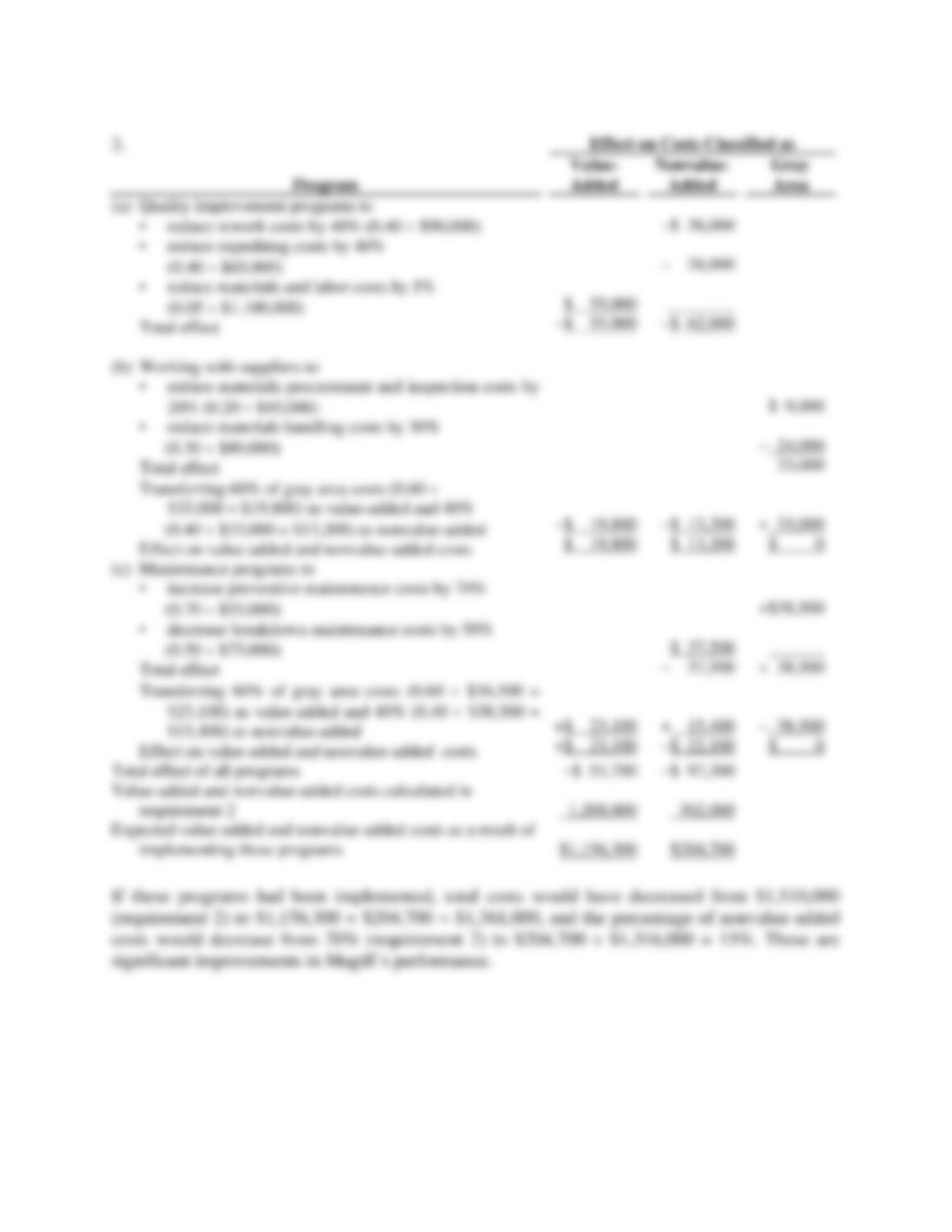
3. Magill is considering the following changes: (a) introducing quality-improvement programs
whose net effect will be to reduce rework and expediting costs by 40% and materials and
labor costs for servicing machine tools by 5%; (b) working with suppliers to reduce
materials-procurement and inspection costs by 20% and materials-handling costs by 30%;
and (c) increasing preventive-maintenance costs by 70% to reduce breakdown-maintenance
costs by 50%. Calculate the effect of programs (a), (b), and (c) on value-added costs, non-
value-added costs, and total costs. Comment briefly.
SOLUTION
13-4
13-5
13-6
13-17 (25−30 min.) Target operating income, value-added costs, service company.
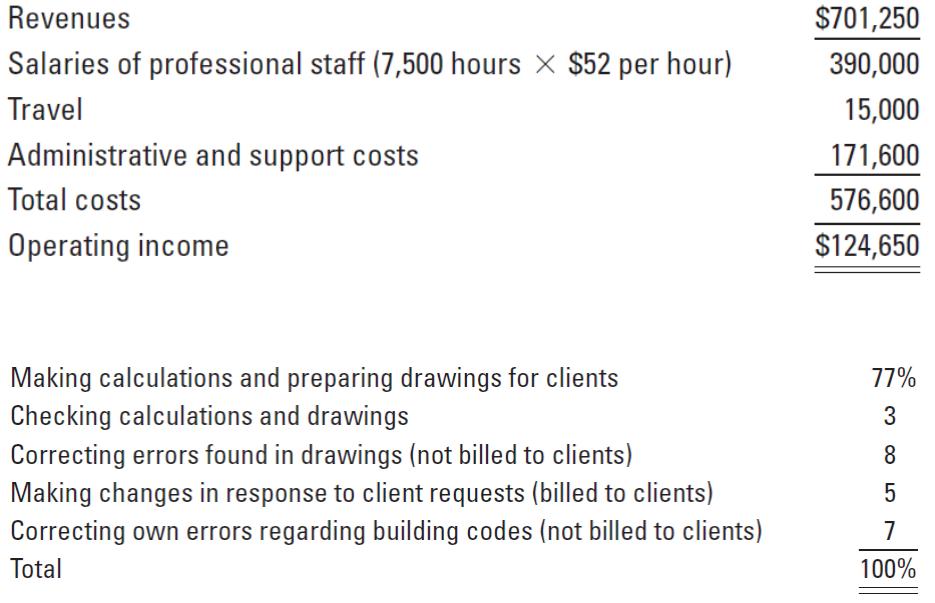
Calvert Associates prepares architectural drawings to conform to local structural-safety codes. Its
income statement for 2013 is as follows:
Following is the percentage of time spent by professional staff on various activities:
Assume administrative and support costs vary with professional-labor costs. Consider each
requirement independently.
Required:
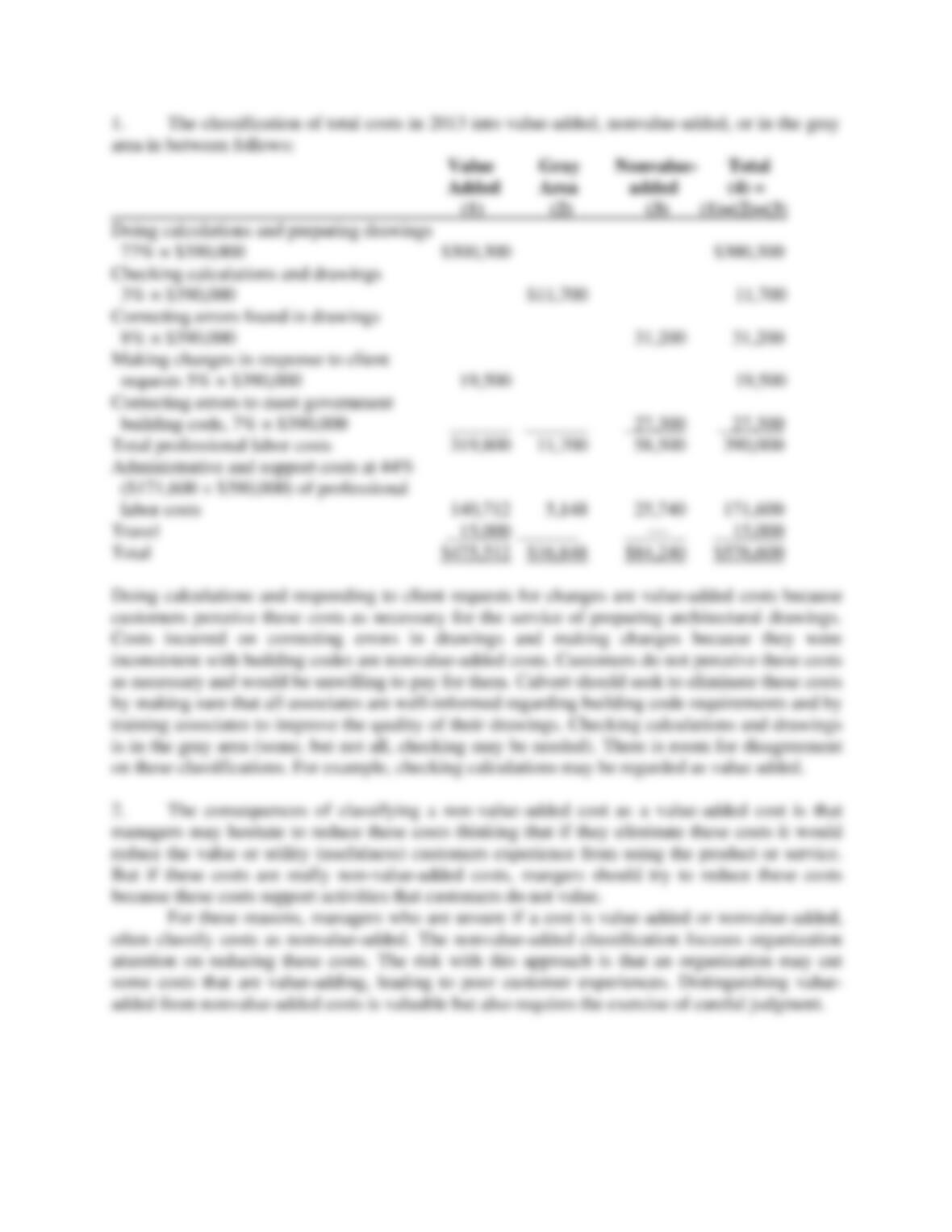
1. How much of the total costs in 2013 are value-added, non-value-added, or in the gray area
between? Explain your answers briefly. What actions can Calvert take to reduce its costs?
2. What are the consequences of misclassifying a non-value-added cost as a value-added cost?
When in doubt, would you classify a cost as a value-added or non-value-added cost? Explain
briefly.
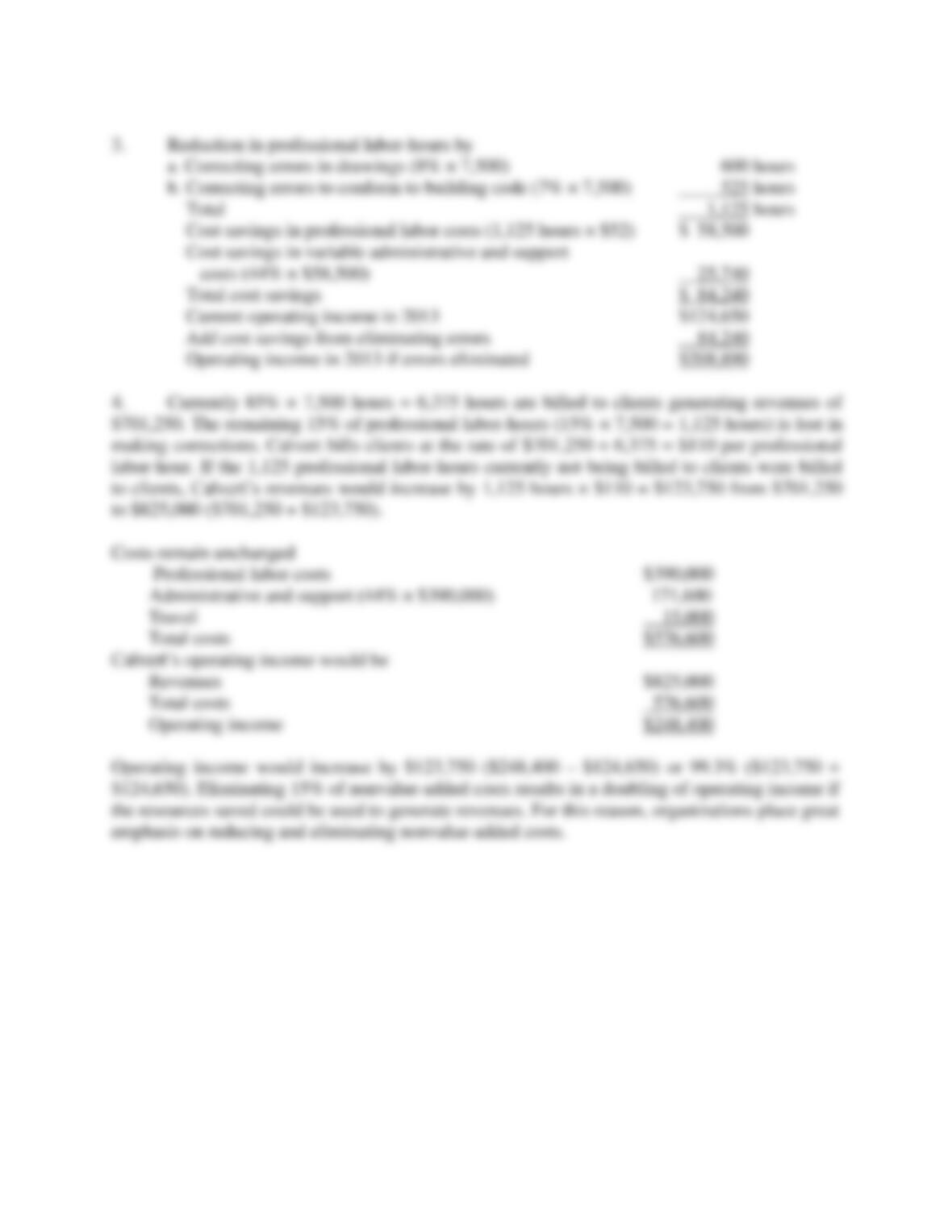
3. Suppose Calvert could eliminate all errors so that it did not need to spend any time making
corrections and, as a result, could proportionately reduce professional-labor costs. Calculate
Calvert’s operating income for 2013.
4. Now suppose Calvert could take on as much business as it could complete, but it could not
add more professional staff. Assume Calvert could eliminate all errors so that it does not
need to spend any time correcting errors. Assume Calvert could use the time saved to
increase revenues proportionately. Assume travel costs will remain at $15,000. Calculate
Calvert’s operating income for 2013.
SOLUTION
13-7
13-8
13-9
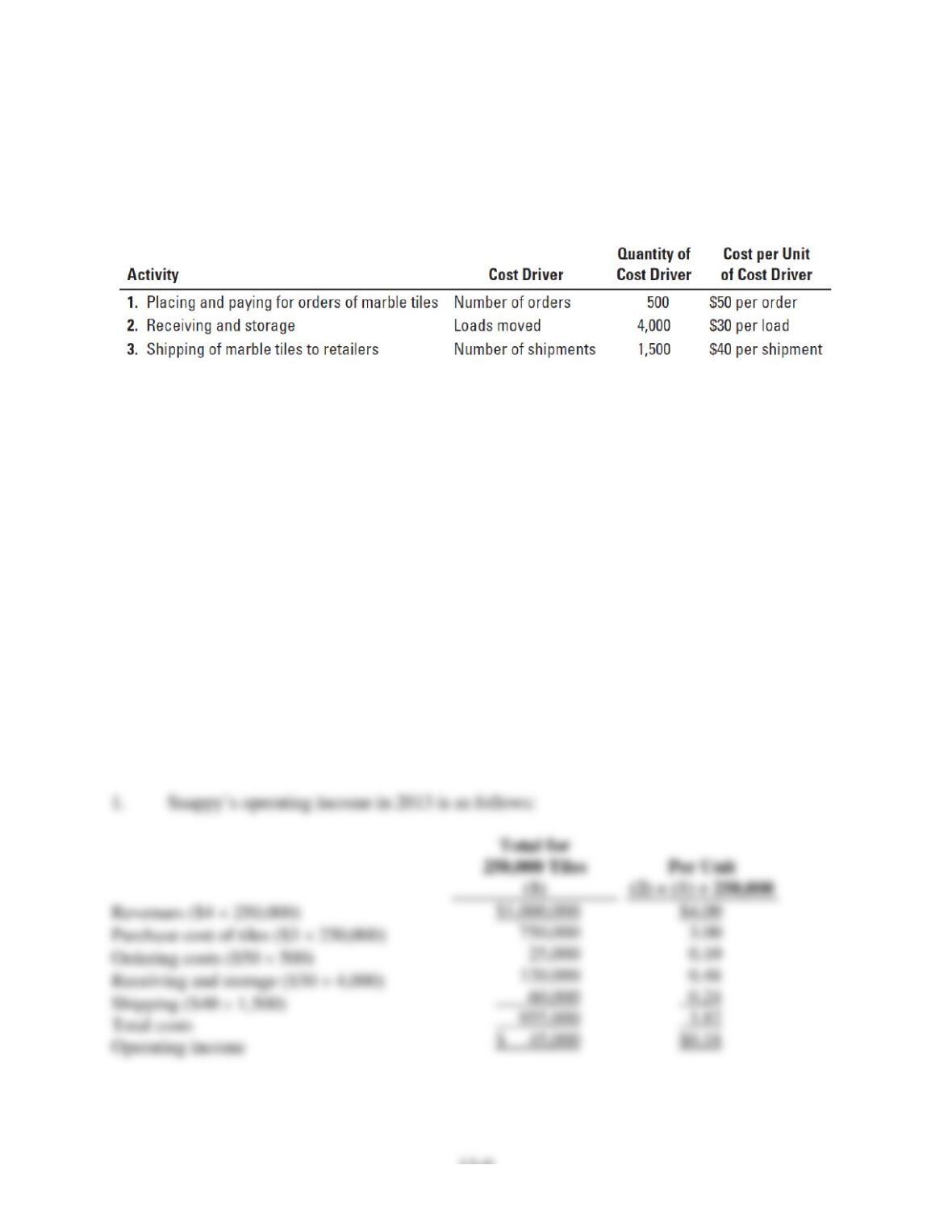
13-18 (25–30 min.) Target prices, target costs, activity-based costing.
Snappy Tiles is a small distributor of marble tiles. Snappy identifies its three major activities and
cost pools as ordering, receiving and storage, and shipping, and it reports the following details
for 2013:
For 2013, Snappy buys 250,000 marble tiles at an average cost of $3 per tile and sells them to
retailers at an average price of $4 per tile. Assume Snappy has no fixed costs and no inventories.
Required:
1. Calculate Snappy’s operating income for 2013.
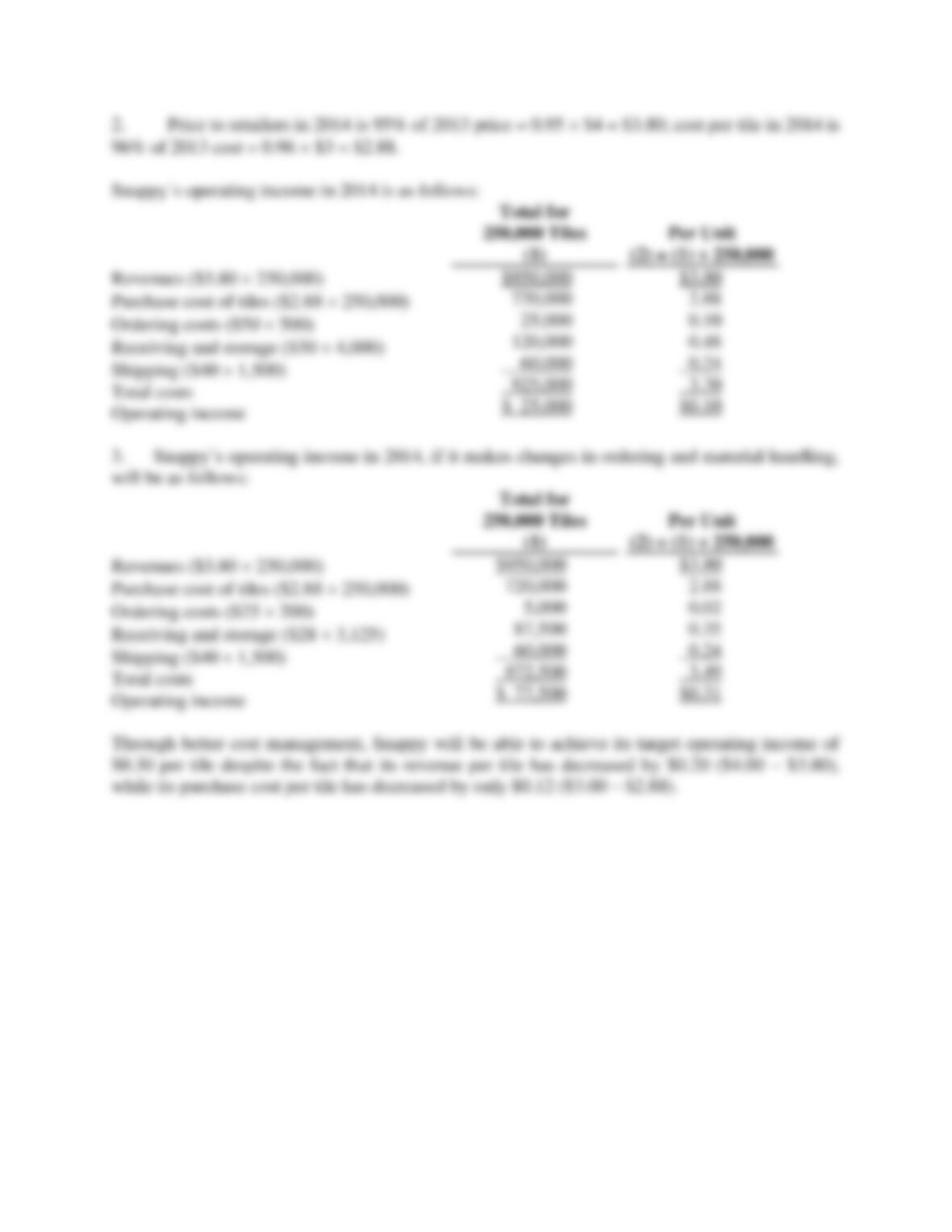
2. For 2014, retailers are demanding a 5% discount off the 2013 price. Snappy’s suppliers are
only willing to give a 4% discount. Snappy expects to sell the same quantity of marble tiles
in 2014 as in 2013. If all other costs and cost-driver information remain the same, calculate
Snappy’s operating income for 2014.
3. Suppose further that Snappy decides to make changes in its ordering and receiving-and-
storing practices. By placing long-run orders with its key suppliers, Snappy expects to reduce
the number of orders to 200 and the cost per order to $25 per order. By redesigning the
layout of the warehouse and reconfiguring the crates in which the marble tiles are moved,
Snappy expects to reduce the number of loads moved to 3,125 and the cost per load moved to
$28. Will Snappy achieve its target operating income of $0.30 per tile in 2014? Show your
calculations.
SOLUTION
13-10
13-19 (20 min.) Target costs, effect of product-design changes on product costs.
Neuro Instruments uses a manufacturing costing system with one direct-cost category (direct
materials) and three indirect-cost categories:
a. Setup, production order, and materials-handling costs that vary with the number of batches
b. Manufacturing-operations costs that vary with machine-hours
c. Costs of engineering changes that vary with the number of engineering changes made
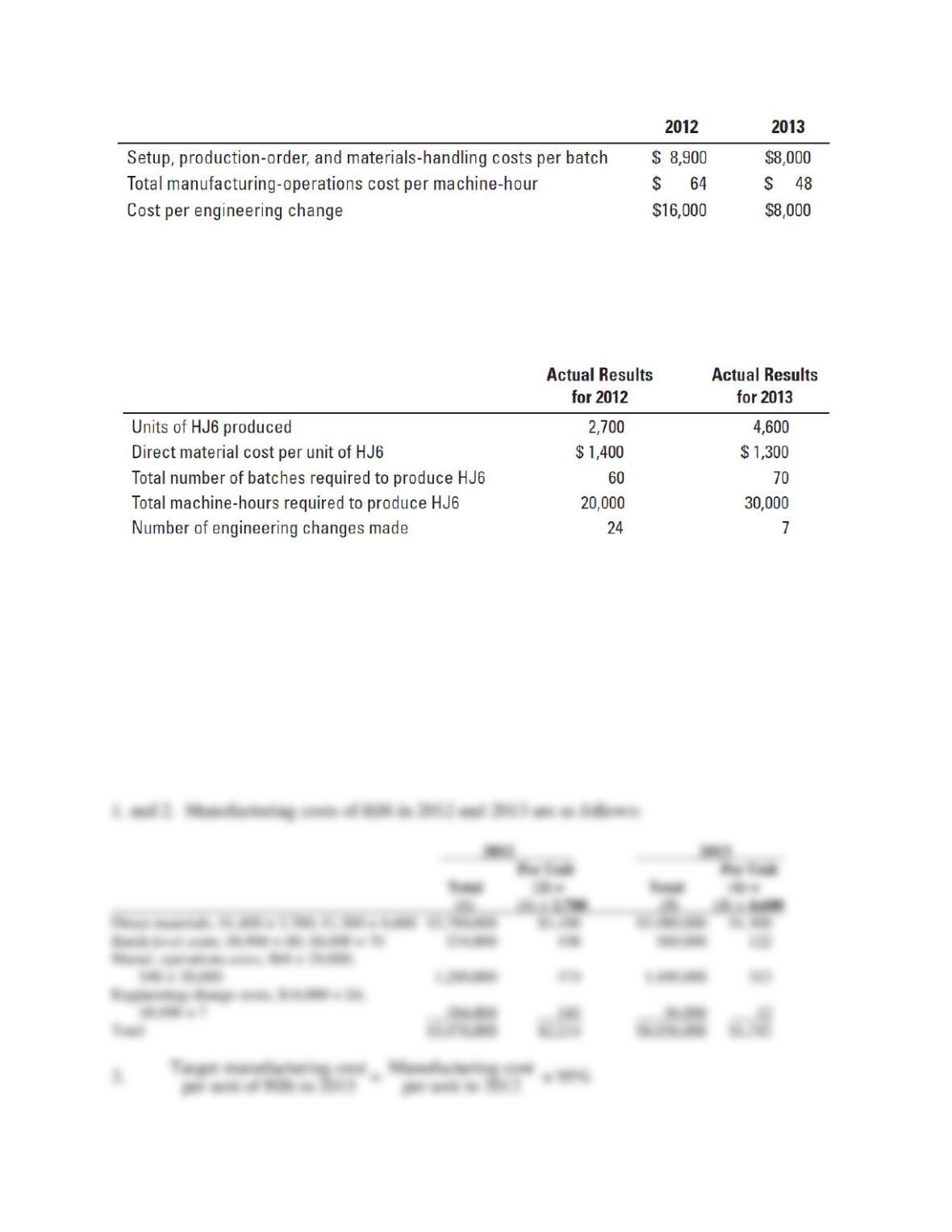
In response to competitive pressures at the end of 2012, Neuro Instruments used value-
engineering techniques to reduce manufacturing costs. Actual information for 2012 and 2013 is
as follows:
13-11
The management of Neuro Instruments wants to evaluate whether value engineering has
succeeded in reducing the target manufacturing cost per unit of one of its products, HJ6, by 5%.
Actual results for 2012 and 2013 for HJ6 are:
Required:
1. Calculate the manufacturing cost per unit of HJ6 in 2012.
2. Calculate the manufacturing cost per unit of HJ6 in 2013.
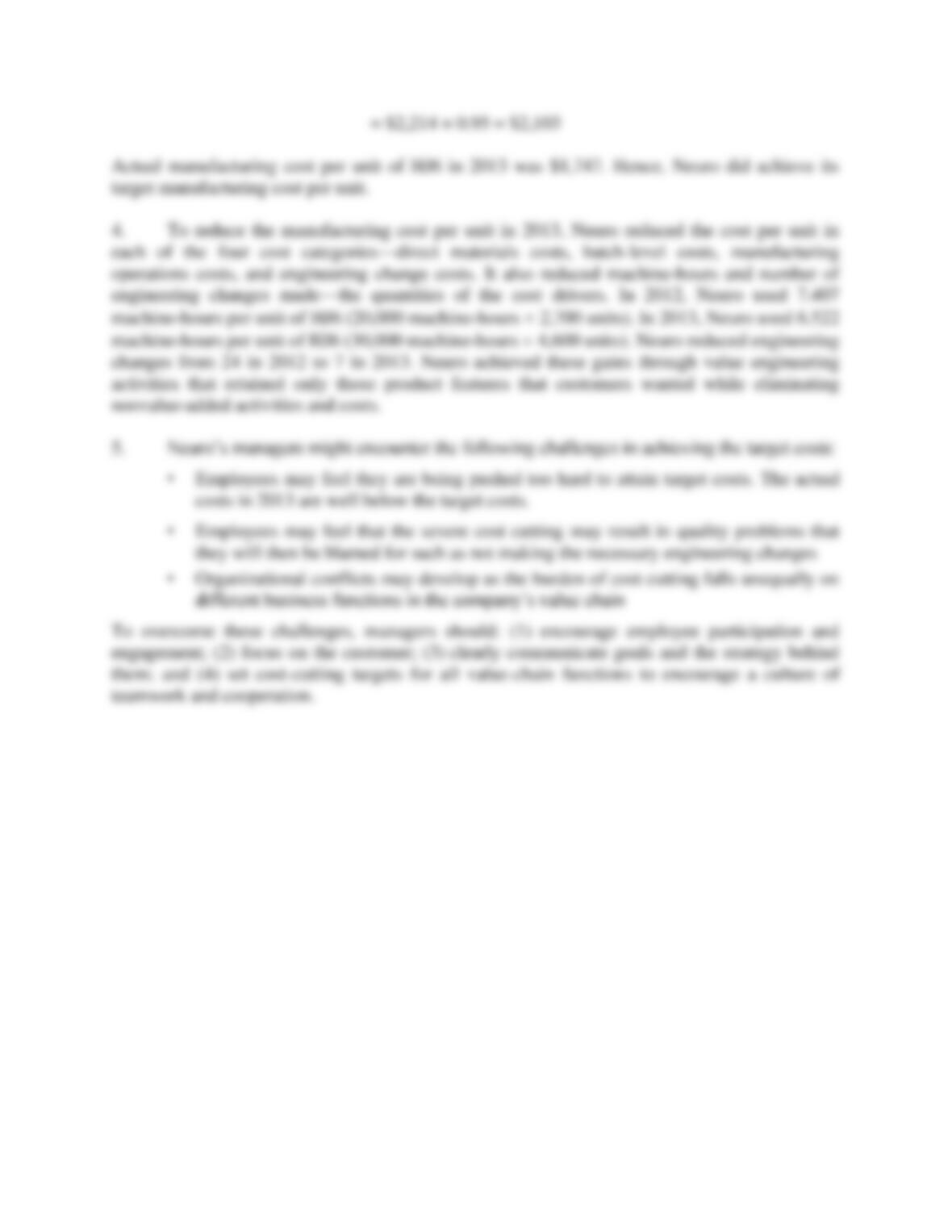
3. Did Neuro Instruments achieve the target manufacturing cost per unit for HJ6 in 2013?
Explain.
4. Explain how Neuro Instruments reduced the manufacturing cost per unit of HJ6 in 2013.
5. What challenges might managers at Neuro Instruments encounter in achieving the target
cost? How might they overcome these challenges?
SOLUTION
13-12
13-20 (25 min.) Target costs, effect of process-design changes on service costs.
Sun Systems provides energy audits in residential areas of southern Ohio. The energy audits
provide information to homeowners on the benefits of solar energy. A consultant from Sun
Systems educates the homeowner about federal and state rebates and tax credits available for
purchases and installations of solar heating systems. A successful energy audit results in the
homeowner purchasing a solar heating system. Sun Systems does not install the solar heating
system, but arranges for the installation with a local company. Sun Systems completes all
necessary paperwork related to the rebates, tax credits, and financing. The company has
identified three major activities that drive the cost of energy audits: identifying new contacts
(that varies with the number of new contacts); traveling to and between appointments (that varies
with the number of miles driven); and preparing and filing rebates and tax forms (that varies with
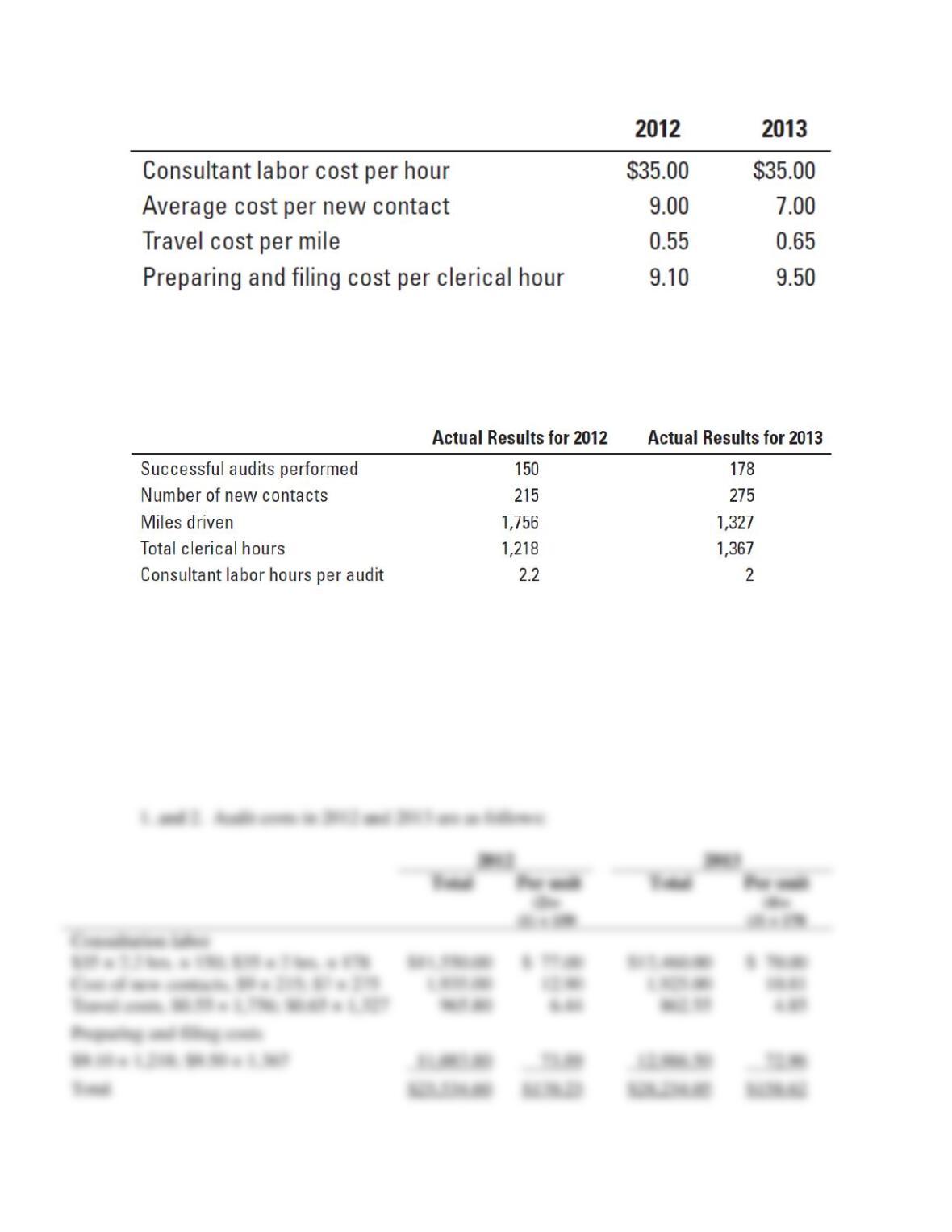
the number of clerical hours). Actual costs for each of these activities in 2012 and 2013 are:
13-13
In 2013, Sun Systems used value engineering to reduce the cost of the energy audits. Managers
at Sun Systems want to evaluate whether value engineering has succeeded in reducing the target
cost per audit by 5%.
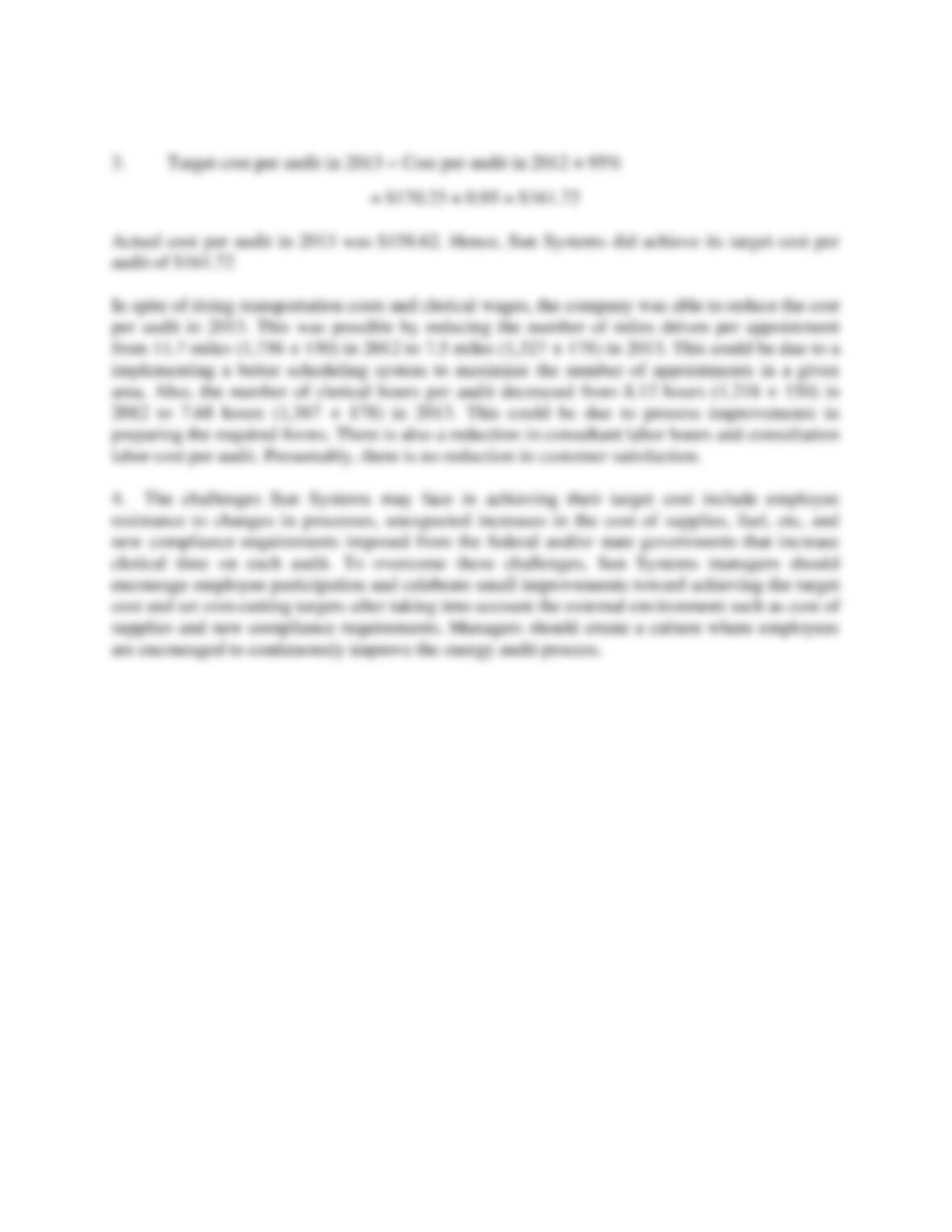
Actual results for 2012 and 2013 for Sun Systems are:
Required:
1. Calculate the cost per audit in 2012.
2. Calculate the cost per audit in 2013.
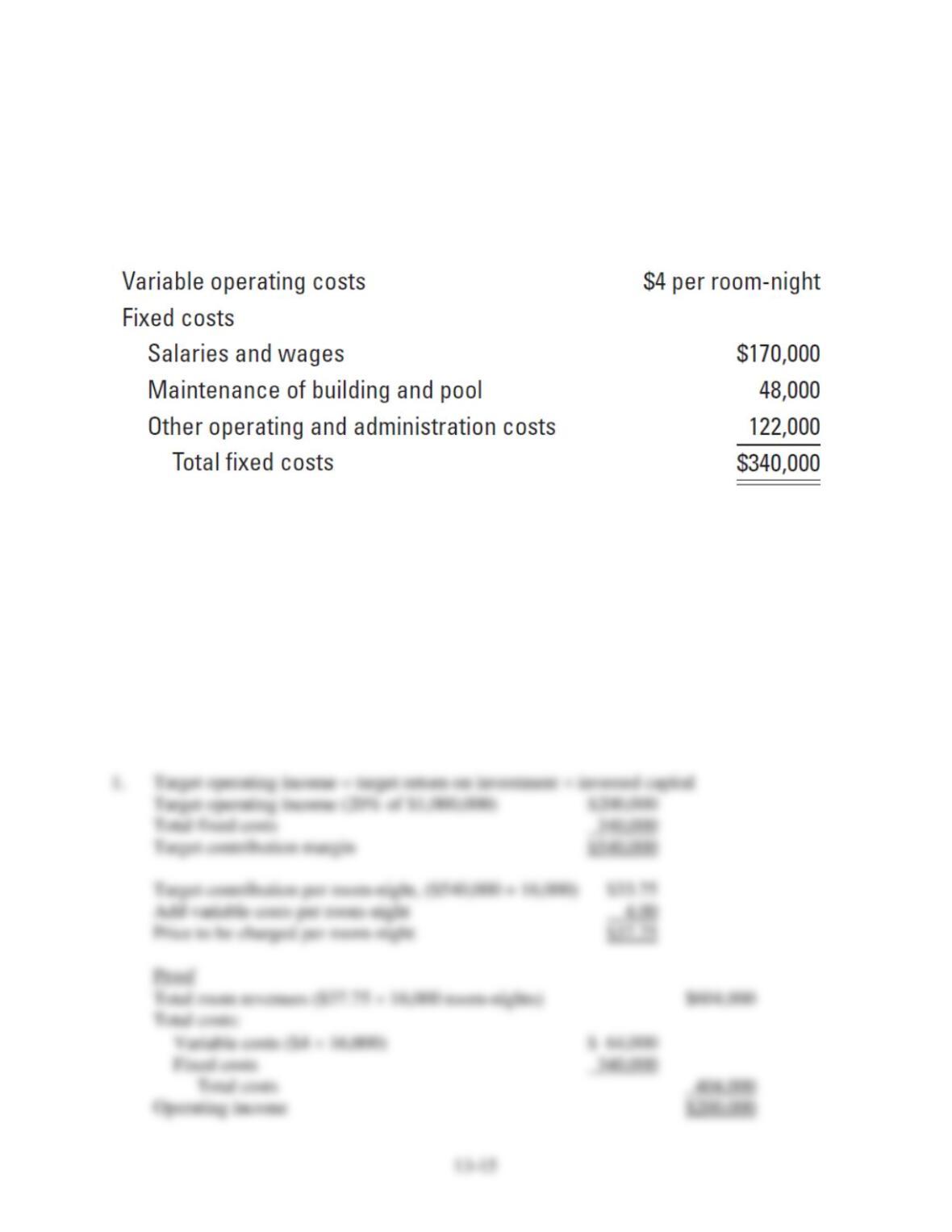
3. Did Sun Systems achieve the target cost per audit in 2013? Explain.
4. What challenges might managers at Sun Systems encounter in achieving the target cost and
how might they overcome these challenges?
SOLUTION
13-14
13-21 (20 min.) Cost-plus target return on investment pricing.
John Branch is the managing partner of a business that has just finished building a 60-room
motel. Branch anticipates that he will rent these rooms for 16,000 nights next year (or 16,000
room-nights). All rooms are similar and will rent for the same price. Branch estimates the
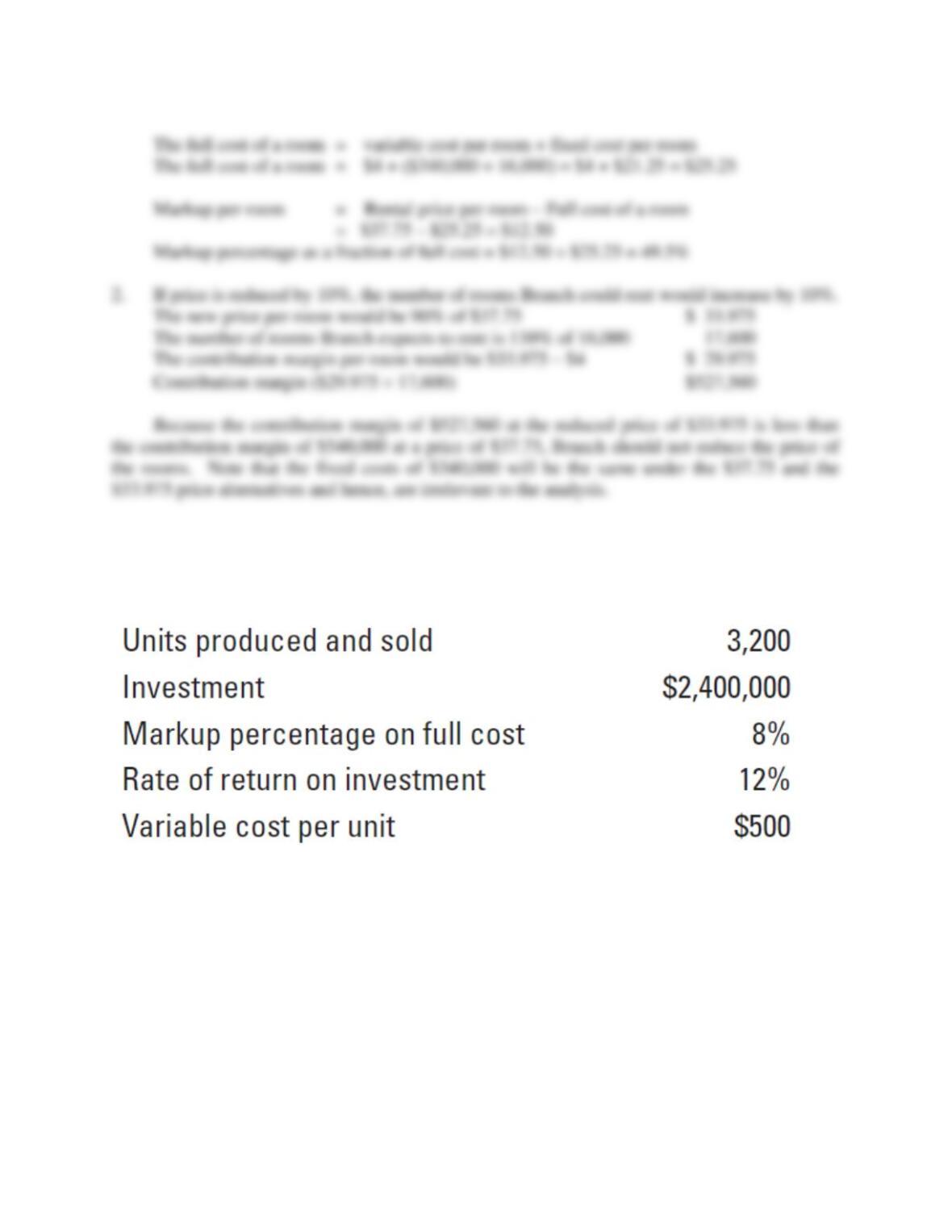
following operating costs for next year:
The capital invested in the motel is $1,000,000. The partnership’s target return on investment is
20%. Branch expects demand for rooms to be uniform throughout the year. He plans to price the
rooms at full cost plus a markup on full cost to earn the target return on investment.
Required:
1. What price should Branch charge for a room-night? What is the markup as a percentage of
the full cost of a room-night?
2. Branch’s market research indicates that if the price of a room-night determined in
requirement 1 is reduced by 10%, the expected number of room-nights Branch could rent
would increase by 10%. Should Branch reduce prices by 10%? Show your calculations.
SOLUTION
13-16
13-22 (25 min.) Cost-plus, target pricing, working backwards.
TinRoof, Inc., manufactures and sells a do–it-yourself storage shed kit. In 2013, it reported the
following:
Required:
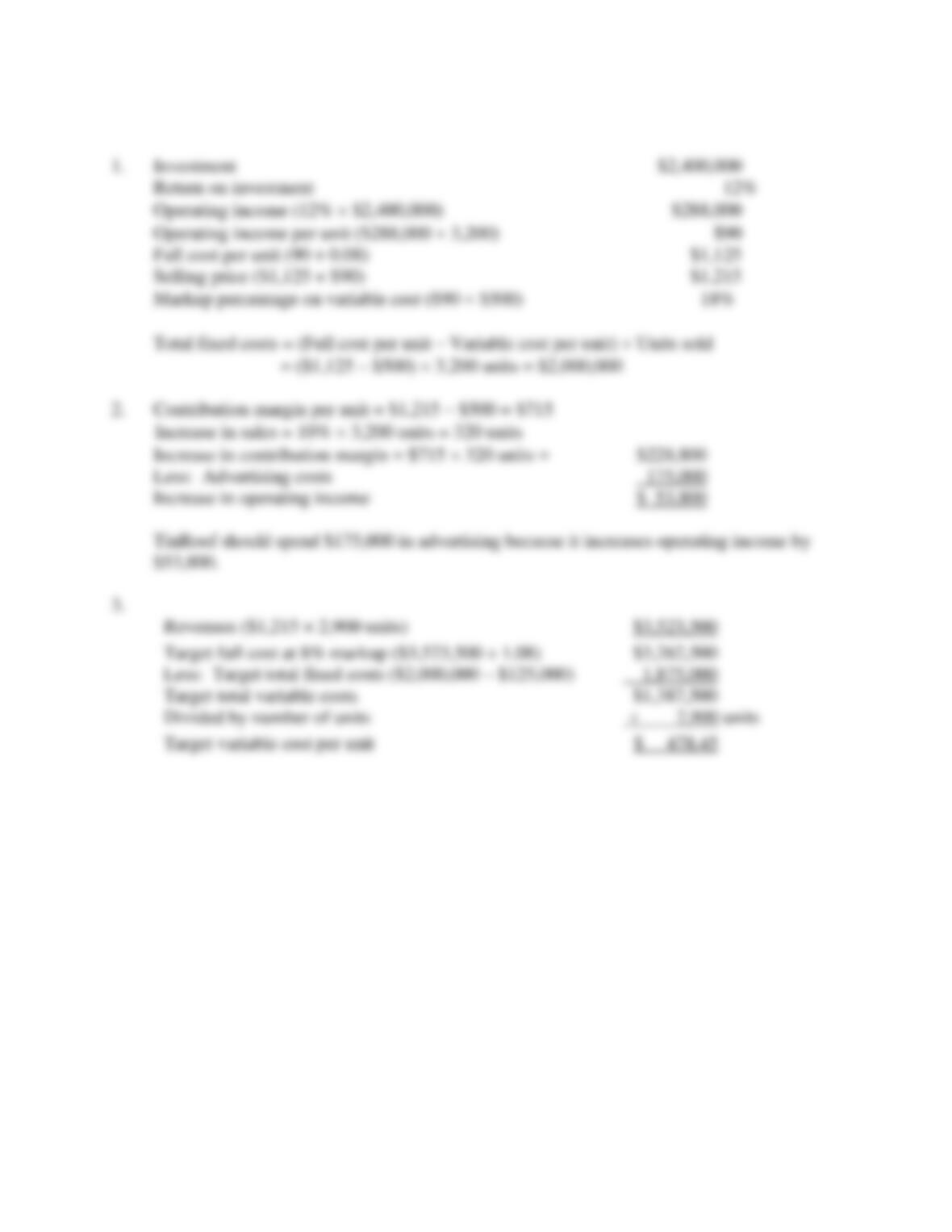
1. What was TinRoof’s operating income in 2013? What was the full cost per unit? What was
the selling price? What was the percentage markup on variable cost?
2. TinRoof is considering increasing the annual spending on advertising by $175,000. The
managers believe that the investment will translate into a 10% increase in unit sales. Should
the company make the investment? Show your calculations.
3. Refer back to the original data. In 2014, TinRoof believes that it will only be able to sell
2,900 units at the price calculated in requirement 1. Management has identified $125,000 in
fixed cost that can be eliminated. If TinRoof wants to maintain an 8% markup on full cost,
what is the target variable cost per unit?
13-17
SOLUTION
13-18
13-23 Life-cycle budgeting and costing.
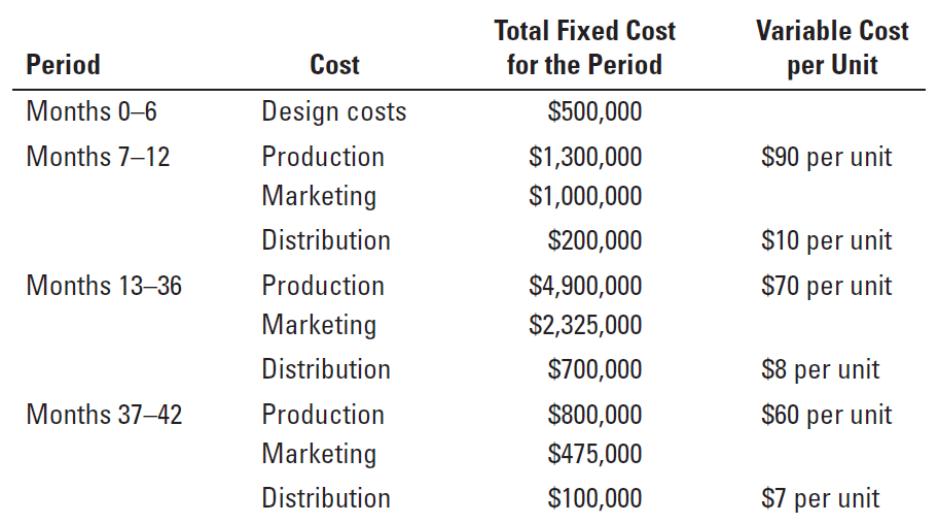
Jurgensen Manufacturing, Inc., plans to develop a new industrial-powered vacuum sweeper for
household use that runs exclusively on rechargeable batteries. The product will take 6 months to
design and test. The company expects the vacuum sweeper to sell 10,000 units during the first 6
months of sales; 20,000 units per year over the following 2 years; and 5,000 units over the final 6
months of the product’s life cycle. The company expects the following costs:
Ignore time value of money.
Required:
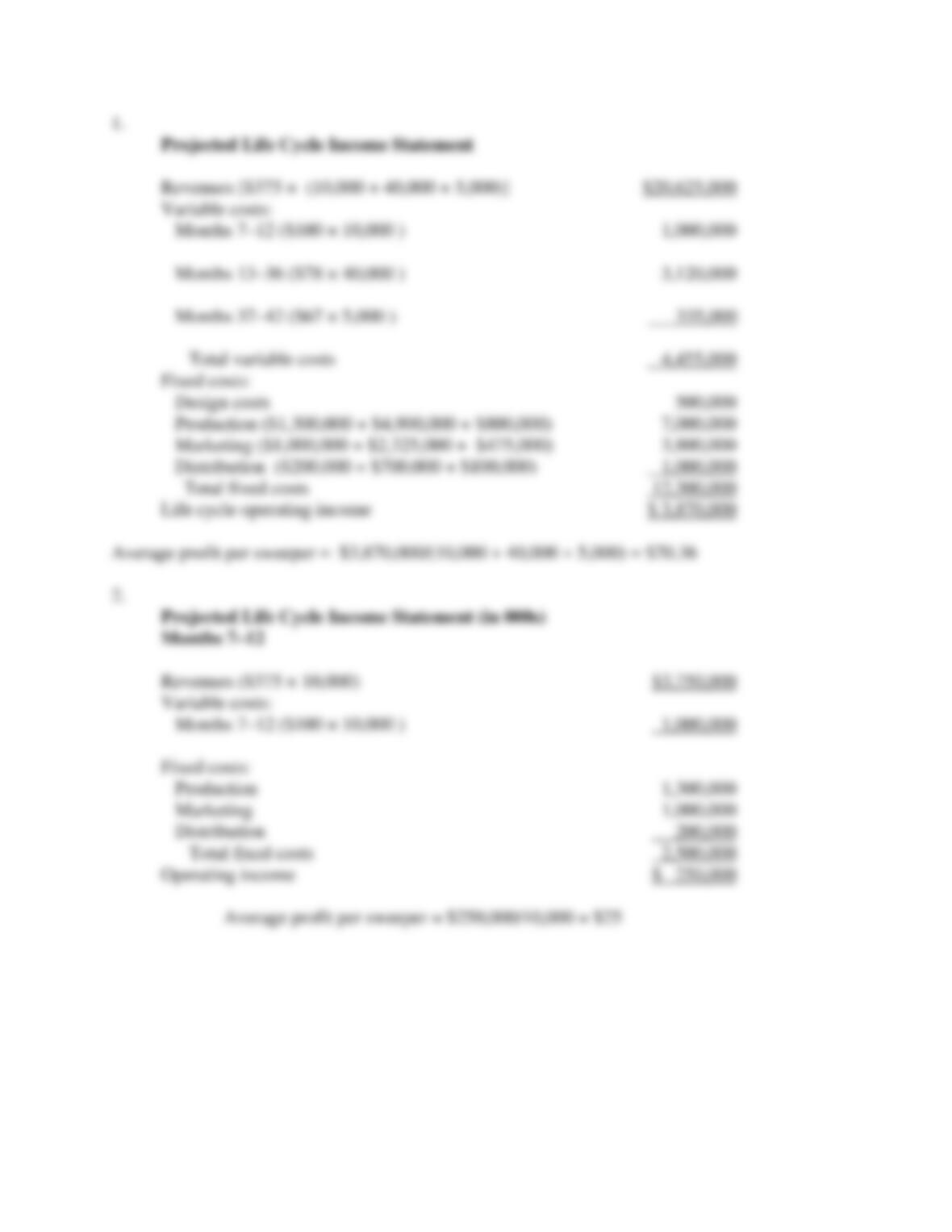
1. If Jurgensen prices the sweepers at $375 each, how much operating income will the company
make over the product’s life cycle? What is the operating income per unit?
2. Excluding the initial product design costs, what is the operating income in each of the three
sales phases of the product’s life cycle, assuming the price stays at $375?
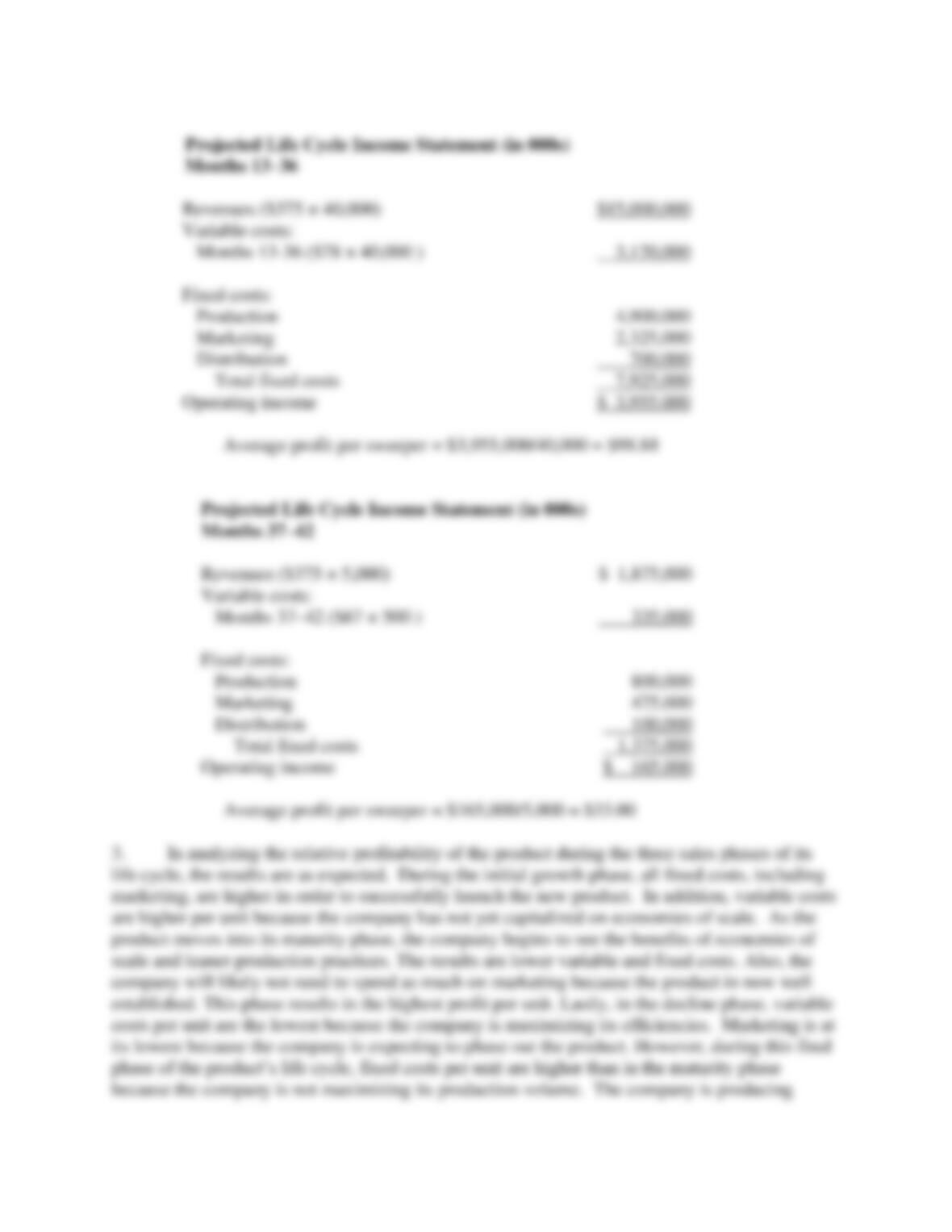
3. How would you explain the change in budgeted operating income over the product’s life
cycle? What other factors does the company need to consider before developing the new
vacuum sweeper?
4. Jurgensen is concerned about the operating income it will report in the first sales phase. It is
considering pricing the vacuum sweeper at $425 for the first 6 months and decreasing the
price to $375 thereafter. With this pricing strategy, Jurgensen expects to sell 9,500 units
instead of 10,000 units in the first 6 months, 19,000 each year over the next 2 years, and
5,000 over the last 6 months. Assuming the same cost structure given in the problem, which
pricing strategy would you recommend? Explain.
SOLUTION
13-19
13-20