Problem 13A-10 (continued)
4. continued
The net operating income at a sales volume of 10,000 units is computed
as follows:
Sales (10,000 units × $20.25 per unit) …………
$202,500
Cost of goods sold (10,000 units × $14.60 per
unit)……………………………………………………
146,000
Gross margin …………………………………………..
56,500
Selling and administrative expenses ($1 per
unit × 10,000 units + $45,000) ………………..
55,000
Net operating income ……………………………….
$ 1,500
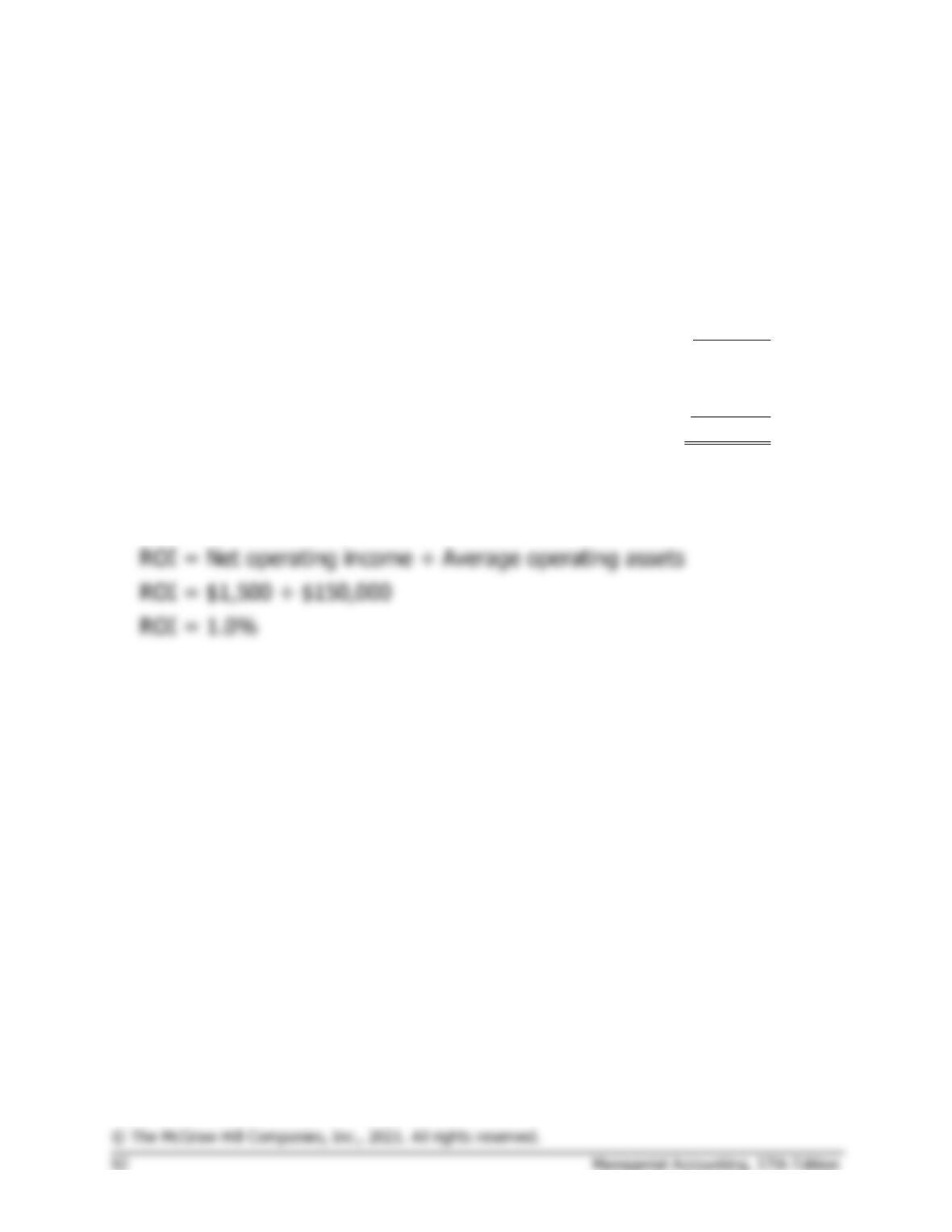
The return on investment (ROI) at a sales volume of 10,000 units is
computed as follows:
Problem 13A-10 (continued)
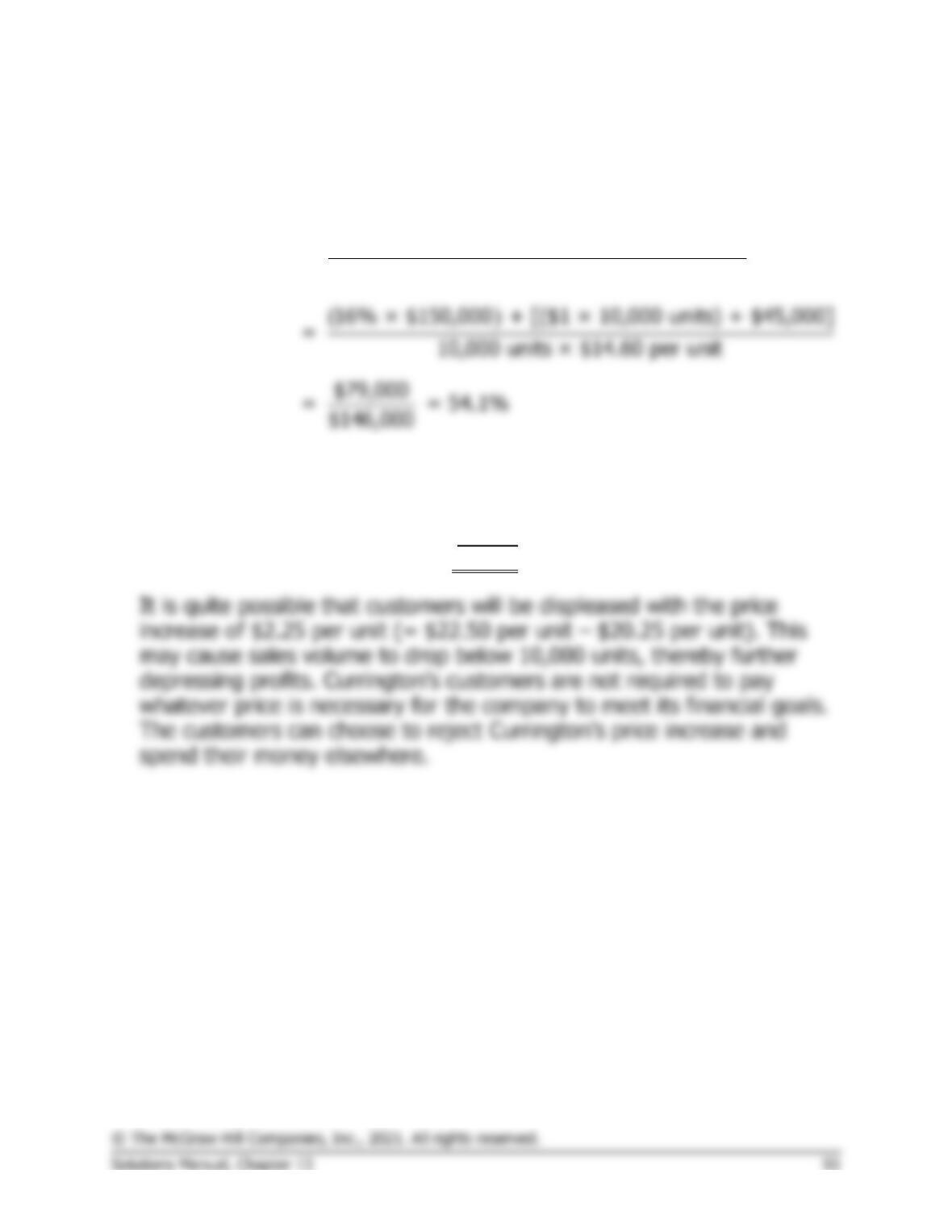
5. The revised markup percentage would be computed as follows:
( )
Required ROI Selling and administraive
+
× Investment expenses
Markup percentage =
on absorption cost Unit sales × Unit product cost
The revised selling price would be computed as follows:
Unit product cost ………………
$14.60
Markup (54.1% × $14.60) ….
7.90
Selling price per unit………….
$22.50
Problem 13A-11 (45 minutes)
1.
Projected sales (100 machines × $4,950 per machine) ..
$495,000
Less desired profit (15% × $600,000) ……………………..
90,000
Target cost for 100 machines ………………………………..
$405,000
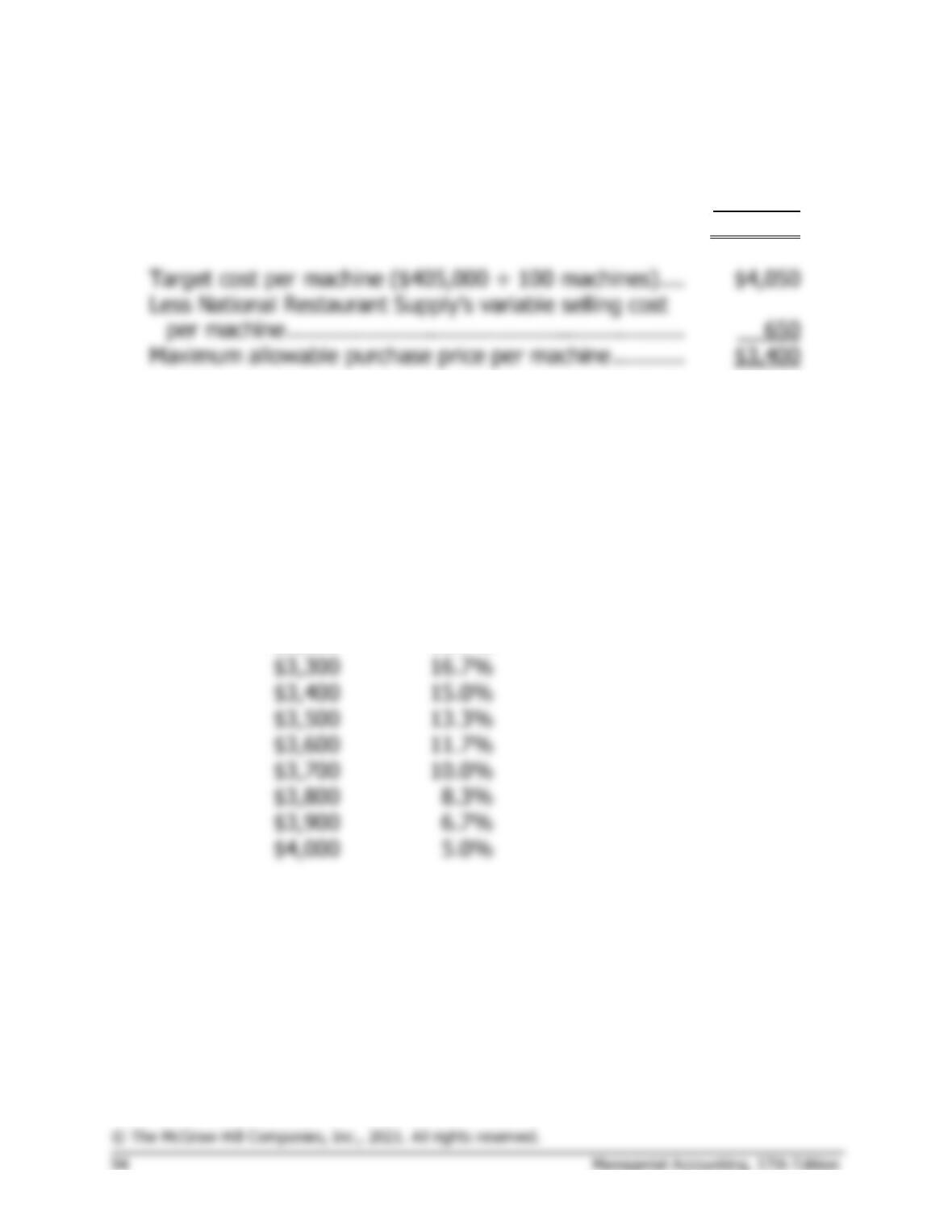
Target cost per machine ($405,000 ÷ 100 machines) ….
650
Maximum allowable purchase price per machine ………..
2. The relation between the purchase price of the machine and ROI can
be developed as follows:
The above formula can be used to compute the ROI for purchase prices
between $3,000 and $4,000 (in increments of $100) as follows:
Purchase price
ROI
$3,000
21.7%
$3,100
20.0%
$3,200
18.3%
$3,400
15.0%
$3,500
13.3%
$3,600
11.7%
$3,700
10.0%
$4,000
Problem 13A-11 (continued)
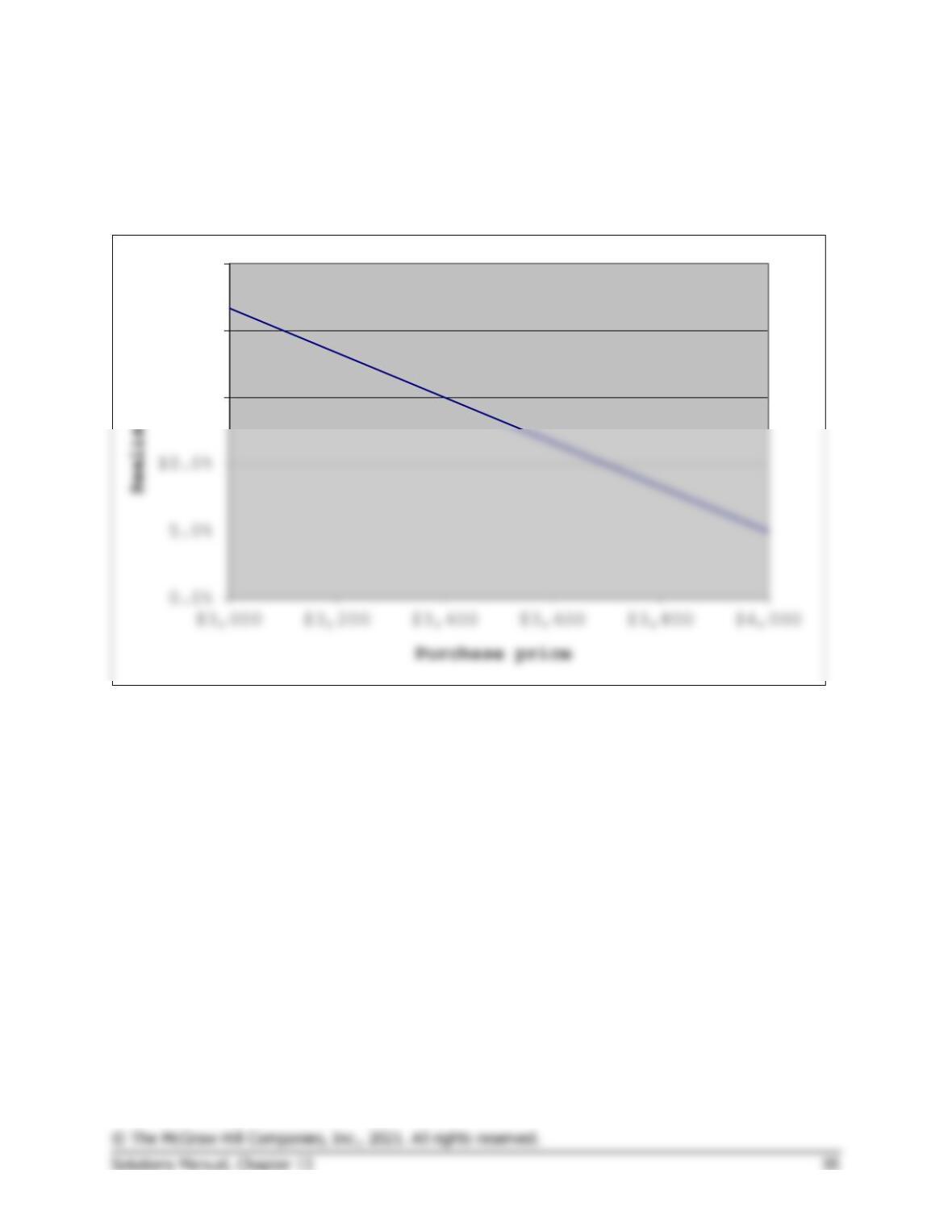
Using the above data, the relation between purchase price and ROI can
be plotted as follows:
15.0%
20.0%
25.0%
Problem 13A-11 (continued)
3. A number of options are available in addition to simply giving up on
adding the new sorbet machines to the company’s product lines. These
options include:
• Check the projected unit sales figures. Perhaps more units could be
sold at the $4,950 price. However, management should be careful not
to indulge in wishful thinking just to make the numbers come out right.
• Improve the selling process to decrease the variable selling costs.
• Rethink the investment that would be required to carry this new
product. Can the size of the inventory be reduced? Are the new
warehouse fixtures really necessary?
Problem 13A-12 (45 minutes)
1. The unit product cost is computed as follows:
Direct materials ……………………………………….
$12.00
Direct labor …………………………………………….
8.00
Unit product cost ……………………………………..
$28.00
2. The markup percentage on absorption cost is computed as follows:
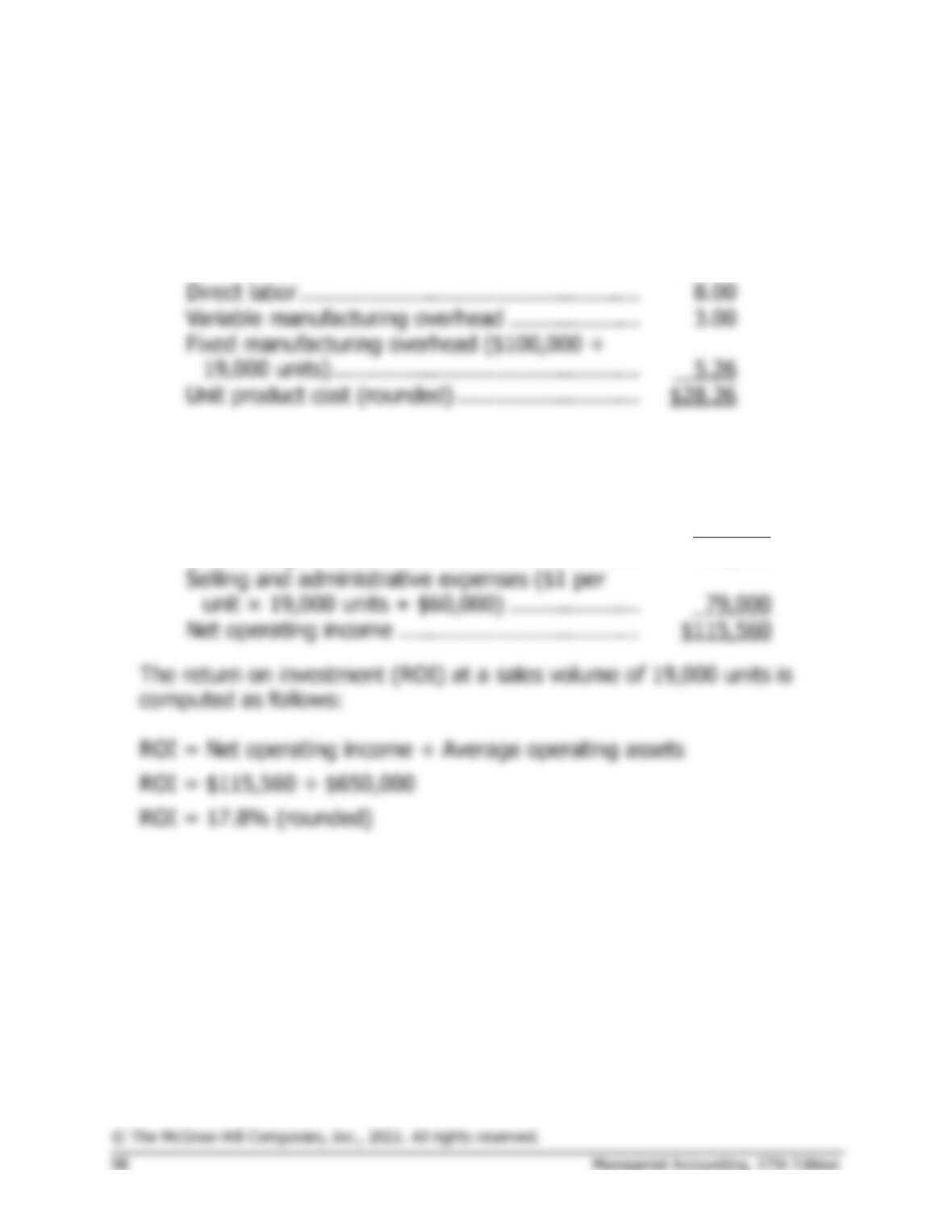
3. The selling price is computed as follows:
Unit product cost………………….
Markup (37.5% × $28.00) ……..
Selling price per unit …………….
Problem 13A-12 (continued)
4. The absorption net operating income at a price of $38.50 and a
production and sales volume of 19,000 units is computed in two steps:
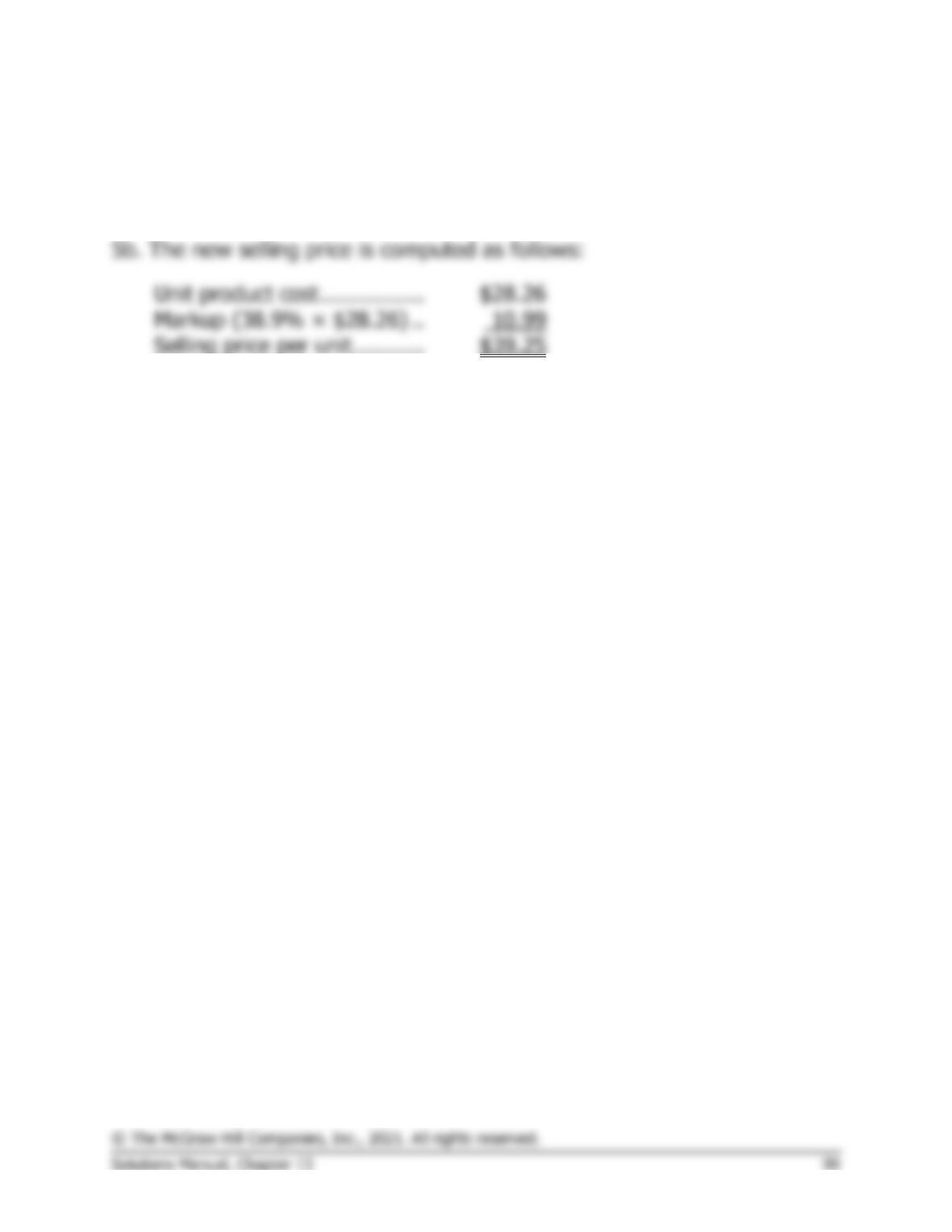
First, the unit product cost should be recomputed as follows:
Direct materials ……………………………………….
$12.00
Direct labor …………………………………………….
8.00
Variable manufacturing overhead ………………..
3.00
Unit product cost (rounded) ……………………….
$28.26
The second step is to compute the net operating income as follows:
Sales (19,000 units × $38.50 per unit) …………
$731,500
Cost of goods sold (19,000 units × $28.26 per
unit)……………………………………………………
536,940
Gross margin …………………………………………..
194,560
Net operating income ……………………………….
Problem 13A-12 (continued)
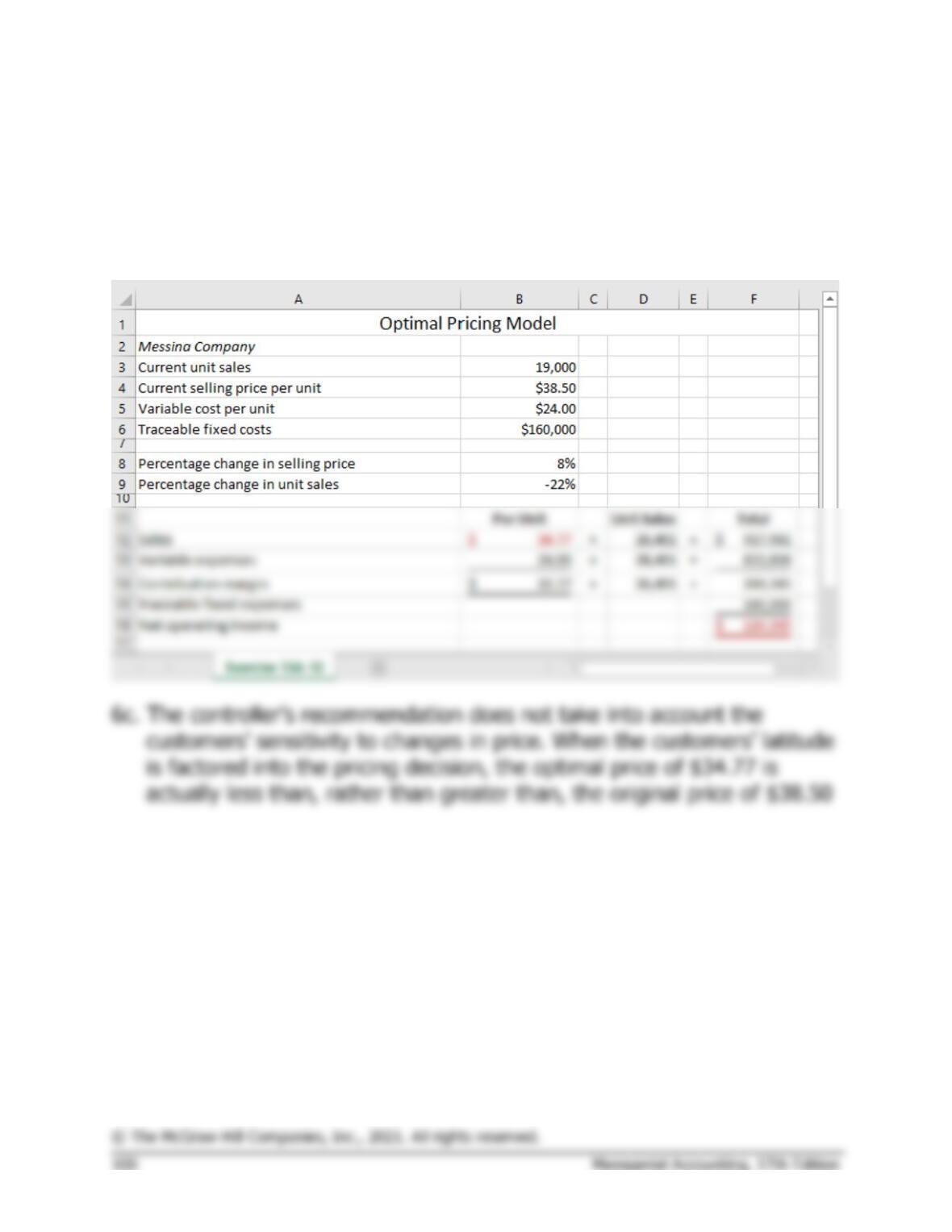
5a. The new markup percentage is computed as follows:
Problem 13A-12 (continued)
6a and 6b.
The optimal selling price ($34.77) and optimal profit ($124,345) are shown
below:
Problem 13A-13 (30 minutes)
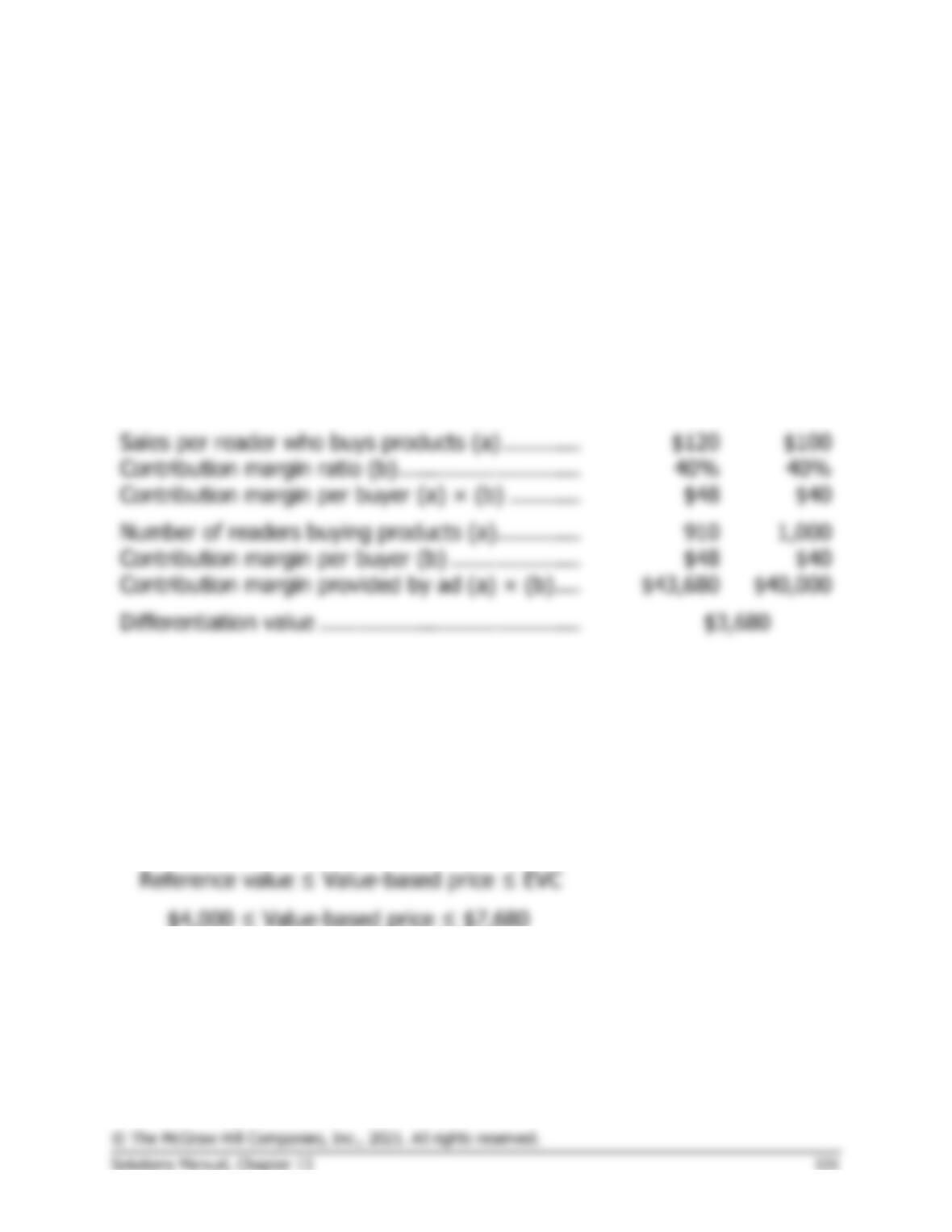
1. The reference value is the price of a full-page ad in Trophy Whitetails
magazine of $4,000 per month.
2. The differentiation value offered by a full-page ad in Midwest Whitetails
magazine is computed as follows:
Midwest
Whitetails
Trophy
Whitetails
Number of readers (a) ……………………………….
130,000
200,000
Percent of readers who buy products (b) ……….
0.7%
0.5%
Number of readers who buy products (a) × (b) .
910
1,000
Sales per reader who buys products (a) …………
Contribution margin ratio (b) ……………………….
Contribution margin per buyer (a) × (b) ………..
$48
$40
Number of readers buying products (a)………….
910
1,000
Contribution margin per buyer (b) ………………..
$48
$40
Contribution margin provided by ad (a) × (b) ….
$43,680
$40,000
Differentiation value ………………………………….
3. The economic value to the customer (EVC) is computed as follows:
EVC = Reference value + Differentiation value
EVC = $4,000 + $3,680
EVC = $7,680
4. The range of possible prices is as follows: