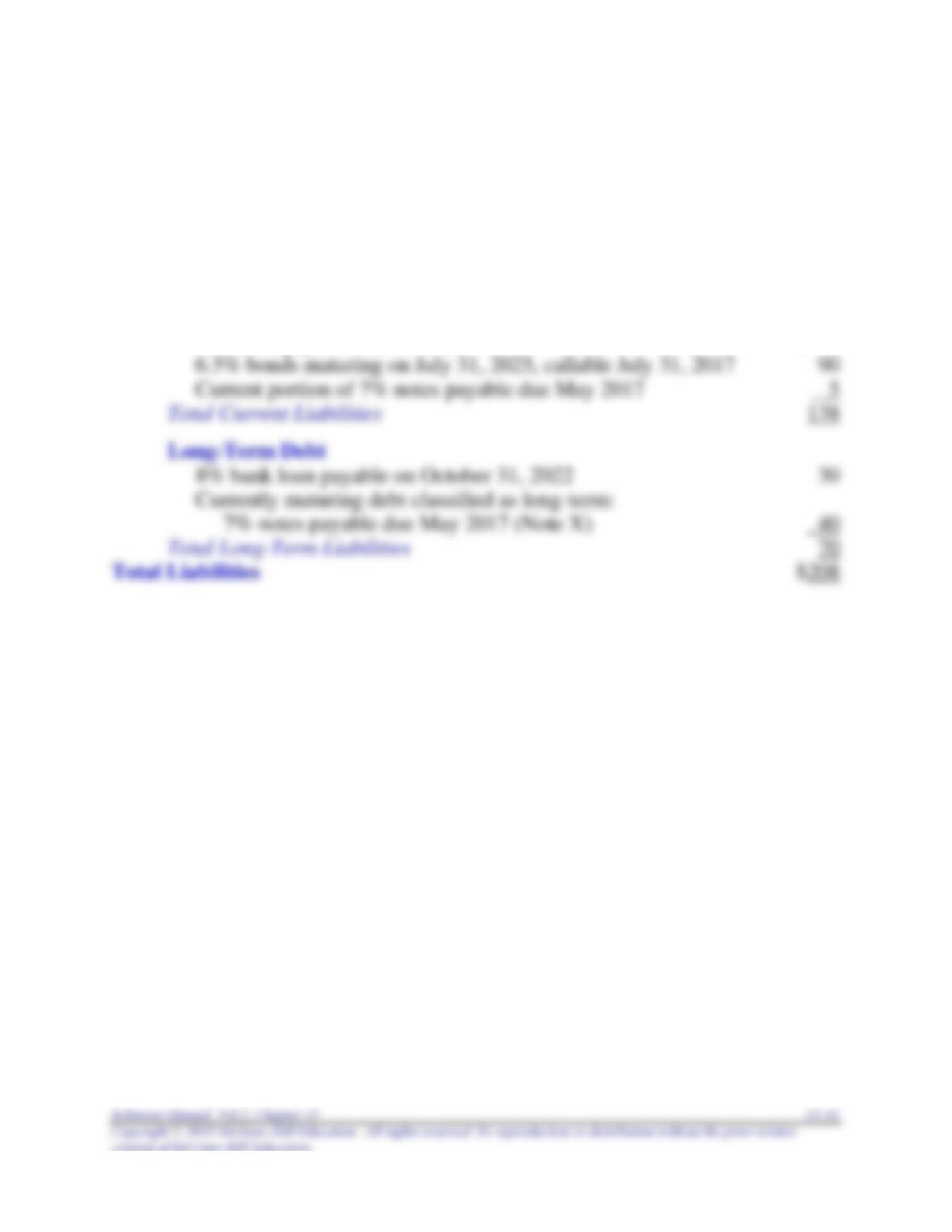
Problem 13–12 (continued)
Requirement 5
December 31, 2016
($ in millions)
Current Liabilities
Accounts payable and accruals $ 43
13–62 Intermediate Accounting, 8/e
Problem 13–12 (continued)
Requirement 6
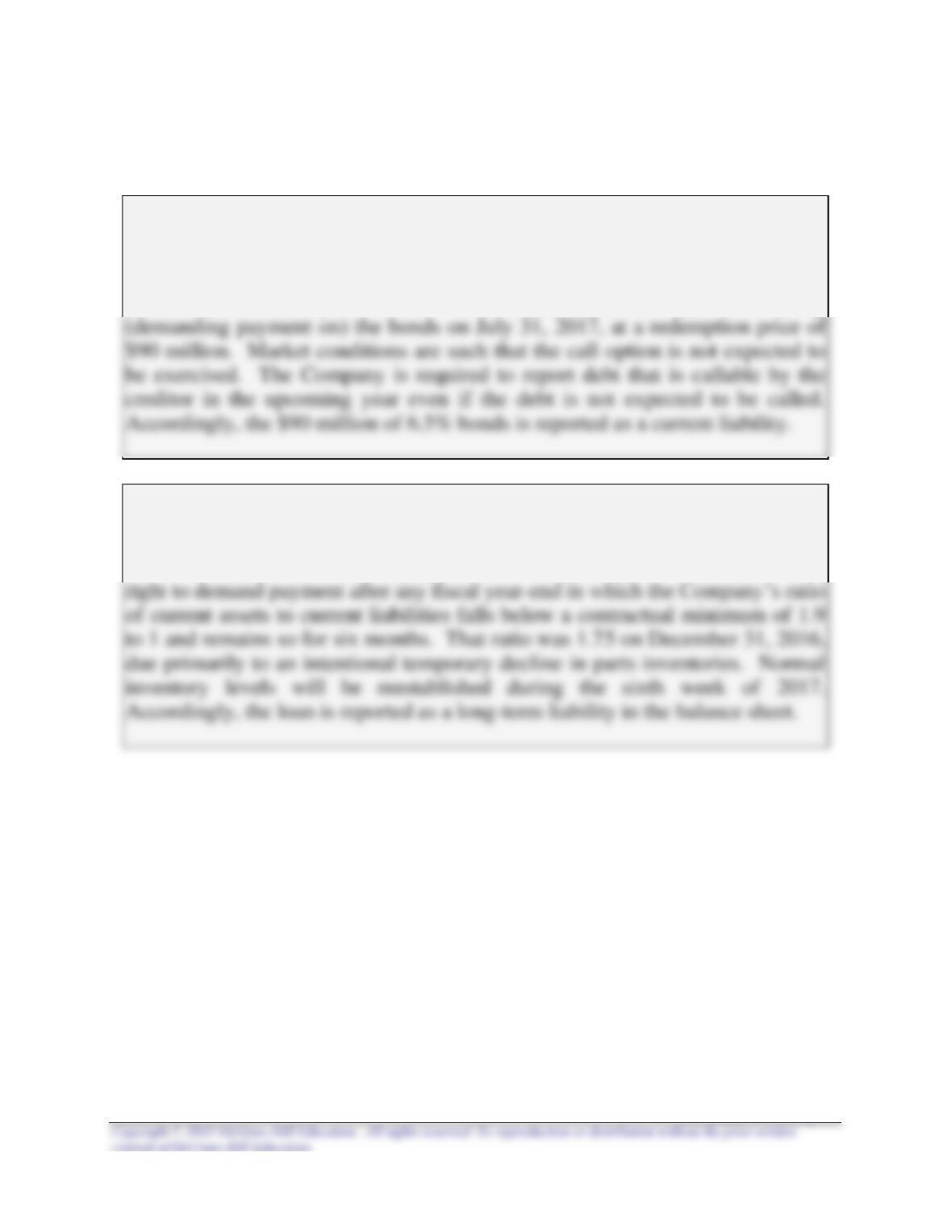
NOTE X: CALLABLE DEBT CLASSIFIED AS CURRENT
Transit has outstanding 6.5% bonds with a face amount of $90 million. The
bonds mature on July 31, 2025. Bondholders have the option of calling
NOTE X: LOAN IN VIOLATION OF DEBT COVENANT
A $30 million 8% bank loan is payable on October 31, 2022. The bank has the
Problem 13–12 (concluded)
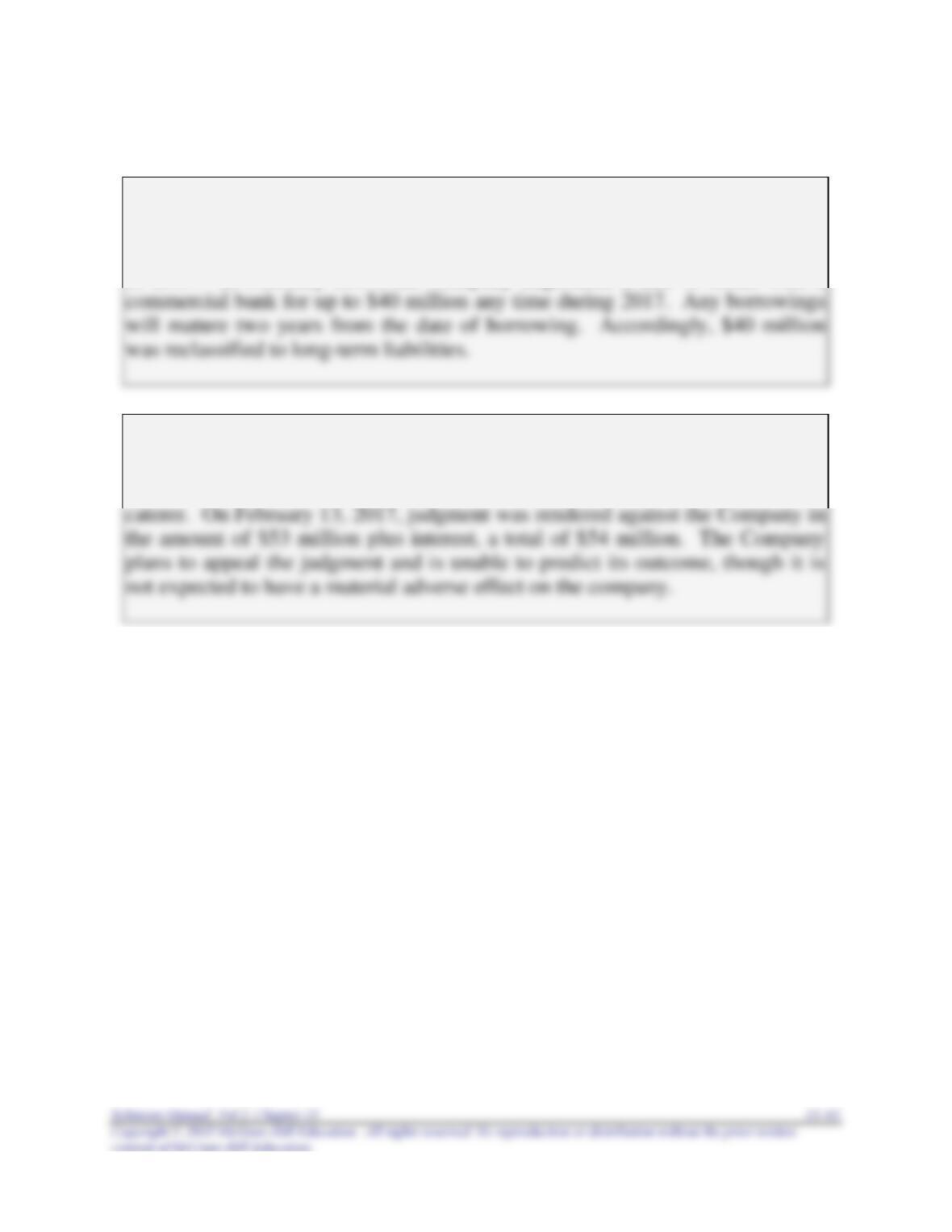
NOTE X: CURRENTLY MATURING DEBT CLASSIFIED AS LONG–TERM
The Company intends to refinance $45 million of 7% notes that mature in May
of 2017. In February 2017, the Company negotiated a line of credit with a
NOTE X: LAWSUIT
The Company is involved in a lawsuit resulting from a dispute with a food
13–64 Intermediate Accounting, 8/e
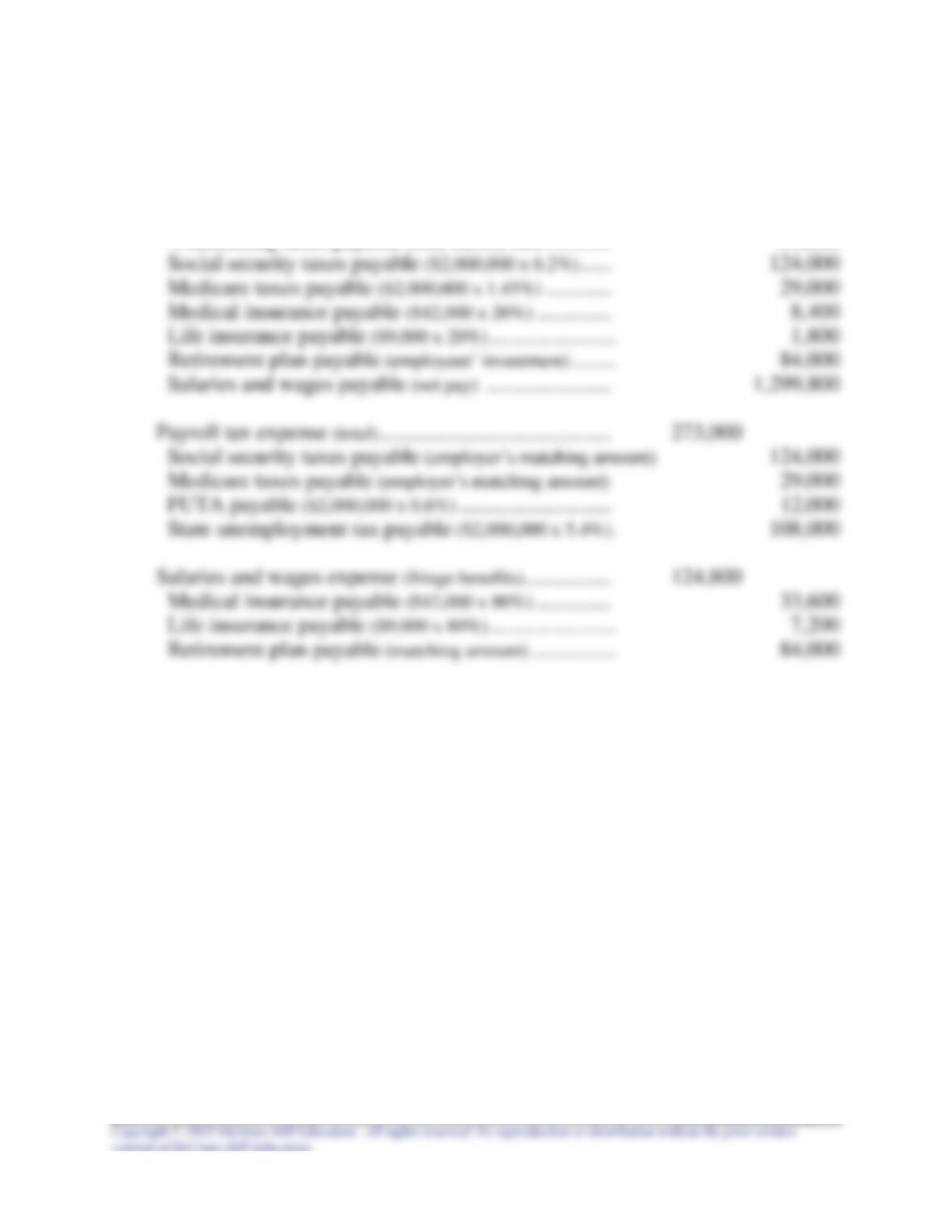
Problem 13–13
Salaries and wages expense (total amount earned) ………. 2,000,000
Withholding taxes payable (federal income tax) ………. 400,000
Withholding taxes payable (local income tax) ………… 53,000
CASES
Research Case 13–1
[Note: This case encourages the student to reference authoritative pronouncements.]
The $2,000,000 of commercial paper liquidated in November 2016 would be
classified as a current liability in Cheshire’s balance sheet at September 30, 2016.
The relevant authoritative literature can be found in the FASB’s codification
at ACS 470–10–45–15: “Debt–Overall–Other Presentation Matters–Intent and
Ability to Refinance on a Long-Term Basis.”
The $3,000,000 of commercial paper liquidated in January 2017 but
13–66 Intermediate Accounting, 8/e
Real World Case 13–2
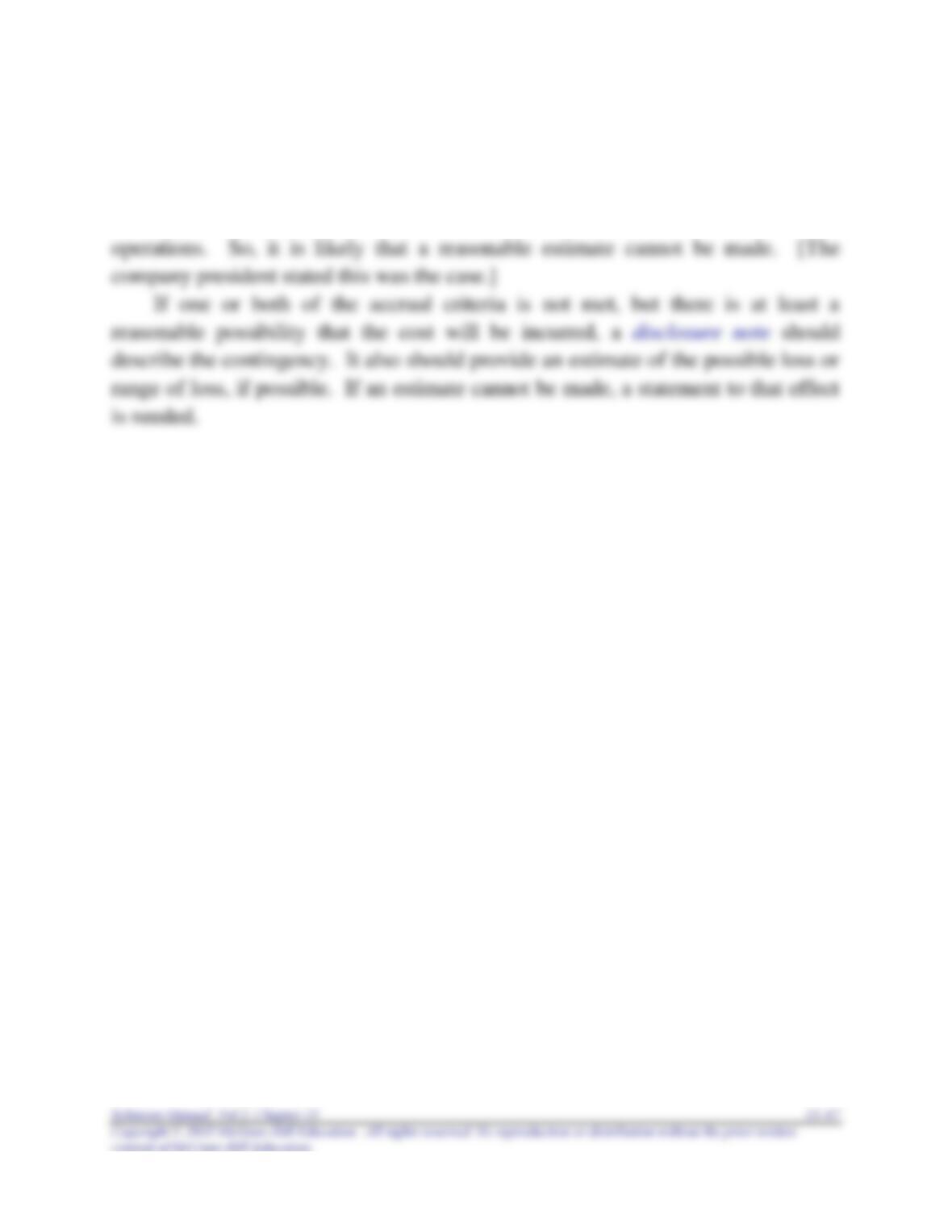
Collecting cash from a customer as a refundable deposit normally creates a
liability to return the deposit if the deposit is expected to be refunded. In this case,
the deposit is not returnable to the customer, but payment still will be made—to the
When Containers Purchased
Inventory (1,000 x $1.76) ………………………………………… 1,760
Cash ……………………………………………………………….. 1,760
When Product Sold
When Containers Returned
Inventory (1,000 x 40% x $1.76) ………………………………… 704
Case 13–2 (concluded)
It is probable that at least some pails will be returned. But this is a start-up
company without past experience and there are no other firms with similar
13–68 Intermediate Accounting, 8/e
Research Case 13–3
[Note: This case encourages the student to reference authoritative pronouncements.]
Paragraph 54 of SFAC No. 6 explains:
“Assets are probable future economic benefits owned or controlled by the
entity. Its liabilities are claims to the entity’s assets by other entities and, once
Judgment Case 13–4
Requirement 1
The conditions, all of which must be met for accrual, are:
1. The obligation is attributable to employees’ services already performed.
Requirement 2
a. Military leave, maternity leave, and jury time
Custom and practice also influence whether unused rights to paid
absences expire or can be carried forward. Obviously, if rights vest
b. Paid sabbatical leave
An expense and related liability should not be accrued if the sabbatical
13–70 Intermediate Accounting, 8/e
Case 13–4 (concluded)
c. Sick days
If payment of sick pay benefits depends on future illness, an employer
Ethics Case 13–5
Discussion should include these elements.
Liabilities had been recorded previously.
When a high degree of uncertainty exists concerning the collection of
receivables, revenue should not be recorded at the time of sale. Instead,
Ethical Dilemma:
How does a doubtful justification for a change in reporting methods compare
Who is affected?
Rice
Sun
Other managers?
13–72 Intermediate Accounting, 8/e
Trueblood Accounting Case 13–6
[Note: This case encourages the student to reference authoritative pronouncements.]
Communication Case 13–7
Assumptions students make will determine the correct answer to some
classifications. Depending on the assumptions made, different views can be
convincingly defended. The process of developing and synthesizing the arguments
A significant benefit of this case is forcing students’ consideration of why
liabilities currently due are sometimes classified as long term. It also requires
them to carefully consider the profession’s definition of current liabilities.
Arguments likely will include the following:
a. Commercial paper
If it’s assumed that early April is prior to the actual issuance of the financial
statements, then $12 million can be reported as long term, but $3 million must be
b. 11% notes
The debt should be reported as a current liability because it is payable in the
upcoming year and will not be refinanced with long-term obligations. The fact that
13–74 Intermediate Accounting, 8/e
Case 13–7 (concluded)
c. 10% notes
Short-term obligations that are expected to be refinanced with long-term
obligations can be reported as noncurrent liabilities only if the firm (a) intends to
refinance on a long-term basis and (b) actually has demonstrated the ability to do
d. Bonds
If it’s assumed that March 15 is prior to the actual issuance of the financial
Communication Case 13–8
Memorandum:
To: Mitch Riley
From: Your Name
Re: Accounting for contingencies
Below is a brief overview of my initial thoughts on how Western should account
for the four contingencies in question.
1. The labor disputes constitute a loss contingency. Though a loss is probable,
the amount of loss is not reasonably estimable. A disclosure note is
appropriate:
2. The A. J. Conner matter is a gain contingency. Gain contingencies are not
accrued even if the gain is probable and reasonably estimable. The gain
should be recognized only when realized.
13–76 Intermediate Accounting, 8/e
Case 13–8 (concluded)
3. The contingency for warranties should be accrued. During the period
Western would make the following journal entries:
4. The Crump Holdings lawsuit is a loss contingency. Even though the lawsuit
occurred in 2017, the cause for the action occurred in 2016. Only a
disclosure note is needed because an unfavorable outcome is reasonably
possible, but not probable. Also, the amount is not reasonably estimable.
_______________________________
Note X: Contingency
Crump Holdings filed suit in January 2017 against the Company seeking
$88 million, as an adjustment to the purchase price in connection with the
We can discuss these further in our meeting later today.
Judgment Case 13–9
This is a loss contingency. Valleck can use the information from the February
negotiations (occurring after the end of the year) in determining appropriate
disclosure. The cause for the suit existed at the end of the year. Valleck should