FINANCIAL ACCOUNTING – Eleventh Edition Solutions Manual
P13-57B
(20-30 min.)
Requirement
Solution:
1. Discuss the relative strengths and weaknesses of Western Air and Tech
Flights. Conclude your discussion by recommending one of the companies’
stocks as an investment.
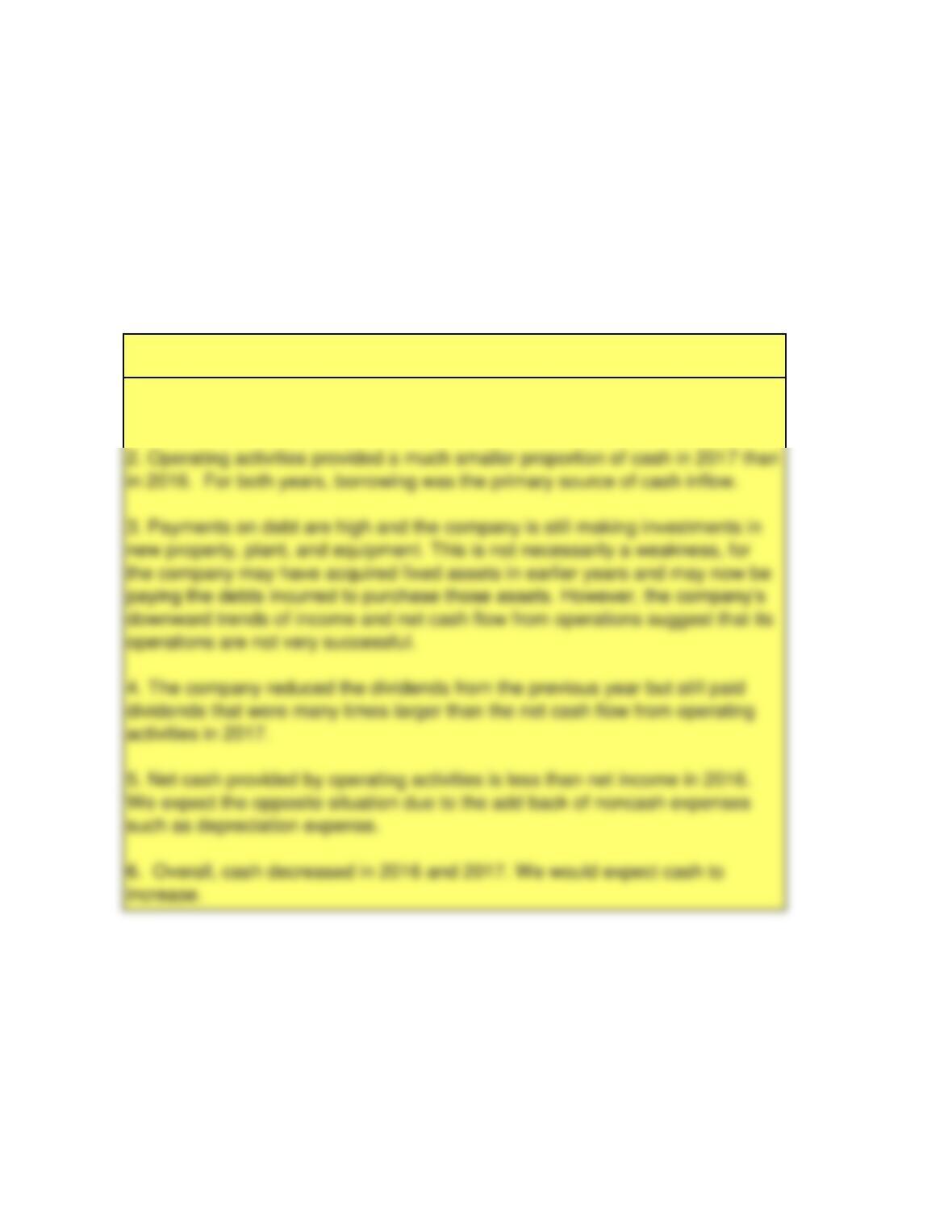
Western Air’s statement of cash flows reveals few strengths. The company’s
weaknesses include:
1. Net income and net cash provided by operations are down significantly.
There was a net loss in 2017.
Chapter 13: Financial Statement Analysis Page 61 of 94
FINANCIAL ACCOUNTING – Eleventh Edition Solutions Manual
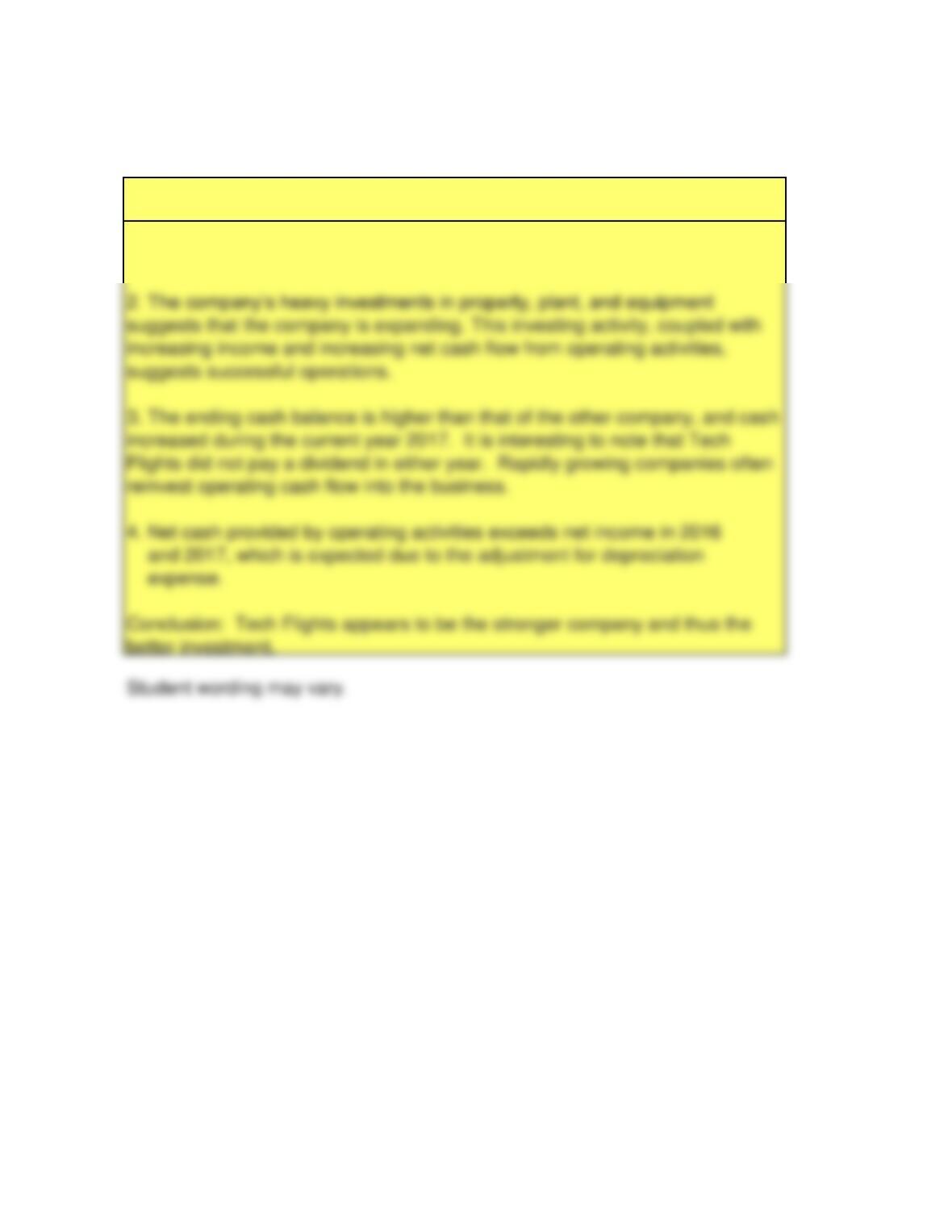
Tech Flight’s statement of cash flows reveals the following strengths (no
significant weaknesses):
1. During both years, operating activities generated the bulk of the company’s
cash. Furthermore, the trend of net income is up, a favorable sign.
Chapter 13: Financial Statement Analysis Page 62 of 94
FINANCIAL ACCOUNTING – Eleventh Edition Solutions Manual
P13-58B
(30-40 min.)
Requirements
Solution:
Req. 1
$298
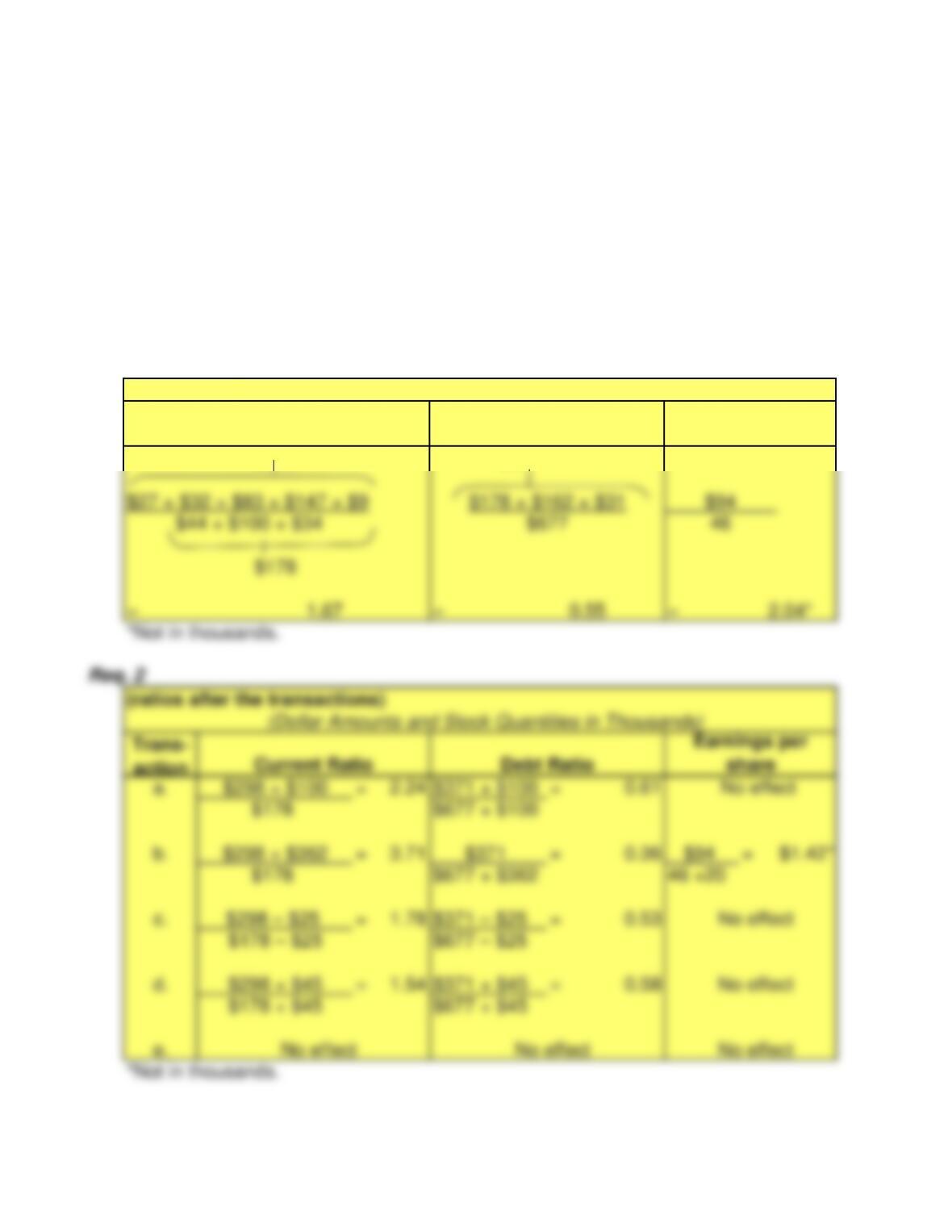
1. Compute Eastland’s current ratio, debt ratio, and earnings per share.
Round all ratios to two decimal places.
2. Compute the three ratios after evaluating the effect of each transaction that
follows. Consider each transaction separately.
(Dollar Amounts and Stock Quantities in Thousands)
Earnings per
share
Current Ratio
Debt Ratio
$371
Chapter 13: Financial Statement Analysis Page 63 of 94
$178
Earnings per
FINANCIAL ACCOUNTING – Eleventh Edition Solutions Manual
P13-59B
(40-50 min.)
Requirements
Solution:
Req. 1
a. Current ratio $568 1.93 $522 1.75
$295 $298
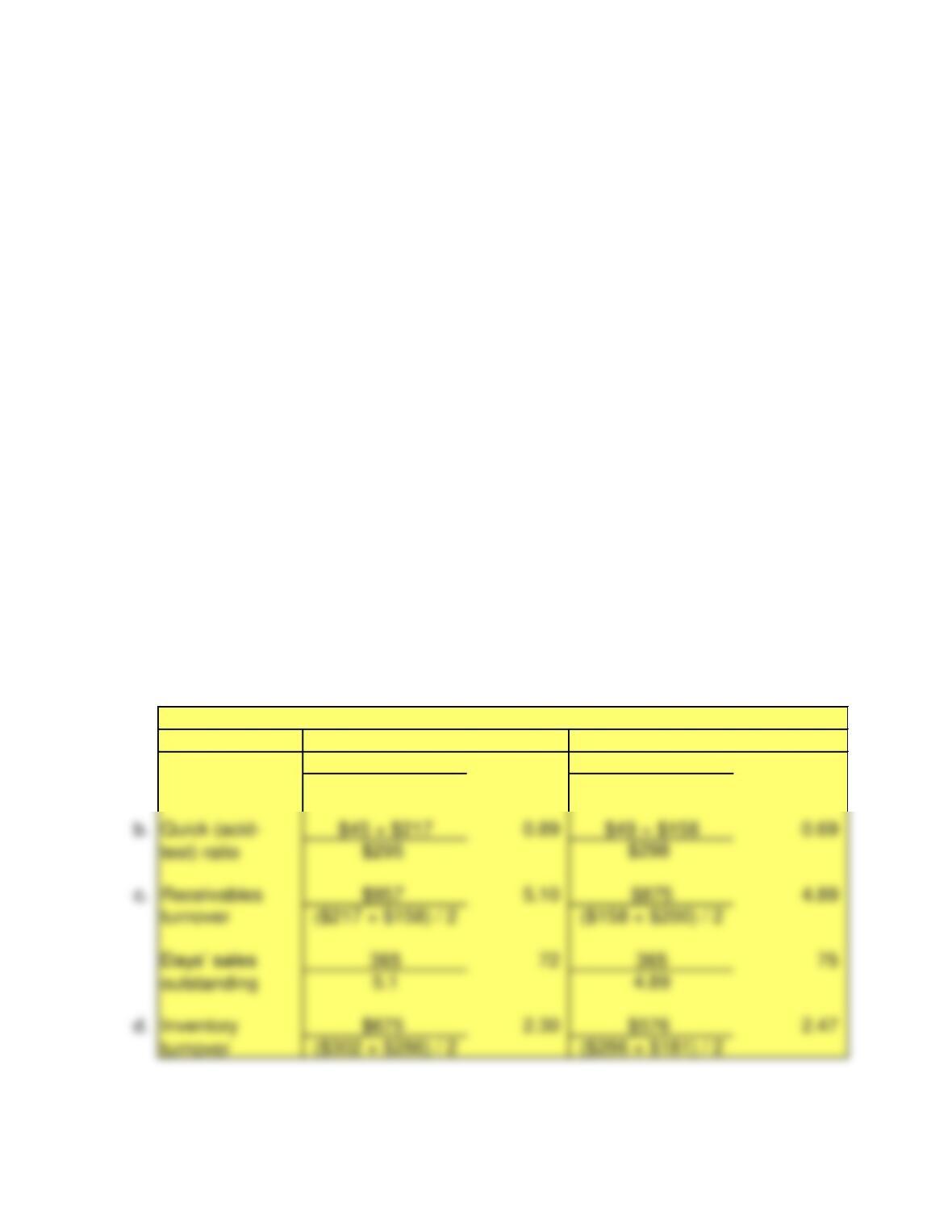
1. Compute the following ratios for 2016 and 2015:
a. Current ratio
b. Quick (acid-test) ratio
c. Receivables turnover and days’ sales outstanding (DSO); round to nearest whole
day
d. Inventory turnover and days’ inventory outstanding (DIO); round to nearest whole
day
e. Accounts payable turnover and days’ payable outstanding (DPO); use cost of goods
sold in the turnover ratio and round DPO to nearest whole day
f. Cash conversion cycle (in days)
g. Times-interest-earned ratio
h. Return on assets; use DuPont Analysis
i. Return on common stockholders’ equity; use DuPont Analysis
j. Earnings per share of common stock
k. Price-earnings ratio
2. Decide whether (a) Arch’s financial position improved or deteriorated during 2016
and (b) whether the investment attractiveness of Arch’s common stock appears to
have increased or decreased.
3. How will what you learned in this problem help you evaluate an investment?
(Dollar Amounts and Stock Quantities in Thousands)
2016
2015
Chapter 13: Financial Statement Analysis Page 64 of 94
FINANCIAL ACCOUNTING – Eleventh Edition Solutions Manual
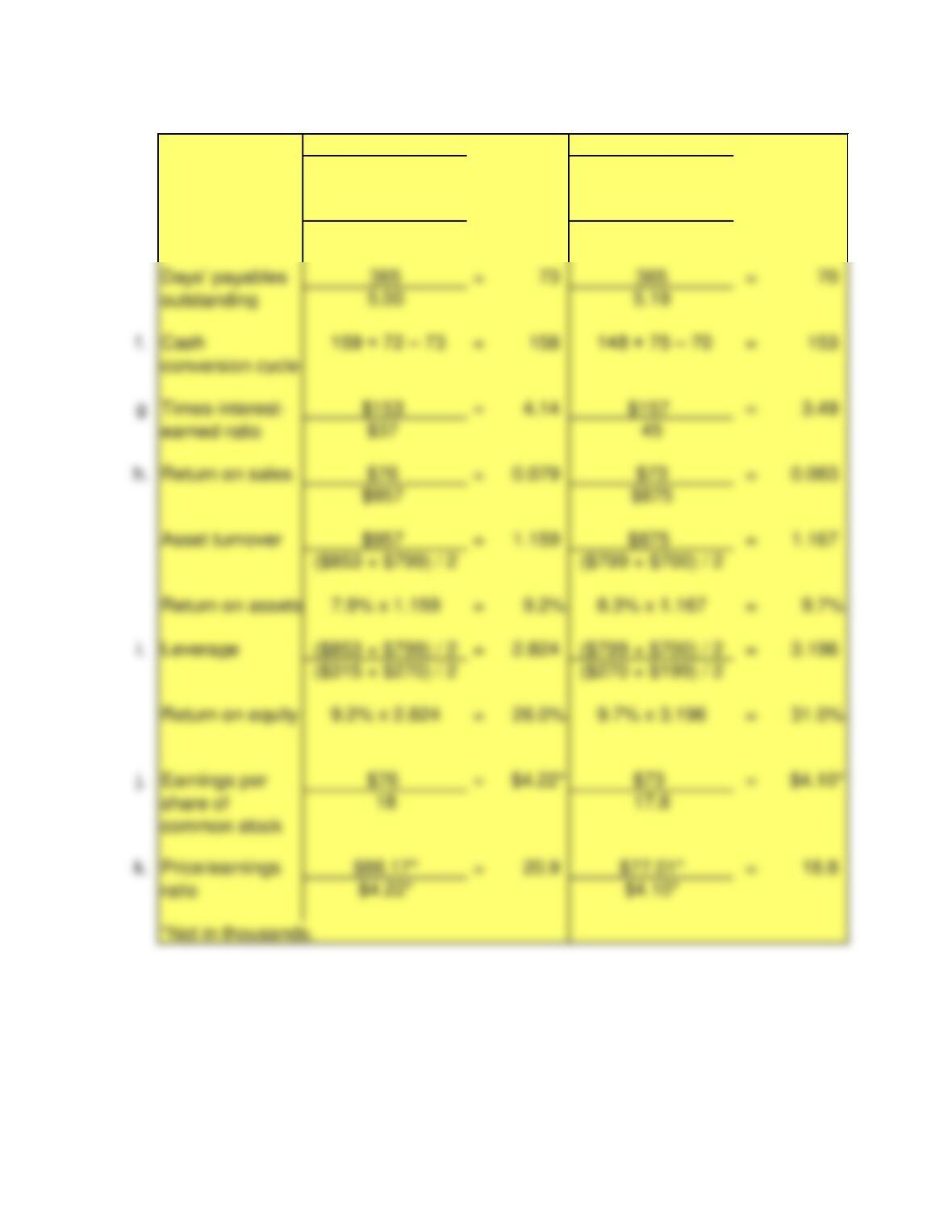
365 =159 365 =148
2.30 2.47
e. $675 = 5.00 $576 = 5.19
($160 + $110) / 2 ($110 + $112) / 2
Accounts
payable
Days’ inventory
outstanding
Chapter 13: Financial Statement Analysis Page 65 of 94
365 =73 365 =70
5.00 5.19
($315 + $270) / 2 ($270 + $199) / 2
Days’ payables
Cash
conversion cycle
Return on sales
Return on equity
Price/earnings
earned ratio
FINANCIAL ACCOUNTING – Eleventh Edition Solutions Manual
Req. 2
Decisions:
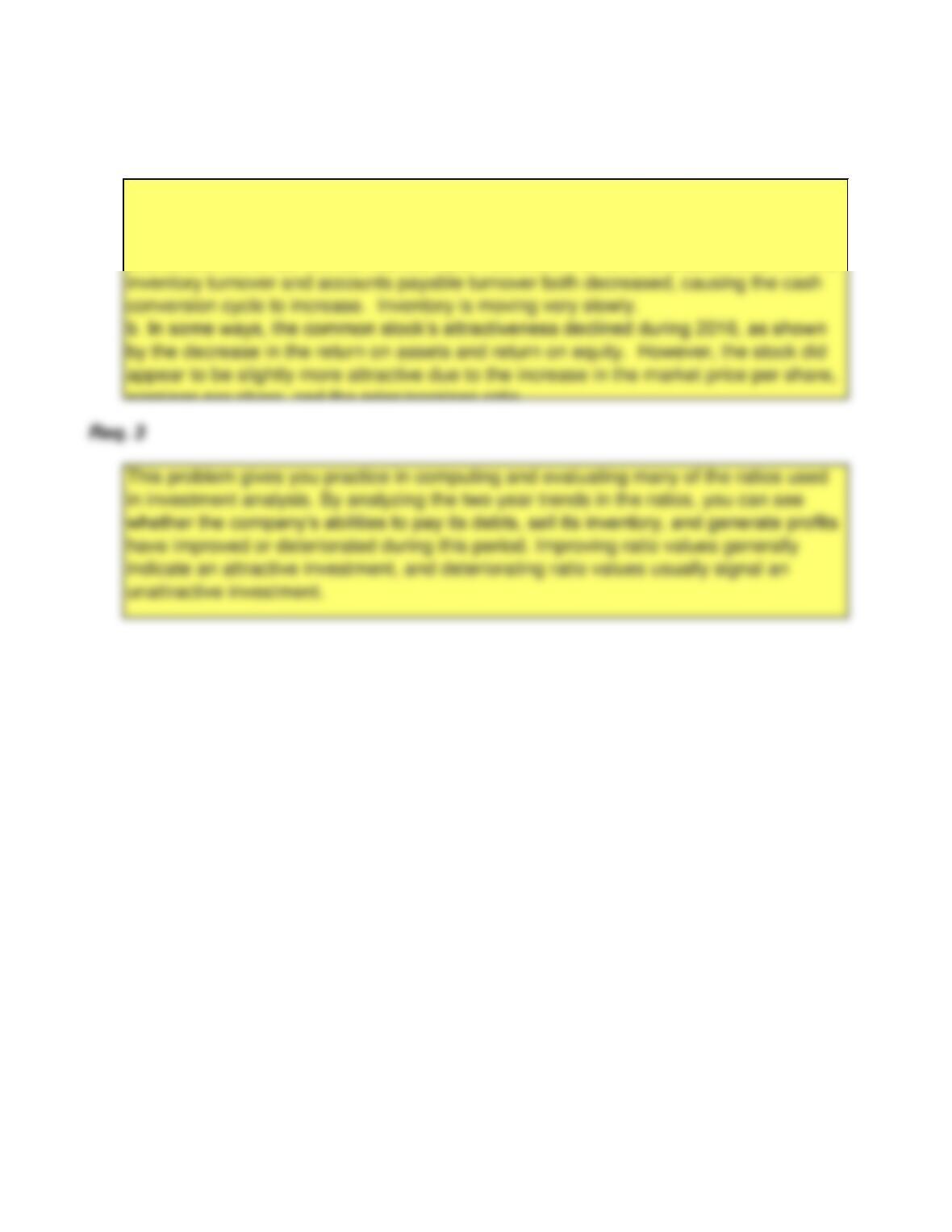
a. The company’s financial position improved slightly during 2016 as shown by
increases in the current ratio, the quick ratio, the receivables turnover, earnings per
share, and the times-interest-earned ratio. However, it is not a favorable trend that the
Chapter 13: Financial Statement Analysis Page 66 of 94
FINANCIAL ACCOUNTING – Eleventh Edition Solutions Manual
P13-60B
(45-60 min.)
Requirements
Solution:
Req. 1
a. $26 + $7 + $184 = 0.59 $42 + $12 + $162 = 0.64
$365 $335
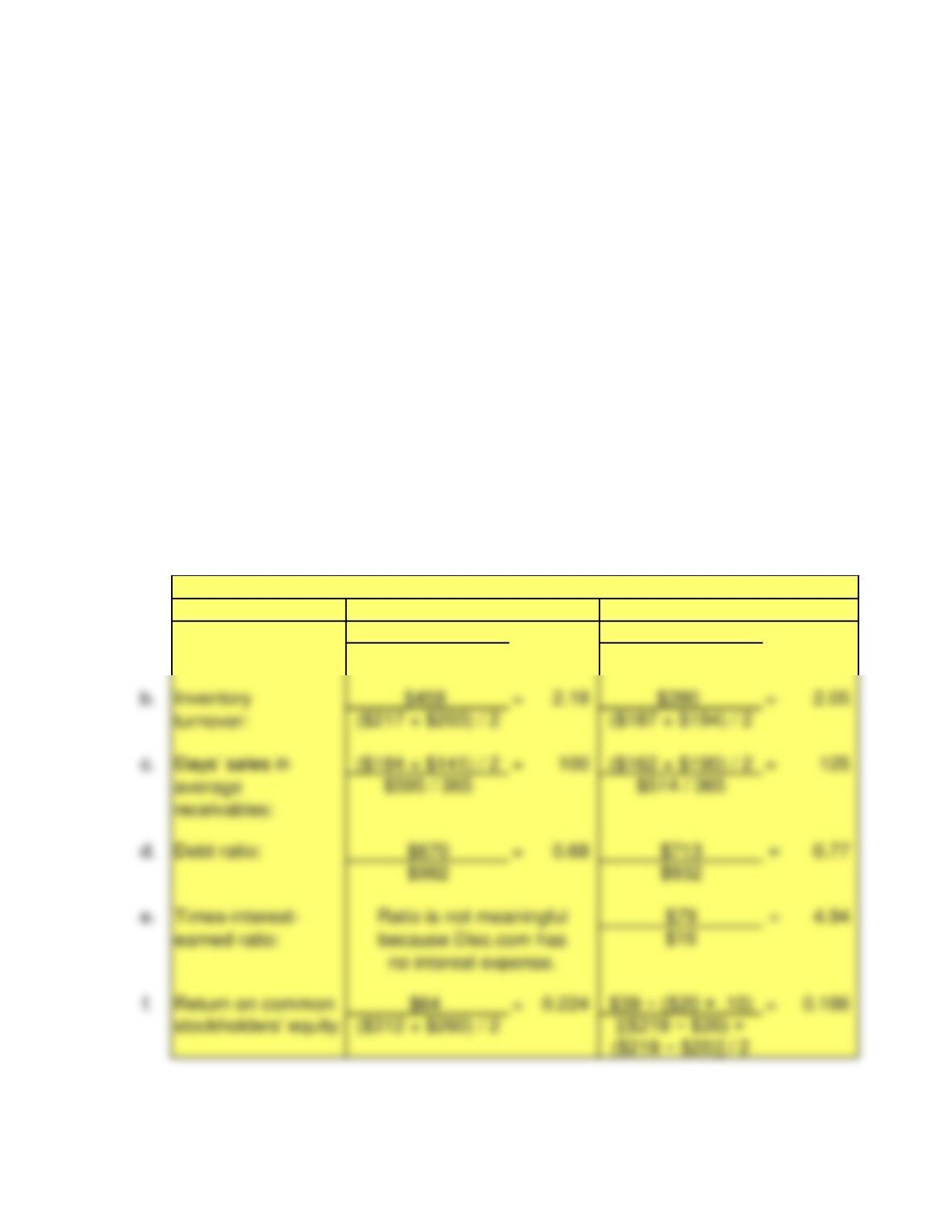
1. Compute the following ratios for both companies for the current year, and decide
which company’s stock better fits your investment strategy.
a. Quick (acid-test) ratio
b. Inventory turnover
c. Days’ sales in average receivables
d. Debt ratio
e. Times-interest-earned ratio
f. Return on common stockholders’ equity
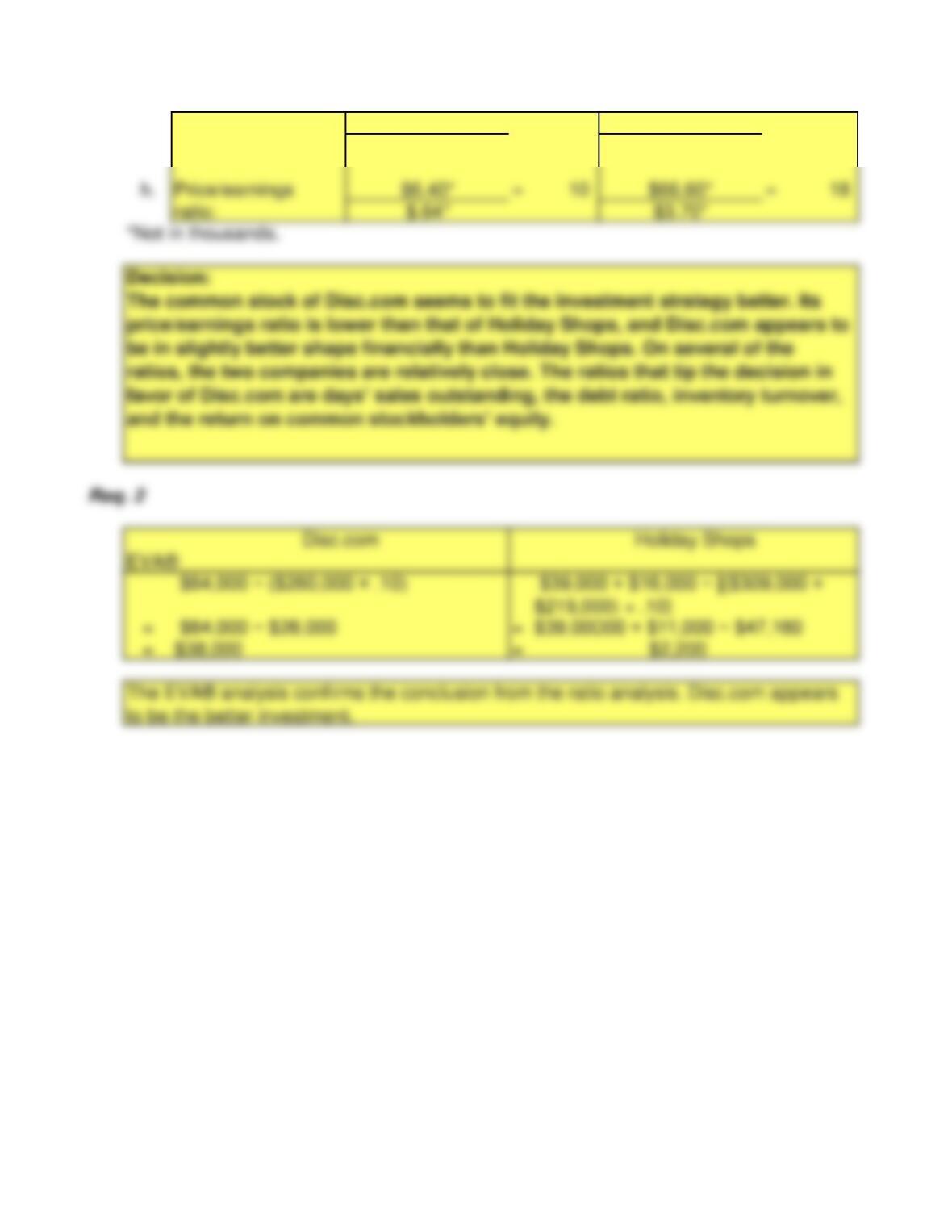
g. Earnings per share of common stock
h. Price-earnings ratio
2. Compute each company’s economic-value-added (EVA®) measure and determine
whether the companies’ EVA®s confirm or alter your investment decision. Each
company’s cost of capital is 10%.
(Dollar Amounts and Stock Quantities in Thousands)
Disc.com
Holiday Shops
Quick (acid-test)
ratio:
Chapter 13: Financial Statement Analysis Page 67 of 94
FINANCIAL ACCOUNTING – Eleventh Edition Solutions Manual
g. Earnings per share $64 $0.64* $39 − ($20 × .10) = $3.70*
of common stock: 100 =10
Chapter 13: Financial Statement Analysis Page 68 of 94
FINANCIAL ACCOUNTING – Eleventh Edition Solutions Manual
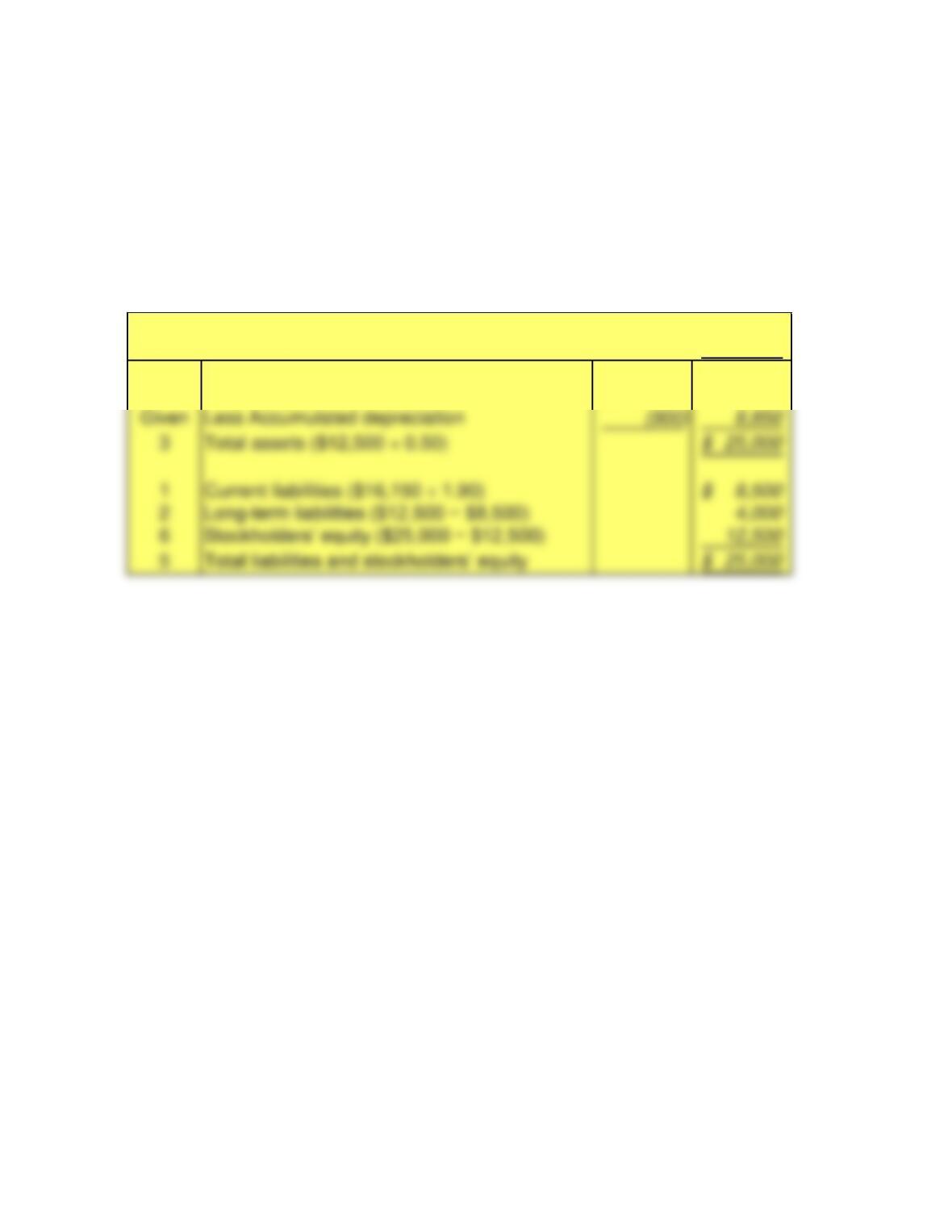
E13-61
(20-30 min.)
Requirement
Solution
ORDER OF
COMPUTATION Millions
Given Current assets 16,150$
4 Property, plant, and equipment 9,750$
1. Complete the following condensed balance sheet. Report amounts to the
nearest million dollars.
Chapter 13: Financial Statement Analysis Page 69 of 94
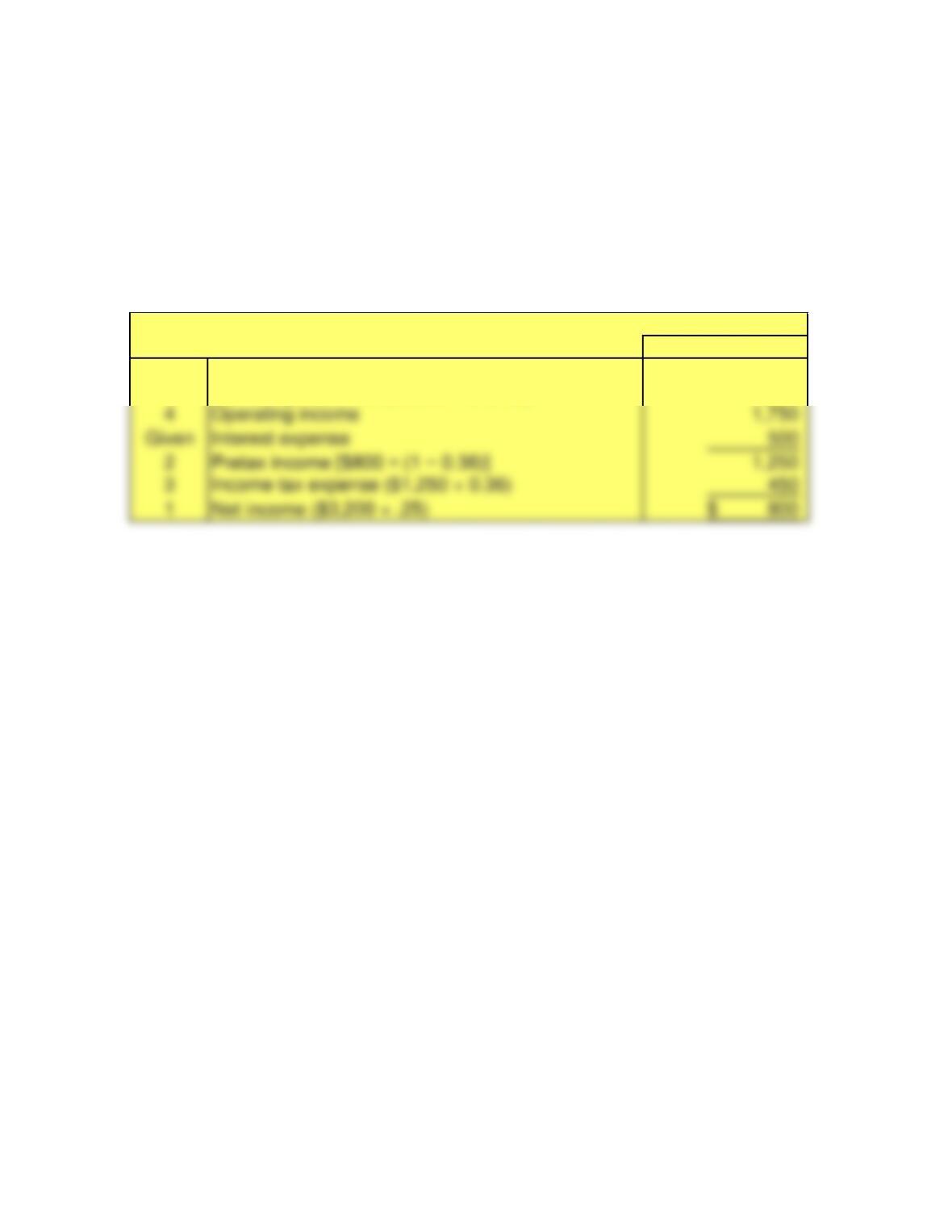
FINANCIAL ACCOUNTING – Eleventh Edition Solutions Manual
E13-62
(20-30 min.)
Requirement
Solution
ORDER OF
COMPUTATION
5 Sales ($1,750 ÷ 0.35) 5,000$
6Operating expenses ($5,000 − $1,750) 3,250
1. Complete the following condensed income statement. Report amounts to the
nearest million dollars.
Millions
Chapter 13: Financial Statement Analysis Page 70 of 94
2Pretax income [$800 ÷ (1 − 0.36)] 1,250
FINANCIAL ACCOUNTING – Eleventh Edition Solutions Manual
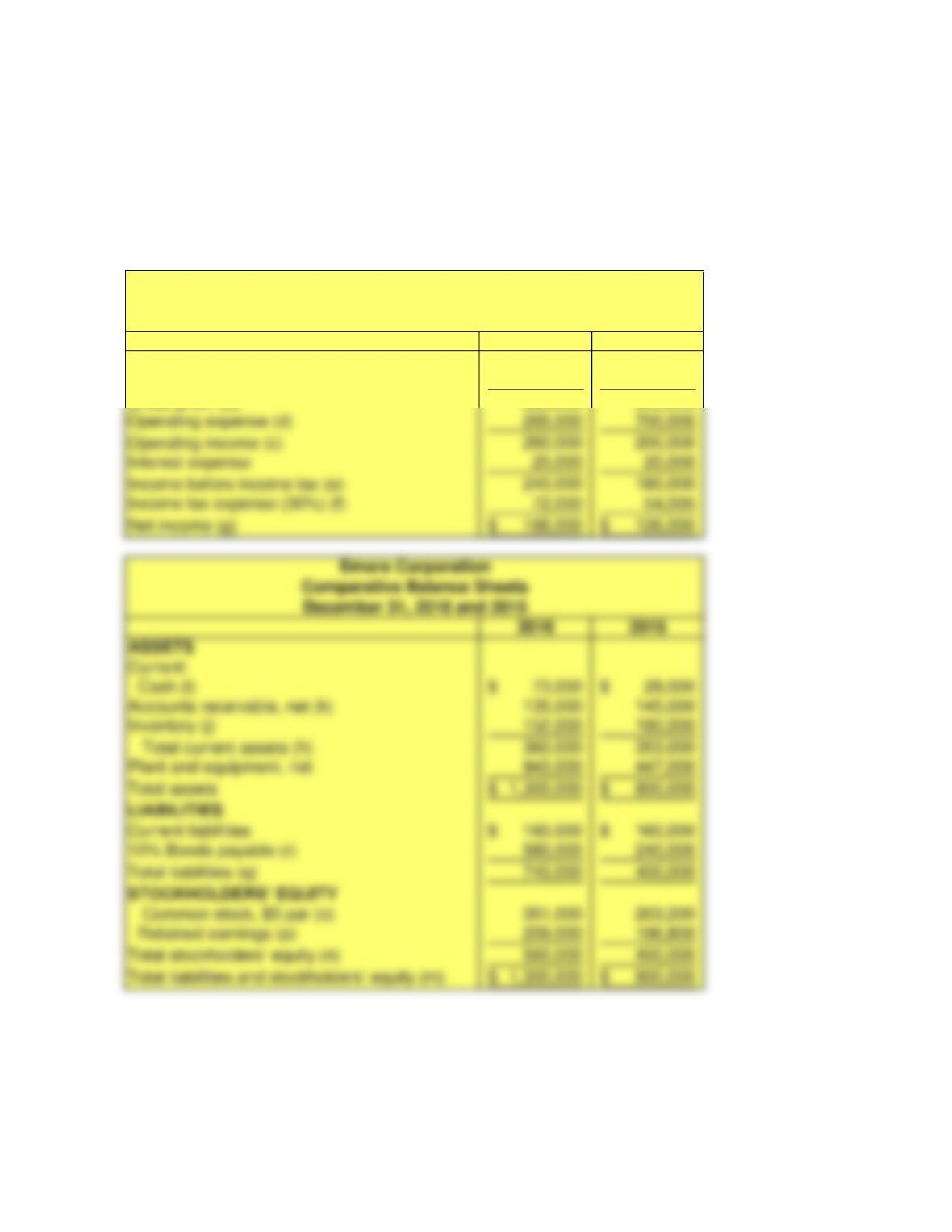
P13-63
(30-40 min.)
Requirement
Solution
2016 2015
Sales revenue 2,100,000$ 2,000,000$
Cost of goods sold (a) 1,575,000 1,100,000
Gross profit (b) 525,000 900,000
1. Using the ratios, common-size percentages, and trend percentages given, complete the income
statement and balance sheet for Emore for 2016. Additional information:
Emore Corporation
Comparative Income Statements
Years Ended December 31, 2016 and 2015
Chapter 13: Financial Statement Analysis Page 71 of 94
Operating income (c) 260,000 200,000
Income before income tax (e) 240,000 180,000
Cash (l) 73,000$ 28,000$
Accounts receivable, net (k) 135,000 145,000
Total current assets (h) 360,000 353,000
Current liabilities 160,000$ 160,000$
Emore Corporation
FINANCIAL ACCOUNTING – Eleventh Edition Solutions Manual
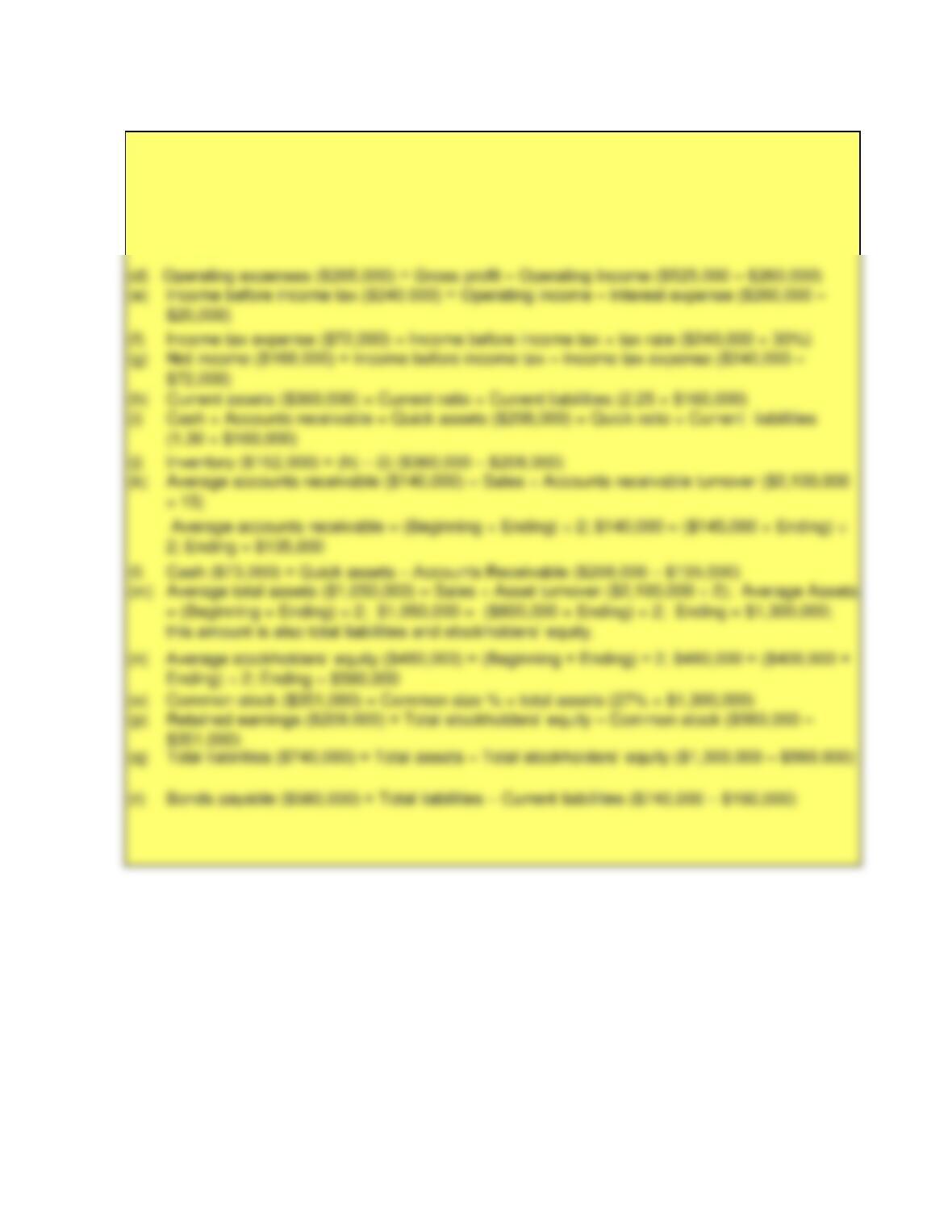
Computations (alternate order of calculations is possible)
(a) Cost of goods sold ($1,575,000) = Sales x COGS % ($2,100,000 × 75%)
(b) Gross profit ($525,000) = Sales – COGS ($2,100,000 – $1,575,000)
(c) Op
Operating income ($260,000) = Operating income in 2016 × 2015 Trend % ($200,000 ×
130%)
Chapter 13: Financial Statement Analysis Page 72 of 94
FINANCIAL ACCOUNTING – Eleventh Edition Solutions Manual
Decision Case 1
(30 min.)
Requirement 1
Solution:
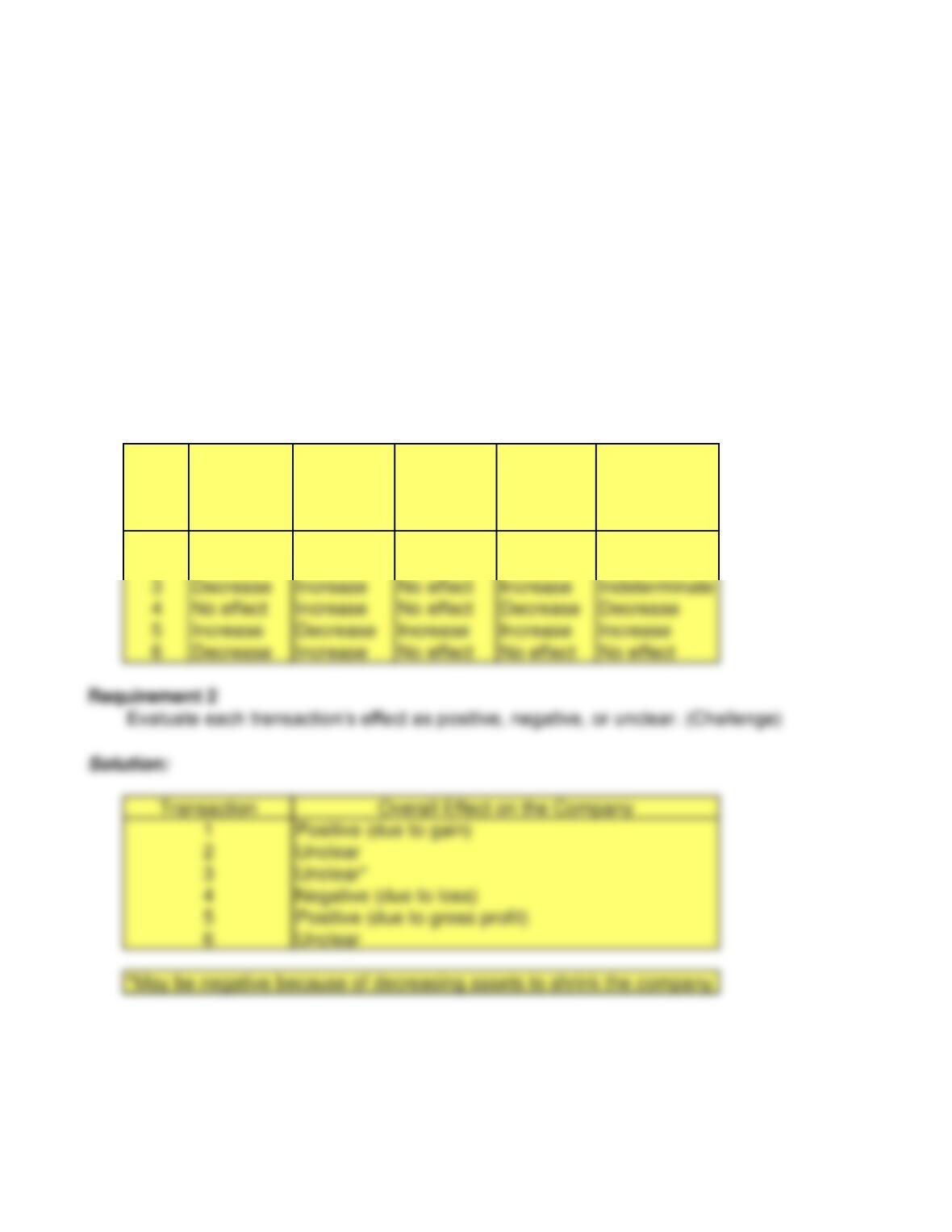
1 Increase Decrease No effect Increase Increase
2 Increase Increase No effect No effect No effect
Trans-
action
Book Value
Per Share
1. Top management wants to know the effects of these transactions (increase,
decrease, or no effect) on the following ratios of American Cable and Entertainment:
a. Current ratio
b. Debt ratio
c. Times-interest-earned ratio (measured as [Net income + Interest expense]/Interest
expense)
d. Return on equity
e. Book value per share of common stock
Current
Ratio
Debt Ratio
Times-
Interest-
Earned
Ratio
Return on
Equity
Chapter 13: Financial Statement Analysis Page 73 of 94
3 Decrease Increase No effect Increase Indeterminate
4 No effect Increase No effect Decrease Decrease
6 Decrease Increase No effect No effect No effect
Requirement 2
FINANCIAL ACCOUNTING – Eleventh Edition Solutions Manual
Decision Case 2
(20-30 min.)
Solution:
1. Current ratio
2. Quick (acid-test) ratio
3.
and
4.
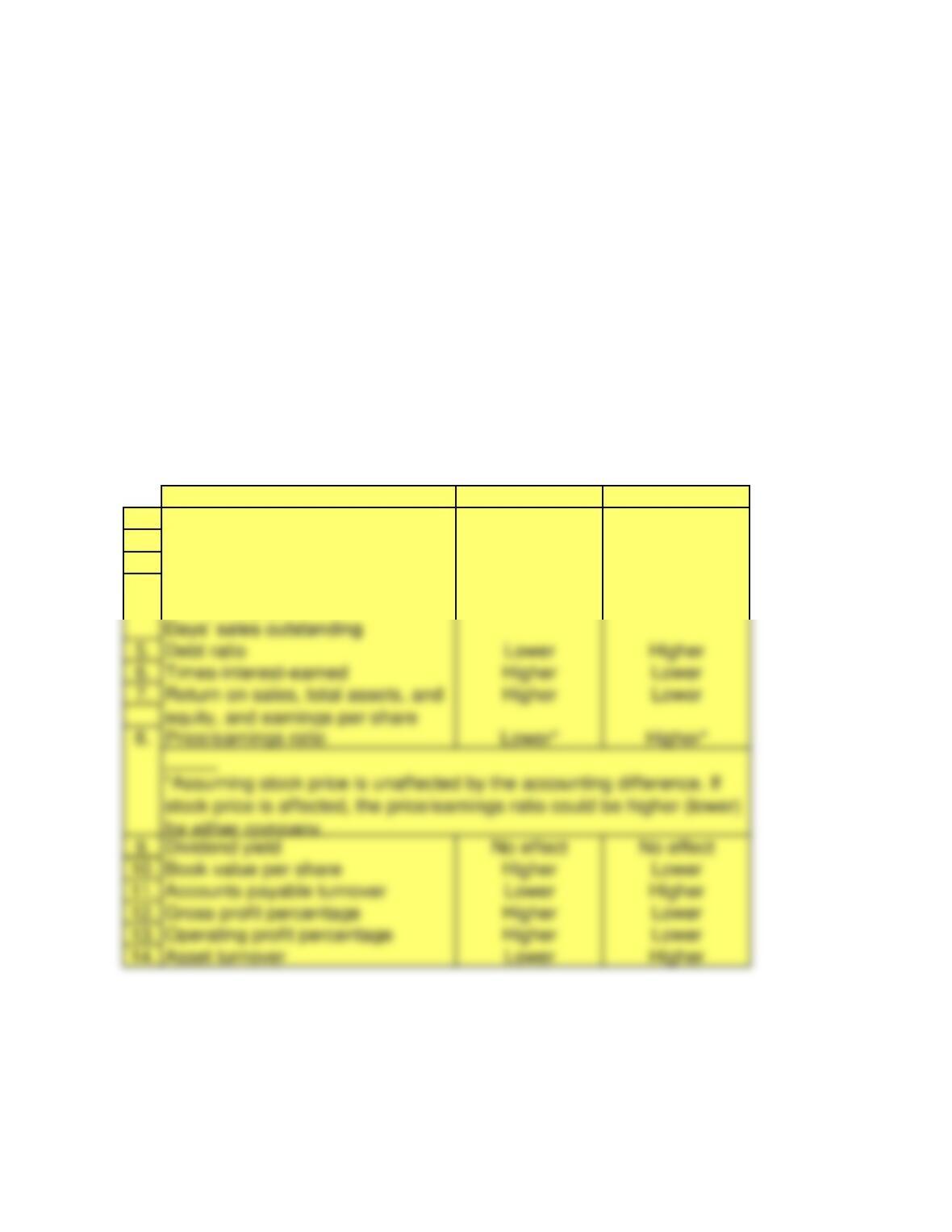
Assume that you are a financial analyst. You are trying to compare the financial
statements of Caterpillar, Inc., with those of CNH Global, an international company
that uses international financial reporting standards (IFRS). Caterpillar, Inc., uses
the last-in, first-out (LIFO) method to account for its inventories. IFRS does not
permit CNH Global to use LIFO, so they use FIFO. Analyze the effect of this
difference in accounting method on the two companies’ ratio values. For each ratio
discussed in this chapter, indicate which company will have the higher (and the
lower) ratio value. Also identify those ratios that are unaffected by the FIFO/LIFO
difference. Ignore the effects of income taxes, and assume inventory costs are
increasing. Then, based on your analysis of the ratios, summarize your conclusions
as to which company looks better overall.
Caterpillar
CNH
Ratio
Inventory turnover
Receivable turnover
No effect
Lower
Higher
No effect
No effect
No effect
Higher
Lower
Chapter 13: Financial Statement Analysis Page 74 of 94
5. Debt ratio
6. Times-interest-earned
7.
9. Dividend yield
Higher
Lower
Lower
Higher
Lower
Higher
No effect
No effect
Lower
Higher
Higher
Lower
Lower*
Lower
Higher
Higher
Higher
Lower
Lower

FINANCIAL ACCOUNTING – Eleventh Edition Solutions Manual
Overall, CNH will look better than Caterpillar because of:
CONCLUSION:
Chapter 13: Financial Statement Analysis Page 75 of 94
FINANCIAL ACCOUNTING – Eleventh Edition Solutions Manual
Decision Case 3
(20-30 min.)
Requirement
Solution:
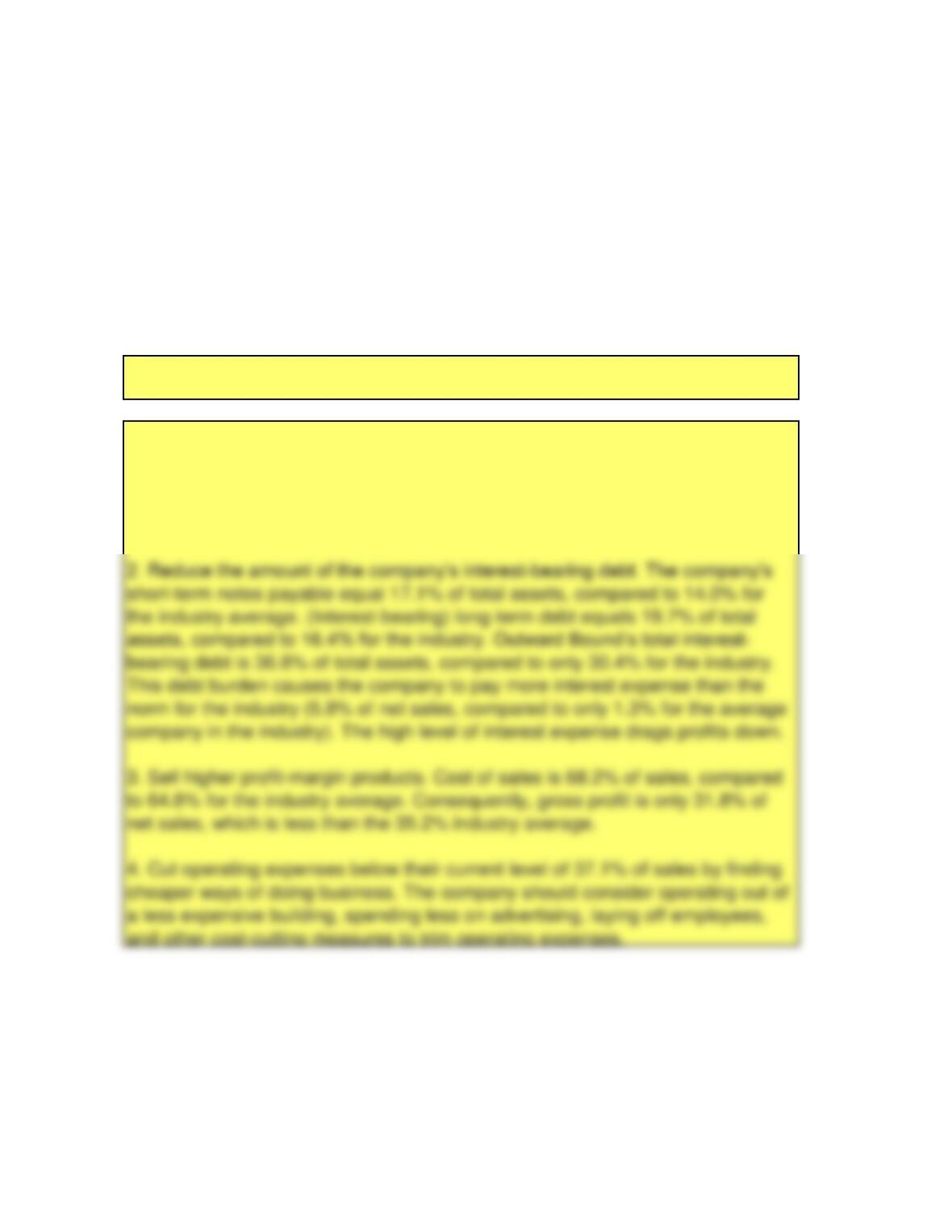
On the basis of your analysis of these figures, suggest four courses of action
Outward Bound might take to reduce its losses and establish profitable
operations. Give your reason for each suggestion. (Challenge)
1. Make a dedicated effort to collect receivables and consider extending less
credit to customers. Receivables make up 15.2% of assets, compared to 11.0%
for the industry average. The company’s inability to collect its receivables may
explain the shortage of cash (3.0% of total assets compared to 6.8% for the
industry).
To reduce losses and establish profitable operations, Outward Bound should
take the following steps:
Chapter 13: Financial Statement Analysis Page 76 of 94
FINANCIAL ACCOUNTING – Eleventh Edition Solutions Manual
Ethical Issue
Requirements
Solution:
Req. 1
Req. 2 and Req. 3
1. What is the accounting issue in this case? What ethical decision needs to
be made?
2. Who are the stakeholders?
3. Analyze the potential impact on the stakeholders from the following
standpoints: (a) economic,
(b) legal, and (c) ethical.
4. Shortly after the financial statements are released, sales improve; so, too,
does the current ratio. As a result, Turnberry management decides not to sell
the investments it had reclassified as short-term. Accordingly, the company
reclassifies the investments as long-term. Has management acted unethically?
Give the reasoning underlying your answer.
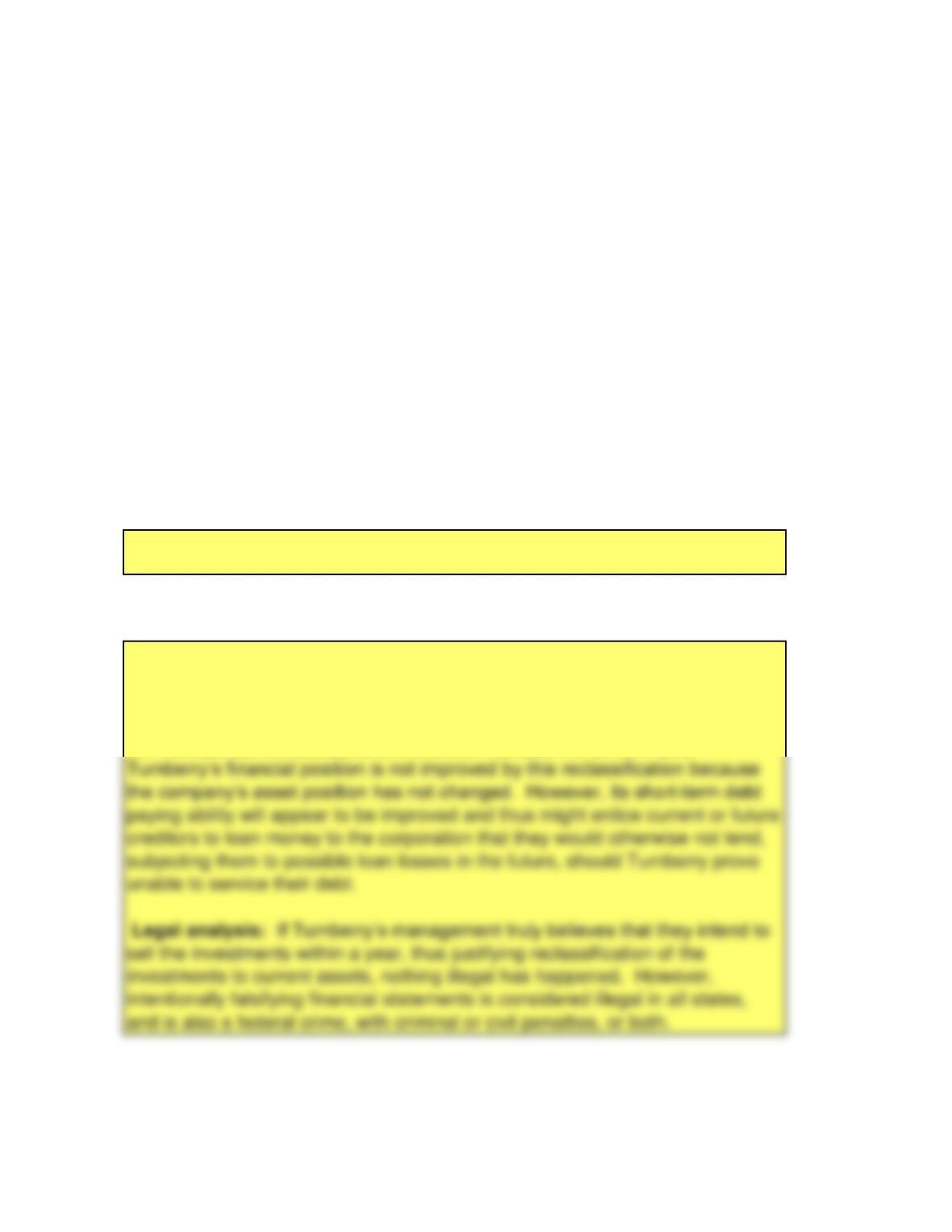
The ethical issue is: Should Turnberry reclassify its investments from long-
term to short-term?
The stakeholders in the decision are Turnberry Corporation, its officers and
directors, stockholders, and its current and future creditors.
Economic analysis: Reclassifying the long-term investments as short-term
will increase current assets and, therefore, increase the current ratio.
Chapter 13: Financial Statement Analysis Page 77 of 94