CHAPTER 13 Corporations: Organization, Stock Transactions, and Dividends
Ex. 13-24
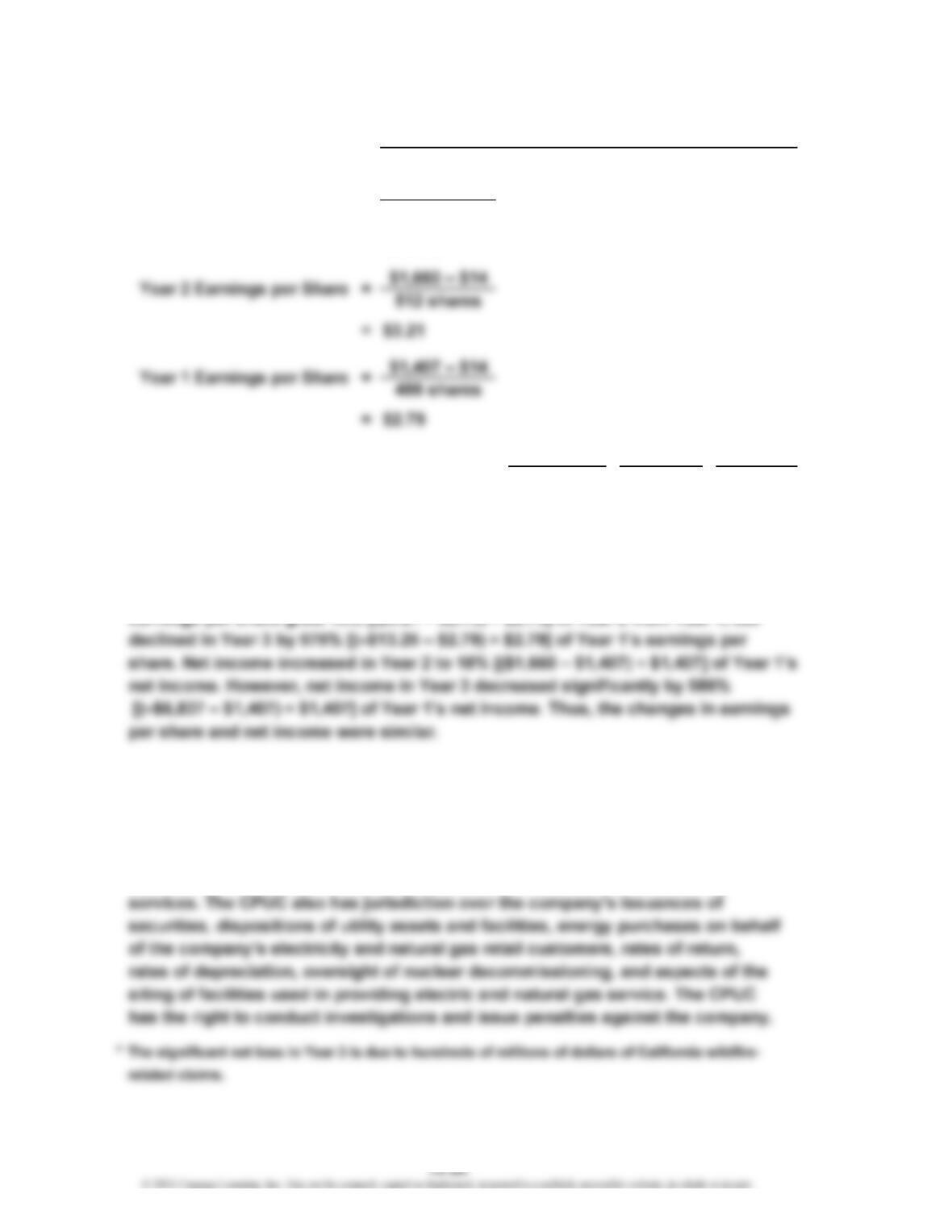
$(6,837) – $14
517 shares
= $(13.25)
b. Year 3 Year 2 Year 1
Earnings per share…………………………………
…
$(13.25) $3.21 $2.79
Growth as a percent of Year 1 (base year)……
…
(575)% 15% 100%
Net income (loss)……………………………………
…
$(6,837) $1,660 $1,407
Growth as a percent of Year 1 (base year)……
…
(586)% 18% 100%
Earnings per share and net income varied significantly over the three-year period.
The variability of earnings per share and net income is partially explained by the
unpredictable nature of Pacific Gas and Electric’s regulatory environment. For
example, Pacific Gas and Electric is regulated by the California Public Utilities
Commission (CPUC). The CPUC has jurisdiction over the rates, terms, and
conditions of service for the company’s electricity and natural gas distribution
operations, electricity generation, and natural gas transmission and storage
a. Net Income – Preferred Dividends
=
Avg. Number of Common Shares Outstanding
Year 3 Earnings per Share
=Earnings per Share
*
*
CHAPTER 13 Corporations: Organization, Stock Transactions, and Dividends
Ex. 13-25
a. Caterpillar Inc.
Deere & Company
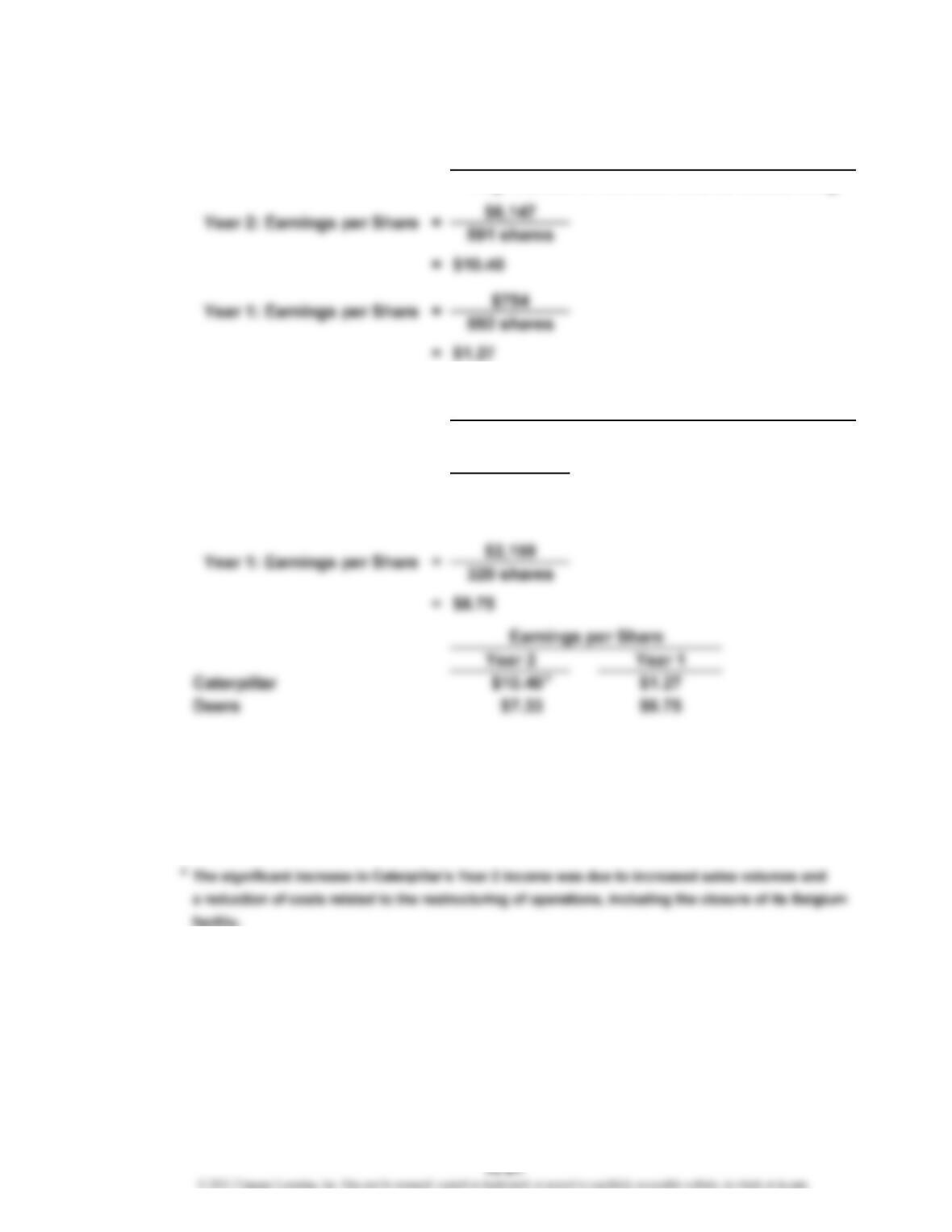
$2,368
323 shares
= $7.33
b. Deere’s earnings per share for Year 1 is higher than Caterpillar’s. However, from
Year 1 to Year 2, the earnings per share for both companies increased. Caterpillar’
s
earnings per share increased by 719% [$10.40 − $1.27) ÷ $1.27], while Deere’s
earnings per share increased by 9% [$7.33 − $6.75) ÷ $6.75]. Overall, Caterpillar
appears to be the more profitable company.
Earnings per Share = Net Income
Avg. Number of Common Shares Outstanding
Avg. Number of Common Shares Outstanding
Net Income
=Earnings per Share
=Year 2: Earnings per Share
CHAPTER 13 Corporations: Organization, Stock Transactions, and Dividends
Prob. 13-1A
1.
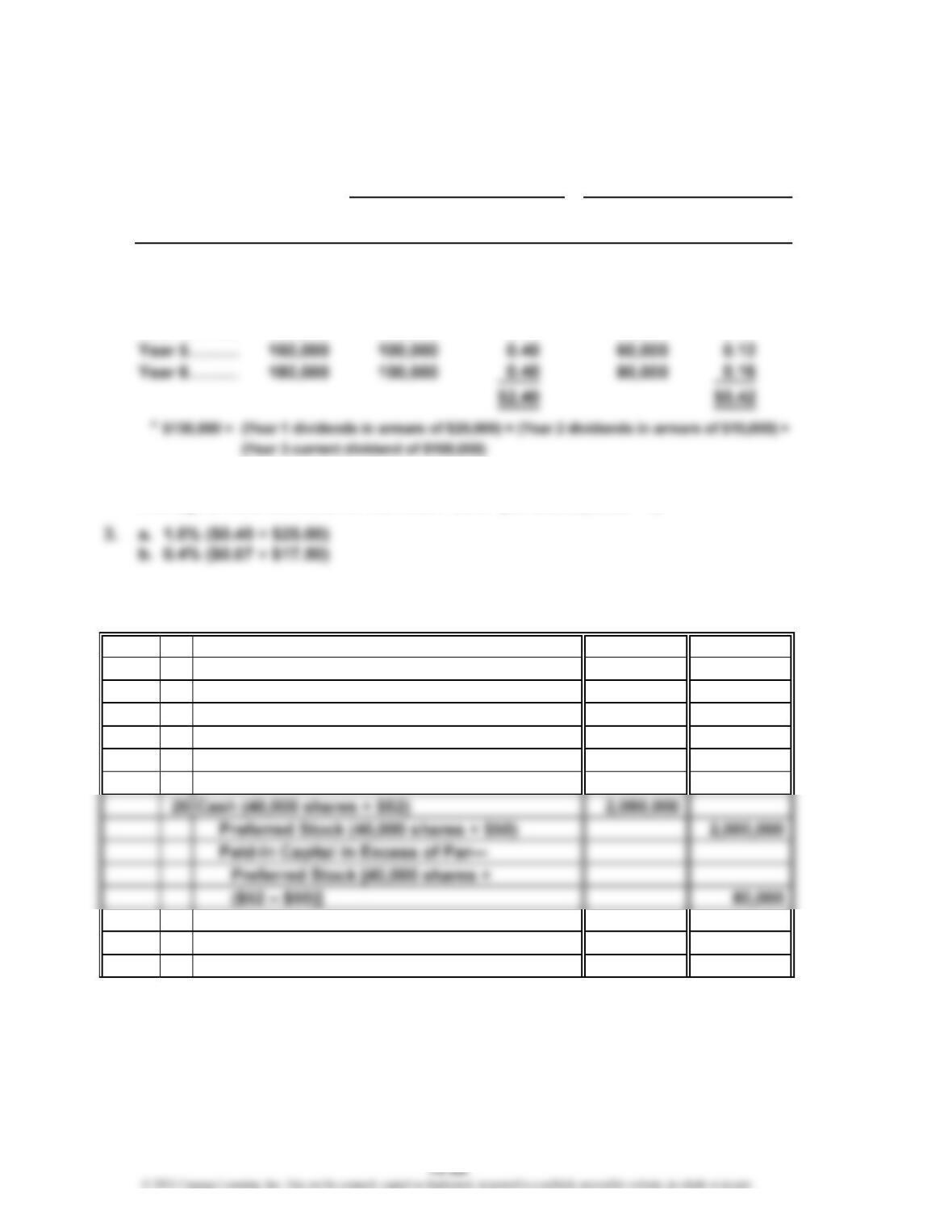
Total Per Per
Dividends Total Share Total Share
Year 1……… $ 80,000 $ 80,000 $0.32 $ 0 $0.00
Year 2……… 90,000 90,000 0.36 0 0.00
Year 3……… 150,000 130,000 0.52 20,000 0.04
Year 4……… 150,000 100,000 0.40 50,000 0.10
2. Average annual dividend for preferred: $0.40 per share ($2.40 ÷ 6)
Average annual dividend for common: $0.07 per share ($0.42 ÷ 6)
Prob. 13-2A
11 Building 3,375,000
Land 1,500,000
Common Stock (125,000 shares × $35) 4,375,000
Paid-In Capital in Excess of Par—
Common Stock [125,000 shares ×
($39 – $35)] 500,000
31 Cash 4,000,000
Mortgage Note Payable 4,000,000
PROBLEMS
Year
Preferred Dividends Common Dividends
May
*
CHAPTER 13 Corporations: Organization, Stock Transactions, and Dividends
Prob. 13-3A
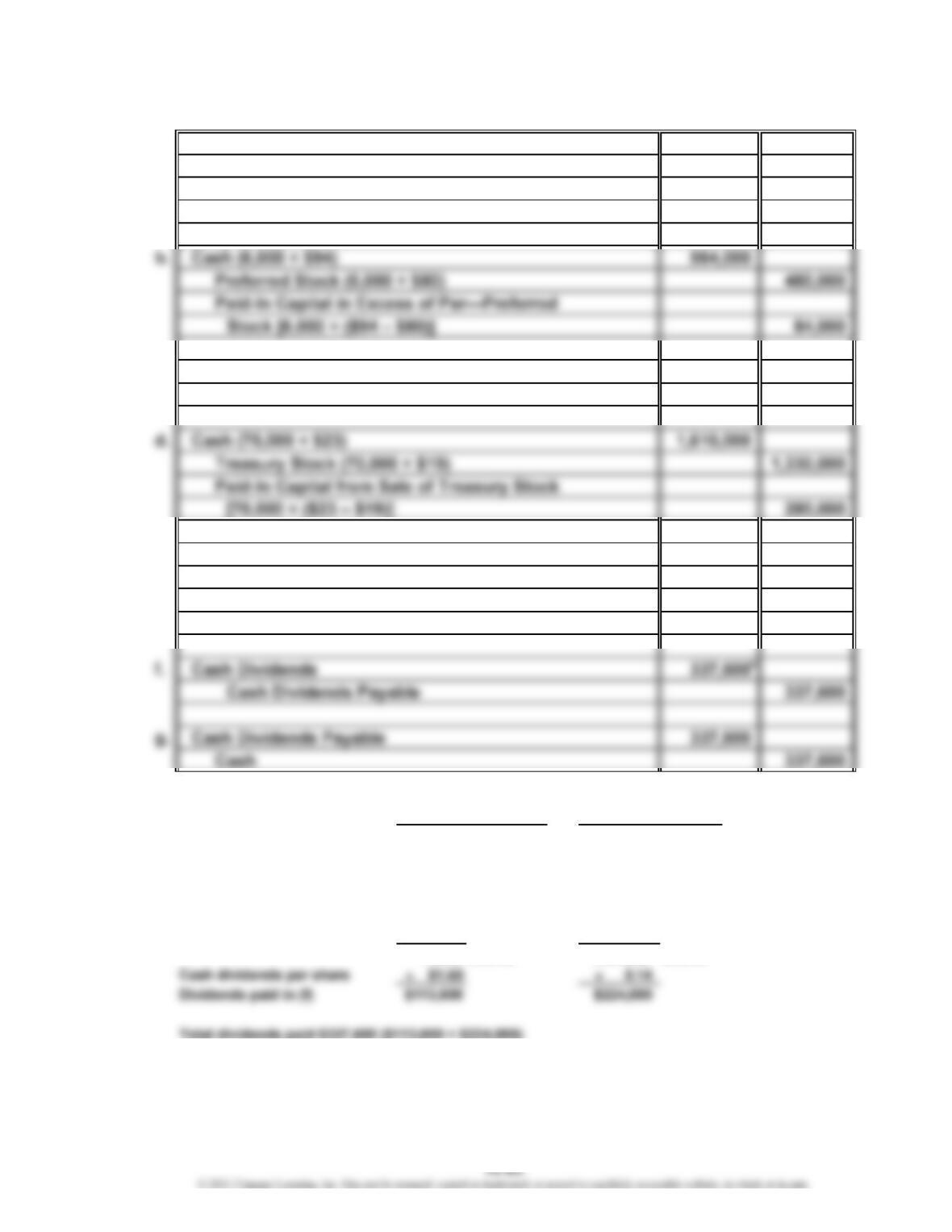
a. Cash (220,000 × $15)
Common Stock (220,000 × $12) 2,640,000
Paid-In Capital in Excess of Par—Common
Stock [220,000 × ($15 – $12)] 660,000
c. Treasury Stock (130,000 × $19)
Cash 2,470,000
e. Cash (40,000 × $17)
Paid-In Capital from Sale of Treasury Stock
[40,000 × ($19 – $17)]
Treasury Stock (40,000 × $19) 760,000
* Calculation of cash dividends:
Beginning of year 65,000 shares 1,400,000 shares
(a) 220,000
(b) 6,000
(c) (130,000)
(d) 70,000
(e) 40,000
71,000 shares 1,600,000 shares
3,300,000
2,470,000
680,000
80,000
Outstanding Shares of Stock
Preferred Stock Common Stock
CHAPTER 13 Corporations: Organization, Stock Transactions, and Dividends
Prob. 13-4A
1. and 2.
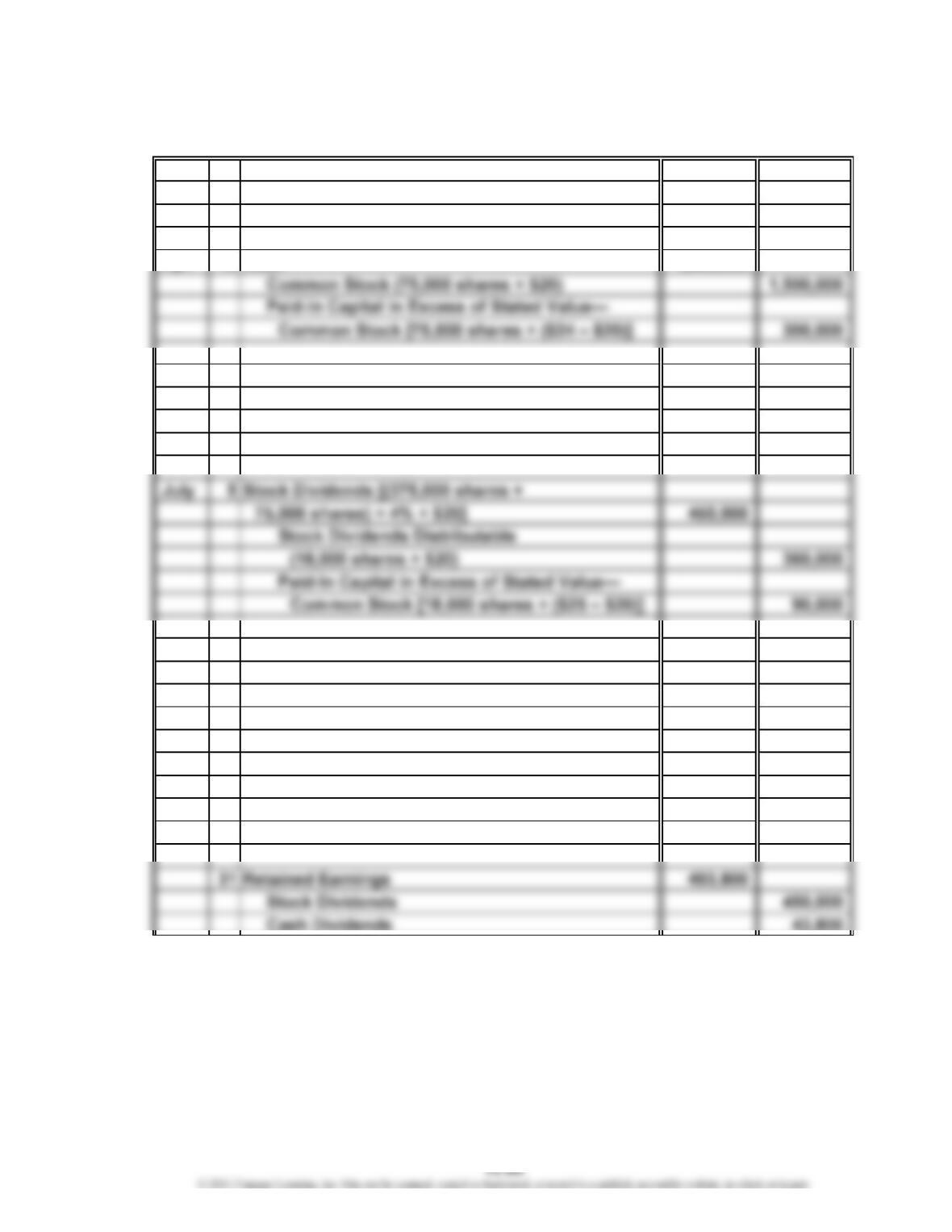
Jan. 1 Bal. 7,500,000
Apr. 10 1,500,000
Aug. 15 360,000
Dec. 31 Bal. 9,360,000
Dec. 31 493,800 Jan. 1 Bal. 33,600,000
Dec. 31 1,125,000
Dec. 31 Bal. 34,231,200
June 6 200,000
Dec. 28 43,800 Dec. 31 43,800
Common Stock
Retained Earnings
Cash Dividends
Paid-In Capital from Sale of Treasury Stock
CHAPTER 13 Corporations: Organization, Stock Transactions, and Dividends
Prob. 13-4A (Continued)
2.
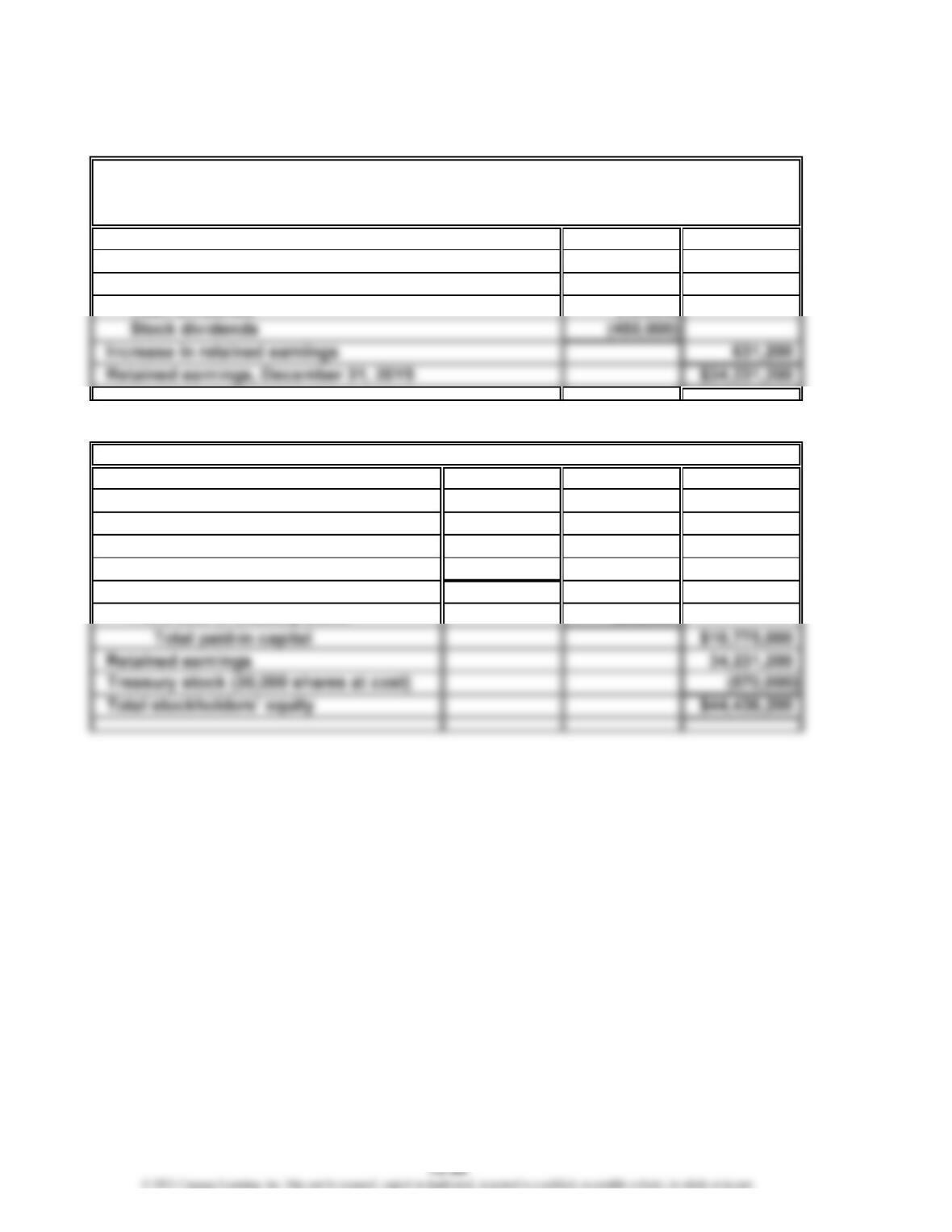
Jan. 22 Cash Dividends Payable [(375,000 shares –
25,000 shares) × $0.08] 28,000
Cash 28,000
June 6 Cash (25,000 shares × $26) 650,000
Treasury Stock (25,000 shares × $18) 450,000
Paid-In Capital from Sale of Treasury Stock
[25,000 shares × ($26 – $18)] 200,000
Aug. 15 Stock Dividends Distributable 360,000
Common Stock 360,000
Nov. 23 Treasury Stock (30,000 shares × $19) 570,000
Cash 570,000
Dec. 28 Cash Dividends [(375,000 shares + 75,000 shares +
18,000 shares – 30,000 shares) × $0.10] 43,800
Cash Dividends Payable 43,800
Cash Dividends 43,800
CHAPTER 13 Corporations: Organization, Stock Transactions, and Dividends
Prob. 13-4A (Concluded)
3.
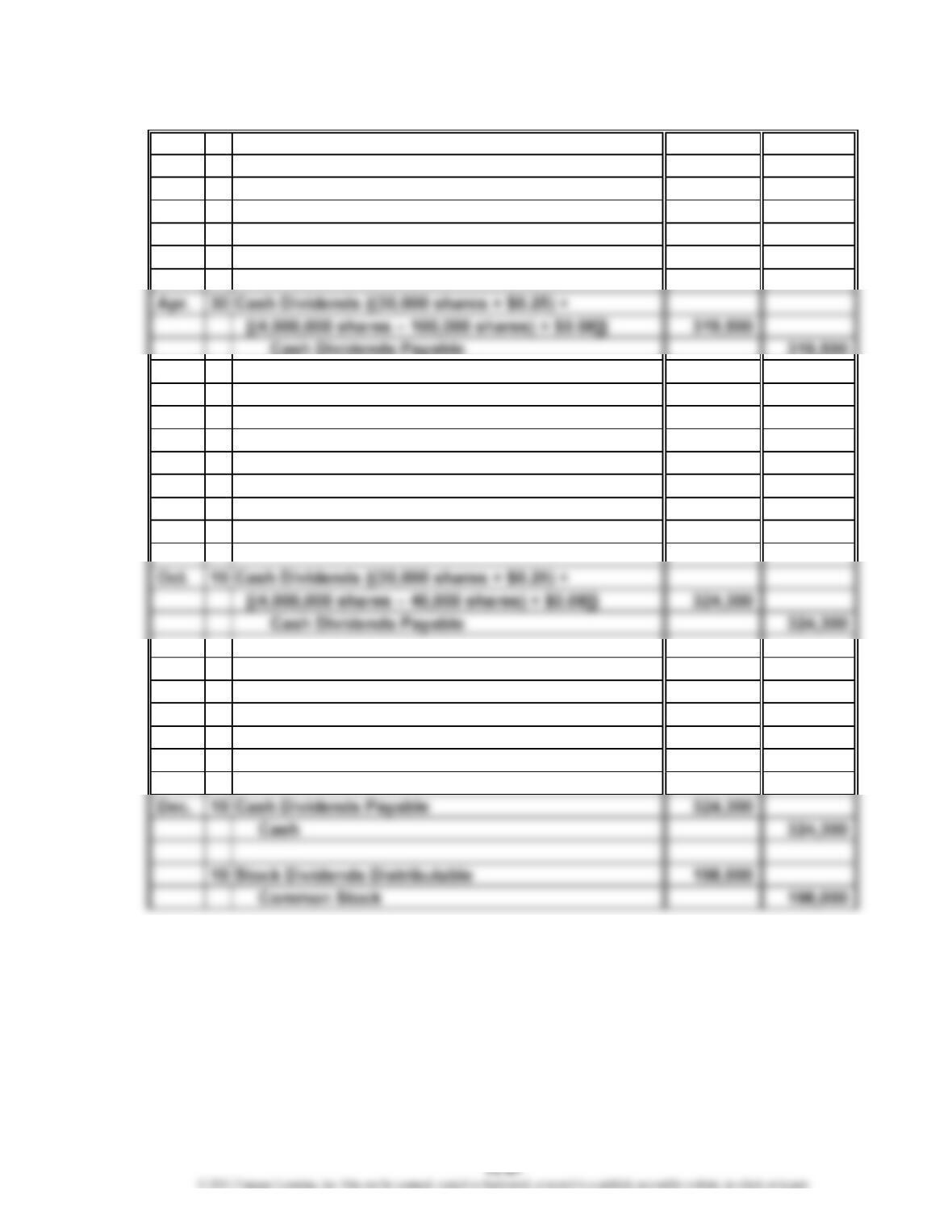
Retained earnings, January 1, 20Y5 $33,600,000
Net income $1,125,000
Dividends:
4.
Paid-in capital:
Common stock, $20 stated value
(500,000 shares authorized,
468,000 shares issued) $9,360,000
Excess over stated value 1,215,000
Paid-in capital, common stock $10,575,000
From sale of treasury stoc
k
200,000
Stockholders’ Equity
Morrow Enterprises Inc.
Retained Earnings Statement
For the Year Ended December 31, 20Y5
CHAPTER 13 Corporations: Organization, Stock Transactions, and Dividends
Prob. 13-5A
Jan. 5 No entry required. The stockholders’ ledger would
be revised to record the increased number of shares
held by each stockholder and the new par value.
Mar. 10 Treasury Stock (100,000 shares × $30) 3,000,000
Cash 3,000,000
Cash Dividends Payable 319,500
June 15 Cash Dividends Payable 319,500
Cash 319,500
Aug. 20 Cash (60,000 shares × $40) 2,400,000
Treasury Stock (60,000 shares × $30) 1,800,000
Paid-In Capital from Sale of Treasury
Stock [60,000 shares × ($40 – $30)] 600,000
15 Stock Dividends (39,600 shares × $35) 1,386,000
Stock Dividends Distributable
(39,600 shares × $5) 198,000
Paid-In Capital in Excess of Par—
Common Stock (39,600 shares × $30) 1,188,000
CHAPTER 13 Corporations: Organization, Stock Transactions, and Dividends
Prob. 13-1B
1.
Total Per Per
Dividends Total Share Total Share
Year 1………
…
$ 42,500 $ 42,500 $0.85 $0 $0.00
Year 2………
…
18,000 18,000 0.36 0 0.00
Year 3………
…
223,500 179,500 3.59 44,000 0.44
$9.60 $4.26
*
$179,500 = Year 1 dividends in arrears of $37,500 + Year 2 dividends in arrears of $62,000 +
Year 3 current dividend of $80,000
2. Average annual dividend for preferred: $1.60 per share ($9.60 ÷ 6)
Average annual dividend for common: $0.71 per share ($4.26 ÷ 6)
Prob. 13-2B
9 Cash 1,500,000
Mortgage Note Payable 1,500,000
17 Cash (20,000 shares × $126) 2,520,000
Preferred Stock (20,000 shares × $120) 2,400,000
Paid-In Capital in Excess of Par—
Preferred Stock [20,000 shares ×
($126 – $120)] 120,000
Year
Preferred Dividends Common Dividends
Oct.
*
…
…
…
CHAPTER 13 Corporations: Organization, Stock Transactions, and Dividends
Prob. 13-3B
a. Treasury Stock (87,500 shares × $8)
Cash 700,000
d. Cash (400,000 shares × $13)
Common Stock (400,000 shares × $9) 3,600,000
Paid-In Capital in Excess of Par—Common
Stock [400,000 shares × ($13 – $9)] 1,600,000
e. Cash (18,000 shares × $7.50)
Paid-In Capital from Sale of Treasury Stock
[18,000 shares × ($8.00 – $7.50)]
Treasury Stock (18,000 shares × $8) 144,000
* Calculation of cash dividends:
Beginning of year 60,000 shares 1,750,000 shares
(a) (87,500)
(b) 55,000
(c) 20,000
5,200,000
Preferred Stock Common Stock
Outstanding Shares of Stock
9,000
135,000
700,000
CHAPTER 13 Corporations: Organization, Stock Transactions, and Dividends
Prob. 13-4B
1. and 2.
Jan. 1 Bal. 3,100,000
Apr. 13 1,000,000
July 16 123,000
Dec. 31 Bal. 4,223,000
Dec. 31 248,068 Jan. 1 Bal. 4,875,000
Dec. 31 775,000
Dec. 31 Bal. 5,401,932
Mar. 15 36,000
July 16 123,000 June 14 123,000
Common Stock
Retained Earnings
Paid-In Capital from Sale of Treasury Stock
Stock Dividends Distributable
CHAPTER 13 Corporations: Organization, Stock Transactions, and Dividends
Prob. 13-4B (Continued)
2.
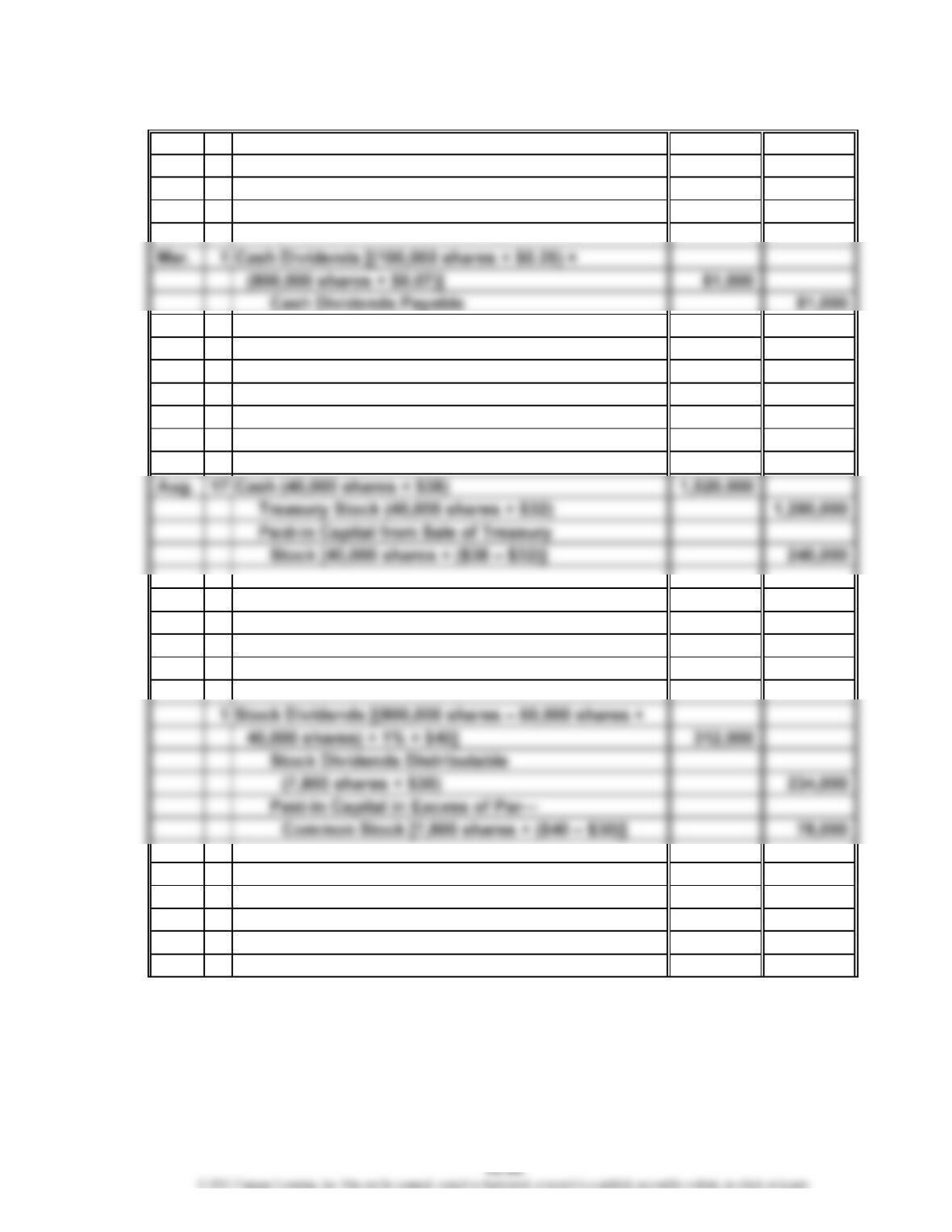
Jan. 15 Cash Dividends Payable
[(620,000 shares – 48,000 shares) × $0.06] 34,320
Cash 34,320
Mar. 15 Cash (48,000 shares × $6.75) 324,000
Treasury Stock (48,000 shares × $6.00) 288,000
Paid-In Capital from Sale of Treasury Stock
[48,000 shares × ($6.75 – $6.00)] 36,000
June 14 Stock Dividends
[(620,000 shares + 200,000 shares) × 3% × $7.50] 184,500
Stock Dividends Distributable
(24,600 shares × $5) 123,000
Paid-In Capital in Excess of Stated Value—
Common Stock [24,600 shares ×
($7.50 – $5.00)] 61,500
Dec. 30 Cash Dividends [(620,000 shares +
200,000 shares + 24,600 shares –
50,000 shares) × $0.08] 63,568
Cash Dividends Payable 63,568
CHAPTER 13 Corporations: Organization, Stock Transactions, and Dividends
Prob. 13-4B (Concluded)
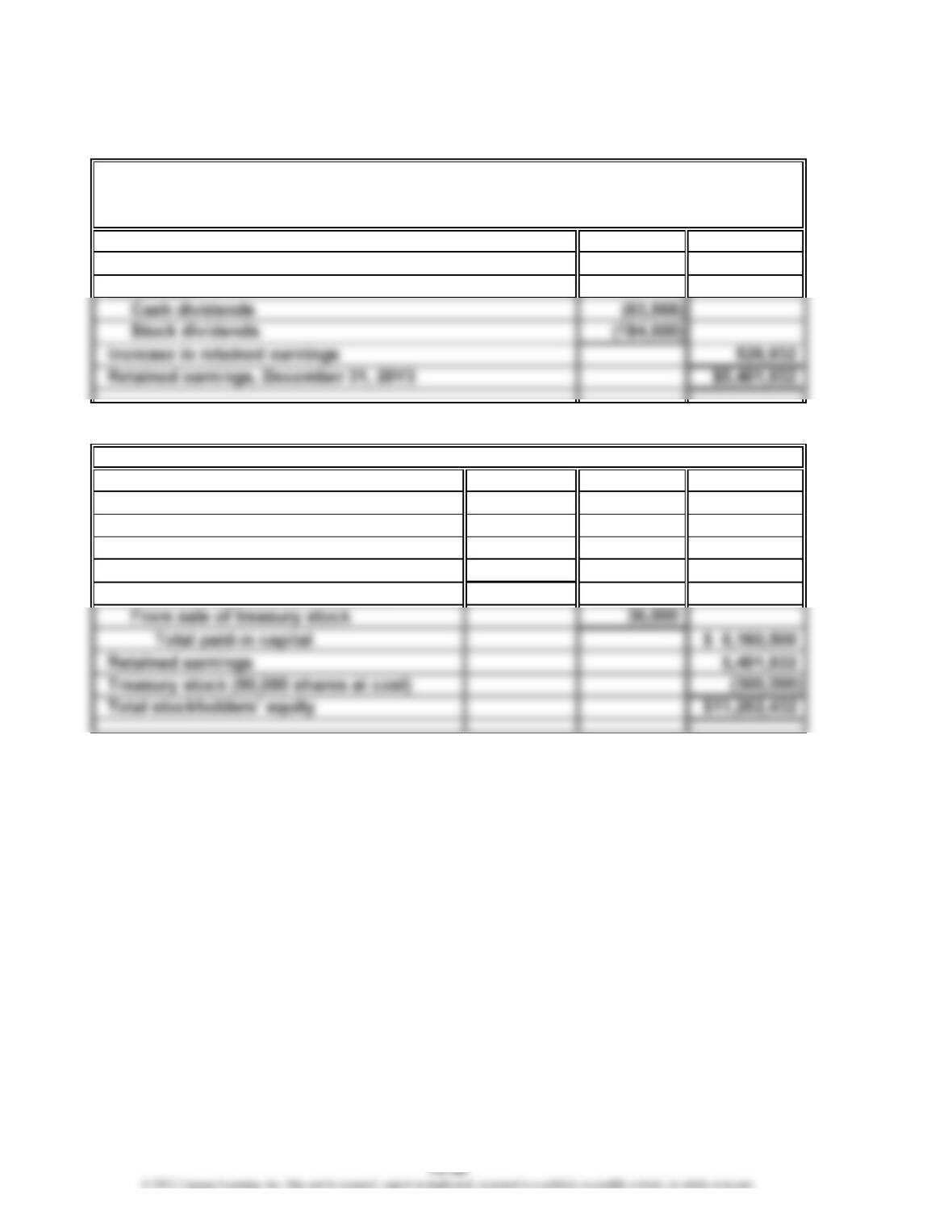
3.
Retained earnings, January 1, 20Y3 $4,875,000
Net income $ 775,000
Dividends:
4.
Paid-in capital:
Common stock, $5 stated value
(900,000 shares authorized, 844,600
shares issued) $4,223,000
Excess over stated value 1,901,500
Paid-in capital, common stock $6,124,500
Stockholders’ Equity
Nav-Go Enterprises Inc.
Retained Earnings Statement
For the Year Ended December 31, 20Y3
CHAPTER 13 Corporations: Organization, Stock Transactions, and Dividends
Prob. 13-5B
Jan. 15 No entry required. The stockholders’ ledger would
be revised to record the increased number of
shares held by each stockholder and the new par
value.
Apr. 30 Cash Dividends Payable 81,000
Cash 81,000
May 31 Treasury Stock (60,000 shares × $32) 1,920,000
Cash 1,920,000
Sept. 1 Cash Dividends {(100,000 shares × $0.25) +
[(800,000 shares – 60,000 shares +
40,000 shares) × $0.09]} 95,200
Cash Dividends Payable 95,200
Oct. 31 Cash Dividends Payable 95,200
Cash 95,200
31 Stock Dividends Distributable 234,000
Common Stock 234,000
CHAPTER 13 Corporations: Organization, Stock Transactions, and Dividends
CP 13-1
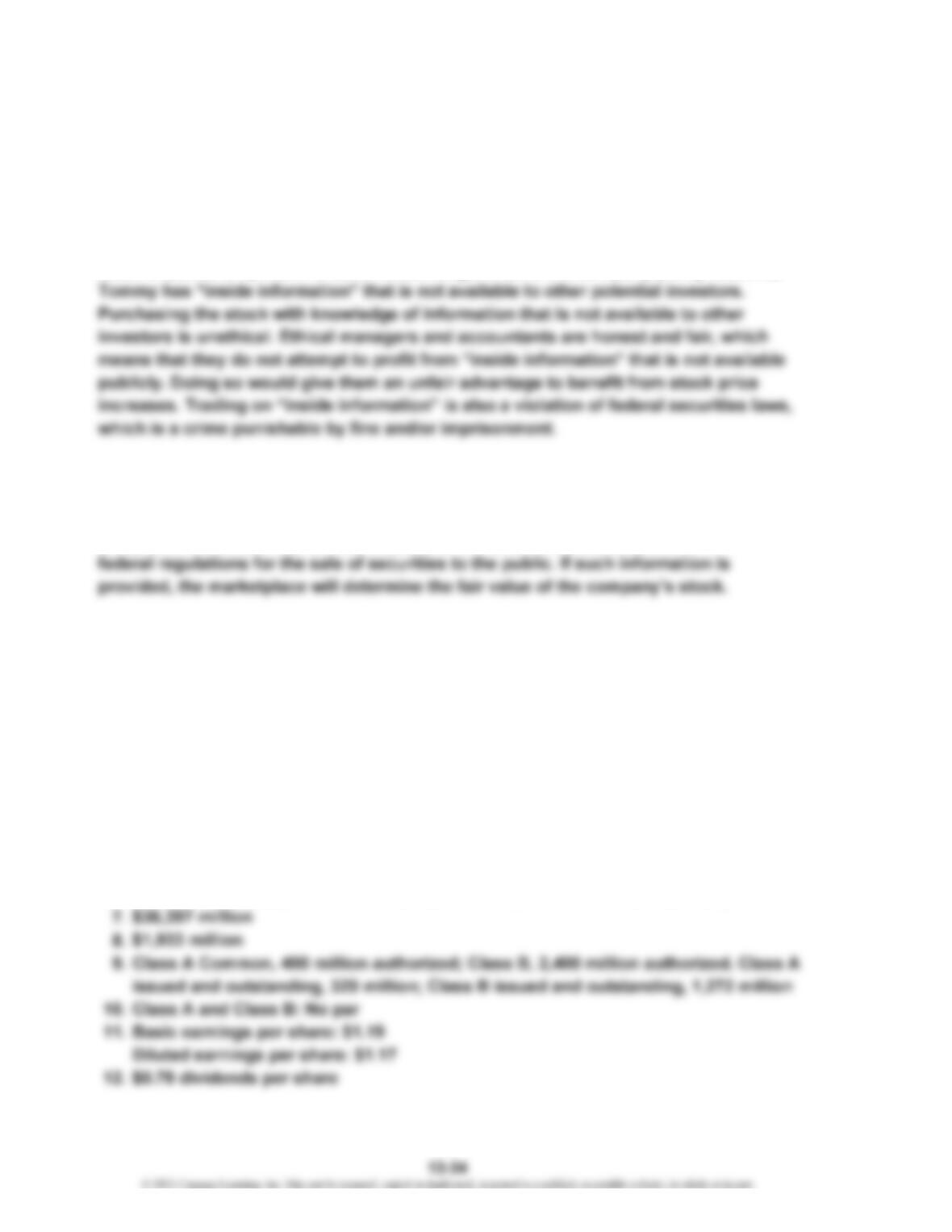
Tommy is clearly acting unethically for several reasons. First, he is violating the
company’s policy on stock purchases. This policy was established to ensure the fair
and timely dissemination of information that gives all potential investors the same
chance to participate in the stock price increases. The fact that he is purchasing the
stock in partnership with his father does not get around the company policy. Second,
CP 13-2
Lou and Shirley are behaving in a professional manner as long as full and
complete information is provided to potential investors in accordance with
CP 13-3
A sample solution based on Nike Inc.’s Form 10-K for the fiscal year ended May 31, 2018
,
follows:
1. Nike, Inc.
2. Oregon
3. Our principal business activity is the design, development, and worldwide
marketing and selling of athletic footwear, apparel, equipment, accessories,
and services.
4. $22,536 million
5. $12,724 million
6. $9,812 million ($22,536 million total assets – $12,724 million total liabilities)
CASES & PROJECTS
CHAPTER 13 Corporations: Organization, Stock Transactions, and Dividends
CP 13-4
Memo
To: Matt Cengage
From: A+ Student
Re: Fourth Quarter 20Y8 Cash Dividend
In order to declare a dividend prudently for the fourth quarter, the company must
have a sufficient Retained Earnings balance from which to declare the dividend.
On December 31, 20Y8, Motion Designs has a $4,630,000 balance in Retained
Earnings. This balance is more than enough to cover the $90,000 declaration of
the normal quarterly cash dividend of $0.50 per share. In addition, the company
must have enough cash on hand to pay the dividend while meeting the remaining
cash needs of the business. The company has a December 31, 20Y8, cash balance
of $250,000, of which $100,000 is committed as the compensating balance under
the loan agreement. This leaves only $150,000 to pay the dividend of $90,000 and
finance normal operations. Unless the cash balance can be expected to increase
significantly in early 20Y9, it is questionable whether the company’s cash balance
is large enough to both pay the cash dividend and provide for the company’s
near-term operating needs.
CP 13-5
At the time of this decision, the WorldCom board had come under intense scrutiny.
This was the largest loan by a company to its CEO in history. The SEC began an
investigation into this loan, and Bernie Ebbers was eventually terminated as the
CEO, with this loan being cited as part of the reason. The board indicated that
the decision to lend Ebbers this money was to keep him from selling his stock
Some press comments:
1. When he borrowed money personally, he used his WorldCom stock as
collateral. As these loans came due, he was unwilling to sell at “depressed
2. It was astonishing to read the other day that the board of directors of the
United States’ second-largest telecommunications company claims to have
had its shareholders’ interests in mind when it agreed to grant more than $430
million in low-interest loans to the company’s CEO, mainly to meet margin
calls on his stock.
Yet that’s the level to which fiduciary responsibility seems to have sunk on
the board of Clinton, Mississippi-based WorldCom, the deeply troubled
telecom giant, as it sought to bail Bernard Ebbers out of the folly of
speculating in shares of WorldCom itself. Sadly, WorldCom is hardly alone.
CHAPTER 13 Corporations: Organization, Stock Transactions, and Dividends
CP 13-5 (Concluded)
best one by far—at least from the point of view of the shareholders—was to
CP 13-6
1. This case involves a transaction in which a security has been issued that has
characteristics of both stock and debt. The primary argument for classifying
the issuance of the common stock as debt is that the investors have a legal
right to an amount equal to the purchase price (face value) of the security.
This is similar to a note payable or a bond payable. The additional $120
payment could be argued to be equivalent to an interest payment, whose
payment has been deferred until a later date.
2. In practice, the $25 million stock issuance would probably be classified as
common stock. However, full disclosure should be made of the 5% of sales
and $120 per share payment obligations in the notes to the financial statements.
In addition, as Epstein Engineering Inc. generates sales, a current liability should
be recorded for the payment to stockholders. Such payments would be classified
as dividend payments rather than interest payments. Dan Fisher should also