CHAPTER 13
Financial Analysis: The Big Picture
Learning Objectives
1. Understand the concept of sustainable income.
2. Indicate how irregular items are presented.
3. Explain the concept of comprehensive income.
4. Describe and apply horizontal analysis.
5. Describe and apply vertical analysis.
6. Identify and compute ratios used in analyzing a company’s liquidity, solvency, and profitability.
7. Understand the concept of quality of earnings.
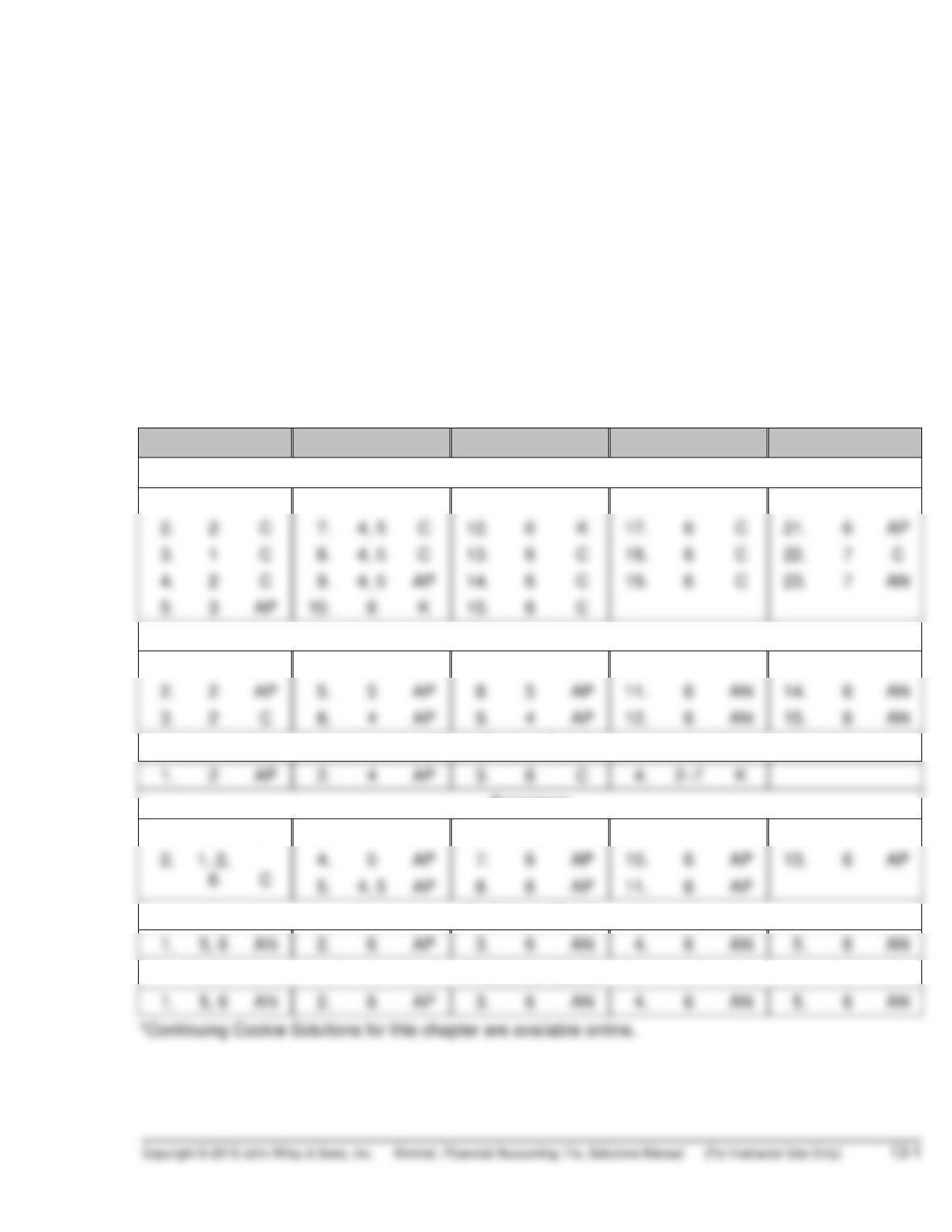
Summary of Questions by Learning Objectives and Bloom’s Taxonomy
Item LO BT Item LO BT Item LO BT Item LO BT Item LO BT
Questions
1. 1 C 6. 6 C 11. 6 C 16. 6 C 20. 6 C
Brief Exercises
1. 2 AP 4. 4 AP 7. 4 AP 10. 6 AP 13. 6 AN
Do It! Review Exercises
Exercises
1. 2 AP 3. 4 AP 6. 4, 5 AP 9. 6 AP 12. 6 AP
Problems: Set A
Problems: Set B
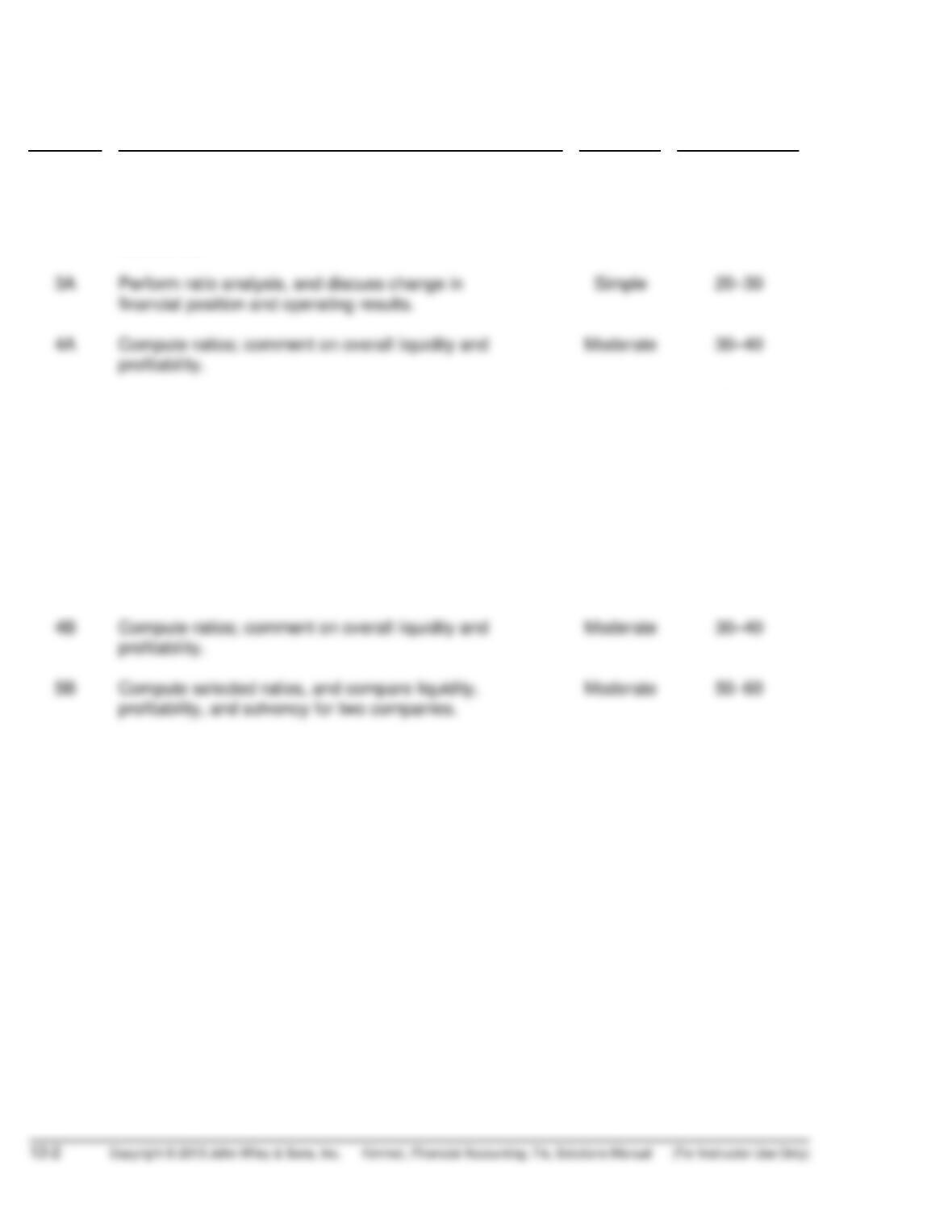
ASSIGNMENT CHARACTERISTICS TABLE
Problem
Number
Description
Difficulty
Level
Time
Allotted (min.)
1A Prepare vertical analysis and comment on profitability. Simple 20–30
2A Compute ratios from balance sheet and income
statements.
Simple 20–30
5A Compute selected ratios, and compare liquidity,
profitability, and solvency for two companies.
Moderate 50–60
1B Prepare vertical analysis and comment on profitability. Simple 20–30
2B Compute ratios from balance sheet and income
statements.
Simple 20–30
3B Perform ratio analysis, and discuss change in
financial position and operating results.
Simple 20–30
ANSWERS TO QUESTIONS
1. Sustainable income is defined as the most likely level of income to be obtained in the future. It is
the amount of regular income that a company can expect to earn from its normal operations.
In order to distinguish a company’s net income from its sustainable income, irregular items, such
as an extraordinary gain or discontinued operations, are reported separately on the income
statement.
4. Companies report a change from FIFO to average cost pricing for inventory retroactively. That is,
they report both the current period and any previous periods reported on the face of the state-
ment using the new principle. As a result, the same principle applies in all periods. This treatment
improves the ability to compare results across years.
7. (a) Comparison of financial information can be made on an intracompany basis, an inter-
company basis, and an industry average basis.
1. An intracompany basis compares the same item with prior periods, or with other
(b) The intracompany basis of comparison is useful in detecting changes in financial relation-
ships and significant trends within a company.
8. Horizontal analysis (also called trend analysis) measures the dollar and percentage increase or
decrease of an item over a period of time. In this approach, the amount of the item on one state–
Questions Chapter 13 (Continued)
9. (a) $300,000 X 1.245 = $373,500, 2014 net income.
10. (a) Liquidity ratios: Working capital, current ratio, current cash debt coverage, inventory turnover,
11. Andrea is correct. A single ratio by itself may not be very meaningful and is best interpreted by
12. (a) Liquidity ratios measure the short-term ability of the company to pay its maturing obligations
and to meet unexpected needs for cash.
13. Working capital and the current ratio both relate current assets to current liabilities. Working
capital produces a dollar amount that indicates the difference between current assets and current
14. Quick Mart does not necessarily have a problem. The accounts receivable turnover can be
15. (a) Asset turnover.
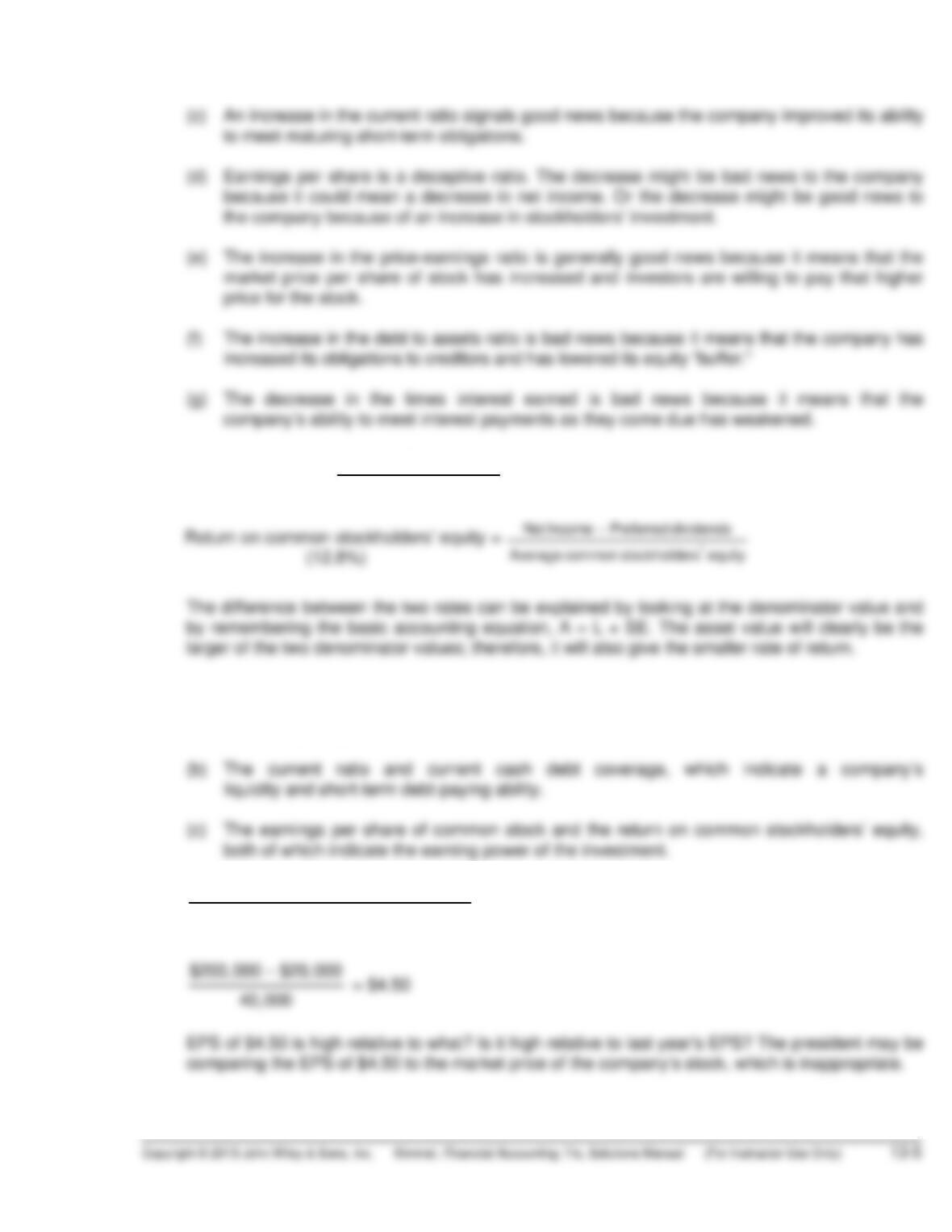
16. The price earnings (P-E) ratio is a reflection of investors’ assessments of a company’s future
earnings. The P-E ratio takes into account such factors as relative risk, stability of earnings,
17. The payout ratio is cash dividends declared on common stock divided by net income. In a growth
company, the payout ratio is often low because the company is reinvesting earnings in the business.
Questions Chapter 13 (Continued)
19.
Return on assets
(7.6%)
= Net Income
Average Total Assets
20. (a) Times interest earned, which is an indication of the company’s ability to meet interest charges,
and the debt to total assets ratio, which indicates the company’s ability to withstand losses
without impairing the interests of creditors.
21. Net income – Preferred dividends
Average common shares outstanding = Earnings per share.
Questions Chapter 13 (Continued)
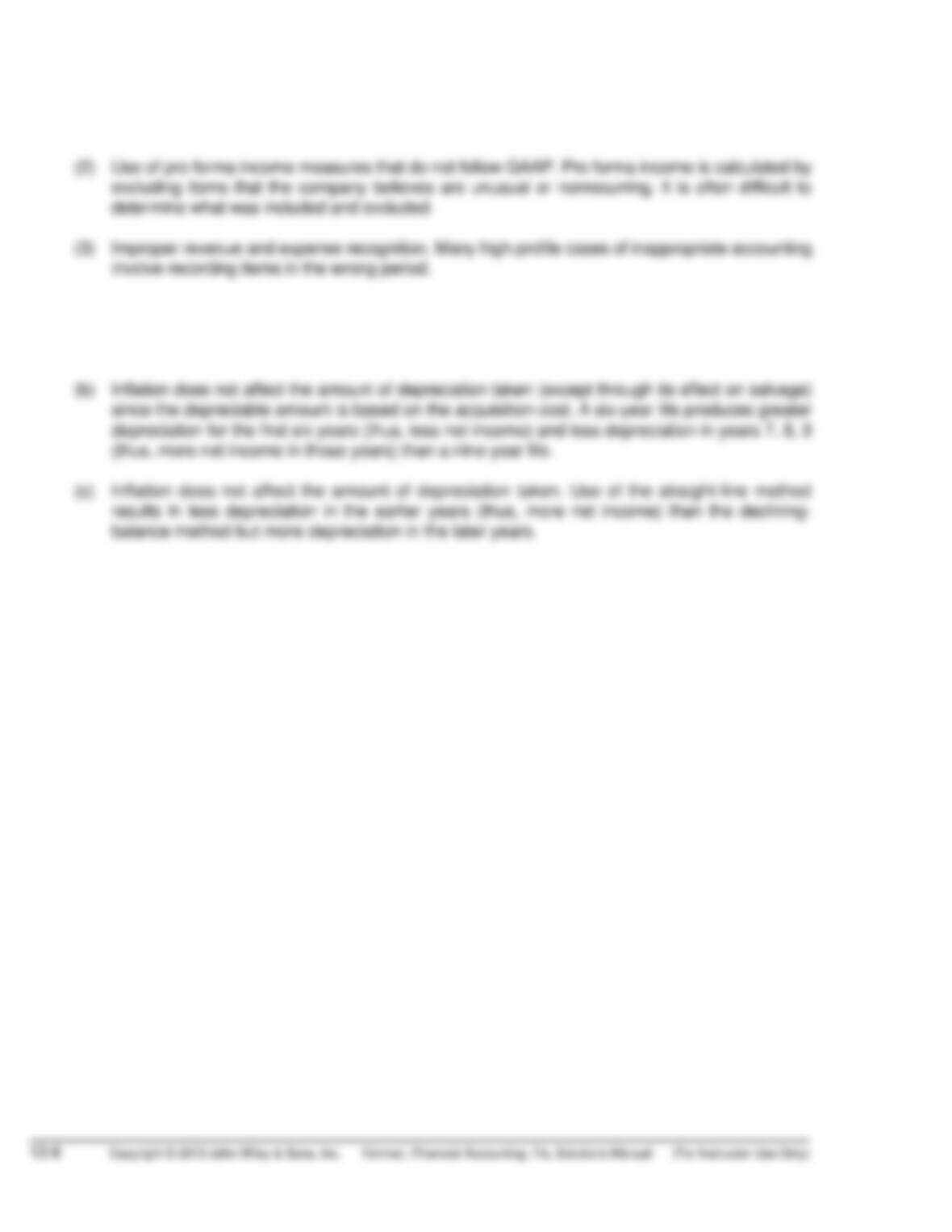
22. (1) Use of alternative accounting methods. Variations among companies in the application of
generally accepted accounting principles may hamper comparability.
23. (a) During a period of inflation, net income will be less under the LIFO inventory costing method
than it will be using the FIFO method because LIFO results in the larger cost of goods sold
amount.
SOLUTIONS TO BRIEF EXERCISES
BRIEF EXERCISE 13-1
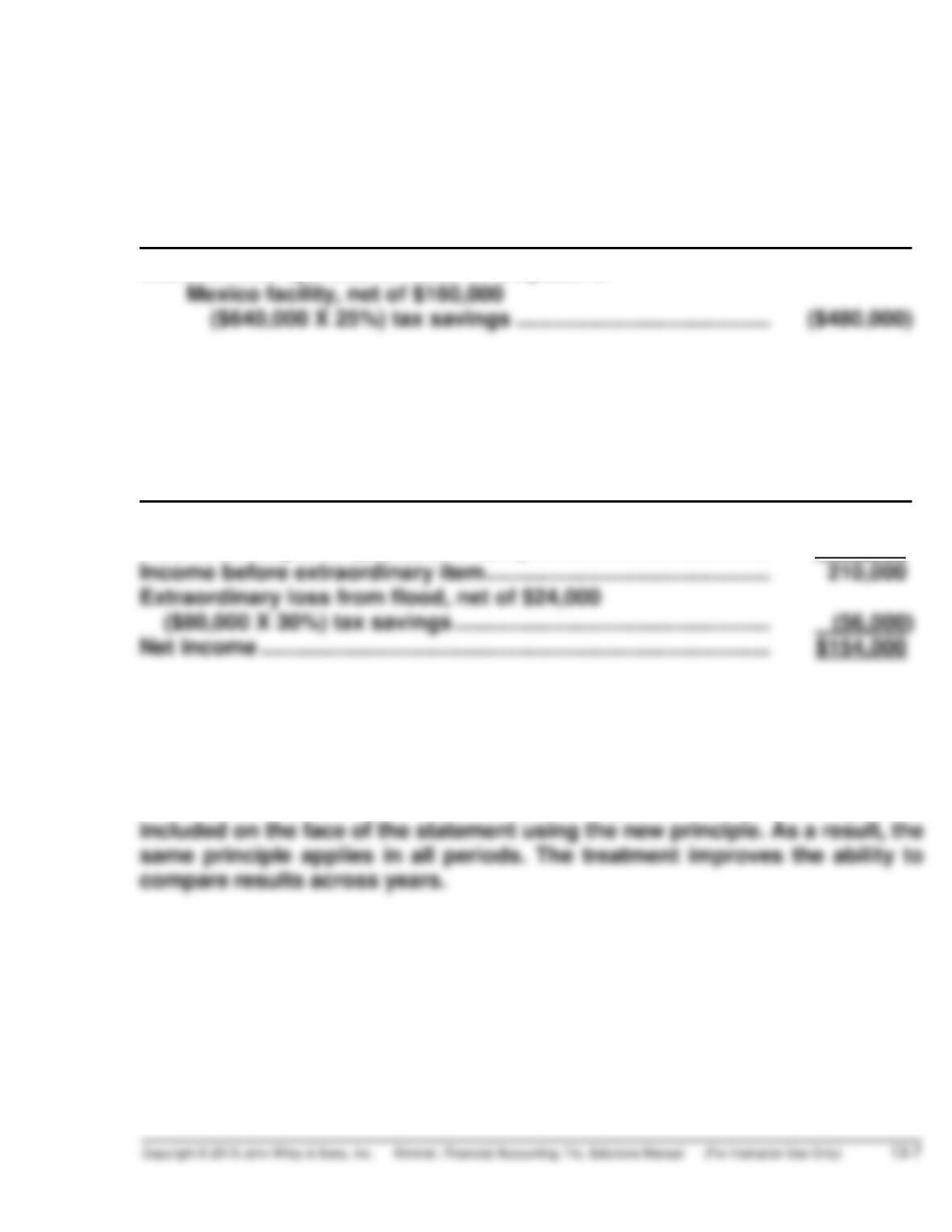
REYES CORPORATION
Partial Income Statement
Discontinued operations: Loss on disposal of
BRIEF EXERCISE 13-2
FIELDER CORPORATION
Partial Income Statement
Income before income taxes ………………………………………………. $300,000
Income tax expense ($300,000 X 30%) ………………………………… 90,000
BRIEF EXERCISE 13-3
The change in inventory pricing for Jenner should be reported retroactively.
That is, it should report both the current period and previous periods
BRIEF EXERCISE 13-4
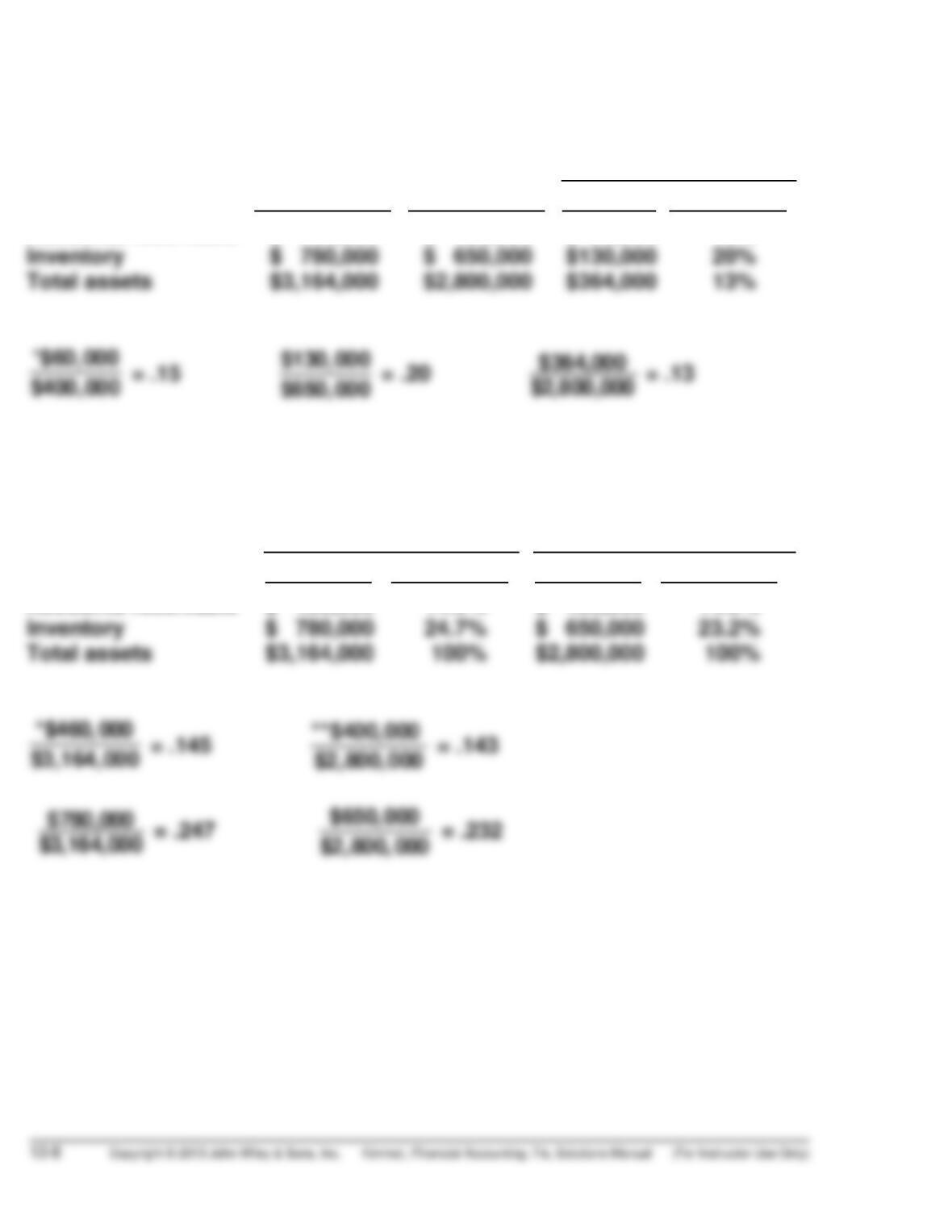
Horizontal analysis:
Increase
or (Decrease)
Dec. 31, 2014 Dec. 31, 2013
A
mount Percentage*
Accounts receivable
$ 460,000
$ 400,000
$ 60,000
15%
BRIEF EXERCISE 13-5
Vertical analysis:
Dec. 31, 2014 Dec. 31, 2013
Amount Percentage*
A
mount Percentage**
Accounts receivable
$ 460,000
14.5%
$ 400,000
14.3%
BRIEF EXERCISE 13-6
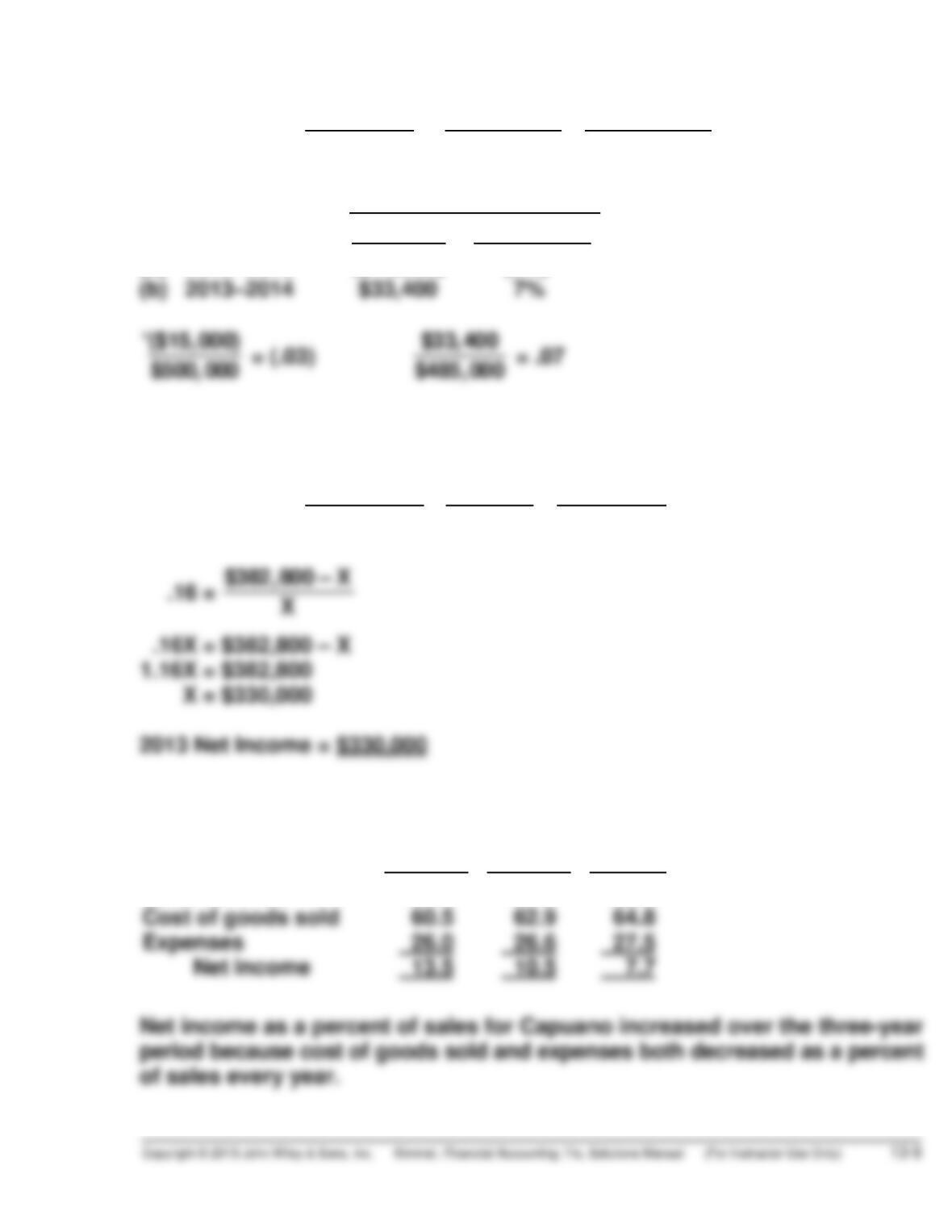
2014 2013 2012
Net income $518,400 $485,000 $500,000
Increase or (Decrease)
Amount Percentage*
(a)
2012
–
2013
($15,000)
(3%)
BRIEF EXERCISE 13-7
2014 2013 Increase
Net income $382,800
X
16%
BRIEF EXERCISE 13-8
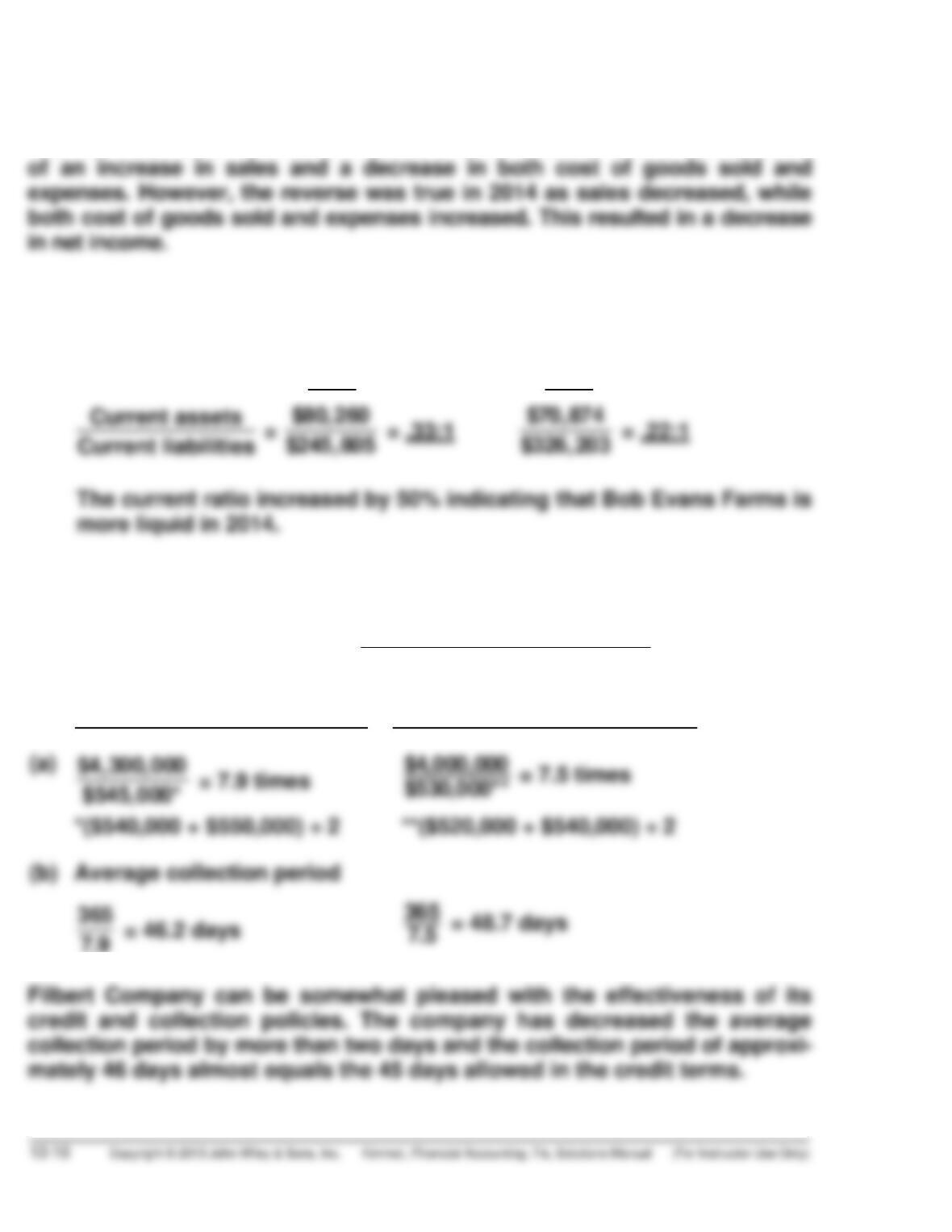
2014 2013 2012
Sales revenue
100.0
100.0
100.0
BRIEF EXERCISE 13-9
Comparing the percentages presented results in the following conclusions:
The net income for Roswell increased in 2013 because of the combination
BRIEF EXERCISE 13-10
Current ratio:
2014 2013
BRIEF EXERCISE 13-11
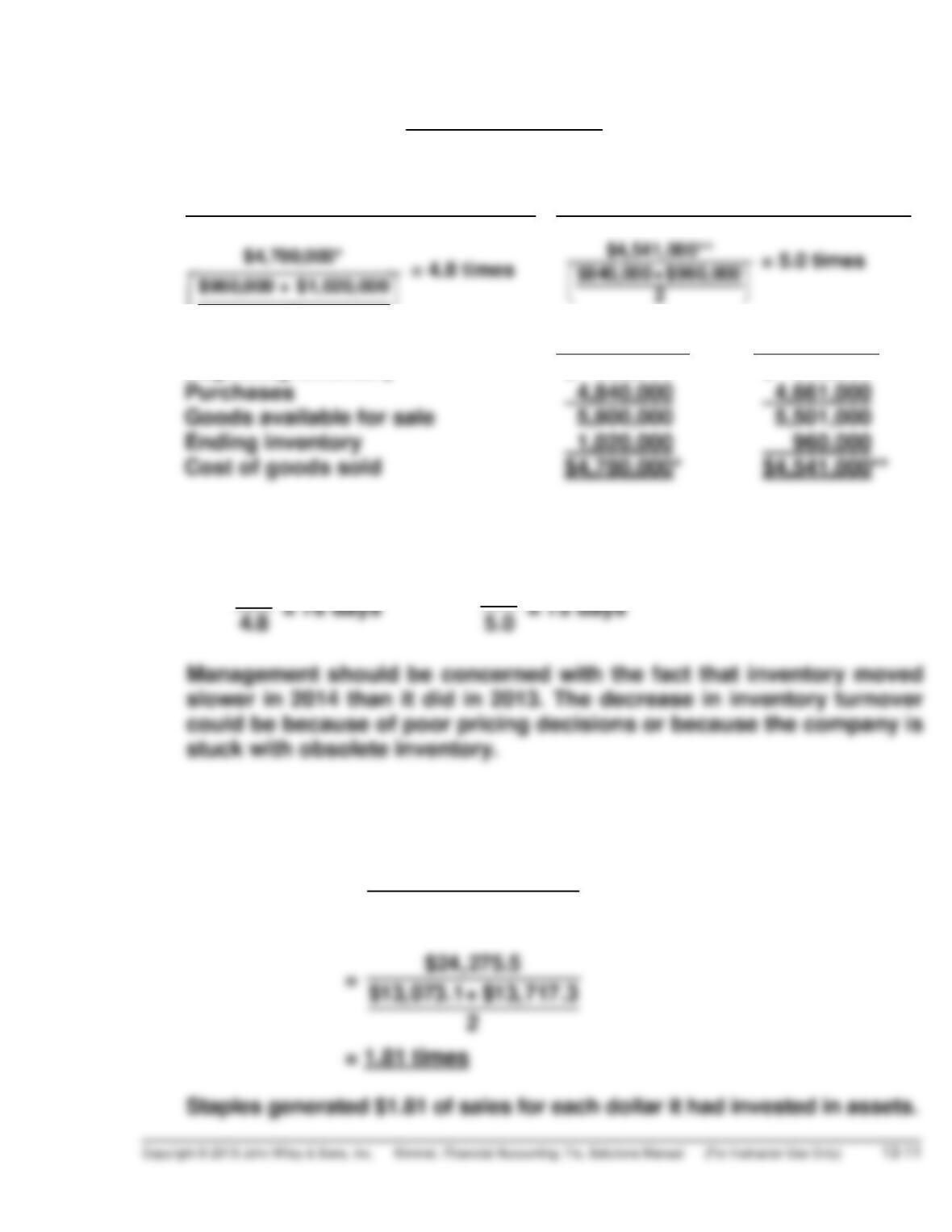
Accounts receivable turnover = Net credit sales
Average net accounts receivable
2014 2013
BRIEF EXERCISE 13-12
(a) Inventory turnover = Cost of goods sold
Average inventory
2014 2013
2
⎝
⎜⎞
⎠
⎟
2014 2013
Beginning inventory
$ 960,000
$ 840,000
(b) Days in inventory
BRIEF EXERCISE 13-13
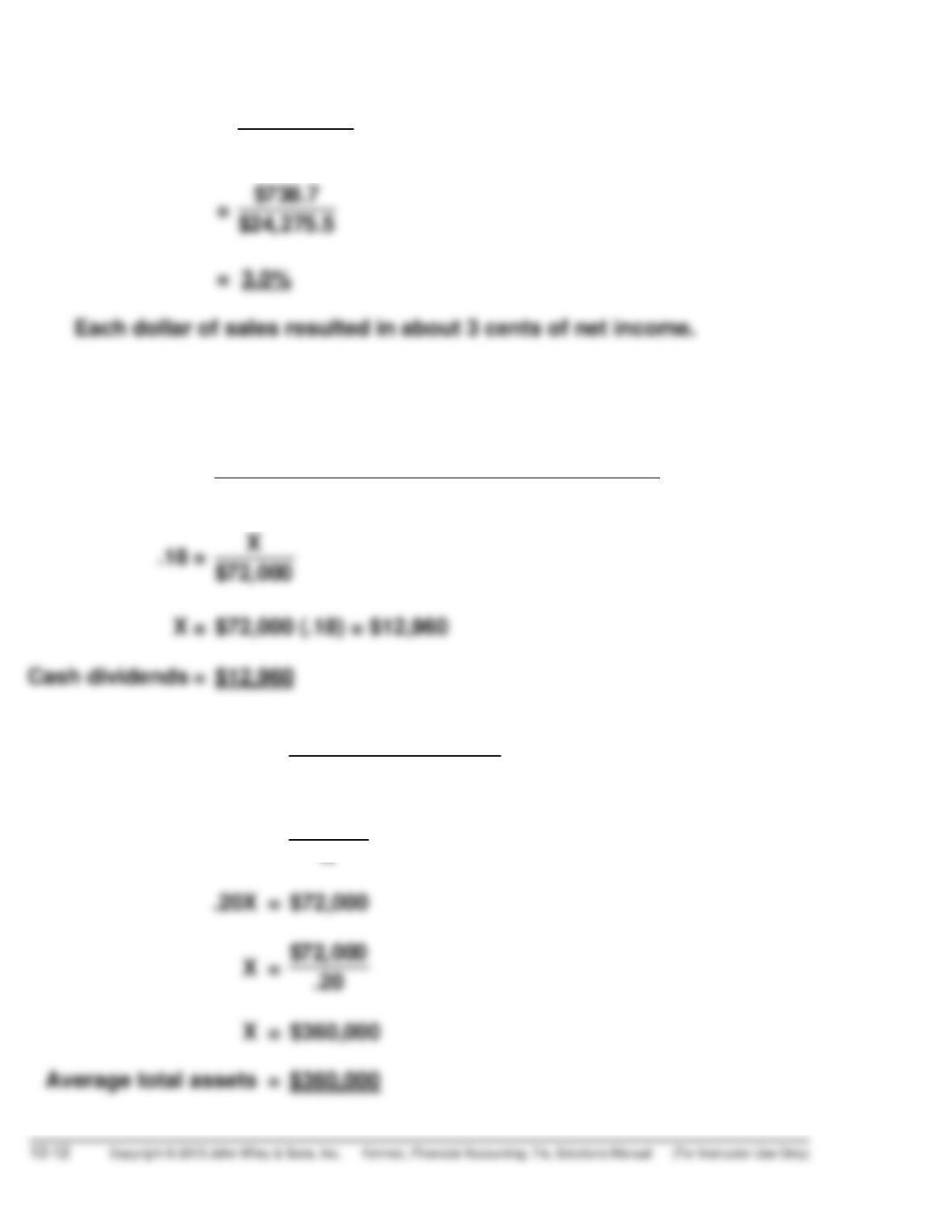
(a) Asset turnover = Net sales
Average total assets
BRIEF EXERCISE 13-13 (Continued)
(b) Profit margin =
Net income
Net sales
BRIEF EXERCISE 13-14
Payout ratio =
Cash dividends declared on common stock
Net income
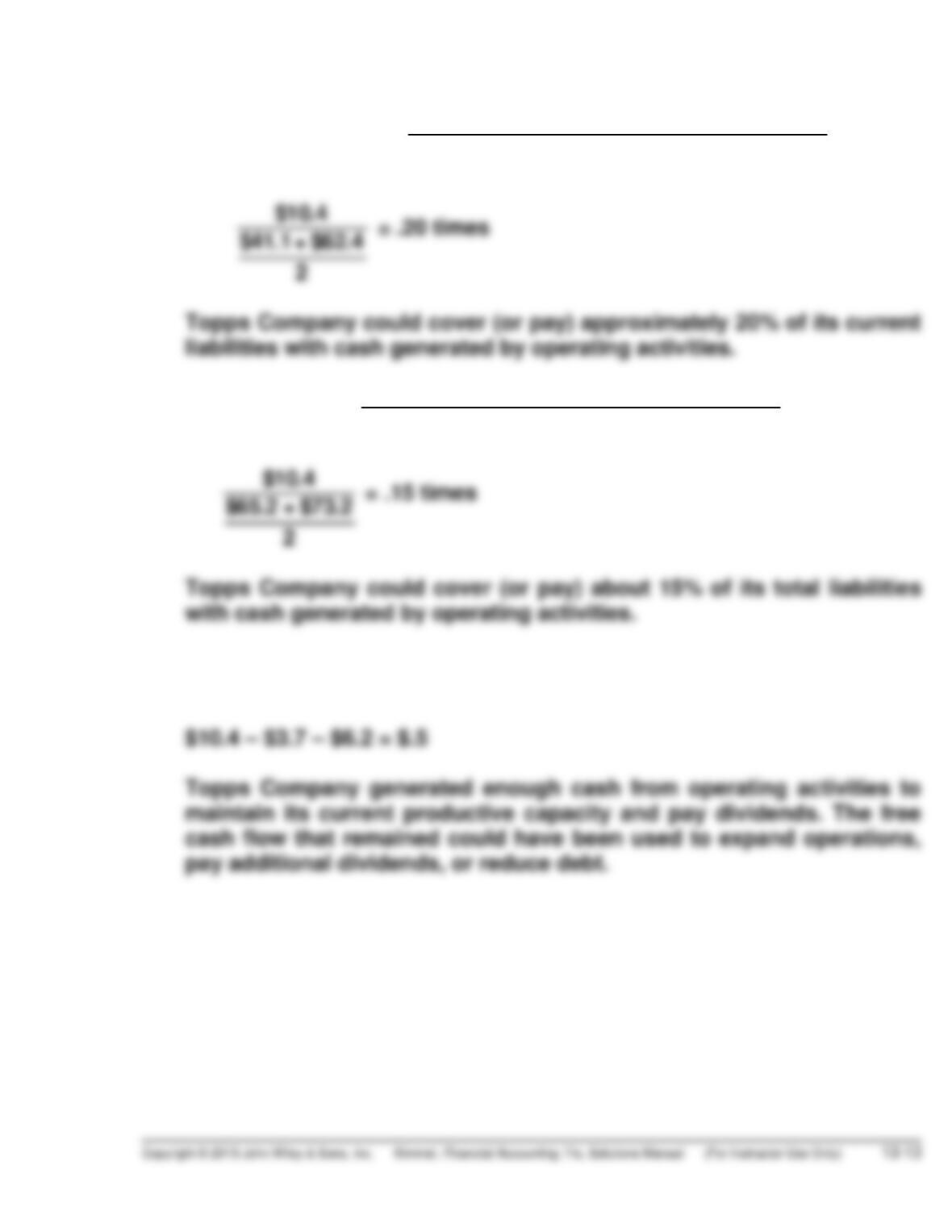
Return on assets = Net income
Average total assets
.20 =
$72, 000
X
BRIEF EXERCISE 13-15
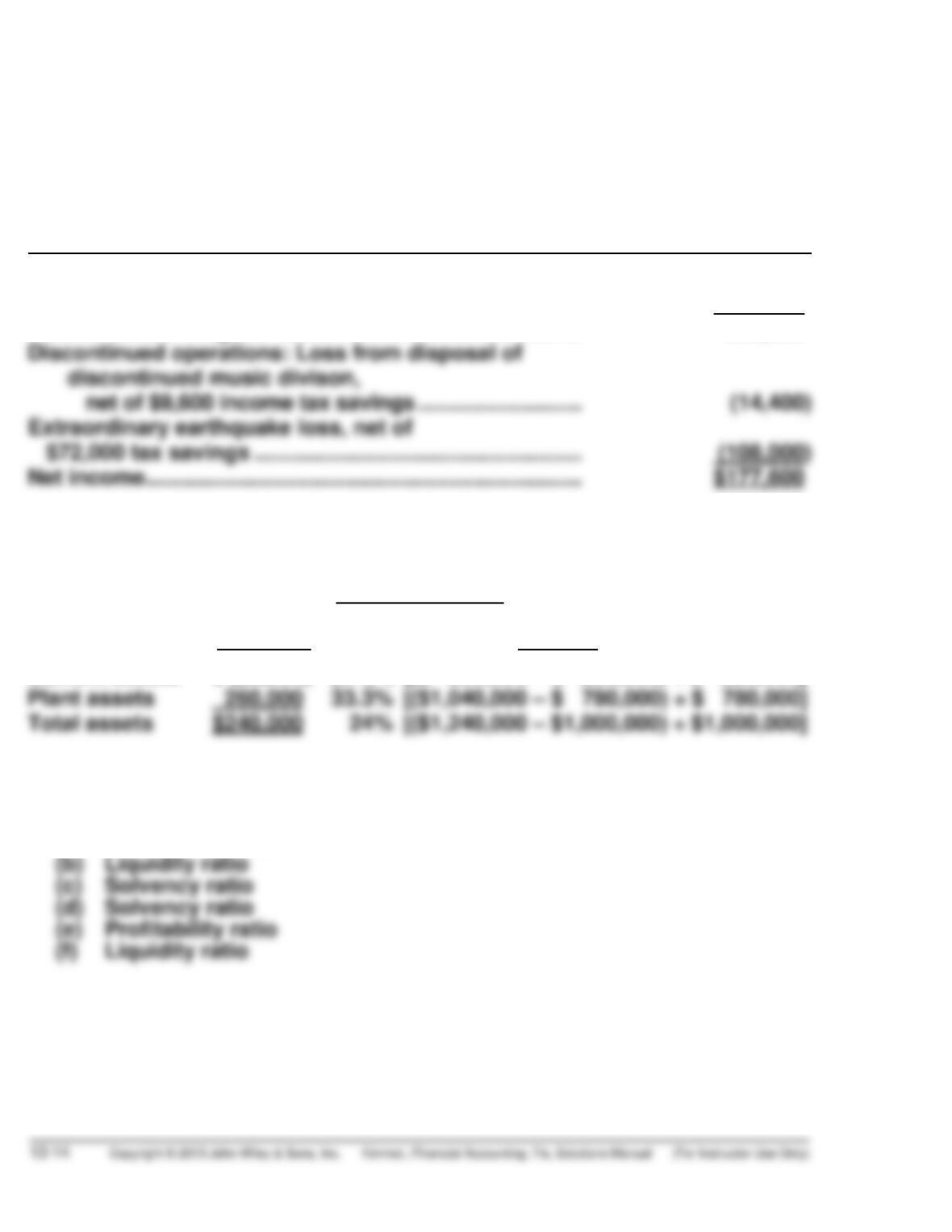
(a) Current cash debt
coverage =Net cash provided by operating activities
Average current liabilities
(b) Cash debt
coverage =Net cash provided by operating activities
Average total liabilities
(c) Free Cash Flow = Cash provided by operating activities –
Capital expenditures – Cash dividends
SOLUTIONS TO DO IT! REVIEW EXERCISES
DO IT! 13-1
SUNFLOWER CORPORATION
Income Statement (partial)
Income before income taxes ……………………………………. $500,000
Income tax expense ………………………………………………… 200,000
Income before irregular items …………………………………. 300,000
DO IT! 13-2
Increase in 2014
Amount Percent
Current assets $ (20,000) (9.1)% [($ 200,000 – $ 220,000) ÷ $ 220,000]
DO IT! 13-3
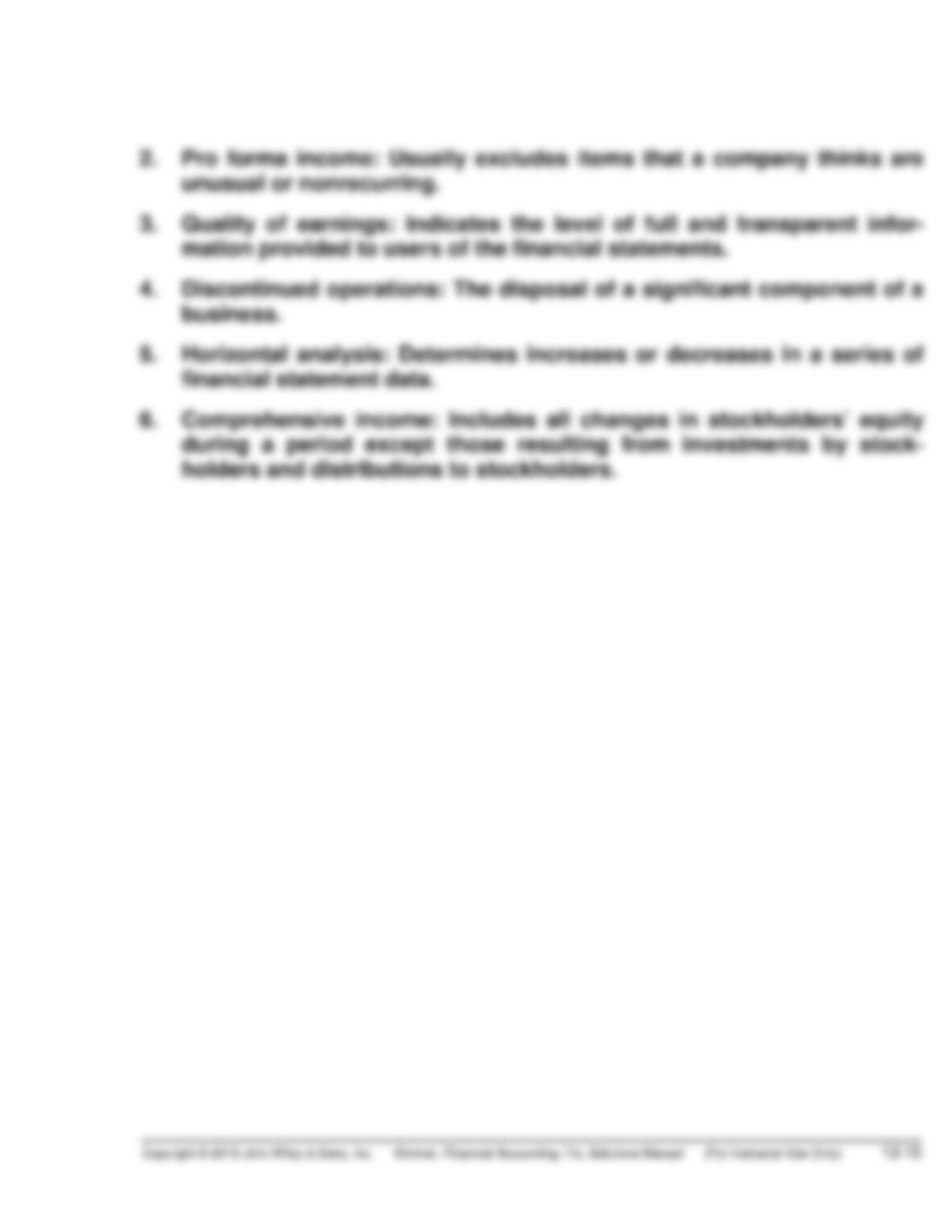
(a) Profitability ratio
DO IT! 13-4
1. Current ratio: A measure used to evaluate a company’s liquidity.
SOLUTIONS TO EXERCISES
EXERCISE 13-1
UTECH COMPANY
Partial Income Statement
For the Year Ended December 31, 2014
Income before irregular items …………………………………………….. $310,000
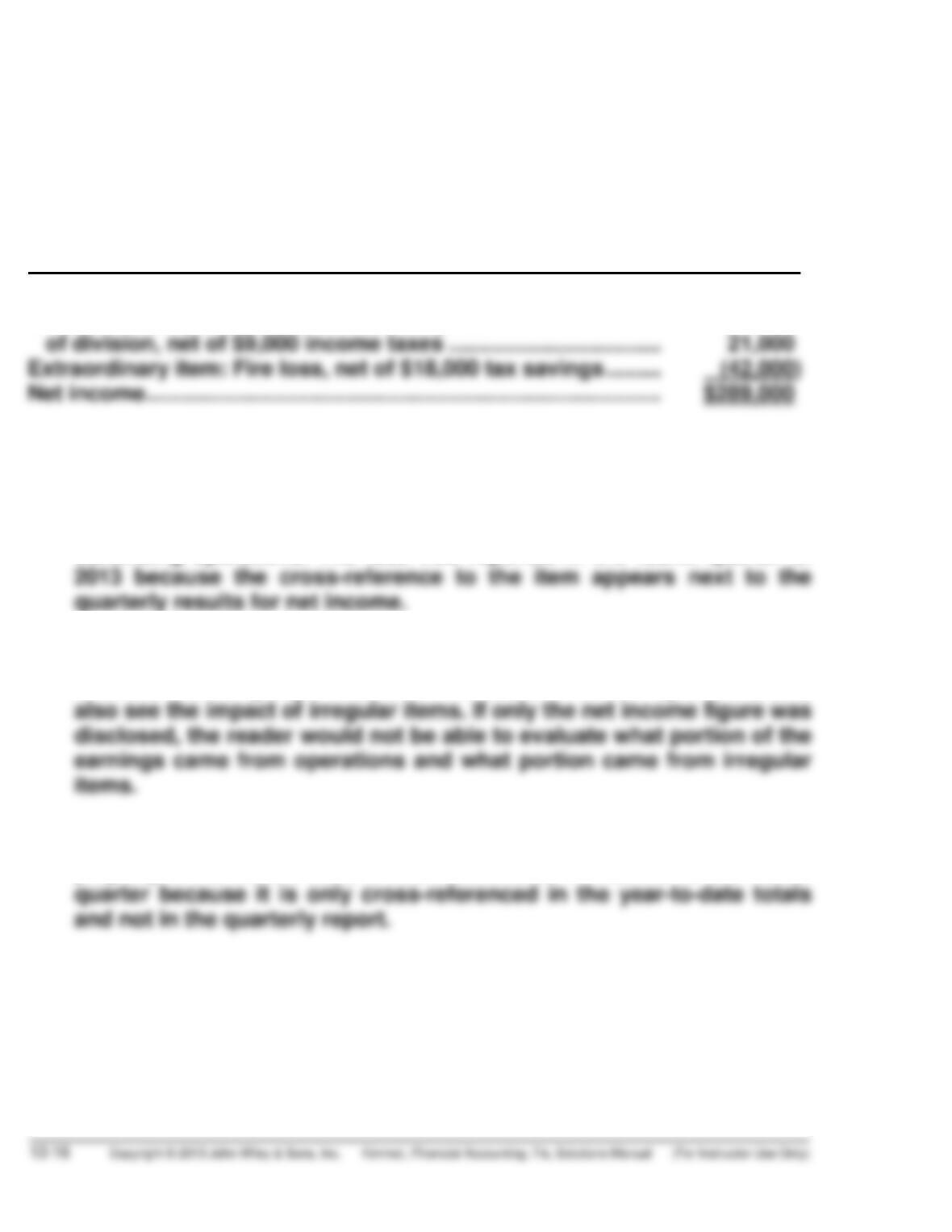
Discontinued operations: Gain from disposal
EXERCISE 13-2
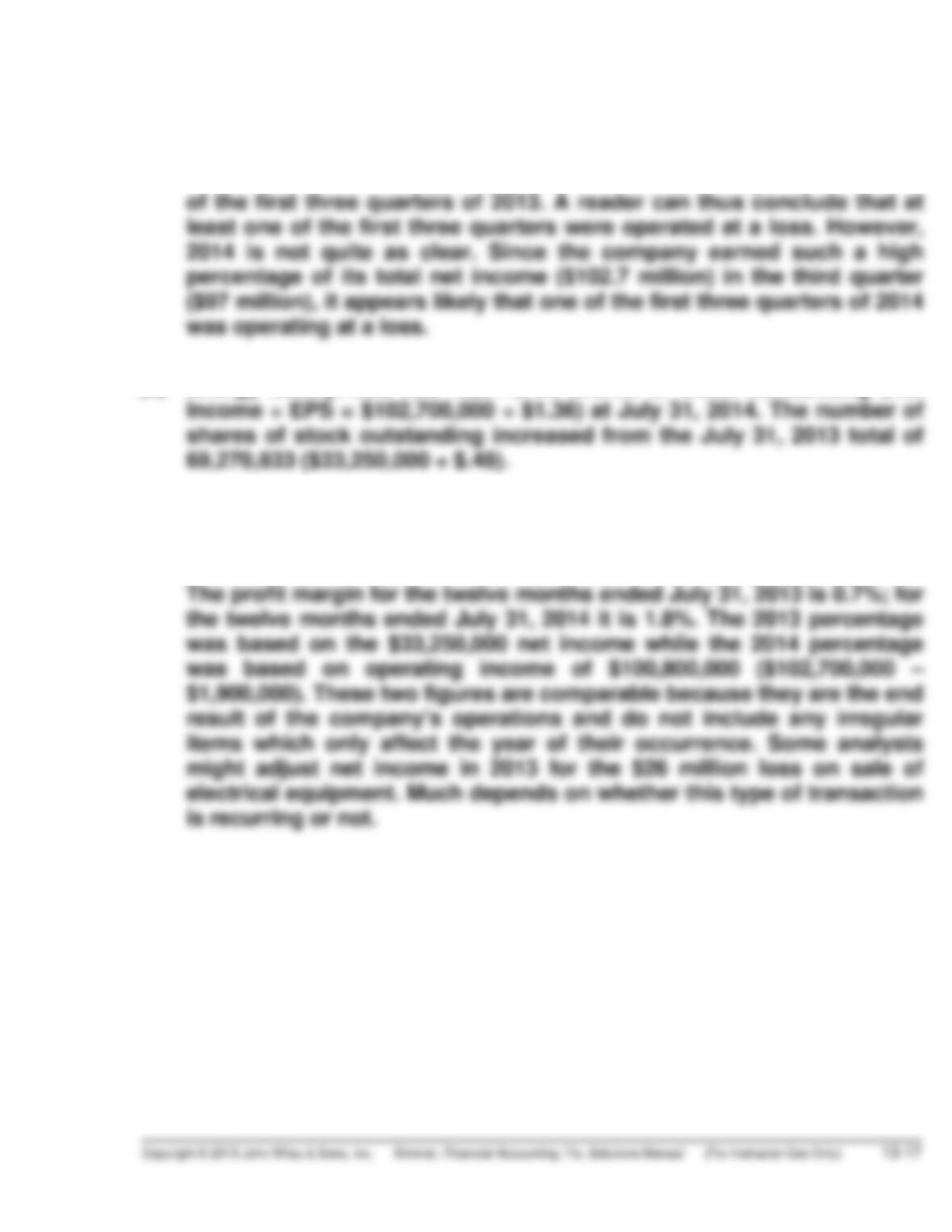
(a) The loss on the sale of electrical equipment was reported as a part of
continuing operations. The loss was reported in the fourth quarter of
(b) The extraordinary items are listed separately so that the reader can
evaluate the company’s results on the basis of normal operations and
(c) The extraordinary gain is the expropriation (takeover) of company
property in the Middle East. It was not included in income for the fourth
EXERCISE 13-2 (Continued)
(d) The company had net income of over $68 million during the fourth
quarter of 2013 but the year-to-date total shows net income of only $33.25
million. Therefore, Energy Enterprises had an operating loss at the end
(e) Energy Enterprises had 75,514,706 shares of stock outstanding (Net
(f) The profit margin should be based on the company’s net income from
its normal and continuing operations. The net income figure should be
a more conservative amount and should not include any irregular items.
EXERCISE 13-3
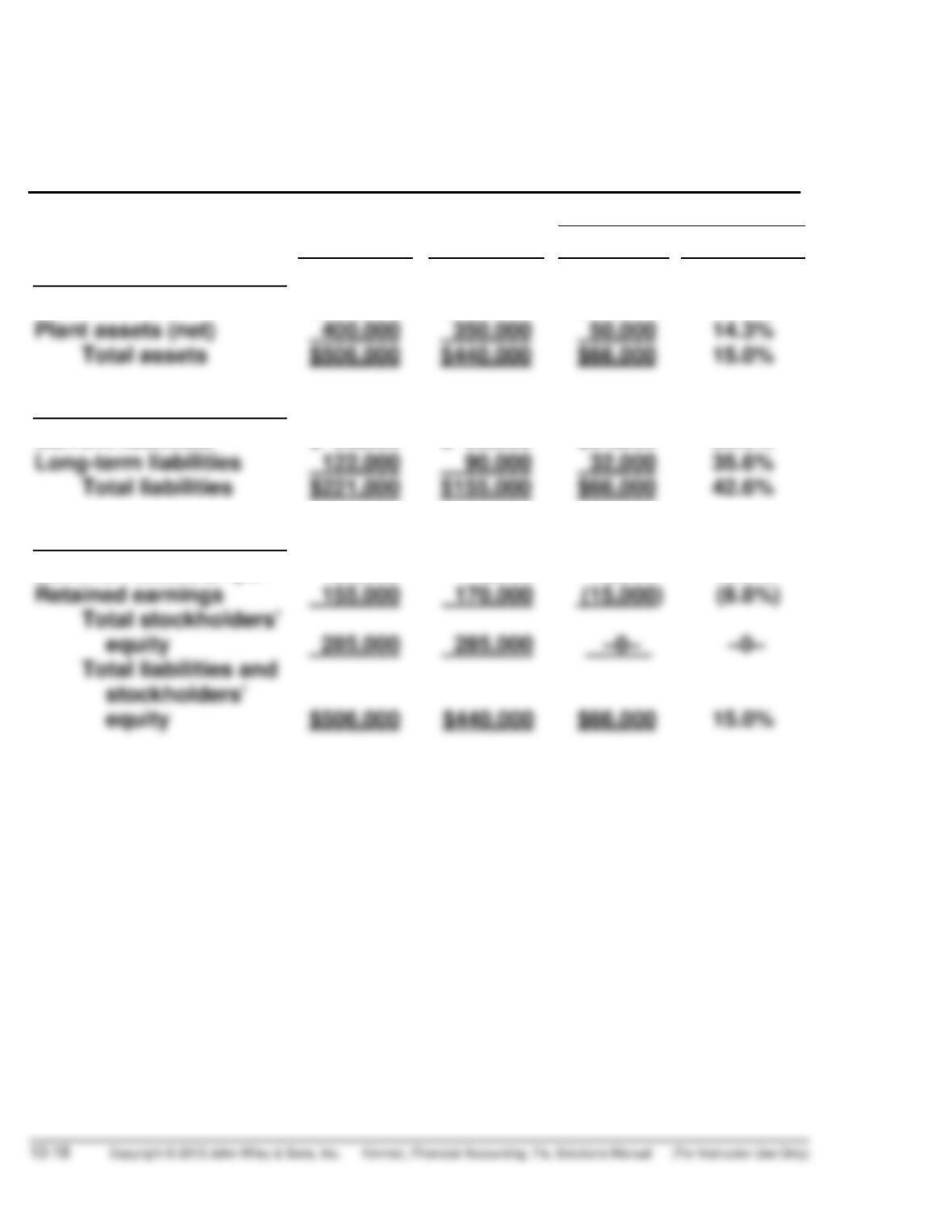
SPANGLES INC.
Condensed Balance Sheet
December 31
Increase or (Decrease)
2014 2013
A
mount Percentage
Assets
Current assets
$106,000
$ 90,000
($16,000
(17.8%)
Liabilities
Current liabilities
$ 99,000
$ 65,000
($34,000
(52.3%)
Stockholders’ Equity
Common stock, $1 par
130,000
115,000
15,000
(13.0%)
EXERCISE 13-4
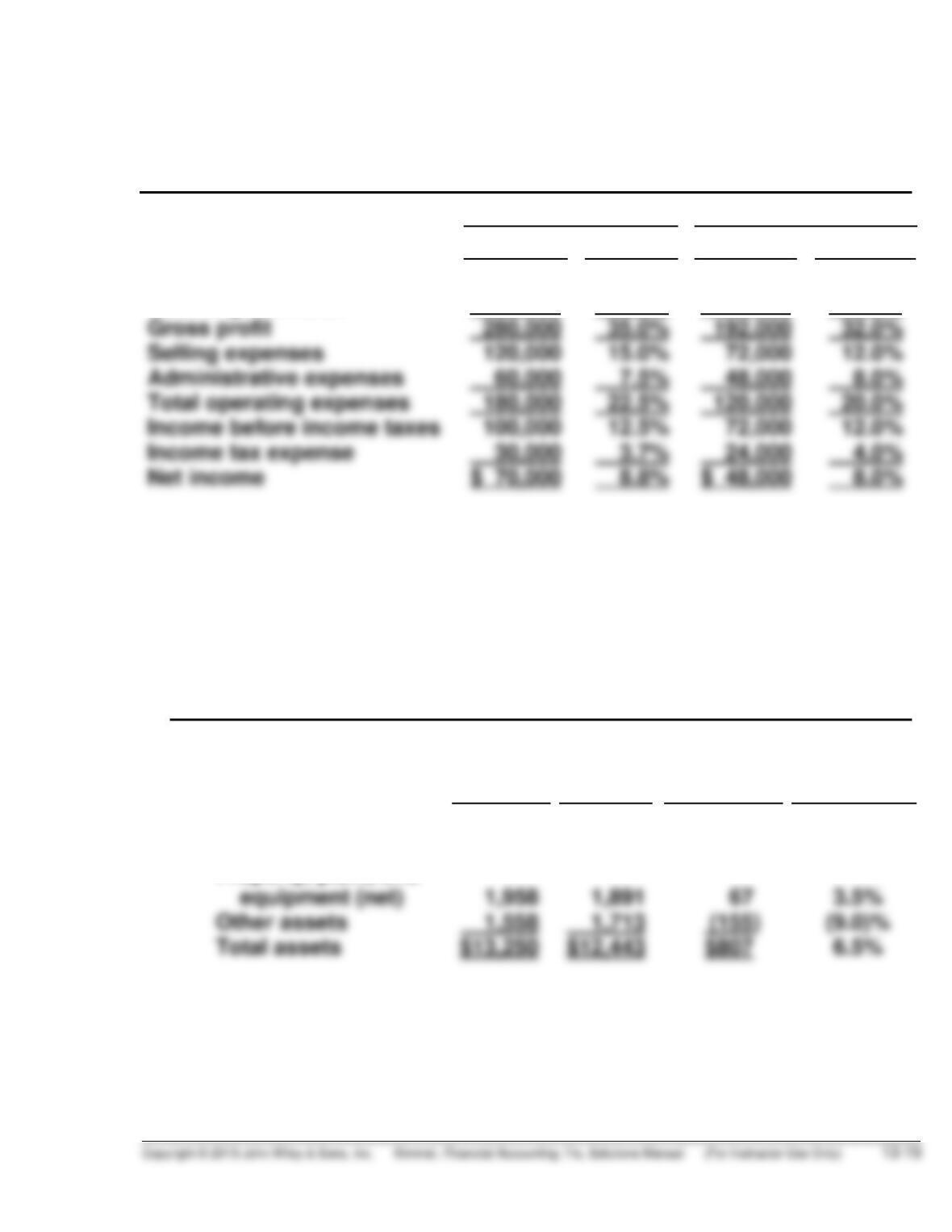
JACOBS CORPORATION
Condensed Income Statement
For the Years Ended December 31
2014 2013
A
mount Percent Amount Percent
Sales revenue
Cost of goods sold
$800,000
520,000
100.0%
65.0%
$600,000
408,000
100.0%
68.0%
EXERCISE 13-5
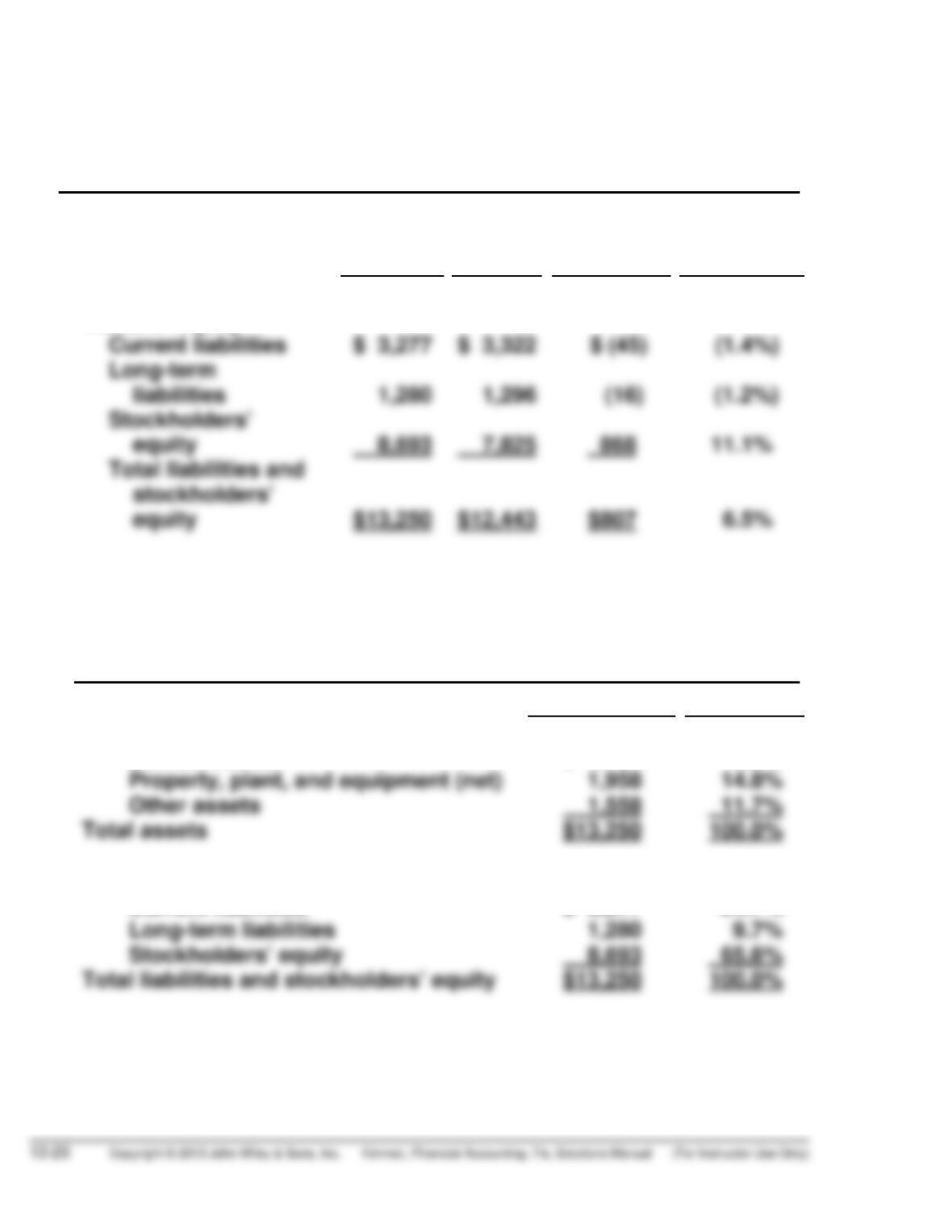
(a) NIKE, INC.
Condensed Balance Sheet
May 31
($ in millions)
2014
2013
Increase
(Decrease)
Percentage
Change
from 2013
Assets
Current assets
Property, plant, and
$ 9,734
$ 8,839
$895
10.1%
EXERCISE 13-5 (Continued)
NIKE, INC.
Condensed Balance Sheet (Continued)
December 31
2014
2013
Increase
(Decrease)
Percentage
Change
from 2013
Liabilities and stock-
holders’ equity
(b) NIKE, INC.
Condensed Balance Sheet
May 31, 2014
$ (in millions) Percent
Assets
Current assets
Liabilities and stockholders’ equity
Current liabilities
$ 9,734
$ 3,277
73.5%
24.7%