13
Planning and Budgeting
Solutions to Review Questions
13–1.
Next period’s budget has more detail because it is closer in time than the longer-range
forecasts. The budget plan is a blueprint for operations in the coming period. It must be
sufficiently detailed so that it provides adequate direction to the various people
responsible for operations.
13–2.
Cash receipts and disbursements often take place in different time periods from when
items are recognized in the income statement and balance sheet. Thus, a company
needs to prepare a cash budget to ensure that cash needs will be met.
13–3.
Answers will vary, but examples include:
13–4.
The master budget links long-term objectives and short-term, tactical plans.
Organization goals are broad-based statements of purpose. Strategic plans take the
broad-based statements and expresses them in terms of detailed steps needed to attain
those goals. Budgets are the short-term plans used to implement the steps included in
the strategic plans.
For example, a company might have a goal of “Becoming the number 1 company in the
industry.” The strategic plans would include such statements as: “Increase sales volume
by 20% per year.” The master budget would state the number of units that are needed
to be produced and sold in the coming period to meet the 20% volume increase as well
as the production and marketing costs necessary to attain that objective. The master
budget would also include estimates of the levels of cash, accounts receivable,
inventories, and fixed assets needed to support the budgeted level of activity.
13–5.
Because middle management has better knowledge about operations at lower levels in
the organization, and because budgets are usually used to evaluate performance or
13–6.
Budgeting aids in coordination in a number of ways. By relating sales forecasts to
production activities it is possible to reduce the likelihood of over– or under-production. It
13–7.
Participative budgeting is a process that uses inputs from lower- or middle-management
employees. The advantages include enhanced motivation, acceptance of goals,
increased information. The primary disadvantage is the time taken away from other
activities.
13–8.
13–9.
It is often more difficult to create the marketing and administration budget, because the
managers have more discretion about both the amount and timing of the spending.
13–10.
Solutions to Critical Analysis and Discussion Questions
13–11.
13–12.
Answers will vary. Two possible reasons are (1) smaller firms have less of a “cushion”
and therefore require better estimates of cash and (2) smaller firms might have more
difficulty (might need to pay higher rates) borrowing money.
13–13.
The earlier the budgeting process is started, the earlier the company will understand
13–14.
Because inventories would be eliminated, the timing of purchases would be closer to
the time of production. This would minimize the differences between the timing of cash
outflows for materials purchases, work in process and finished goods, and the time
when the related costs are recognized in the production budget.
13–15.
The purpose of tying spending to budgets is to ensure that the wishes of the legislature
are carried out. The problem is that managers cannot take advantage of funds in one
budget to use in another area, even if that means lower overall costs to the government.
13–16.
Planning communicates the goals of the organization and can be used to coordinate the
activities of different units in the organization. The control purpose of the budget is to
13–17.
It is common to start the budgeting process with a sales forecast because sales are
13–18.
In organizations where spending is literally tied to the budget, managers often spend
what remains in the budget as the year ends to avoid losing the funds and potentially
leading to lower budgets in the future.
13–19.
A positive balance at the end of the budgeting period does not ensure that there is
always cash available. An example is when all bills are due on the first of the month and
receipts are collected at the end of the month. The net cash flows can be positive even
though, during the month, there is a negative cash balance.
13–20.
Answers will vary. Many people will submit a budget in excess of their best guess. Part
of this is natural conservatism. Part of this is concern over their performance evaluation.
Other people might submit a number below their best guess, because they fear that
management will cancel the project if the estimated cost is too high.
13–21.
Answers will vary. Some basic factors are the nature of the product and the nature of
the market. For products that are well established (mature), there might be enough data
13–22. (10 min.) Role of Budgets and Plans: Cosmic Corporation.
Step 1:
C:
Develop the organization’s goals
Step 4:
Evaluate actual results with the budget
13–23. (10 min.) Human Element in Budgeting: Roller Partners.
a. Answers will vary. An advantage of Janet’s forecast is that it incorporates her
local knowledge of the area (the disasters and the agricultural prices) that might
not be included in the econometric forecasts. In addition, given the last sentence
in the email, (“…setting us up for failure”) the higher sales forecast might have a
detrimental effect on performance if the Region 5 managers believe it is not
attainable.
13–24. (15 min.) Estimate Sales Revenues: Stubs-R-Us.
.80
=
market volume in the coming year (as a percent of last year)
.95
=
number of sales in the coming year (as a percent of last year)
1.10
=
average commission per ticket in the coming year (as a percent of last year)
900,000 tickets × $5 per sale × .80 × .95 × 1.10 = $3,762,000.
Note: This is not the same as a 25 percent reduction (20% + 5%) because the volume
would not have been 5 percent of last year’s volume but 5 percent of the reduced
volume of 720,000 sales (= 900,000 × 80%).
13–25. (15 min.) Estimate Sales Revenues: Friendly Financial.
13–26. (15 min.) Estimate Sales Revenues: Larson, Inc.
Market size last year
=
85,000 units ÷ 0.2
Market size next year
=
1.15 × 425,000 units
=
488,750 units
Company share
=
=
78,200 units
Sales revenue
=
78,200 units × $22 per unit
Portfolio
Amount
Interest
Rate
Income
(thousands)
Consumer loans …………….
Home equity loans………….
Securities ……………………..
13–27. (15 min.) Estimate Production Levels: Offenbach & Son.
Offenbach & Son
Production Budget
For the Year Ended December 31
(in units)
Expected sales revenue …………………………………………….
225,000
units
Add: Desired ending inventory of finished goods
(1 months ÷ 12 months) × 225,000 …………………………..
18,750
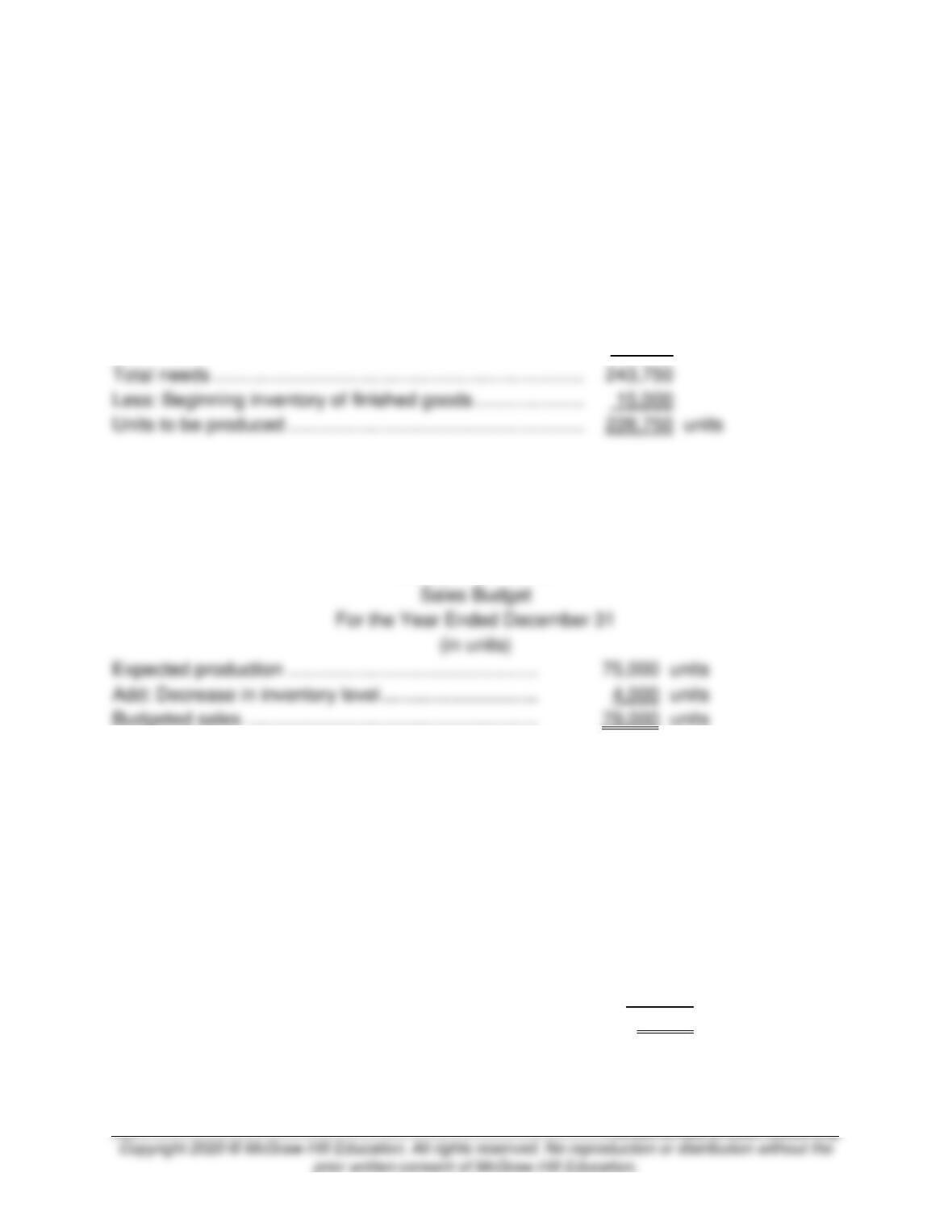
Total needs ……………………………………………………………..
Less: Beginning inventory of finished goods …………………
13–28. (15 min.) Estimate Sales Levels Using Production Budgets: Sunset
Motors, Inc.
Sunset Motors, Inc.
Expected production …………………………………………
units
units
Budgeted sales ………………………………………………..
units
13–29. (15 min.) Estimate Inventory Levels Using Production Budgets: Flex-Tite.
Flex-Tite
Sales Budget
For the Year Ended December 31
(in units)
Expected sales ………………………………………………………..
900,000
units
Plus: Desired ending inventory (1/12 × 900,000 × 130%)
97,500
units
Subtract: Planned production …………………………………….
930,000
units
Beginning inventory ………………………………………………….
67,500
units
13–30. (15 min.) Estimate Production Levels: Capacity Constraints: Waterloo,
Ltd.
a.
Waterloo Ltd.
Sales Budget
For the Year Ended December 31
(in units)
Expected sales ………………………………………………
660,000
units
Add: Desired ending inventory (660,000 × 1/12 × 1.5)
82,500
units
Subtract: Beginning inventory ………………………….
30,000
units
Required production ……………………………………….
712,500
units
13–31. (15 min.) Estimate Production and Materials Requirements: Wyoming
Machines.
a.
Wyoming Machines
Casings Plant
Production Budget
For the Year Ended December 31
(in units)
Expected sales ……………………………………………………………………..
160,000
units
Add: Desired ending inventory of finished goods ……………………….
5,000
Total needs ………………………………………………………………………….
165,000
Less: Beginning inventory of finished goods ……………………………..
20,000
Units to be produced ……………………………………………………………..
145,000
units
b.
Wyoming Machines
Casings Plant
Direct Materials Requirements
For the Year Ended December 31
(in units)
Units to be produced ……………………………………………………………….
145,000
Direct materials needed per unit ……………………………………………….
× 6
ounces
Total production needs (amount per unit times 145,000 units) ………
870,000
ounces
Add: Desired ending inventory
(2 months ÷ 12 months)
× 160,000 × 6 …………………………...
160,000
Total direct materials needs ……………………………………………………..
1,030,000
Less: Beginning inventory of materials ……………………………………….
Direct materials to be purchased……………………………………………….
ounces
=
Sales + EB
=
Usage + EB
(6 × 145,000) + (2 ÷ 12) × 160,000 × 6 oz.
13–32. (25 min.) Estimate Purchases And Cash Disbursements: Midland
Company.
a. and b. Midland Company
Merchandise Purchases Budget
For the Period Ended March 31
(in units)
January
February
March
Estimated sales revenue ……………….
12,400
17,800
13,200
Add: Estimated sales inventory ……….
45,200a
37,000
31,000
Total merchandise needs ……………
57,600
57,800
44,200
Less: Beginning inventory ………………
28,000
45,200
37,000
Merchandise to be purchased …………
Estimated cost per unit ………………….
13–33. (25 min.) Estimate Purchases And Cash Disbursements: Lakeside
Components.
a. Lakeside Components
Merchandise Purchase Budget
For the Period Ended July 31
(in units)
June
July
Estimated sales …………………………...
12,900
10,500
Add: Estimated ending inventory …….
10,500
11,100
Total merchandise needs ………………
23,400
21,600
Less: Beginning inventory ………………
12,000
10,500
Merchandise to be purchased …………
11,400
11,100
b. Payments for these purchases are made as follows:
Month of Delivery
Month of Payment
Total
May
June
July
June ……………..
July ………………
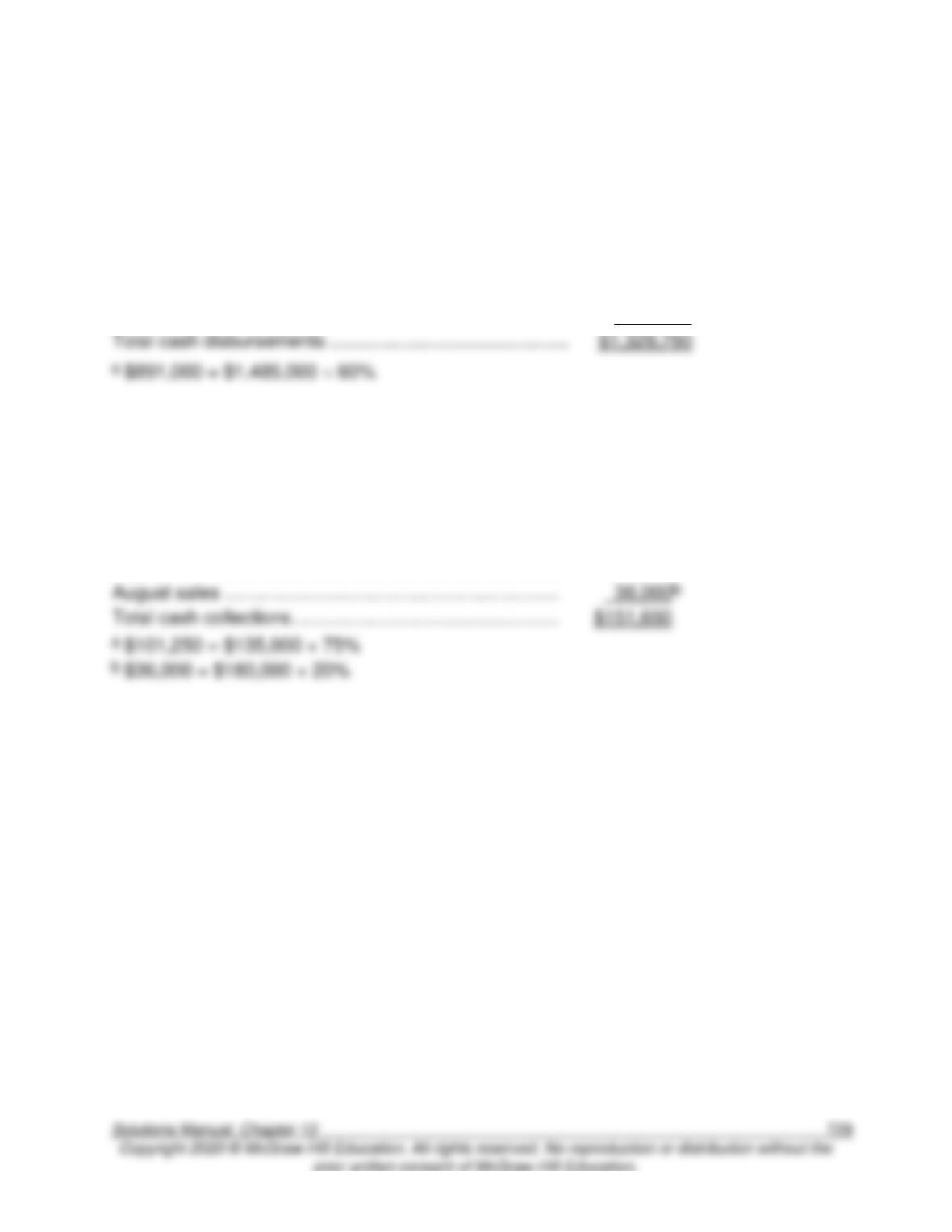
13–34. (15 min.) Estimate Cash Disbursements: Cascade, Ltd.
Cascade, Ltd.
Schedule of Cash Disbursements
For the Period Ended March 31
Payments for purchases prior to February …………………
$ 67,500
Payments for February purchases …………………………...
371,250
March purchases ……………………………………………………
891,000a
Total cash disbursements ……………………………………….
13–35. (15 min.) Estimate Cash Collections: Minot Corporation.
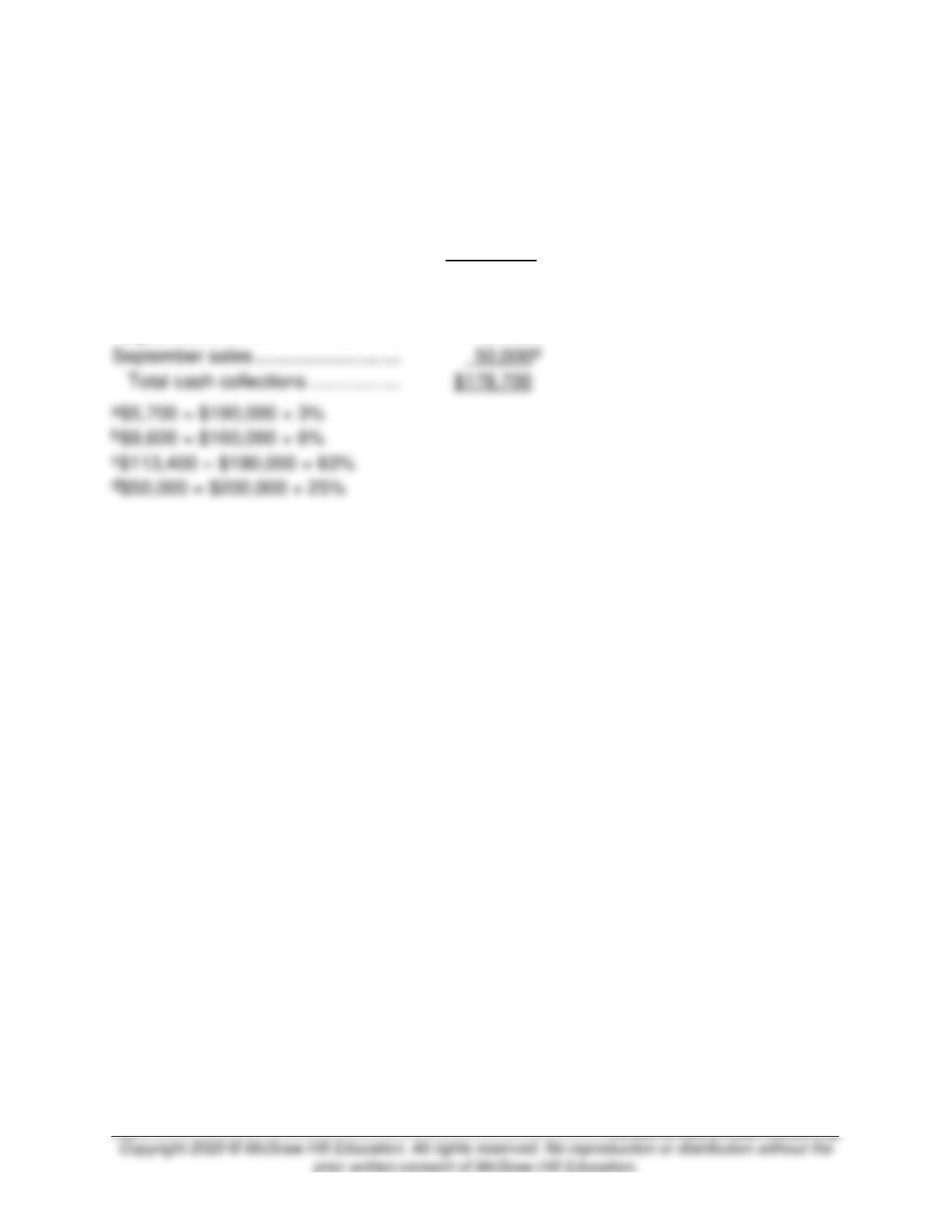
Minot Corporation
Schedule of Cash Collections
For the Month Ended August 31
Collections in August for sales prior to July ………………
$ 14,400
July sales ……………………………………………………………
101,250a
August sales ……………………………………………………….
13–36. (20 min.) Estimate Cash Collections: Ewing Company.
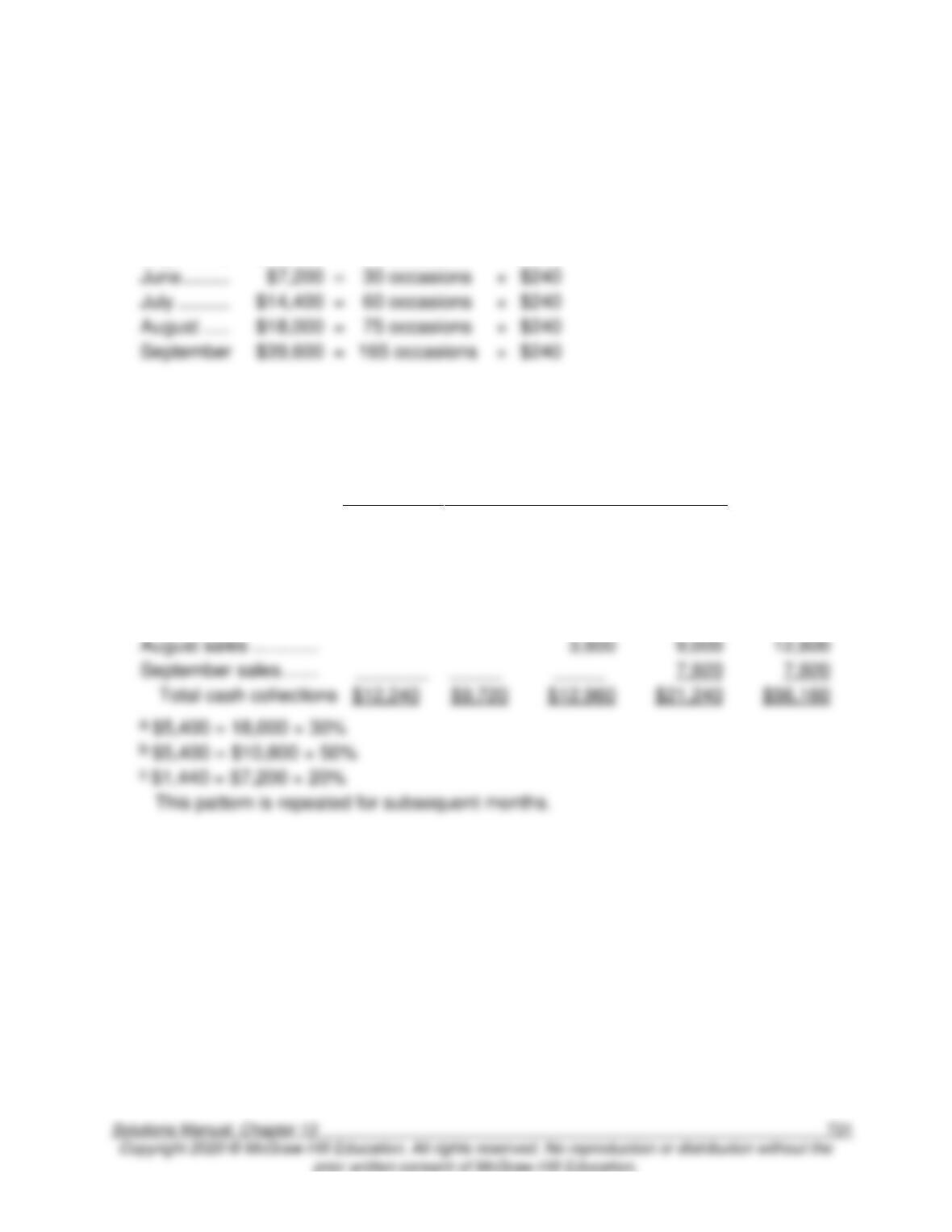
Ewing Company
Schedule of Cash Collections
For the Month Ended September 30
September
June sales ………………………………..
$ 5,700a
July sales …………………………………
9,600b
August sales …………………………….
113,400c
September sales ……………………….
13–37. (30 min.) Estimate Cash Receipts: Scare-2-B-U.
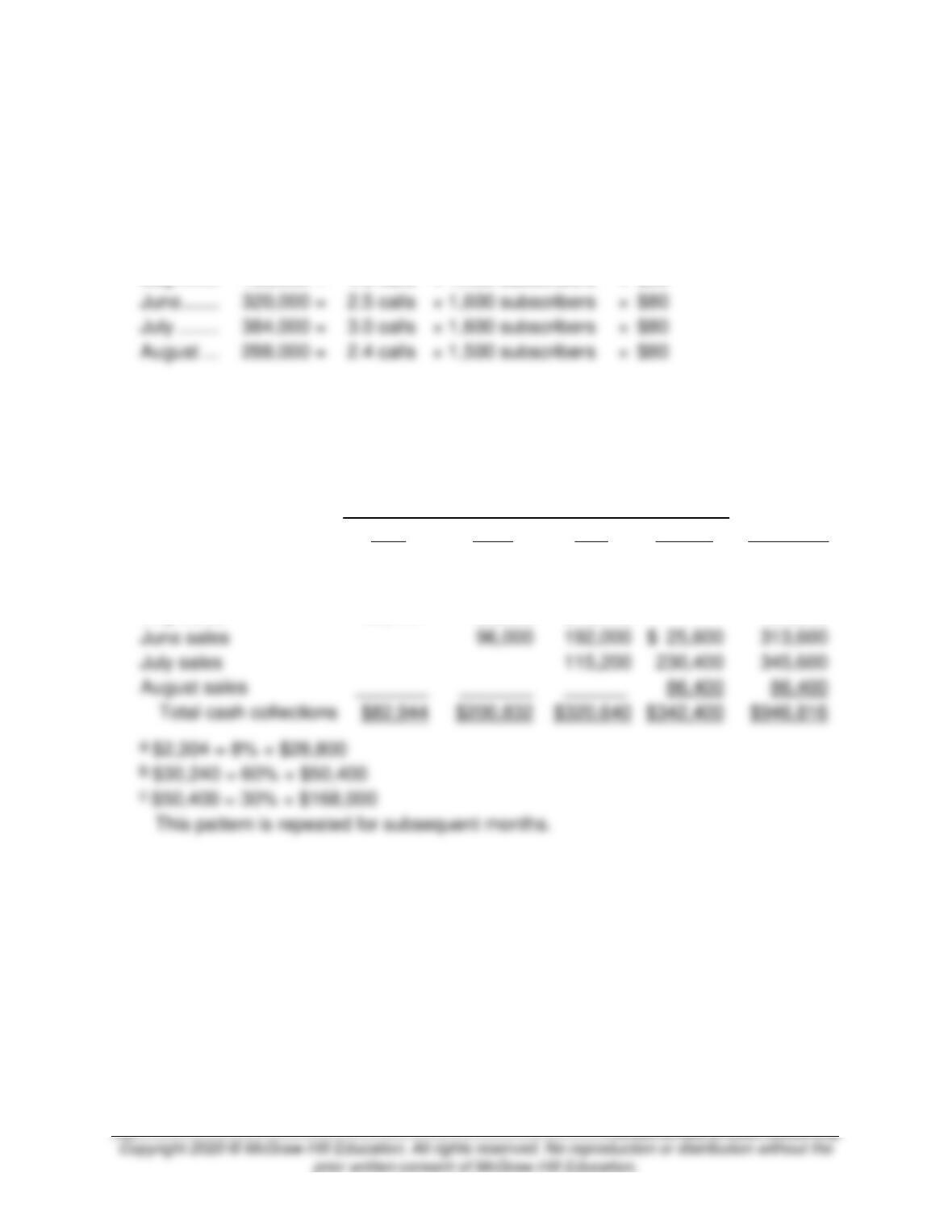
a. Revenues are as follows:
April ………
$18,000
=
75 occasions
×
$240
May ……….
$10,800
=
45 occasions
×
$240
June ………
$240
July ……….
$14,400
=
×
$240
August …..
$18,000
=
75 occasions
×
$240
September
$240
b. Cash receipts are as follows:
Scare-2-B-U
Multiperiod Schedule of Cash Receipts
Cash Receipts in Month of:
Total Cash
Receipts for
April
May
June
July
Period
April sales ……………..
$ 5,400a
$ 5,400
May sales………………
5,400b
$3,240
8,640
June sales……………..
1,440c
3,600
$ 2,160
7,200
July sales ………………
2,880
7,200
$ 4,320
14,400
August sales ………….
9,000
September sales …….
_______
_____
7,920
7,920
13–38. (30 min.) Estimate Cash Receipts: Varmit-B-Gone.
Revenues are as follows:
March …..
$28,800
=
0.6 calls
×
600 subscribers
×
$80
April …….
50,400
=
0.9 calls
×
700 subscribers
×
$80
May ……..
=
×
$80
June …….
=
2.5 calls
×
×
$80
July ……..
=
3.0 calls
×
×
$80
August …
=
×
$80
Collections of these revenues are expected according to the following schedule:
Varmit-B-Gone
Multiperiod Schedule of Cash Receipts
Cash Receipts in Month of:
Total Cash
Receipts
May
June
July
August
for Period
March sales
$ 2,304a
$2,304
April sales
30,240b
$ 4,032
34,272
May sales
50,400c
100,800
$13,440
164,640
June sales
July sales
August sales
_______
_______
______
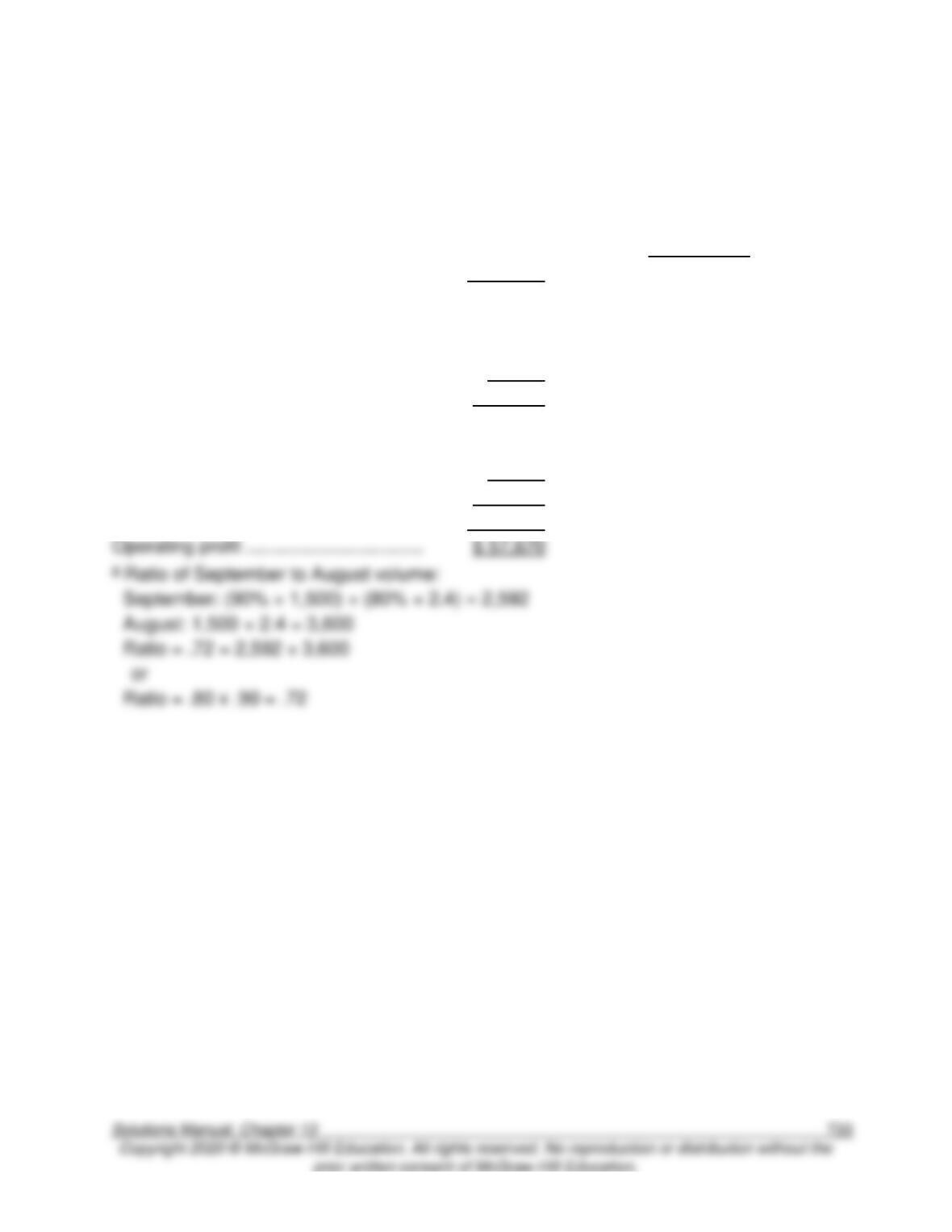
13–39. (30 min.) Prepare Budgeted Financial Statements: Varmit-B-Gone.
Varmit-B-Gone
Budgeted Income Statement
For the Month of September
Calculations
Sales revenue ………………………………
$207,360
(90% × 1,500) × (80% × 2.4) × $80
Less service costs:
Variable costs …………………………...
$ 17,280
(.72a × $24,000)
Maintenance and repair ………………
22,220
(1.01 × $22,000)
Depreciation ……………………………..
42,000
(no change)
Total service costs ………………………..
$ 81,500
Marketing and administrative:
Marketing (variable) …………………..
$ 10,440
(.72a × $14,500)
Administrative (fixed) …………………
57,750
(1.05 × $55,000)
Total marketing and administrative costs
$ 68,190
Total costs ……………………………………
$149,690
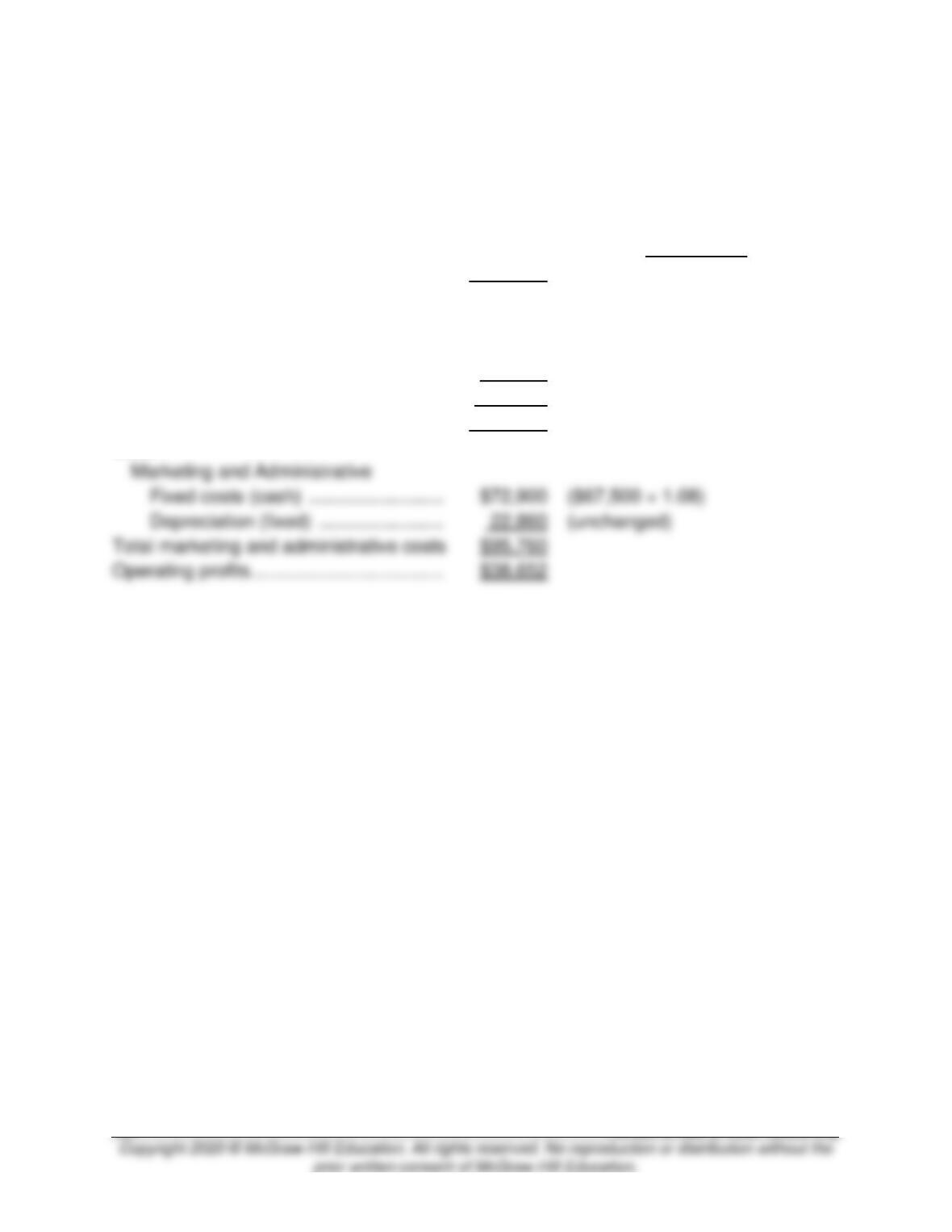
13–40. (15 min.) Prepare Budgeted Financial Statements: Cycle-1
Cycle-1
Budgeted Income Statement
November
Calculations
Sales revenue (360 units @ $540/unit) .
$194,400
($180,000 × 1.20 × .90)
Less
Manufacturing costs:
Variable …………………………..………..
$ 32,448
($26,000 × 1.20 × 1.04)
Depreciation (fixed) ……………………
27,540
(unchanged)
Total manufacturing costs ………………….
$ 59,988
Gross profit margin …………………………...
$134,412
Less:
Marketing and Administrative
Fixed costs (cash) ……………………..
($67,500 × 1.08)
Depreciation (fixed) ……………………
(unchanged)
Total marketing and administrative costs
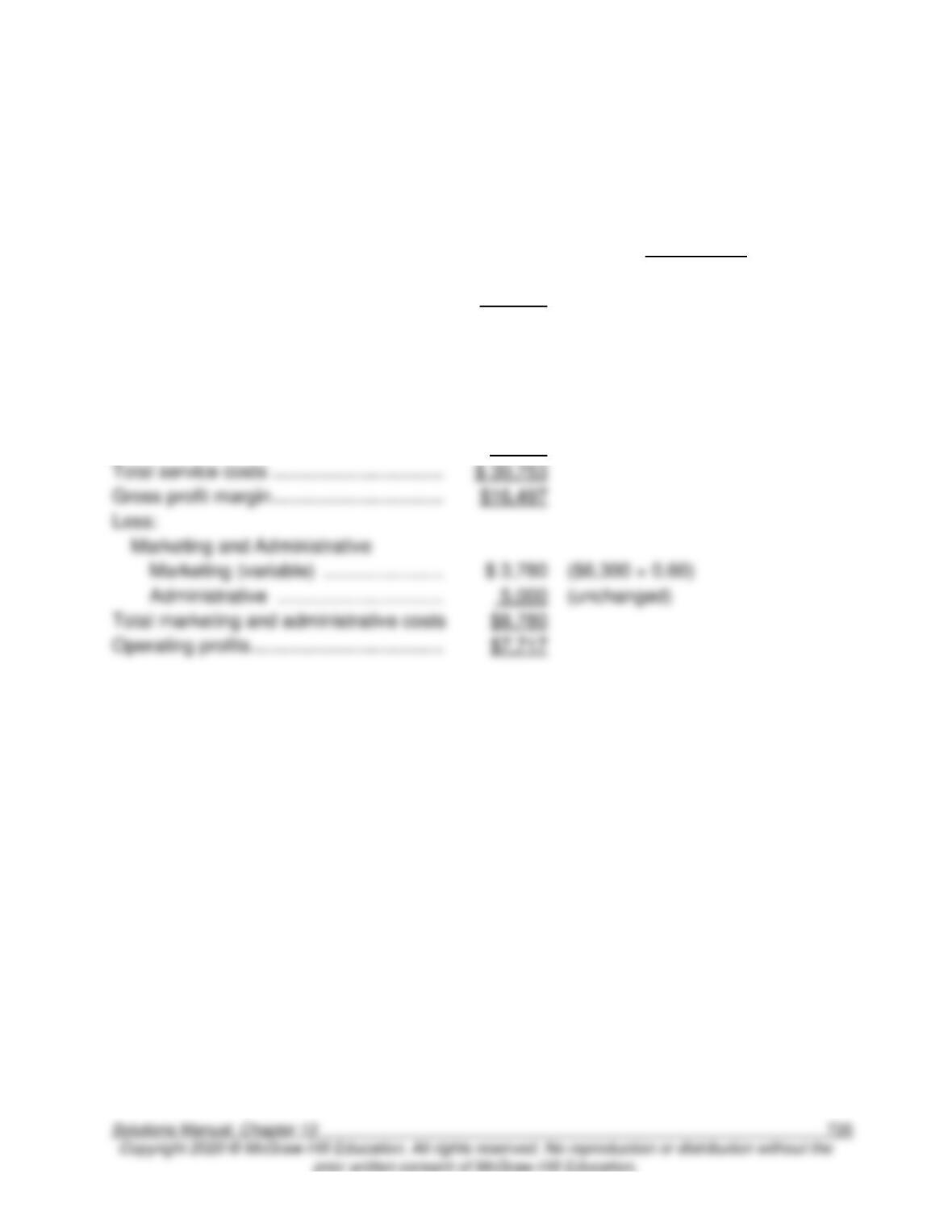
13–41. (15 min.) Prepare Budgeted Financial Statements: Carreras Café.
Carreras Café
Budgeted Income Statement
June
Calculations
Sales revenue
(2,520 meals @ $18.75/meal) ……………
$47,250
($15 × 4,200 × 0.60 × 1.25)
Less
Service costs:
Food ……………………………………………
$ 7,623
($11,550 × 0.60 × 1.10)
Labor …………………………………………..
10,080
($16,800 × 0.60)
Other variable costs ………………………
3,450
($5,750 × 0.60)
Fixed service costs ……………………….
9,600
(unchanged)
Total service costs …………………………...
Gross profit margin …………………………...
Less:
Marketing and Administrative
Marketing (variable) …………………..
Administrative …………………………..
(unchanged)
Total marketing and administrative costs
$8,780
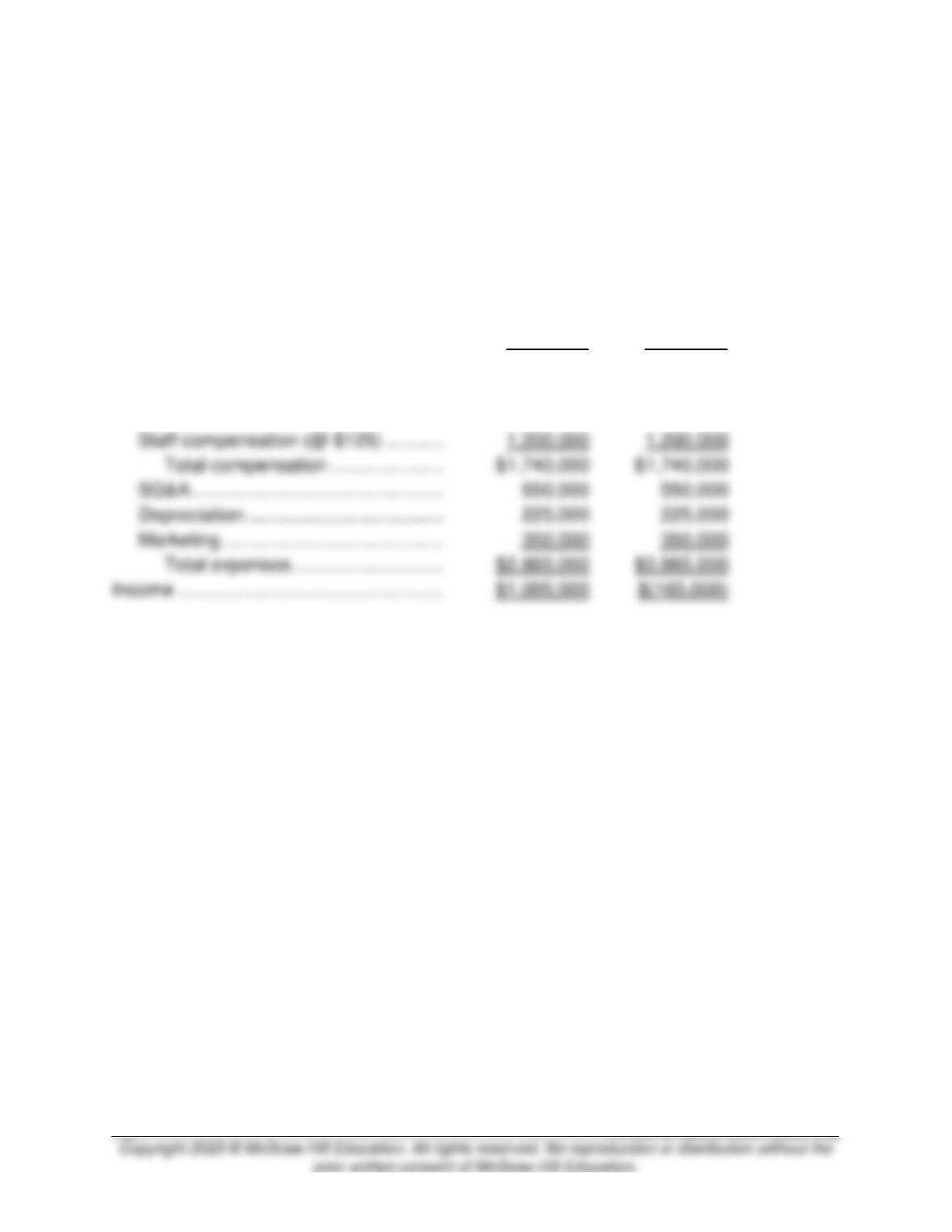
13–42. (15 min.) Budgeting in a Service Organization: Executive Solutions.
Executive Solutions
Budgeted Income Statement
May and June
May
June
Revenues:
Managers (@ $900) ……………………..
$1,080,000
$675,000
Staff (@ $450) ……………………………..
2,880,000
2,025,000
Total revenue ………………………….
$3,960,000
$2,700,000
Expenses:
Manager compensation (@ $225) …..
$540,000
$540,000
Total compensation ………………….
$1,740,000
SG&A …………………………………………
Marketing ……………………………………
Total expenses ………………………..
$2,865,000