LO 13-9 Explain how to use sensitivity analysis to budget under uncertainty.
BUDGETING UNDER UNCERTAINTY
• Formal planning models allow many alternatives and options to be explored in the planning
process.
o Any projection of the future is uncertain.
▪ Managers often perform sensitivity analysis on their projections.
• By asking and answering hypothetical questions during the planning phase,
management can determine the risk of various phases of its operations and can
develop contingency plans.
o The incorporation of uncertainty into budget estimates can be quite useful.
▪ Spreadsheets are extremely useful in preparing budgets, which require considerable
what-if thinking.
• Exhibit 13.15 shows a spreadsheet analysis of alternative budgeting scenarios.
Matching
A.
Budget
H.
Organization goals
B.
Budgeted balance sheets
I.
Participative budgeting
C.
Cash budget
J.
Production budget
D.
Critical success factors
K.
Profit plan
Delphi technique
Strategic long-range plan
Econometric models
M
Trend analysis
G.
Master budget
_____ 1. A statement of cash on hand at the start of the budget period, expected cash receipts,
expected cash disbursements, and the resulting cash balance at the end of the budget
period.
_____ 5. The financial plan of an organization for the coming year or other planning period.
_____ 6. The use of input from lower- and middle-management employees for budget
preparation.
_____ 7. The income statement portion of the master budget.
_____ 8. A forecasting method that ranges from simple visual extrapolation of points on a
graph to highly sophisticated computerized time series analysis.

Matching Answers
2. H
4. E
6. I
8. M
9. F
10. A
12. J
Multiple Choice
1. Which of the following statements is correct?
a. Critical success factors are strengths of a company that enable it to outperform
competitors.
b. The strategic long-range profit plan is a statement detailing steps to take to achieve a
company’s budget.
c. The master budget is a long-range financial plan of an organization.
d. Budgeting is a static process.
2. Which of the following method(s) can be used to extract sales forecast?
3. Jim is preparing the production budget for his company. He estimates that 21,000 units have
to be produced to meet the sales forecast of 18,000 units and the desired ending inventory of
4,000 units. How many units should be in the beginning inventory?
4. For next year, 21,000 units of finished goods have to be produced, each consuming 3 units of
materials at $6. The expected beginning and ending materials inventories are 8,000 units and
12,000 units, respectively. How much is expected to be spent for materials purchases next
year?
a. $360,000
b. $372,000
c. $390,000
d. $402,000
5. For next year, 21,000 units of finished goods have to be produced, each requiring 1.5 hours
of labor. The prevailing hourly rate is expected to be $12 per hour. What is the direct labor
cost for next year?
6. Which of the following statements is not correct?
7. The following information is available.
Cash collected from current month’s sales
40%
Cash collected from last month’s sales
55%
Uncollectible sales
5%
100%
The expected credit sales of the second quarter are:
April
$400,000
May
450,000
June
500,000
How much cash will be collected in May?
8. The following information is available.
Cash payment for current month’s purchases
30%
Cash payment for last month’s purchases
67%
Cash discount taken
3%
100%
The expected credit purchases of the second quarter are:
April
$180,000
May
250,000
June
300,000
How much cash will be paid in May?
a. $184,500
b. $195,600
c. $200,750
d. $221,400
9. Which of the following statements is not correct?
a. A key difference in the master budget between a service enterprise and a manufacturing
firm is the absence of product or material inventories.
b. Service businesses need to carefully coordinate sales with the necessary labor.
c. The purchase budget in retail and wholesale businesses drives the rest of the budgeted
income statement.
d. A merchandiser has no production budget.
10. Which of the following statements is correct?
11. Participative budgeting:
a. relies on input from top management for budget preparation.
b. is also called grass root budgeting.
c. is efficient and expedient.
d. prevents employees from accepting the goals of their organization.
12. Which of the following statements is correct?
Multiple Choice Answers
1. a (LO1)
3. c (LO4)
4. d (LO4)
5. c (LO4)
$12 × 1.5 hours × 21,000 units = $378,000
6. b (LO4)
7. b (LO5)
$400,000 × 55% + $450,000 × 40% = $400,000
9. c (LO7)
11. b (LO2)

Demonstration Problem 1
East Mountain Bike expects to sell 25,000 electronic bicycles next year. The management
estimates that the beginning and ending inventory will be 2,000 units and 3,500 units,
respectively.
Required:
Prepare a production budget for next year.
Demonstration Problem 1 – Solution
East Mountain Bike
Production Budget
For the budget year ended December 31
(in units)
Expected sales
25,000
Add: Desired ending inventory of finished goods
3,500
Total needs
28,500
Less: Beginning inventory of finished goods
Units to be produced
26,500
Demonstration Problem 2
(Continued from Demonstration Problem 1)
Each electronic bicycle produced at East Mountain Bike requires two major parts (frame and
tires) and an electronic subassembly from its suppliers as inputs. The following information is
available:
Frame
Tires
Electronic
Subassembly
Material per bike
1
2
1
Unit cost
$900
$30
$420
Beginning inventory
Ending inventory
1,800
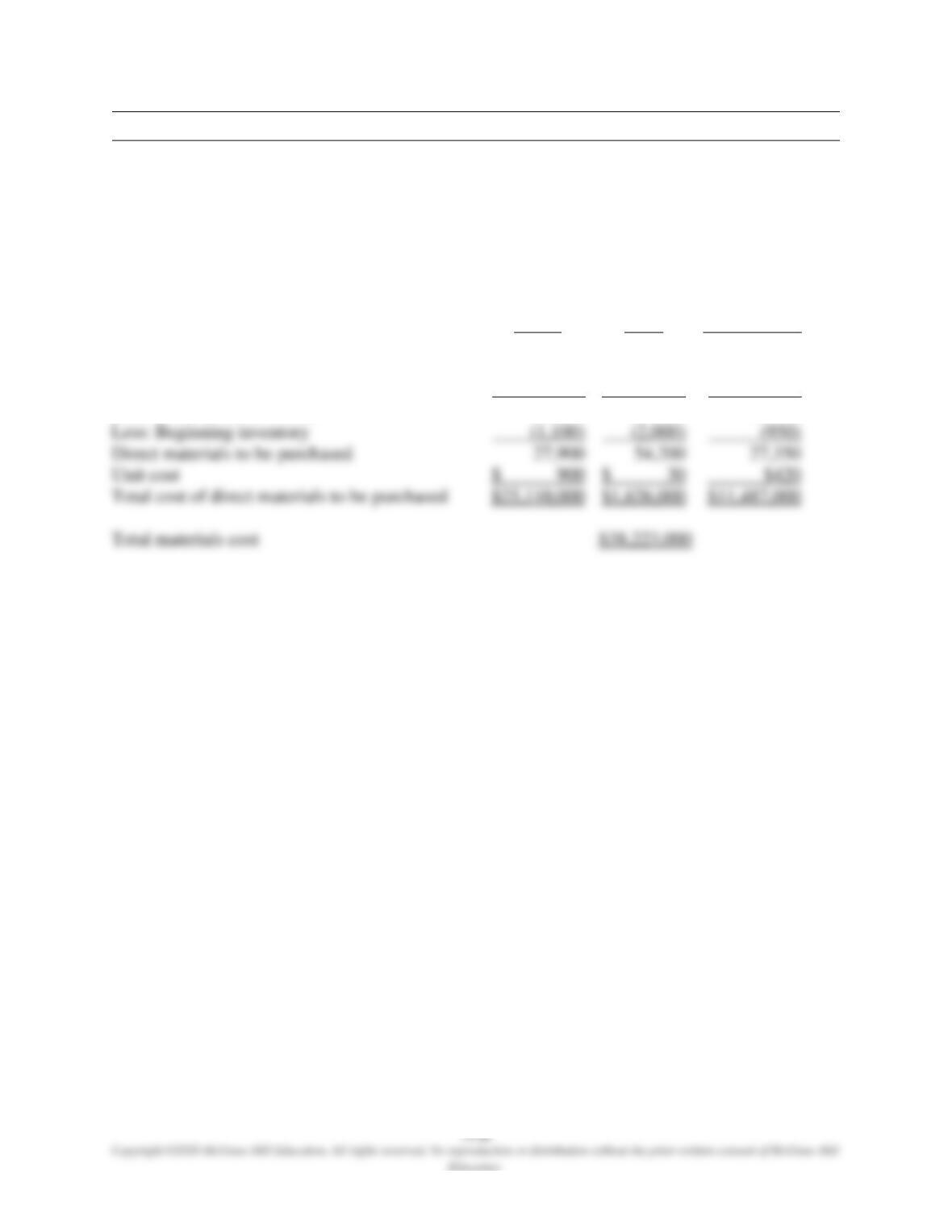
Demonstration Problem 2 – Solution
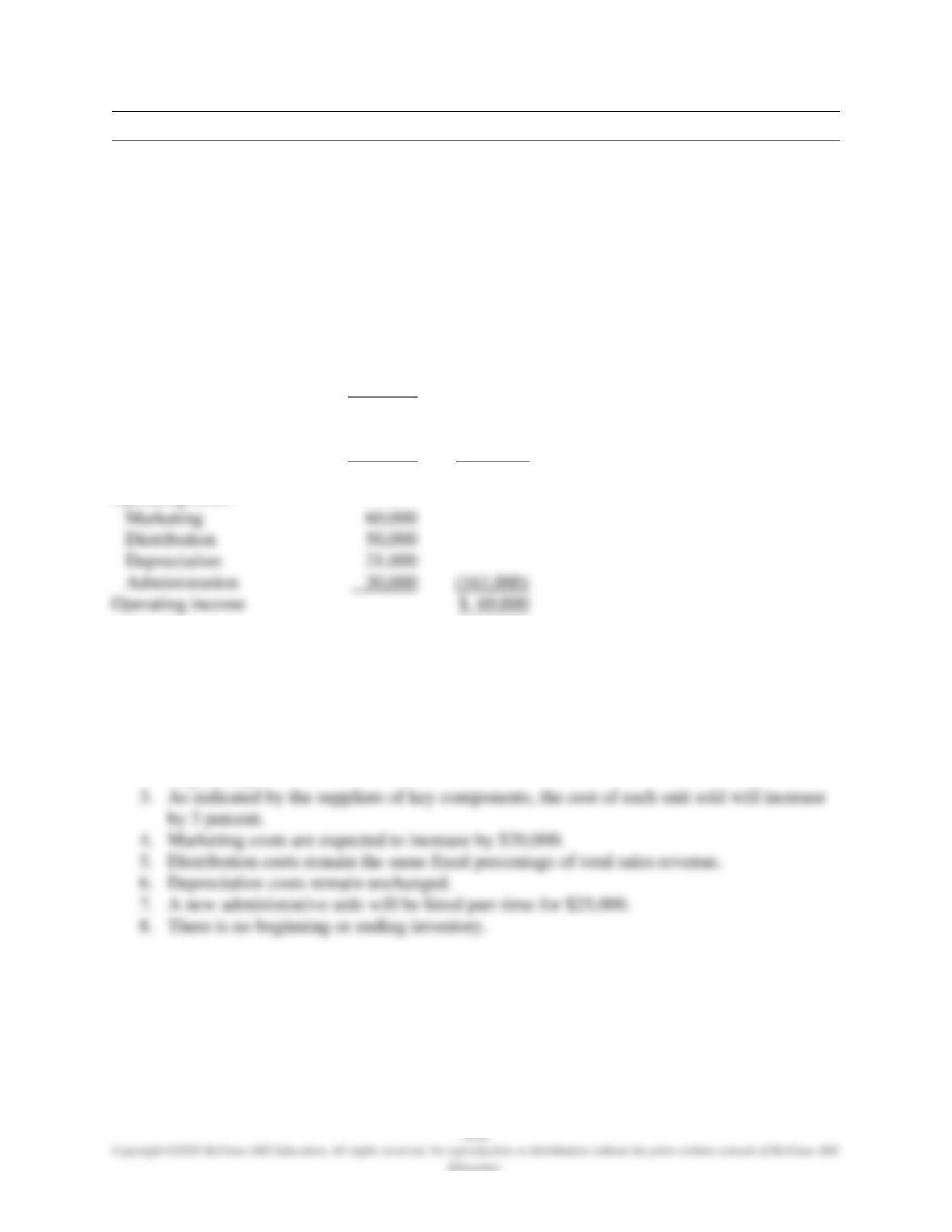
East Mountain Bike
Direct Materials Budget
For the budget year ended December 31
Units to be produced next year (from the production budget above): 26,500
Frame
Tires
Electronic
Subassembly
Direct material needed per bike
1
2
1
Total production needs
26,500
53,000
26,500
Add: Desired ending inventory
2,500
3,200
1,800
Total direct materials needs
29,000
56,200
28,300
Less: Beginning inventory
(2,000)
Direct materials to be purchased
27,900
54,200
27,350
Unit cost
$ 900
$ 30
$420
Total cost of direct materials to be purchased
$25,110,000
$1,626,000
$11,487,000
Total materials cost
Demonstration Problem 3
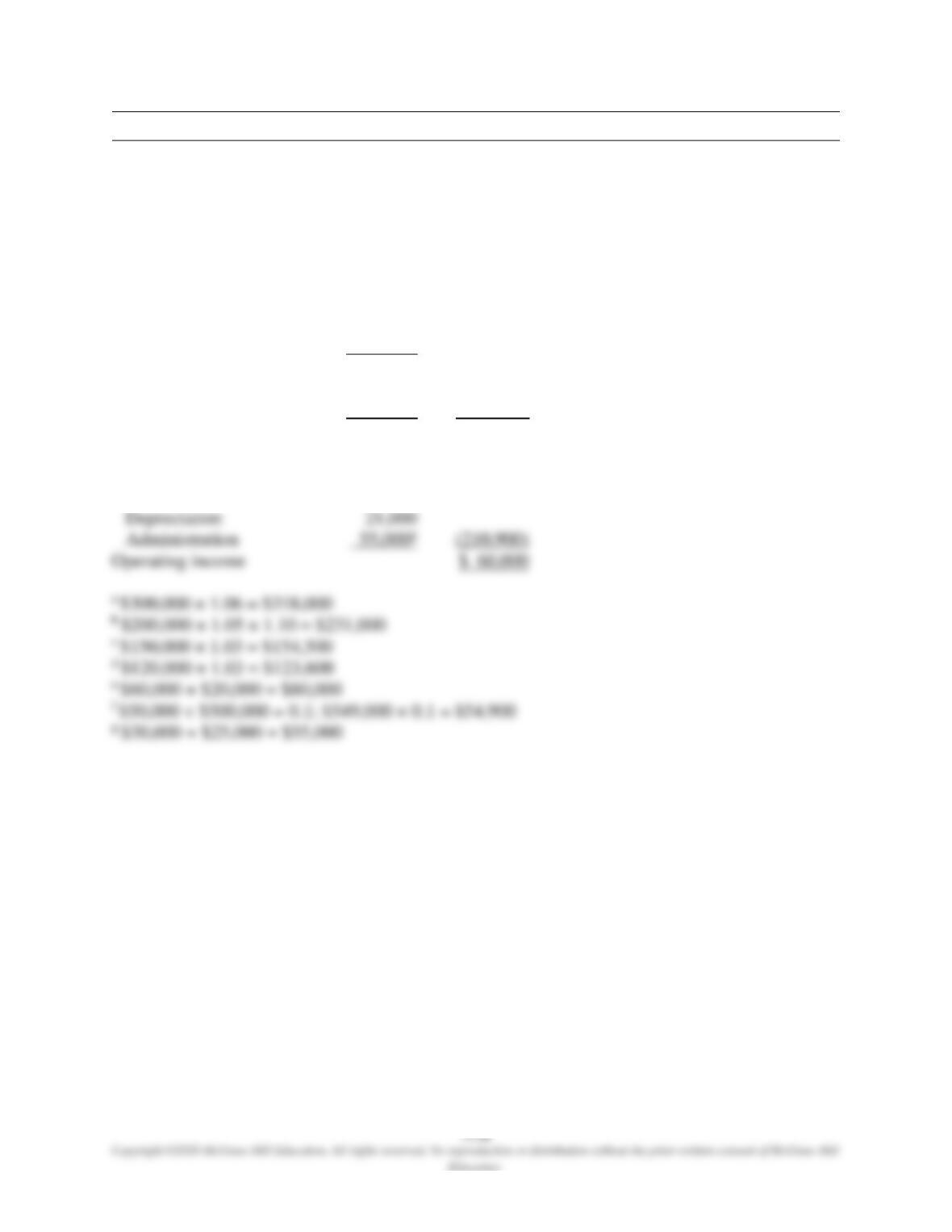
Emerson Manufacturing Company produces two products: Model S and Model Z. The following
income statement shows this year’s operating results.
Emerson Manufacturing Company
Income Statement
For the year ended December 31
Revenue:
Model S
$300,000
Model Z
200,000
$500,000
Cost of goods sold:
Model S
150,000
Model Z
120,000
(270,000)
Gross margin
$230,000
Operating costs:
Marketing
Distribution
Depreciation
Administration
(161,000)
Operating income
$ 69,000
Emerson’s management is in the process of preparing next year’s budget. The following
information is under consideration.
1. The selling price of Model S is expected to remain the same, but the units sold will
increase by 6 percent
2. The selling price and units of Model Z will increase by 5 percent and 10 percent,
respectively.
Required:
Prepare a budgeted income statement for next year.
Demonstration Problem 3 – Solution
Emerson Manufacturing Company
Budgeted Income Statement
For the budget year ended December 31
Revenue:
Model S
$318,000a
Model Z
231,000b
$549,000
Cost of goods sold:
Model S
154,500c
Model Z
123,600d
(278,100)
Gross margin
$270,900
Operating costs:
Marketing
80,000e
Distribution
54,900f
Depreciation
Administration
(210,900)
Operating income
$ 60,000
Demonstration Problem 4
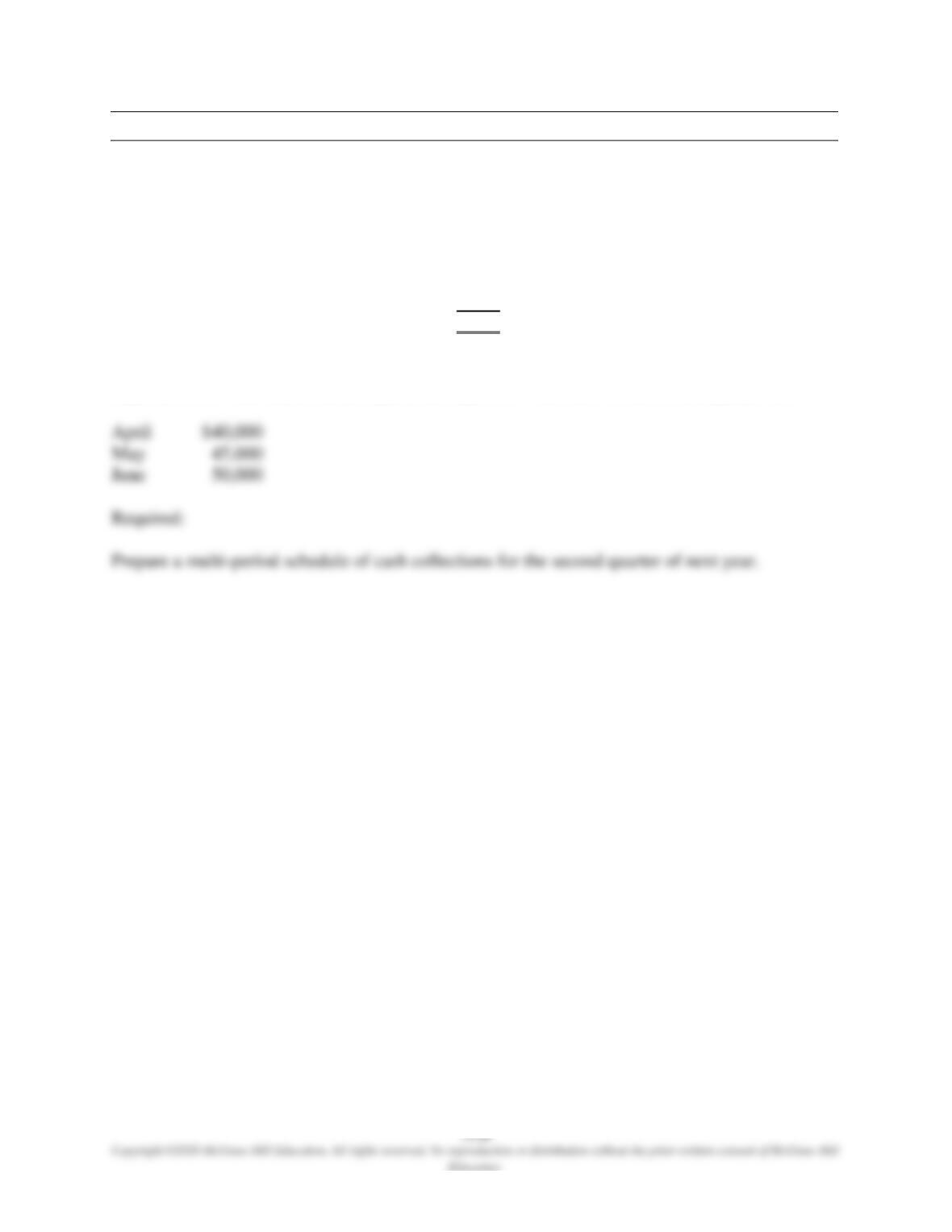
The management at Emerson Manufacturing Company is studying the cash inflow pattern in
preparation for its cash budget. The following information is available.
Cash collected from current month’s sales
40%
Cash collected from last month’s sales
55%
Cash discount taken
2%
Uncollectible sales
3%
100%
For the second quarter of next year, the beginning balance of accounts receivable ($23,000) is
expected to be collected in full in April. The expected credit sales of the second quarter are:
April
May
June

Demonstration Problem 4 – Solution
Emerson Manufacturing Company
Multiperiod Schedule of Cash Collections
For the quarter ended June 30
Month
April
May
June
Total
Accounts receivable, April 1
$23,000
$ 23,000
April credit sales
16,000a
$22,000b
38,000
May credit sales
18,000c
$24,750d
42,750
June credit sales
20,000e
20,000
Total cash collection
$39,000
$ 40,000
$ 44,750
$123,750