Chapter 13
Accounting for Bad Debts
Chapter Overview
Handling bad debts is a necessary part of accounting and this chapter looks at how bad debts are
handled in a business. It discusses how accounts receivable becomes uncollectible along with
how these transactions are journalized. Accrual accounting matches earned revenue with
expenses that occur in the same period. When a company has credit customers, one of the
expenses incurred in earning the revenue is allowing for bad debts. The business accounts for
Learning Objectives
After studying Chapter 13, your students should gain proficiency in the following:
2. Use the Allowance Method to Estimate Bad Debts and Prepare an Aging of Accounts
Receivable.
Chapter 13 Assignment Grid
Estimated Level
Learning Time in of
Assignment Topic(s) Objective(s) Minutes Difficulty
Discussion Questions and Critical Thinking/Ethical Case
1 Matching Principle 1 5 Easy
9 Aging of Accounts Receivable 2 5 Easy
10 Writing off Accounts 3 5 Easy
11 Net Realizable Value 3 5 Medium
12 Direct Write-off Method 3 5 Easy
13 Bad Debts Recovered 3 5 Easy
14 Ethical Case 3 5 Medium
Concept Checks
1 Categorizing Accounts 3 5 Easy
Exercises (Set A)
13A-1 Partial Balance Sheet 1 20 Medium
13A-2 Adjusting Entry 2 20 Medium
Exercises (Set B)
13B-1 Partial Balance Sheet 1 20 Medium
13B-2 Adjusting Entry 2 20 Medium
Problems (Set A)
13A-1 Journal Entries 1, 2, 3 25 Medium
Problems (Set B)
13B-4 Entries, Posting, Partial Balance Sheet 1, 2, 3 60 Hard
Estimated Level
Learning Time in of
Assignment Topic(s) Objective(s) Minutes Difficulty
Financial Report Problem
Learning Unit 13-1: Accrual Accounting and Journalizing Bad
Debts Transactions
Summary: Generally accepted accounting principles (GAAP) require use of the allowance
method, a method that estimates the amount of losses or unpaid receivables at the same time
(month) that the sales (revenue) occur. At the time of the sales, it is extremely difficult to
determine which customer will default. Therefore, we estimate, based on prior experience, a
group or an amount that will not make payments by the end of the period. Bad Debts Expense is
an expense account whose normal balance is a debit. It is a temporary account that is closed to
or the percentage of receivables (balance sheet method).
Key Concepts: Bad debts expense, allowance for doubtful accounts, net realizable value.
Lecture Outline:
1. Accrual accounting matches revenues earned and expenses incurred in the same period.
Therefore, accrual accounting requires an approximate estimate amount that might be
deemed uncollectible:
Journal entry to record the estimate of future bad debts:
Dr. Bad Debt Expense XX
Cr. Allowance for Doubtful Accounts XX
b. Allowance for doubtful accounts:
c. Net-realizable value:
(i) is the amount of receivables a company expects to collect.
(ii) calculated by subtracting allowance for doubtful accounts from accounts
receivable.
d. Write-off under the allowance method:
(i) When it becomes clear an account can be deemed uncollectible, it can no
longer be considered an account receivable and needs to be removed
from the ledger.
Journal entry:
Teaching Tips/Strategy: While discussing the chapter it is critical to explain the reasoning of
estimating the bad debts at the time of the sales, not at the time of default to apply the matching
principle. Since the journal entries tend to confuse students, explain that under the allowance
method the journal entries are similar; and the amount is what varies. Take some time to explain
the concept of the allowance account and how estimates are calculated. Use the Discussion
Questions #1 – #5 to start the class discussion over these topics.
Use the “Ten-Minute Quiz” questions #1, #2 #3, and #7 to reinforce the learning objective.
Learning Unit 13-2: The Allowance Method
Summary: The allowance method is used to estimate the amount of bad debts for the current
period. This estimate can be determined by the following methods: the income statement or the
balance sheet approach. The income statement approach (or percent-of-sales method) is a
The balance sheet approach bases the new total allowance for doubtful accounts on the current
accounts receivable on the balance sheet. Thus, the adjustment is reduced by the old balance in
allowance for doubtful accounts. When the adjustment is credited, the new balance will reflect the
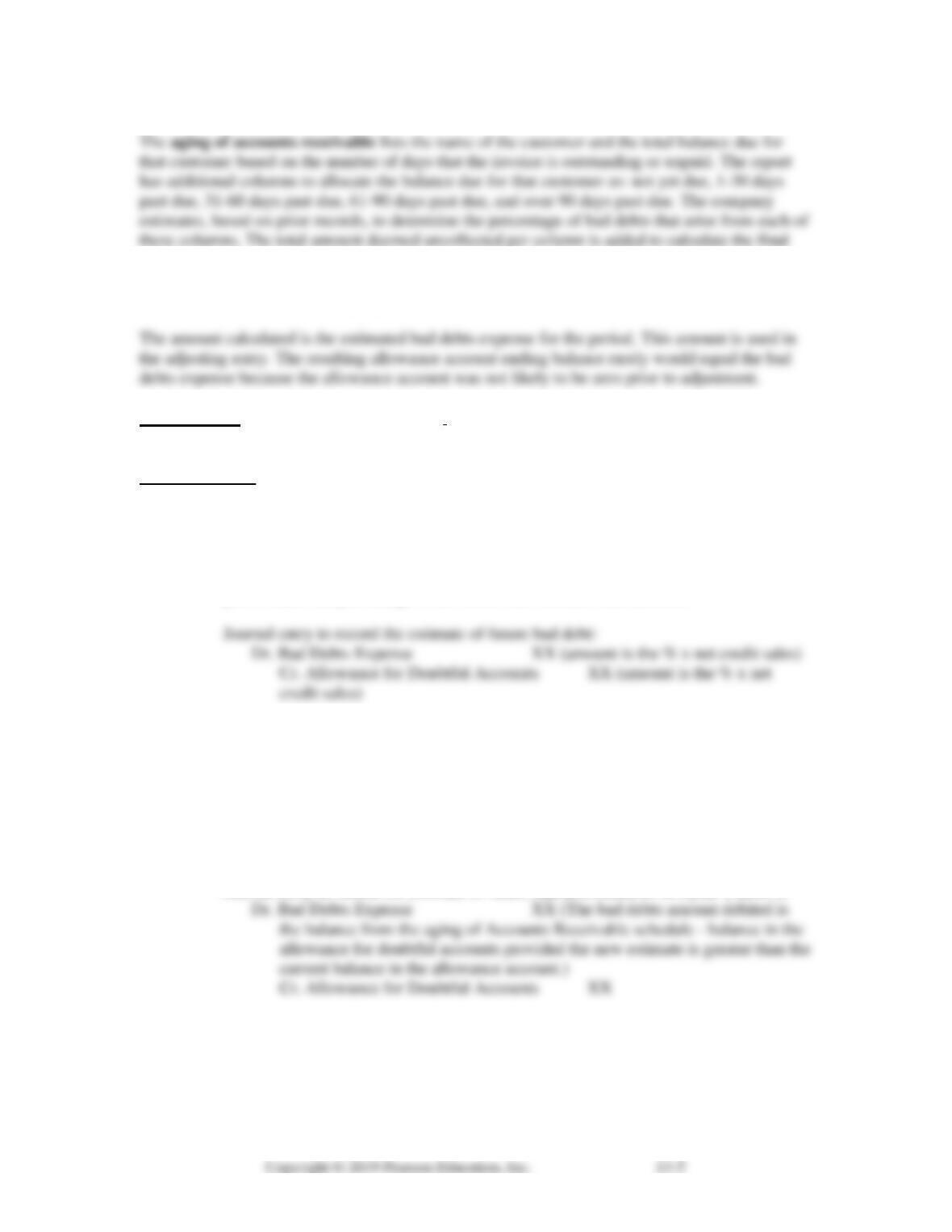
uncollectible expense or bad debts expense for the overall receivables. The journal entry is for the
amount necessary to adjust the allowance for doubtful accounts to equal the required balance as
determined necessary per the aging schedule.
Key Concepts: Income statement approach, balance sheet approach, aging of accounts
receivable.
Lecture Outline:
Methods of estimating how many accounts will become uncollectible.
1. Income statement approach:
a. This approach is a method that estimates the amount of bad debts expense that will
result based on a percentage of net credit sales for the year.
b. This amount is calculated by multiplying the dollar value of sales on account for the
period times the percentage of net credit sales deemed uncollectible.
2 Balance sheet approach:
a. This approach is a method used to calculate the amount required in the allowance for
doubtful accounts.
b. This method is based on the accounts receivable aging process.
c. Because some account receivables can exceed the operating cycle, this approach has
to consider the current balance in the allowance for doubtful accounts, or the same
receivable could be counted twice.
Journal entry to record the estimate of future bad debt based on this year’s sales is:
3. The aging of accounts receivable (See Table 13.1):
a) lists the name of the customer.
b) the total balance due for that customer based on the number of days that the invoice
is outstanding or unpaid.
c) report has additional columns to allocate the balance due for that customer as: not yet
due as well as columns for brackets of days past due.
d) is based on company estimates and on prior records to determine the percentage of
bad debts that arise from each of these columns.
e) total amount deemed uncollected per column is added to calculate the final
uncollectible expense or bad debts expense for the overall receivables.
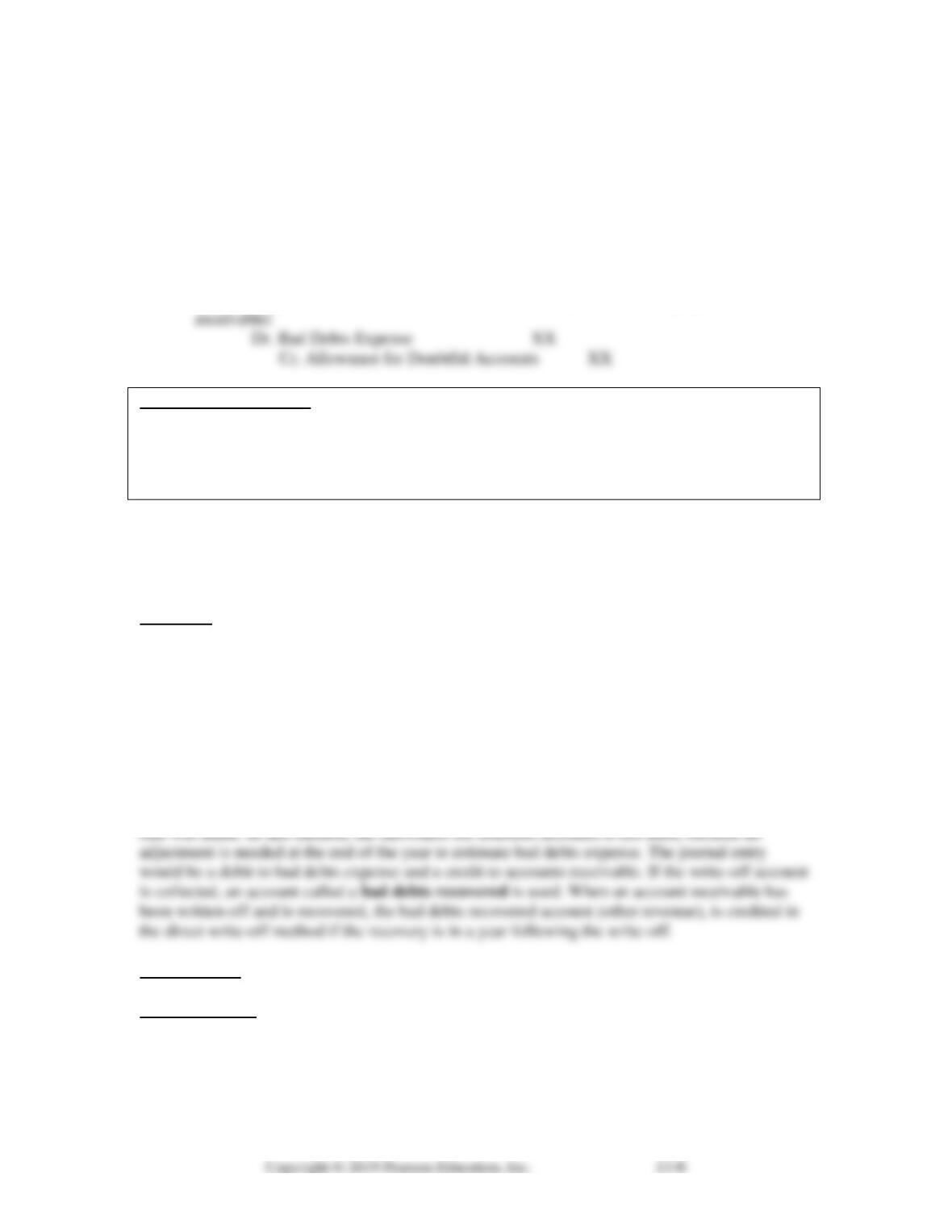
f) journal entry is the amount necessary to adjust the allowance for doubtful accounts to
equal the required balance as determined necessary per the aging schedule.
Journal entry to record the estimate of future bad debt (based on the aging of accounts
Teaching Tips/Strategy: For class demonstration use the Concept Checks #2 and #3, Exercises
13A-2, 13A-3, 13A-4, and 13A-5. Assign Problems 13A-3 and 13A-4. The Exercises will cover
the critical topics necessary for the completion of the required journal entries in the assignment.
Use the “Ten-Minute Quiz” questions #4, #5, #6, and #8 to reinforce the concepts.
Learning Unit 13-3: Writing Off and Recovering Uncollectible
Accounts
Summary: When the organization determines that a specific customer is not able to pay the debt,
the accounts receivable amount should no longer be considered an asset and should be written off.
The journal entry reduces the allowance for doubtful accounts and reduces the accounts
receivable controlling account as well as the accounts receivable subsidiary ledger. This journal
entry does not affect any expenses. Bad debts expense is not affected when an account is finally
written off. The estimate for bad debts expense was recorded in the previous year before the bad
debt actually occurred.
When a company cannot reasonably estimate its bad debts expense, it may use the direct write-
off method. Using this method, an account that is determined to be uncollectible would be
directly written off to this year’s bad debts expense account without regard to when the original
Key Concepts: Direct write-off method, bad debts recovered.
Lecture Outline:
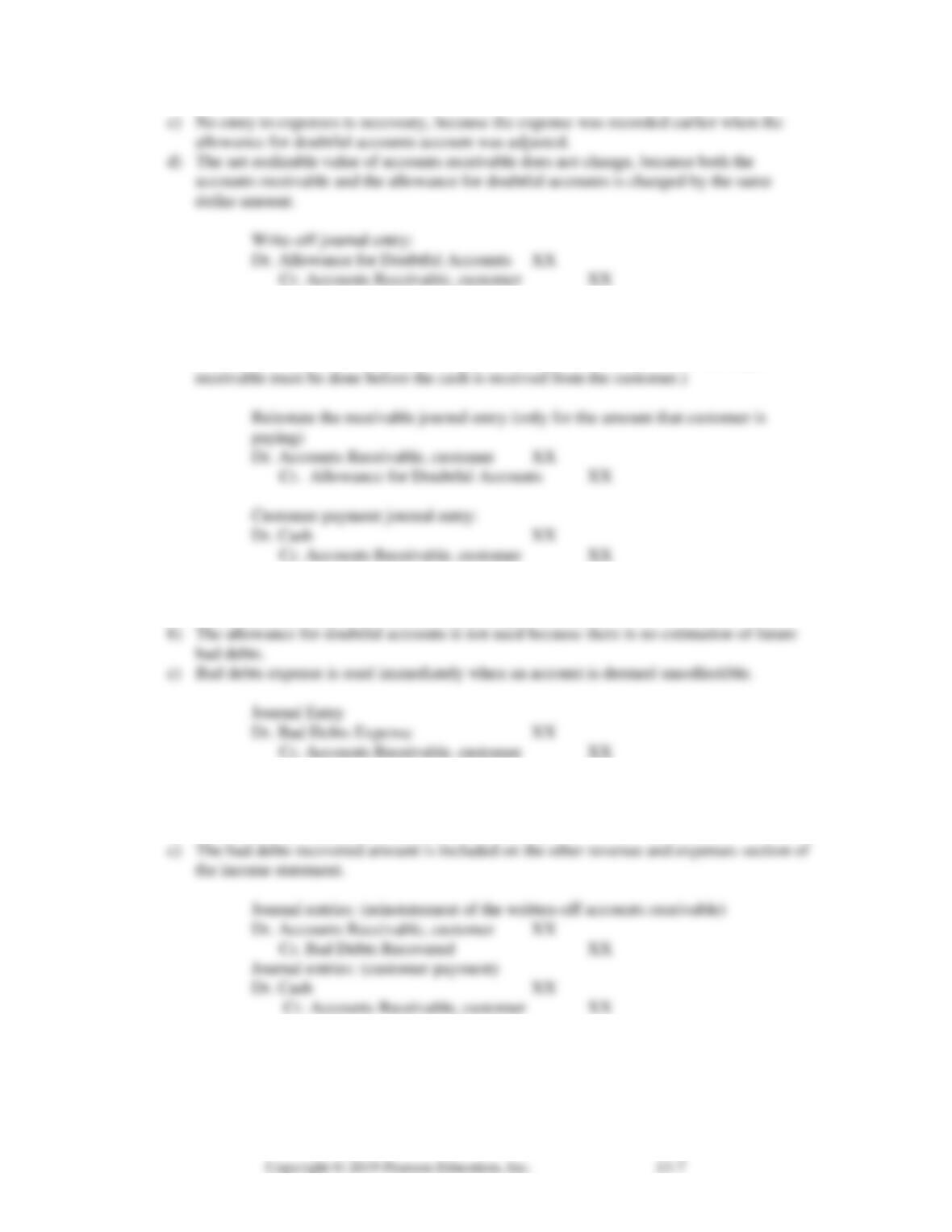
1. Write off an account using the allowance method:
a) When an account is deemed uncollectible, it is no longer an asset.
b) The account would be written off the company books so as to not overstate a company’s
assets.
2. Bad debts recovery:
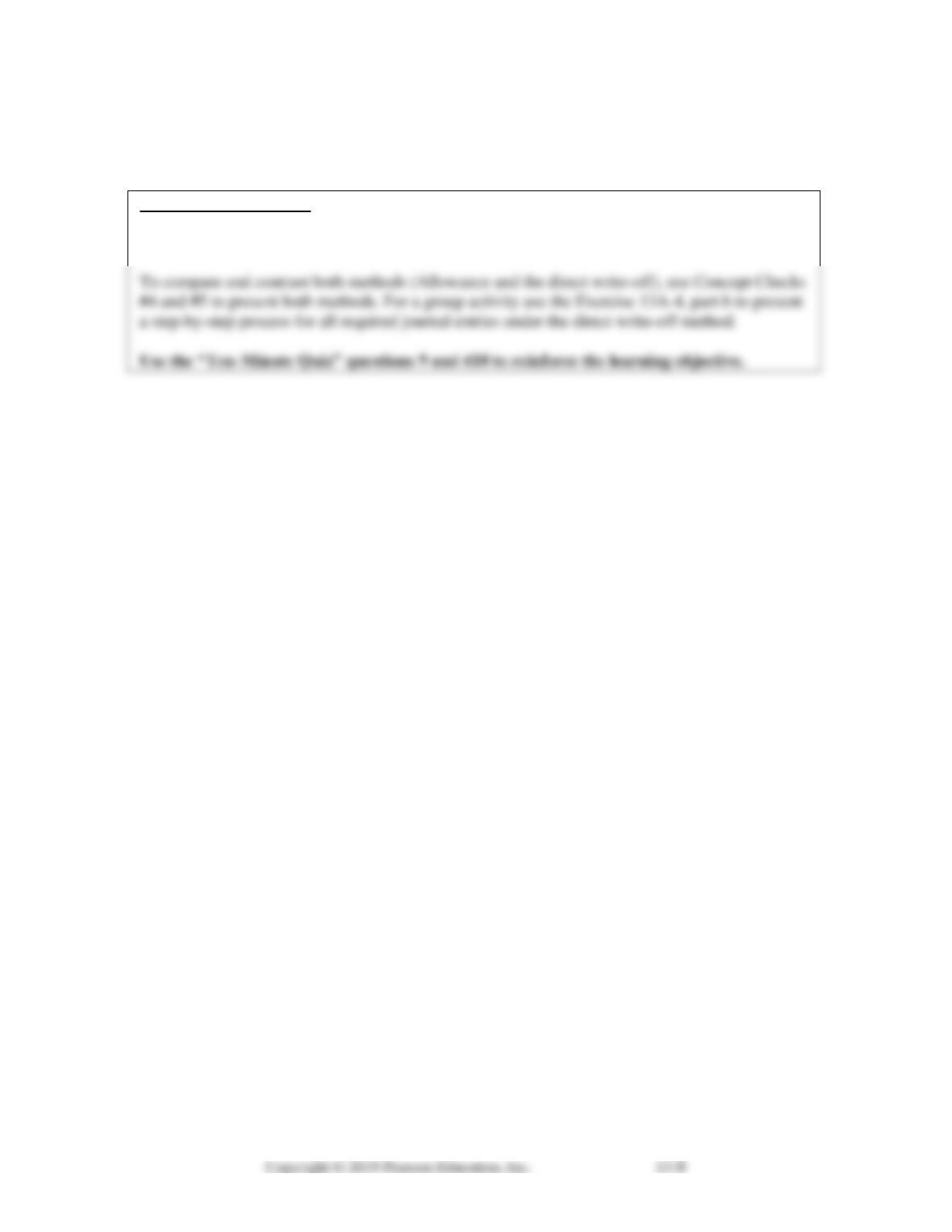
a) Two journal entries need to be recorded if the bad debt is recovered in the future to
reinstate the receivable and record the payment. (The reinstatement of the accounts
3. Direct write-off method:
a) This method does not use the matching principle or GAAP.
4. When the bad debt is recovered in a future operating cycle:
a) Bad debts recovered account is credited.
b) The amount recovered is classified as other revenue.
5. If the bad debt is recovered in the same operating cycle, the journal entries are:
Journal entries: (reinstatement of the write-off accounts receivable)
Dr. Accounts Receivable, customer XX
Cr. Bad Debts Expense XX
Journal entries: (customer payment)
Dr. Cash XX
Cr. Accounts Receivable, customer XX
Teaching Tips/Strategy: Use a comprehensive exercise that includes the allowance estimates, a
write off, and the recovery journal entries. It might be lengthy, but it will cover the entire process
presented on the chapter. Problem 13A-4 is excellent for class demonstration.

Name Date Section
CHAPTER 13
TEN-MINUTE QUIZ
Circle the letter of the best response.
1. Two methods of estimating uncollectible receivables are the:
a. aging of receivables and direct write-off method
b. aging of receivables and the percentage-of-sales method
c. allowance for doubtful accounts method and the direct write-off method
d. percentage-of-sales method and the direct write-off method
2. Allowance for doubtful accounts is a:
a. contra-asset account b. contra-liability account
c. contra-revenue account d. contra-expense account
3. Which account shows the amount of accounts receivable that a company does not expect
to collect?
a. Bad debts expense b. Allowance for doubtful accounts
c. Net realizable value d Allowance for net realizable value
4. The percentage-of-sales method estimates bad debts:
a. as a percentage of accounts receivable
b. as a percentage of net credit sales
c. as a percentage of each column in the aging of accounts receivable
d as a percentage of net realizable value
5. The aging of accounts receivable:
a. does not consider the balance in the allowance for doubtful accounts
b. does not consider the balance in bad debts expense
c. considers the balance in the allowance for doubtful accounts
d. considers the balance in Bad debts expense
6. When writing off an uncollectible account:
a. allowance for doubtful accounts does not change
b. accounts receivable and net realizable value decrease
c. bad debts expense increases
d. net realizable value does not change
7. Net-realizable value is:
a. accounts receivable less bad debts expense
b. accounts receivable
c. accounts receivable less allowance for doubtful accounts
d. bad debts expense
8. If the balance in the allowance for doubtful accounts is a debit balance of $1,200 and the
aging of accounts receivable estimates $2,500 in uncollectibles, bad debts expense is:
a. credited for $1,300 b. debited for $1,300
c. credited for $3,700 d. debited for $3,700

9. When using the direct write-off method, the journal entry to estimate future bad debt:
a. credits bad debts expense b. debits bad debts expense
c. credits allowance for doubtful accounts d. does not exist
10. A company that uses the direct write-off method records the bad debt:
a. as a percentage of net credit sales during the year
b. as an amount that is based on the aging of accounts receivable
c. as an amount that is based on the aging of accounts receivable after considering the
current balance in the allowance for doubtful accounts account.
d. as the receivable is deemed worthless
Answer Key to Chapter 13 Quiz