Problem 13-20 (15 minutes)
1.
Per 16-Ounce
T-Bone
Sales from further processing:
Sales price of one filet mignon (6 ounces ×
$12.00 per pound ÷ 16 ounces per pound) …
$4.50
Sales price of one New York cut (8 ounces ×
$8.80 per pound ÷ 16 ounces per pound) …..
4.40
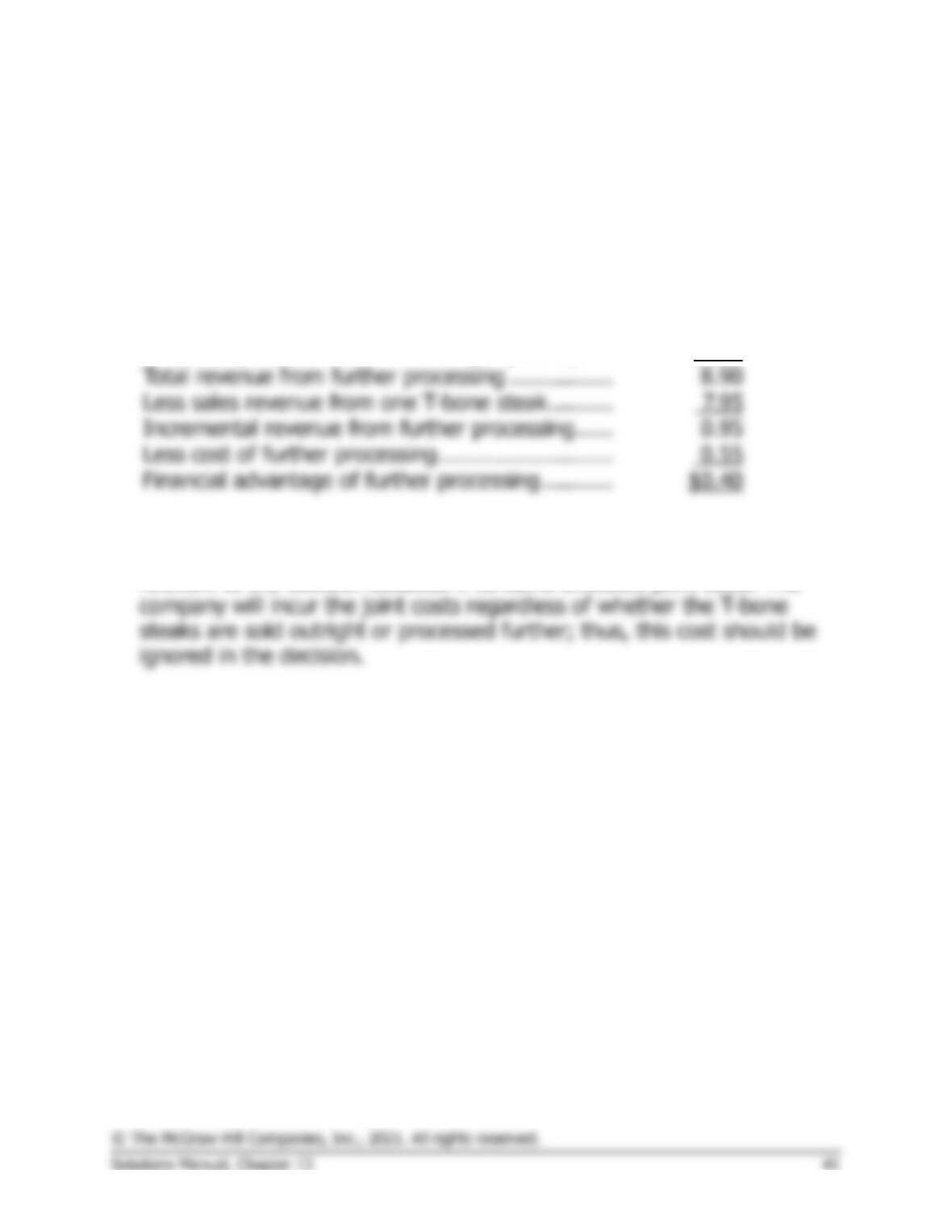
Financial advantage of further processing ………..
2. The T-bone steaks should be processed further into the filet mignon and
the New York cut. The $4.15 “profit” per pound shown in the text is not
Problem 13-21 (30 minutes)
1.
Contribution margin lost if the flight is
discontinued ………………………………………………
$(12,950)
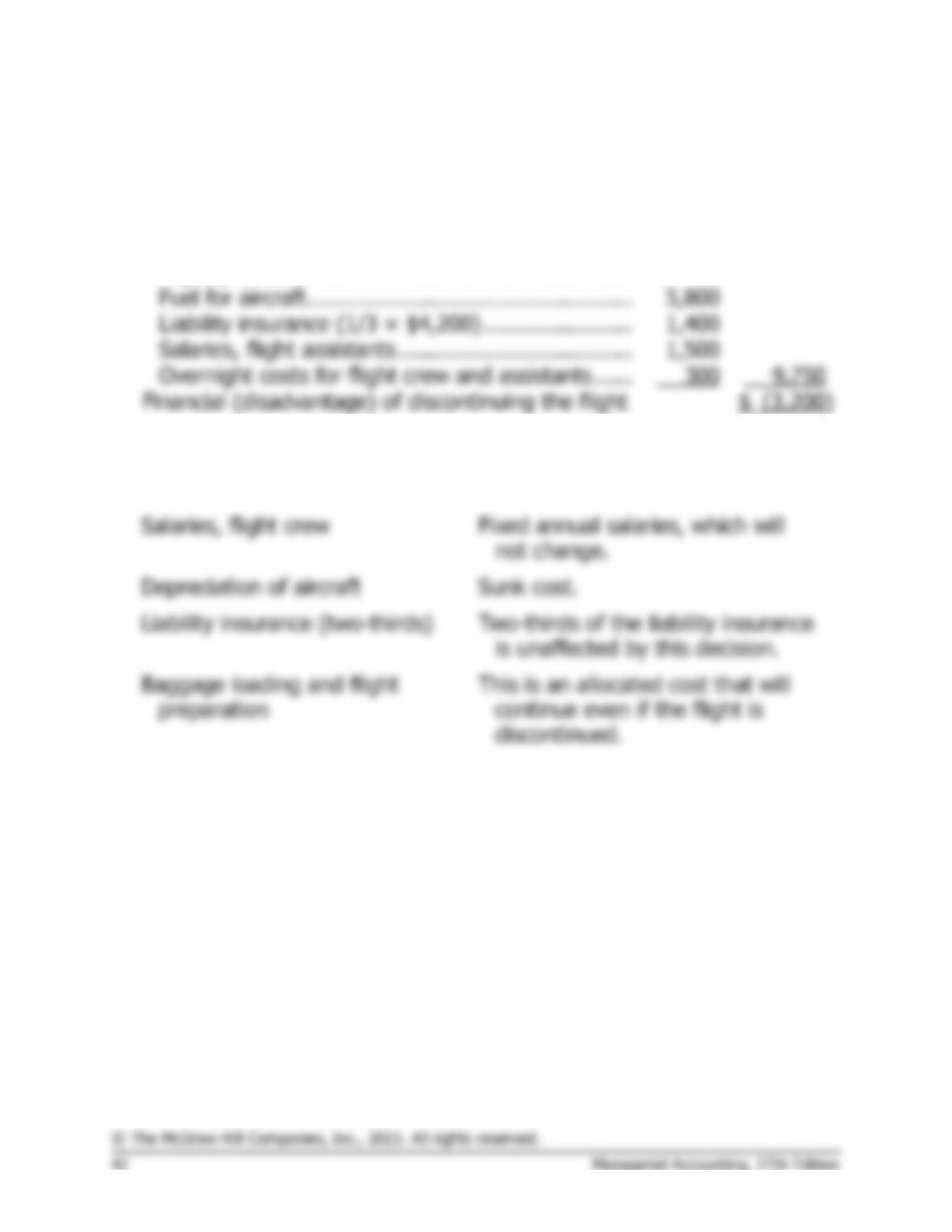
Flight costs that can be avoided if the flight is
discontinued:
Flight promotion …………………………………………
$ 750
Fuel for aircraft …………………………………………..
Liability insurance (1/3 × $4,200) …………………..
Salaries, flight assistants ………………………………
Financial (disadvantage) of discontinuing the flight
The following costs are not relevant to the decision:
Cost
Reason
Salaries, flight crew
Fixed annual salaries, which will
Depreciation of aircraft
Sunk cost.
Problem 13-21 (continued)
Alternative Solution:
Keep the
Flight
Drop the
Flight
Difference:
Net
Operating
Income
Increase or
(Decrease)
Ticket revenue ………………………………..
$14,000
$ 0
$(14,000)
Variable expenses …………………………….
1,050
0
1,050
Contribution margin ………………………….
12,950
0
(12,950)
Less flight expenses:
Salaries, flight crew ……………………….
1,800
1,800
0
Flight promotion …………………………...
750
0
750
Depreciation of aircraft ……………………
1,550
1,550
0
Fuel for aircraft ……………………………..
5,800
0
Liability insurance ………………………….
4,200
2,800
Salaries, flight assistants …………………
1,500
Baggage loading and flight preparation
1,700
1,700
0
0
Total flight expenses …………………………
9,750
Net operating loss …………………………...
$ (7,850)
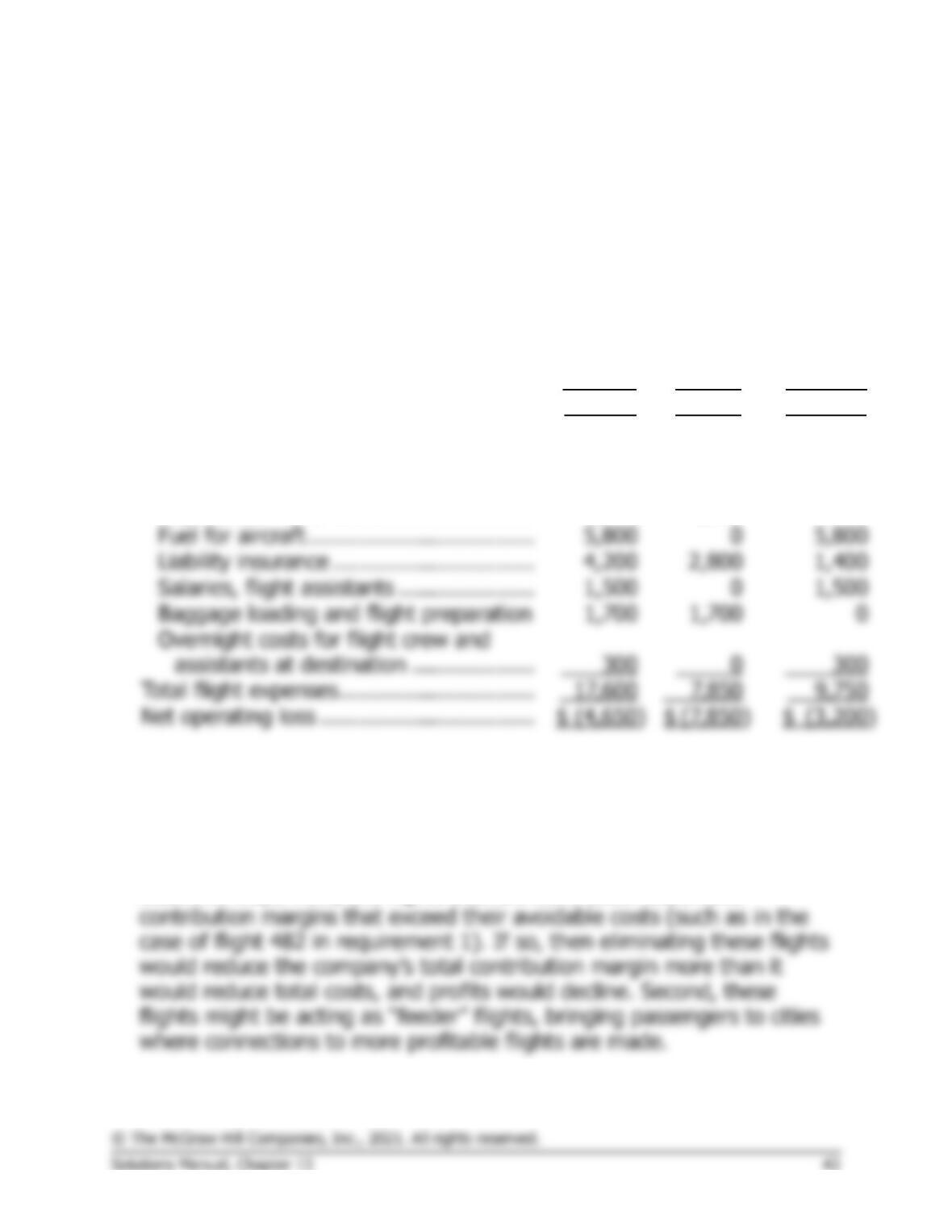
2. The goal of increasing the seat occupancy could be obtained by
eliminating flights with a lower-than-average seat occupancy. By
eliminating these flights and keeping the flights with a higher-than-
average seat occupancy, the overall average seat occupancy for the
company as a whole would be improved. This could reduce profits in at
least two ways. First, the flights that are eliminated could have
Problem 13-22 (30 minutes)
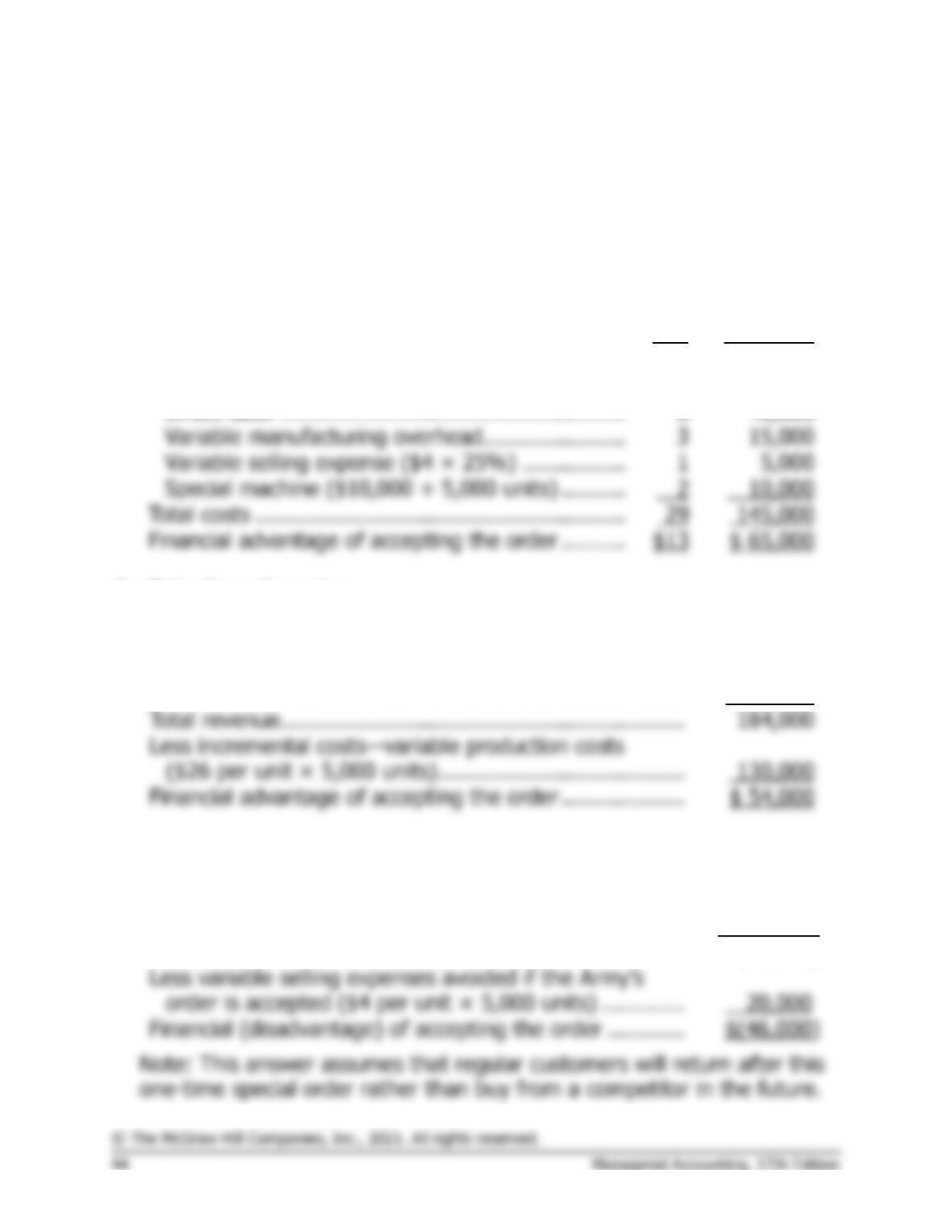
1. Because the fixed costs will not change as a result of the order, they are
not relevant to the decision. The cost of the new machine is relevant,
and this cost will have to be recovered by the current order because
there is no assurance of future business from the retail chain.
Unit
Total—
5,000 units
Sales from the order ($50 × 84%) ………………….
$42
$210,000
Less costs associated with the order:
Direct materials ………………………………………..
15
75,000
Direct labor ……………………………………………..
40,000
Variable manufacturing overhead ………………….
15,000
Variable selling expense ($4 × 25%) …………….
Special machine ($10,000 ÷ 5,000 units) ……….
Total costs …………………………………………………
Financial advantage of accepting the order ……….
2.
Sales from the order:
Reimbursement for production costs (variable
production costs of $26 plus fixed overhead cost of
$9 = $35 per unit; $35 per unit × 5,000 units) ……..
$175,000
Fixed fee ($1.80 per unit × 5,000 units) ………………..
9,000
Total revenue ……………………………………………………..
Financial advantage of accepting the order ……………….
3.
Sales:
From the U.S. Army (above) ………………………………..
$184,000
Lost sales from regular channels ($50 per unit ×
5,000 units) …………………………………………………..
(250,000)
Net decrease in revenue ……………………………………….
(66,000)
20,000
Financial (disadvantage) of accepting the order …………
$(46,000)
Problem 13-23 (60 minutes)
1. The starting point for answering requirement 1 is separating the
manufacturing overhead per unit of $1.40 into its variable and fixed
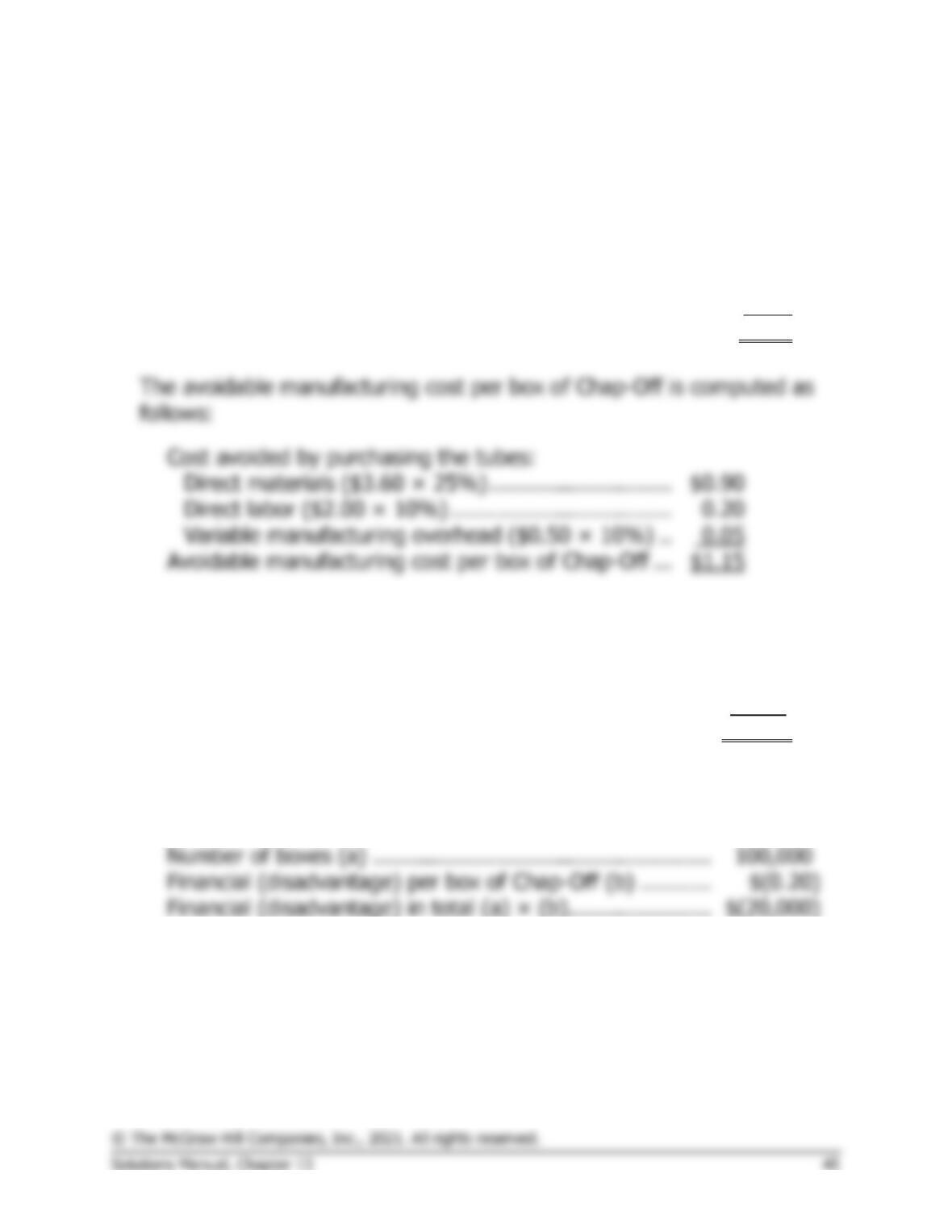
components. The variable manufacturing overhead per box of Chap-Off
would be $0.50, as shown below:
Total manufacturing overhead cost per box of Chap-Off ..
$1.40
Less fixed portion ($90,000 ÷ 100,000 boxes) ……………
0.90
Variable overhead cost per box ……………………………….
$0.50
Cost avoided by purchasing the tubes:
Direct materials ($3.60 × 25%) ……………………….
$0.90
Avoidable manufacturing cost per box of Chap-Off …
$1.15
2. The financial (disadvantage) per box of Chap-Off is computed as
follows:
Avoidable manufacturing cost per box of Chap-Off ………
$ 1.15
Less price paid to supplier ………………………………………
1.35
Financial (disadvantage) per box of Chap-Off ……………..
$(0.20)
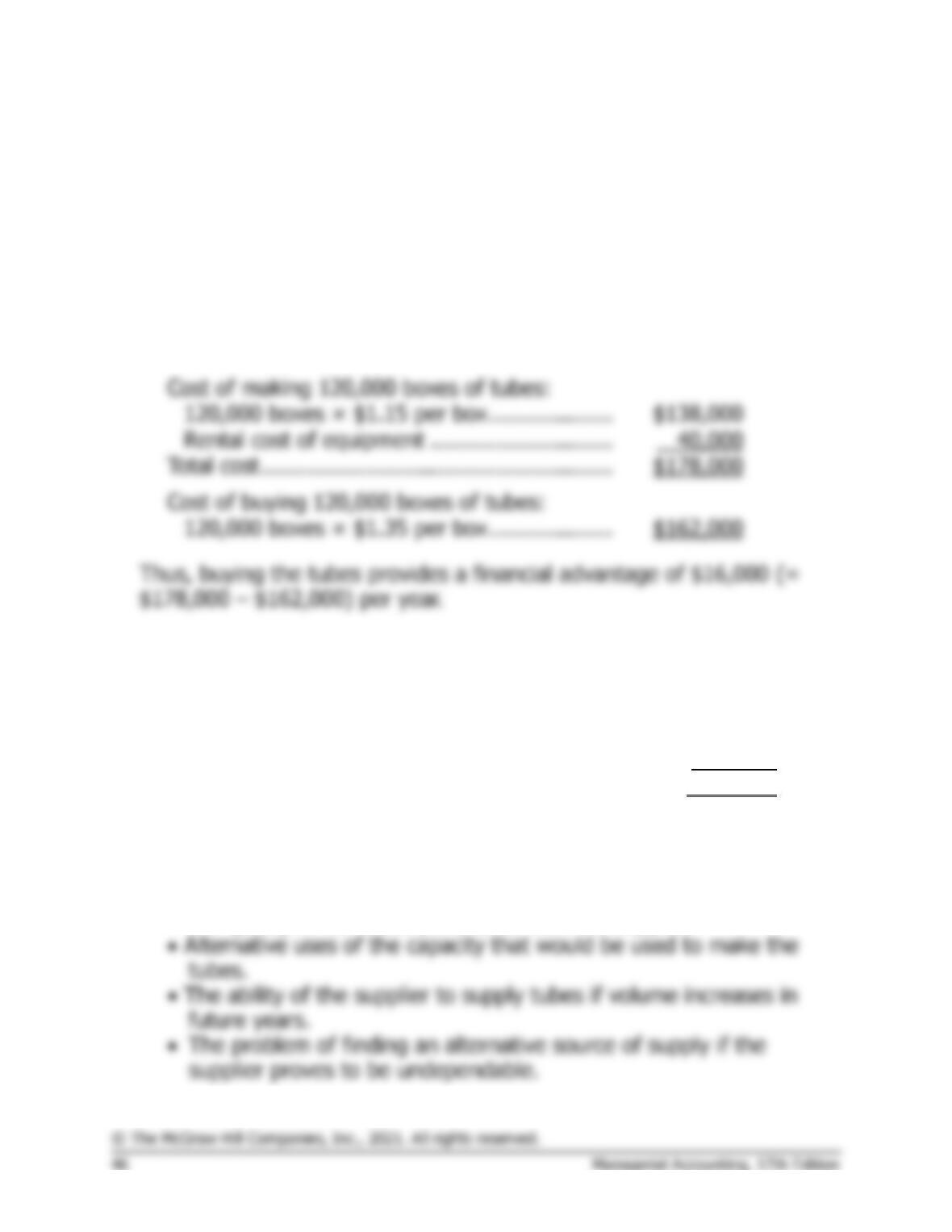
3. The financial (disadvantage) of outsourcing 100,000 boxes of Chap-Off
is computed as follows:
Number of boxes (a) …………………………………………….
Financial (disadvantage) per box of Chap-Off (b) ………..
Financial (disadvantage) in total (a) × (b) ………………….
4. Silven should make the tubes because the price paid to the supplier
($1.35) exceeds the avoidable manufacturing cost per unit ($1.15).
Problem 13-23 (continued)
5. The maximum purchase price would be $1.15 per box. The company
would not be willing to pay more than this amount because the $1.15
represents the cost of producing one box of tubes internally. To make
purchasing the tubes attractive, however, the purchase price should be
less than
$1.15 per box.
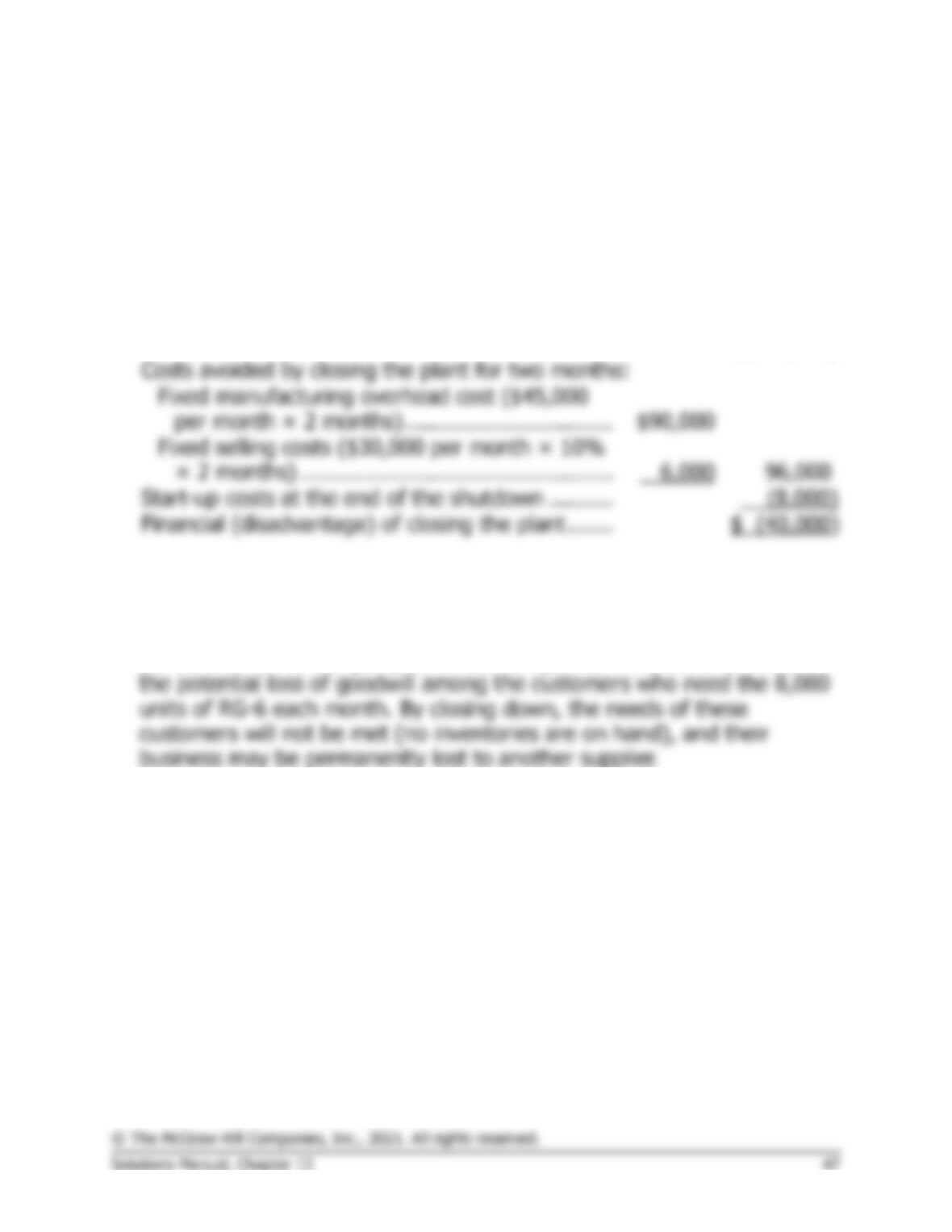
6. At a volume of 120,000 boxes, the company should buy the tubes. The
computations are:
Cost of making 120,000 boxes of tubes:
Total cost ………………………………………………
Cost of buying 120,000 boxes of tubes:
7. Under these circumstances, the company should make 100,000 boxes of
tubes and purchase the remaining 20,000 boxes of tubes from the
outside supplier. The costs would be as follows:
Cost of making: 100,000 boxes × $1.15 per box ……
$115,000
Cost of buying: 20,000 boxes × $1.35 per box ………
27,000
Total cost ………………………………………………………
$142,000
8. Management should take into account at least the following additional
factors:
• The ability of the supplier to meet required delivery schedules.
• The quality of the tubes purchased from the supplier.
Problem 13-24 (45 minutes)
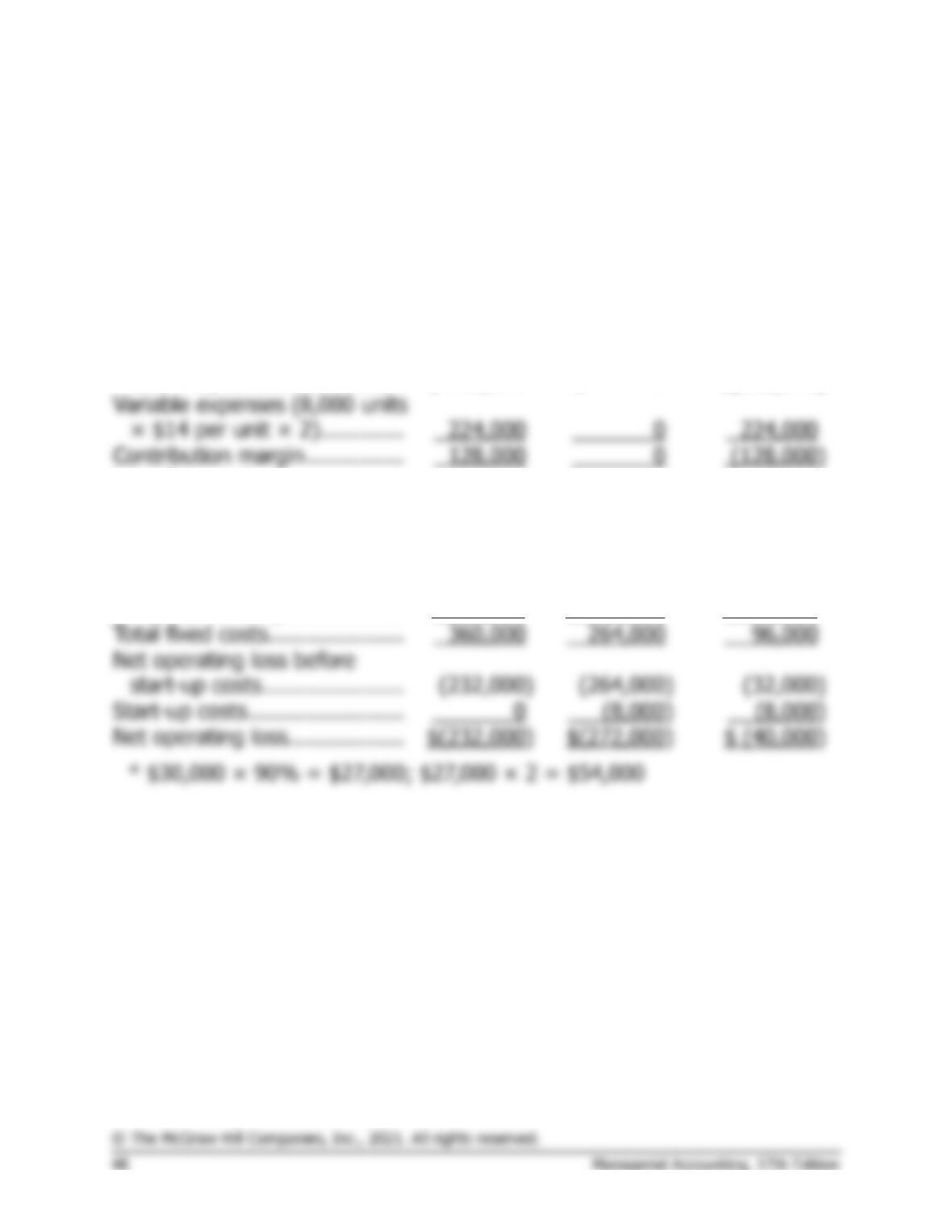
1. Product RG-6 has a contribution margin of $8 per unit (= $22 – $14). If
the plant closes, this contribution margin will be lost on the 16,000 units
(= 8,000 units per month × 2 months) that could have been sold during
the two-month period. However, the company will be able to avoid some
fixed costs as a result of closing down. The analysis is:
Contribution margin lost by closing the plant for
two months ($8 per unit × 16,000 units) ………
$(128,000)
2. No, the company should not close the plant; it should continue to
operate at the reduced level of 8,000 units produced and sold each
month. Closing will result in a $40,000 greater loss over the two-month
period than if the company continues to operate. An additional factor is
Problem 13-24 (continued)
Alternative Solution:
Plant
Kept
Open
Plant
Closed
Difference:
Net
Operating
Income
Increase or
(Decrease)
Sales (8,000 units × $22 per
unit × 2) ……………………….
$ 352,000
$ 0
$(352,000)
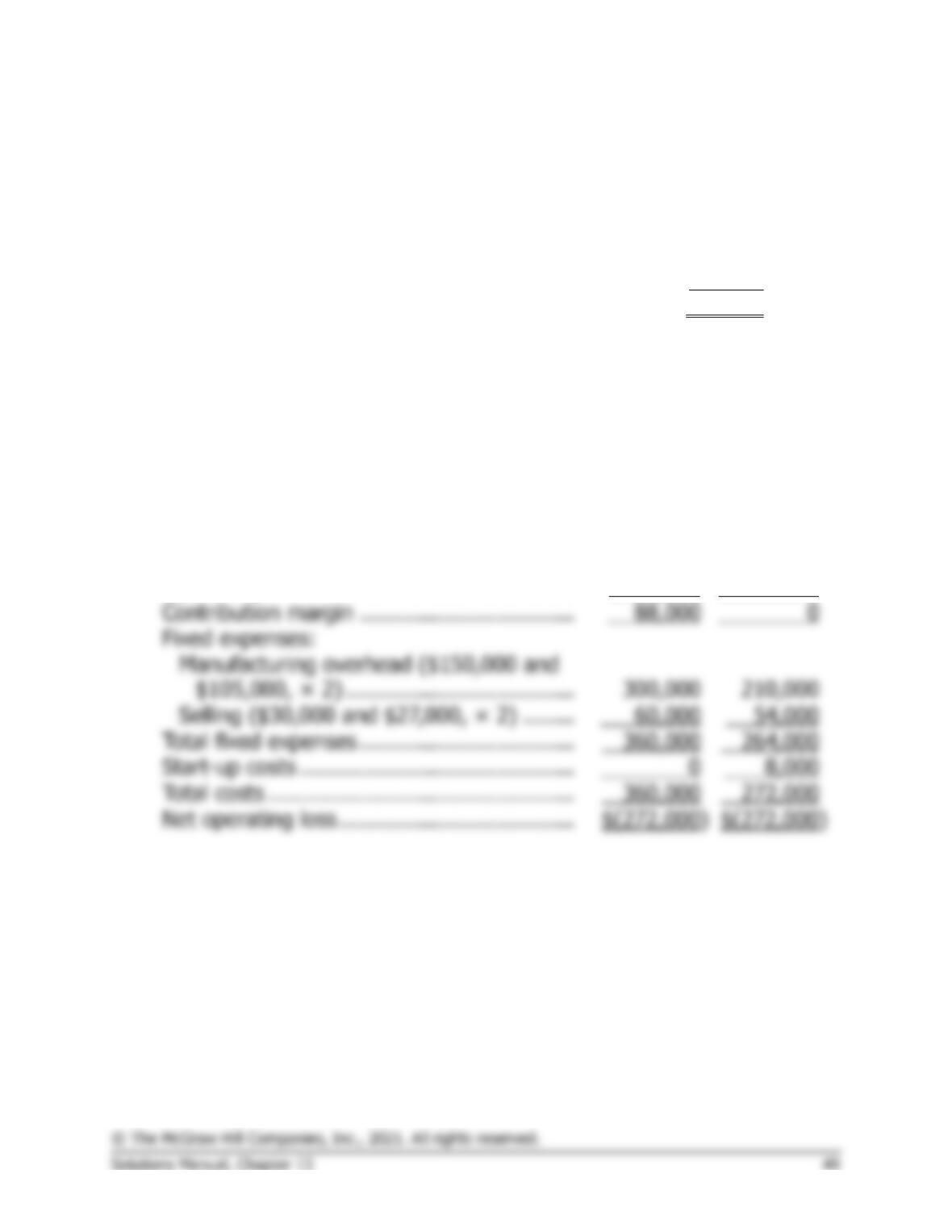
Contribution margin ……………
(128,000)
Less fixed costs:
Fixed manufacturing
overhead costs ($150,000
× 2) …………………………..
300,000
210,000
90,000
Fixed selling costs
($30,000 × 2) ………………
60,000
54,000
*
6,000
Total fixed costs…………………
Start-up costs ……………………
Net operating loss………………
$30,000 × 90% = $27,000; $27,000 × 2 = $54,000
Problem 13-24 (continued)
3. Birch Company will be indifferent if it can sell 11,000 units over the two–
month period. The computations are:
Cost avoided by closing the plant for two months
(see above) …………………………………………………
$96,000
Less start-up costs ………………………………………….
8,000
Net avoidable costs …………………………………………
$88,000
= 11,000 units
Verification:
Operate at
11,000
Units for
Two
Months
Close for
Two
Months
Sales (11,000 units × $22 per unit) ………..
$ 242,000
$ 0
Variable expenses (11,000 units × $14
per unit) ………………………………………..
154,000
0
Contribution margin …………………………...
0
Total fixed expenses …………………………...
264,000
Start-up costs ……………………………………
8,000
Total costs …………………………..……………
272,000
Problem 13-25 (60 minutes)
1.
Debbie
Trish
Sarah
Mike
Sewing
Kit
Direct labor cost per unit (a) ….
$6.40
$4.00
$11.20
$8.00
$3.20
Direct labor rate per hour (b) …
$16.00
$16.00
$16.00
$16.00
$16.00
Direct labor hours per unit (a)
÷ (b) ……………………………..
0.40
0.25
0.70
0.50
0.20
2.
Debbie
Trish
Sarah
Mike
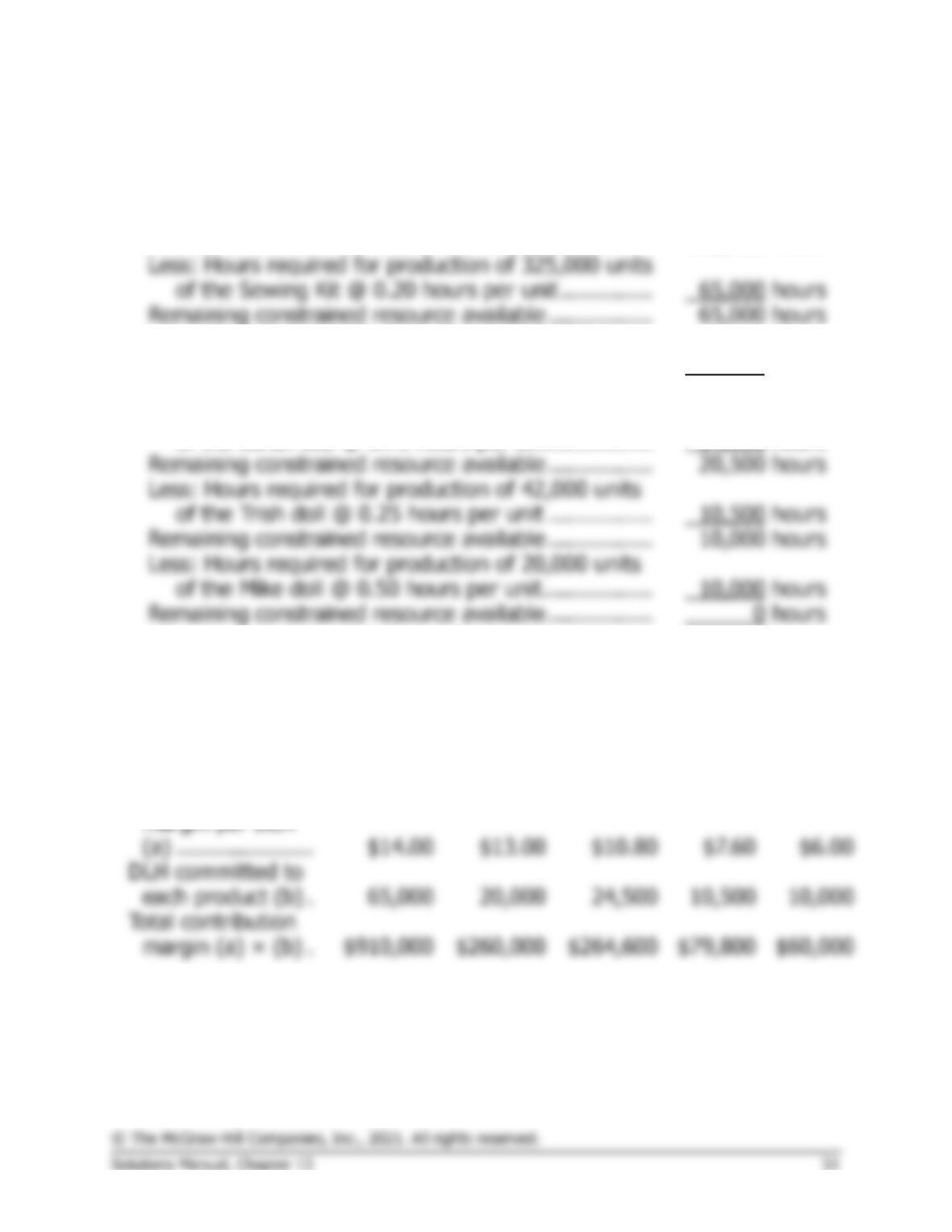
Variable overhead per hour (a)
$2.00
$2.00
$2.00
$2.00
$2.00
Direct labor hours per unit (b) .
0.40
0.25
0.70
0.50
0.20
Variable overhead per unit (a)
Sewing
3.
Debbie
Trish
Sarah
Mike
Sewing
Kit
Selling price ……………………….
$16.70
$7.50
$26.60
$14.00
$ 9.60
Variable costs:
6.44
2.00
11.20
8.00
0.80
0.50
0.40
Total variable costs ……………..
Contribution margin (a) ………..
Direct labor hours per unit (b) .
0.40
0.25
0.70
0.50
0.20
Problem 13-25 (continued)
4. The first step is to compute how many direct labor-hours would be
committed to each of the five products as follows:
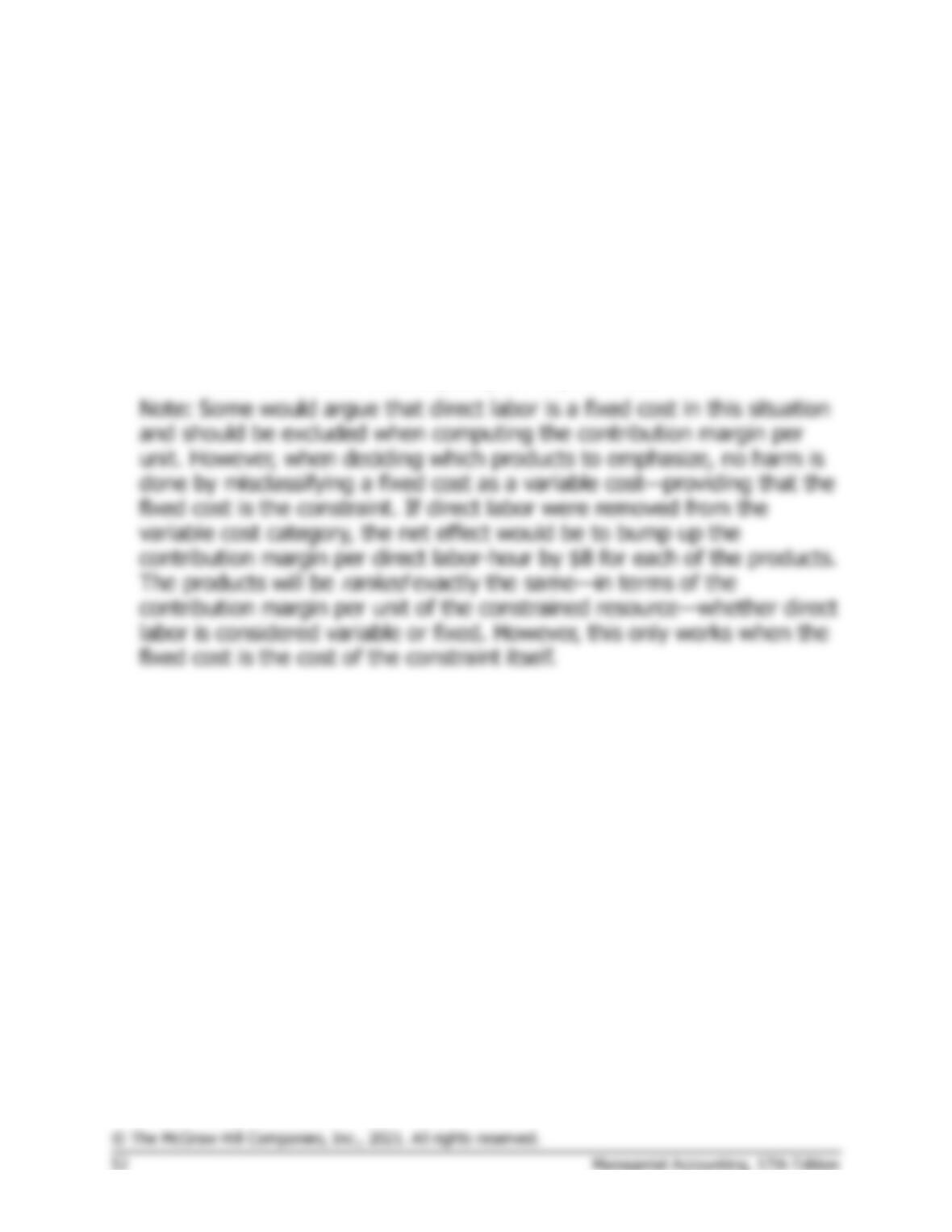
Amount of constrained resource available …………….
130,000 hours
Less: Hours required for production of 325,000 units
of the Sewing Kit @ 0.20 hours per unit …………..
65,000 hours
Remaining constrained resource available …………….
65,000 hours
Less: Hours required for production of 50,000 units
of the Debbie doll @ 0.40 hours per unit ………….
20,000 hours
Remaining constrained resource available …………….
45,000 hours
Less: Hours required for production of 35,000 units
24,500 hours
Remaining constrained resource available …………….
Less: Hours required for production of 42,000 units
10,500 hours
Remaining constrained resource available …………….
10,000 hours
Less: Hours required for production of 20,000 units
10,000 hours
Remaining constrained resource available …………….
The second step is to multiple the direct labor-hours committed to each
product by its respective contribution margin per direct labor-hour as
shown below:
Sewing
Kit
Debbie
Sarah
Trish
Mike
Contribution
DLH committed to
The highest total contribution margin that the company can earn is
$1,574,400 (= $910,000 + $260,000 + $264,600 + $79,800 + $60,000).
Problem 13-25 (continued)
5. Because the additional capacity would be used to produce the Mike doll,
the company should be willing to pay up to $22 per hour ($16 per hour
usual rate plus $6 contribution margin per hour) for added labor time.
6. Additional output could be obtained in a number of ways including
working overtime, adding another shift, expanding the workforce,
contracting out some work to outside suppliers, and eliminating wasted
labor time in the production process. The first four methods are costly,
but the last method can add capacity at very low cost.
Problem 13-26 (60 minutes)
1. and 2.
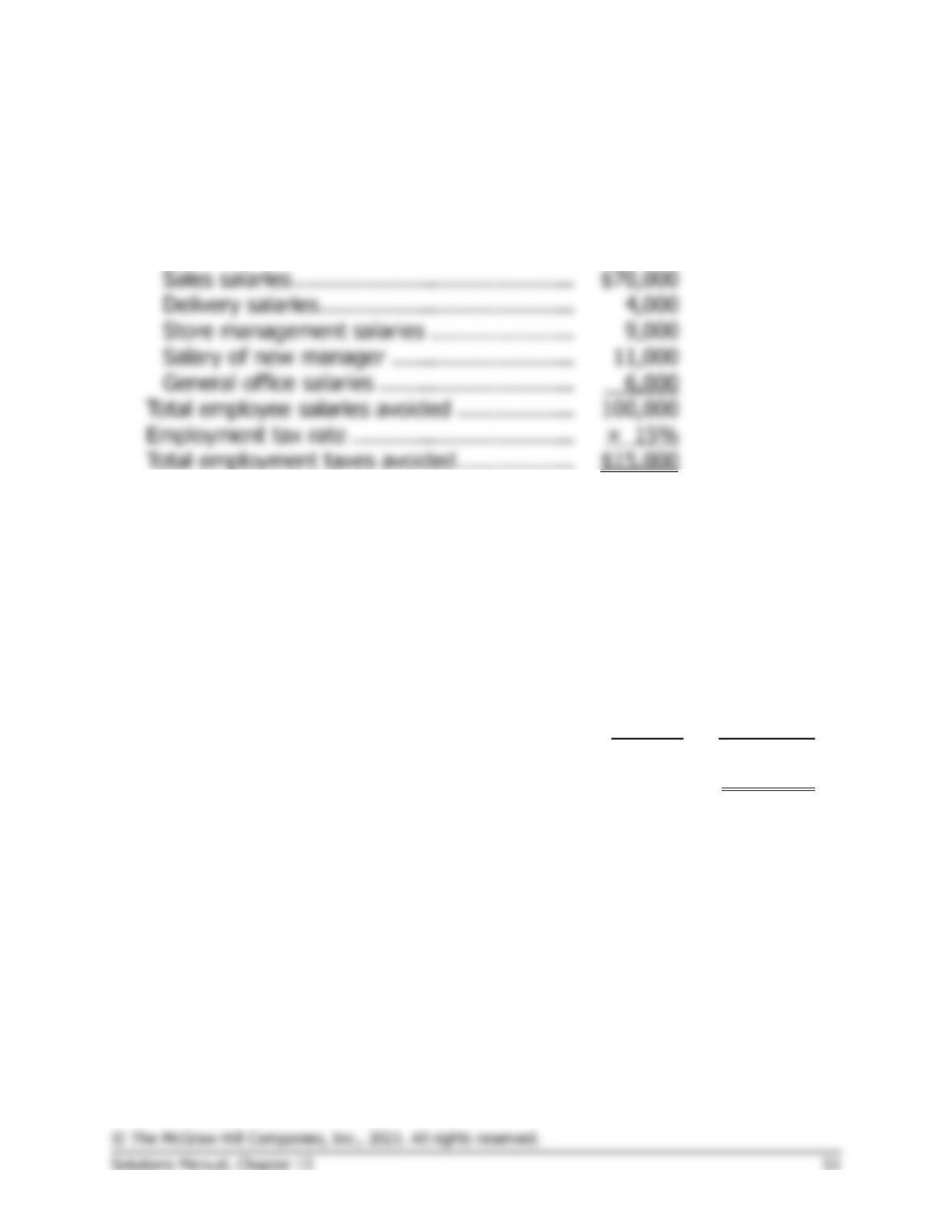
The avoided employee salaries and employment taxes are computed as
follows:
Sales salaries …………………………………….
$70,000
Delivery salaries …………………………………
4,000
Store management salaries ………………….
Salary of new manager ……………………….
General office salaries …………………………
6,000
Total employee salaries avoided ………………
100,000
Employment tax rate …………………………….
Total employment taxes avoided ………………
$15,000
3. The simplest approach to the solution is:
Gross margin lost if the store is closed …………
$(316,800)
Costs that can be avoided:
Employee salaries (see requirement 1) …….
$100,000
Employment taxes (see requirement 2) …..
$15,000
Direct advertising ………………………………..
51,000
Store rent ………………………………………….
85,000
Insurance on inventories ($7,500 × 2/3) ….
5,000
Utilities ……………………………………………..
31,000
287,000
Financial (disadvantage) of closing the North
Store ………………………………………………..
$ (29,800)
Problem 13-26 (continued)
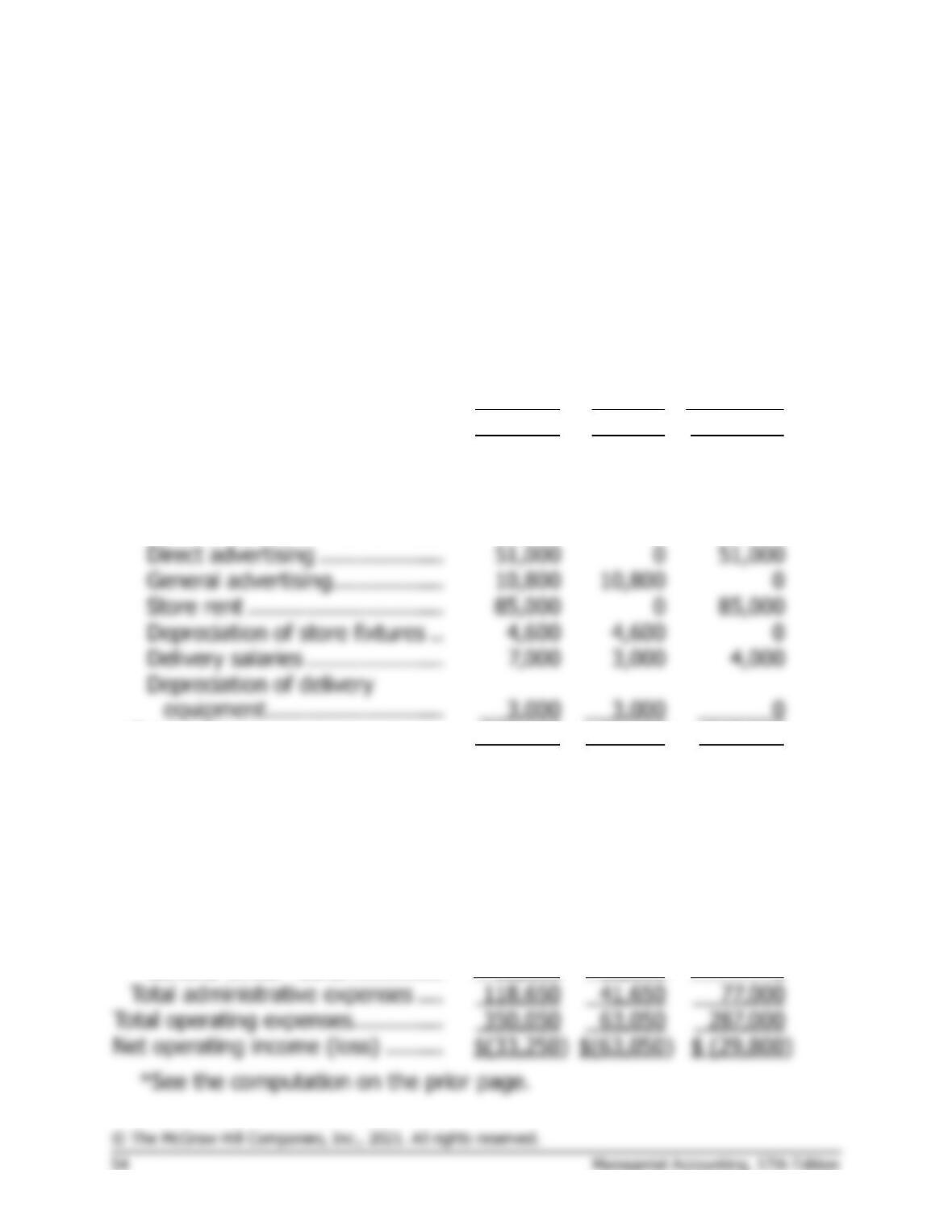
Alternative Solution (Total cost approach):
North
Store
Kept
Open
North
Store
Closed
Difference:
Net
Operating
Income
Increase or
(Decrease)
Sales…………………………………….
$720,000
$ 0
$(720,000)
Cost of goods sold …………………..
403,200
0
403,200
Gross margin ………………………….
316,800
0
(316,800)
Selling and administrative
expenses:
Selling expenses:
Sales salaries …………………….
70,000
0
70,000
Direct advertising ……………….
51,000
General advertising ……………..
10,800
Store rent …………………………
85,000
Depreciation of store fixtures ..
4,600
Delivery salaries …………………
3,000
4,000
0
Total selling expenses …………….
231,400
21,400
210,000
Administrative expenses:
Store management salaries …..
21,000
12,000
9,000
Salary of new manager ………..
11,000
0
11,000
General office salaries ………….
12,000
6,000
6,000
Insurance on fixtures and
inventory ………………………..
7,500
2,500
5,000
Utilities …………………………….
31,000
0
31,000
Employment taxes ………………
18,150
3,150
15,000
*
General office—other …………..
18,000
18,000
0
Total administrative expenses ….
118,650
41,650
77,000
Total operating expenses…………..
350,050
63,050
Net operating income (loss) ………
$(33,250)
$ (29,800)
Problem 13-26 (continued)
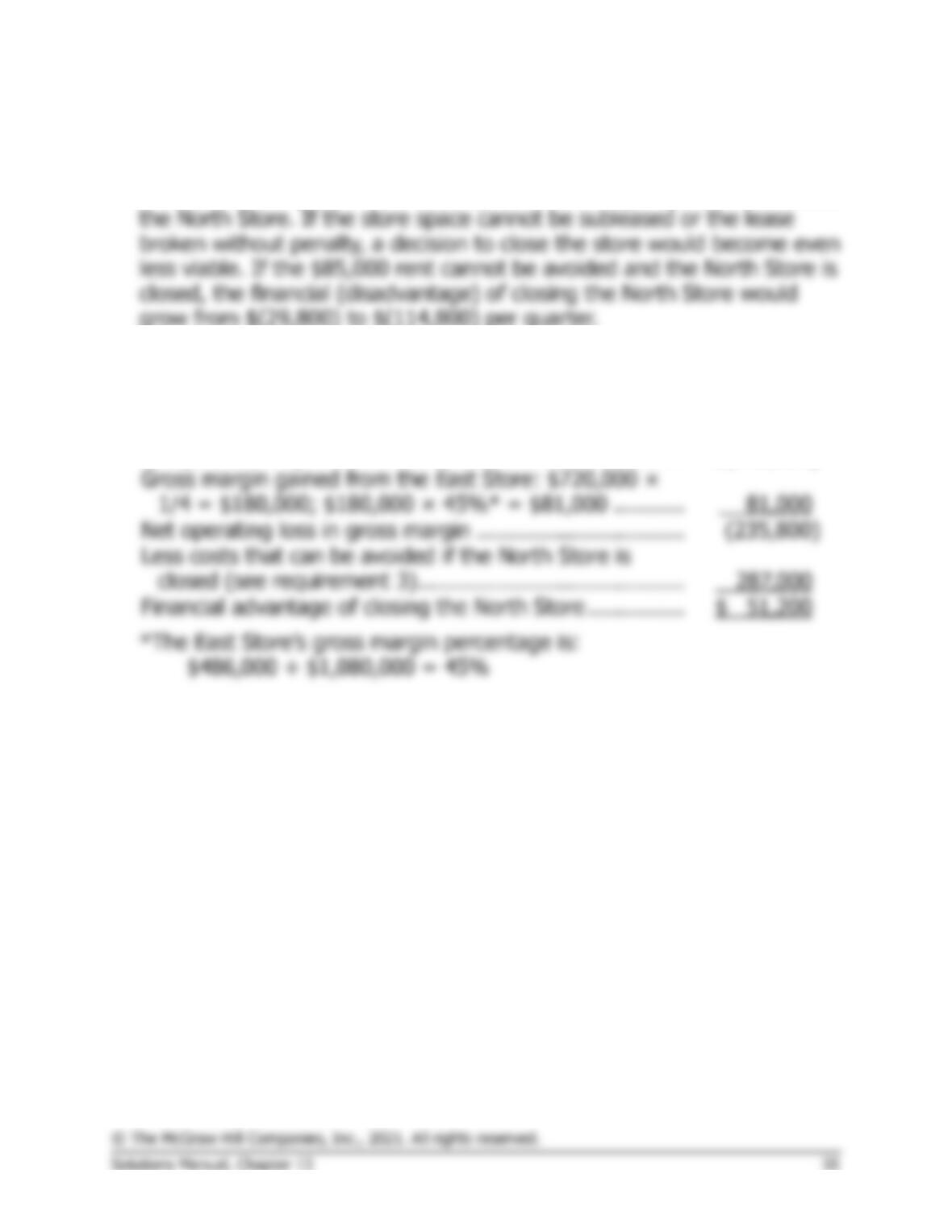
4. Based on the data in requirement (3), the North Store should not be
closed. The company would be $29,800 worse off per quarter if it closed
5. Under these circumstances, the North Store should be closed. The
computations are as follows:
Gross margin lost if the North Store is closed (see
requirement 3) …………………………..……………………..
$(316,800)
Gross margin gained from the East Store: $720,000 ×
Less costs that can be avoided if the North Store is
closed (see requirement 3) …………………………………..
Problem 13-27 (60 minutes)
1. The incremental revenue per jar from further processing of the Grit 337
is:
Selling price of the silver polish, per jar …………….
$4.00
Selling price of 1/4 pound of Grit 337 ($2.00 ÷ 4) .
0.50
Incremental revenue per jar …………………………...
$3.50
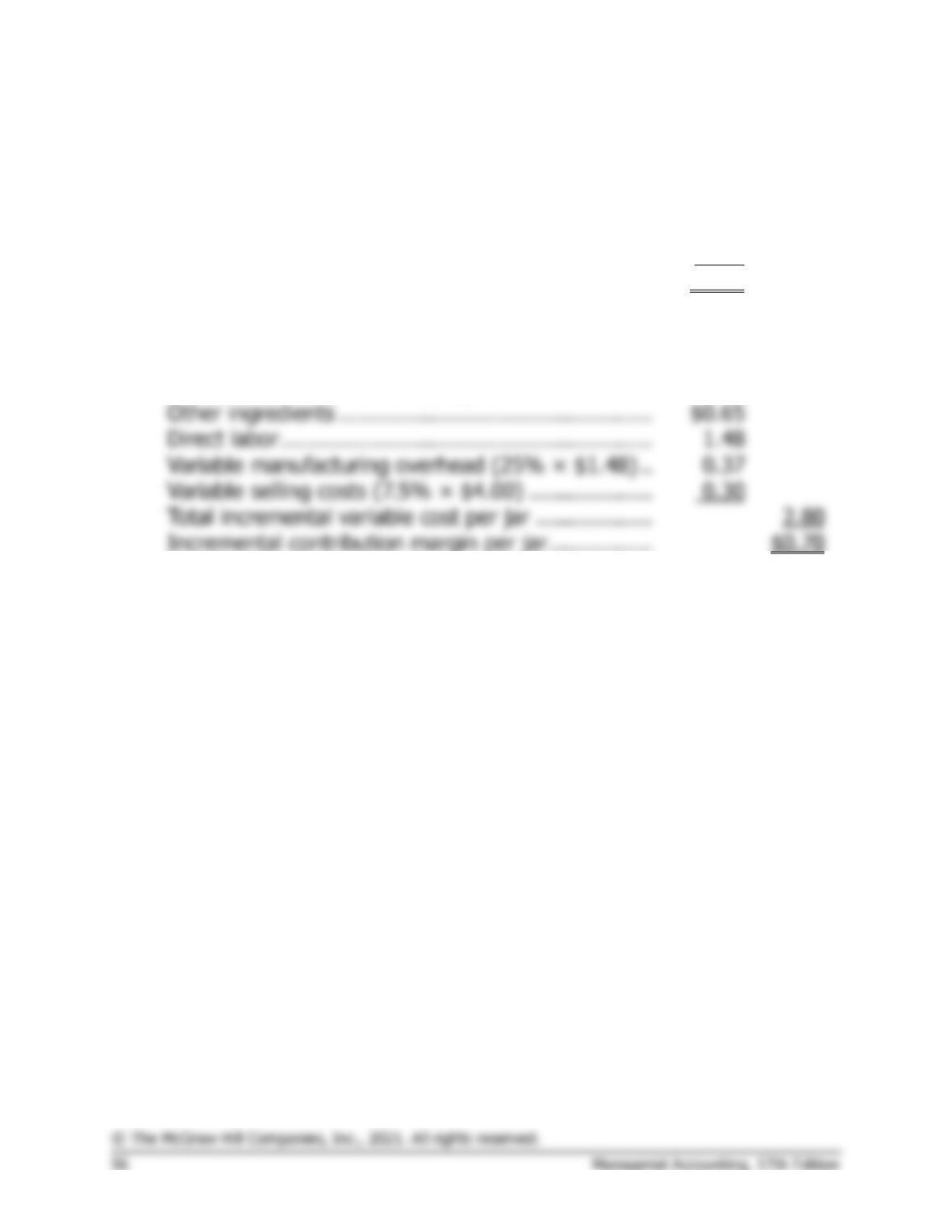
2. The incremental contribution margin per jar:
Incremental revenue per jar …………………………...
$3.50
Incremental variable costs per jar:
Other ingredients …………………………………………
Direct labor …………………………………………………
Variable manufacturing overhead (25% × $1.48) ..
Variable selling costs (7.5% × $4.00) ……………….
Total incremental variable cost per jar ………………
Incremental contribution margin per jar …………….
The $1.60 cost per pound (= $0.40 per 1/4 pound) required to produce
the Grit 337 would not be relevant in this computation because it is
incurred regardless of whether the Grit 337 is further processed into
silver polish or sold outright.
Problem 13-27 (continued)
3. Only the cost of advertising and the cost of the production supervisor
are avoidable if production of the silver polish is discontinued.
Therefore, the number of jars of silver polish that must be sold each
month to justify continued processing of the Grit 337 into silver polish
is:
Production supervisor ……….
$3,000
Advertising—direct …………..
4,000
Avoidable fixed costs ………..
$7,000
Avoidable fixed costs $7,000
=
Incremental CM per jar $0.70 per jar
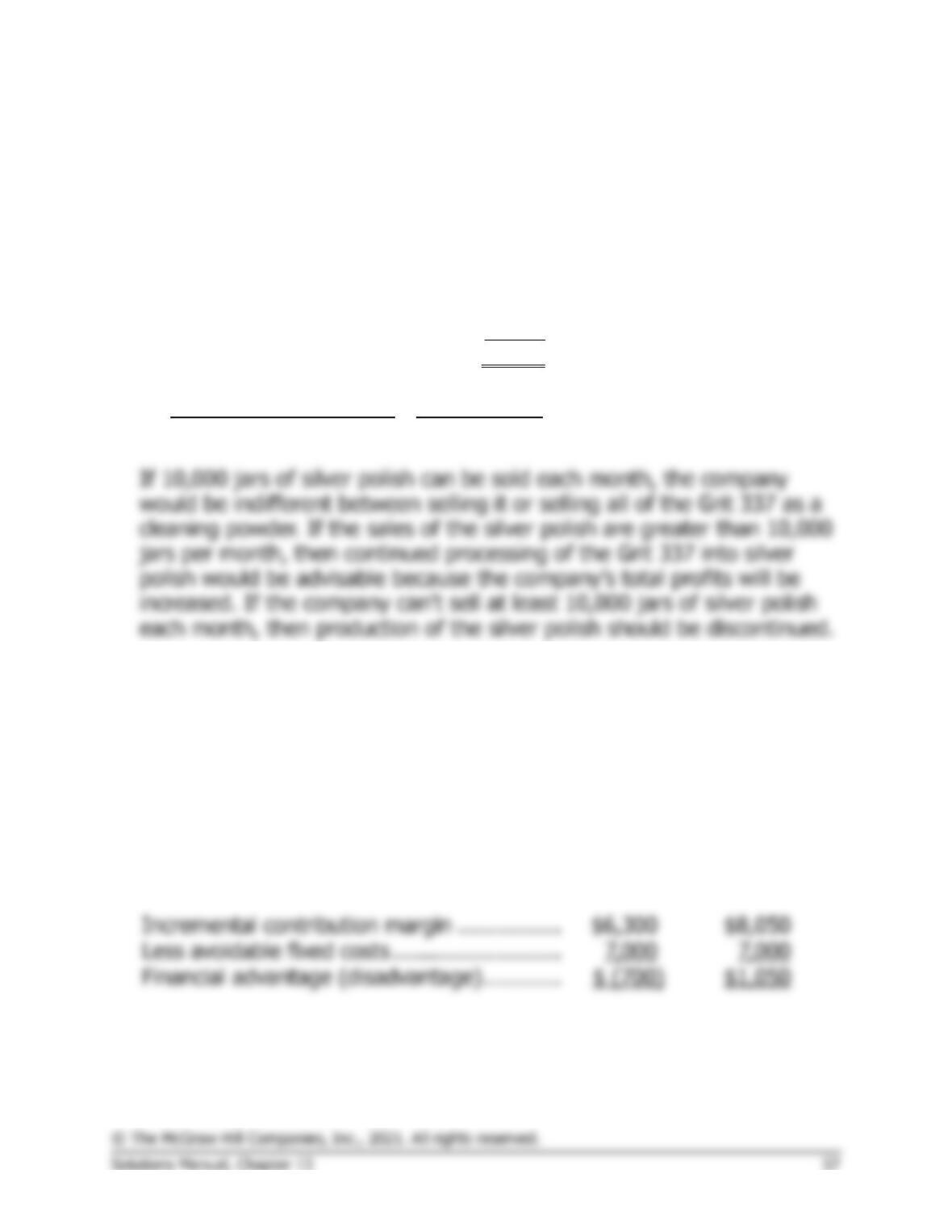
= 10,000 jars per month
4. and 5.
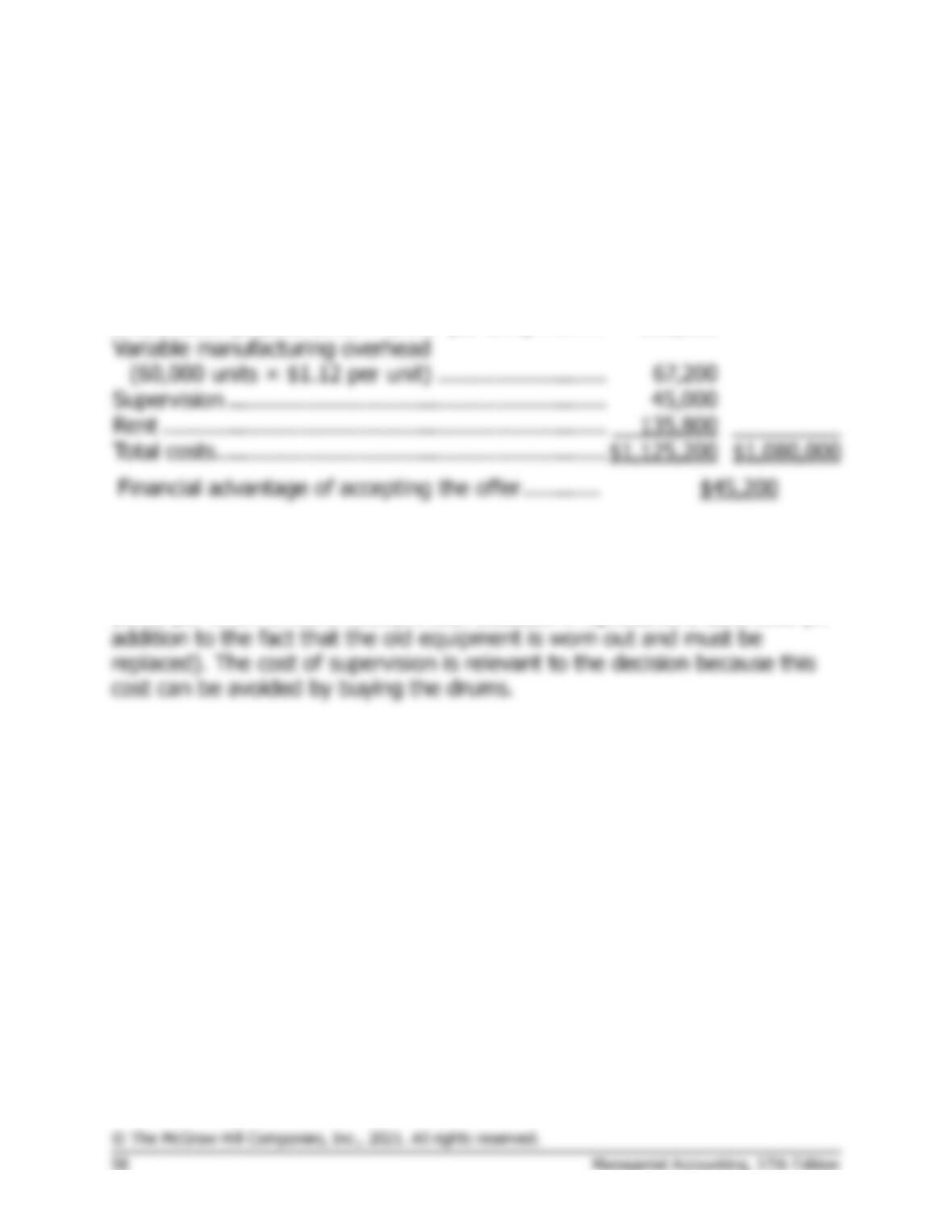
The financial advantage (disadvantage) is computed as follows:
9,000
jars
11,500
jars
Incremental contribution margin per jar (a)
$0.70
$0.70
Number of jars sold (b) ………………………..
9,000
11,500
Incremental contribution margin (a) × (b) ..
$6,300
$8,050
Incremental contribution margin …………….
$8,050
Less avoidable fixed costs ……………………..
7,000
7,000
Financial advantage (disadvantage) …………
$1,050
Problem 13-28 (60 minutes)
1. The financial advantage of accepting the supplier’s offer is computed as
follows:
Make
Buy
Cost of purchasing (60,000 units × $18 per unit) …
$1,080,000
Direct materials (60,000 units × $10.35 per unit) …
$ 621,000
Direct labor (60,000 units × $4.27 per unit) ………..
256,200
Variable manufacturing overhead
Supervision ………………………………………………….
Rent …………………………………………………………..
Total costs ……………………………………………………
Note: The $2.80 per drum general overhead cost is not relevant to the
decision because this cost will be the same regardless of whether the
company decides to make or buy the drums. Also, the depreciation of
$1.60 per drum is not a relevant cost because it represents a sunk cost (in
Problem 13-28 (continued)
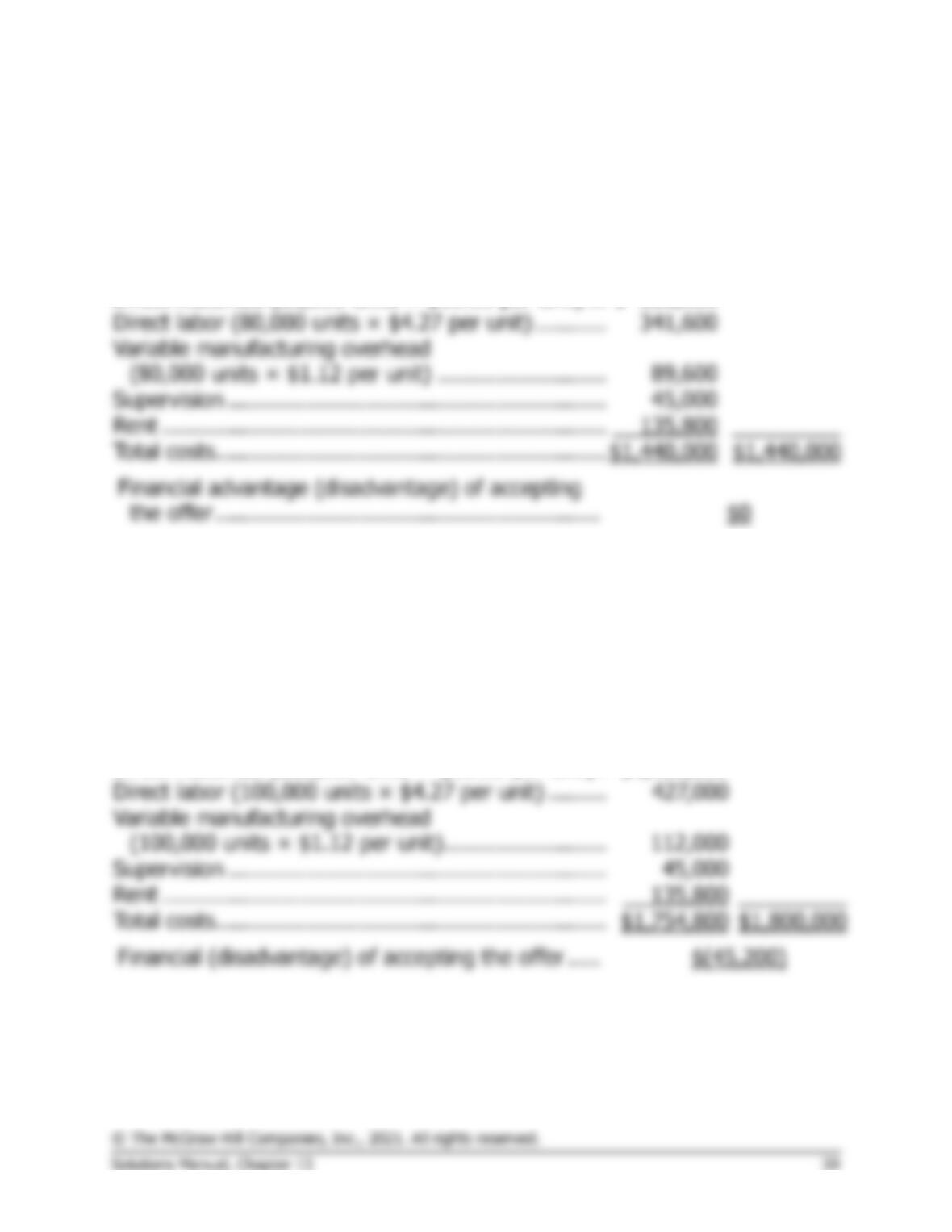
2. The financial advantage (disadvantage) of accepting the supplier’s offer
is computed as follows:
Make
Buy
Cost of purchasing (80,000 units × $18 per unit) …
$1,440,000
Direct materials (80,000 units × $10.35 per unit) …
Direct labor (80,000 units × $4.27 per unit) ………..
Variable manufacturing overhead
Supervision ………………………………………………….
Rent …………………………………………………………..
135,800
Total costs ……………………………………………………
$1,440,000
$1,440,000
Note: The company would be indifferent between the two alternatives if
80,000 drums were needed each year.
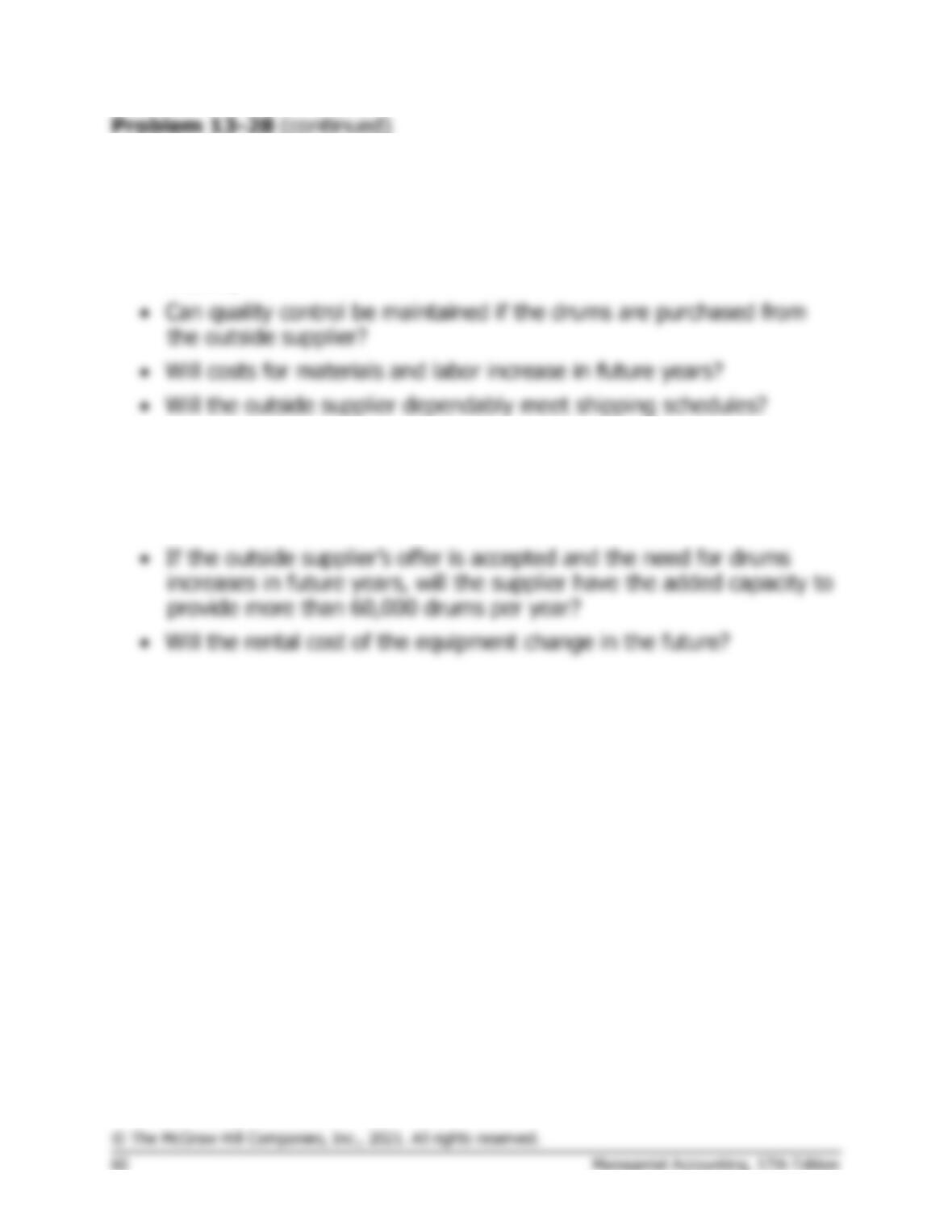
3. The financial (disadvantage) of accepting the supplier’s offer is
computed as follows:
Make
Buy
Cost of purchasing (100,000 units × $18 per unit) ..
$1,800,000
Direct materials (100,000 units × $10.35 per unit) .
$1,035,000
Direct labor (100,000 units × $4.27 per unit) ………
Variable manufacturing overhead
Supervision ………………………………………………….
Rent …………………………………………………………..
Total costs ……………………………………………………
The company should rent the new equipment and make the drums if
90,000 units per year are needed.
4. Other factors that the company should consider include:
• Will volume in future years increase, or will it remain constant at
60,000 units per year? (If volume increases, then renting the new
equipment becomes more desirable, as shown in the computations
above.)
• Can the company begin making the drums again if the supplier
proves to be undependable? Are there alternative suppliers?
• What is the labor outlook in the supplier’s industry (e.g., are frequent
labor strikes likely)?