395
CHAPTER 13
BUDGETING AND STANDARD COST SYSTEMS
CLASS DISCUSSION QUESTIONS
1. The three major objectives of budgeting are
(1) to establish specific goals for future oper-
ations, (2) to direct and coordinate plans to
achieve the goals, and (3) to periodically
compare actual results with the goals.
4. Budgeting more resources for travel than
requested by department personnel is an ex-
ample of budgetary slack.
5. A budget that is set too loosely may fail to moti–
vate managers and employees to perform effi–
ciently. In addition, a loose budget may cause a
“spend it or lose it” mentality, where excess
budget resources are spent in order to protect
the budget from future reductions.
8. A static budget is most appropriate in situations
where costs are not variable to an underlying
activity level. As a result, it is reasonable to
plan spending on the basis of a fixed quantity
of resources for the year. This will occur in
some administrative functions, such as human
resources, accounting, or public relations.
budget preparation when large quantities of
data need to be processed. In addition, by
using computerized simulation models, man-
agement can determine the impact of various
operating alternatives on the master budget.
100% of planned production, with no idle
time or overtime, and there should be neither
excessive inventories nor inventories insuffi-
cient to fill sales orders.
12. Purchases of direct materials should be
closely coordinated with the production bud-
get so that inventory levels can be main-
tained within reasonable limits.
13. Direct materials purchases budget, direct
curities or used to reduce loans.
15. The schedule of collections from sales is
used to determine the amount of cash col-
lected from current- and prior-period sales,
based on collection history. The schedule is
used to help determine the estimated cash
receipts portion of the cash budget.
396
17. Standard costs assist in controlling costs
and in motivating managers and employees
to focus on costs.
19. Reporting by the “principle of exceptions” is
the reporting of only variances (or “excep-
tions”) between standard and actual costs to
the individual responsible for cost control.
20. There is no set time period for the revision
of standards. They should be revised when
prices, product design, labor rates, and
manufacturing methods change to such an
extent that current standards no longer rep-
resent a useful measure of performance.
22. a. The two variances in direct materials
cost are:
(1) Price
(2) Quantity
b. The price variance is the result of a
difference between the actual price and
the standard price. It may be caused by
such factors as a change in market pric-
23. The offsetting variances might have been
caused by the purchase of low-priced, infe-
rior materials. The low price of the materials
24. a. The two variances in direct labor costs
are:
(1) Rate
(2) Time
b. The direct labor cost variance is usually
under the control of the production su-
pervisor.
25. No. Even though the assembly workers are
covered by union contracts, direct labor cost
service operations. Fast-food restaurants can
use standards for evaluating the productivity of
the counter and food preparation employees.
In addition, standards could be used to plan
staffing patterns around various times of the
day (e.g., increasing staff during the lunch
hour).
27. Nonfinancial performance measures provide
managers additional measures beyond the
397
EXERCISES
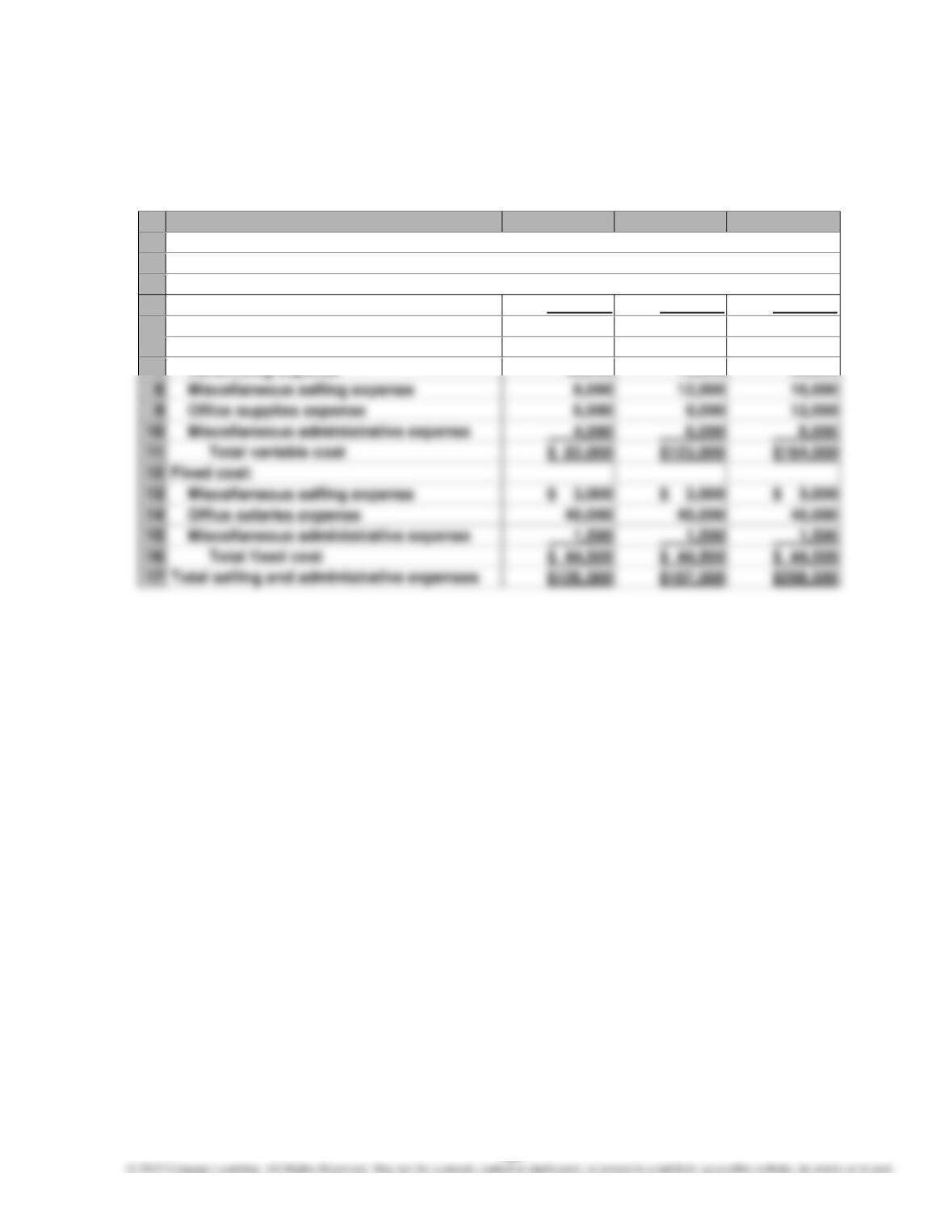
E13–1
A
B
C
D
1
HOMEPORT
2
Flexible Selling and Administrative Expenses Budget
3
For the Month Ending March 31
4
Total sales
$400,000
$600,000
$800,000
5
Variable cost:
6
Sales commissions
$ 16,000
$ 24,000
$ 32,000
7
Advertising expense
48,000
72,000
96,000
8
Miscellaneous selling expense
8,000
9
Office supplies expense
6,000
Miscellaneous administrative expense
Total variable cost
$123,000
$164,000
Fixed cost:
Miscellaneous selling expense
$ 3,000
$ 3,000
Office salaries expense
40,000
40,000
40,000
Miscellaneous administrative expense
Total fixed cost
$ 44,500
$ 44,500
Total selling and administrative expenses
$126,500
$167,500
$208,500
398
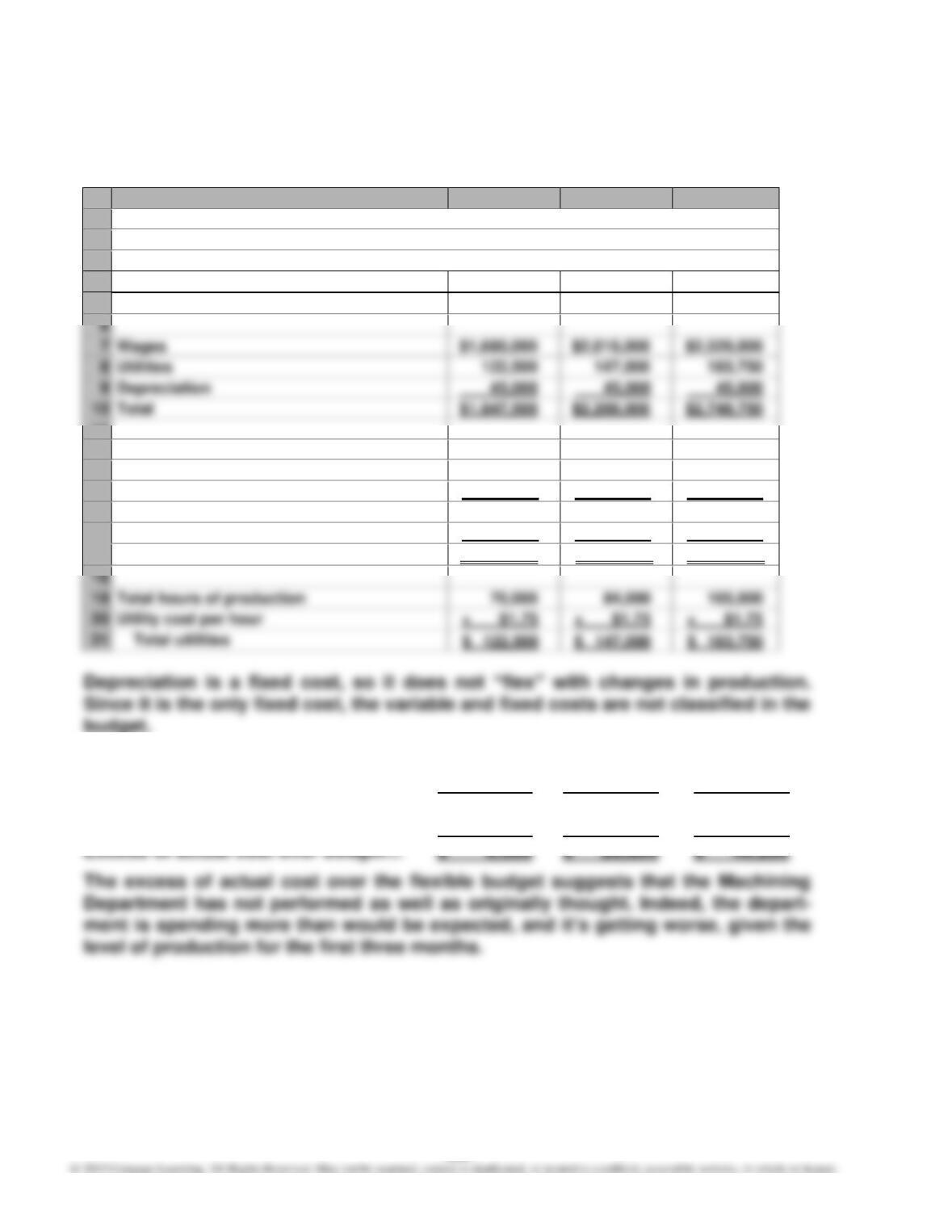
E13–2
a.
A
B
C
D
1
PAULK COMPANY—MACHINING DEPARTMENT
2
Flexible Production Budget
3
For the Three Months Ending March 31
4
January
February
March
5
Units of production
50,000
60,000
75,000
6
7
Wages
$1,680,000
$2,016,000
$2,520,000
9
Depreciation
45,000
45,000
10
Total
11
12
Supporting calculations:
13
Units of production
50,000
60,000
75,000
14
Hours per unit
× 1.4
× 1.4
× 1.4
15
Total hours of production
70,000
84,000
105,000
16
Wages per hour
× $24
× $24
× $24
17
Total wages
$1,680,000
$2,016,000
$2,520,000
18
19
Total hours of production
84,000
20
Utility cost per hour
× $1.75
× $1.75
× $1.75
21
Total utilities
b.
January February March
Total actual cost ………………………….. $ 1,854,000 $ 2,236,800 $ 2,798,000
Total flexible budget …………………….. 1,847,500 2,208,000 2,748,750
399
E13–3
A
B
C
D
1
STEELCASE INC.—FABRICATION DEPARTMENT
2
Flexible Production Budget
3
May
4
(Assumed Data)
5
Units of production
20,000
25,000
30,000
6
7
Variable cost:
8
Direct labor
9
Direct materials
10
Total variable cost
$438,000
$ 547,500
$ 657,000
11
12
Fixed cost:
13
Supervisor salaries
$ 175,000
$ 175,000
$ 175,000
14
Depreciation
18,000
18,000
18,000
15
Total fixed cost
$ 193,000
$ 193,000
$ 193,000
16
Total department cost
$ 631,000
$ 740,500
$ 850,000
17
18
19
21
22
23
400
E13–4
a.
A
B
C
D
1
SURROUND AUDIO COMPANY
2
Sales Budget
3
For the Month Ending April 30
4
Product and Area
Unit Sales
Volume
Unit Selling
Price
Total Sales
5
Model SJ30:
6
East Region
7,000
$ 80
$ 560,000
7
West Region
9,000
80
720,000
9
Model SX99:
East Region
$200
$ 600,000
West Region
800,000
b.
A
B
C
1
SURROUND AUDIO COMPANY
2
Production Budget
3
For the Month Ending April 30
4
Units
5
Model SJ30
Model SX99
6
Expected units to be sold
7
Plus desired inventory, April 30
8
Total
401
E13–5
A
B
C
D
1
SALAZAR & CRENSHAW, CPAs
2
Professional Fees Earned Budget
3
For the Year Ending July 31, 20Y6
4
Billable
Hourly
Total
Hours
Rate
Revenue
5
Audit Department:
6
Staff
40,000
$150
$ 6,000,000
7
Partners
6,000
350
2,100,000
8
Total
46,000
$ 8,100,000
9
Tax Department:
Staff
$150
$ 4,500,000
Partners
4,500
350
1,575,000
Total
34,500
$ 6,075,000
Small Business Accounting Department:
Staff
$150
$ 1,200,000
Partners
350
630,000
Total
9,800
$ 1,830.000
Total professional fees earned
E13–6
A
B
C
1
SALAZAR & CRENSHAW, CPAs
2
Professional Labor Cost Budget
3
For the Year Ending July 31, 20Y6
4
Staff
Partners
5
Audit Department
40,000
6,000
6
Tax Department
30,000
4,500
7
Small Business Accounting Department
78,000
12,300
E13–7
A
B
C
D
E
1
GINO’S FROZEN PIZZA INC.
2
Direct Materials Purchases Budget
3
For the Month Ending June 30
4
Dough
Tomato
Cheese
Total
Units required for production:
Plus desired inventory,
June 30
Total
49,000
10
Less estimated inventory,
June 1
11
Total units to be purchased
45,000
31,700
44,400
12
Unit price
× $0.90
× $1.20
× $3.00
13
Total direct materials to be
purchased
$40,500
$38,040
$133,200
$211,740
14
20
403
E13–8
A
B
C
D
1
COCA-COLA ENTERPRISES—DALLAS PLANT
2
Direct Materials Purchases Budget
3
For the Month Ending October 31
4
(Assumed Data)
5
Concentrate
2-Liter Bottles
Carbonated Water
6
Materials required for production:
7
Coke®
6,000* lbs.
1,500,000 btls.
3,000,000 ltrs.
8
Sprite®
2,400*
800,000
1,600,000
9
Total materials
8,400 lbs.
2,300,000 btls.
4,600,000 ltrs.
Direct materials unit price
× $75
× $0.04
× $0.03
E13–9
A
B
C
1
ISNER RACKET COMPANY
2
Direct Labor Cost Budget
3
For the Month Ending August 31
4
Forming
Assembly
Department
Department
5
Hours required for production:
6
Ace1
3,000
4,800
7
Pro Tour2
1,500
3,500
4,500
0.70 hr. × 5,000 = 3,500 hrs.
E13–10
a.
A
B
C
1
LEVI STRAUSS & CO.
2
Production Budget
3
February
4
(Assumed Data)
5
Dockers®
501 Jeans®
6
Expected units to be sold
62,500
48,000
Plus February 28 desired inventory
8
Total units
67,500
50,500
Less February 1 estimated inventory
_2,000
10
Total units to be produced
63,000
48,500
b.
A
B
C
D
E
F
1
LEVI STRAUSS & CO.
2
Direct Labor Cost Budget
3
February
4
(Assumed Data)
6
63,000
75,600
37,800
50,400
7
58,200
43,650
29,100
14,550
8
Total minutes
66,900
64,950
2,020.0
1,987.5
10
× Direct labor rate
× $14
× $14
× $18
× $18
11
Total direct labor cost
$ 28,280
$ 27,825
$20,070
12
13
1(63,000 ÷ 10 pairs) × 10 min. = 63,000 min.
14
(63,000 ÷ 10 pairs) × 12 min. = 75,600 min.
15
(63,000 ÷ 10 pairs) × 6 min. = 37,800 min.
16
(63,000 ÷ 10 pairs) × 8 min. = 50,400 min.
17
2(48,500 ÷ 10 pairs) × 12 min. = 58,200 min.
18
(48,500 ÷ 10 pairs) × 9 min. = 43,650 min.
19
(48,500 ÷ 10 pairs) × 6 min. = 29,100 min.
20
(48,500 ÷ 10 pairs) × 3 min. = 14,550 min.
405
E13–11
A
B
C
1
MICKEY’S CANDY COMPANY
2
Factory Overhead Cost Budget
3
For the Month Ending November 30
4
Variable factory overhead costs:
5
Manufacturing supplies
$ 8,000
6
Power and light
36,000
7
Production supervisor wages
145,000
8
Production control salaries
40,000
Total variable factory overhead costs
Fixed factory overhead costs:
Factory insurance
$ 42,000
Factory depreciation
88,000
Total fixed factory overhead costs
130,000
Total factory overhead costs
406
E13–12
A
B
C
D
1
PUEBLO CERAMICS INC.
2
Cost of Goods Sold Budget
3
For the Month Ending April 30
4
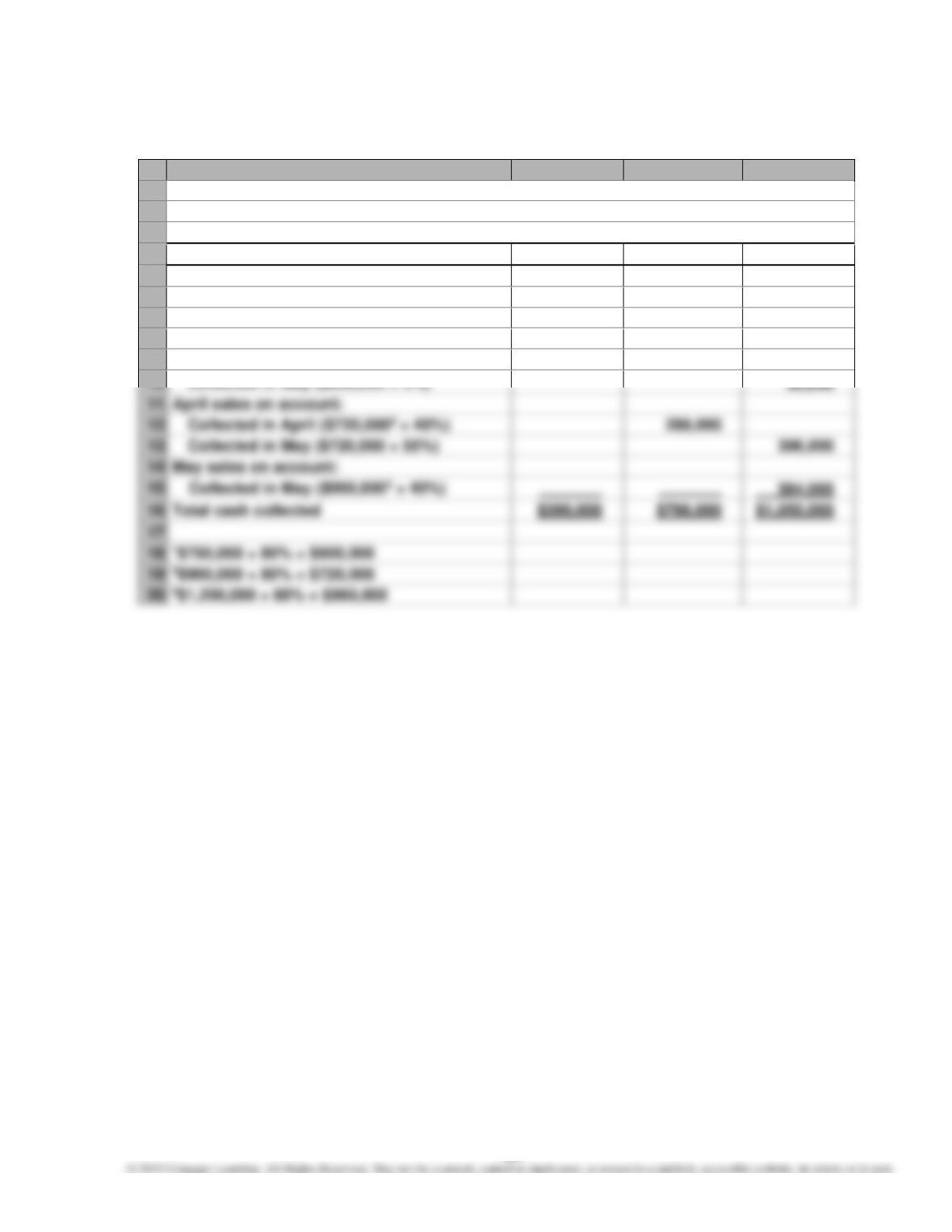
Finished goods inventory, April 1
$ 10,000
5
$ 11,400
6
7
$ 13,000
8
181,000
$194,000
10
15,000
11
production
$179,000
12
Direct labor
200,000
13
Factory overhead
107,000
14
Total manufacturing costs
486,000
15
Total work in process during the period
$497,400
16
9,500
17
Cost of goods manufactured
487,900
18
Cost of finished goods available for sale
$497,900
19
Less finished goods inventory,
Less work in process inventory,
407
E13–13
A
B
C
D
1
FIDO & LUCY WHOLESALE INC.
2
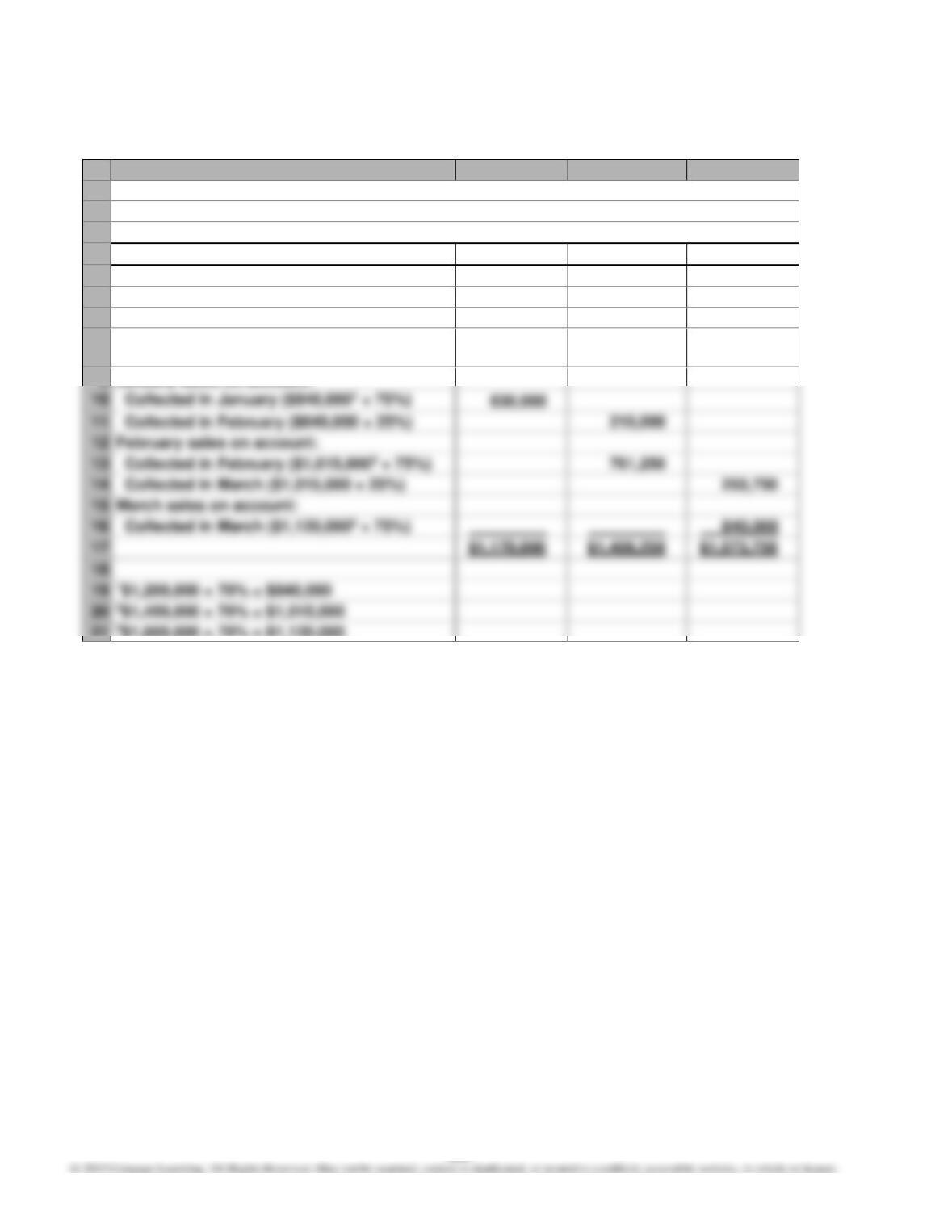
Schedule of Collections from Sales
3
For the Three Months Ending May 31
4
March
April
May
5
Receipts from cash sales:
6
Cash sales (20% × current month’s sales)
$150,000
$180,000
$ 240,000
7
March sales on account:
8
Collected in March ($600,0001 × 40%)
240,000
9
Collected in April ($600,000 × 55%)
330,000
10
Collected in May ($600,000 × 5%)
April sales on account:
Collected in April ($720,0002 × 40%)
Collected in May ($720,000 × 55%)
May sales on account:
1$750,000 × 80% = $600,000
2$900,000 × 80% = $720,000
3$1,200,000 × 80% = $960,000
408
E13–14
A
B
C
D
1
INNOVATIVE OFFICE INC.
2
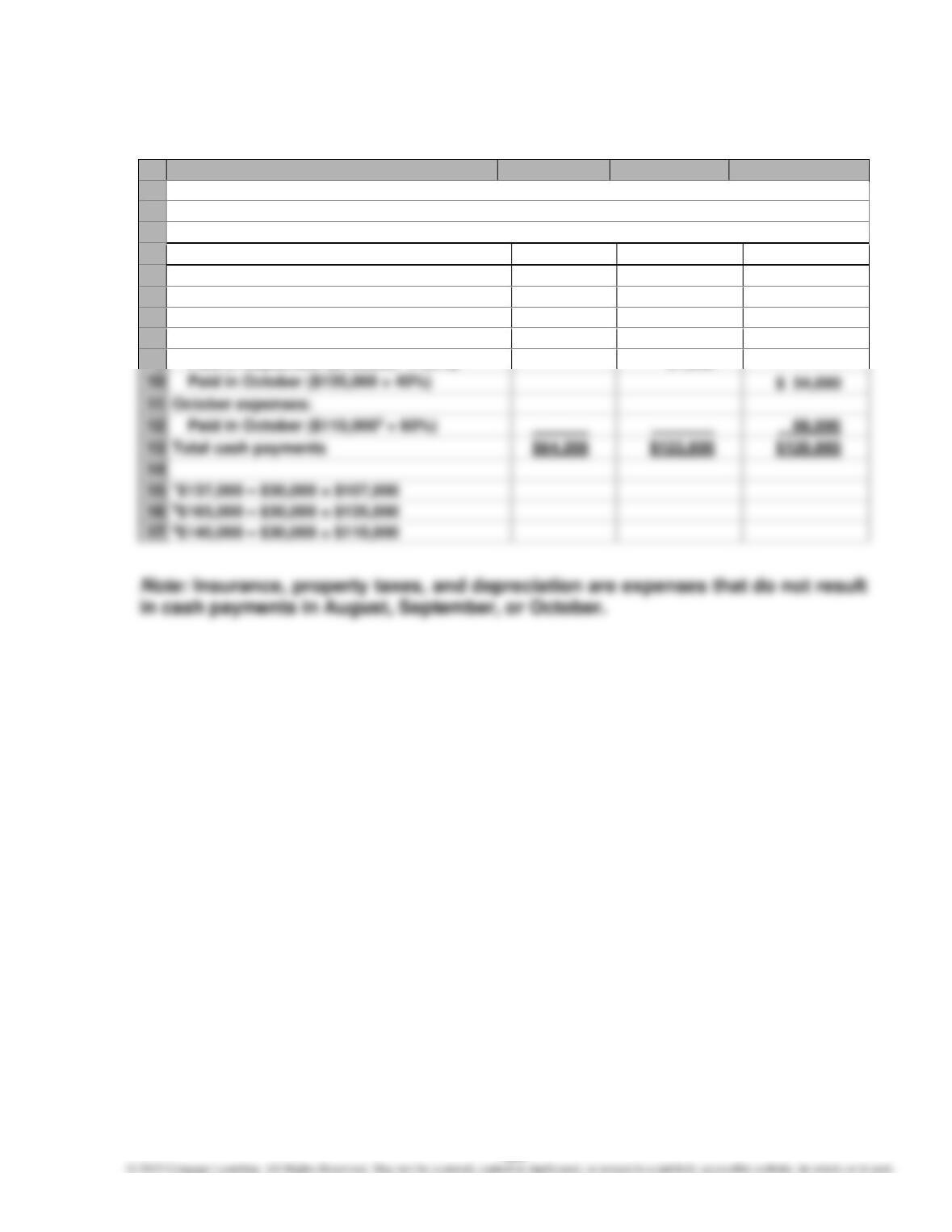
Schedule of Collections from Sales
3
For the Three Months Ending March 31, 20Y4
4
January
February
March
5
Receipts from cash sales:
6
Cash sales (30% × current month’s sales)
$ 360,000
$ 435,000
$ 480,000
7
December sales on account:
8
Collected in January (Accounts
Receivable balance)
180,000
9
January sales on account:
11
12
February sales on account:
13
14
15
March sales on account:
16
840,000
18
19
1$1,200,000 × 70% = $840,000
20
2$1,450,000 × 70% = $1,015,000
21
3$1,600,000 × 70% = $1,120,000
409
E13–15
A
B
C
D
1
PEANUT LEARNING SYSTEMS INC.
2
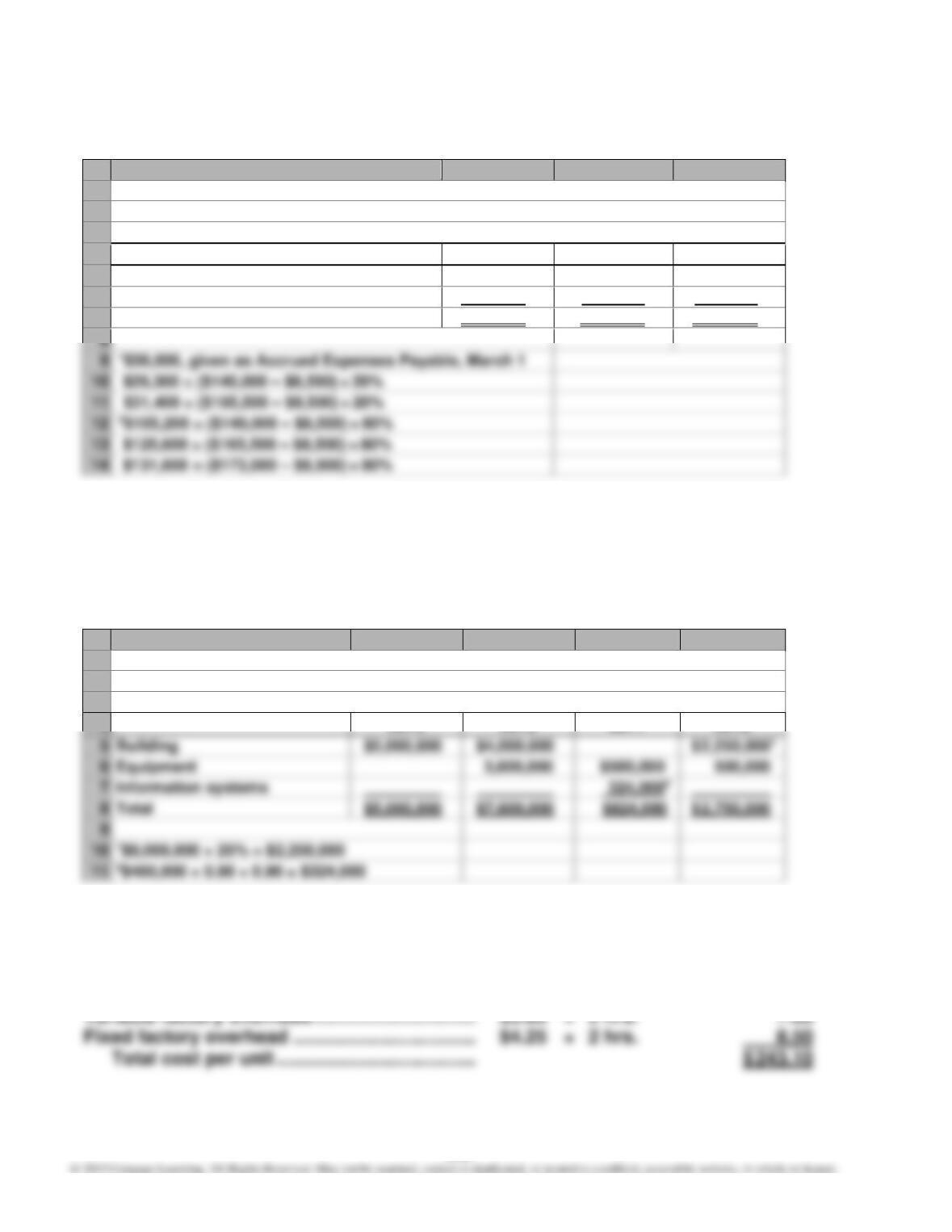
Schedule of Cash Payments for Selling and Administrative Expenses
3
For the Three Months Ending October 31, 20Y7
4
August
September
October
5
August expenses:
6
Paid in August ($107,0001 × 60%)
$64,200
7
Paid in September ($107,000 × 40%)
$ 42,800
8
September expenses:
9
Paid in September ($135,0002 × 60%)
81,000
$ 54,000
October expenses:
1$137,000 – $30,000 = $107,000
2$165,000 – $30,000 = $135,000
3$140,000 – $30,000 = $110,000
410
E13–16
A
B
C
D
1
REHAB PHYSICAL THERAPY INC.
2
Schedule of Cash Payments for Operations
3
For the Three Months Ending May 31
4
March
April
May
5
Payment of prior month’s expense1
$ 36,000
$ 26,300
$ 31,400
6
Payment of current month’s expense2
105,200
125,600
131,600
7
Total payment
$141,200
$151,900
$163,000
8
9
1$36,000, given as Accrued Expenses Payable, March 1
$26,300 = ($140,000 – $8,500) × 20%
$31,400 = ($165,500 – $8,500) × 20%
$125,600 = ($165,500 – $8,500) × 80%
$131,600 = ($173,000 – $8,500) × 80%
Note: Insurance and depreciation are expenses that do not result in cash pay-
ments in March, April, and May.
E13–17
A
B
C
D
E
1
HANDY DAN TOOLS INC.
2
Capital Expenditures Budget
3
For the Four Years Ending December 31, 20Y5–20Y8
4
20Y5
20Y6
20Y7
20Y8
5
Building
$5,000,000
$4,000,000
$ 2,250,0001
6
Equipment
3,600,000
$500,000
500,000
7
Information systems
324,0002
8
Total
$5,000,000
$7,600,000
$824,000
$ 2,750,000
9
1$9,000,000 × 25% = $2,250,000
E13–18
Direct labor ………………………………………………. $21.00 × 2 hrs. $ 42.00
Direct materials ………………………………………… $9.25 × 20 bd. ft. 185.00
411
E13–19
a.
A
B
1
MCALISTERS BOTTLE COMPANY
2
Manufacturing Cost Budget
3
For the Month Ended May 31
6
Direct labor
7
Direct materials
Factory overhead
Total
10
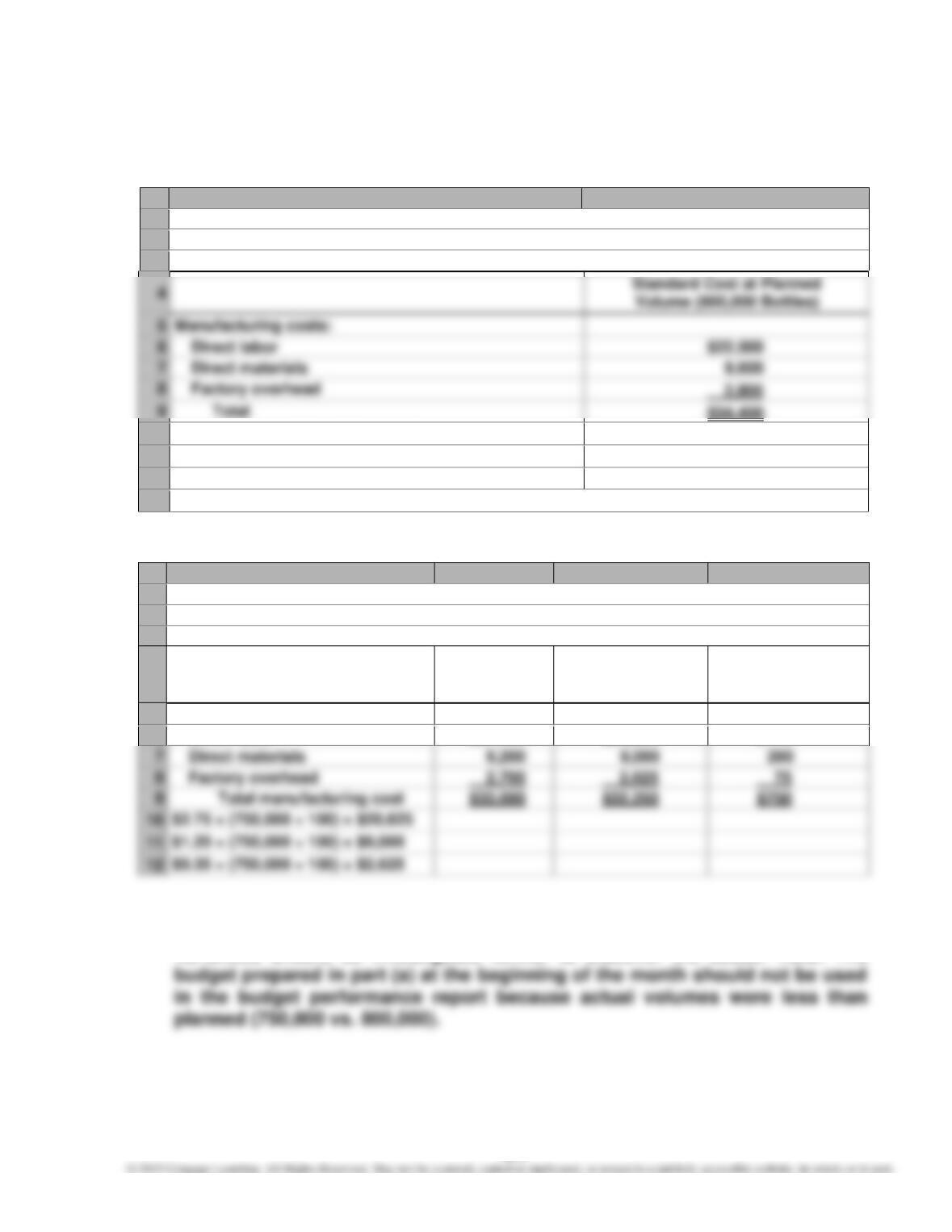
$2.75 × (800,000 ÷ 100) = $22,000
11
$1.20 × (800,000 ÷ 100) = $9,600
12
$0.35 × (800,000 ÷ 100) = $2,800
13
Note: The cost standards are expressed as “per 100 bottles.”
b.
A
B
C
D
1
MCALISTERS BOTTLE COMPANY
2
Manufacturing Costs—Budget Performance Report
3
For the Month Ended May 31
4
Actual
Costs
Standard Cost at
Actual Volume
(750,000 bottles)
Cost Variance—
Unfavorable
(Favorable)
5
Manufacturing costs:
6
Direct labor
$21,100
$20,625
$ 475
7
8
Factory overhead
9
Total manufacturing cost
$33,000
$2.75 × (750,000 ÷ 100) = $20,625
$1.20 × (750,000 ÷ 100) = $9,000
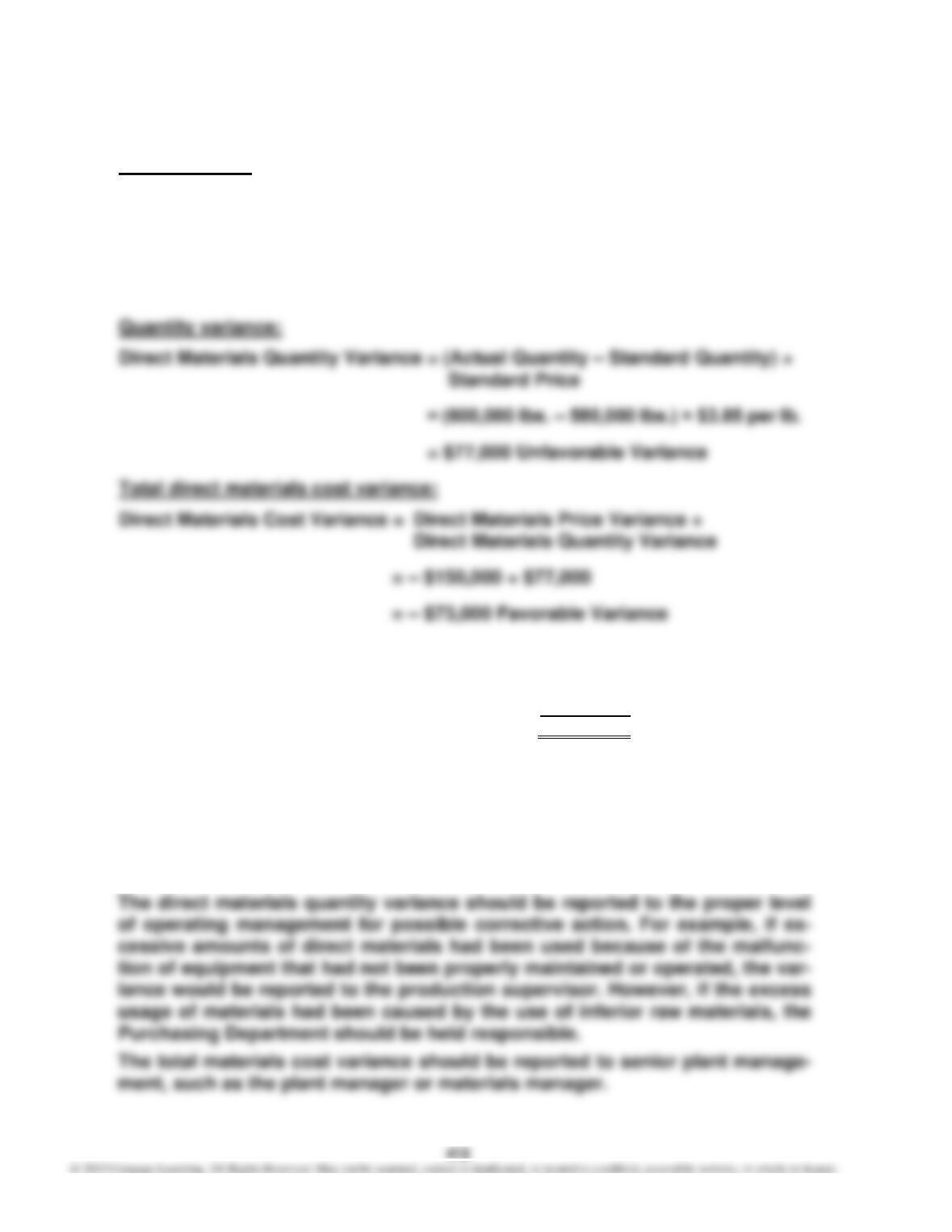
c. McAlisters Bottle’s actual costs were $750 more than budgeted. The largest
unfavorable variance of $475 was related to direct labor. The unfavorable
variances should be investigated further to discover the cause. Note: The
E13–20
a. Price variance:
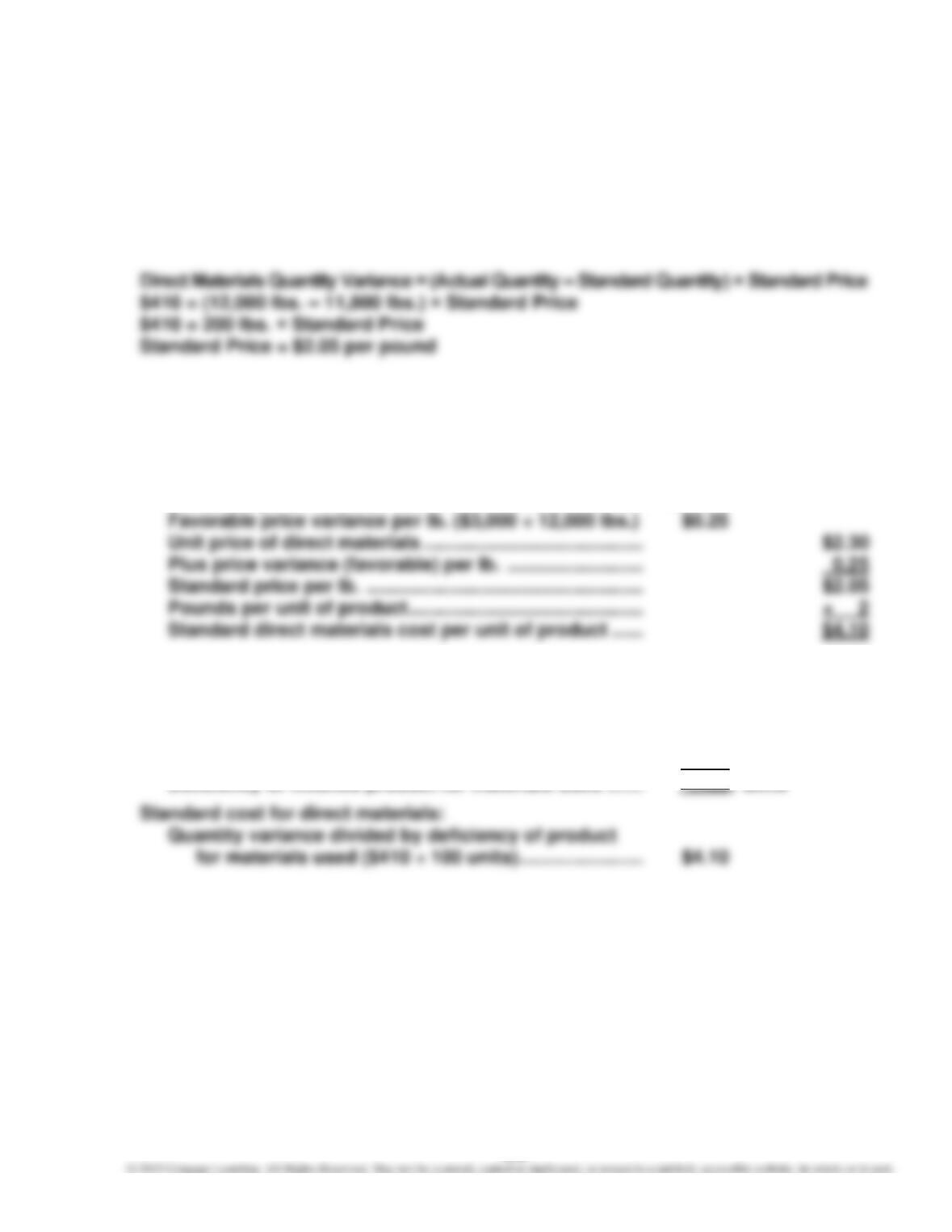
Direct Materials Price Variance = (Actual Price – Standard Price) ×
Actual Quantity
= ($3.60 per lb. – $3.85 per lb.) × 600,000 lbs.
= – $150,000 Favorable Variance
Also computed as:
Actual total direct materials cost ……………. $2,160,000
Less standard total direct materials cost … 2,233,000
Total direct materials cost variance …….. –$ 73,000 Favorable Variance
b. The direct materials price variance should normally be reported to the Pur-
chasing Department, which may or may not be able to control this variance. If
materials of the same quality were purchased from another supplier at a price
lower than the standard price, the variance was controllable. However, if the
variance resulted from a market-wide price decrease, the variance was not
subject to control.
413
E13–21
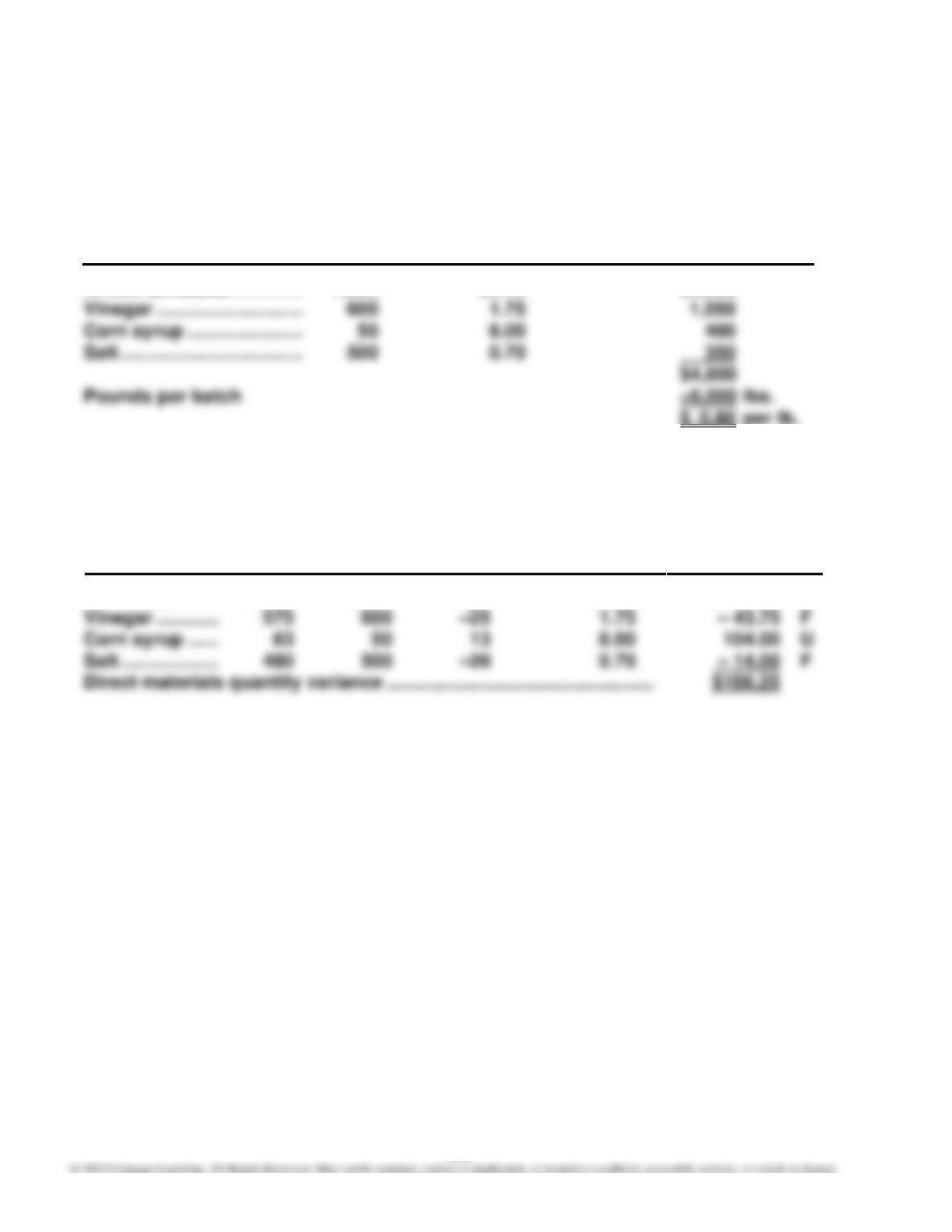
Standard direct materials for units produced (5,900 units × 2 lbs.) …… 11,800 lbs.
Using the equation for direct materials quantity variance, solve for the standard
direct materials price per pound.
Standard Price per Unit of Product = $2.05 × 2 lbs. per unit = $4.10
Alternate Solution One:
Materials used ………………………………………………………... 12,000 lbs.
Favorable price variance ………………………………………… $3,000
Alternate Solution Two:
Product finished ……………………………………………………….…. 5,900 units
Standard finished product for direct materials used
(12,000 lbs. ÷ 2 lbs.) ………………………………………………… 6,000
Deficiency of finished product for materials used ……. (100) units
414
E13–22
a.
Standard Standard Standard Cost
Quantity × Price = per Batch
Whole tomatoes ………….. 7,500 $0.40 $3,000
b.
Actual
Quantity
for Batch
H3001
Standard
Quantity
per
Batch
Quantity
Difference
×
Standard
Price
=
Materials
Quantity
Variance
Tomatoes ………
7,850
7,500
350
$0.40
$ 140.00
U
Vinegar …………
–25
1.75
– 43.75
F
Corn syrup ……
8.00
104.00
U
Salt ……………….
–20
0.70
F
Direct materials quantity variance ……………………………………………