
Chapter 13 Corporations: Organization, Stock Transactions, and Dividends 227
Cash Dividends Stock Dividends
Bal. 12,000 Bal. 8,000
Clos. 12,000 Clos. 8,000
OBJECTIVE 5
Describe and illustrate the accounting for treasury stock transactions.
KEY TERMS
Treasury Stock
SUGGESTED APPROACH
The term “treasury stock” originated because the treasurer’s office of a corporation usually has the
responsibility for purchasing and maintaining custody of such stock. The text presents the cost method of
accounting for treasury stock. The par value method is mentioned only in a footnote. The following
Demonstration Problem presents sample entries that you can review with your class.
You will want to stress that the treasury stock account is a contra equity account, reducing shareholders’
equity for the amount returned to shareholders through the purchase of treasury stock. Many students are
under the false impression that treasury stock is an asset, because it has a debit balance. Point out that a
corporation does not (1) pay dividends on treasury stock, (2) vote treasury stock, or (3) recognize gains or
DEMONSTRATION PROBLEM — Entries for Treasury Stock
Record the following entries for Lawry Corporation:
Lawry purchased 1,000 shares of $5 par value common stock for $10 per share.
Treasury Stock…………………………………….. 10,000
Cash……………………………………….. 10,000
228 Chapter 13 Corporations: Organization, Stock Transactions, and Dividends
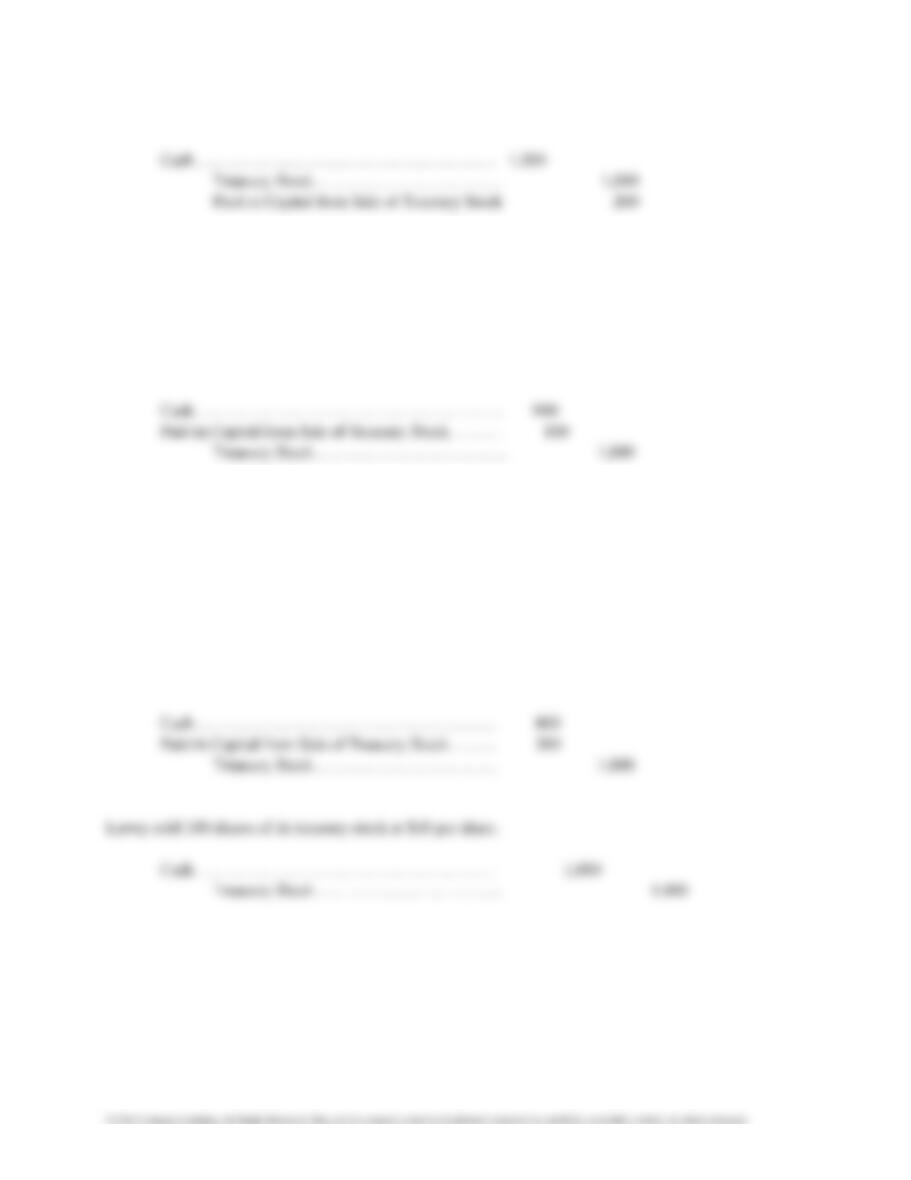
Lawry sold 100 shares of its treasury stock at $12 per share.
Emphasize that paid-in capital from the sale of treasury stock is not reported on the income statement. A
corporation cannot report a gain as the result of buying and selling its own stock. This would encourage
insider trading. Paid-in capital from treasury stock is reported as an increase in stockholders’ equity.
When purchasers of treasury stock pay more than the cost of the stock, they have contributed additional
capital to the corporation.
Lawry sold 100 shares of its treasury stock at $9 per share.
After demonstrating these entries, ask your students to record the following three transactions in their
notes:
Lawry sold 100 shares of its treasury stock at $14 per share.
Cash……………………………………………….. 1,400
Treasury Stock……………………………. 1,000
Paid-in Capital from Sale of Treasury Stock 400
Lawry sold 100 shares of its treasury stock at $8 per share.
WRITING EXERCISE — Treasury Stock
Ask your students to respond to the following (TM 13-8):
Name and explain two reasons that a corporation might choose to repurchase its own
stock.

Answers are found on TM 13-7.
OBJECTIVE 6
Describe and illustrate the reporting of stockholders’ equity.
KEY TERMS
Prior Period Adjustments Retained Earnings Statement
Restrictions Statement of Stockholders’ Equity
SUGGESTED APPROACH
This objective covers paid-in capital, retained earnings, and treasury stock on the balance sheet. It also
illustrates the retained earnings statement, describes restrictions on retained earnings, and describes prior
period adjustments. Lecture Aids to cover each of these items are discussed below.
LECTURE AID — Paid-in Capital on the Balance Sheet
Paid-in capital and retained earnings are the two major sources of stockholders’ equity; therefore, they are
the two major sections on a corporation’s balance sheet.
You will probably need to remind your students that paid-in capital consists of the following accounts:
Preferred Stock
Paid-in Capital in Excess of Par—Preferred Stock
Common Stock
Paid-in Capital in Excess of Par—Common Stock
Paid-in Capital from Treasury Stock
TM 13-11 lists the stockholders’ equity accounts that are reported in the paid-in capital section of the
balance sheet.
Refer your students to Exhibit 4 in the text to see two examples of how these accounts are reported. Stress
that the second format for Stockholder’s Equity summarizes all of the paid-in capital accounts as one
total, labeled “Additional Paid–in Capital.”
230 Chapter 13 Corporations: Organization, Stock Transactions, and Dividends
DEMONSTRATION PROBLEM — Retained Earnings Statement
Begin by reviewing the concept of retained earnings. Retained earnings are profits that have been kept
(retained) by a corporation. They are profits that have not been returned to shareholders through
dividends. Therefore, retained earnings are increased by a corporation’s net income and reduced by
dividends declared.
Ask your students to compute the retained earnings balance at the end of the year for Parks Corporation,
based on the following data:
Retained Earnings, Jan. 1 $ 50,000
LECTURE AID — Restrictions on Retained Earnings
Many students have the following misconception: Restricting retained earnings sets aside cash for a
specific purpose. You must work to dispel the notion that restricting retained earnings affects a
corporation’s cash.
Use the following story to introduce the concept of restricted retained earnings:
Let’s say that you have decided to treat yourself to a nice lunch off campus today. You have $30 in your
Chapter 13 Corporations: Organization, Stock Transactions, and Dividends 231
WRITING EXERCISE — Restriction of Retained Earnings
Ask your students to write a response to the following question (TM 13-13):
Technograph Corporation discovered that some hazardous material was buried on a parcel of land
currently owned by the corporation. A former owner of the property buried the material. It will cost
Technograph $1 million to remove the material and dispose of it properly.
DEMONSTRATION PROBLEM — Prior–Period Adjustments
When an error in a prior year’s net income is discovered, it is reported as a prior-period adjustment. Prior-
period adjustments are shown on the retained earnings statement as a correction to the beginning balance
of retained earnings.
The text does not illustrate a retained earnings statement with a prior-period adjustment. The following
example will help you give a brief practical example of this concept:
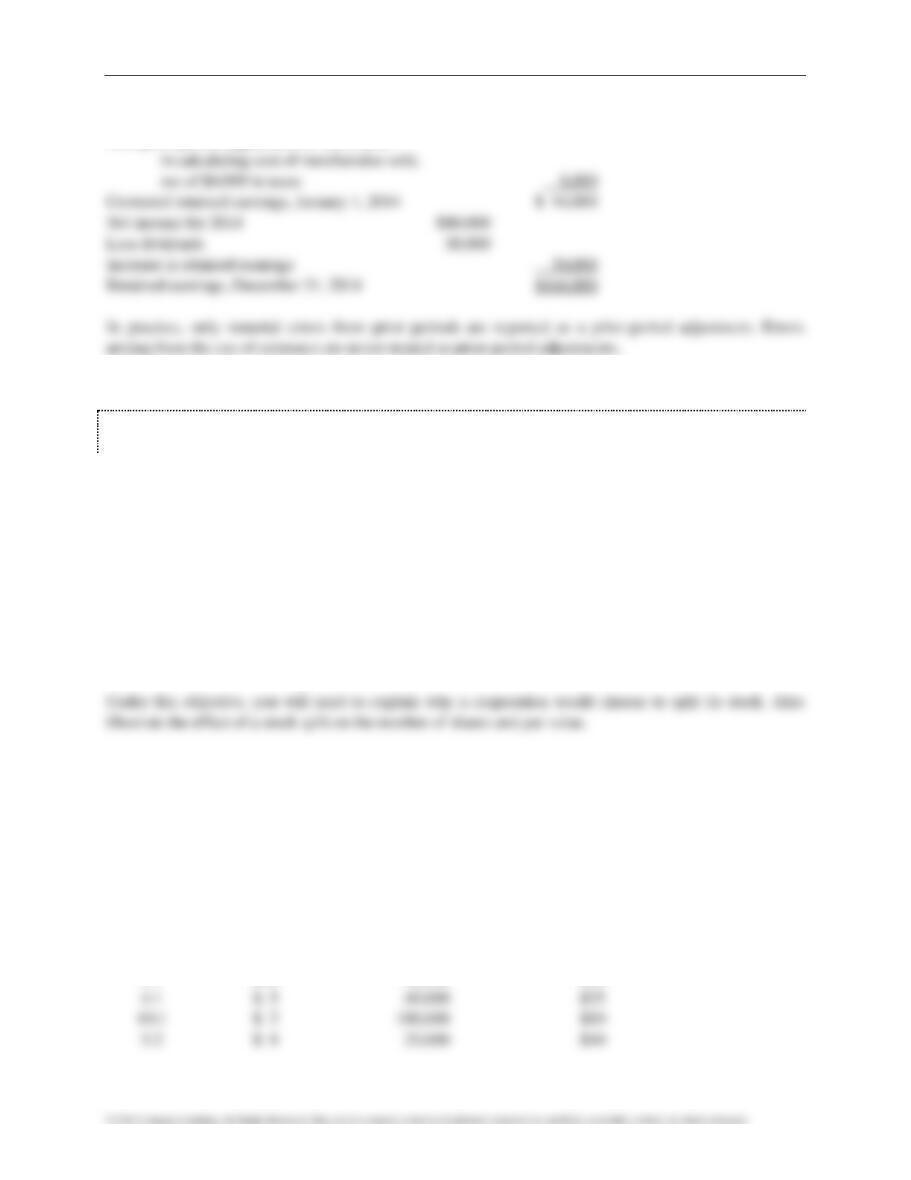
At the end of 2014, E & M Corporation discovered that several errors were made in the physical
inventory count taken at the end of 2013. As a result, the cost of merchandise sold was understated by
$10,000 in 2013, causing income before taxes to be overstated by the same amount. E & M reported
$100,000 in retained earnings on December 31, 2013.
E & M made $80,000 of net income after taxes in 2014. The company declared $30,000 in dividends. E &
M’s tax rate is 40 percent.
E & M Corporation
Retained Earnings Statement
For the Year Ended December 31, 2014
232 Chapter 13 Corporations: Organization, Stock Transactions, and Dividends
Retained earnings, January 1, 2014 $100,000
Less prior-period adjustment for 2013 error
OBJECTIVE 7
Describe the effect of stock splits on corporate financial statements.
KEY TERM
Stock Split
SUGGESTED APPROACH
With a stock split, one share of stock is split into two or more shares. When this occurs, the par value of
the stock decreases, and the number of shares increases. The market value of the stock should also fall.
DEMONSTRATION PROBLEM — Stock Splits
Bravara Corporation has 10,000 shares of $20 par-value common stock selling at $100 per share.
Determine the new number of shares, par value, and market price under each of the following
independent assumptions.
“Theoretical” New
New Par Value
New No. of shares
Market Price
(Current Par
(Current No. of
(Current Market
Split
Value = $20)
shares = 10,000)
Price = $100)
2:1
$10
20,000
$50
4:1
$ 5
40,000
$25
$ 2
$10

Chapter 13 Corporations: Organization, Stock Transactions, and Dividends 233
The new market price is what the stock should sell for in theory after the stock split. However, many
factors other than the split may affect the price of the stock. For example, favorable news about the
economy may keep the price of the stock from dropping as low as it should.
INTERNET ACTIVITY — Stock Splits
Since stock splits create excitement in the stock market, many investors track which companies have
announced stock splits. The following Web site provides a “Stock Split Calendar.”
http://investing.money.msn.com/investments/calendar/stock-splits
Have your students visit this site or perform a search on “stock splits” for more information.
WRITING EXERCISE — Stock Splits
Ask your students to answer the following question (TM 13-9):
Why would a company choose to split its stock?
Possible response: Stock splits tend to be very good for shareholders. The split will lower the price,
OBJECTIVE 8
Describe and illustrate the use of earnings per share in evaluating a company’s profitability.
KEY TERM
Earnings per Common Share (EPS)

234 Chapter 13 Corporations: Organization, Stock Transactions, and Dividends
SUGGESTED APPROACH
Explain the significance of earnings per share data and present the formula for basic earnings per share.
LECTURE AID — Earnings per Share
Assume that two couples residing in the same city each have combined incomes of $70,000. Would you
expect both couples to have about the same lifestyle? If you knew that one of those couples had no
children and the other couple had seven children, would you still expect both couples to have the same
lifestyle? In this case, the per-person income of the two families is dramatically different.
Couple A—No Children Couple B—Seven Children
Earnings per person =
$70,000 $35,000
2
=
Earnings per person =
$70,000 $7,778
9
=
This same concept can be applied to corporations. Assume that two corporations both made $100,000 of
net income last year. Corporation A has 1,000 shares of stock, and Corporation B has 100,000 shares.
Would you rather have a share of stock in Corporation A or B? Corporation A has more income for each
share of stock.
Corporation A Corporation B
Earnings per share =
$100,000 $100
1,000
=
Earnings per share =
$100,000 $1
100,000
=
GROUP LEARNING ACTIVITY — Earnings per Share
Ask your class to work end of chapter practice exercise 13-8A or 13-8B to calculate and report earnings-
per-share data.
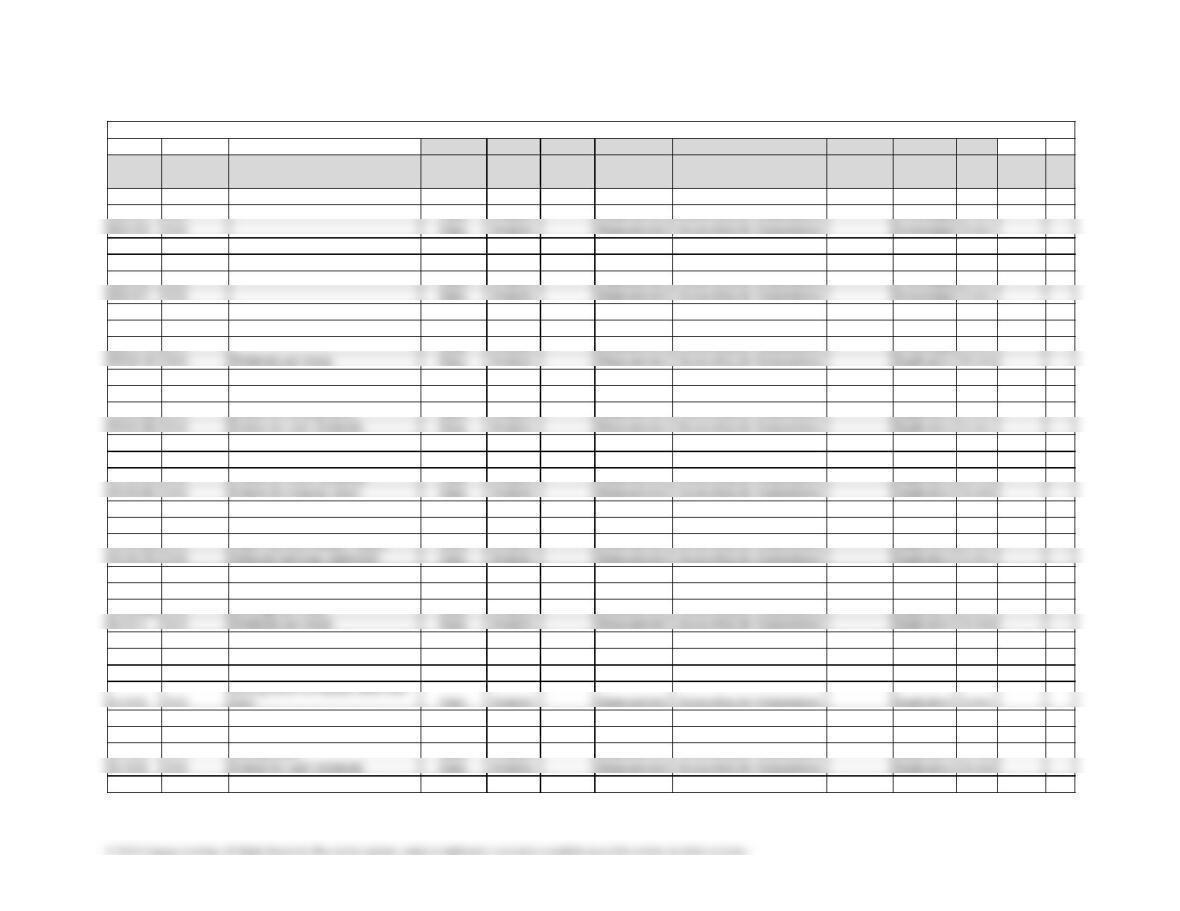
DIFFICULTY BUSPROG AICPA AICPA ACBSP ACBSP BLOOM’S TIME
Problem
Learning
Objective
Description Primary
Broad
Business
Functional Primary Secondary
Spread-
sheet
GL
DQ13-1 13-3 Easy Analytic Measurement Accounting for Corporations Knowledge 5 min
DQ13-2 13-3 Easy Analytic Measurement Accounting for Corporations Knowledge 5 min
DQ13-3 13-4 Easy Analytic Measurement Accounting for Corporations Knowledge 5 min
DQ13-4 13-4 Easy Analytic Measurement Accounting for Corporations Knowledge 5 min
DQ13-5 13-4 Easy Analytic Measurement Accounting for Corporations Knowledge 5 min
DQ13-6 13-5 Easy Analytic Measurement Accounting for Corporations Knowledge 5 min
DQ13-7 13-5 Easy Analytic Measurement Accounting for Corporations Knowledge 5 min
DQ13-8 13-6 Easy Analytic Measurement Accounting for Corporations Knowledge 5 min
DQ13-9 13-6 Easy Analytic Measurement Accounting for Corporations Knowledge 5 min
DQ13-10 13-7 Easy Analytic Measurement Accounting for Corporations Knowledge 5 min
PE13-1A 13-3 Dividends per share Easy Analytic Measurement Accounting for Corporations Application 10 min
PE13-1B 13-3 Dividends per share Easy Analytic Measurement Accounting for Corporations Application 10 min
PE13-2A 13-3 Entries for issuing stock Easy Analytic Measurement Accounting for Corporations Application 5 min
PE13-2B 13-3 Entries for issuing stock Easy Analytic Measurement Accounting for Corporations Application 5 min
PE13-3A 13-4 Entries for cash dividends Easy Analytic Measurement Accounting for Corporations Application 5 min
PE13-3B 13-4 Entries for cash dividends Easy Analytic Measurement Accounting for Corporations Application 5 min
PE13-4A 13-4 Entries for stock dividends Easy Analytic Measurement Accounting for Corporations Application 10 min
PE13-4B 13-4 Entries for stock dividends Easy Analytic Measurement Accounting for Corporations Application 10 min
PE13-5A 13-5 Entries for treasury stock Easy Analytic Measurement Accounting for Corporations Application 10 min
PE13-5B 13-5 Entries for treasury stock Easy Analytic Measurement Accounting for Corporations Application 10 min
PE13-6A 13-6 Reporting stockholders’ equity Easy Analytic Measurement Accounting for Corporations Application 5 min
PE13-6B 13-6 Reporting stockholders’ equity Easy Analytic Measurement Accounting for Corporations Application 5 min
PE13-7A 13-6 Retained earnings statement Easy Analytic Measurement Accounting for Corporations Application 5 min
PE13-7B 13-6 Retained earnings statement Easy Analytic Measurement Accounting for Corporations Application 5 min
PE13-8A 13-8 Earnings per share Easy Analytic Measurement Accounting for Corporations Application 5 min
PE13-8B 13-8 Earnings per share Easy Analytic Measurement Accounting for Corporations Application 5 min
Ex13-1 13-3 Dividends per share Easy Analytic Measurement Accounting for Corporations Application 10 min
Ex13-2 13-3 Dividends per share Easy Analytic Measurement Accounting for Corporations Application 10 min
Ex13-3 13-3 Entries for issuing par stock Easy Analytic Measurement Accounting for Corporations Application 10 min
Ex13-4 13-3 Entries for issuing no-par stock Easy Analytic Measurement Accounting for Corporations Application 10 min
Ex13-6 13-3 Selected stock transactions Easy Analytic Measurement Accounting for Corporations Application 15 min
Ex13-7 13-3 Issuing stock Moderate Analytic Measurement Accounting for Corporations Application 10 min
Ex13-8 13-3 Issuing stock Easy Analytic Measurement Accounting for Corporations Application 10 min
Ex13-10 13-4 Entries for stock dividends Moderate Analytic Measurement Accounting for Corporations Application 15 min
HOMEWORK CHART WITH LEARNING OUTCOMES TAGGING
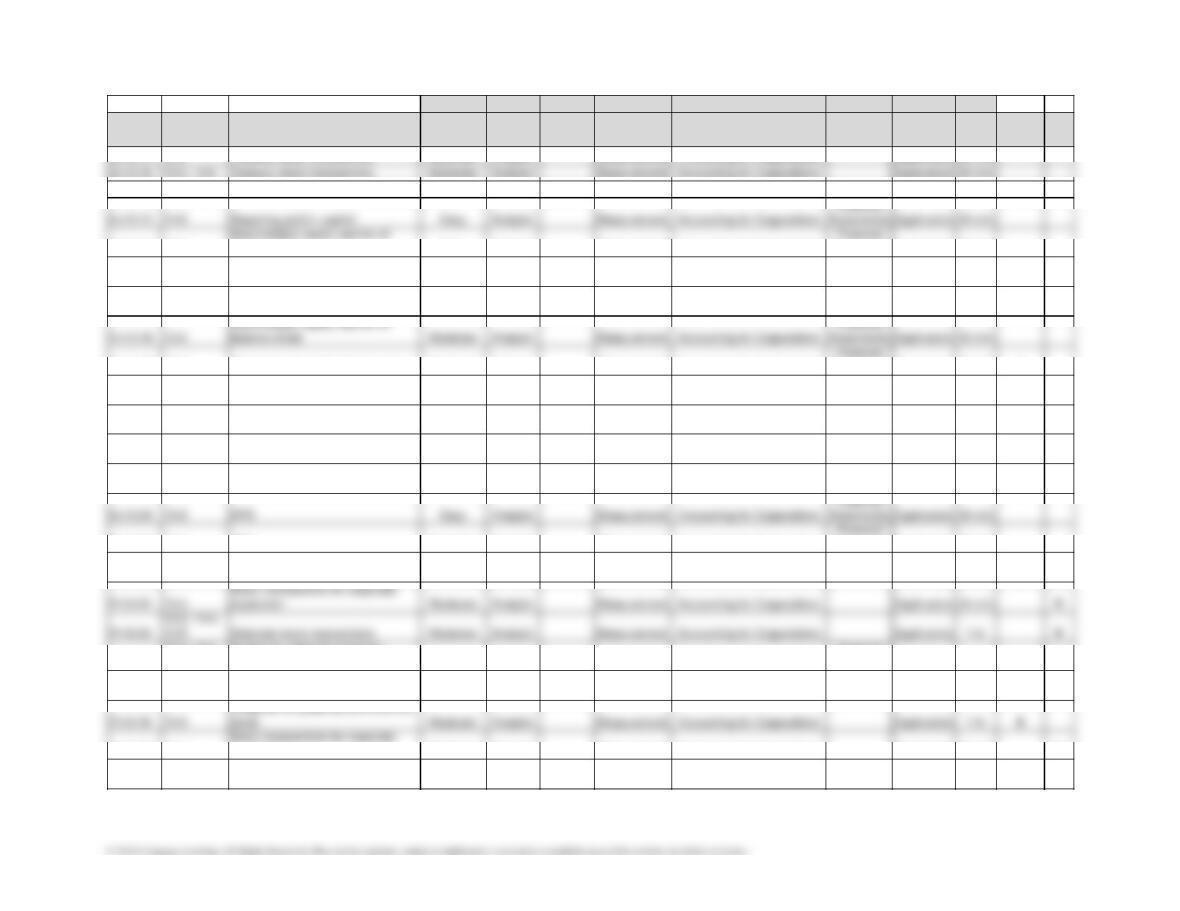
DIFFICULTY BUSPROG AICPA AICPA ACBSP ACBSP BLOOM’S TIME
Problem
Learning
Objective
Description Primary
Broad
Business
Functional Primary Secondary
Spread-
sheet
GL
Ex13-11 13-5 Treasury stock transactions Moderate Analytic Measurement Accounting for Corporations Application 15 min
Ex13-12 13-5, 13-6 Treasury stock transactions Moderate Analytic Measurement Accounting for Corporations Application 15 min
Ex13-13 13-5, 13-6 Treasury stock transactions Moderate Analytic Measurement Accounting for Corporations Application 15 min
Ex13-14 13-6 Reporting paid-in capital Easy Analytic Measurement Accounting for Corporations
Financial
Statements
Application 10 min
Stockholders‘ equity section of
Financial
Ex13-15 13-6
balance sheet
Easy Analytic Measurement Accounting for Corporations
Statements
Application 10 min
Ex13-16 13-6
Stockholders‘ equity section of
balance sheet
Easy Analytic Measurement Accounting for Corporations
Financial
Statements
Application 10 min
Ex13-17 13-6 Retained earnings statement Easy Analytic Measurement Accounting for Corporations
Financial
Statements
Application 10 min
Ex13-18 13-6
Stockholders‘ equity section of
Moderate Analytic Measurement Accounting for Corporations
Financial
Statements
Application 15 min
Financial
Ex13-19 13-6 Statement of stockholders‘ equity Moderate Analytic Measurement Accounting for Corporations
Statements
Application 15 min X
Ex13-20 13-7 Effect of stock split Easy Analytic Measurement Accounting for Corporations
Financial
Statements
Application 5 min
Ex13-21 13-4, 13-7
Effect of cash dividend and stock
split
Easy Analytic Measurement Accounting for Corporations
Financial
Statements
Application 5 min
Ex13-22 13-4, 13-7
Selected dividend transactions,
stock split
Moderate Analytic Measurement Accounting for Corporations
Financial
Statements
Application 15 min
Ex13-23 13-8 EPS Easy Analytic Measurement Accounting for Corporations
Financial
Statements
Application 5 min
Ex13-24 13-8 EPS Easy Analytic Measurement Accounting for Corporations
Application 10 min
Ex13-25 13-8 EPS Moderate Analytic Measurement Accounting for Corporations
Statements
Application 10 min
Pr13-1A 13-3
Dividends on preferred and common
stock
Moderate Analytic Measurement Accounting for Corporations Application 1 hr X
Pr13-2A 13-3
Stock transactions for corporate
expansion
Moderate Analytic Measurement Accounting for Corporations Application 45 min X
13-3, 13-4,
Pr13-4A
13-3, 13-4,
13-5, 13-6
Entries for selected corporate
transactions
Challenging Analytic Measurement Accounting for Corporations
Financial
Statements
Application 1 hr X X
Pr13-5A
13-3, 13-4,
13-5, 13-7
Entries for selected corporate
transactions
Moderate Analytic Measurement Accounting for Corporations Application 1 hr X
Pr13-1B 13-3
Moderate Analytic Measurement Accounting for Corporations Application 1 hr X
Stock transactions for corporate
Pr13-2B 13-3
expansion
Moderate Analytic Measurement Accounting for Corporations Application 45 min X
Pr13-3B
13-3, 13-4,
13-5
Selected stock transactions Moderate Analytic Measurement Accounting for Corporations Application 1 hr X
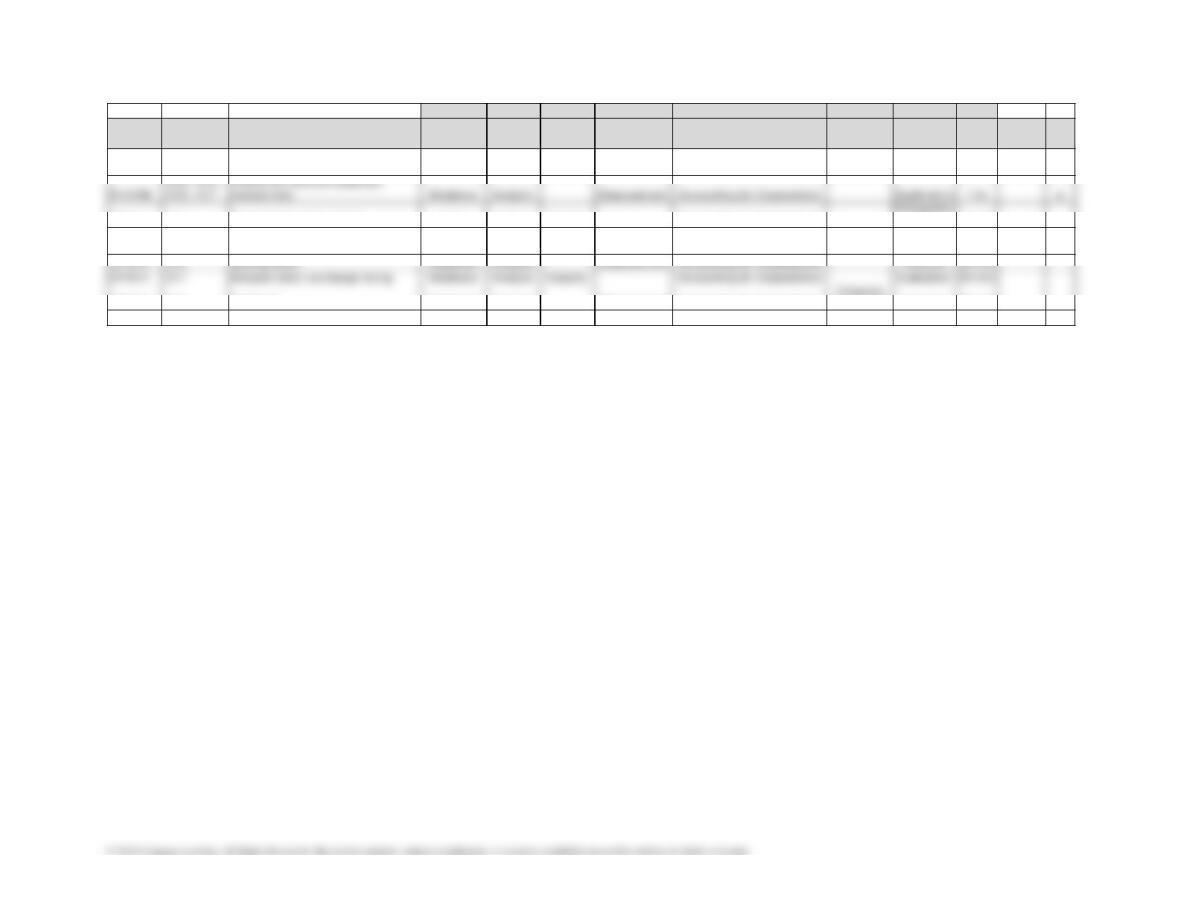
DIFFICULTY BUSPROG AICPA AICPA ACBSP ACBSP BLOOM’S TIME
Problem
Learning
Objective
Description Primary
Broad
Business
Functional Primary Secondary
Spread-
sheet
GL
Pr13-4B
13-3, 13-4,
13-5, 13-6
Entries for selected corporate
transactions
Challenging Analytic Measurement Accounting for Corporations Application 1 hr X X
CP13-1 13-1 Board of directors’ actions Easy Ethics Industry Accounting for Corporations
sion
10 min
CP13-2 13-3
Ethics and professional conduct in
business
Easy Ethics Industry Accounting for Corporations Analysis 10 min
CP13-5 13-4 Dividends Moderate Analytic Measurement Accounting for Corporations
Statements
Analysis 20 min
CP13-6 13-1 Profiling a corporation Moderate Analytic Industry Accounting for Corporations Analysis 30 min