215
chapter
13
Corporations: Organization,
Stock Transactions, and
Dividends
______________________________________________
OPENING COMMENTS
This chapter explains the characteristics of a corporation. It also introduces many of the terms related to
stock: common, preferred, par value, stated value, no-par, cumulative, and noncumulative. Additional
topics covered in Chapter 13 are treasury stock (cost method), stock splits, dividends, and computation
and significance of earnings per share.
After studying the chapter, your students should be able to:
2. Describe the two main sources of stockholders’ equity.
4. Describe and illustrate the accounting for cash dividends and stock dividends.
6. Describe and illustrate the reporting of stockholders’ equity.
8. Describe and illustrate the use of earnings per share in evaluating a company’s profitability.

216 Chapter 13 Corporations: Organization, Stock Transactions, and Dividends
STUDENT FAQS
• Why is there a difference between issued and outstanding stock?
• When you sell stock above par value, why can you not have a gain instead of having to put it in paid-
in capital in excess of par value?
• Treasury stock cannot be a good name for ownership of stock in our own company. Can we call it by
some other name, and why can we not record a gain/loss on the sale of treasury stock?
• Treasury stock is not an asset, but I do not understand why. Can you explain?
• Does common stock always have to be sold before preferred stock?
• Why is the normal balance for treasury stock a debit?
• By using par or stated value, aren’t corporations just playing around with the value of their stock?
• Would it be better for a company to issue 10 shares of $1,000 par value stock or 10,000 shares of $1
par value stock?
• Why can’t you pay dividends on treasury stock?
• Why would a company consider issuing preferred stock? If it needs to raise capital, wouldn’t it be
better just to borrow the money from a bank?
• If “dividends in arrears” means we still owe the preferred shareholders a dividend, why are we not
required to book it as a liability? After all, isn’t it a debt or obligation of the company?
• What is the most number of shares a company can issue? Is there a limit on the number besides what
is listed as authorized stock?
• How is it that common stock investors have a greater potential for earning more dividends than do
investors in preferred stock?
• When a corporation buys back its own stock, the cash account is credited – where does the cash
physically “go”?
OBJECTIVE 1
Describe the nature of the corporate form of organization.
KEY TERMS
Stock Stockholders

Chapter 13 Corporations: Organization, Stock Transactions, and Dividends 217
SUGGESTED APPROACH
Objective 1 opens with the characteristics of a corporation. Use Transparency Master (TM) 13-1 to
review these characteristics. When covering the concept of limited liability, point out that it is common
for owners of small private corporations to pledge their personal assets in order to obtain bank loans. Also
emphasize the penalty resulting from double taxation of corporate earnings; this is one of the main
disadvantages of the corporate form of business.
The following is an interesting real-world note you can share with your students: Nonprofit entities often
organize as corporations to limit their legal liability and to obtain favorable tax treatment under federal
tax laws. Examples of nonprofit corporations include the United Way and the Salvation Army.
This objective also explains the steps necessary to form a corporation and the accounting treatment for the
resulting organizational costs. The Lecture Aid and Group Learning Activity below will help you present
this material.
LECTURE AID — Organization Costs
To begin the process of forming a corporation, a business must file an application of incorporation with
the state in which the company will incorporate. After approving this application, the state grants a charter
(or articles of incorporation) that formally creates the corporation. You may wish to point out that state
incorporation laws differ. Since Delaware has more favorable incorporation laws than other states, more
than half of the largest companies are incorporated in Delaware. Exhibit 3 in the text lists some of them.
Organization costs are the costs incurred during the process of incorporating a business. These costs can
be significant. They include the following:
1. Legal fees
3. State incorporation fees
5. Promotional costs
Organization costs are recorded as an expense as they are incurred.
GROUP LEARNING ACTIVITY — Organization Costs
Ask your students to record the following entry for Hoover Corporation (see TM 13-2). The correct
journal entry is listed on TM 13-3.
Hoover Corporation was organized early in 2014. Legal costs and other fees associated with incorporation
totaled $3,500.

218 Chapter 13 Corporations: Organization, Stock Transactions, and Dividends
OBJECTIVE 2
Describe the two main sources of stockholders’ equity.
KEY TERMS
Deficit Retained Earnings
Dividends Stockholders’ Equity
Paid-in Capital
SUGGESTED APPROACH
Ask your class the following question: If you need money, what legal methods can you use to get it?
Usually, students’ responses will fit into one of the following categories:
1. You can borrow money.
3. Someone (such as a parent) can give it to you.
This will allow you to point out that a corporation has the same options to obtain the cash it needs for
operations. It can borrow money, creating a liability. It can also get cash by making a profit from its
Therefore, the two sources of owner’s equity are as follows:
1. Paid-in capital (also called contributed capital): funds invested by the shareholders
2. Retained earnings: the net income of the corporation less the dividends that have been paid to the
shareholders. If the business has sustained net losses, Retained Earnings may have a negative (or
deficit) balance.
OBJECTIVE 3
Describe and illustrate the characteristics of stock, classes of stock, and entries for issuing
stock.
KEY TERMS
Common Stock Outstanding Stock
Cumulative Preferred Stock Par
Discount Preferred Stock
In Arrears Premium

Chapter 13 Corporations: Organization, Stock Transactions, and Dividends 219
SUGGESTED APPROACH
As you can see from the list of key terms above, this objective presents a number of definitions. Use the
following Lecture Aid to explain the difference between common and preferred stock. You will also need
to reinforce the difference between cumulative and noncumulative preferred stock, using a Demonstration
Problem.
Other terms that merit special emphasis are “legal capital” and “outstanding shares.” Legal capital is the
amount invested by shareholders that cannot be returned in the form of dividends. In most states, the par
or stated value of the stock establishes legal capital. Legal capital provides protection to creditors
because, even in liquidation, it cannot be returned to stockholders until all debts are paid.
Stock that is “issued” has been sold to stockholders. Stock is “outstanding” if it is still owned by
stockholders. Stock that has been reacquired by a corporation (introduced in Objective 5 as treasury
stock) is issued, but it is not outstanding. This can be expressed through the following equation:
Issued Stock – Stock Reacquired (Treasury Stock) = Outstanding Stock
Ask your students to solve the following problem: XYZ Corporation is authorized to sell 1 million shares
of common stock; 750,000 shares have been issued, and 50,000 shares have been reacquired by XYZ.
How many shares are outstanding? (Answer: 700,000)
LECTURE AID — Classes of Capital Stock
A corporation may have different classes of stockholders. The most common class of stock is called
common stock. The major rights usually granted to a common shareholder are:
2. The right to share in distributions of earnings
3. The right to share in assets upon liquidation
A corporation may establish additional classes of stock by granting certain shareholders preferential
treatment in one or more of these rights. In many cases, the corporation will issue stock that is given
preferential treatment in the area of dividends, called preferred stock. A corporation can even establish
more than one class of preferred stock. Ask your students to check The Wall Street Journal and identify
corporations that have multiple classes of preferred stock.
LECTURE AID — Preferred Stock
Before discussing the dividend characteristics of preferred stock, stress that dividends are not a liability of
a corporation until declared by the board of directors. Corporations are not required to pay dividends.
Cumulative vs. Noncumulative Preferred Stock: Although preferred shareholders are “first in line” for
dividends, they are not guaranteed dividends. If a corporation determines that it needs to keep its earnings
to finance growth, or if earnings are low, the preferred dividend may be passed in one or more years.
These passed dividends are called “dividends in arrears.”
220 Chapter 13 Corporations: Organization, Stock Transactions, and Dividends
If the preferred stock is cumulative, all dividends in arrears must be paid before any dividends are granted
to the common shareholder. If the preferred stock is noncumulative, the preferred stockholder forfeits any
passed dividends.
Investors in common stock run a greater risk of not receiving dividends than do investors in preferred
stock. On the other hand, common stock investors have a greater potential for earning more dividends
than do investors in preferred stock.
DEMONSTRATION PROBLEM — Distributing Dividends
Belson Corporation has 10,000 common shareholders and 5,000 preferred shareholders. The preferred
stock has a $5 dividend rate. Two years of dividends are currently in arrears. Assume that the preferred
stock is cumulative. Belson has $155,000 to distribute in the form of dividends. Use this information to
calculate the dividends distributed to the preferred and common shareholders.
Preferred Common Total
Shareholders Shareholders Distributed
Dividends in arrears (5,000 $5 2) $50,000 $50,000
You may want to illustrate an example of noncumulative preferred stock to emphasize the impact this
feature can have on dividend distribution. Use the data above, but assume that the preferred stock is
noncumulative. In this case, dividends would be distributed as follows:
Preferred Common Total
Shareholders Shareholders Distributed
Regular dividend $25,000 25,000
GROUP LEARNING ACTIVITY — Distributing Dividends
Ask your students to work in groups to distribute $65,000 of dividends to be paid by Belson Corporation
under each of the following assumptions:
2. There are three years of preferred dividends in arrears. The preferred stock is noncumulative.
Chapter 13 Corporations: Organization, Stock Transactions, and Dividends 221
The solutions are shown on TMs 13-4 and 13-5.
WRITING EXERCISE — Characteristics of Preferred Stock
Ask your students to respond to the following question (TM 13-6):
Assume that you have decided to invest a portion of your money in the stock market. You ask your broker
to recommend several preferred stocks for you to consider as an investment. Your broker recommends the
following two companies. Both are start-up corporations, but you agree with your broker that both have
excellent potential for the future.
Possible response: Both Company A and Company B stocks will provide the same dividend per share,
assuming dividends are paid. However, since Company A stock is less expensive, the investor can obtain
more of Company A stock. Company B provides the additional guarantee that if dividends are not
declared in a given year, they will be paid in future years. In order to receive this additional “piece of
SUGGESTED APPROACH — Journalizing the Entries for Issuing Stock
Explain the terms “par value” and “stated value.” Illustrate how these stock characteristics affect the
journal entries for issuing stock, using the Demonstration Problem below.
DEMONSTRATION PROBLEM — Entries for Issuance of Capital Stock
Par value is an arbitrary amount assigned to shares of stock. When preferred or common stock is issued,
the par value of the stock is credited to the stock account. Any amount received above par (called a

222 Chapter 13 Corporations: Organization, Stock Transactions, and Dividends
Example: Belson Corporation sold 1,000 shares of $10 par value common stock for $17 per share.
Ask your students to record the following entry in their notes:
Belson sold 1,000 shares of $25 par value preferred stock for $30 per share.
Cash………………………………………………………………. 30,000
To emphasize that par value is not related to market value, compare the par value of the sample annual
report for common stock found in Appendix C to the current selling price from The Wall Street Journal.
No-par stock does not have an assigned par value. Some states require that a stated value be assigned to
any no-par stock. If a stock has a stated value, it is treated the same as a par value in recording the stock.
The stock account is credited for the stated value, and any premium is recorded in “Paid-in Capital in
Excess of Stated Value.” If a no-par stock does not have a stated value, the full proceeds from issuing the
stock are recorded in the stock account.
Ask your students to record the following entry in their notes:
1. Camden Corporation issued 100 shares of no-par preferred stock for $50 per share.
2. Camden Corporation also issued 500 shares of common stock with a stated value of $5 per share for $7
per share.
3. Camden Corporation also issued 1,000 shares of $5 stated value common stock in exchange for
equipment with a fair market value of $8,500.
Equipment………………………………………………………… 8,500
Common Stock……………………………………………. 5,000
Paid-in Capital in Excess of Stated Value—Common Stock 3,500
Chapter 13 Corporations: Organization, Stock Transactions, and Dividends 223
OBJECTIVE 4
Describe and illustrate the accounting for cash dividends and stock dividends.
KEY TERMS
Cash Dividend Stock Dividend
SUGGESTED APPROACH
Begin this topic by commenting on dividend policies. Point out that some companies make it a policy not
to pay dividends at all, plowing all profits back into the company. Stockholders in these corporations
count on share appreciation in order to receive a return on their investment. Companies that do pay
dividends usually try to maintain a stable regular dividend, generally paid quarterly.
DEMONSTRATION PROBLEM — Cash Dividends
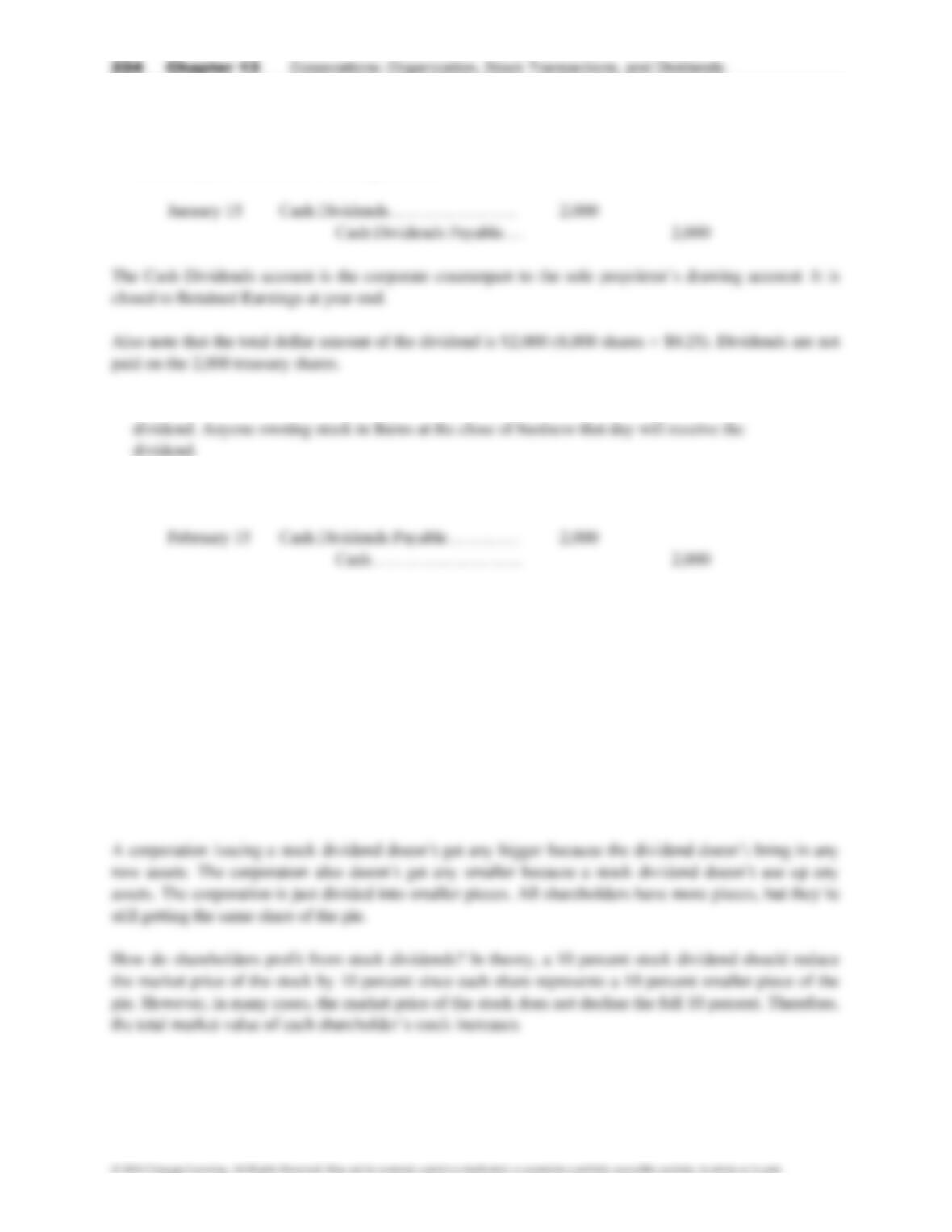
1. Date of Declaration: Once declared, the dividend becomes a liability of the corporation.
Therefore, it is credited to a liability account.
2. Date of Record: No journal entry is required. This date determines who will receive the
3. Date of Payment: The liability is paid by mailing the dividend checks.
LECTURE AID — Stock Dividends
When stock dividends are “paid,” additional shares of stock are mailed to the shareholders (or credited to
their account, actual paper shares of stock being rare these days). This allows the corporation to give a
return to its shareholders without using any of its cash.
In reality, shareholders own exactly the same portion of the corporation after the stock dividend as they
did before the dividend was issued. You can compare the corporation to a pie. Let’s say that you cut a pie
into six pieces. If you have three pieces, you have half of the pie. If you originally cut that same pie into
eight pieces, four pieces equal half the pie. Four pieces may seem like more than three, but because they
are smaller pieces, you still get the same amount of dessert (and calories).
Chapter 13 Corporations: Organization, Stock Transactions, and Dividends 225
DEMONSTRATION PROBLEM — Stock Dividends
On June 20, the board of directors of Carlisle Corporation declares a 4 percent stock dividend on its
50,000 shares of common stock. The shares will be issued on July 14. The par value of the stock is $10
per share; the market value on June 20 is $16 per share.
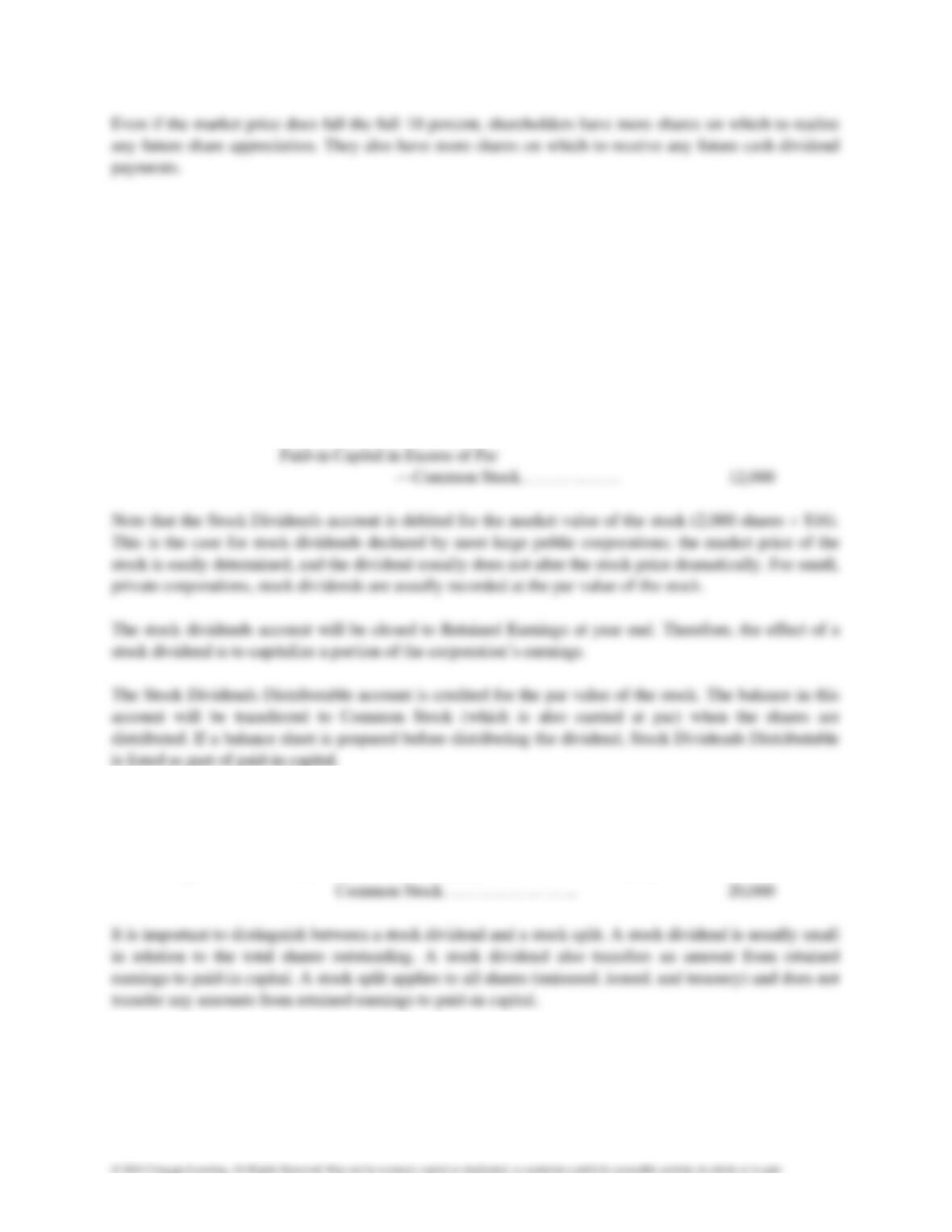
1. Declaration Date: A liability to distribute the dividends is established with a credit to the Stock
Dividends Distributable account.
June 20 Stock Dividends………………………………… 32,000
Stock Dividends Distributable………………….. 20,000
2. Distribution Date: The additional shares are mailed to the shareholders, relieving the corporation’s
liability. The shares are recorded as outstanding by crediting the common stock account.
July 14 Stock Dividends Distributable…………… 20,000
WRITING EXERCISE — Stock Dividends
Ask your students to explain the following (TM 13-10):
226 Chapter 13 Corporations: Organization, Stock Transactions, and Dividends
Explain the benefits of a stock dividend, both to the corporation issuing the dividend and
to the shareholder receiving the dividend.
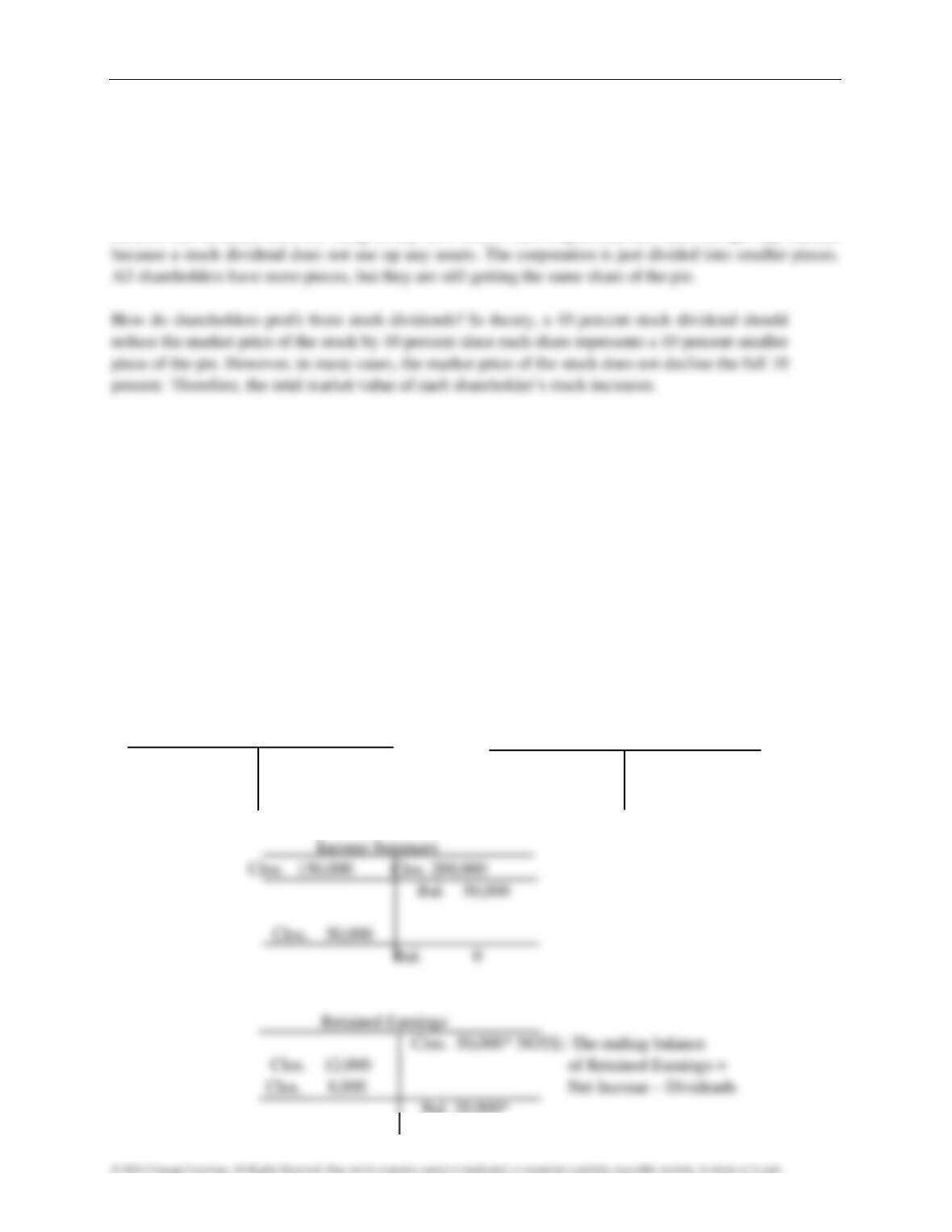
Answer from Lecture Aid above: A corporation issuing a stock dividend does not get any bigger
because the dividend does not bring in any new assets. The corporation also does not get any smaller
DEMONSTRATION PROBLEM — Closing Entries for a Corporation
Assume a corporation had the following account balances at the end of a fiscal year. (For simplicity, all
expenses are assumed to be recorded in one expense account.)
Revenues $200,000
Expenses 150,000
Cash Dividends 12,000
Stock Dividends 8,000
Use these accounts to demonstrate closing entries for a corporation. Remind students that (1) revenues
and expenses are closed to Income Summary, (2) Income Summary is closed to Retained Earnings, and
(3) dividend accounts are closed to Retained Earnings.
Revenues Expenses
Bal. 200,000 Bal. 150,000
Clos. 200,000 Clos. 150,000