PROBLEM 13-4B
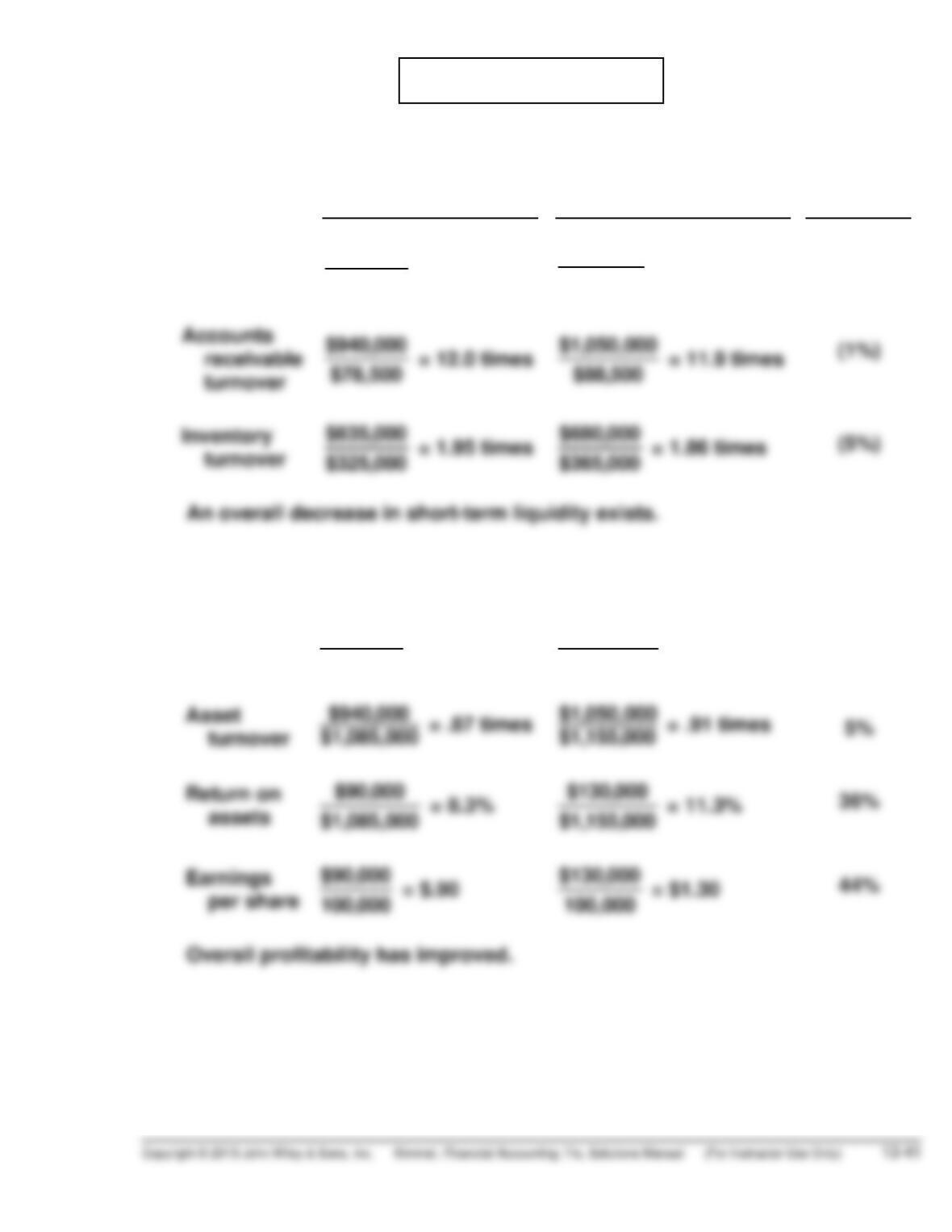
(a) LIQUIDITY
2013 2014 Change
Current
ratio
$520,000
$165,000 = 3.15:1 $670, 000
$330,000 = 2.03:1 (36%)
PROFITABILITY
Profit
margin
$90,000
$940,000 = 9.6% $130,000
$1,050,000 = 12.4% 29%
PROBLEM 13-4B (Continued)
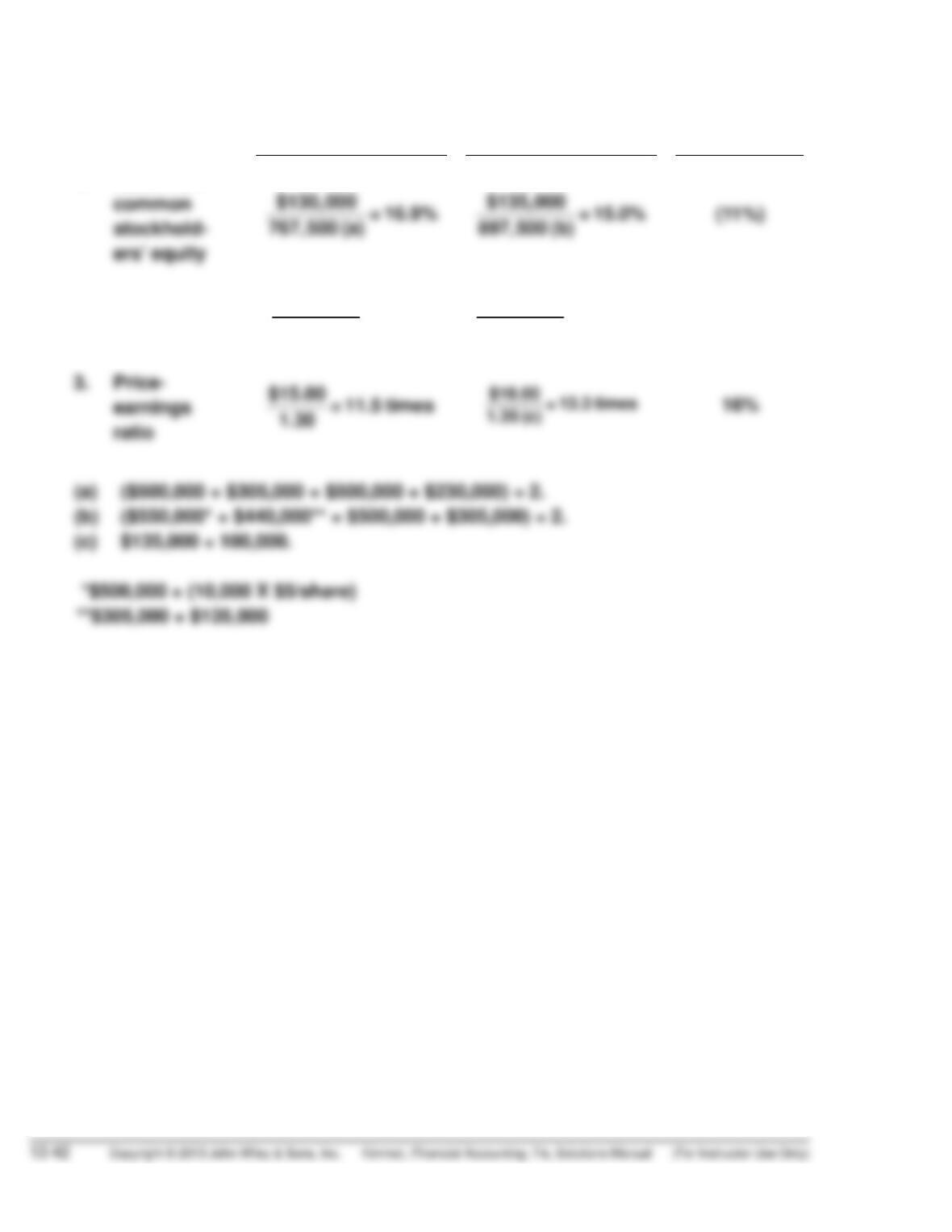
(b) 2014 2015 % Change
1. Return on
2. Debt
to assets
$510,000 = 39%
1,315,000 $390,000 =29%
1,350,000 (26%)
PROBLEM 13-5B
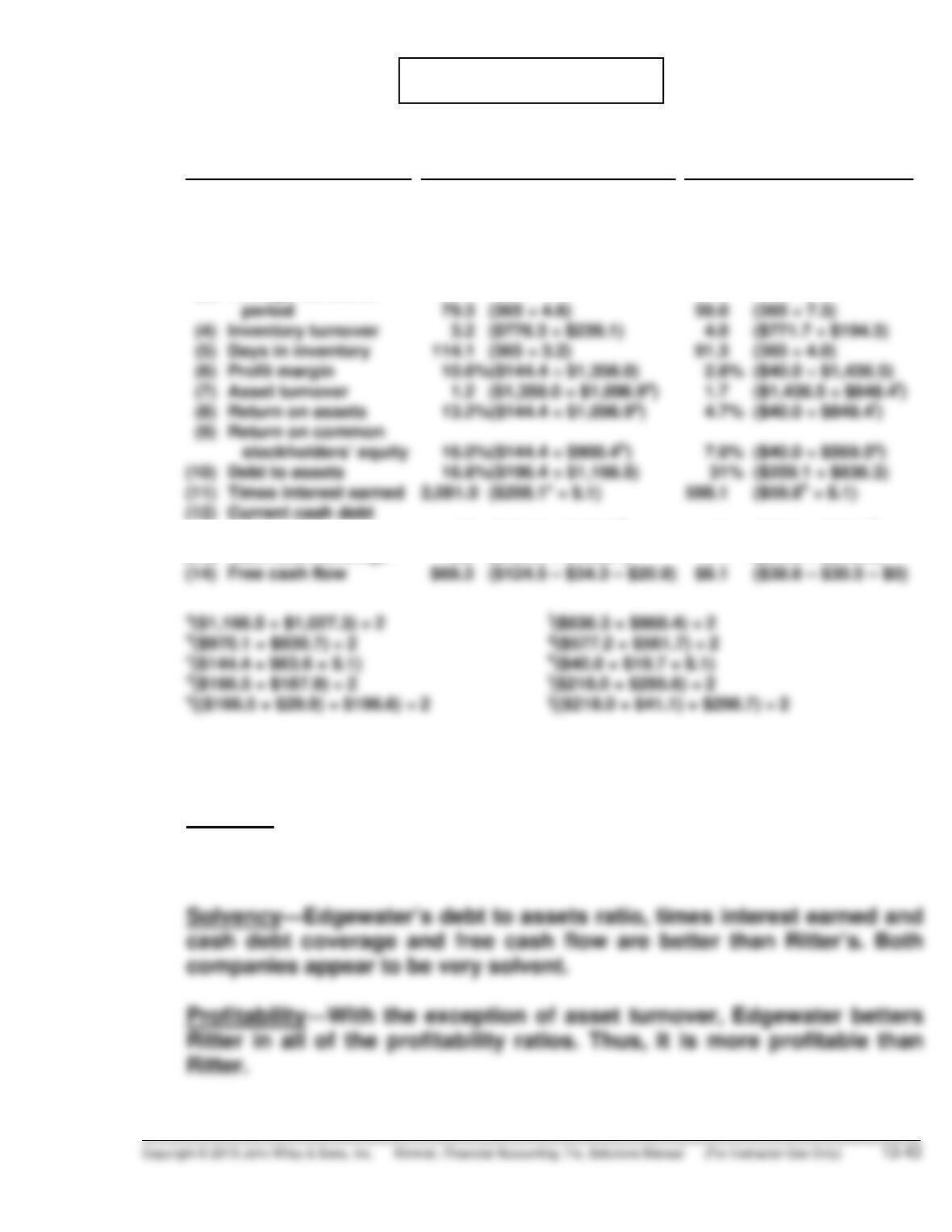
(a) Ratio Edgewater Ritter
(All Dollars Are in Millions)
(1) Current
(2) Accounts receivable
turnover
(3) Average collection
coverage
(13) Cash debt coverage
5.32:1 ($885.7 ÷ $166.5)
4.6 ($1,356.0 ÷ $293.2)
.70 ($124.5 ÷ $177.2d)
.63 ($124.5 ÷ $196.5e)
2.83:1 ($617.2 ÷ $218.0)
7.3 ($1,436.5 ÷ $196.1)
.15 ($38.6 ÷ $251.8i)
.14 ($38.6 ÷ $278.9j)
(b) The comparison of the two companies shows the following:
Liquidity—Edgewater’s current ratio and current cash debt coverage are
much better than Ritter’s. However, Ritter has better accounts
receivable and inventory turnovers.
\
BYP 13-1 FINANCIAL REPORTING PROBLEM
(a) TOOTSIE ROLL INDUSTRIES, INC.
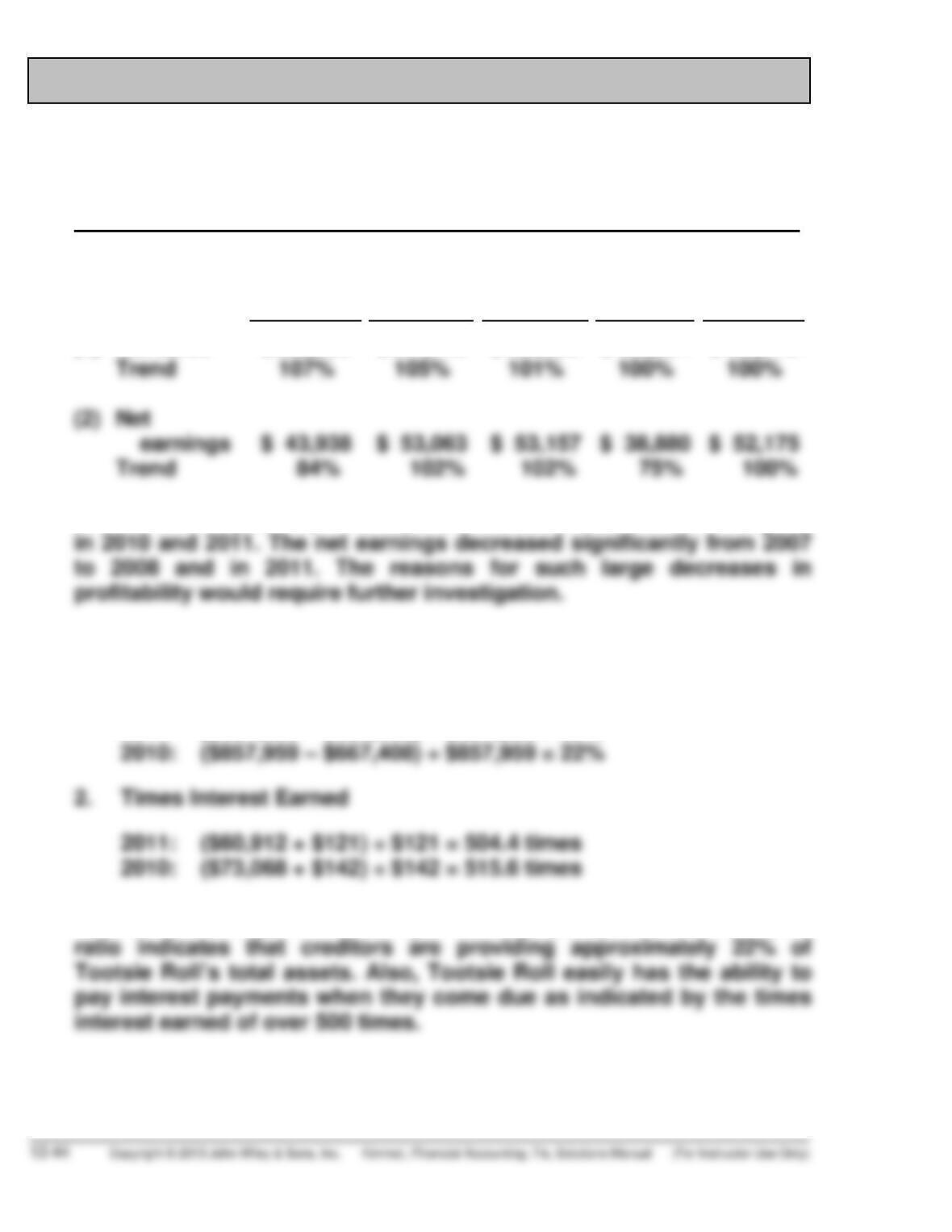
Trend Analysis of Net Sales and Net Earnings
For the Five Years Ended 2011
Base Period 2007—($ in thousands)
2011 2010 2009 2008 2007
(1) Net sales
$528,369
$517,149
$495,592
$492,051
$492,742
Net sales changed very little from 2007 to 2009, but increased slightly
(b) (000’s omitted)
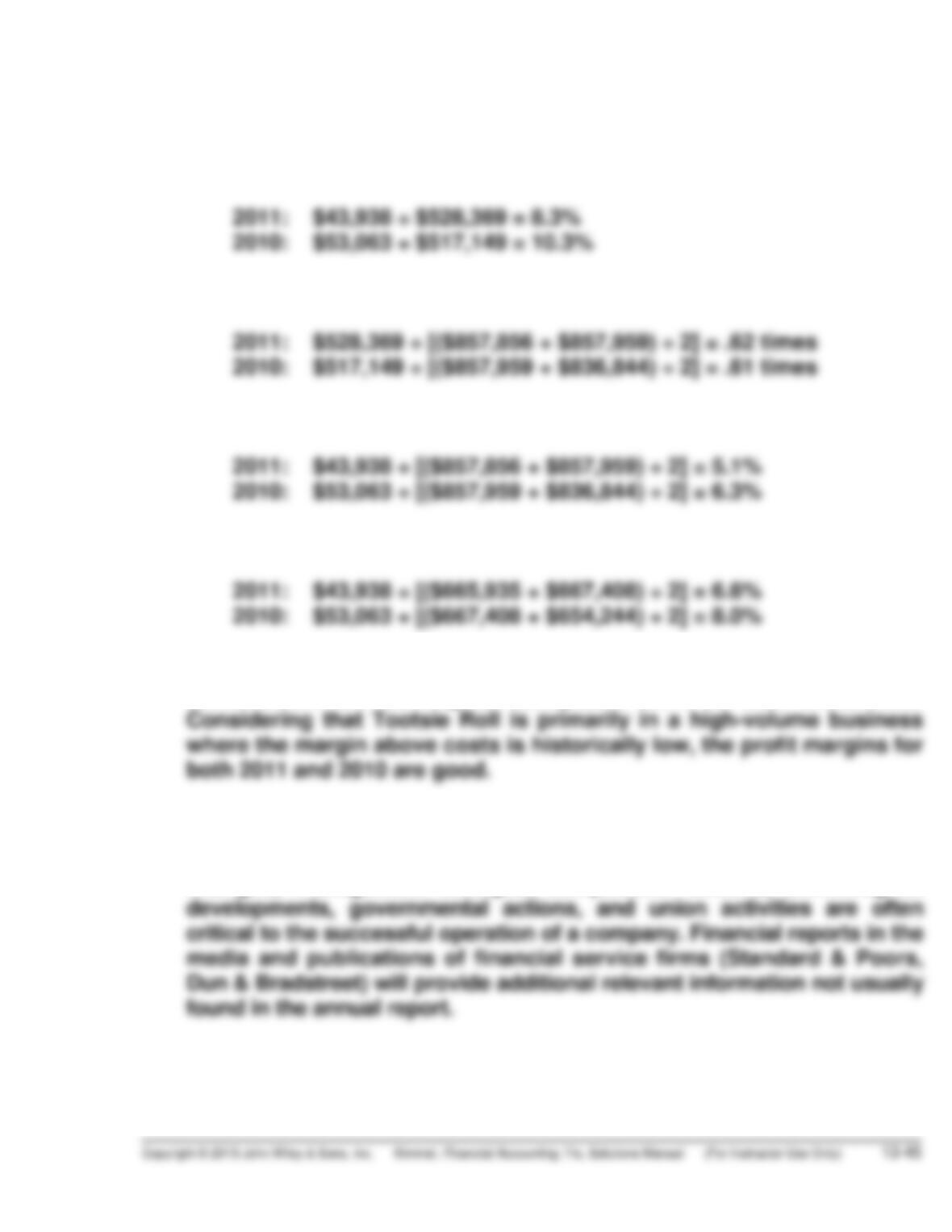
1. Debt to Assets Ratio
2011: ($857,856 – $665,935) ÷ $857,856 = 22%
Tootsie Roll’s long-term solvency is not in jeopardy. The debt to assets
BYP 13-1 (Continued)
(c) (000’s omitted)
1. Profit Margin
2. Asset Turnover
3. Return on Assets
4. Return on Common Stockholders’ Equity
All of the profitability ratios except asset turnover decreased in 2011.
Stockholders are earning an acceptable 6.6% on their investment.
(d) Substantial amounts of important information about a company are not
in its financial statements. Events involving such things as industry
changes, management changes, competitors’ actions, technological
BYP 13-2 COMPARATIVE ANALYSIS PROBLEM
(
a
)
Hershey Tootsie Roll
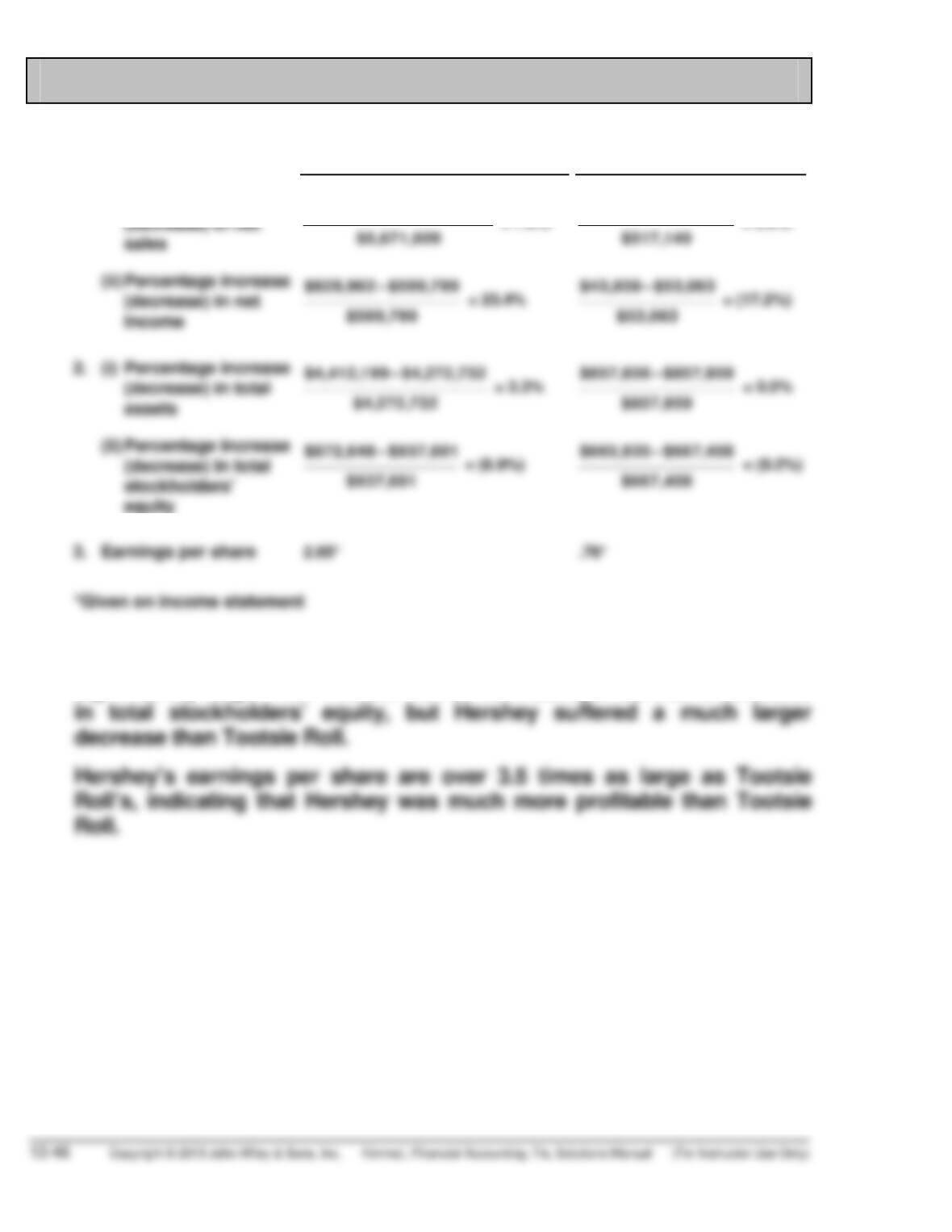
1. (i) Percentage increase
$6,080,788 – $5,671,009
(b) Hershey’s increases in net sales, net income, and total assets were all
significantly larger than Tootsie Roll’s. Both Companies had a decrease
BYP 13-3 RESEARCH CASE
(a) The article explains that unrealized losses on certain types of
investment securities, known as available-for-sale securities, do not
(b) Companies are required to report these losses in net income when
the company determines that the loss is permanent. This would occur
(c) At the time of the article companies in the Standard and Poor’s 500
(d) The article emphasizes that these companies actually are following
accepted accounting standards.
(e) The implications for investors are that investors need to look for
BYP 13-4 RESEARCH CASE
(a) As discussed in Chapter 11, when a company does a stock split, its
share price drops accordingly. If Amazon had not engaged in past stock
splits its stock price at the time of the article would have been $1,166.
(b) Amazon dramatically increased its capacity to handle customer orders
through its spending on fulfillment centers. However, until its sales
(d) The article notes that Amazon’s 2012 operating margin was about half
what it had been in the typical previous year. In the past, many of
Amazon’s customers did not pay sales taxes on their purchases, which
BYP 13-5 INTERPRETING FINANCIAL STATEMENTS
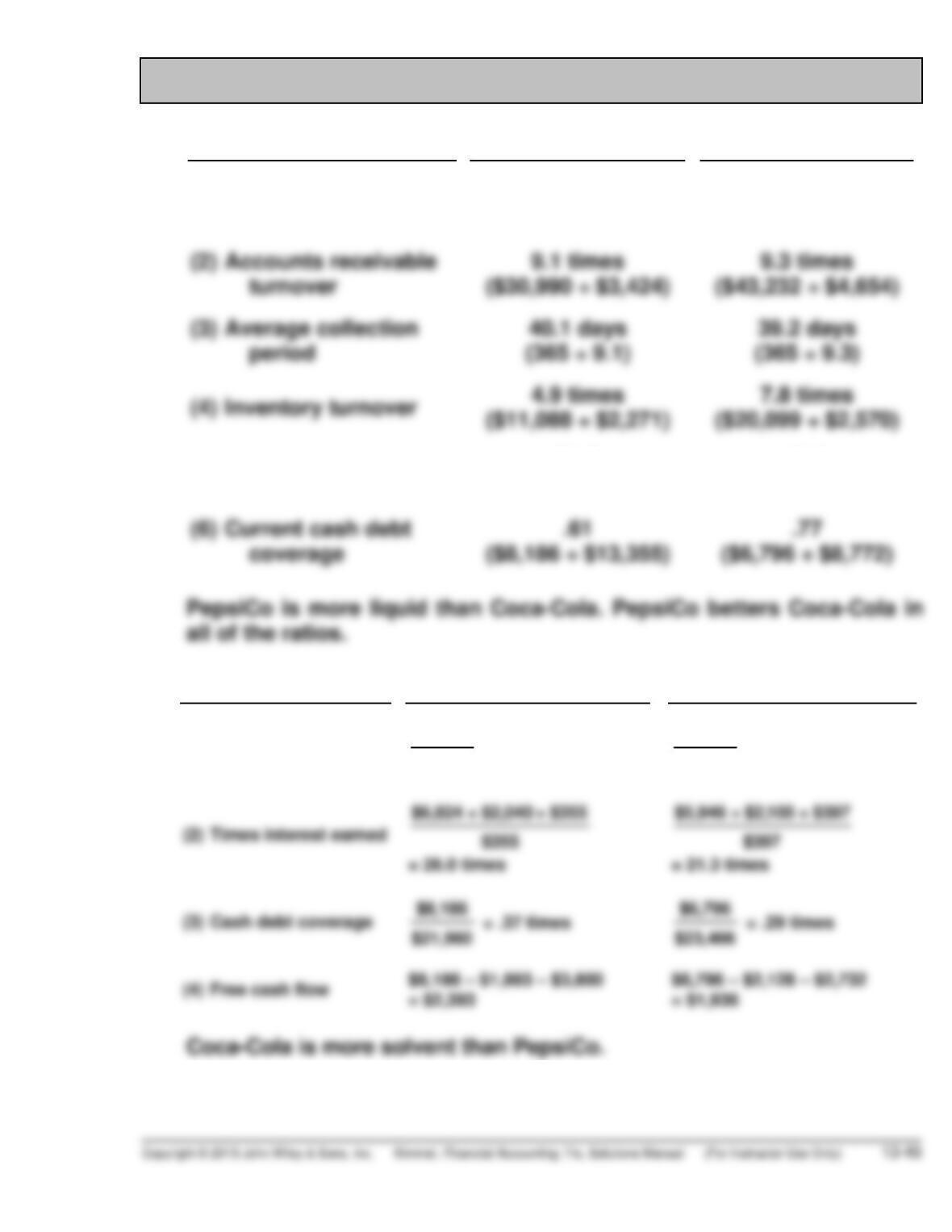
(a) Liquidity Ratios Coca-Cola PepsiCo
(1) Current ratio 1.28:1
($17,551 ÷ $13,721)
1.44:1
($12,571 ÷ $8,756)
(5) Days in inventory 74.5
(365 ÷ 4.9)
46.8
(365 ÷ 7.8)
(
b
)
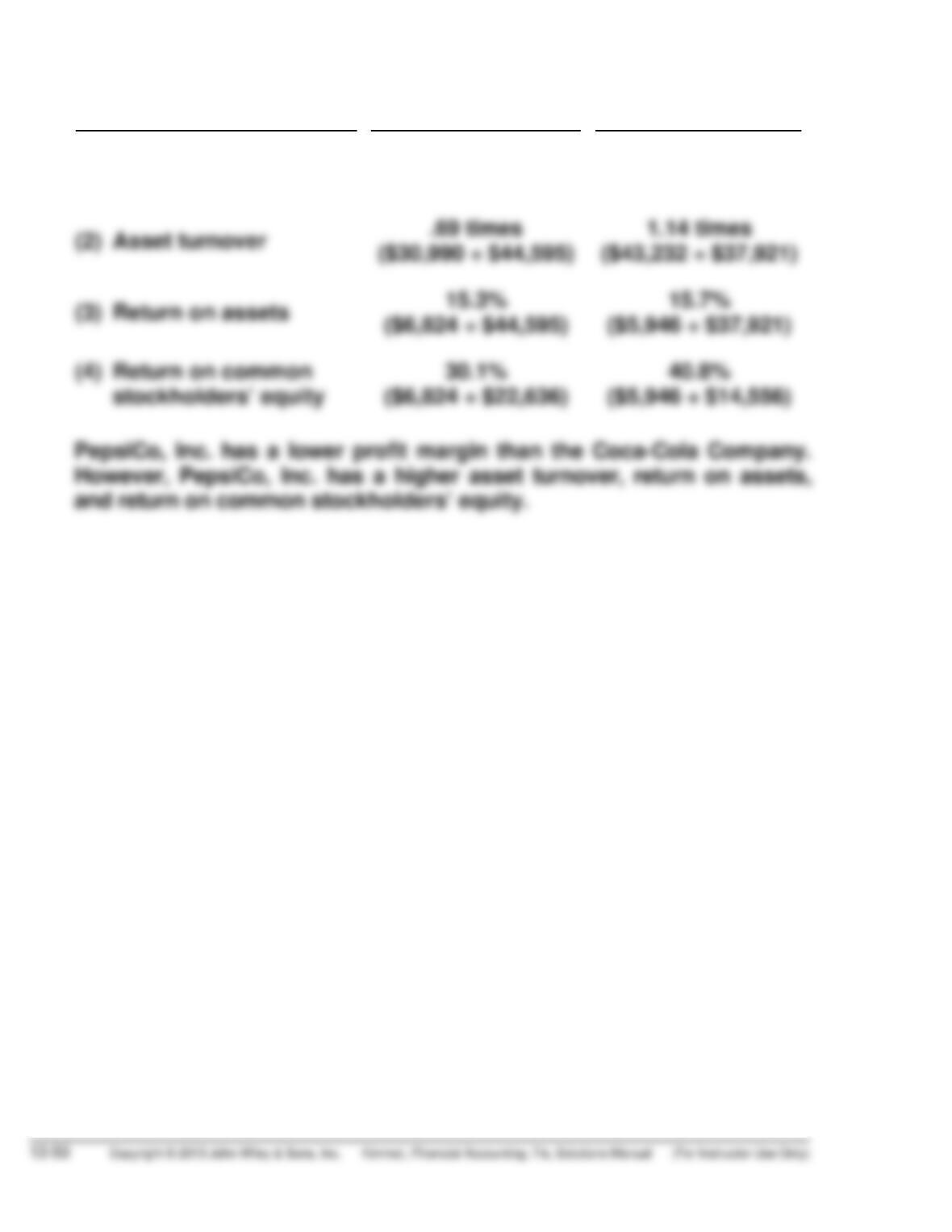
Solvency Ratios Coca-Cola PepsiCo
(1) Debt to assets ratio
$23,872
$48,671 = 49%
$23,044
$39,848 = 58%
BYP 13-5 (Continued)
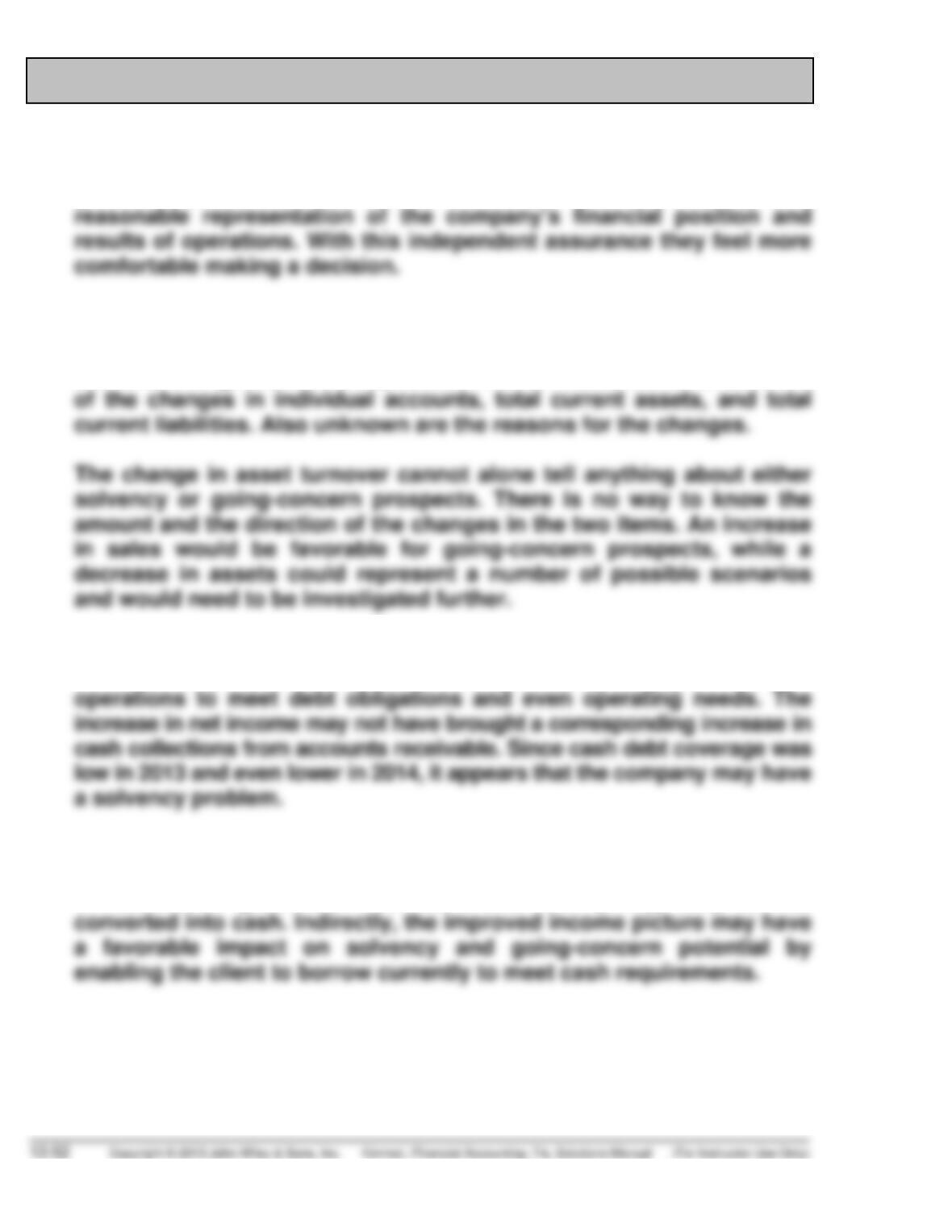
(c) Profitability Ratios Coca-Cola PepsiCo
(1) Profit margin 22.0%
($6,824 ÷ $30,990)
13.8%
($5,946 ÷ $43,232)

BYP 13-6 REAL-WORLD FOCUS
BYP 13-7 DECISION MAKING ACROSS THE ORGANIZATION
(a) Lenders prefer that financial statements are audited because an audit
gives independent assurance that the financial statements give a
(b) The current ratio increase is a favorable indication as to liquidity, but
alone tells little about the going-concern prospects of the client. From
this ratio change alone, it is impossible to know the amount and direction
The 50 percent [(.1 – .2) ÷ .2] decrease in cash debt coverage may indicate
that the company is having difficulties generating enough cash from
The increase in net income is a favorable indicator for both solvency
and going-concern prospects although much depends on the quality
of receivables generated from sales and how quickly they can be
BYP 13-7 (Continued)
The 32 percent [($3.30 – $2.50) ÷ $2.50] increase in earnings per share,
which is identical to the percentage increase in net income, is an
indication there has probably been no change in the number of shares of
A limitation on comparisons with industry statistics or other companies
within the industry exists because material differences can be created
through the use of alternative (but acceptable) accounting methods.
(c) 1. Current cash debt coverage—indicates liquidity.
BYP 13-8 COMMUNICATION ACTIVITY
To: David Lemay
From: Accounting Student
Re: Financial Statement Analysis
There are two fundamental considerations in financial statement analysis:
(1) the bases of comparison and (2) the limitations of financial statement
analysis. Each of these considerations is explained below.
1. Bases of comparison. The bases of comparison are:
a. Intracompany—This basis compares an item or financial relationship
within a company in the current year with the same item or rela-
2. Three factors that affect quality of earnings are:
a. Alternative accounting methods—Variations among companies in
the application of generally accepted accounting principles (GAAP)
BYP 13-9 ETHICS CASE
(a) The stakeholders in this case are:
Kelli Rice, president of LR Industries.
Laurie Ellis, public relations director.
(b) The president’s press release is deceptive and incomplete and to that
extent her actions are unethical.
(c) As controller you should at least inform Laurie, the public relations
director, about the biased content of the release. She should be aware

BYP 13-10 ALL ABOUT YOU
Student responses will vary. We suggest that in class you ask for a few
students to share their responses in order to increase students under-
BYP 13-11 FASB CODIFICATION ACTIVITY
(a) Discontinued Operations
205-20-45-1 The results of operations of a component of an entity that
either has been disposed of or is classified as held for sale under the
requirements of paragraph 360-10-45-9, shall be reported in
discontinued operations in accordance with paragraph 205-20-45-3 if
both of the following conditions are met:
(b) Extraordinary items are events and transactions that are distinguished
by their unusual nature and by the infrequency of their occurrence.
Thus, both of the following criteria should be met to classify an event
or transaction as an extraordinary item:
(c) Comprehensive Income
IFRS CONCEPTS AND APPLICATION
IFRS 13-1
LING COMPANY
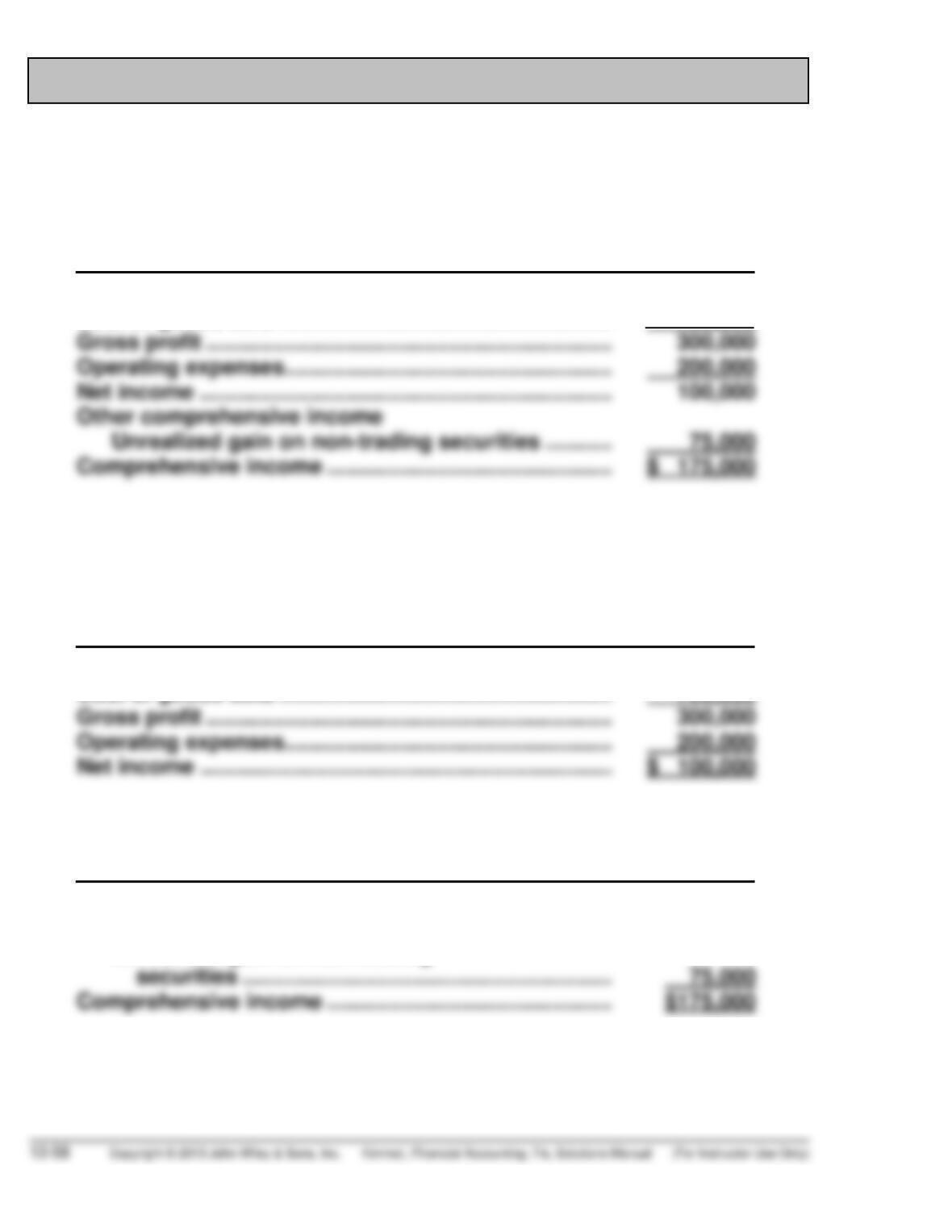
Statement of Comprehensive Income
For the Year Ended December 31, 2014
Sales revenue ………………………………………………………. $1,000,000
Cost of goods sold ………………………………………………. 700,000
IFRS 13-2
LING COMPANY
Income Statement
For the Year Ended December 31, 2014
Sales revenue ………………………………………………………. $1,000,000
Cost of goods sold ………………………………………………. 700,000
LING COMPANY
Statement of Comprehensive Income
For the Year Ended December 31, 2014
Net income ………………………………………………………….. $100,000
Other comprehensive income
Unrealized gain on non-trading
IFRS 13-3 INTERNATIONAL FINANCIAL REPORTING PROBLEM
(a) The company decided to sell its Baked Snacks business. It said it was
doing this in order to enhance earnings and focus its resources on its
core profitable divisions.