Chapter 13
Differential Analysis: The Key to Decision
Making
Solutions to Questions
13-1 A relevant cost is a cost that differs in
total between the alternatives in a decision.
13-2 An incremental cost (or benefit) is the
change in cost (or benefit) that will result from
some proposed action. An opportunity cost is
the benefit that is lost or sacrificed when
rejecting some course of action. A sunk cost is a
cost that has already been incurred and that
cannot be changed by any future decision.
13-4 No. Not all fixed costs are sunk—only
those for which the cost has already been
irrevocably incurred. A variable cost can be a
sunk cost if it has already been incurred.
13-6 No. Only those future costs that differ
between the alternatives are relevant.
13-7 Only those costs that would be avoided
as a result of dropping the product line are
relevant in the decision. Costs that will not be
affected by the decision are irrelevant.
only if the contribution margin that will be lost
as a result of dropping the product is less than
the fixed costs that would be avoided. Even in
that situation the product may be retained if it
promotes the sale of other products.
13-9 Allocations of common fixed costs can
make a product (or other segment) appear to be
unprofitable, whereas in fact it may be
profitable.
facilities have to be used to make the part. The
company’s opportunity cost is measured by the
benefits that could be derived from the best
alternative use of the facilities.
policy that prevents the organization from
furthering its goals.
13-12 Assuming that fixed costs are not
affected, profits are maximized when the total
contribution margin is maximized. A company
can maximize its total contribution margin by
focusing on the products with the greatest
costs are the costs that are incurred up to the
split-off point. The split-off point is the point in
the manufacturing process where joint products
can be recognized as individual products.
13-14 Joint costs should not be allocated
among joint products for decision-making
purposes. If joint costs are allocated among the
13-15 If the incremental revenue from further
processing exceeds the incremental costs of
further processing, the product should be
processed further.
13-16 Most costs of a flight are either sunk
costs, or costs that do not depend on the
number of passengers on the flight.
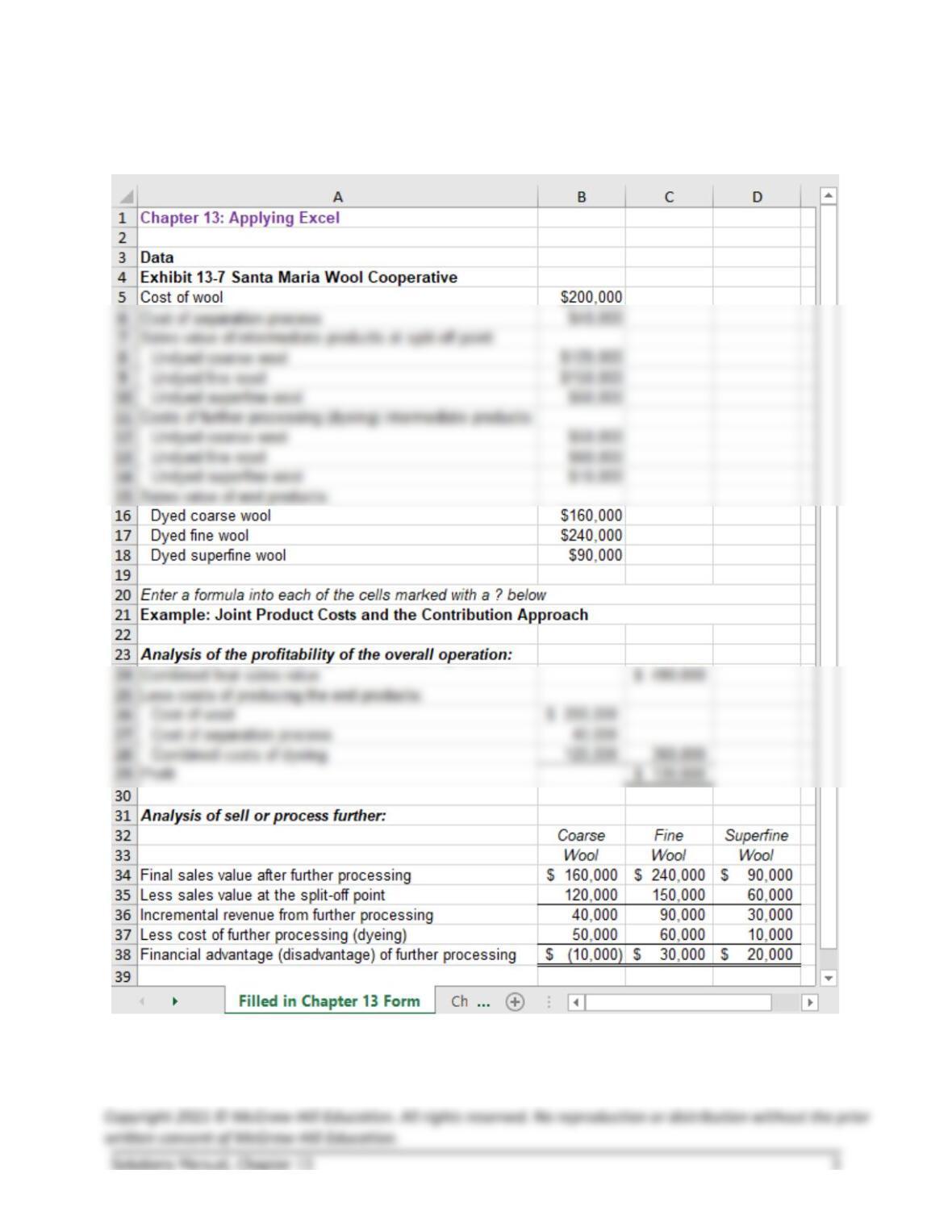
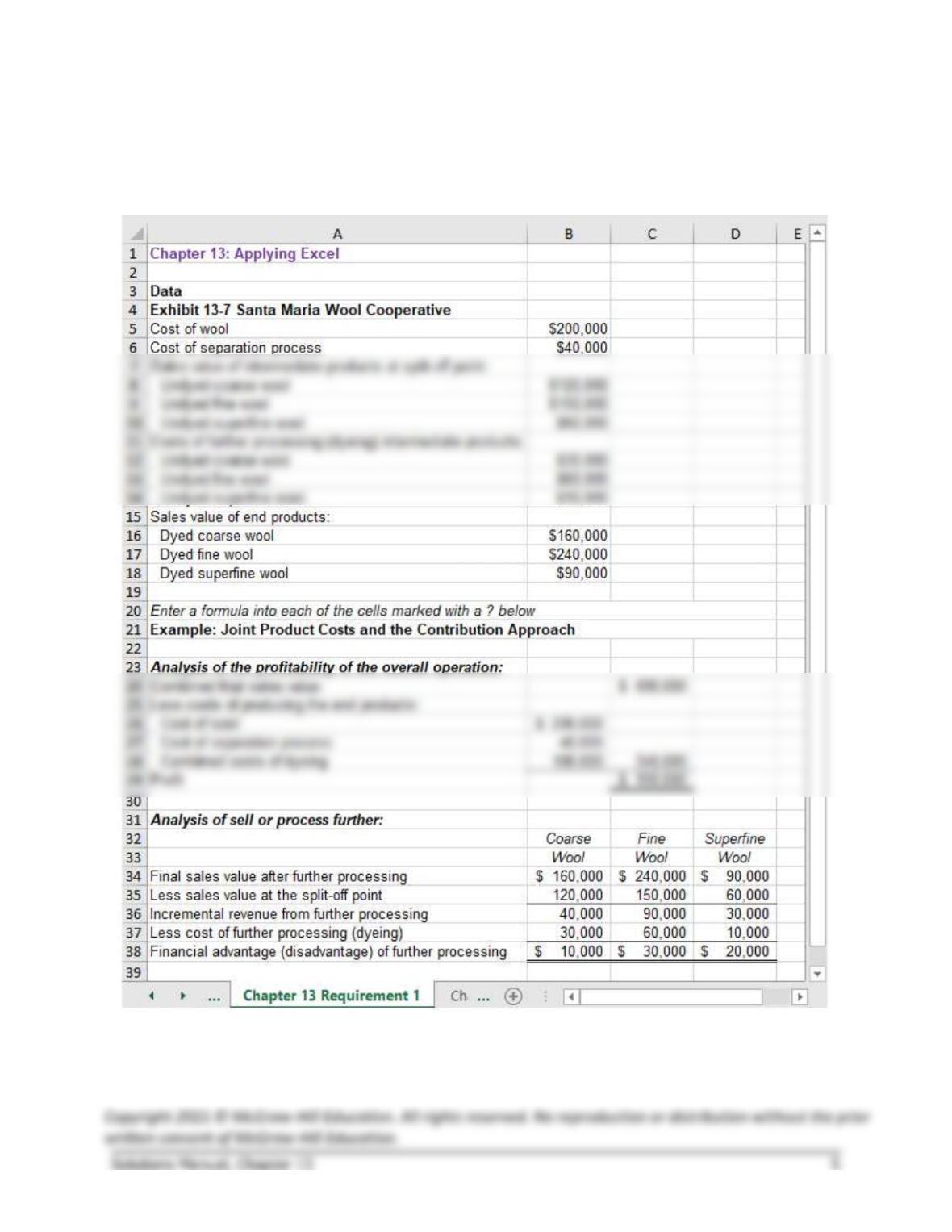
Chapter 13: Applying Excel
The completed worksheet is shown below.
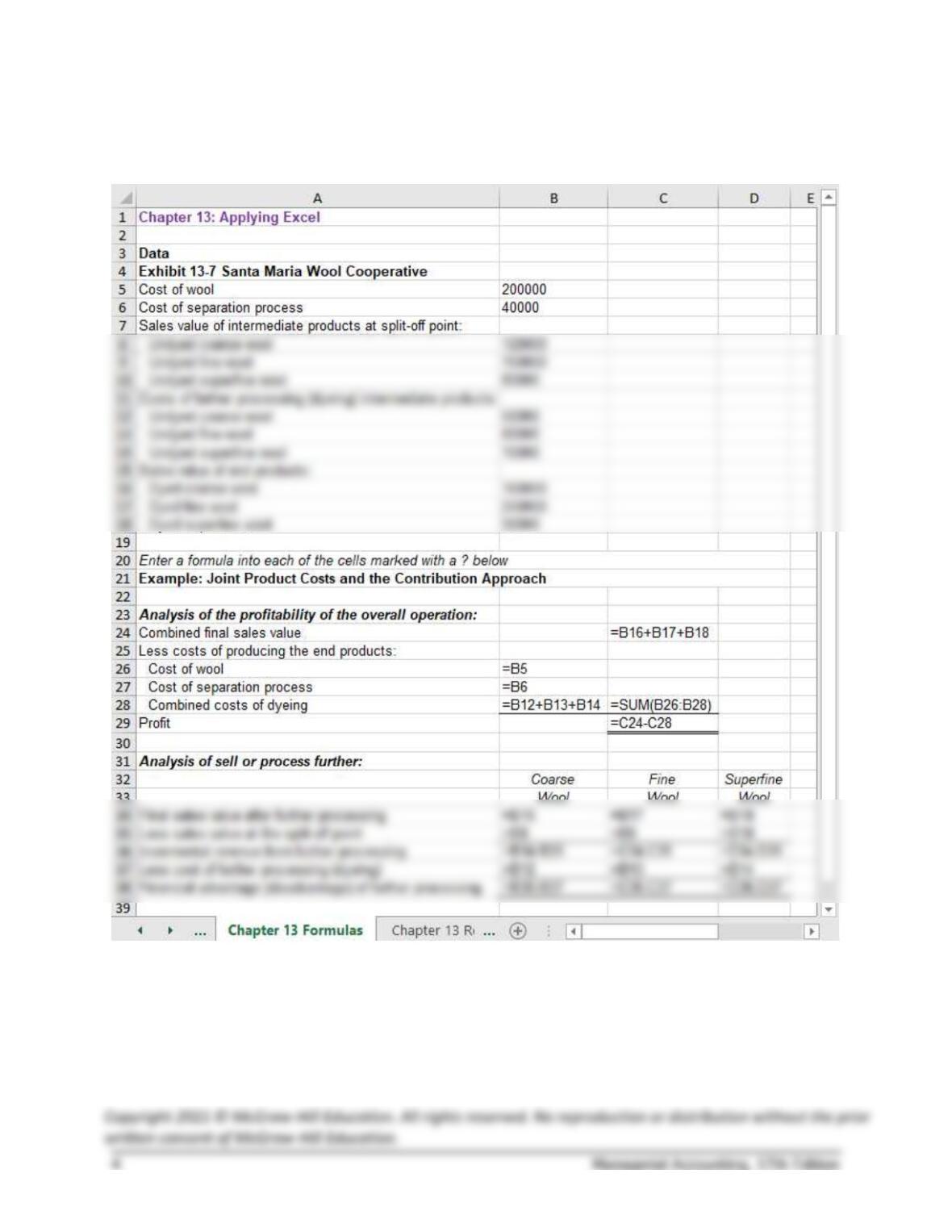
Chapter 13: Applying Excel (continued)
The completed worksheet, with formulas displayed, is shown below.
Chapter 13: Applying Excel (continued)
1. With the change in the cost of further processing undyed course wool,
the result is:
With the reduction in the cost of further processing undyed coarse wool,
it is now profitable to process undyed coarse wool into dyed coarse
wool.
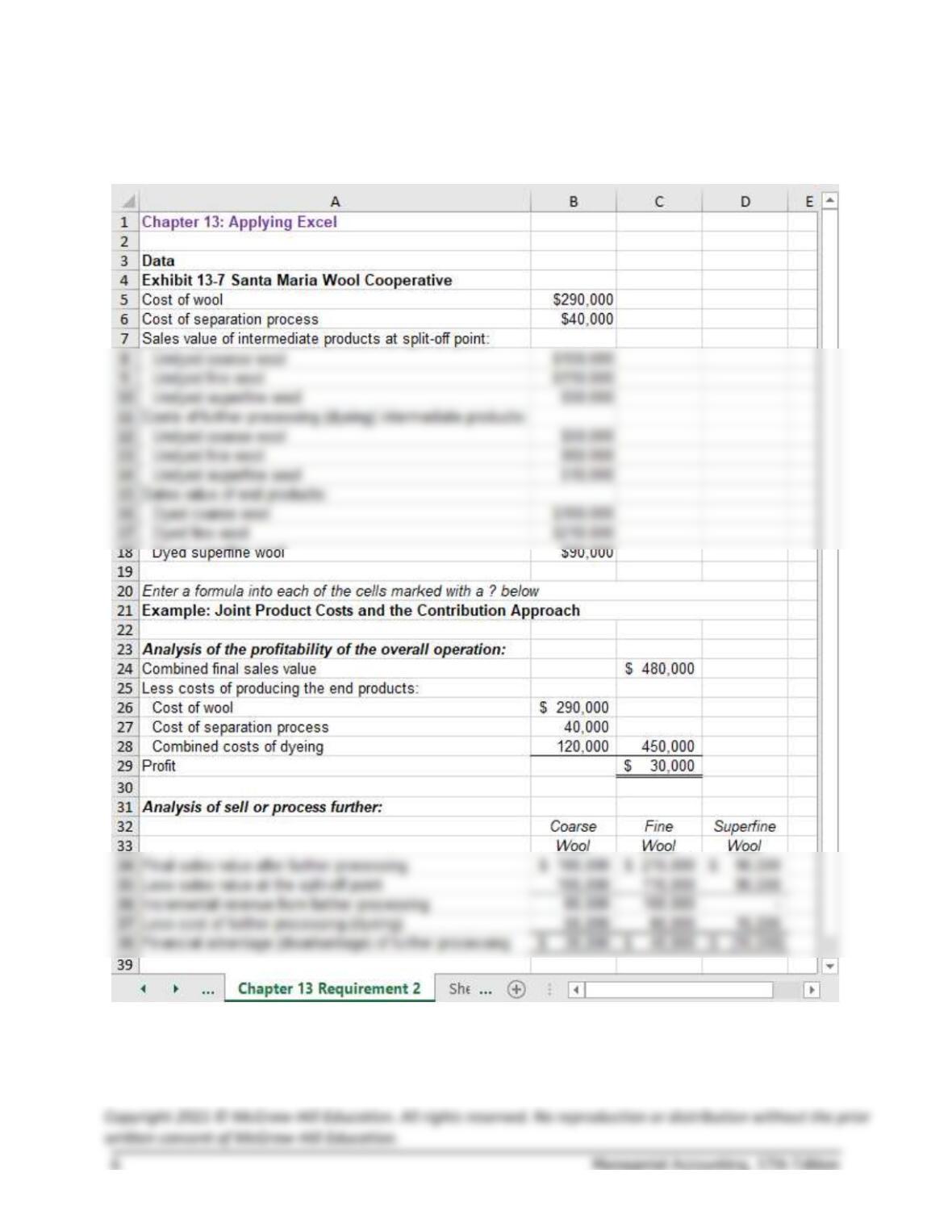
Chapter 13: Applying Excel (continued)
2. With the revised data, the worksheet should look like this:
Chapter 13: Applying Excel (continued)
a. The profit of the overall operation is now $30,000 if all intermediate
products are processed into final products.
b. The financial advantage (disadvantage) from further processing each
intermediate product is shown below.
Coarse
Fine
Superfine
Wool
Wool
Wool
Financial advantage (disadvantage)
from further processing ……………….
$30,000
$40,000
$(10,000)
$480,000
Less costs of producing the end products:
$290,000
Profit …………………………………………………
The Foundational 15
1. The total traceable fixed manufacturing overhead for Alpha and Beta is
computed as follows:
Alpha
Beta
Traceable fixed overhead per unit (a) ……
Level of activity in units (b) …………………
100,000
100,000
Total traceable fixed overhead (a) × (b) ..
2. The total common fixed expenses is computed as follows:
Alpha
Beta
Common fixed expenses per unit (a) …….
$15
$10
Level of activity in units (b) …………………
100,000
100,000
Total common fixed expenses (a) × (b) …
$1,500,000
$1,000,000
The company’s total common fixed expenses would be $2,500,000.
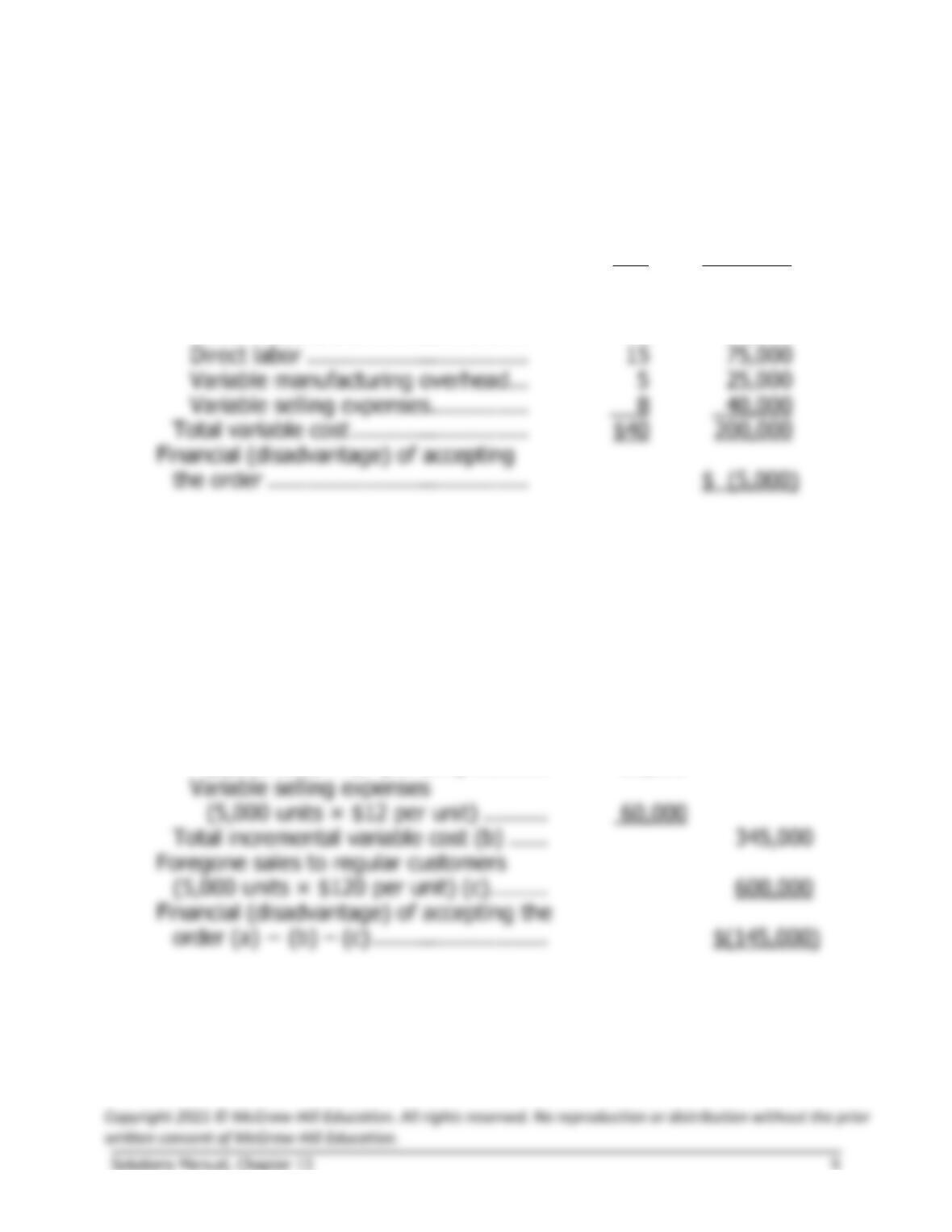
3. The financial advantage of accepting the order is computed as follows:
Per
Total
Unit
10,000 units
The Foundational 15 (continued)
4. The financial (disadvantage) is computed as follows:
Per
Total
Unit
5,000 units
Incremental revenue ……………………..
$39
$195,000
Incremental costs:
Variable costs:
Direct materials ……………………….
12
60,000
Direct labor …………………………….
15
75,000
Variable selling expenses ……………
$40
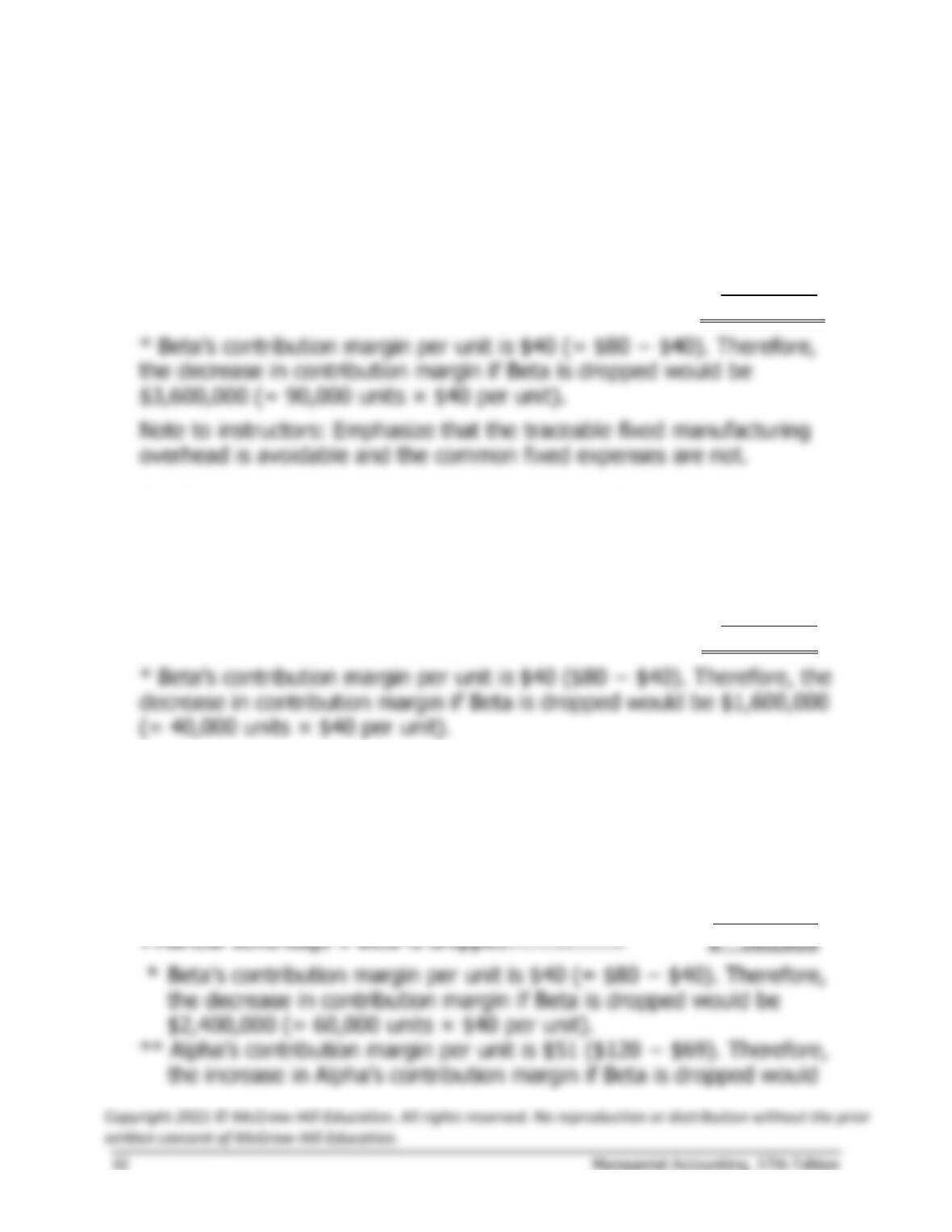
5. The financial (disadvantage) is computed as follows:
Incremental revenue
(10,000 units × $80 per unit) (a) ……..
$800,000
Incremental variable costs:
Direct materials (5,000 units × $30
per unit) …………………………………
$150,000
Direct labor (5,000 units × $20 per
unit) ………………………………………
100,000
Variable manufacturing overhead
(5,000 units × $7 per unit) …………
35,000
Total incremental variable cost (b) ……
Foregone sales to regular customers
Note to instructors: There will be additional sales of 10,000 units to the
new customer, but because sales to existing customers will decline by
5,000 units, the net effect will be to increase production and sales by
5,000 units.
The Foundational 15 (continued)
6. The financial (disadvantage) of dropping the Beta product line is
computed as follows:
Contribution margin lost if the Beta product line is
dropped* …………………………………………………………
$(3,600,000)
Traceable fixed manufacturing overhead ……………………
1,800,000
Financial (disadvantage) if Beta is dropped ………..
$(1,800,000)
7. The financial advantage of dropping the Beta product line is computed
as follows:
Contribution margin lost if the Beta product line is
dropped* ……………………………………………………..
$(1,600,000)
Traceable fixed manufacturing overhead ………………..
1,800,000
Financial advantage if Beta is dropped ………………
$ 200,000
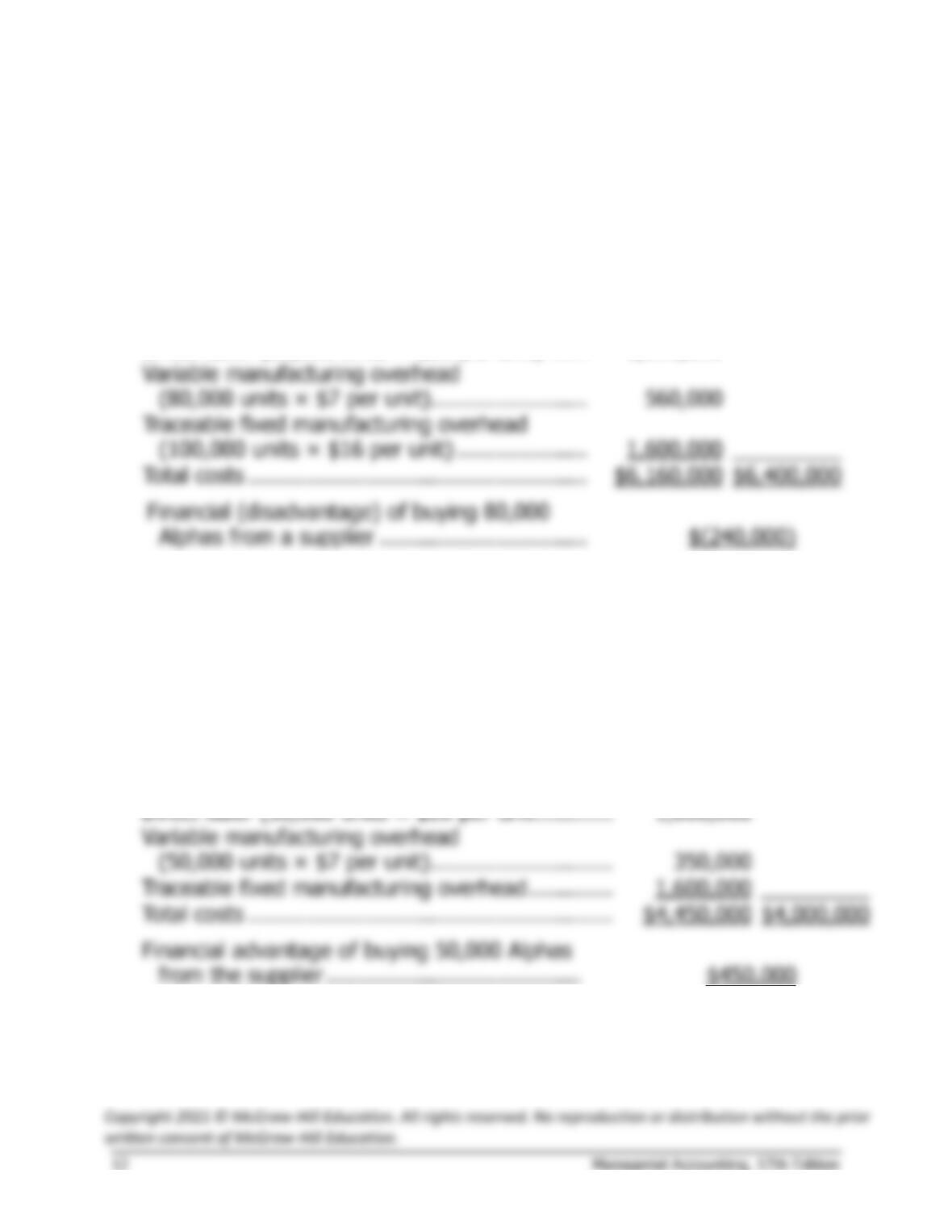
8. The financial advantage of dropping the Beta product line is computed
as follows:
Contribution margin lost if the Beta product line is
dropped* ……………………………………………………..
$(2,400,000)
Traceable fixed manufacturing overhead ………………..
1,800,000
Contribution margin on additional Alpha sales** ……..
765,000
Financial advantage if Beta is dropped ………………

The Foundational 15 (continued)
9. The financial (disadvantage) of buying 80,000 Alphas from a supplier
rather than making them is computed as follows:
Make
Buy
Cost of purchasing (80,000 units × $80 per
unit) ………………………………………………….
$6,400,000
Direct materials (80,000 units × $30 per unit)
$2,400,000
Direct labor (80,000 units × $20 per unit) ……
1,600,000
(80,000 units × $7 per unit) ……………………
1,600,000
Total costs …………………………………………….
$6,160,000
$6,400,000
Alphas from a supplier …………………………..
Note to instructors: Emphasize that the variable selling expenses are
irrelevant to this decision because they will be incurred regardless of
whether the company makes or buys its Alphas.
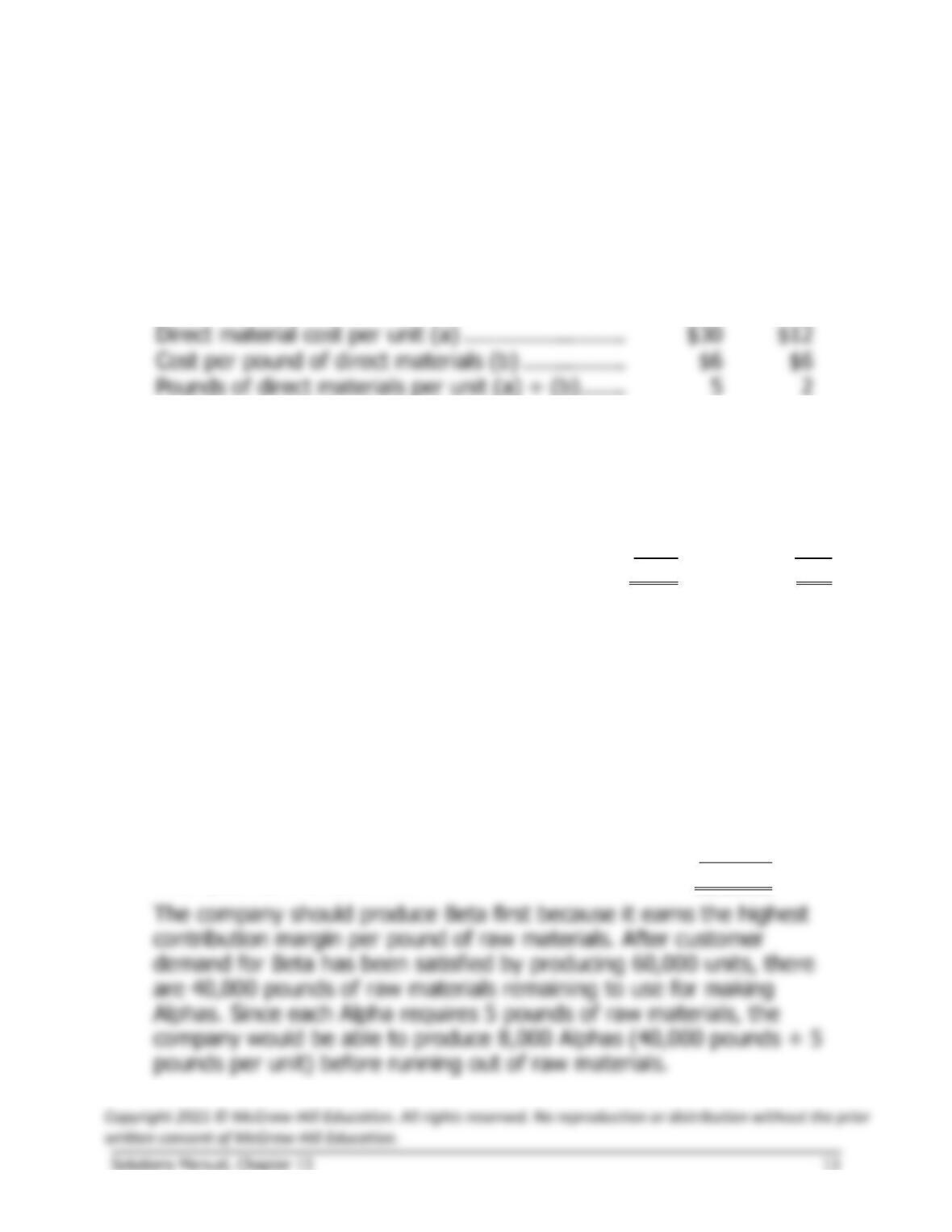
10. The financial advantage of buying 50,000 Alphas from a supplier rather
than making them is computed as follows:
Make
Buy
Cost of purchasing (50,000 units × $80 per unit)
$4,000,000
Direct materials (50,000 units × $30 per unit) ….
$1,500,000
Direct labor (50,000 units × $20 per unit …………
Traceable fixed manufacturing overhead ………….
Total costs ………………………………………………..
$4,450,000
$4,000,000
Financial advantage of buying 50,000 Alphas
from the supplier …………………………………
The Foundational 15 (continued)
Note to instructors: Emphasize that the variable selling expenses are
irrelevant to this decision in requirement 10 because they will be
incurred regardless of whether the company makes or buys its Alphas.
11. The pounds of raw material per unit are computed as follows:
Alpha
Beta
Direct material cost per unit (a) …………………….
Cost per pound of direct materials (b) …………….
Pounds of direct materials per unit (a) ÷ (b) …….
12. The contribution margins per pound of raw materials are computed as
follows:
Alpha
Beta
Selling price per unit ………………………..
$120
$80
Variable cost per unit ……………………….
69
40
Contribution margin per unit (a) …………
$ 51
$40
Pounds of direct material required to
produce one unit (b) ……………………..
5 pounds
2 pounds
Contribution margin per pound (a) ÷ (b)
$10.20
per pound
$20.00 per
pound
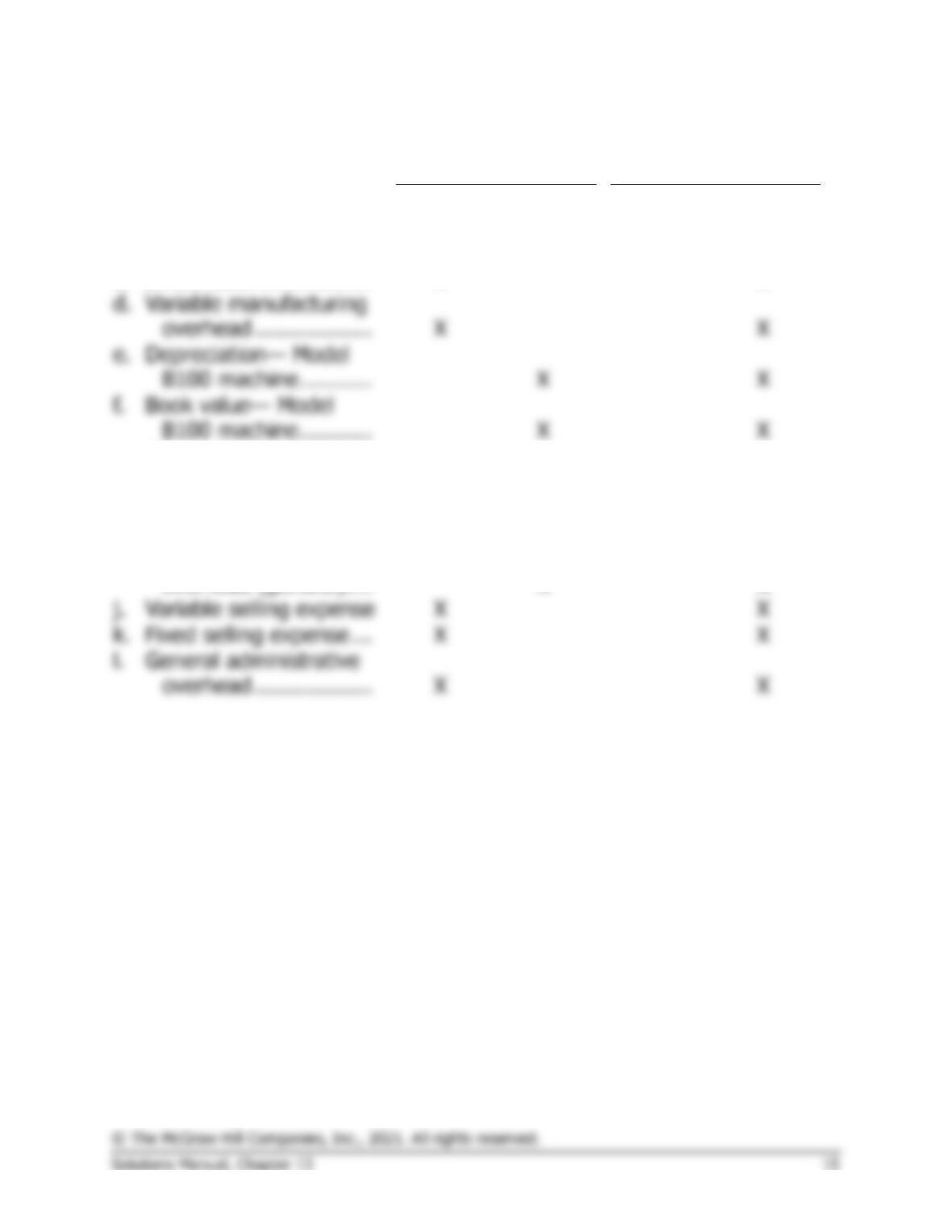
13. The optimal number of units to produce would be computed as
follows:
Product
Pounds
Per Unit
Units
Produced
Total
Pounds
Beta ……………………………..
2
60,000
120,000
Alpha …………………………...
5
8,000
40,000
Total pounds available ………
160,000
The Foundational 15 (continued)
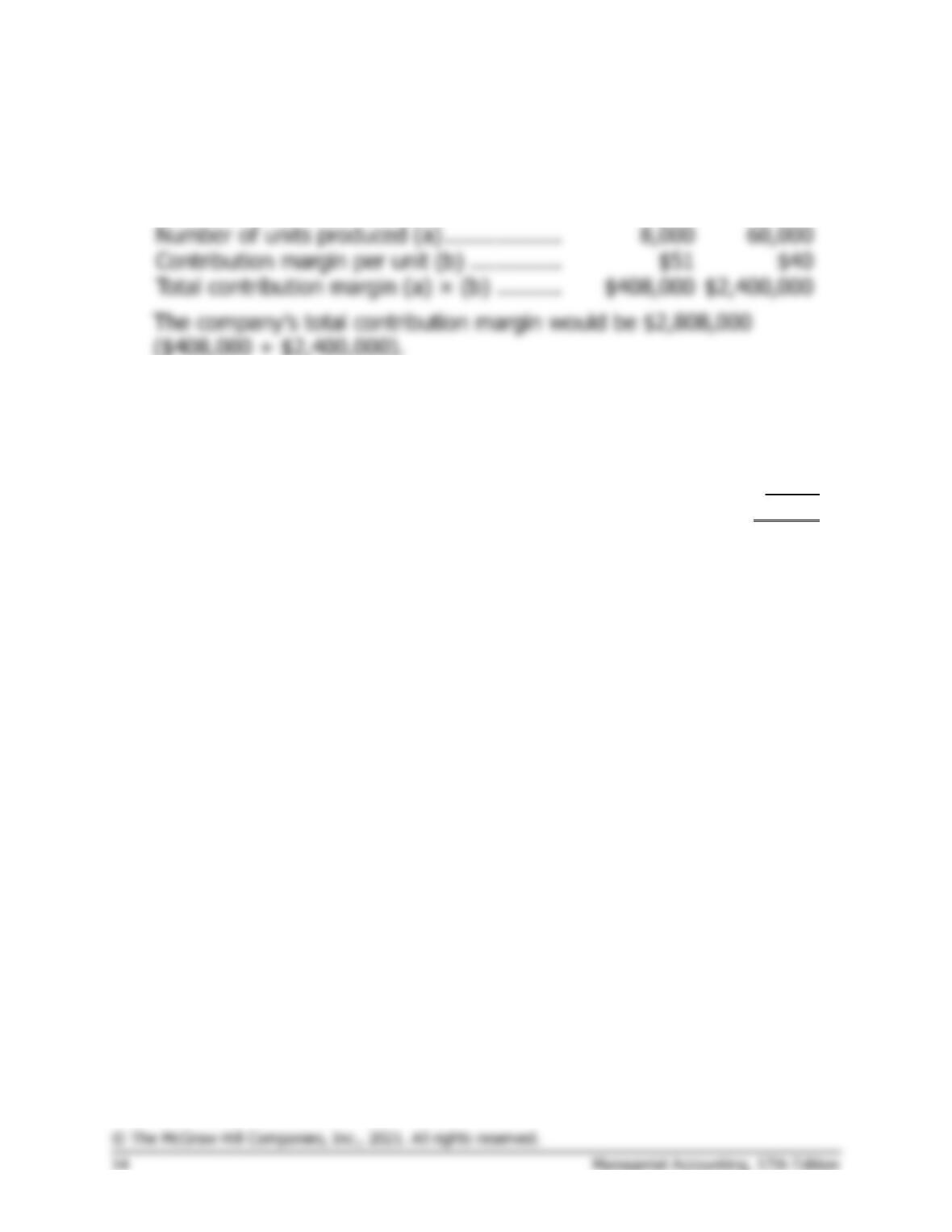
14. The total contribution margin would be computed as follows:
Alpha
Beta
Number of units produced (a) ………………
Contribution margin per unit (b) …………..
Total contribution margin (a) × (b) ……….
15. The maximum price per pound is computed as follows:
Alpha
Regular direct material cost per pound ………………………..
$ 6.00
Contribution margin per pound of direct materials ………….
10.20
Maximum price to be paid per pound ………………………….
$16.20
Because the company has satisfied all demand for Betas, it would use
additional raw materials to produce Alphas.
Exercise 13-1 (15 minutes)
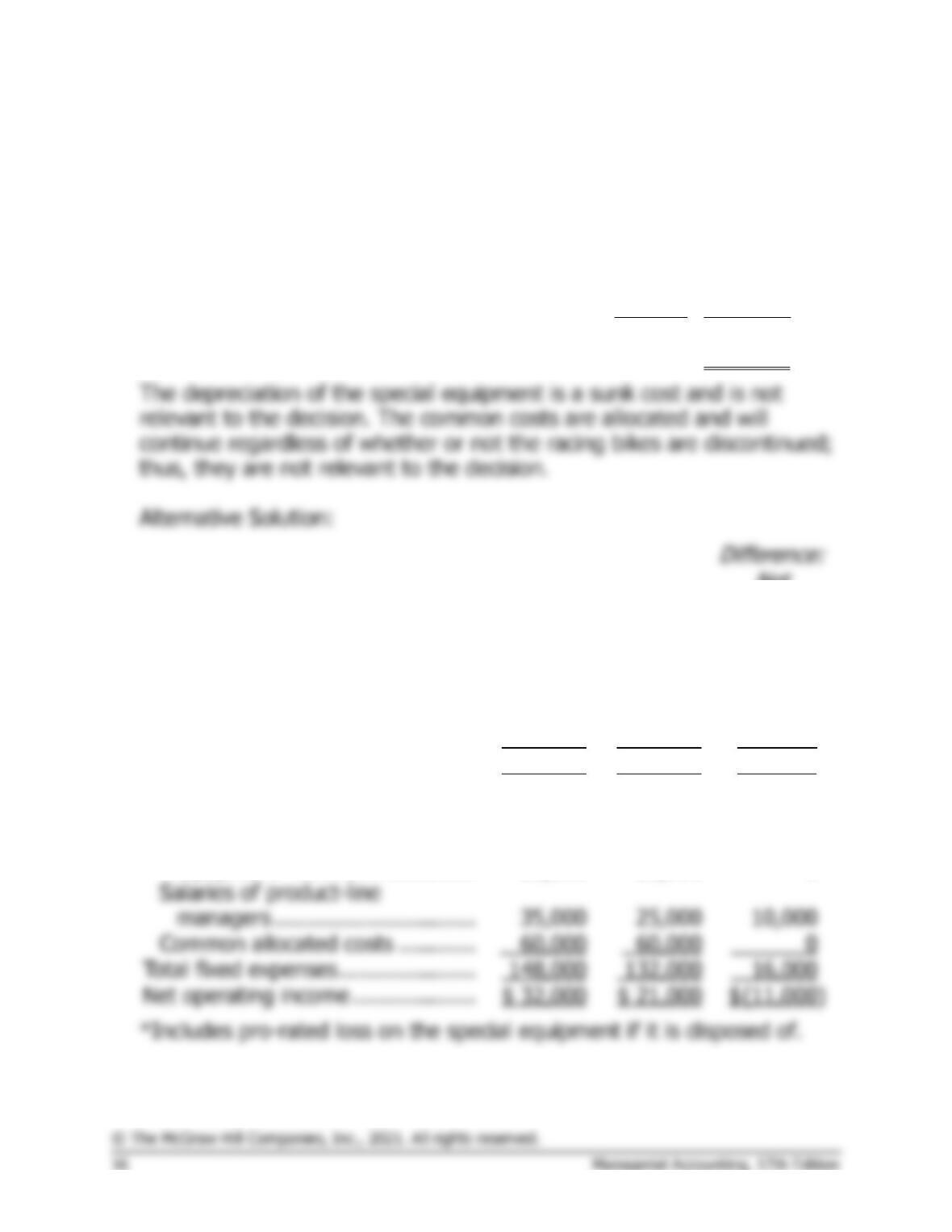
Case A
Case B
Item
Relevant
Irrelevant
Relevant
Irrelevant
a.
Sales revenue …………..
X
X
b.
Direct materials ………..
X
X
c.
Direct labor ……………..
X
X
Variable manufacturing
X
X
Book value— Model
B100 machine ………..
X
g.
Disposal value— Model
B100 machine ………..
X
X
h.
Market value—Model
B300 machine (cost) .
X
X
i.
Fixed manufacturing
overhead (general) ….
X
X
Variable selling expense
X
X
Fixed selling expense …
X
X
l.
General administrative
X
X
Exercise 13-2 (30 minutes)
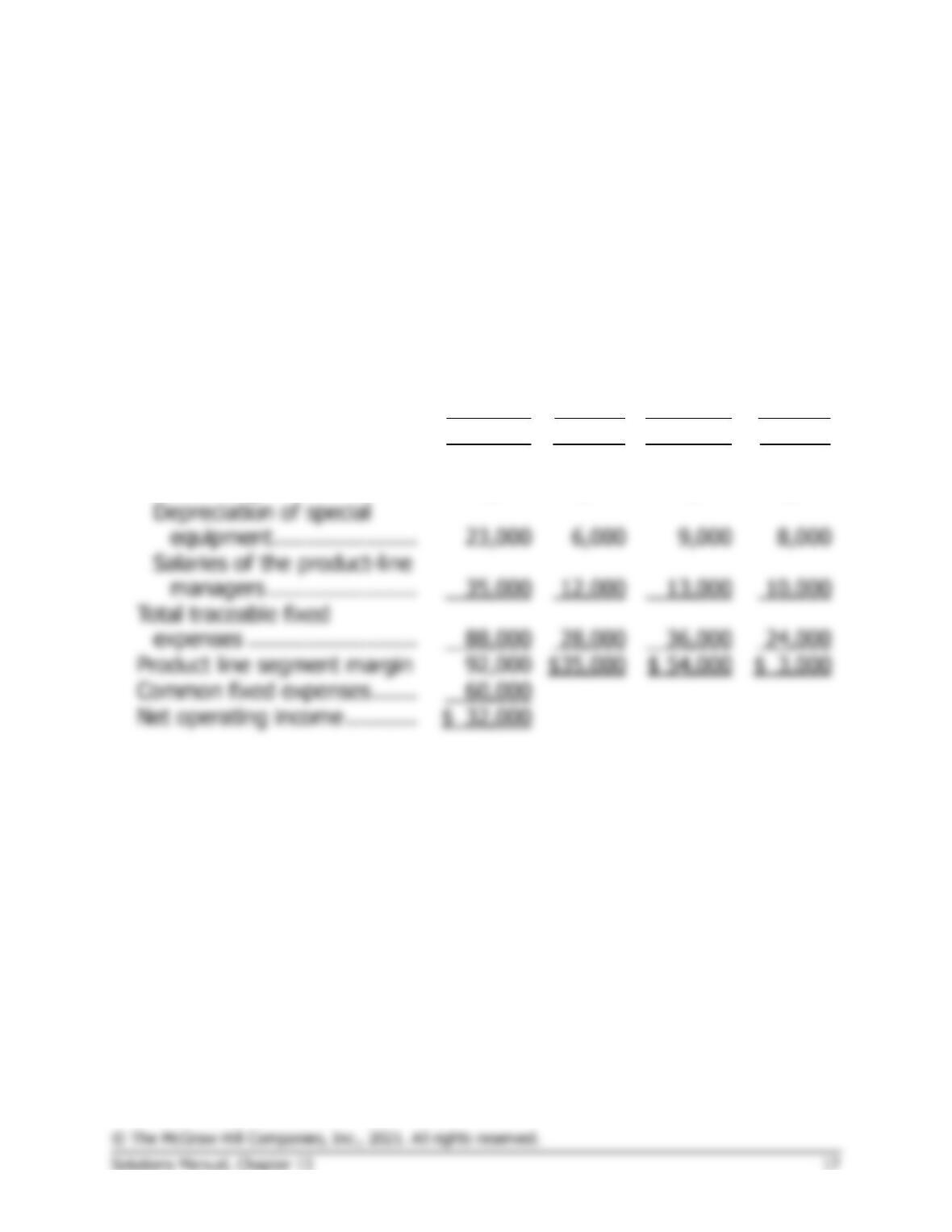
1. The financial (disadvantage) of discontinuing the racing bikes is
computed as follows:
Lost contribution margin …………………………..
$(27,000)
Fixed costs that can be avoided:
Advertising, traceable …………………………….
$ 6,000
Salary of the product-line manager …………..
10,000
16,000
Financial (disadvantage) of discontinuing the
Racing Bikes ………………………………………..
$(11,000)
Current
Total
Total If
Racing
Bikes Are
Dropped
Net
Operating
Income
Increase or
(Decrease)
Sales …………………………………….
$300,000
$240,000
$(60,000)
Variable expenses ……………………
120,000
87,000
33,000
Contribution margin …………………
180,000
153,000
(27,000)
Fixed expenses:
Advertising, traceable …………….
30,000
24,000
6,000
Depreciation on special
equipment* ……………………….
23,000
23,000
0
35,000
Common allocated costs …………
0
Total fixed expenses …………………
148,000
Net operating income ……………….
$ 32,000
$ 21,000
Exercise 13-2 (continued)
2. No, production and sale of the racing bikes should not be discontinued.
3. The segmented report can be improved by eliminating the allocation of
the common fixed expenses. Following the format introduced in Chapter
6 for a segmented income statement, a better report would be:
Total
Dirt
Bikes
Mountain
Bikes
Racing
Bikes
Sales ……………………………..
$300,000
$90,000
$150,000
$60,000
Variable manufacturing and
selling expenses …………….
120,000
27,000
60,000
33,000
Contribution margin ………….
180,000
63,000
90,000
27,000
Traceable fixed expenses:
Advertising ……………………
30,000
10,000
14,000
6,000
12,000
Product line segment margin
$35,000
$ 54,000
$ 3,000
Common fixed expenses …….
Net operating income ………..
$ 32,000
Exercise 13-3 (30 minutes)
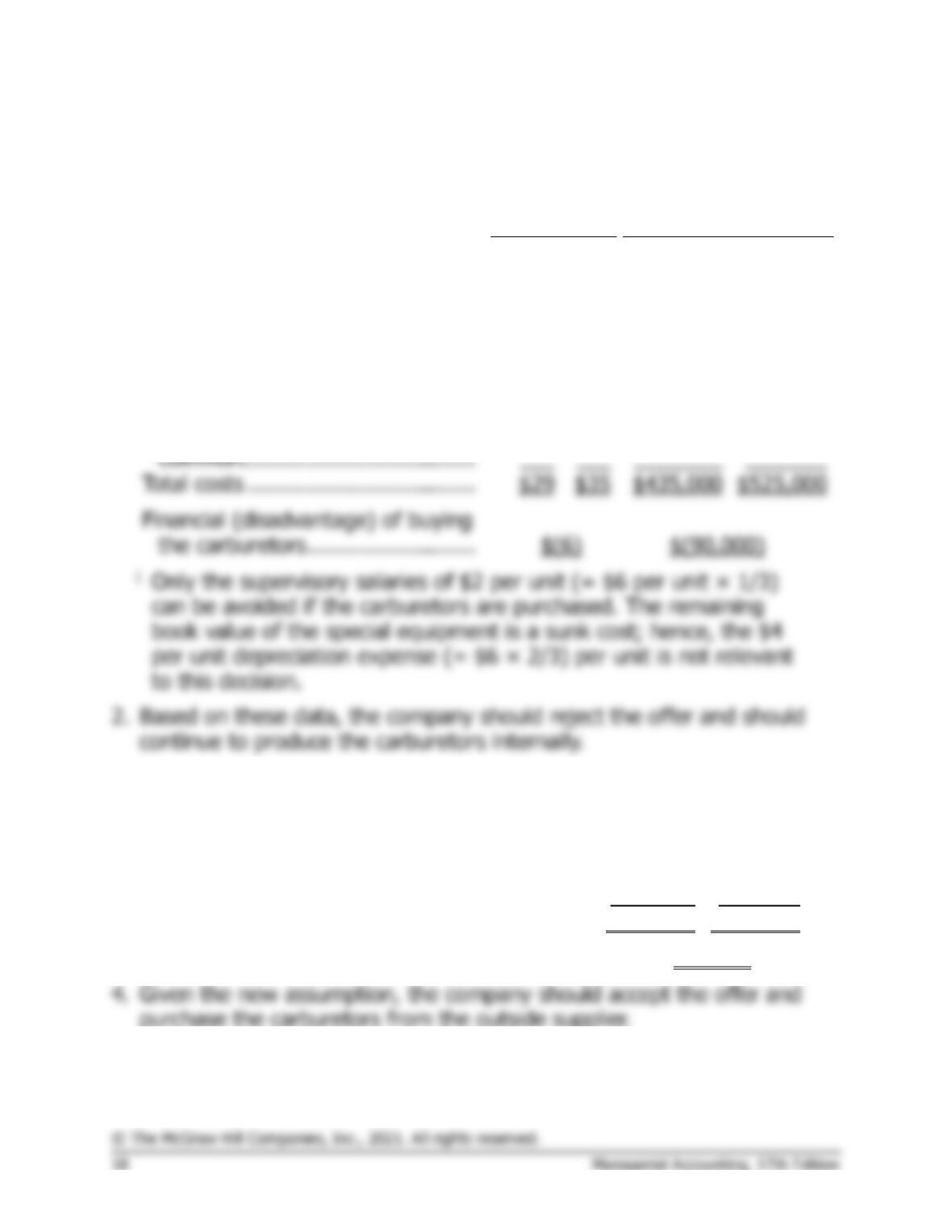
1.
Per Unit
Differential
Costs
15,000 units
Make
Buy
Make
Buy
Cost of purchasing …………………..
$35
$525,000
Direct materials ……………………….
$14
$210,000
Direct labor …………………………….
10
150,000
Variable manufacturing overhead ..
3
45,000
Fixed manufacturing overhead,
traceable1 …………………………….
2
30,000
Total costs ……………………………..
Financial (disadvantage) of buying
$(6)
Fixed manufacturing overhead,
3.
Make
Buy
Cost of purchasing (see requirement 1) ……….
$525,000
Cost of making (see requirement 1) ……………
$435,000
Opportunity cost—segment margin foregone
on a potential new product line ……………….
150,000
Total cost ………………………………………………
$585,000
$525,000
Financial advantage of buying the carburetors
$60,000
Exercise 13-4 (15 minutes)
1. Only the incremental costs and benefits are relevant. In particular, only
the variable manufacturing overhead and the cost of the special tool are
relevant overhead costs in this situation. The other manufacturing
overhead costs are fixed and are not affected by the decision.
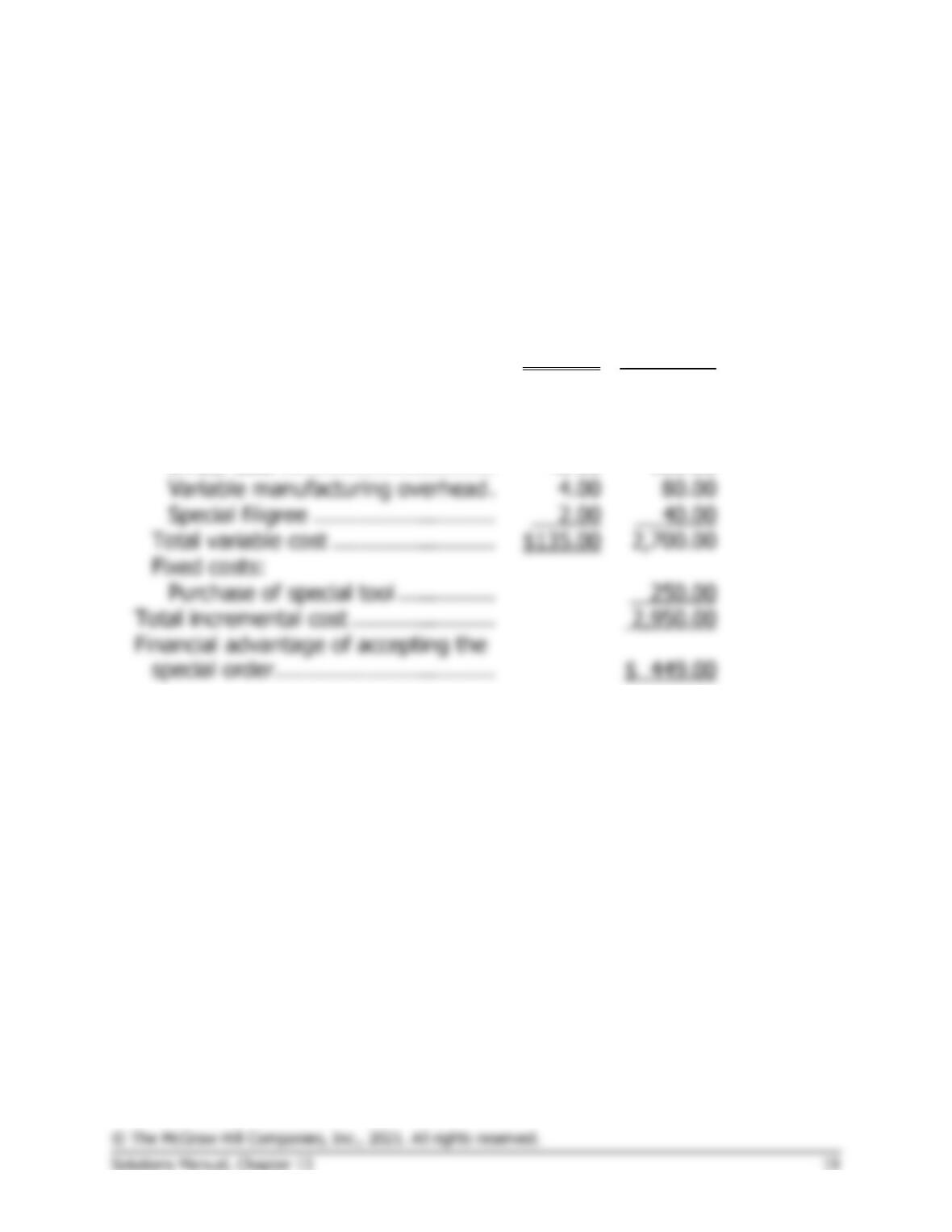
Per Unit
Total
for 20
Bracelets
Incremental revenue ……………………
$169.95
$3,399.00
Incremental costs:
Variable costs:
Direct materials ………………………
$ 84.00
1,680.00
Direct labor …………………………...
45.00
Variable manufacturing overhead .
$135.00
Fixed costs:
Purchase of special tool ……………
Total incremental cost ………………….
2. Even though the price for the special order is below the company’s
regular price for such an item, the company would be better off
accepting the order. This conclusion would not necessarily follow if the
special order affected the regular selling price of bracelets or if it
required the use of a constrained resource.
Exercise 13-5 (20 minutes)
1. The most profitable use of the constrained resource is determined by
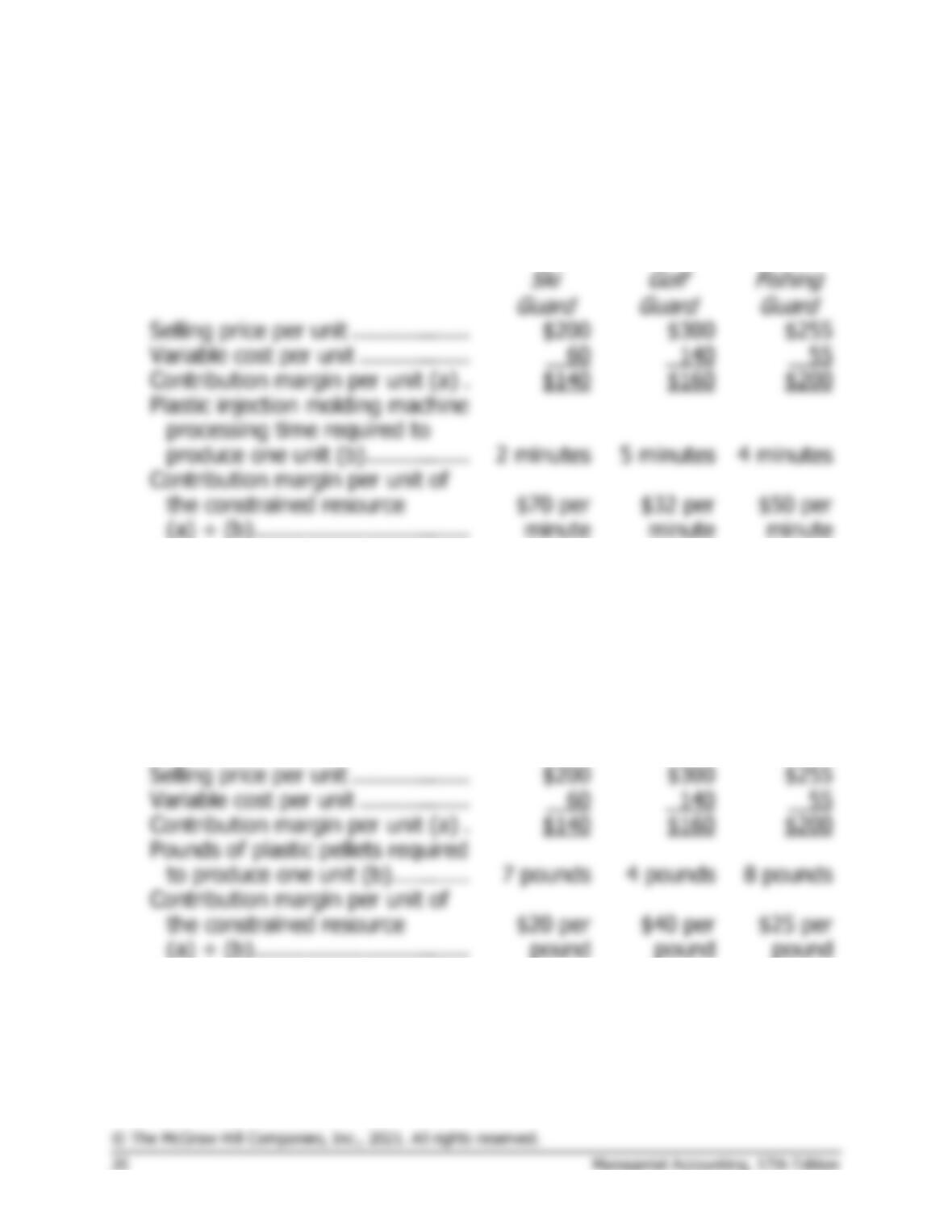
the contribution margin per unit of the constrained resource. In part 1,
the constrained resource is time on the plastic injection molding
machine. Therefore, the analysis would proceed as follows:
Ski
Golf
Fishing
Guard
Guard
Guard
2. Production of the Ski Guard product would be the most profitable use of
the constrained resource which is, in this case, time on the plastic
injection molding machine. The contribution margin per minute is $70
for this product, which is larger than for the other two products.
3. In this part, the constraint is the available pounds of plastic pellets.
Ski
Golf
Fishing
Guard
Guard
Guard
4. In this case, production of the Golf Guard would be the most profitable
use of the constrained resource. The contribution margin per unit of the
constrained resource for this product is $40, which is larger than for the
other two products.