13-1
—————————————-————–Chapter 13————————————————
REVIEW QUESTIONS
Q 13-1 The Financial Accounting Standards Board (FASB) sets standards for not-for-profit hospitals in its Ac-
counting Standards Codification (ASC). Governmental hospitals are governed by generally accepted ac-
Q 13-2 General Funds are used to account for day–to-day operations of a hospital and its unrestricted resources.
Donor-Restricted Funds are used to account for resources that must be used in compliance with the terms
Q 13-3 Not-for-profit hospitals present a balance sheet, a statement of operations, a statement of changes in net
assets, and a statement of cash flows. The balance sheet reports assets, liabilities, and net assets segregated
classified as unrestricted, temporarily restricted, and permanently restricted balances. The statement of op-
Q 13-4 A contractual adjustment is the difference between a hospital’s established billing rate and the actual pay-
ment amount negotiated with a third party payer.
Q 13-5 For financial reporting purposes, not-for-profit patient service revenues are reported net of contractual ad-
Q 13-6 Gross patient service revenues are reduced by the amount determined to be charity care. It is not reported
Q 13-7 Both prospective and retrospective contractual adjustments affect the computation of net patient service
revenue. However, prospective contractual adjustments are known at the time of billing, whereas retro-
Q 13-8 Not-for-profit hospitals must report investments in equity securities at fair value at the balance sheet date.
Therefore, the hospital should report the securities at its fair value of $12,000. A governmental hospital
13-2
Q 13-10 Recording a hospital’s expenses by natural classification means recording by object of account, such as sal-
aries and benefits, medical supplies and drugs, and insurance. Recording by function means recording by
Q 13-11 Whether expenses and liabilities need to be recognized on malpractice claims depends on whether risk has
been transferred by the hospital to third-party insurance companies or public entity risk pools. The basic
Q 13-12 Resources that are board-designated are usually placed in accounts whose names identify the segregation;
e.g.; Investments – board designated for plant and equipment.
Q 13-13 Resources raised by a not-for-profit hospital’s fund–raising foundation are reported in the hospital’s finan-
Q 13-15 First, the generic not-for-profit statement of activities (operating statement) is split into two statements—a
statement of operations and a statement of changes in net assets. A not-for-profit hospital’s Statement of
DISCUSSION SCENARIOS AND ISSUES
D 13-1 A not-for-profit hospital must follow the requirements of FASB ASC Section 958-605-25. That section re-
quires that, if donated services require specialized skills, are provided by individuals who possess those
D 13-2 The hospital cannot use donor restricted funds for any purpose other than that specified by the donor. In
many instances to use either the principle or income of a restricted fund for any purpose other than that for
D 13-3 The answer to this question depends on the donor’s intent. If the donor clearly intended the gift to be unre-
stricted, Ms. Friend is at liberty to place the money in a board–designated fund, provided, of course, the board is
agreeable. If there is a written agreement between the donor and the hospital, that agreement should identify any re-
D 13-4 This situation involves two issues – the use of due care in preparing estimates and materiality of the amount
involved. Failure to exercise due care could subject the hospital to accusation of fraud.
Estimating procedures: The hospital is duty-bound to estimate the allowance for bad debts using the best in-
formation available at the time the financial statements are prepared. The comptroller cannot simply lower
EXERCISES
E 13-1 (5 minutes)
1. not-for-profit
E 13-2 (10 minutes)
1. GF
E 13-3 (10 minutes)
1. a. Unrestricted
2. b. Temporarily restricted
E 13-4 (20 minutes)
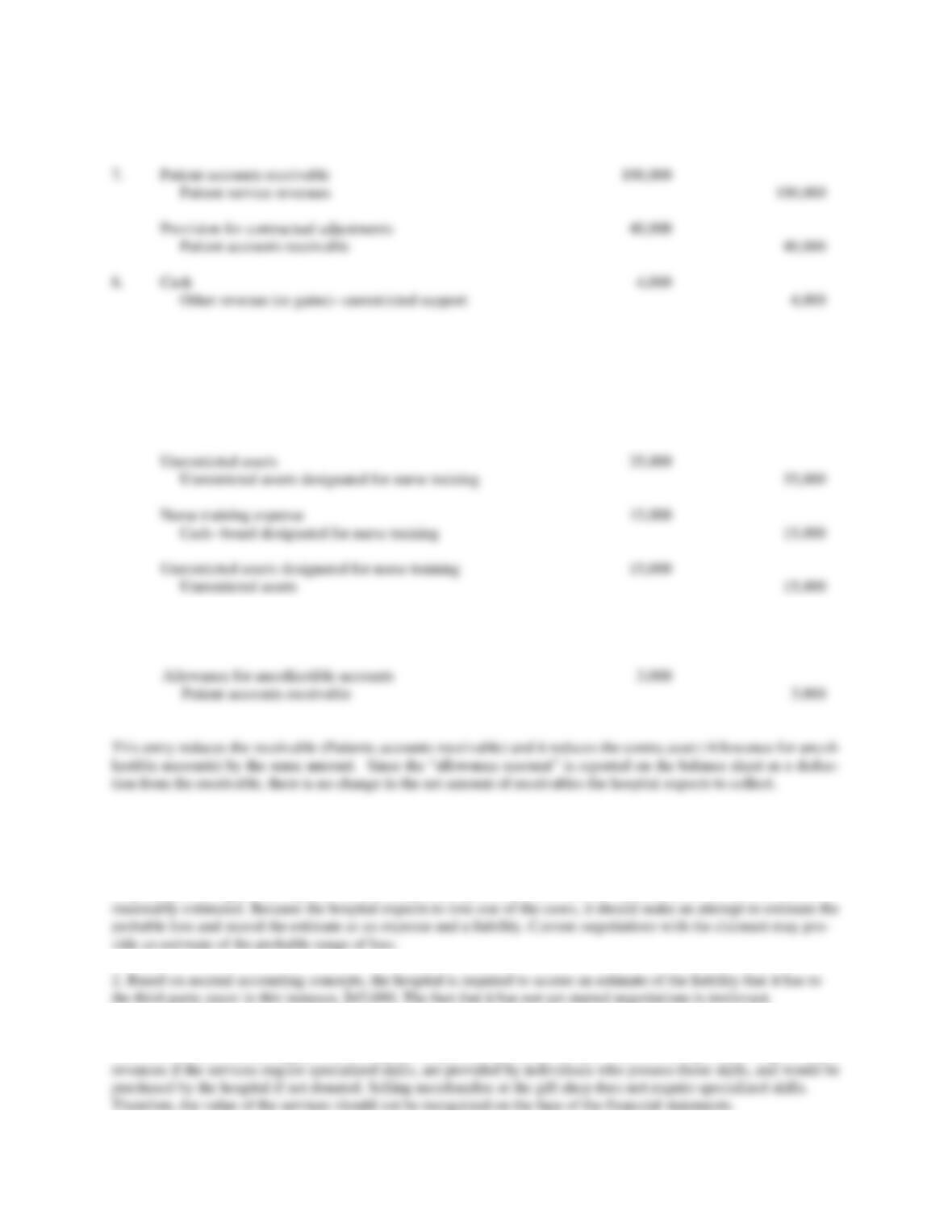
1. Patient accounts receivable 250,000
Patient service revenues 250,000
3. Administrative services expense 10,000
Cash 10,000
5. Depreciation expense 34,000
Accumulated depreciation 34,000
13-5
6. No entry needed. These donated services do not require specialized skills.
E 13-5 (10 minutes)
In the General Fund
Cash – board designated for nurse training 35,000
Cash 35,000
E 13-6 (5 minutes)
E 13-7 (25 minutes)
1. Because risk of loss has not been transferred to a third–party insurance company or a public entity risk pool, the
hospital must recognize an expense and a liability if it is probable that a loss has been incurred and the loss can be
3. FASB standards, which apply to not-for-profit hospitals, require that donated services be reported as expenses and
13-6
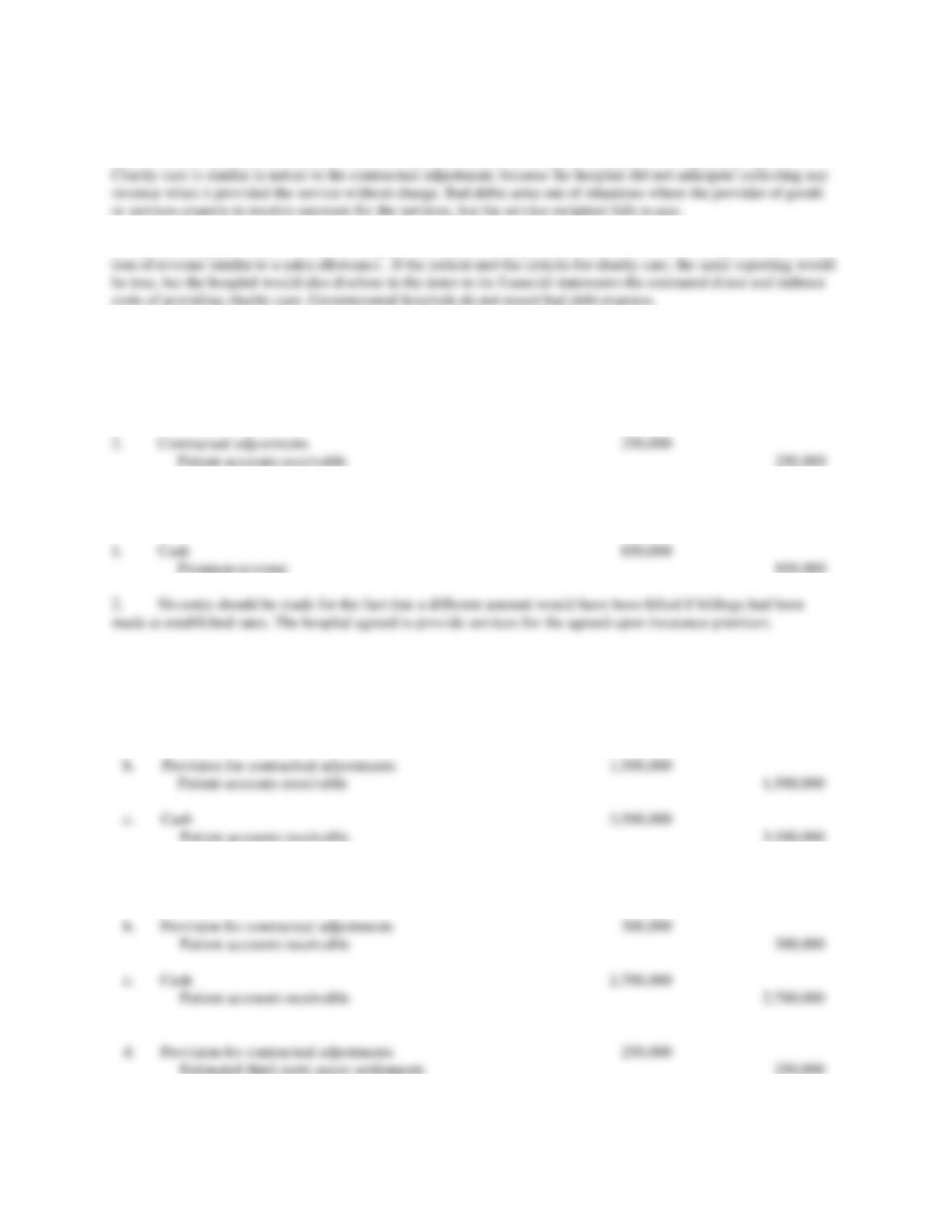
4. Neither the contractual adjustment nor the charity care should be reported as bad debts. The contractual adjust-
ment is similar to a sales allowance, which is treated as a reduction of gross revenues in the operating statement.
5. Because the patient did not meet the hospital’s criteria for charity care, the $20,000 should be reported as a reduc-
E 13-8 (5 minutes)
1. Patient accounts receivable 1,000,000
Patient service revenue 1,000,000
E 13-9 (5 minutes)
E 13-10 (25 minutes)
1.a. Patient accounts receivable 5,000,000
Patient service revenue 5,000,000
2.a. Patient accounts receivable 3,000,000
Patient service revenues 3,000,000
3.a. Patient accounts receivable 1,000,000
13-7
Patient service revenues 1,000,000
E 13-11 (25 minutes)
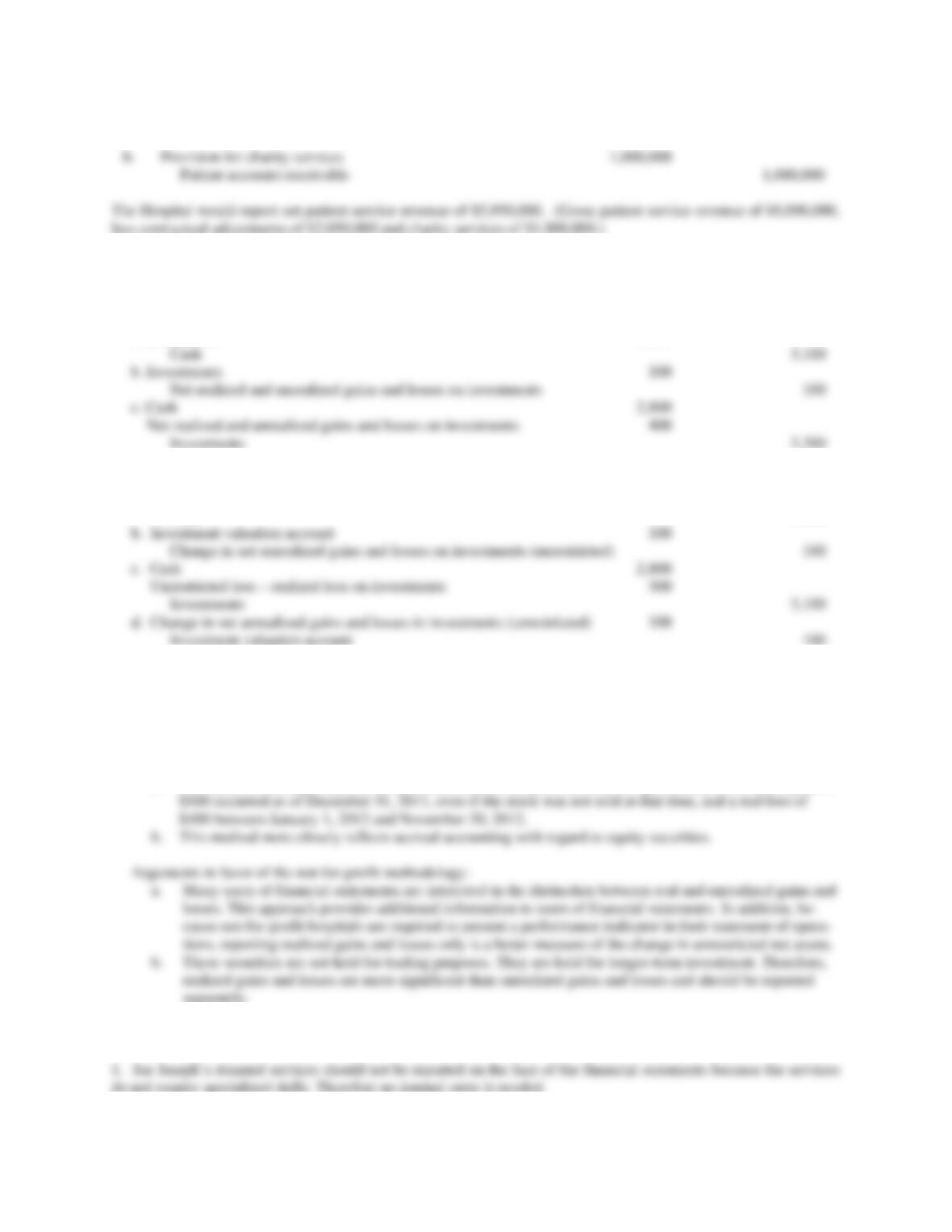
1. Governmental hospital
a. Investments 3,100
2. Not-for-profit hospital
a. Investments 3,100
Cash 3,100
E 13-12 (15 minutes)
Students are likely to have differing opinions on this question.
Arguments in favor of the governmental methodology:
a. This method better portrays the economics of the investment. In terms of opportunity costs, a real gain of
E 13-13 (20 minutes)
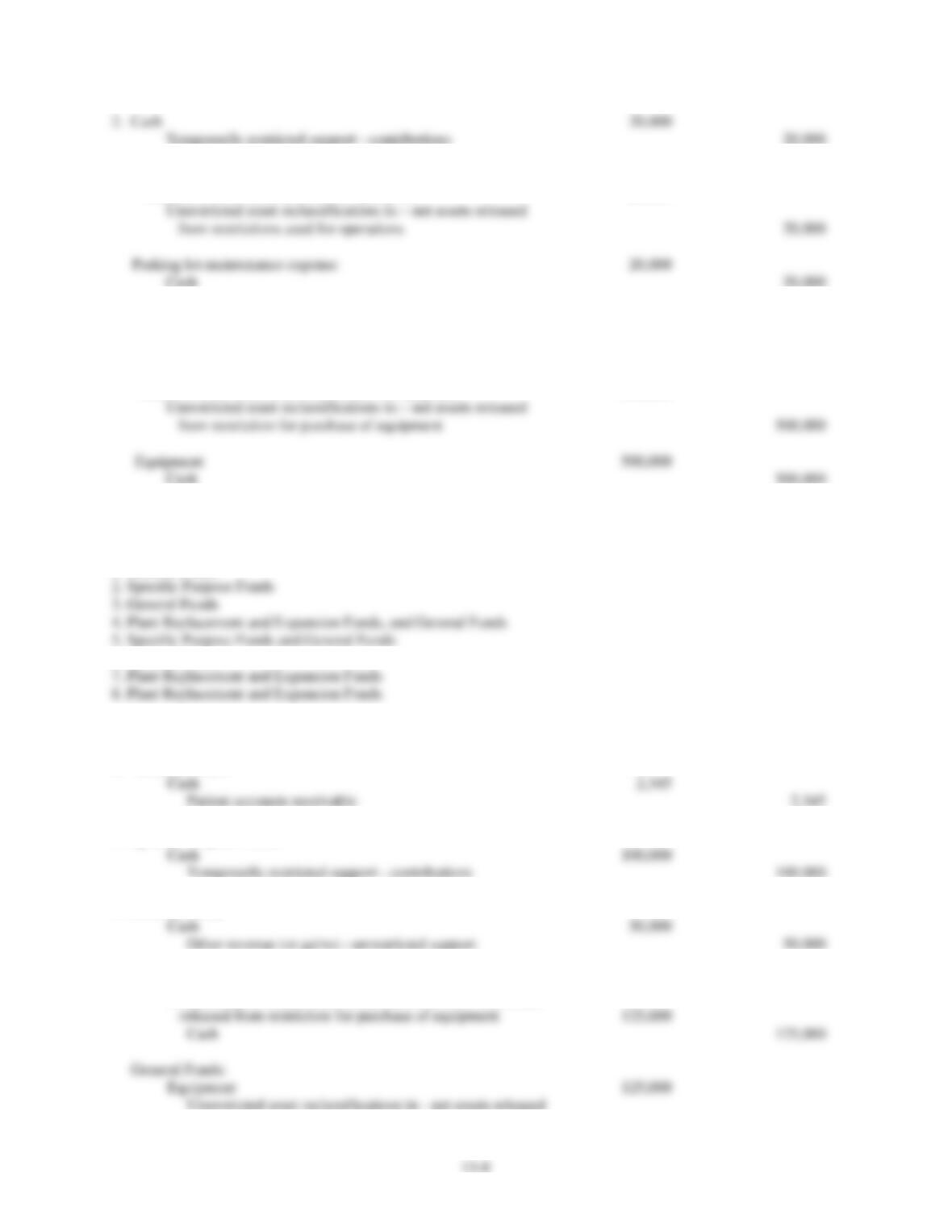
3. Temporarily restricted asset reclassifications out – net assets
released from restriction used for operations 20,000
4. Cash 500,000
Temporarily restricted support – contributions 500,000
5. Temporarily restricted asset reclassifications out – net assets
released from restriction for purchase of equipment 500,000
E 13-14 (10 minutes)
1. General Funds
6. General Funds
E 13-15 (25 minutes)
1. General Funds:
2. Specific Purpose Funds:
3. General Funds:
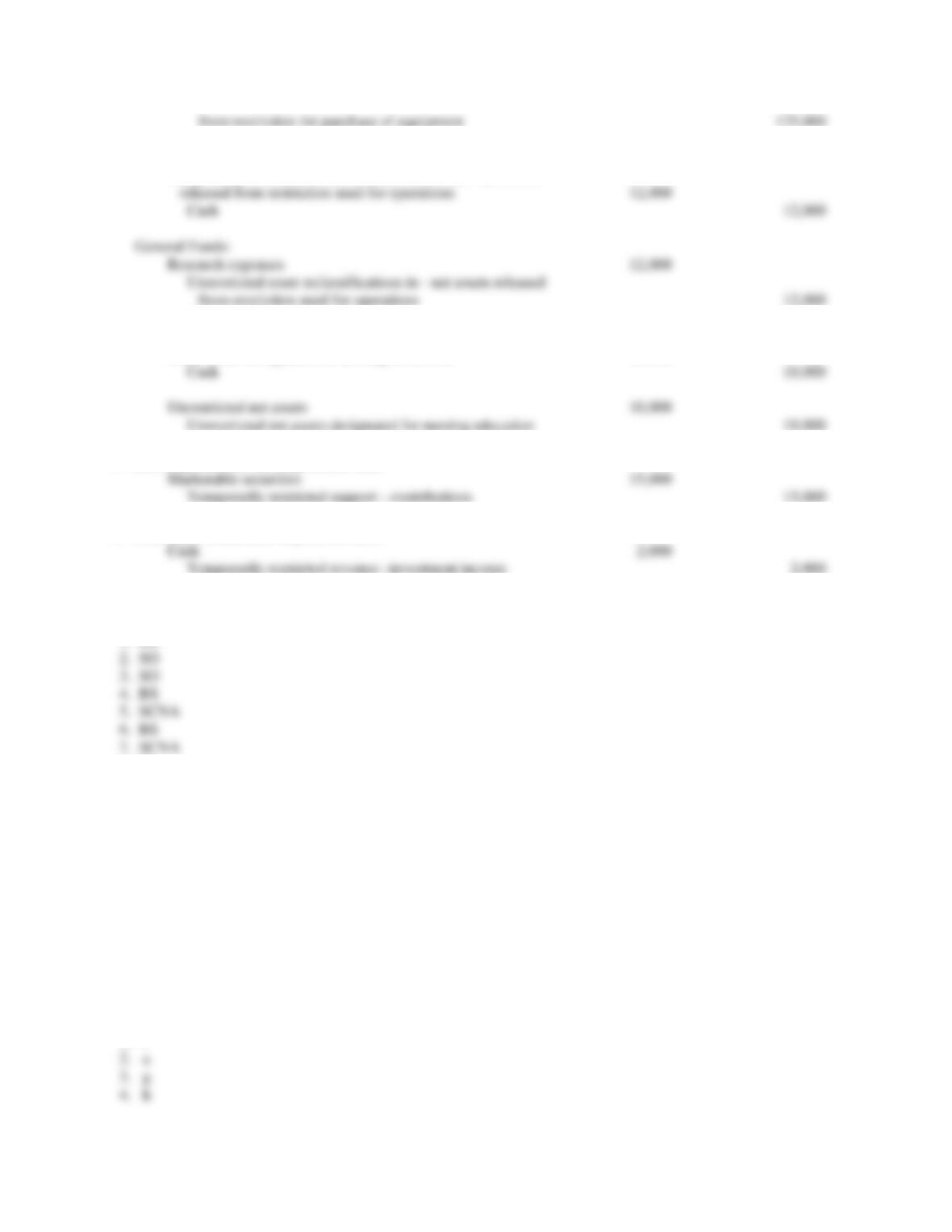
4. Plant Replacement and Expansion Fund:
Temporarily restricted asset reclassifications out – net assets
13-9
5. Specific Purpose Funds:
Temporarily restricted asset reclassifications out – net assets
6. General Funds:
Cash—board designated for nursing education 10,000
7. Plant Replacement and Expansion Fund:
8. Plant Replacement and Expansion Fund:
E 13-16 (15 minutes)
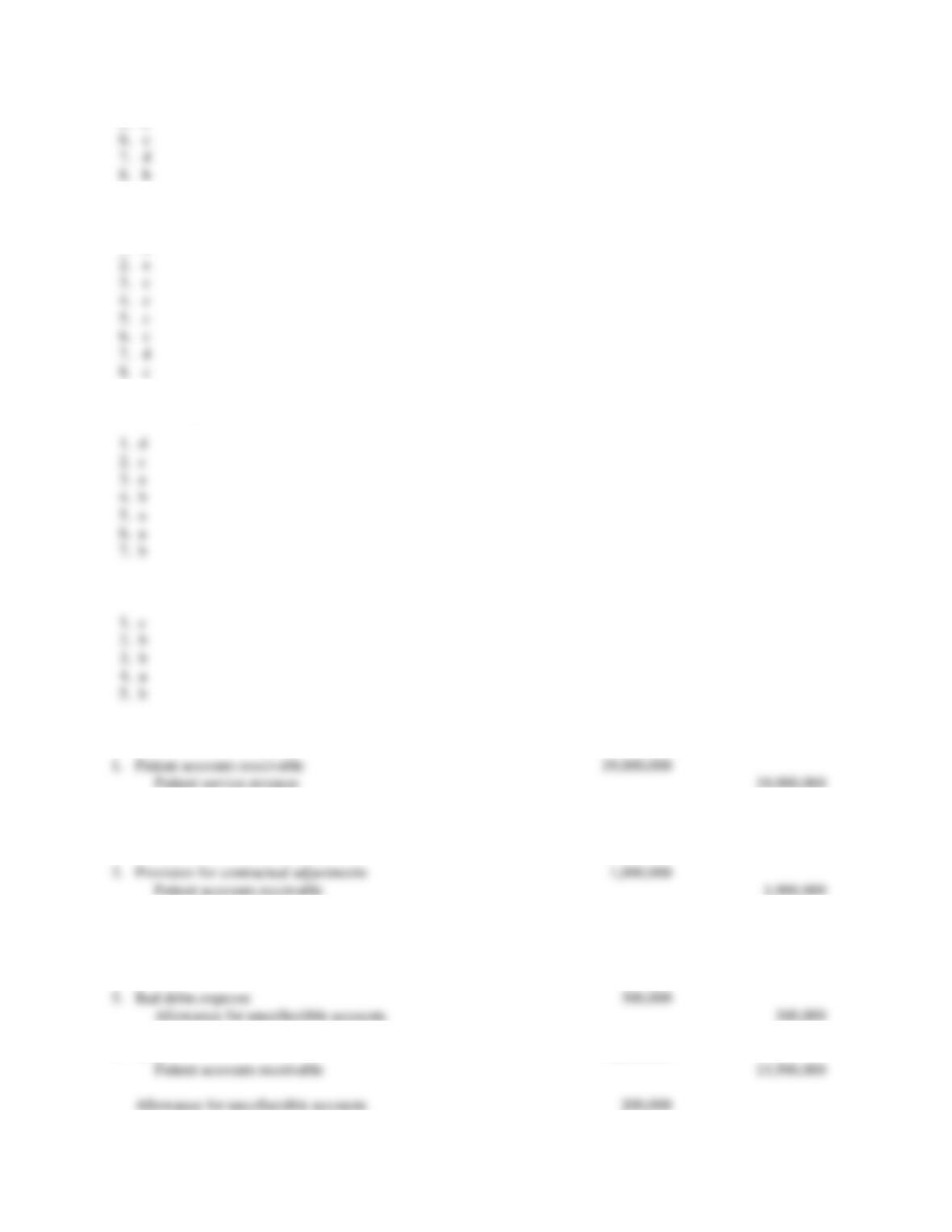
1. BS
8. BS
PROBLEMS
P 13-1 (Moderate, 10 minutes)
1. f
13–10
5. c
P 13-2 (Moderate, 15 minutes)
1. a
P 13-3 (Difficult, 20 minutes)
P13-4 (Difficult, 15 minutes)
P 13-5 (Moderate, 35 minutes)
2. Provision for contractual adjustments 1,500,000
Patient accounts receivable 1,500,000
4. Provision for charity care 500,000
Patient accounts receivable 500,000
6. Cash 13,500,000
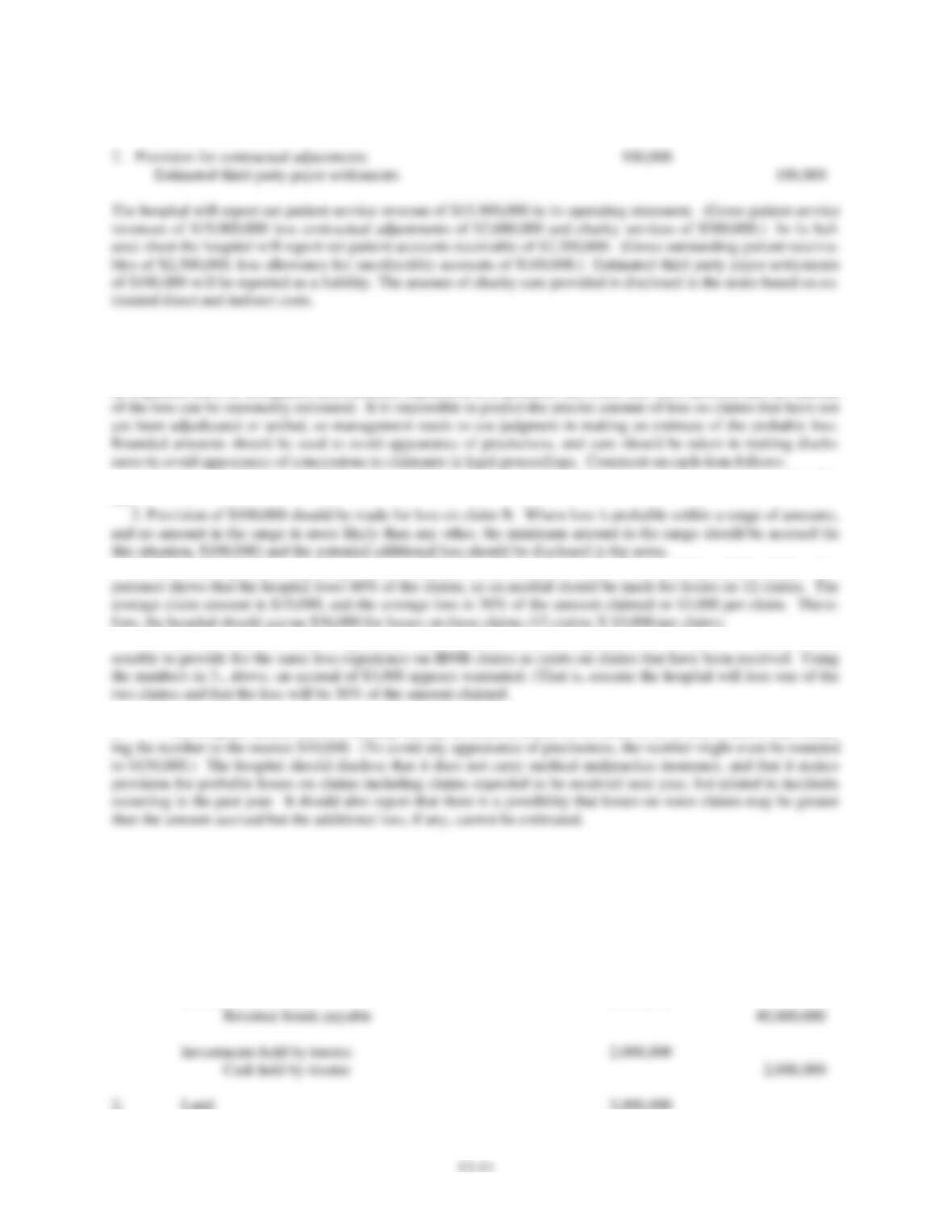
Patient accounts receivable 200,000
P 13-6 (Moderate, 25 minutes)
a. The basic rule on medical malpractice claims is that, if risk has not been transferred to an external third par-
ty, expenses must be recognized and liabilities reported if it is probable that a loss has been incurred and the amount
1. No provision for loss should be made on claim A because the hospital’s attorney believes a loss is not proba-
ble.
3. Historical experience regarding losses on claims should be applied to the 20 outstanding smaller claims. Ex-
4. An accrual should be made for potential losses on incurred but not reported (IBNR) claims. It would be rea-
b. The hospital should report a liability of, say, $140,000, based on the total of 2, 3, and 4, above and round-
P 13-7 (Moderate, 120 minutes)
(a. – Journal entries)
1. Cash 38,000,000
Cash held by trustee 2,000,000