Case 13-29 (45 minutes)
1. As much yarn as possible should be processed into sweaters. Products
should be processed further so long as the added revenues from further
processing are greater than the added costs. In this case, the added
revenues and costs are:
Per Sweater
Added revenue ($30.00 – $20.00) …….
$10.00
Added costs:
Buttons, thread, lining ………………….
$2.00
Direct labor ……………………………….
5.80
7.80
Financial advantage ……………………….
$ 2.20
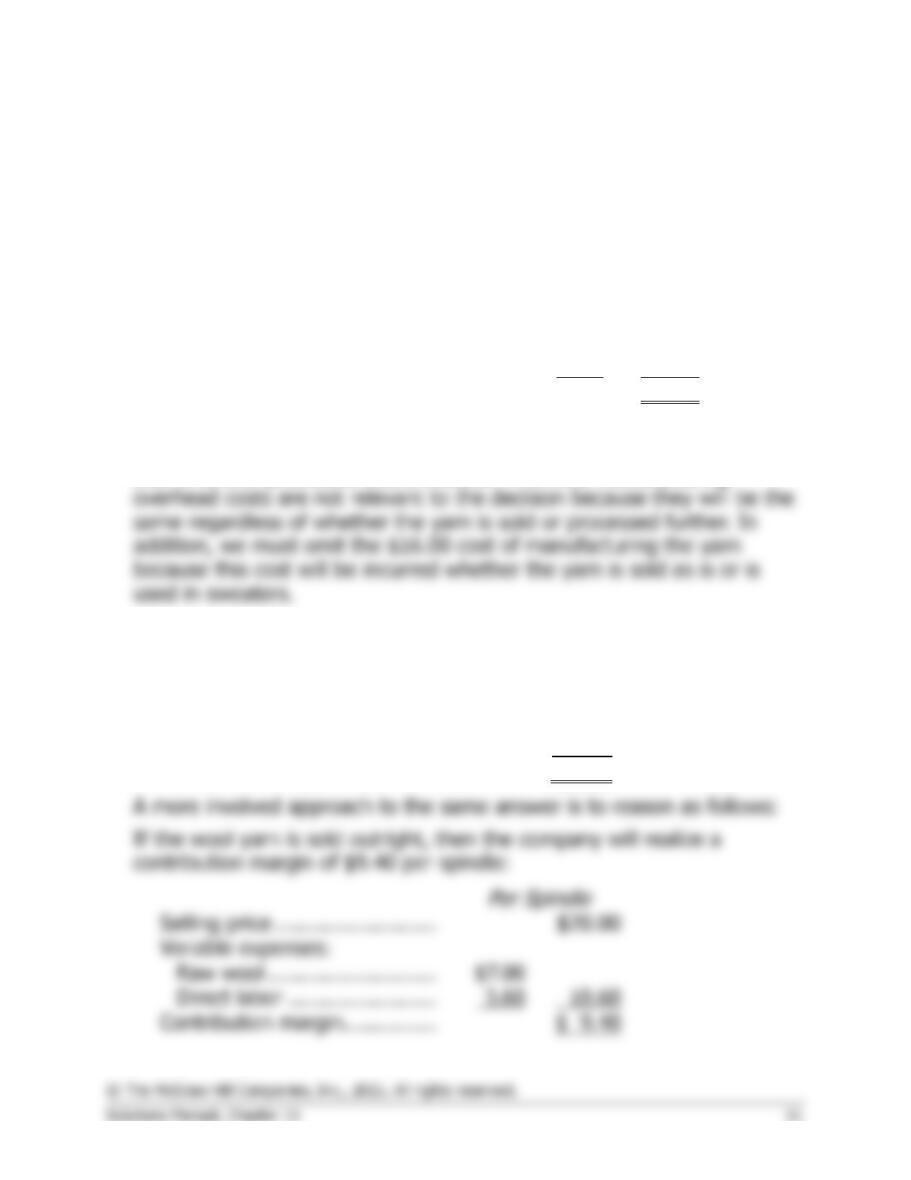
2. The company should process the wool yarn into sweaters because the
company will gain $2.20 in contribution margin for each spindle of yarn
3. The lowest price the company should accept is $27.80 per sweater. The
simplest approach to this answer is:
Present selling price per sweater ………
$30.00
Less added contribution margin being
realized on each sweater sold ………..
2.20
Minimum selling price per sweater …….
$27.80
Selling price ……………………..
Variable expenses:
Raw wool ………………………
Direct labor ……………………
3.60
Case 13-29 (continued)
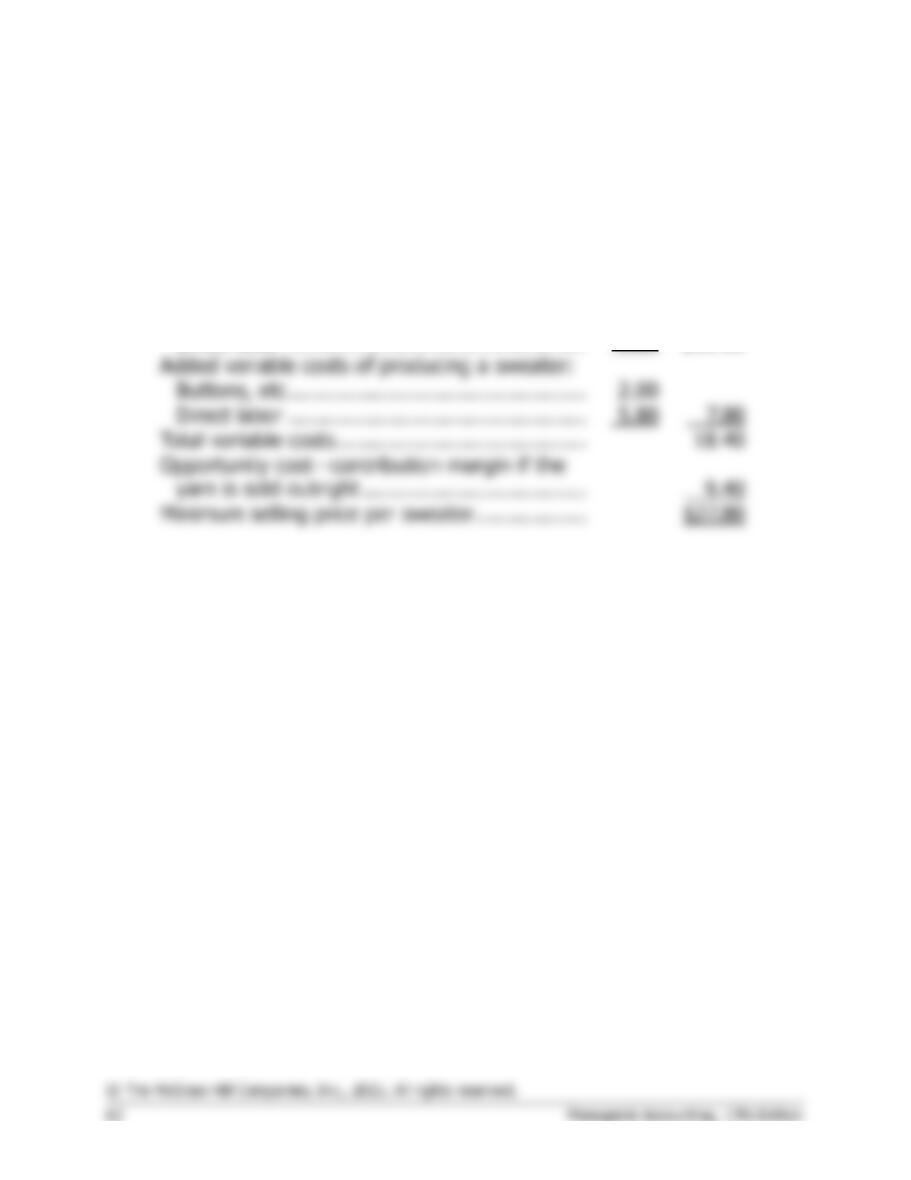
This $9.40 is an opportunity cost. The price of the sweaters must be
high enough to cover this opportunity cost. In addition, the company
must be able to cover all of its variable costs from the time the raw wool
is purchased until the sweater is completed. Therefore, the minimum
price is:
Variable costs of producing a spindle of yarn:
Raw wool ……………………………………………
$7.00
Total variable costs …………………………..……..
Case 13-30 (90 minutes)
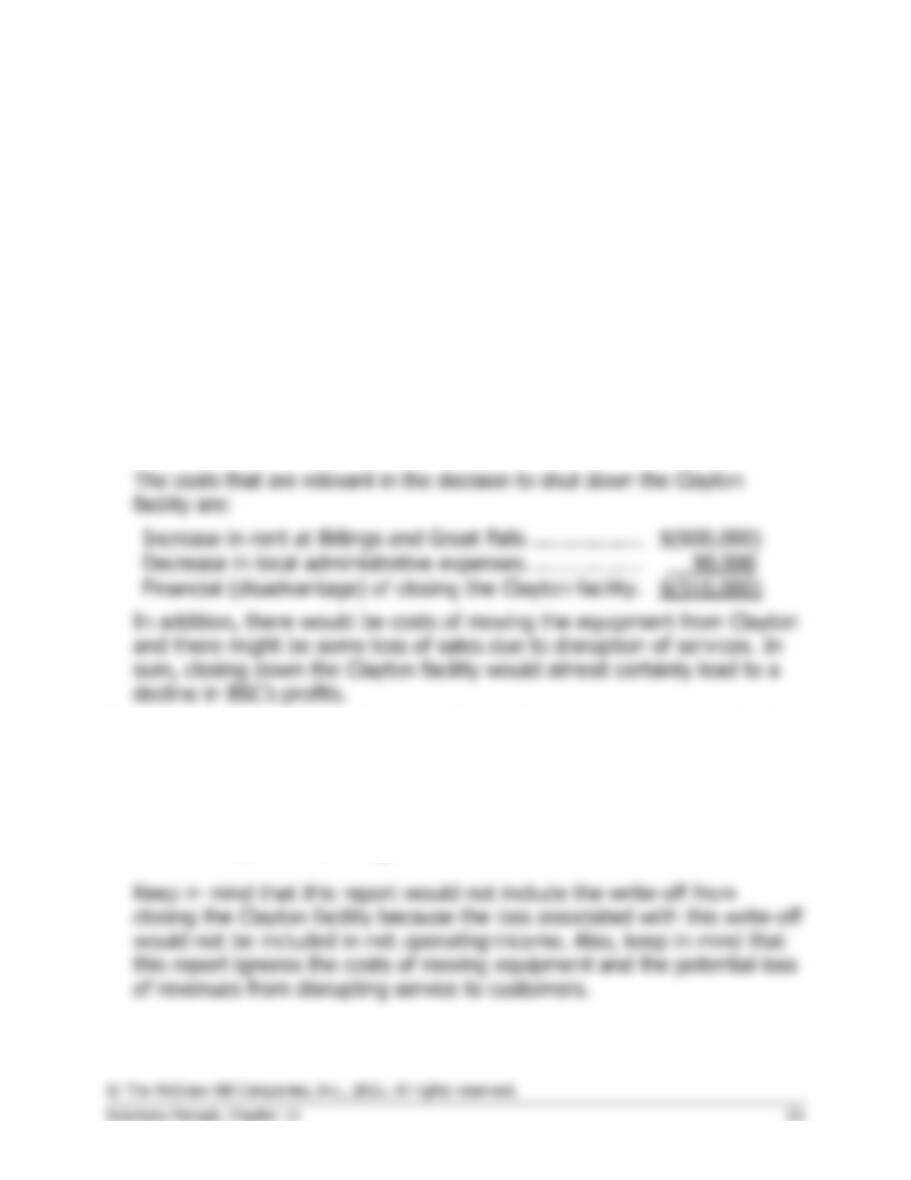
1. The original cost of the facilities at Clayton is a sunk cost and should be
ignored in any decision. The decision being considered here is whether to
continue operations at Clayton. The only relevant costs are the future
facility costs that would be affected by this decision. If the facility were
shut down, the Clayton facility has no resale value. In addition, if the
Clayton facility were sold, the company would have to rent additional
space at the remaining processing centers. On the other hand, if the
facility were to remain in operation, the building should last indefinitely, so
the company does not have to be concerned about eventually replacing it.
Essentially, there is no real cost at this point of using the Clayton facility
despite what the financial performance report indicates. Indeed, it might
be a better idea to consider shutting down the other facilities because the
rent on those facilities might be avoided.
2. Haley’s self-interest is to focus on the performance report that probably
plays an instrumental role in how her boss evaluates her performance.
So, even though closing down the Clayton facility would result in a
decline in overall company profits, from Haley’s standpoint it would
result in an improved performance report (as shown on the next page)
for the Rocky Mountain Region.
Case 13-30 (continued)
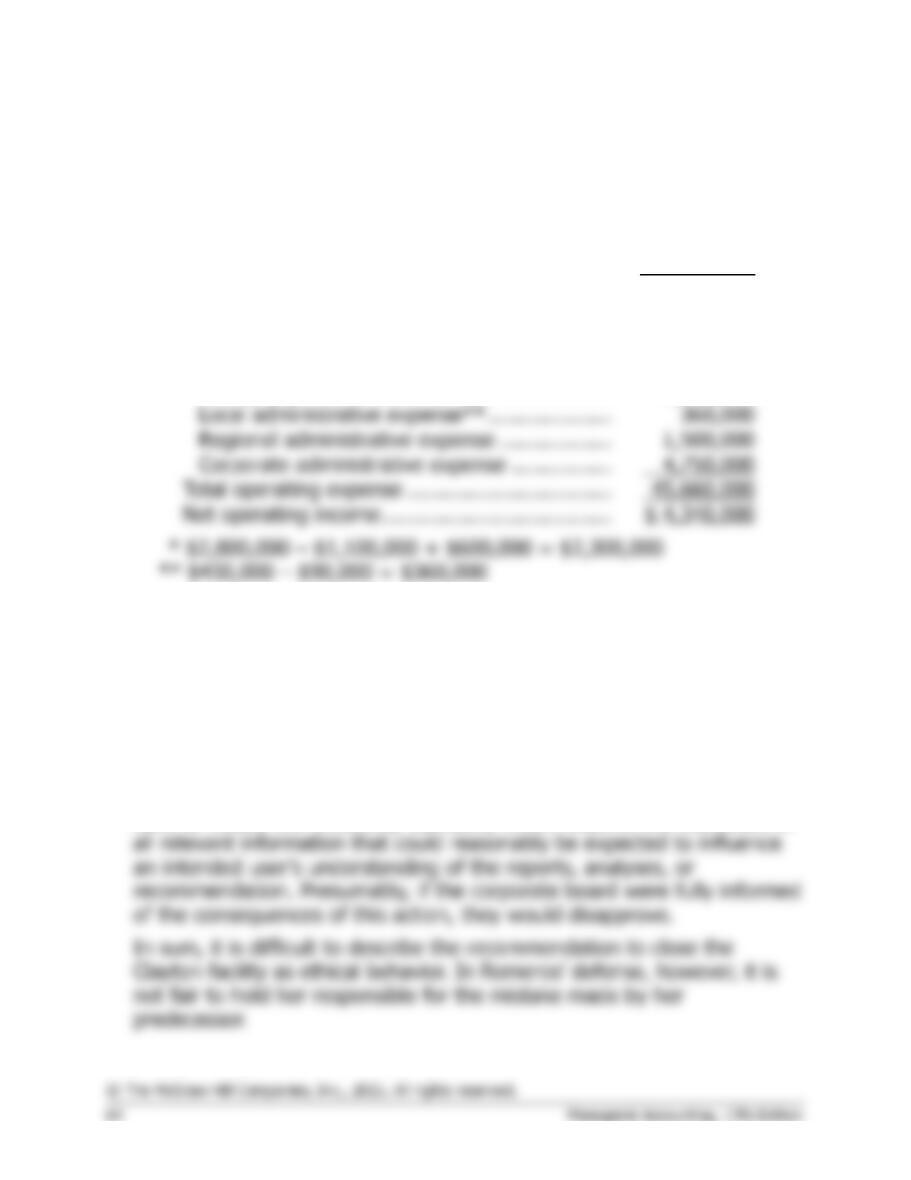
Financial Performance
After Shutting Down the Clayton Facility
Rocky Mountain Region
Total
Sales …………………………………………………….
$50,000,000
Selling and administrative expenses:
Direct labor ………………………………………….
32,000,000
Variable overhead …………………………………
850,000
Equipment depreciation ………………………….
3,900,000
Facility expense* …………………………………..
2,300,000
Local administrative expense** ………………..
360,000
Regional administrative expense ………………
Corporate administrative expense …………….
Total operating expense …………………………...
Net operating income ……………………………….
If the Clayton facility is shut down, BSC’s profits will decline, employees
will lose their jobs, and customers will at least temporarily suffer some
decline in service. Therefore, Romeros is willing to sacrifice the interests
of the company, its employees, and its customers just to make her
performance report look better.
While Romeros is not a management accountant, the Standards of
Ethical Conduct for Management Accountants still provide useful
guidelines. By recommending closing the Clayton facility, Romeros will
have to violate the Credibility Standard, which requires the disclosure of
Case 13-30 (continued)
It should be noted that the performance report required by corporate
headquarters is likely to lead to other problems such as the one
illustrated here. The arbitrary allocations of corporate and regional
administrative expenses to processing centers may make other
processing centers appear to be unprofitable even though they are not.
In this case, the problems created by these arbitrary allocations were
compounded by using an irrelevant facilities expense figure on the
performance report.
Case 13-31 (90 minutes)
1. The lowest price Wesco could bid for the one-time special order of
20,000 pounds (20 lots) and still exactly cover its incremental
manufacturing costs is calculated as follows:
Direct materials:
AG-5: 300 pounds per lot × 20 lots = 6,000 pounds.
Substitute BH-3 on a one-for-one basis to its total of 3,500
pounds. If BH-3 is not used in this order, it will be salvaged
for $600. Therefore, the relevant cost is ………………………
$ 600
The remaining 2,500 pounds (= 6,000 pounds – 3,500
pounds) would be AG-5 at a cost of $1.20 per pound ……..
3,000
KL-2: 200 pounds per lot × 20 lots = 4,000 pounds at $1.05
per pound ……………………………………………………………..
4,200
CW-7: 150 pounds per lot × 20 lots = 3,000 pounds at
$1.35 per pound ……………………………………………………..
4,050
5,600
Case 13-31 (continued)
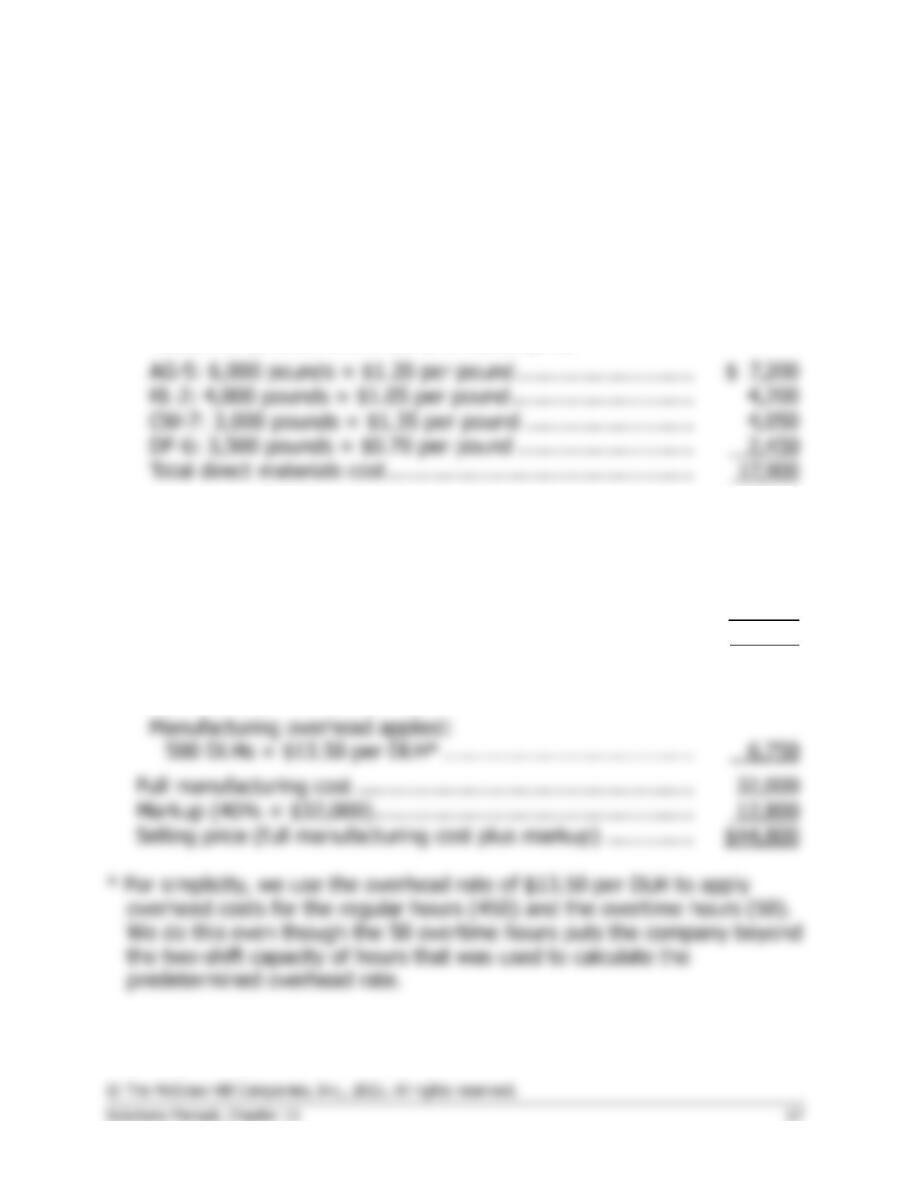
2. In this part, we calculate the price for recurring orders of 20,000 pounds
(20 lots) using the company’s rule of marking up its full manufacturing
cost. This is not the best pricing policy to follow, but is a common
practice in business.
Direct materials: Because the initial order will exhaust existing
inventories of BH-3 and DF-6 and new supplies would have to be
purchased, all raw materials should be charged at their expected
future cost, which is the current market price.
Total direct materials cost ………………………………………….
Direct labor: 90% (i.e., 450 DLHs) of the production of a batch can be
done on regular time; but the remaining production (i.e., 50 DLHs) must
be done on overtime.
Regular time 450 DLHs × $14.00 per DLH …………………….
6,300
Overtime premium 50 DLHs × $21.00 per DLH ………………
1,050
Total direct labor cost ……………………………………………….
7,350
Overhead: The full manufacturing cost includes both fixed and variable
manufacturing overhead.
Full manufacturing cost …………………………..………………….
Markup (40% × $32,000) …………………………..……………….
Selling price (full manufacturing cost plus markup) …………..
Case 13-32 (120 minutes)
1. The product margins computed by the accounting department for the
drums and bike frames should not be used in the decision of which
product to make. The product margins are lower than they should be
due to the presence of allocated fixed common costs that are irrelevant
in this decision. Moreover, even after the irrelevant costs have been
removed, what matters is the profitability of the two products in relation
to the amount of the constrained resource—welding time—that they
2. Assuming direct labor is a fixed cost, the contribution margin per unit for
each product is calculated as follows:
Manufactured
Purchased
WVD
Drums
WVD
Drums
Bike
Frames
Selling price ……………………………….
$149.00
$149.00
$239.00
Variable costs:
Direct materials ………………………..
138.00
52.10
99.40
Variable manufacturing overhead ….
0.00
1.35
1.90
Variable selling and administrative ..
Total variable cost ……………………….
Contribution margin …………………….
$136.40
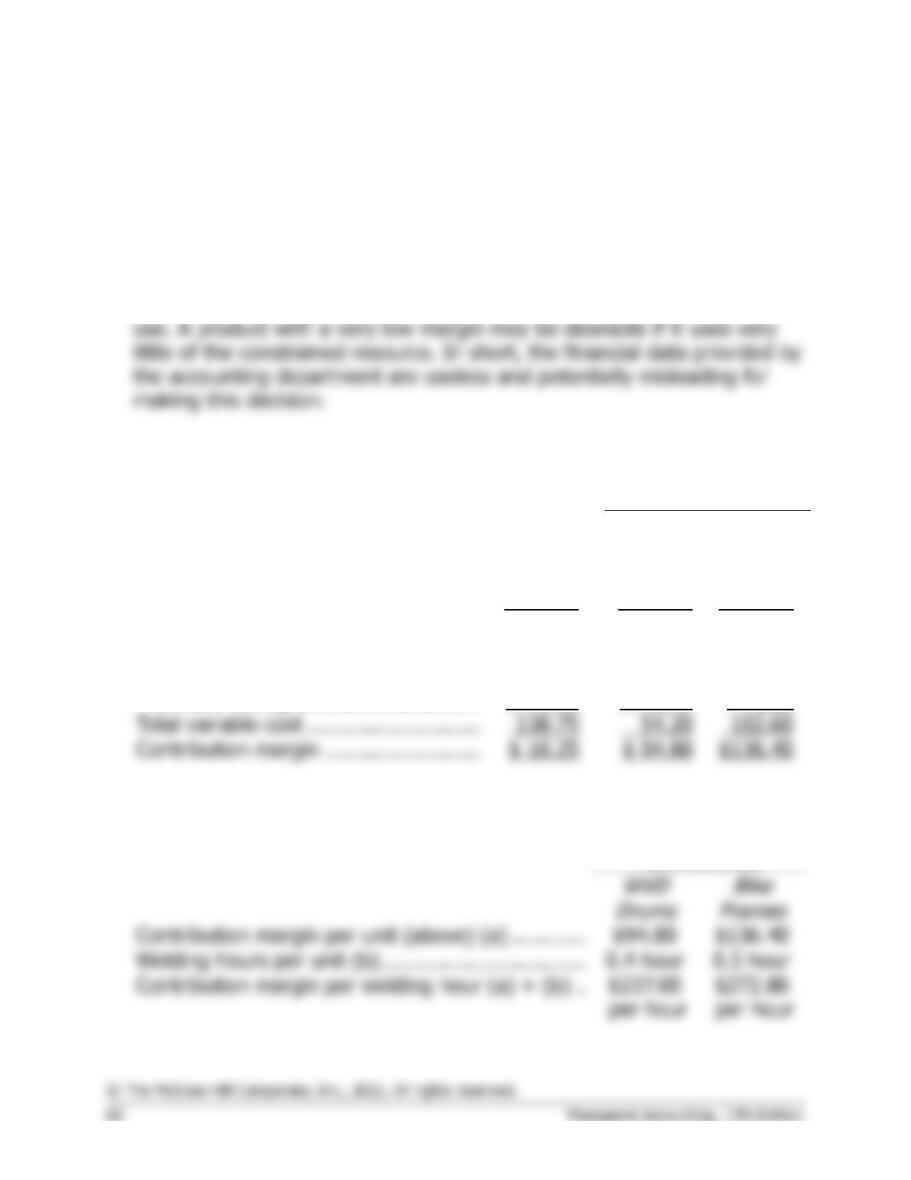
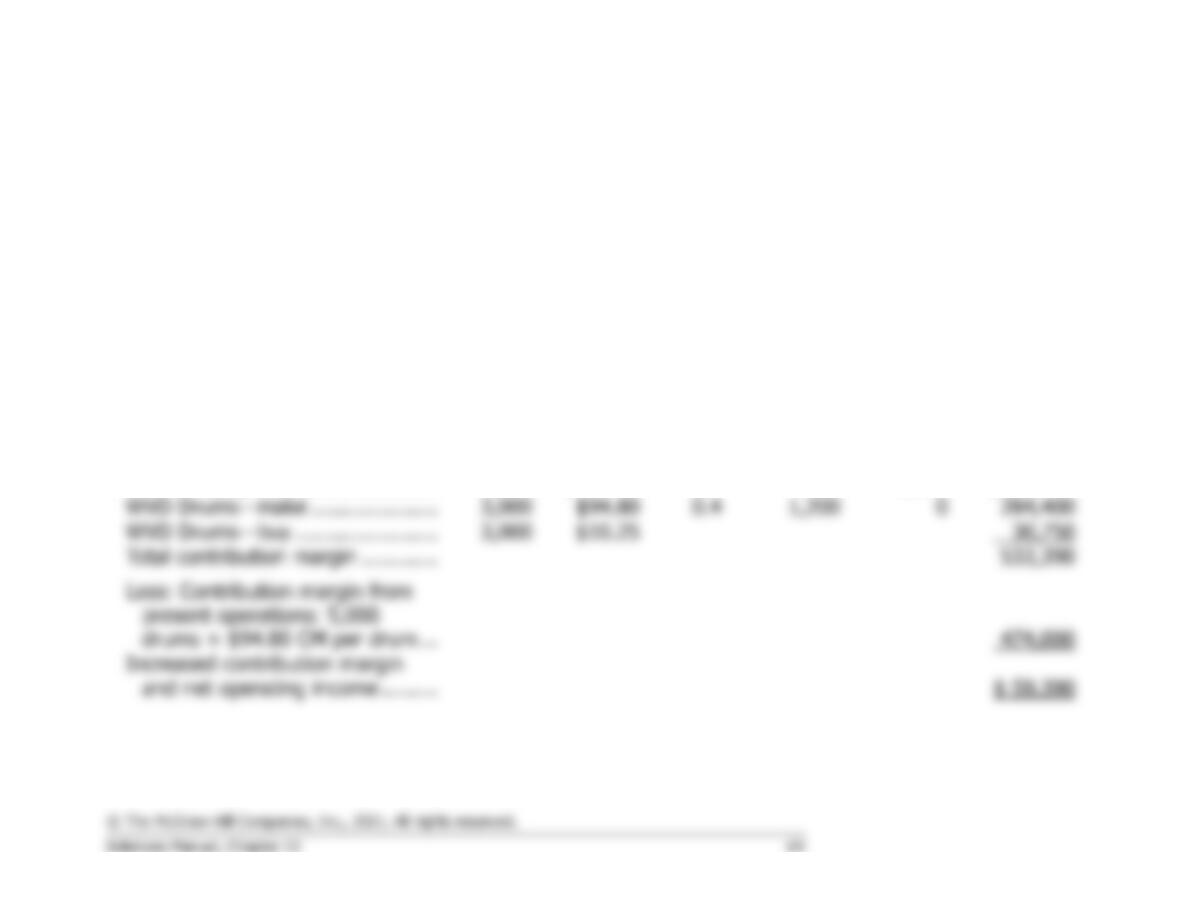
3. Assuming direct labor is a fixed cost, the contribution margin per
welding machine hour for each product is calculated as follows:
Contribution margin per unit (above) (a) …………
Welding hours per unit (b) …………………………...
0.4 hour
0.5 hour
Case 13-32 (continued)
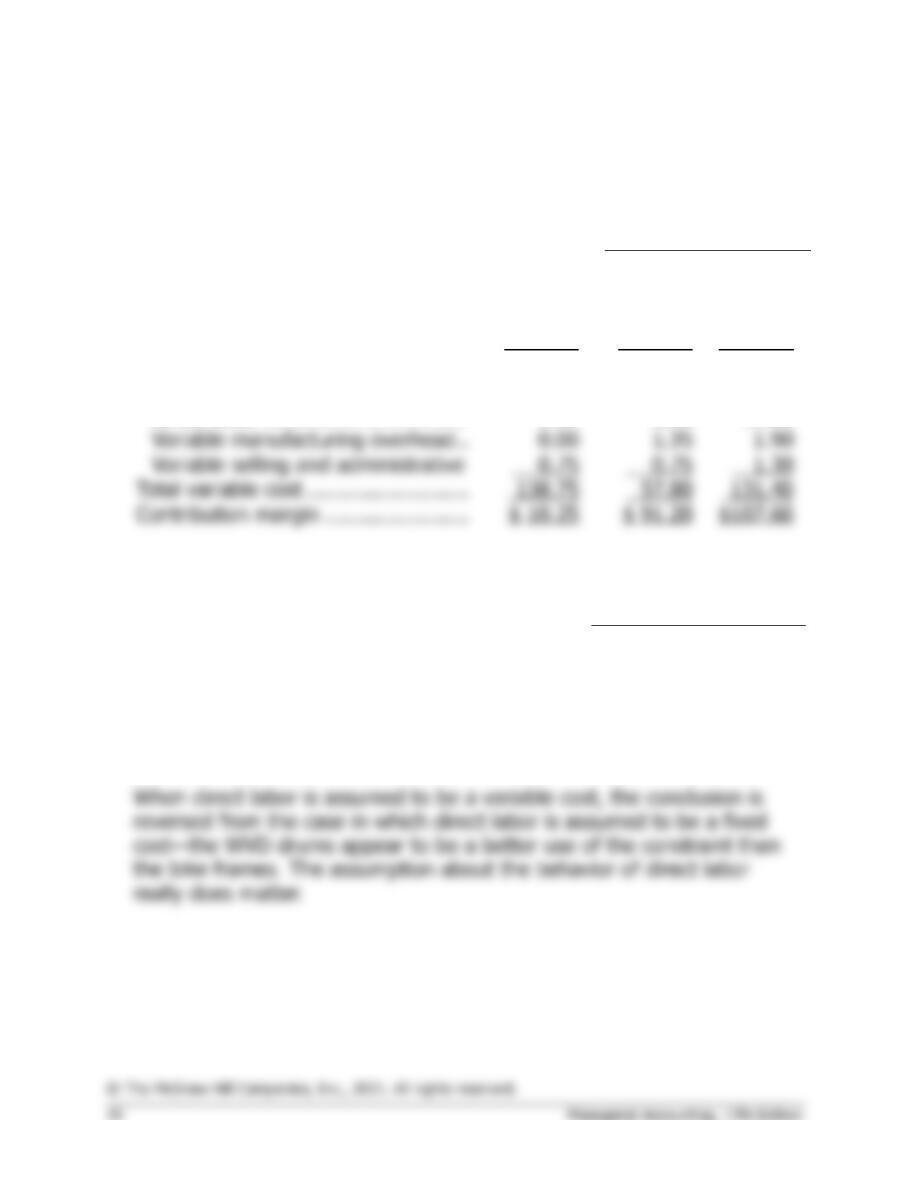
4. Because the contribution margin per unit of the constrained resource (i.e., welding time) is larger
for the bike frames than for the WVD drums, the frames make the most profitable use of the
welding machine (assuming direct labor is a fixed cost). Consequently, the company should
manufacture as many bike frames as possible up to demand and then use any leftover capacity to
produce WVD drums. Buying the drums from the outside supplier can fill any remaining unsatisfied
demand for WVD drums. The necessary calculations are carried out below.
(a)
(b)
(c)
(a) × (c)
(a) × (b)
Quantity
Unit
Contri-
bution
Margin
Welding
Time
per Unit
Total
Welding
Time
Balance
of
Welding
Time
Total
Contri-
bution
Total hours available ……………….
2,000
Bike frames produced ……………..
1,600
$136.40
0.5
800
1,200
$218,240
WVD Drums—make ………………..
3,000
0.4
1,200
WVD Drums—buy …………………..
Total contribution margin …………
474,000
$ 59,390
Case 13-32 (continued)
5. Assuming direct labor is a variable cost, the contribution margin per unit
for each product is calculated as follows:
Manufactured
Purchased
WVD
Drums
WVD
Drums
Bike
Frames
Selling price ……………………………..
$149.00
$149.00
$239.00
Variable costs:
Direct materials ………………………
138.00
52.10
99.40
Direct labor …………………………...
Variable manufacturing overhead ..
Variable selling and administrative
0.75
Total variable cost ……………………..
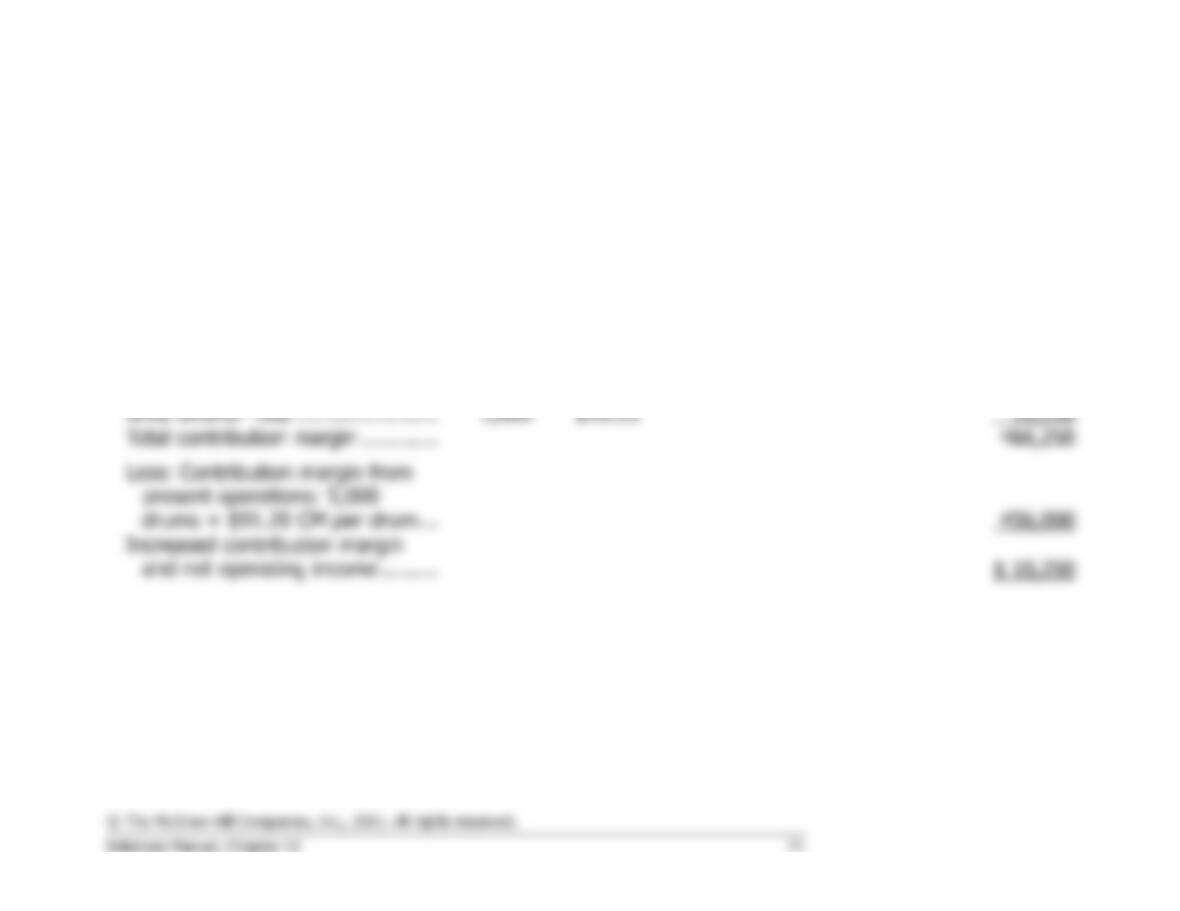
6.
Assuming direct labor is a variable cost, the contribution margin per
welding hour for each product is calculated as follows:
Manufactured
WVD
Drums
Bike
Frames
Contribution margin per unit (above) (a) ……….
$91.20
$107.60
Welding hours per unit (b) ………………………….
0.4 hour
0.5 hour
Contribution margin per welding hour (a) ÷ (b)
$228.00
per hour
$215.20
per hour
Case 13-32 (continued)
7. Assuming direct labor is a variable cost, the optimal product mix and increase in net operating income
is computed as follows:
(a)
(b)
(c)
(a) × (c)
(a) × (b)
Quantity
Unit
Contri-
bution
Margin
Welding
Time
per Unit
Total
Welding
Time
Balance
of
Welding
Time
Total
Contri-
bution
Total hours available ……………….
2,000
WVD Drums—make ………………..
5,000
$91.20
0.4
2,000
0
$456,000
Bike frames produced ……………..
0
$107.60
0.5
0
0
0
WVD Drums—buy …………………..
Total contribution margin …………
Case 13-32 (continued)
8. The case strongly suggests that direct labor is fixed: “The bike frames
could be produced with existing equipment and personnel.”
Nevertheless, it would be a good idea to examine how much labor time
is really needed under the two opposing plans.
Production
Direct Labor-
Hours Per Unit
Total Direct
Labor-Hours
Plan 1:
Bike frames ……………..
1,600
1.6*
2,560
WVD drums ……………..
3,000
0.2**
600
3,160
Plan 2:
WVD drums ……………..
5,000
0.2**
1,000
* $28.80 ÷ $18.00 per hour = 1.6 hour
** $3.60 ÷ $18.00 per hour = 0.2 hour
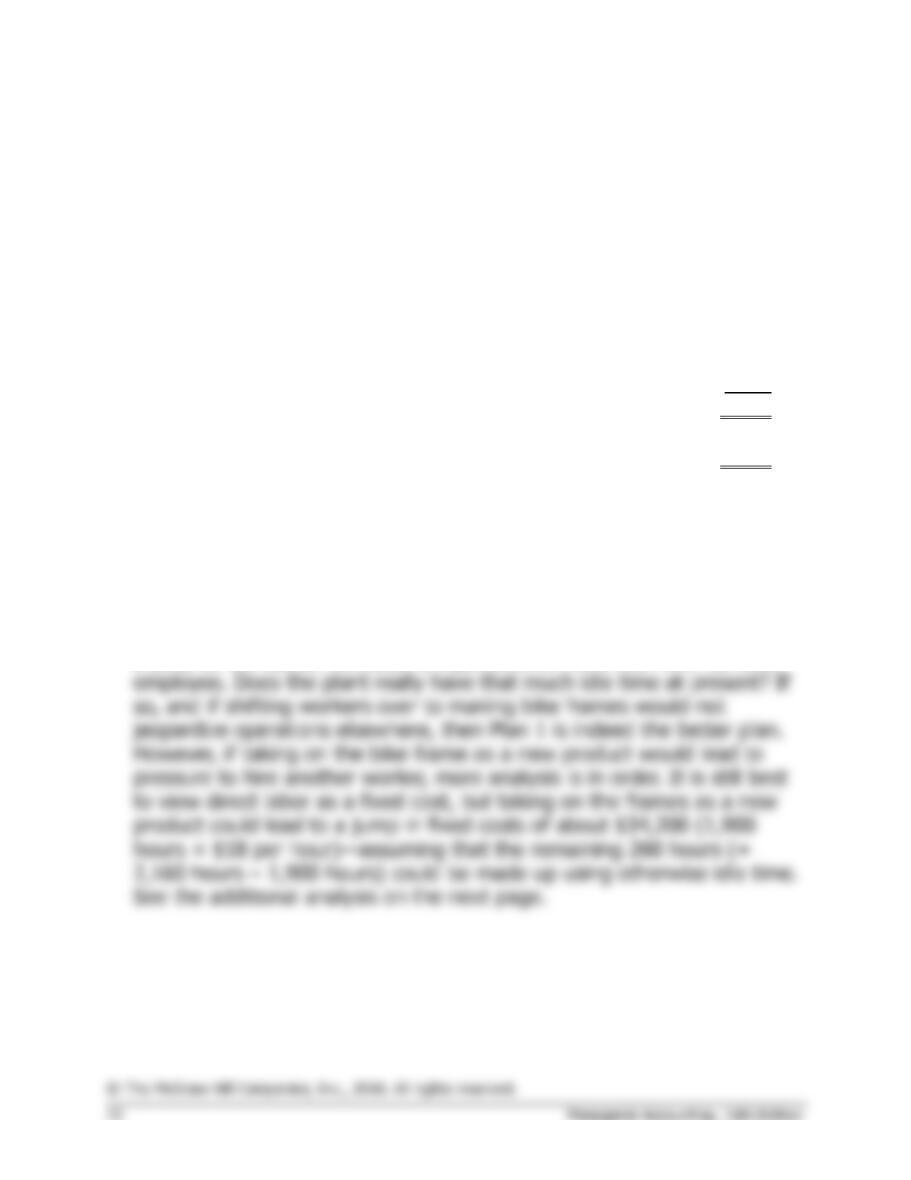
Some caution is advised. Plan 1 assumes that direct labor is a fixed cost.
However, this plan requires 2,160 more direct labor-hours than Plan 2
and the present situation (3,160 DLHs – 1,000 DLHs = 2,160 DLHs). At
40 hours per week a typical full-time employee works about 1,900 hours
a year, so the added workload is equivalent to more than one full-time
Case 13-32 (continued)
Contribution margin from Plan 1:
Bike frames produced (1,600 × $136.40) …………
218,240
WVD Drums—make (3,000 × $94.80) ……………..
284,400
WVD Drums—buy (3,000 × $10.25) ………………..
30,750
Total contribution margin ………………………………
533,390
Less: Additional fixed labor costs ………………………
34,200
Net effect of Plan 1 on net operating income ……….
$499,190
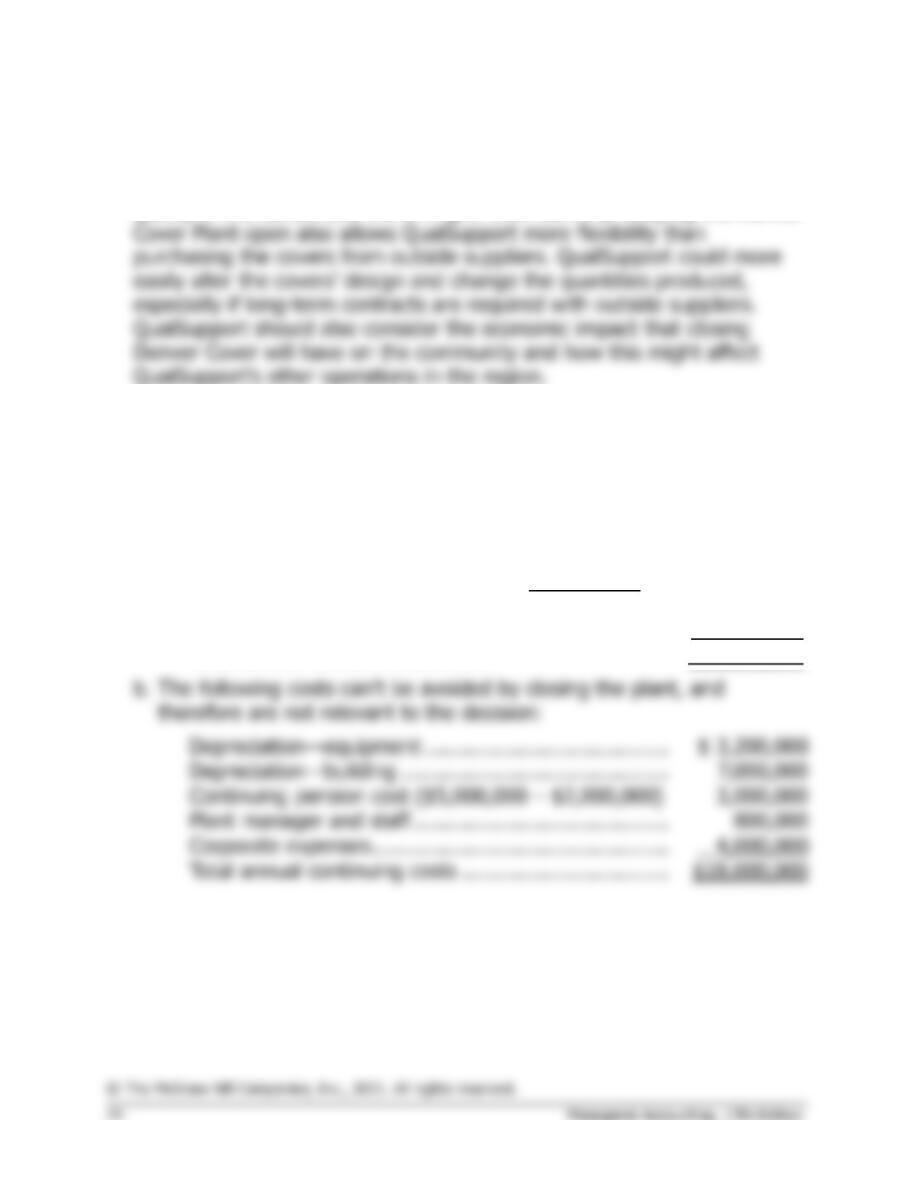
Contribution margin from Plan 2: ………………………
WVD Drums—make (5,000 × $94.80) ……………..
$474,000
WVD Drums—buy (1,000 × $10.25) ………………..
Net effect of Plan 2 on net operating income ……….
Case 13-33 (75 minutes)
1. Continuing to obtain covers from its own Denver Cover Plant would
allow QualSupport to maintain its current level of control over the
2. a. The following costs can be avoided by closing the plant, and
therefore are relevant to the decision:
Materials ……………………………..
$14,000,000
Labor:
Direct ……………………………….
$13,100,000
Supervision ………………………..
900,000
Indirect plant ……………………..
4,000,000
18,000,000
Differential pension cost
($5,000,000 – $3,000,000) ……
2,000,000
Total annual relevant costs ………
$34,000,000
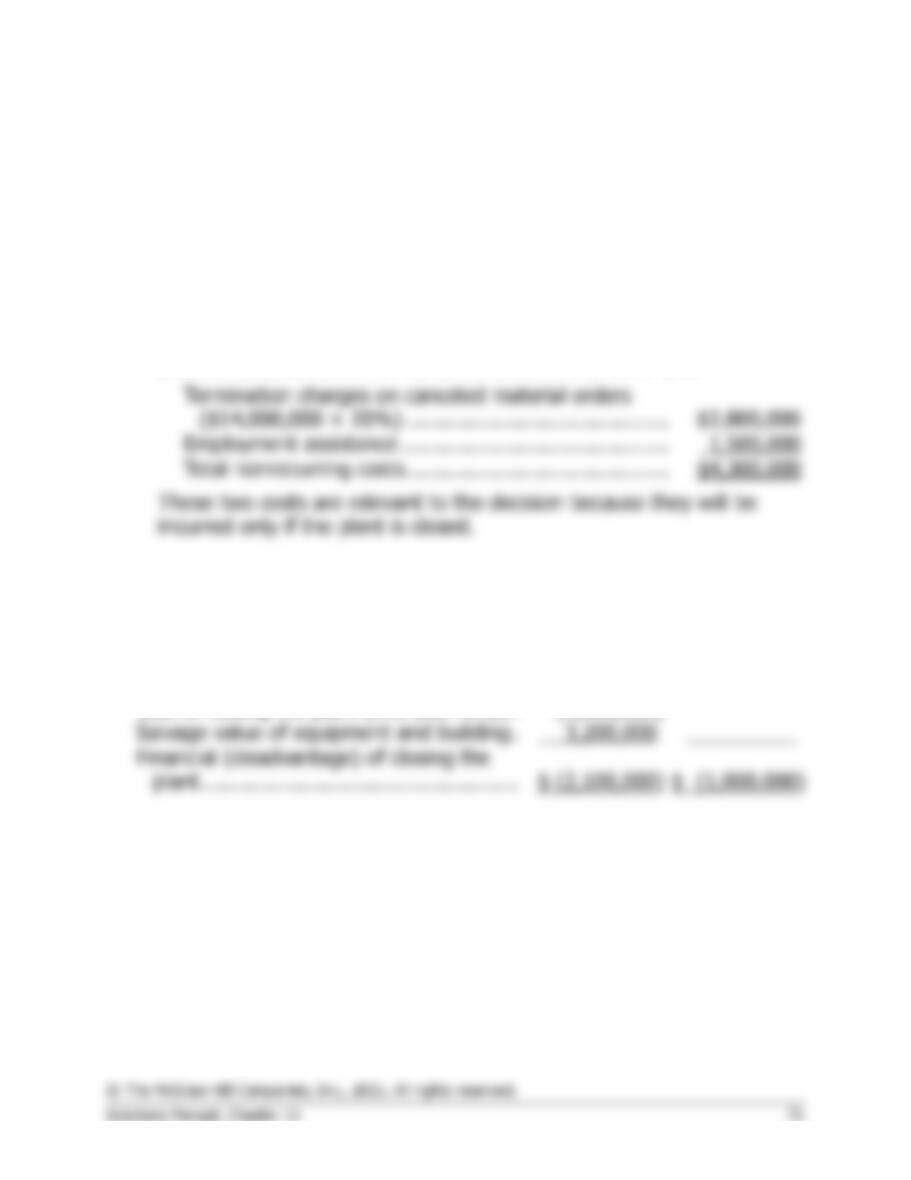
Continuing pension cost ($5,000,000 – $2,000,000)
Plant manager and staff …………………………………..
Corporate expenses ………………………………………..
4,000,000
Total annual continuing costs …………………………...
Case 13-33 (continued)
Depreciation is not relevant because it is a sunk cost. The annual
pension expense of $3,000,000 is not relevant because it would
continue whether or not the plant is closed. The amount for plant
manager and staff is not relevant because Vosilo and his staff would
continue with QualSupport and administer the three remaining plants.
The corporate allocation is not relevant because this represents costs
incurred outside Denver Cover and assigned to the plant.
c. The following nonrecurring costs would arise in the year that the
plant is closed, but would not be incurred in any other year:
Employment assistance …………………………………….
Total nonrecurring costs ……………………………………
3. No, the plant should not be closed. The computations are:
First Year
Other Years
Cost of purchasing the covers outside …..
$(35,000,000)
$(35,000,000)
Costs avoided by closing the plant
[see requirement 2(a)] ……………………
34,000,000
34,000,000
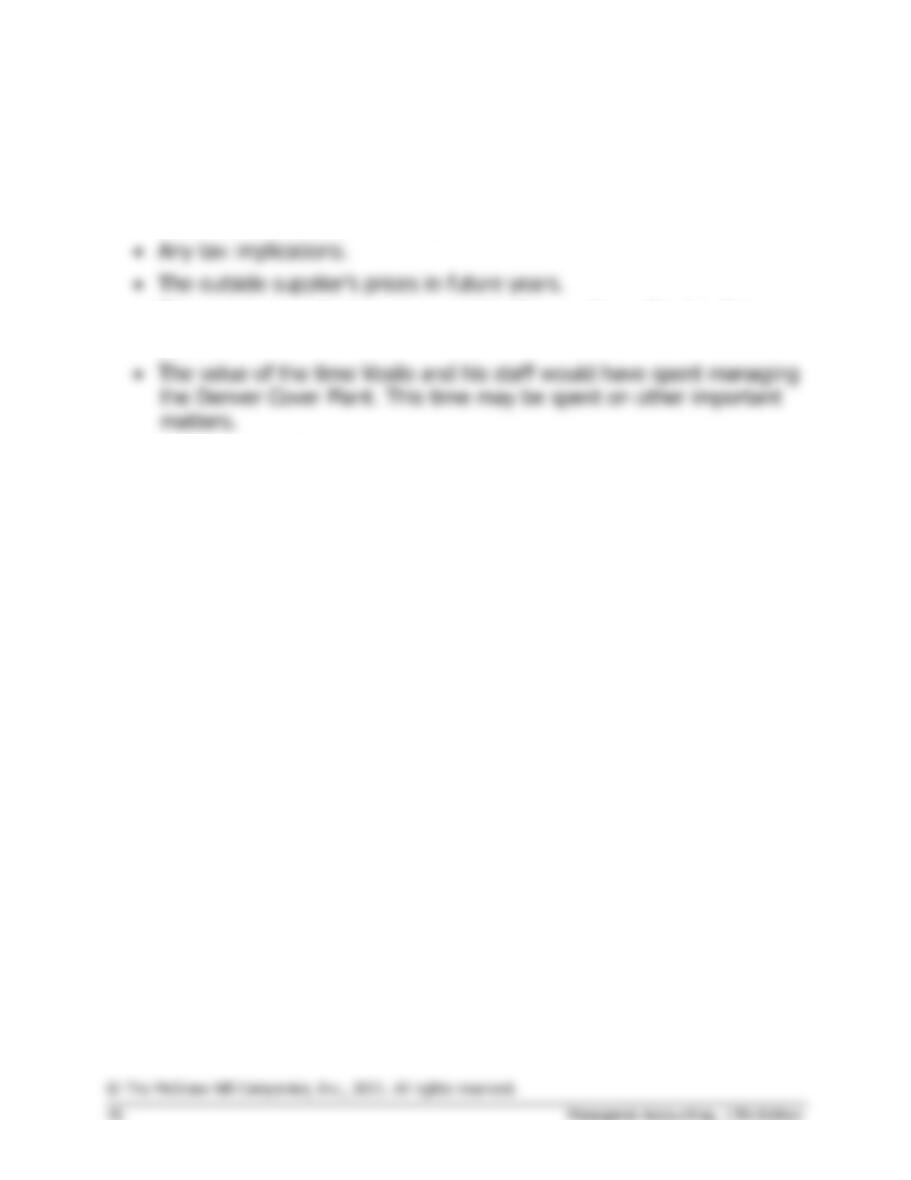
Cost of closing the plant (first year only) .
Salvage value of equipment and building .
Financial (disadvantage) of closing the
plant ……………………………………………
Case 13-33 (continued)
4. Factors that should be considered by QualSupport before making a
decision include:
• Alternative uses of the building and equipment.
• The cost to manufacture covers at the Denver Cover Plant in future
years.
• The morale of QualSupport employees at remaining plants.

Appendix 13A
Pricing Decisions
Exercise 13A-1 (10 minutes)
1.
2.
Unit product cost……………
$25
Markup (40% × $25) ……..
10
Selling price per unit ………
$35
Exercise 13A-2 (10 minutes)
1. Maria’s profit during the first week is computed as follows:
Profit
= (P – V) × Q − Fixed expenses
Profit
= ($3.50 − $0.80) × 1,800 − $2,675
Profit
= $2.70 × 1,800 − $2,675
Profit
= $4,860 − $2,675
Profit
= $2,185
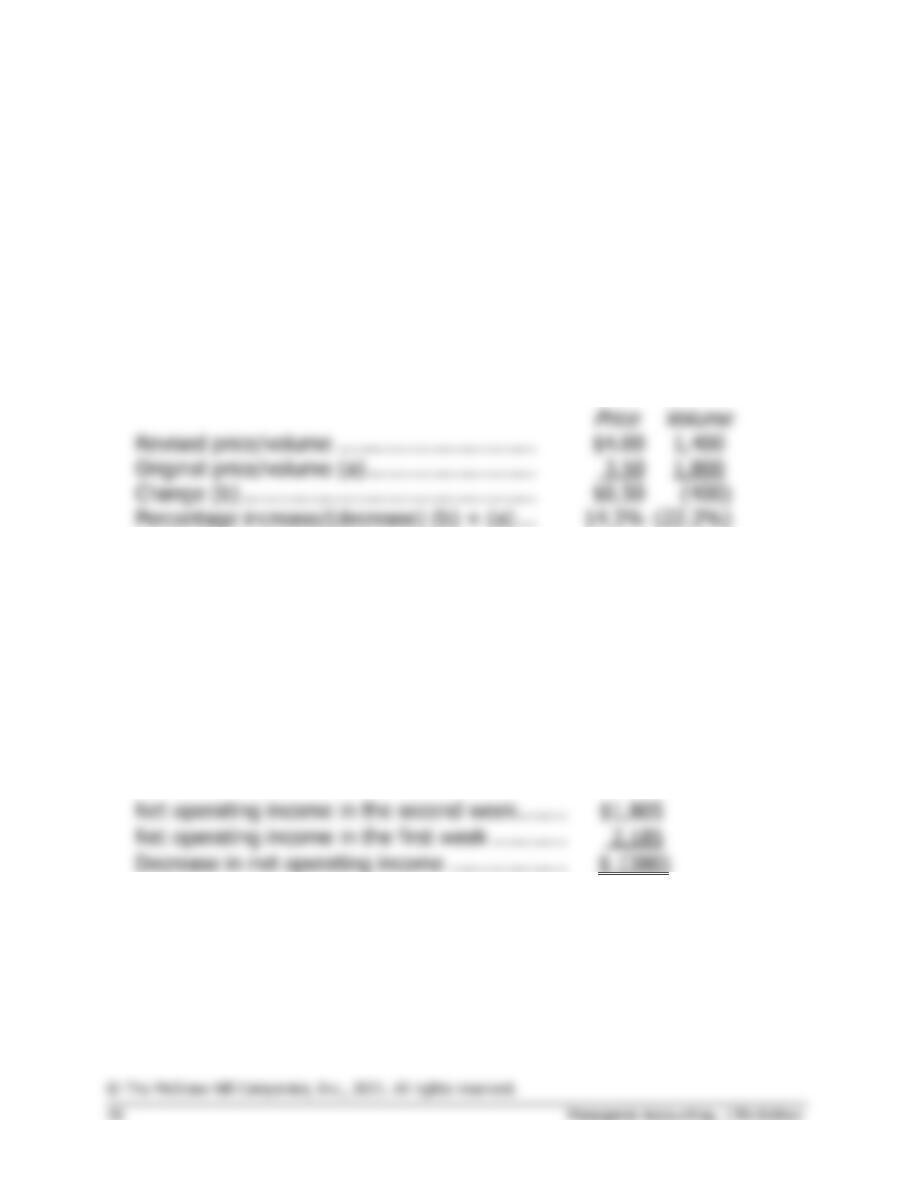
2. The percentage increase in the selling price and the percentage
decrease in unit sales are computed as follows:
3. Maria’s profit during the second week is computed as follows:
Profit
= (P – V) × Q − Fixed expenses
Profit
= ($4.00 − $0.80) × 1,400 − $2,675
Profit
= $3.20 × 1,400 − $2,675
Profit
= $4,480 − $2,675
Profit
= $1,805
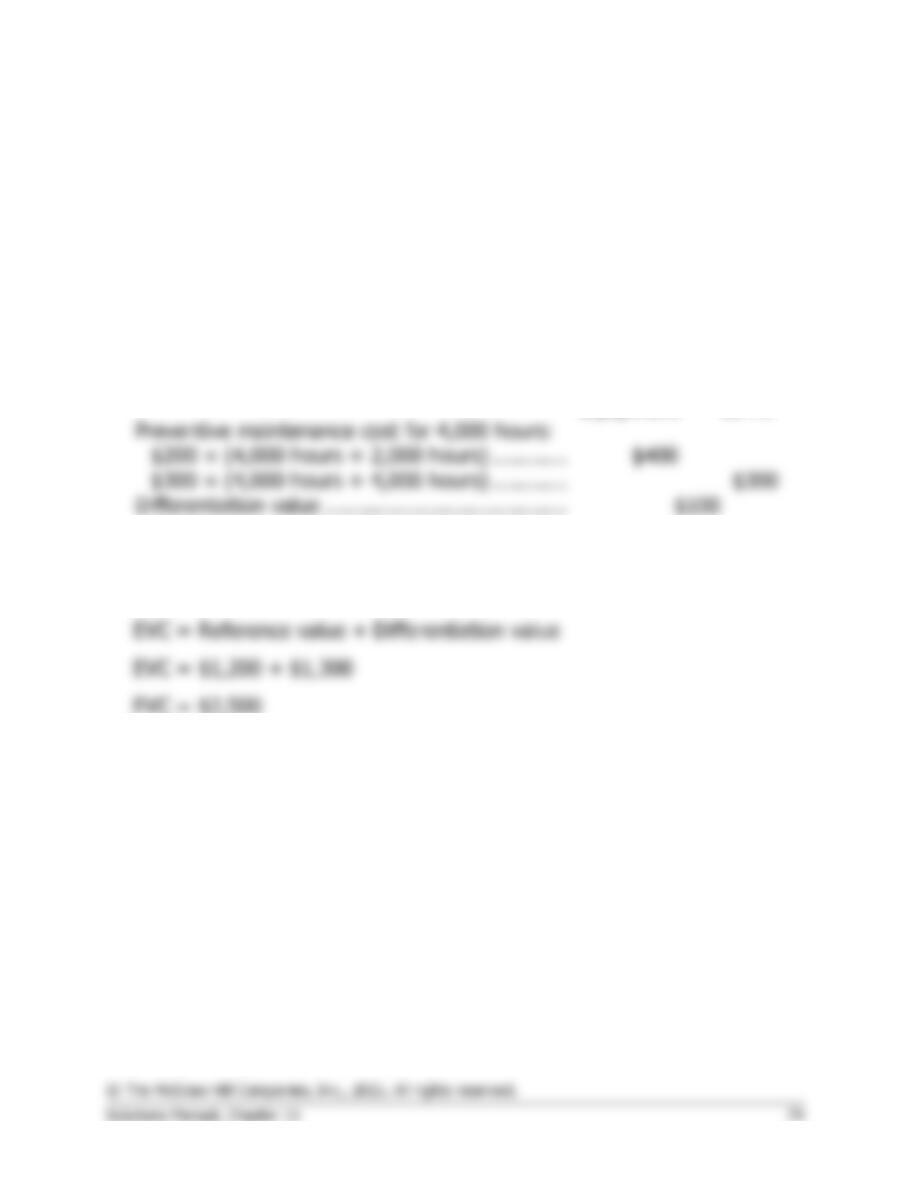
4. The decrease in profits is computed as follows:
Exercise 13A-3 (20 minutes)
1. The reference value is the price of the competing alternative, which is
$1,200.
2. The differentiation value has two components. First, customers who
purchase an IC-75 rather than the competing alternative would avoid
the need to buy a second component part for $1,200 to achieve 4,000
hours of usage. Second, customers who purchase an IC-75 rather than
the competing alternative would realize preventive maintenance savings
of $100 over a 4,000-hour period, computed as follows:
Competing
Thus, the total differentiation value is $1,200 + $100 = $1,300.
3. The economic value to the customer (EVC) is computed as follows:
4. The range of possible prices is as follows:
Reference value ≤ Value-based price ≤ EVC
$1,200 ≤ Value–based price ≤ $2,500

Exercise 13A-4 (10 minutes)
Sales (300,000 units × $15 per unit) …….
$4,500,000
Less desired profit (12% × $5,000,000) …
600,000
Target cost for 300,000 units ……………….
$3,900,000
Target cost per unit = $3,900,000 ÷ 300,000 units = $13 per unit