Problem 13-13A (45 minutes)
Effect on
Ratio
Reason for Increase, Decrease, or No Effect
1.
Decrease
Declaring a cash dividend will increase current liabilities,
2.
Increase
A sale of inventory on account will increase the quick
assets (cash, accounts receivable, marketable securities)
3.
Increase
the common stockholders.
The interest rate on the bonds is only 8%. Since the
4.
Decrease
A decrease in net income would mean less income
available to cover interest payments. Therefore, the
times-interest-earned ratio would decrease.
5.
Increase
current liabilities.
Payment of a previously declared cash dividend will
reduce both current assets and current liabilities by the
6.
No Effect
The dividend payout ratio is a function of the dividends
Problem 13-13A (continued)
Effect on
Ratio
Reason for Increase, Decrease, or No Effect
7.
Increase
A write-off of inventory will reduce the inventory balance,
thereby increasing the turnover in relation to a given level
of sales.
8.
Decrease
compared to assets provided by owners.
Sale of inventory at a profit will increase the assets of a
company. The increase in assets will be reflected in an
9.
Decrease
Extended credit terms for customers means that customers
10.
Decrease
A common stock dividend will result in a greater number of
11.
No Effect
Book value per share is dependent on historical costs of
12.
No Effect
Payments on account reduce cash and accounts payable by
equal amounts; thus, the net amount of working capital is
not affected.
13.
Decrease
shares outstanding, thereby reducing the earnings per
share.
The stock dividend will increase the number of common
Problem 13-13A (continued)
Effect on
Ratio
Reason for Increase, Decrease, or No Effect
14.
Decrease
Payments to creditors will reduce the total liabilities of a
15.
Decrease
A purchase of inventory on account will increase current
16.
No Effect
Write-off of an uncollectible account against the Allowance
for Bad Debts will have no effect on total current assets.
For this reason, the current ratio will remain unchanged.
17.
Increase
up, then the price-earnings ratio will increase.
The price-earnings ratio is obtained by dividing the market
18.
Decrease
The dividend yield ratio is obtained by dividing the dividend
Problem 13-14A (30 minutes)
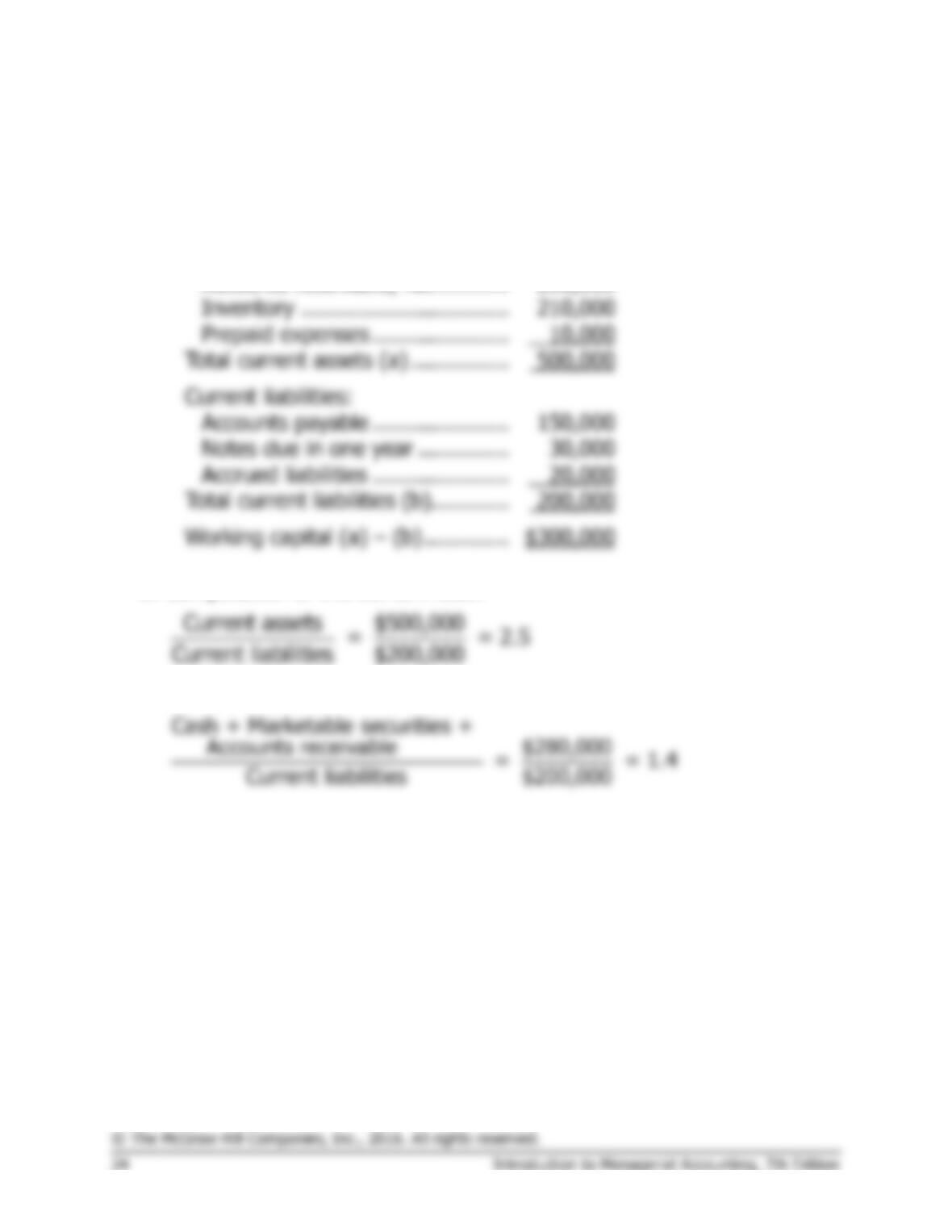
1. a. Computation of working capital:
Current assets:
Cash …………………………………
$ 50,000
Marketable securities …………….
30,000
Accounts receivable, net ………..
200,000
Inventory …………………………..
Prepaid expenses …………………
10,000
Total current assets (a) ……………
Current liabilities:
Accounts payable …………………
150,000
Notes due in one year …………..
30,000
Accrued liabilities …………………
20,000
Total current liabilities (b)…………
Working capital (a) – (b) ………….
b. Computation of the current ratio:
c. Computation of the acid-test ratio:
Problem 13-14A (continued)
2.
The Effect on
Working
Current
Acid-Test
Transaction
Capital
Ratio
Ratio
(a)
Issued capital stock for cash ………
Increase
Increase
Increase
(b)
Sold inventory at a gain …………….
Increase
Increase
Increase
(c)
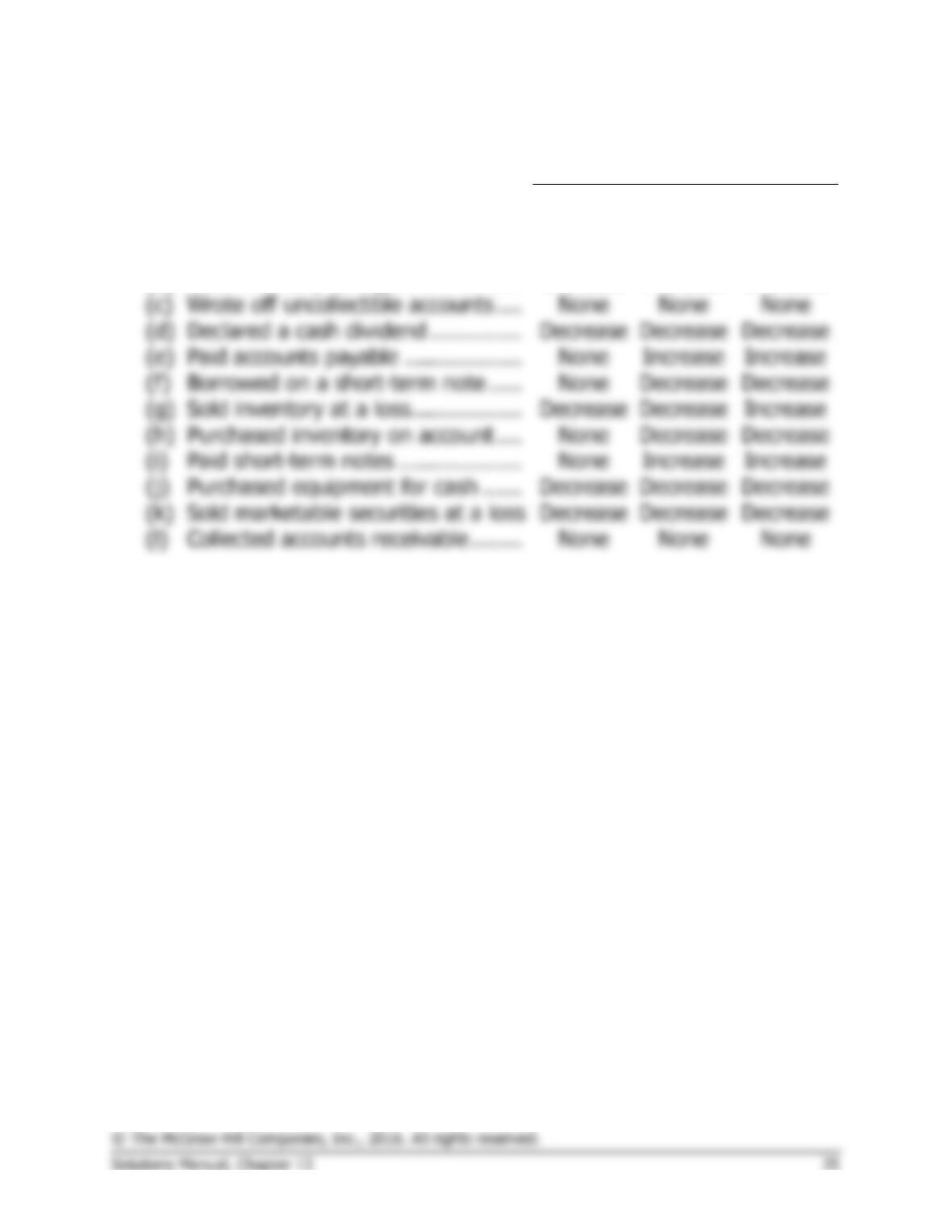
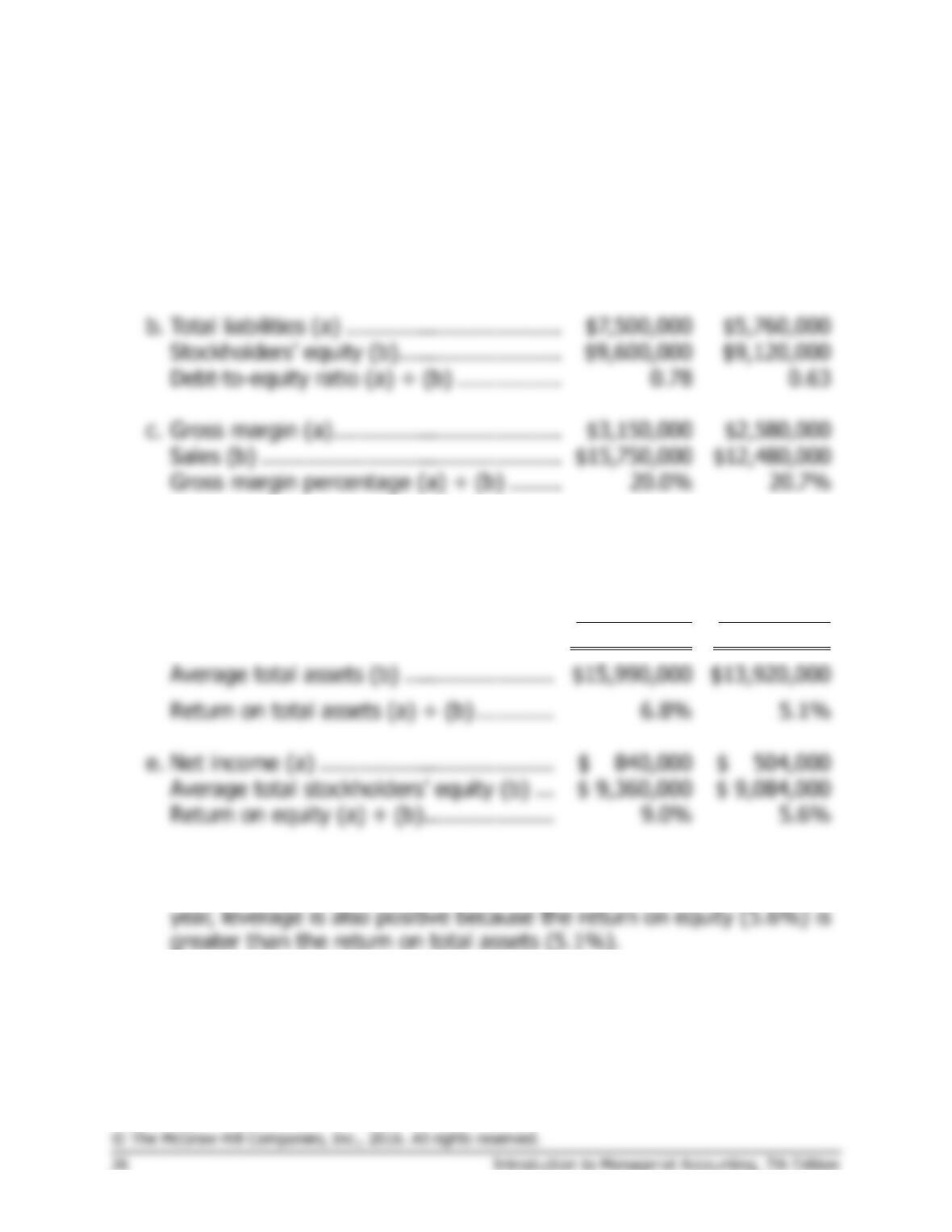
Wrote off uncollectible accounts ….
(f)
Borrowed on a short-term note …..
(g)
Sold inventory at a loss ……………..
Decrease
Increase
(h)
Purchased inventory on account ….
Paid short-term notes ……………….
Increase
Increase
Collected accounts receivable ……..
Problem 13-15A (90 minutes)
This Year
Last Year
1.
a.
Earnings before interest and income
taxes (a) ……………………………………………………….
$1,560,000
$1,020,000
Interest expense (b) …………………………..
$360,000
$300,000
Times interest earned (a) ÷ (b) …………………………..
4.3
3.4
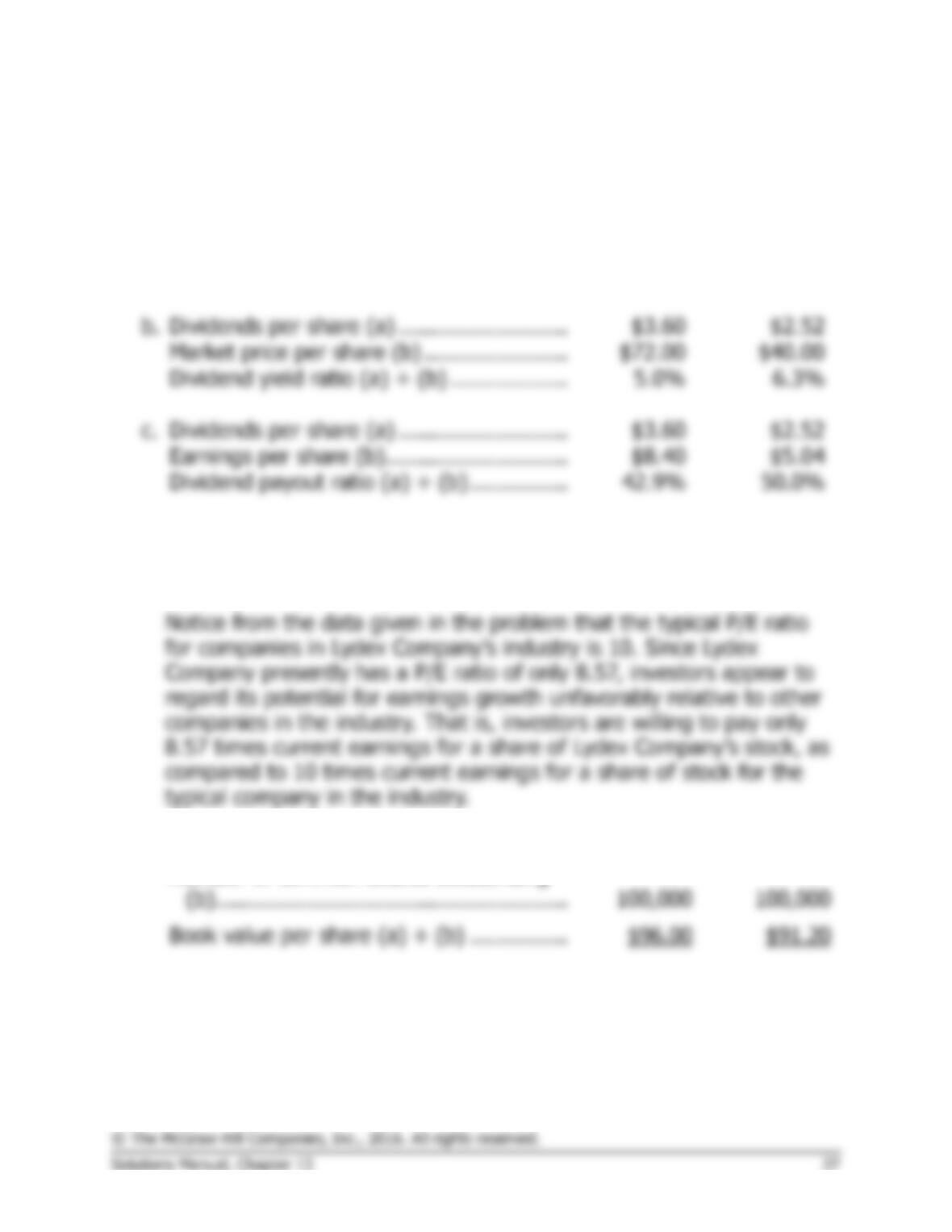
Total liabilities (a) ………………………………………………….
Gross margin (a) ………………………………
Sales (b) ………………………………………..
$15,750,000
Gross margin percentage (a) ÷ (b) ………
d.
Net income ……………………………………
$ 840,000
$ 504,000
Add after-tax cost of interest:
$360,000 × (1 – 0.30) …………………..
252,000
$300,000 × (1 – 0.30) …………………..
210,000
Total (a) ……………………………………….
$ 1,092,000
$ 714,000
Average total assets (b) …………………..
Return on total assets (a) ÷ (b) …………
Net income (a) ………………………………
$ 9,360,000
$ 9,084,000
Return on equity (a) ÷ (b) ………………..
f.
Leverage is positive for this year because the return on equity
(9.0%) is greater than the return on total assets (6.8%). For last
Problem 13-15A (continued)
This Year
Last Year
2.
a.
Net income (a) …………………………………
$840,000
$504,000
Average number of common shares
outstanding (b) ……………………………..
100,000
100,000
Earnings per share (a) ÷ (b) ……………….
$8.40
$5.04
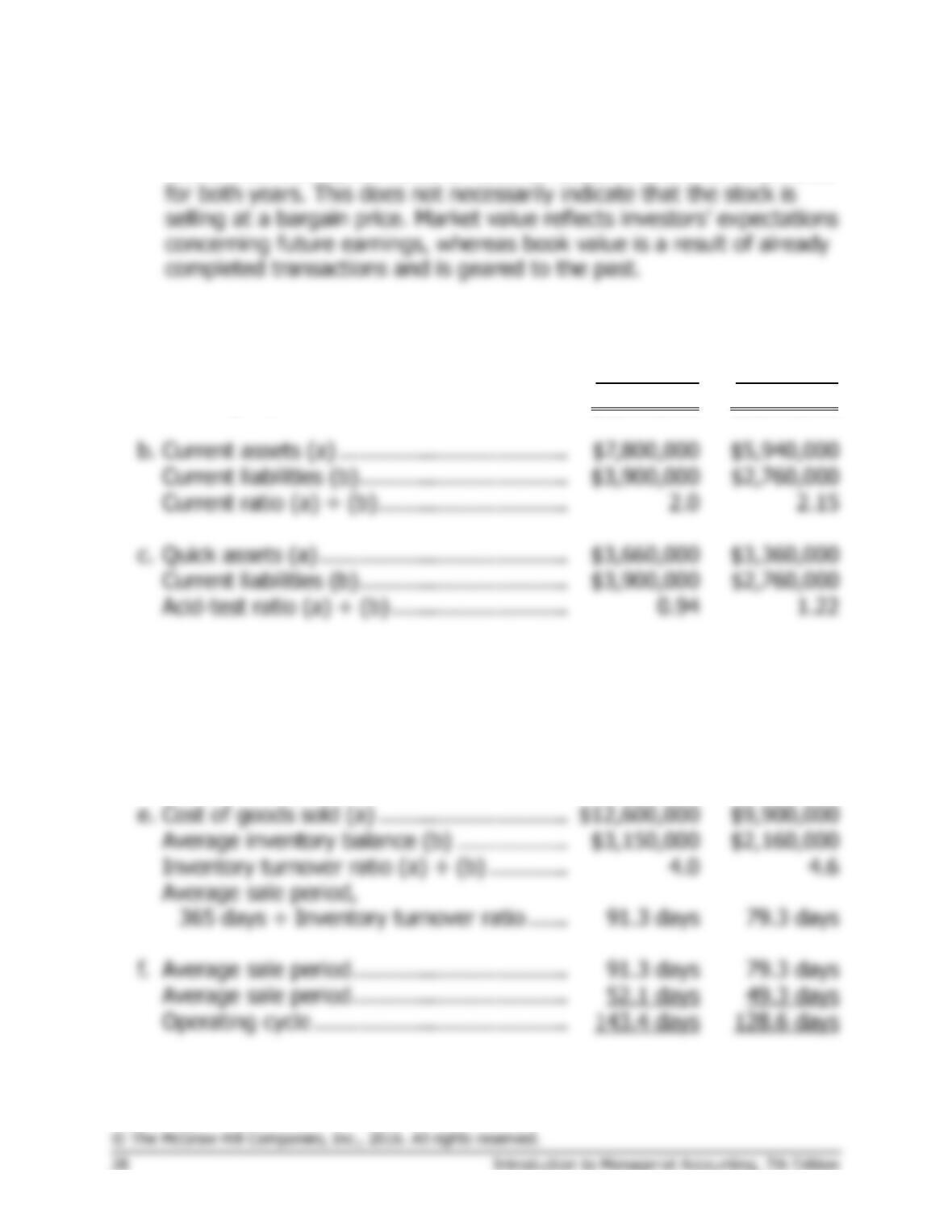
Dividends per share (a) ……………………..
Market price per share (b) ………………….
Dividend yield ratio (a) ÷ (b) ………………
Dividends per share (a) ……………………..
$3.60
$2.52
Earnings per share (b) ……………………….
$8.40
$5.04
Dividend payout ratio (a) ÷ (b) ……………
d.
Market price per share (a) …………………..
$72.00
$40.00
Earnings per share (b) ………………………..
$8.40
$5.04
Price-earnings ratio (a) ÷ (b) ……………….
8.57
7.94
e.
Stockholders’ equity (a) ……………………..
$9,600,000
$9,120,000
Book value per share (a) ÷ (b) ……………
Number of common shares outstanding
Problem 13-15A (continued)
Notice that the market value of common stock is below its book value
This Year
Last Year
3.
a.
Current assets ………………………………….
$7,800,000
$5,940,000
Current liabilities ……………………………….
3,900,000
2,760,000
Working capital …………………………………
$3,900,000
$3,180,000
Current assets (a) ……………………………..
$5,940,000
Current liabilities (b) …………………………..
$3,900,000
$2,760,000
Current ratio (a) ÷ (b) ………………………..
Quick assets (a) ………………………………..
$3,660,000
$3,360,000
Current liabilities (b) …………………………..
$3,900,000
$2,760,000
Acid-test ratio (a) ÷ (b) ………………………
d.
Sales on account (a) ………………………….
$15,750,000
$12,480,000
Average receivables (b) ………………………
$2,250,000
$1,680,000
Accounts receivable turnover (a) ÷ (b) …..
7.0
7.4
Average collection period,
365 days ÷ turnover ………………………..
52.1 days
49.3 days
Cost of goods sold (a) …………………………..
$9,900,000
Average inventory balance (b) …………………………..
$3,150,000
$2,160,000
Inventory turnover ratio (a) ÷ (b) …………………………..
91.3 days
79.3 days
Average sale period ………………………………………………..
91.3 days
79.3 days
Average sale period ………………………………………………..
Operating cycle ……………………………………………………..
Problem 13-15A (continued)
This Year
Last Year
g.
Sales (a) ……………………………………………………….
$15,750,000
$12,480,000
Average total assets (b) …………………………..
$15,990,000
$13,920,000
Total asset turnover (a) ÷ (b) …………………………..
0.99
0.90
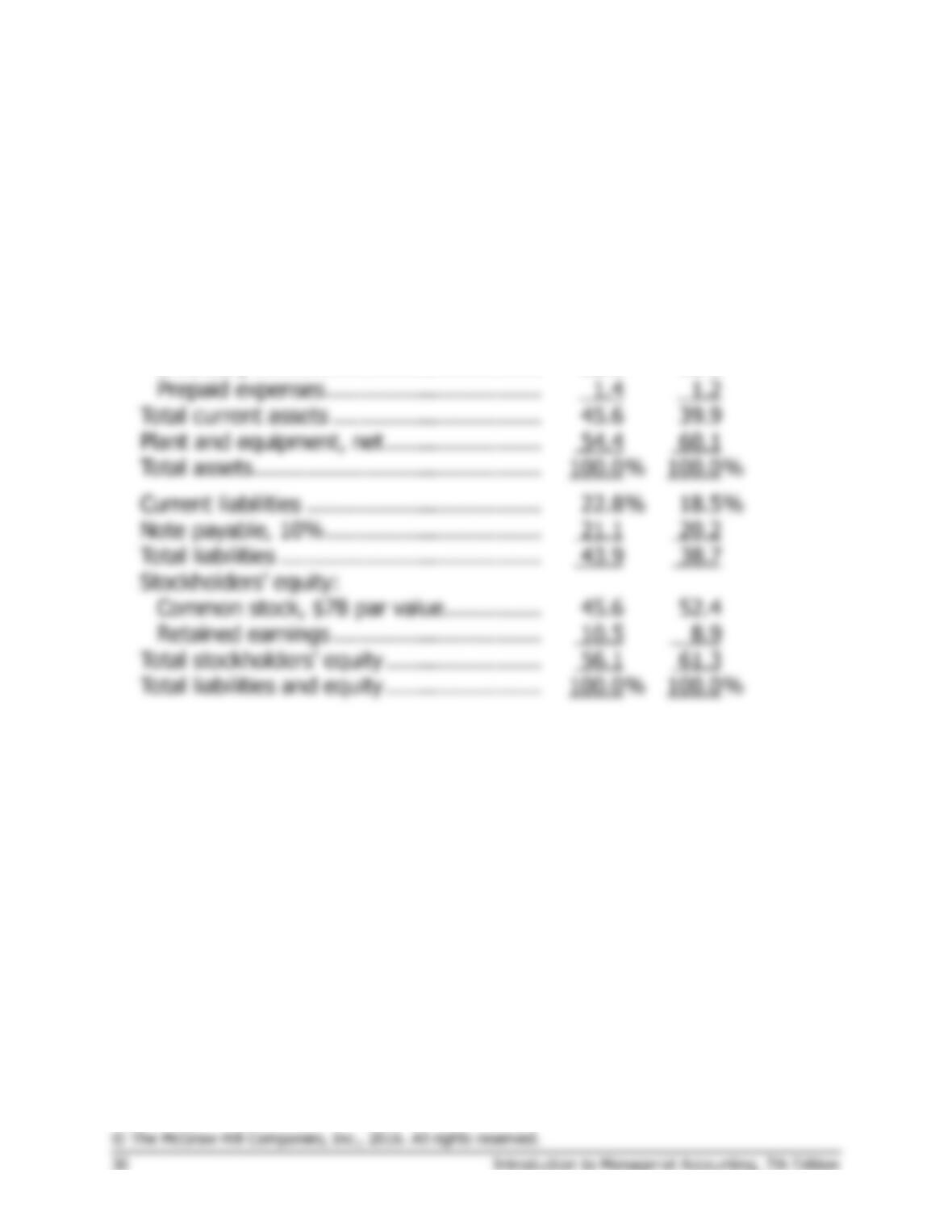
4. With respect to profitability, the return on total assets has improved
From a market performance perspective, the earnings per share
increased from $5.04 to $8.40. However, Lydex’s price earnings ratio of
Problem 13-16A (30 minutes)
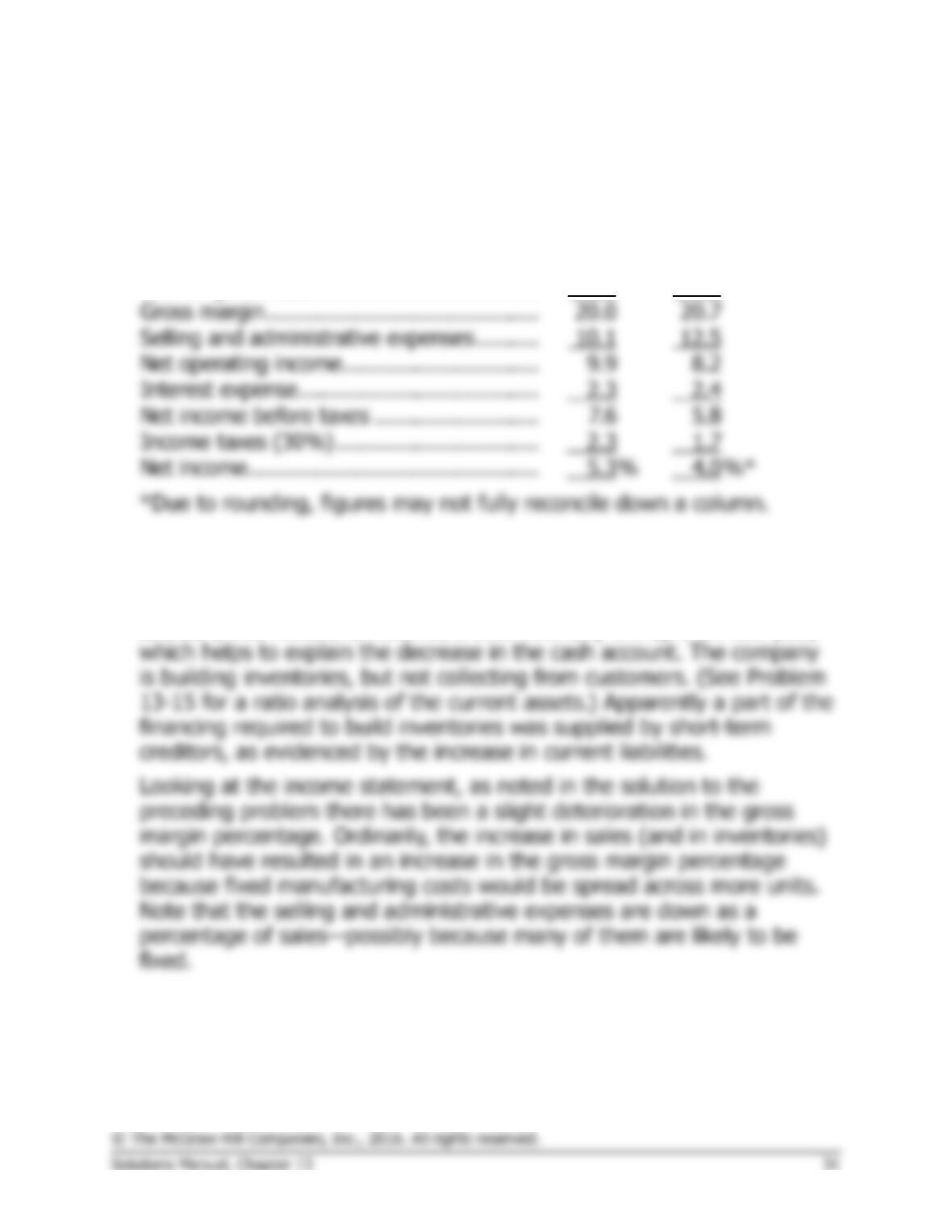
1.
Lydex Company
Comparative Balance Sheets
This Year
Last Year
Current assets:
Cash ……………………………………………
5.6
%
8.5
%
Marketable securities ……………………….
0.0
2.0
Accounts receivable, net …………………..
15.8
12.1
Inventory …………………………..…………
22.8
16.1
Total current assets …………………………..
Plant and equipment, net ……………………
Total assets ……………………………………..
%
%
Current liabilities ………………………………
22.8
%
18.5
%
Note payable, 10% …………………………...
Total liabilities ………………………………….
Common stock, $78 par value ……………
Total liabilities and equity ……………………
%
%
Problem 13-16A (continued)
2.
Lydex Company
Comparative Income Statements
This Year
Last Year
Sales …………………………..…………………
100.0
%
100.0
%
Cost of goods sold ……………………………..
80.0
79.3
Gross margin …………………………………….
Selling and administrative expenses ……….
10.1
12.5
Net operating income ………………………….
Interest expense …………………………..……
Net income before taxes ……………………..
Income taxes (30%) …………………………..
1.7
Net income ……………………………………….
%
3. The company’s current position has declined substantially between the
two years. Cash this year represents only 5.6% of total assets, whereas
it represented 10.5% last year (cash + marketable securities). In
addition, both accounts receivable and inventory are up from last year,
Problem 13-17A (30 minutes)
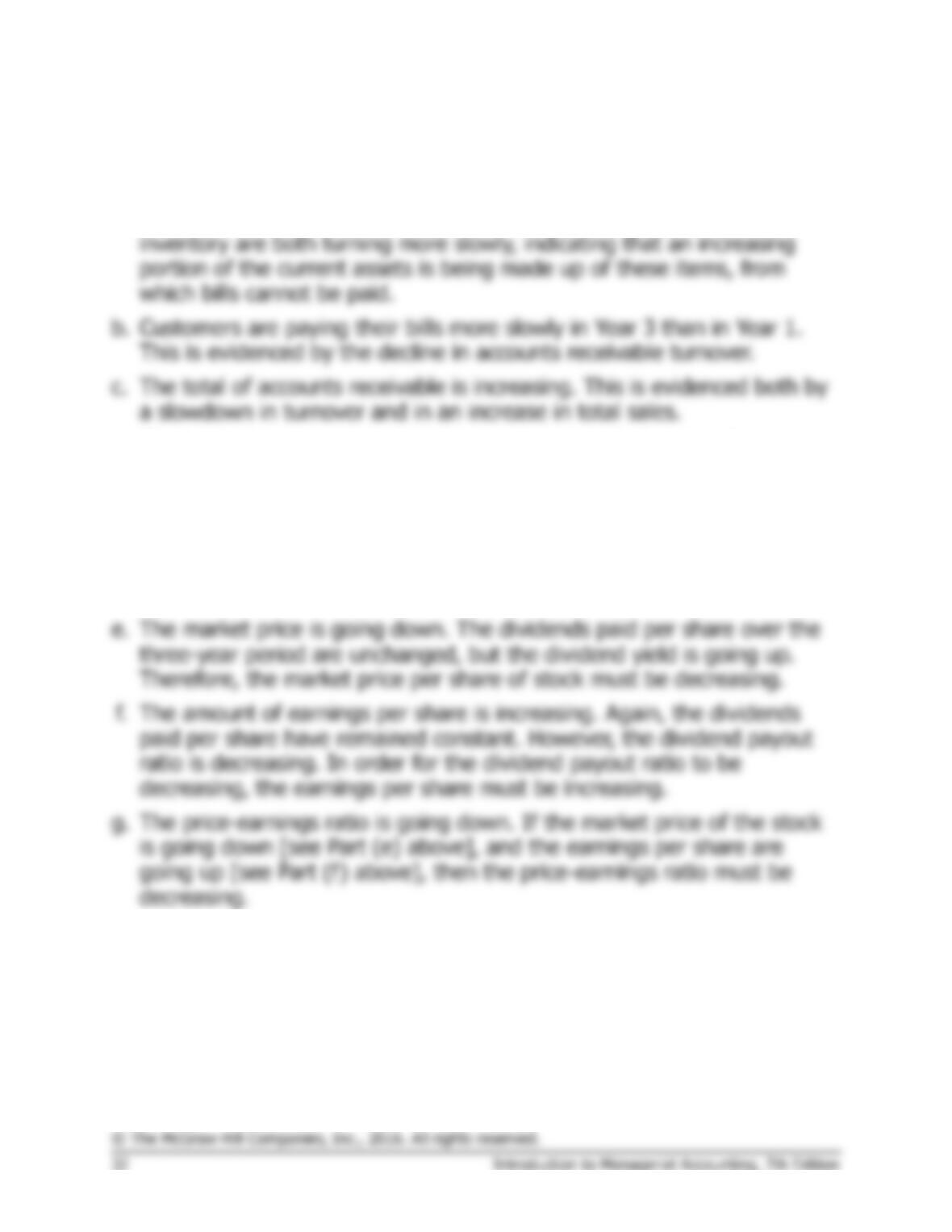
a. It is becoming more difficult for the company to pay its bills as they
come due. Although the current ratio has improved over the three years,
the acid-test ratio is down. Also notice that the accounts receivable and
d. The level of inventory undoubtedly is increasing. Notice that the
inventory turnover is decreasing. Even if sales (and cost of goods sold)
just remained constant, this would be evidence of a larger average
inventory on hand. However, sales are not constant, but rather are
increasing. With sales increasing (and undoubtedly cost of goods sold
also increasing), the average level of inventory must be increasing as
well to service the larger volume of sales.
h. In Year 1 and in Year 2 there was negative leverage because in both
years the return on total assets exceeded the return on common equity.
In Year 3 there was positive leverage because in that year the return on
common equity exceeded the return on total assets employed.
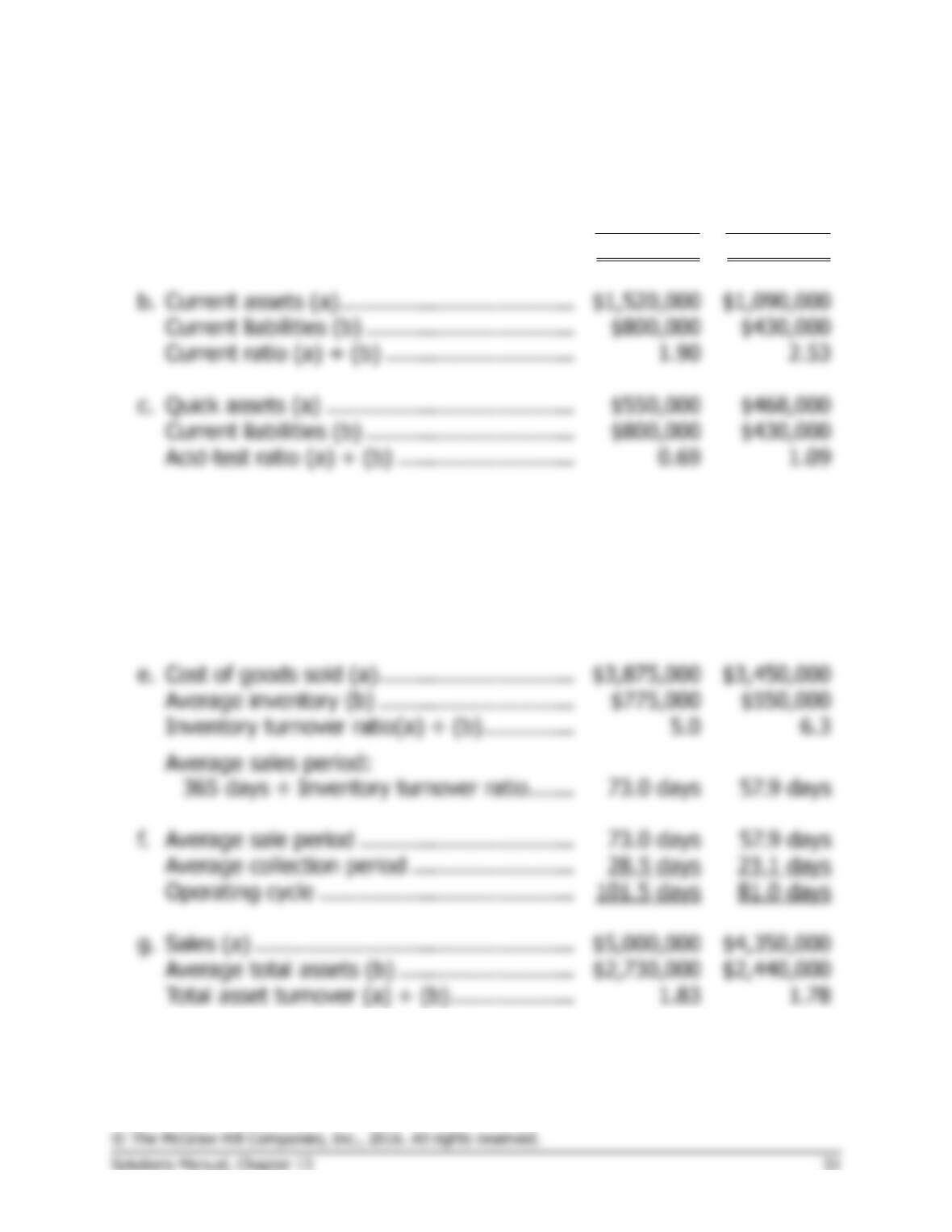
Problem 13-18A (60 minutes)
This Year
Last Year
1.
a.
Current assets …………………………………..
$1,520,000
$1,090,000
Current liabilities ………………………………..
800,000
430,000
Working capital ………………………………….
$ 720,000
$ 660,000
Current assets (a) ………………………………
Current liabilities (b) …………………………..
Current ratio (a) ÷ (b) ………………………..
Quick assets (a) ………………………………..
Current liabilities (b) …………………………..
Acid-test ratio (a) ÷ (b) ………………………
0.69
1.09
d.
Sales on account (a) …………………………..
$5,000,000
$4,350,000
Average receivables (b) ……………………….
$390,000
$275,000
Accounts receivable turnover (a) ÷ (b) …..
12.8
15.8
Average collection period: 365 days ÷
Accounts receivable turnover ……………..
28.5 days
23.1 days
Cost of goods sold (a) …………………………
$3,875,000
$3,450,000
Average inventory (b) …………………………
Inventory turnover ratio(a) ÷ (b) …………..
Average sales period:
73.0 days
57.9 days
Average sale period …………………………...
Average collection period …………………….
28.5 days
23.1 days
Sales (a) ………………………………………….
Average total assets (b) ………………………
$2,440,000
Total asset turnover (a) ÷ (b) ……………….
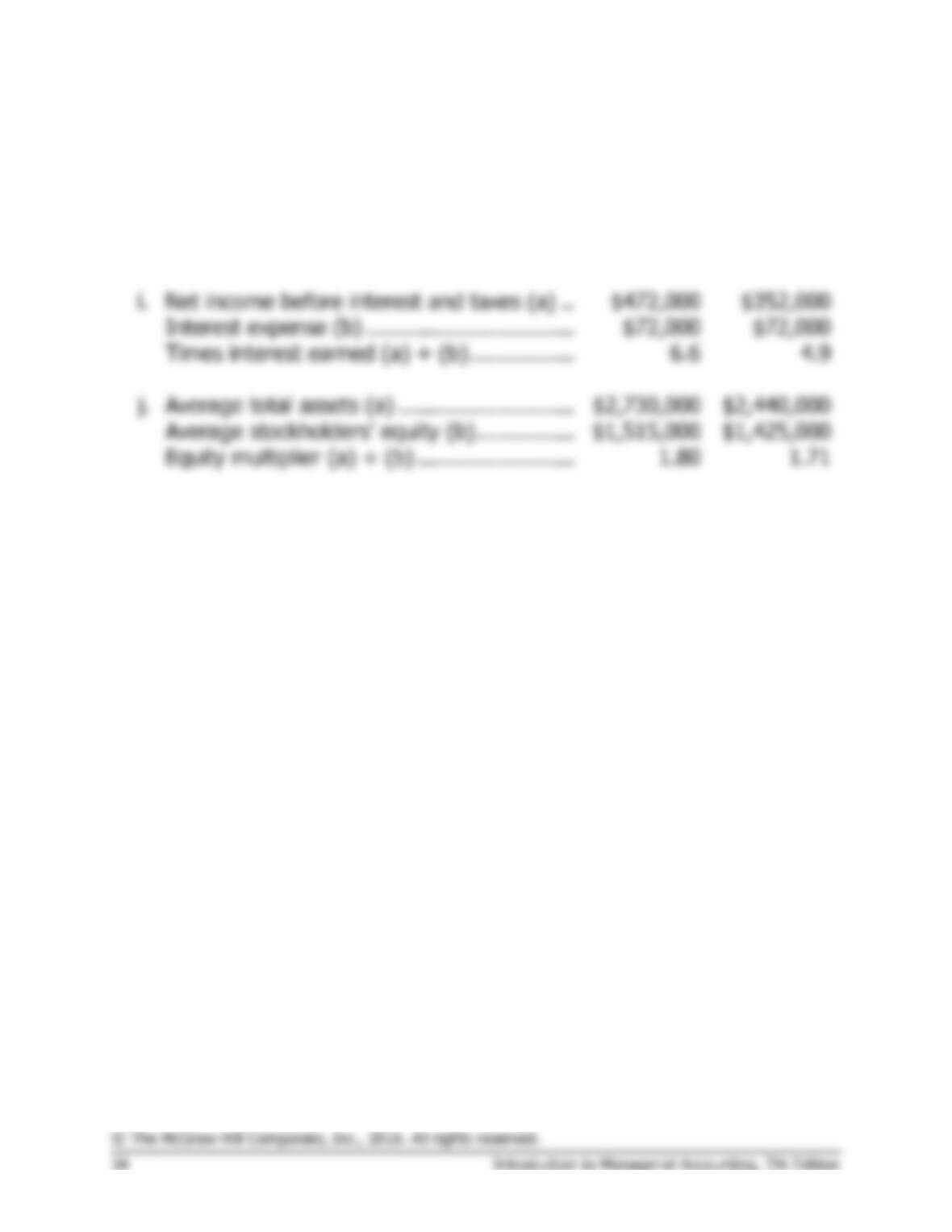
Problem 13-18A (continued)
This Year
Last Year
h.
Total liabilities (a) ………………………………
$1,400,000
$1,030,000
Stockholders’ equity (b) ………………………
$1,600,000
$1,430,000
Debt–to-equity ratio (a) ÷ (b) ……………….
0.875
0.720
Net income before interest and taxes (a) ..
Interest expense (b) …………………………..
Times interest earned (a) ÷ (b) …………….
Average total assets (a) ………………………
Equity multiplier (a) ÷ (b) ……………………
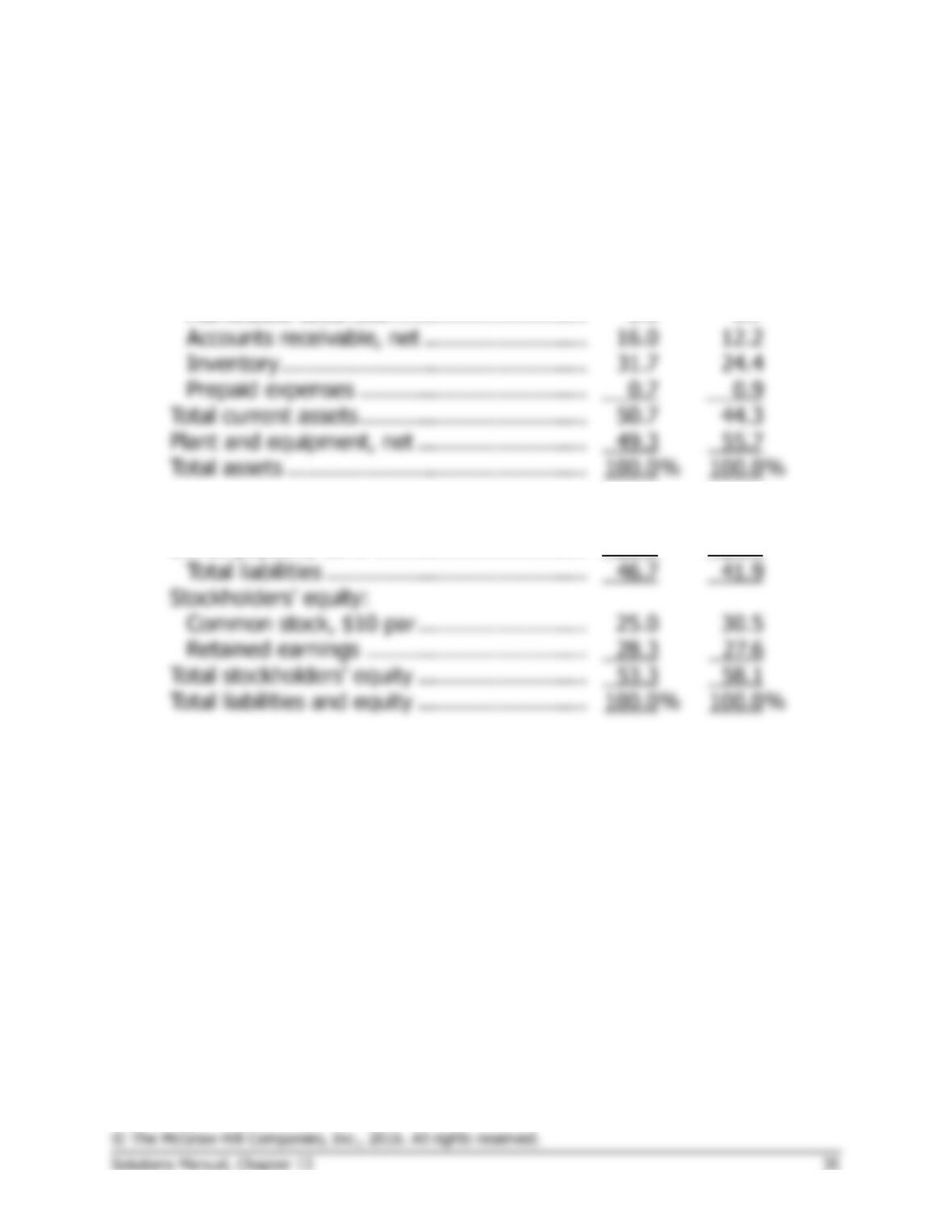
Problem 13-18A (continued)
2.
a.
Sabin Electronics
Common-Size Balance Sheets
This Year
Last Year
Current assets:
Cash ………………………………………………
2.3
%
6.1
%
Marketable securities …………………………
0.0
0.7
Accounts receivable, net …………………….
Inventory ………………………………………..
31.7
Total current assets ……………………………..
Plant and equipment, net ……………………..
Total assets ……………………………………….
%
%
Current liabilities …………………………………
26.7
%
17.5
%
Bonds payable, 12% …………………………...
20.0
24.4
46.7
41.9
Common stock, $10 par ……………………..
Retained earnings …………………………….
Total stockholders’ equity ……………………..
53.3
58.1
Total liabilities and equity ……………………..
%
%