Wild and Shaw Financial and Managerial Accounting 9e Solutions Manual: Chapter 12
Company Analysis — AA 12-1 (15 minutes)
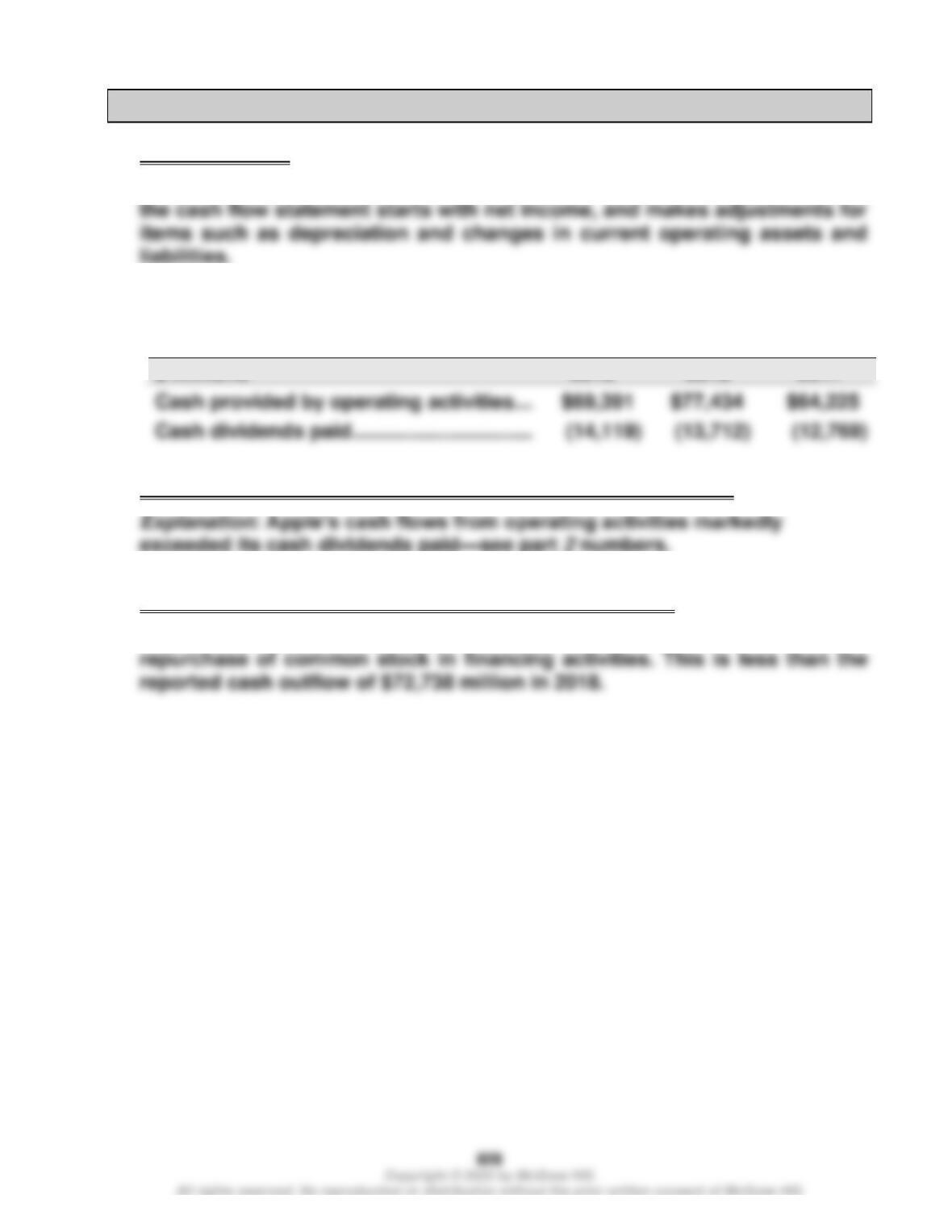
1. Indirect Method
Explanation: We readily know this because the operating activity section of
2. Apple’s cash flows from operating activities and cash dividends paid are
shown in the table below.
$ millions
2019
2018
2017
3. Yes, Apple has Sufficient Cash from Operations for Dividends
4. Less Cash Spent toward Repurchase of Common Stock
Explanation: In 2019, Apple reported a $66,897 million cash outflow for
Wild and Shaw Financial and Managerial Accounting 9e Solutions Manual: Chapter 12
829
Comparative Analysis — AA 12-2 (25 minutes)
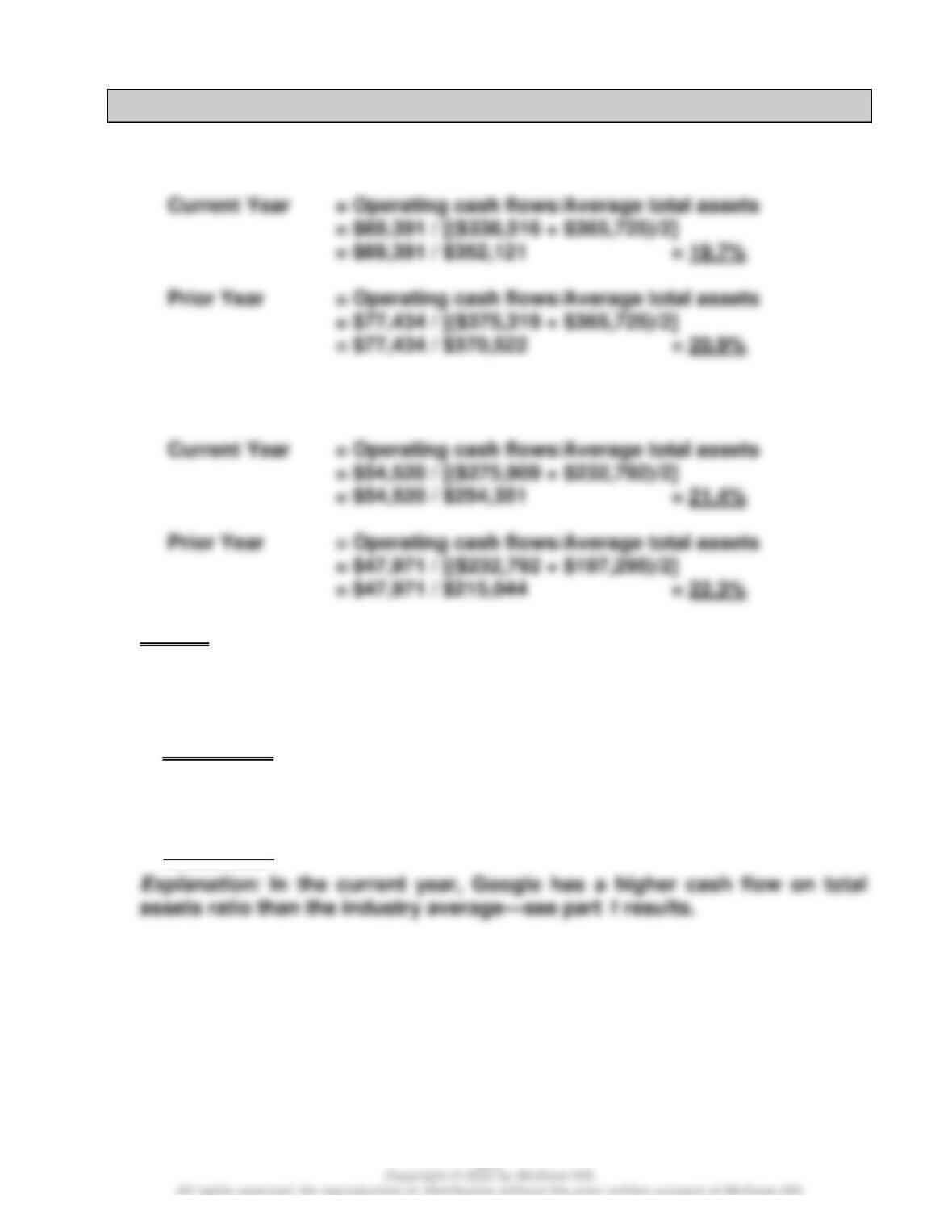
1. Apple’s cash flow on total assets ratio ($ millions)
Google’s cash flow on total assets ratio ($ millions)
2. Google
Explanation: In the current year, Google has a higher cash flow on total
assets ratio than Apple—see part 1 results.
3. a. Outperform
Explanation: In the current year, Apple has a higher cash flow on total assets
ratio than the industry average—see part 1 results.
b. Outperform
Wild and Shaw Financial and Managerial Accounting 9e Solutions Manual: Chapter 12
830
Extended Analysis — AA 12–3 (15 minutes)
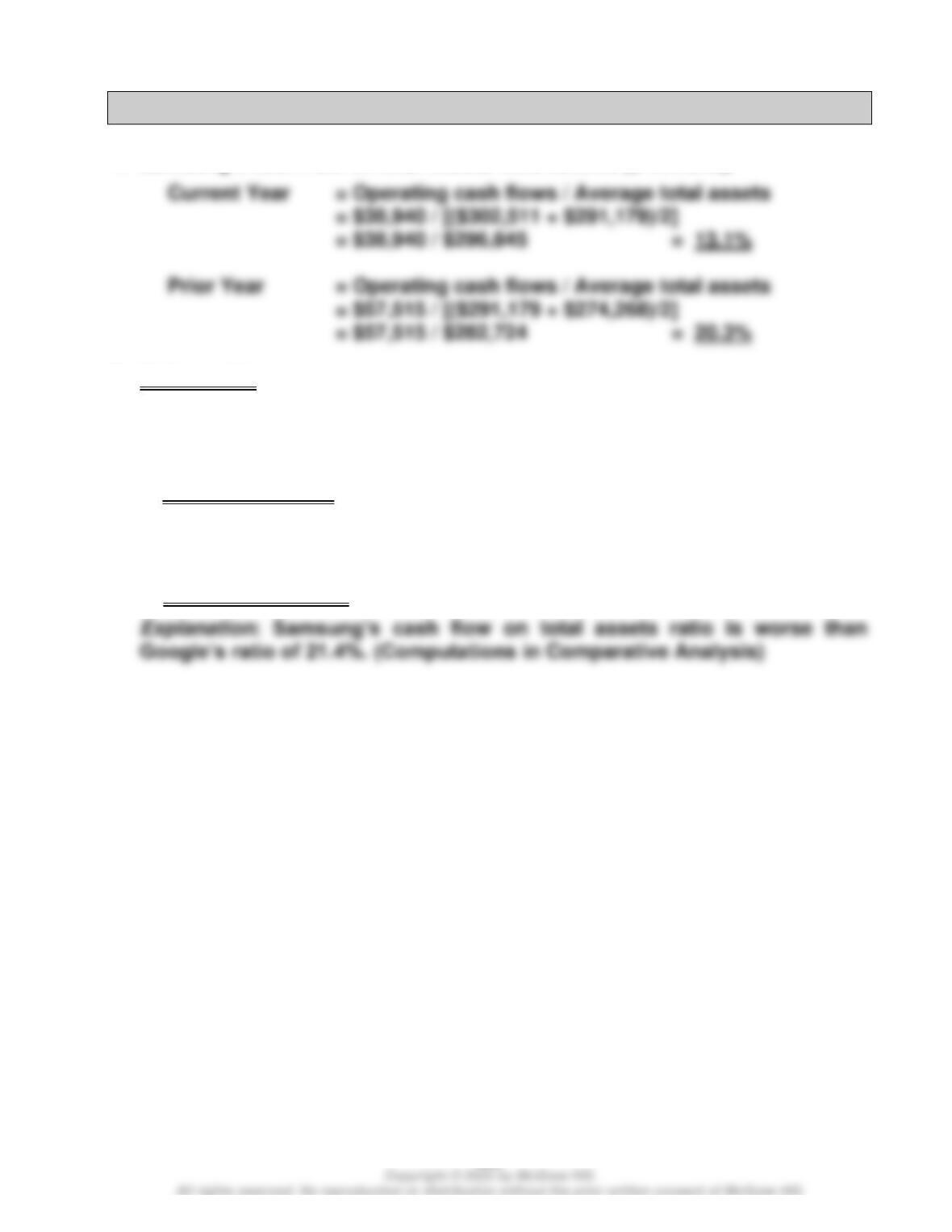
1. Samsung’s cash flow on total assets ratio follows ($ millions).
2. Unfavorable
Explanation: Samsung’s cash flow on total assets ratio worsened in current
year versus the prior year—see part 1 results.
3. a. Worse than Apple
Explanation: Samsung’s cash flow on total assets ratio is worse than Apple’s
ratio of 19.7%. (Computations in Comparative Analysis)
b. Worse than Google
Wild and Shaw Financial and Managerial Accounting 9e Solutions Manual: Chapter 12
DISCUSSION QUESTIONS
1. The purpose of the cash flow statement is to report all major cash receipts (inflows) and
cash payments (outflows) during a period. It helps users to answer questions such as:
• How does a company obtain its cash?
• Where does a company spend its cash?
• What explains the change in the cash balance?
2. On a statement of cash flows, investing activities include cash outflows from purchases
of long-term investments such as stocks and bonds, from purchases of plant assets such
3. On a statement of cash flows, financing activities include cash inflows such as those that
4. The direct method of reporting cash flows from operating activities itemizes the major
classes of cash receipts such as sales to customers, and also itemizes the major classes
of cash payments such as for inventory, interest, taxes, and other operating expenses.
5. On a statement of cash flows prepared according to the direct method, operating activities
generally include cash receipts from the sale of goods and services, cash dividends
6. The indirect method of reporting cash flows from operating activities begins with net
7. Payments of cash dividends should be reported on the statement of cash flows as
financing activities.
8. The amount of the land purchase that was paid for in cash ($400,000) should be reported
on the statement of cash flows as an investing activity. Also, a schedule of noncash
10. Yes; even though a company reports positive net income for the year, it may still show a
net cash outflow from operating activities. When net income is reconciled to the net cash
11. Depreciation is not a source or a use of cash, even though it must be added to net income
when the net cash flow from operating activities is calculated by the indirect method.
Wild and Shaw Financial and Managerial Accounting 9e Solutions Manual: Chapter 12
832
Ethics Challenge — BTN 12-1
1. The business actions available include
a. Encourage early collection of receivables to reduce the accounts
receivable balance.
2. As a business owner, Katie Murphy certainly can exercise discretion over
business actions. However, the underlying economic realities should
support any proposed actions. It is not ethical to pursue actions that
Wild and Shaw Financial and Managerial Accounting 9e Solutions Manual: Chapter 12
833
Communicating in Practice — BTN 12-2
Here is a sample of what the body of the memorandum might include:
TO: Diana Wood
FROM: (Your Name)
SUBJECT: Statement of Cash Flows
DATE: _________________
I am pleased to hear your business is more profitable this year than last.
However, I have been thinking about what you said regarding the statement of
cash flows and have some thoughts as to why you found it confusing.
I recommend that you request your accountant to provide you with a statement
of cash flows that is prepared using the direct method. This will identify exactly
how much cash came in from operating activities like sales. It will also identify
exactly how much cash went out for operating expenses like inventory, wages,
interest, and taxes. It will determine your net operating cash flow by directly
subtracting the total of these operating outflows from the inflows. You should
find this format more understandable.
Wild and Shaw Financial and Managerial Accounting 9e Solutions Manual: Chapter 12
834
Teamwork in Action — BTN 12-3
Part 1
a. The reporting objective of the statement of cash flows is to provide
information about important cash inflows and outflows for business
b. The statement can be prepared using the direct method or the indirect
method for reporting cash flows from operating activities.
Similarities
• Both methods report the same net cash flow from operating activities.
Differences
• Cash flow from operating activities is determined differently. The direct
method determines all operating cash inflows and outflows, and then
Wild and Shaw Financial and Managerial Accounting 9e Solutions Manual: Chapter 12
835
Teamwork in Action (Continued)
c. Steps to prepare the statement of cash flows:
(i) Compute the net increase or decrease in cash using comparative
balance sheet data. This is the target number or the number the
d. Common analyses made from information in the statement of cash flows
include assessing a company’s:
• Ability to generate future cash flows.
Part 2
Adjusting Net Income to Cash Flow from Operating Activities
Items to Add
Items to Subtract
a.
Noncash expenses
Noncash revenues
c.
Decreases in current assets
Increases in current assets
Wild and Shaw Financial and Managerial Accounting 9e Solutions Manual: Chapter 12
836
Teamwork in Action (Concluded)
Part 3
a. Cash receipts from customers = Sales – Increase in Accounts Receivable, or,
b. Cash paid for inventory requires a two-step computation.
(1) Purchases = Cost of goods sold + Increase in inventory, or, – Decrease
in inventory.
c. Cash paid for wages and operating expenses = Wages and other operating
expenses [+ Increase in prepaid expenses, or, – Decrease in prepaid
expenses] and [+ Decrease in accrued liabilities, or, – Increase in accrued
liabilities].
d. Cash paid for interest and taxes = Interest and tax expense + Decrease in
related payable, or, – Increase in related payable.
Explanation: If the related payable decreases, the entity paid for more than
Wild and Shaw Financial and Managerial Accounting 9e Solutions Manual: Chapter 12
837
Entrepreneurial Decision — BTN 12-4
1. It is common for businesses to pay cash in advance for items such as rent,
advertising, supplies, and facilities expansion. Consequently, those costs are
2. It can potentially raise cash financing for expansion by selling shares in the
company or by borrowing money. Moreover, potential lenders will want to
Entrepreneurial Decision — BTN 12-5
Memorandum
To: Jenna and Matt Wilder
From: Your name
Subject: Performance evaluation of Mountain High
Date: Current Date
I have completed my evaluation of your company, Mountain High. My conclusion
is that Mountain High is performing well. This is in spite of its reported net loss
and its negative net cash flow, which I explain in this memorandum.
First, with respect to the net loss, please note that it includes an $85,000 unusual
loss. Absent this unusual loss, Mountain High would report a $75,000 net income.

Wild and Shaw Financial and Managerial Accounting 9e Solutions Manual: Chapter 12
838
++