CHAPTER 12
Intangible Assets
ASSIGNMENT CLASSIFICATION TABLE (BY TOPIC)
Topics
Questions
Brief
Exercises
Exercises
Problems
Concepts
for Analysis
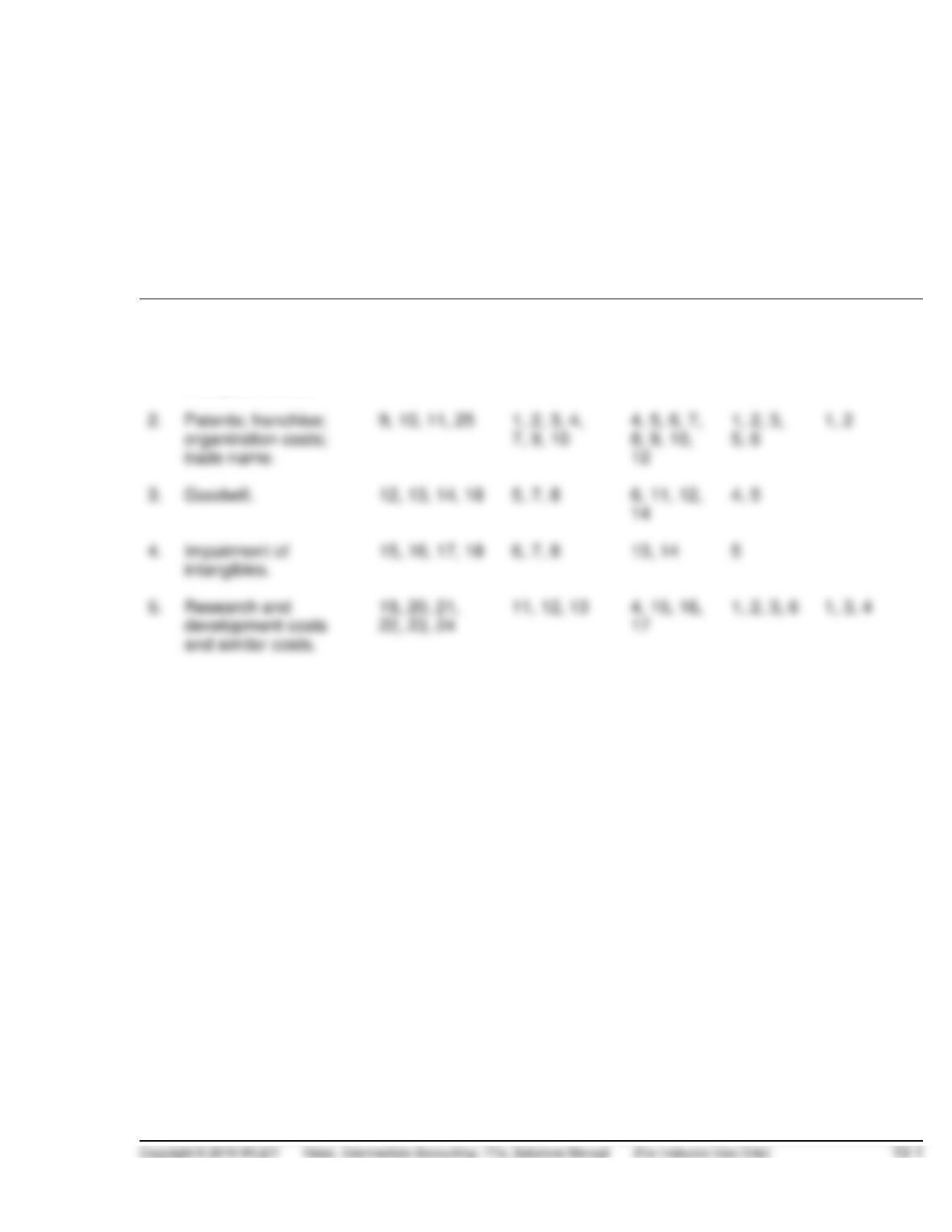
1.
Intangible assets;
concepts, definitions;
items comprising
intangible assets.
1, 2, 3, 4, 5, 6,
7, 8, 9, 10, 11,
12, 13, 14
1, 2, 3,
5, 6
1, 2, 3, 5,
6
1, 2
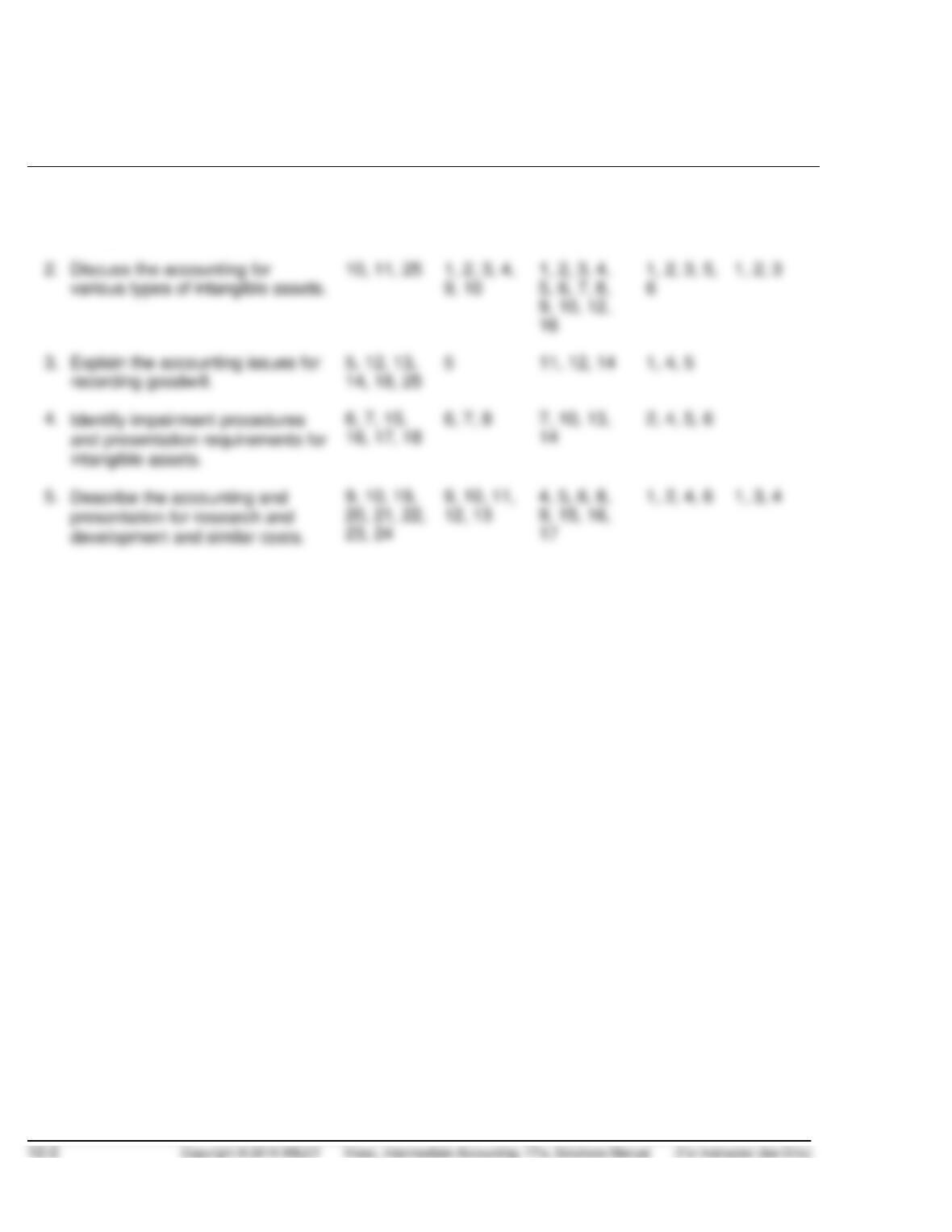
ASSIGNMENT CLASSIFICATION TABLE (BY LEARNING OBJECTIVE)
Learning Objectives
Questions
Brief
Exercises
Exercises
Problems
Concepts
for
Analysis
1.
Discuss the characteristics,
valuation, and amortization of
intangible assets.
1, 2, 3, 6,
7, 8, 9, 10,
25
1, 2, 3, 4,
9, 10
1, 2, 3, 4,
5, 6, 7, 8,
9, 10, 12
1, 2, 3, 5
1, 2, 3, 4
various types of intangible assets.
9, 10
5, 6, 7, 8,
9, 10, 12,
16
6
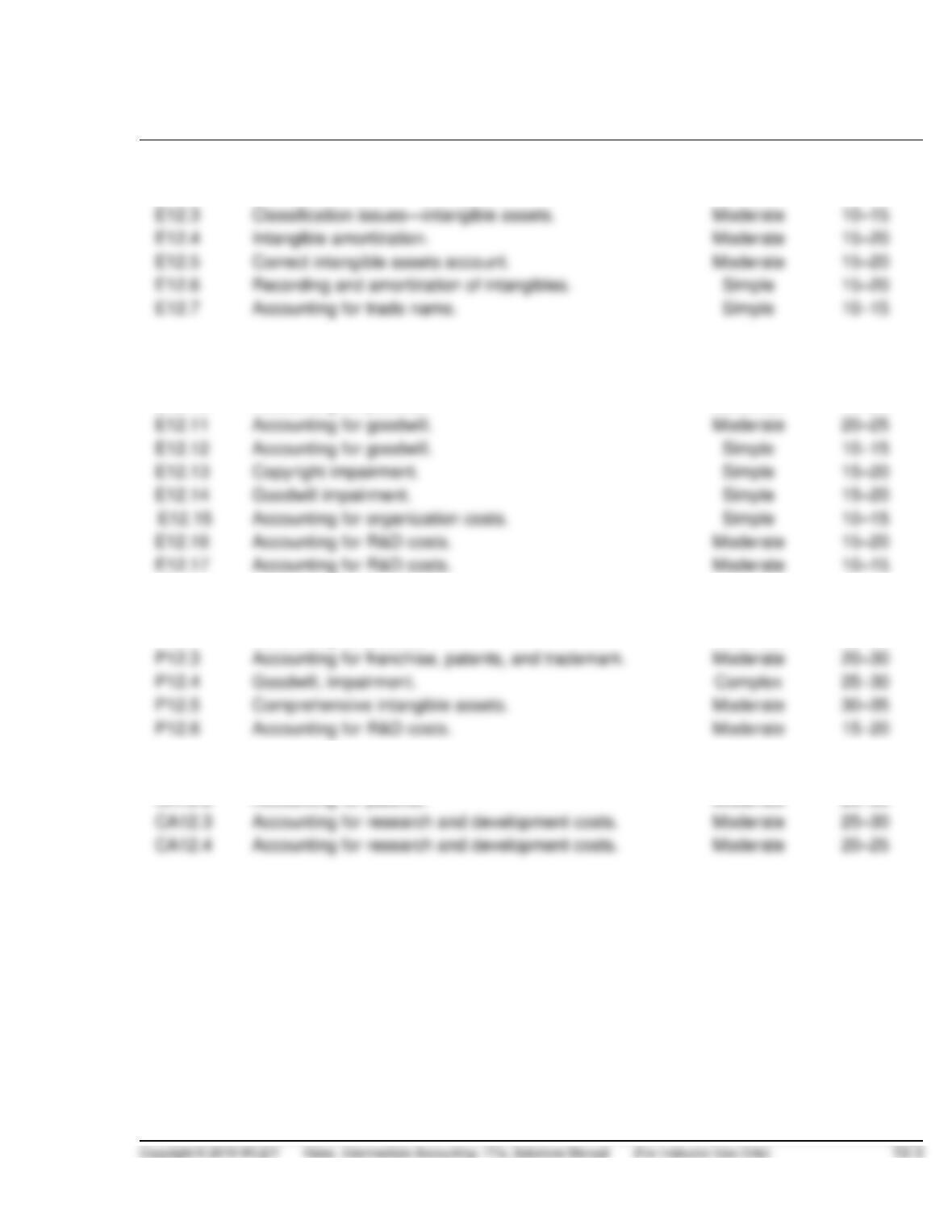
ASSIGNMENT CHARACTERISTICS TABLE
Item
Description
Level of
Difficulty
Time
(minutes)
E12.1
Classification issues—intangibles.
Moderate
15–20
E12.2
Classification issues—intangibles.
Simple
10–15
E12.3
Classification issues—intangible assets.
Moderate
10–15
E12.4
Intangible amortization.
Moderate
15–20
E12.5
Correct intangible assets account.
Moderate
15–20
E12.6
Recording and amortization of intangibles.
Simple
15–20
E12.7
Accounting for trade name.
Simple
10–15
E12.8
Accounting for patents, franchises, and R&D.
Moderate
15–20
E12.9
Accounting for patents.
Moderate
20–25
E12.10
Accounting for patents.
Moderate
15–20
E12.11
Accounting for goodwill.
Moderate
20–25
E12.12
Accounting for goodwill.
Simple
10–15
E12.13
Copyright impairment.
Simple
15–20
E12.14
Goodwill impairment.
Simple
15–20
Accounting for organization costs.
Simple
10–15
E12.16
Accounting for R&D costs.
Moderate
15–20
E12.17
Accounting for R&D costs.
Moderate
10–15
P12.1
Correct intangible assets account.
Moderate
15–20
P12.2
Accounting for patents.
Moderate
20–30
P12.3
Accounting for franchise, patents, and trademark.
Moderate
20–30
P12.4
Goodwill, impairment.
25–30
P12.5
Comprehensive intangible assets.
Moderate
30–35
P12.6
Accounting for R&D costs.
Moderate
15–20
CA12.1
Accounting for pre-opening costs.
Moderate
20–25
CA12.2
Accounting for patents.
Moderate
25–30
CA12.3
Accounting for research and development costs.
Moderate
25–30
CA12.4
Accounting for research and development costs.
Moderate
20–25
ANSWERS TO QUESTIONS
1. The two main characteristics of intangible assets are:
2. If intangibles are acquired for stock, the cost of the intangible is the fair value of the consideration
3. Limited-life intangibles should be amortized by systematic charges to expense over their useful
4. When intangibles are created internally, it is often difficult to determine the validity of any future
service potential. To permit deferral of these types of costs would lead to a great deal of subject-
5. Companies cannot capitalize self-developed, self-maintained, or self-created goodwill. These expen-
6. Factors to be considered in determining useful life are:
(a) The expected use of the asset by the entity.
(b) The expected useful life of another asset or a group of assets to which the useful life of the
7. The amount of amortization expensed for a limited-life intangible asset should reflect the pattern in
which the asset is consumed or used up, if that pattern can be reliably determined. If the pattern of
8. This trademark is an indefinite life intangible and, therefore, should not be amortized.
Questions Chapter 12 (Continued)
9. The $190,000 should be expensed as research and development expense in 2020. The $91,000 is
expensed as selling and promotion expense in 2020. The $45,000 of costs to legally obtain the
10. Amortization Expense ………………………………………………………….. 35,000
11. Artistic-related intangible assets involve ownership rights to plays, pictures, photographs, and
12. Varying approaches are used to define goodwill. They are:
(a) Goodwill should be measured initially as the excess of the fair value of the acquisition cost
over the fair value of the net assets acquired. This definition is a measurement definition but
does not conceptually define goodwill.
(b) Goodwill is sometimes defined as one or more unidentified intangible assets and identifiable
13. Goodwill is recorded only when it is acquired by purchase. Goodwill acquired in a business
combination is considered to have an indefinite life and therefore should not be amortized, but
Questions Chapter 12 (Continued)
14. Many analysts believe that the value of goodwill is so subjective that it should not be given the
same status as other types of assets such as cash, receivables, inventory, etc. The analysts are
15. Accounting standards require that if events or changes in circumstances indicate that the carrying
amount of such assets may not be recoverable, then the carrying amount of the asset should be
assessed. The assessment or review takes the form of a recoverability test that compares the sum
16. Under U.S. GAAP, impairment losses on assets held for use may not be restored.
17. Impairment losses are reported as part of income from continuing operations, generally in the
“Other expenses and losses” section. Impairment losses (and recovery of losses for assets to be
18. The amount of goodwill impaired is $40,000, computed as follows:
Carrying value of net assets …………………………... $1,490,000
19. Research and development costs are incurred to develop new products or processes, to improve
present products, or to discover new knowledge. R&D expenditures present problems of
(1) identifying the costs associated with particular activities, projects, or achievements, and
(2) determining the magnitude of the future benefits and the length of time over which such
benefits may be realized. R&D activities may incur costs classified as follows:
Questions Chapter 12 (Continued)
20. (a) Personnel (labor) type costs incurred in R&D activities should be expensed as incurred.
(b) Materials and equipment costs should be expensed immediately unless the items have
21. (a) Expense as R&D.
22. Each of these items should be charged to current operations. Advertising costs have some minor
24. These costs are referred to as start-up costs, or more specifically organizational costs in this case.
The accounting for start-up costs is straightforward—expense these costs as incurred. The
profession recognizes that these costs are incurred with the expectation that future revenues will
25. The total life, per revised facts, is 40 years (10 + 30). There are 30 (40 – 10) remaining years for
amortization purposes. Original amortization:
$540,000
30
= $18,000 per year; $18,000 X 10 years
SOLUTIONS TO BRIEF EXERCISES
BRIEF EXERCISE 12.1
Patents …………………………………………………………………..
54,000
Cash …………………………..………………………………….
Amortization Expense ……………………………………………..
Patents ($54,000 X 1/10 = $5,400) ……………………..
BRIEF EXERCISE 12.2
Patents …………………………………………………………………..
24,000
Cash …………………………..………………………………….
24,000
Amortization Expense ……………………………………………..
Patents [($43,200 + $24,000) X 1/8 = $8,400] …………
BRIEF EXERCISE 12.3
Trade Names …………………………………………………………..
68,000
Cash …………………………..………………………………….
68,000
Amortization Expense ……………………………………………..
Trade Names ($68,000 X 1/8 = $8,500) ………………
BRIEF EXERCISE 12.4
Franchises ……………………………………………………………..
120,000
Cash …………………………..………………………………….
120,000
Amortization Expense ……………………………………………..
Franchises ($120,000 X 1/8 X 9/12 = $11,250) …….
BRIEF EXERCISE 12.5
Purchase price …………………………………………………….
$700,000
Fair value of assets ………………………………………………
Fair value of liabilities …………………………………………..
Fair value of net assets …………………………………………
BRIEF EXERCISE 12.6
Loss on Impairment ………………………………………………..
190,000
Patents ($300,000 – $110,000) ………………………….
190,000
BRIEF EXERCISE 12.7
Because the fair value of the division exceeds the carrying amount of the
BRIEF EXERCISE 12.8
Loss on Impairment ($800,000 – $750,000) ……………….
50,000
Goodwill ……………………………………………………….
BRIEF EXERCISE 12.9
Carrying
Amount
Life in
Months
Amortization
Per Month
Months
Amortization
Patent (1/1/20)
$288,000
96
$3,000
12
Legal costs (12/1/20)
85,000
85
$1,000
BRIEF EXERCISE 12.10
Copyright No. 1 for $9,900 should be expensed and therefore not reported
on the balance sheet.
BRIEF EXERCISE 12.11
Organization Expense ……………………………………………..
60,000
BRIEF EXERCISE 12.12
BRIEF EXERCISE 12.13
(a) Capitalize
SOLUTIONS TO EXERCISES
EXERCISE 12.1 (15–20 minutes)
(a) 10, 13, 15, 16, 17, 19, 23
(b) 1. Long-term investments in the balance sheet.
2. Property, plant, and equipment in the balance sheet.
3. Research and development expense in the income statement.
4. Current asset (prepaid rent) in the balance sheet.
EXERCISE 12.2 (10–15 minutes)
The following items would be classified as intangible assets:
Cable television franchises Film contract rights
EXERCISE 12.2 (Continued)
Investments in affiliated companies would be classified as part of the
investments section of the balance sheet.
EXERCISE 12.3 (10–15 minutes)
(a)
Trademarks
$15,000
Excess of cost over fair value of net identifiable
assets of acquired subsidiary (goodwill)
(b) Organization costs, $24,000, should be expensed.
Discount on bonds payable, $35,000, should be reported as a contra
account to bonds payable in the long-term liabilities section on the
balance sheet.
EXERCISE 12.4 (15–20 minutes)
1. Alatorre should report the patent at $600,000 ($1,000,000 cost net of
$400,000 accumulated amortization) on the balance sheet. The
2. Alatorre should amortize the franchise over its estimated useful life.
Because it is uncertain that Alatorre will be able to retain the franchise
3. These costs should be expensed as incurred. Therefore $275,000 of
organization expense is reported in income for 2020.
EXERCISE 12.5 (15–20 minutes)
Research and Development Expense ………………………..
940,000
Patents ……………………………………………………………………
75,000
Rent Expense [(5 ÷ 7) X $91,000] ……………………………….
65,000
Prepaid Rent [(2 ÷ 7) X $91,000] …………………………..……
26,000
Advertising Expense ………………………………………………..
207,000
Retained Earnings ……………………………………………………
Discount on Bonds Payable ……………………………………..
82,950*
Interest Expense ……………………………………………………..
Paid in Capital in Excess of Par on Common Stock …..
Intangible Assets ……………………………………………….
Amortization Expense [($75,000 ÷ 10) X 1/2] ……………..
Patents (or Accumulated Amortization)
EXERCISE 12.6 (15–20 minutes)
Patents …………………………………………………………………..
350,000
Goodwill …………………………………………………………………
360,000
Franchise …………………………..…………………………..
450,000
Copyright ……………………………………………………….
156,000
Research and Development Expense ……………………….
215,000
Intangible Assets ……………………………………………
1,531,000
Amortization Expense ……………………………………………..
Patents ($350,000/8) ………………………………………..
Franchise ($450,000/10 X 6/12) …………………………
Copyright ($156,000/5 X 5/12) …………………………..
EXERCISE 12.7 (10–15 minutes)
(a) 2019 amortization: $16,000 ÷ 10 = $1,600.
12/31/19 book value: $16,000 – $1,600 = $14,400.
(c) Carrying amount ($19,733) > future cash flows ($16,000); thus the
trade name fails the recoverability test. The new carrying value is
$15,000—the trade name’s fair value.
EXERCISE 12.8 (15–20 minutes)
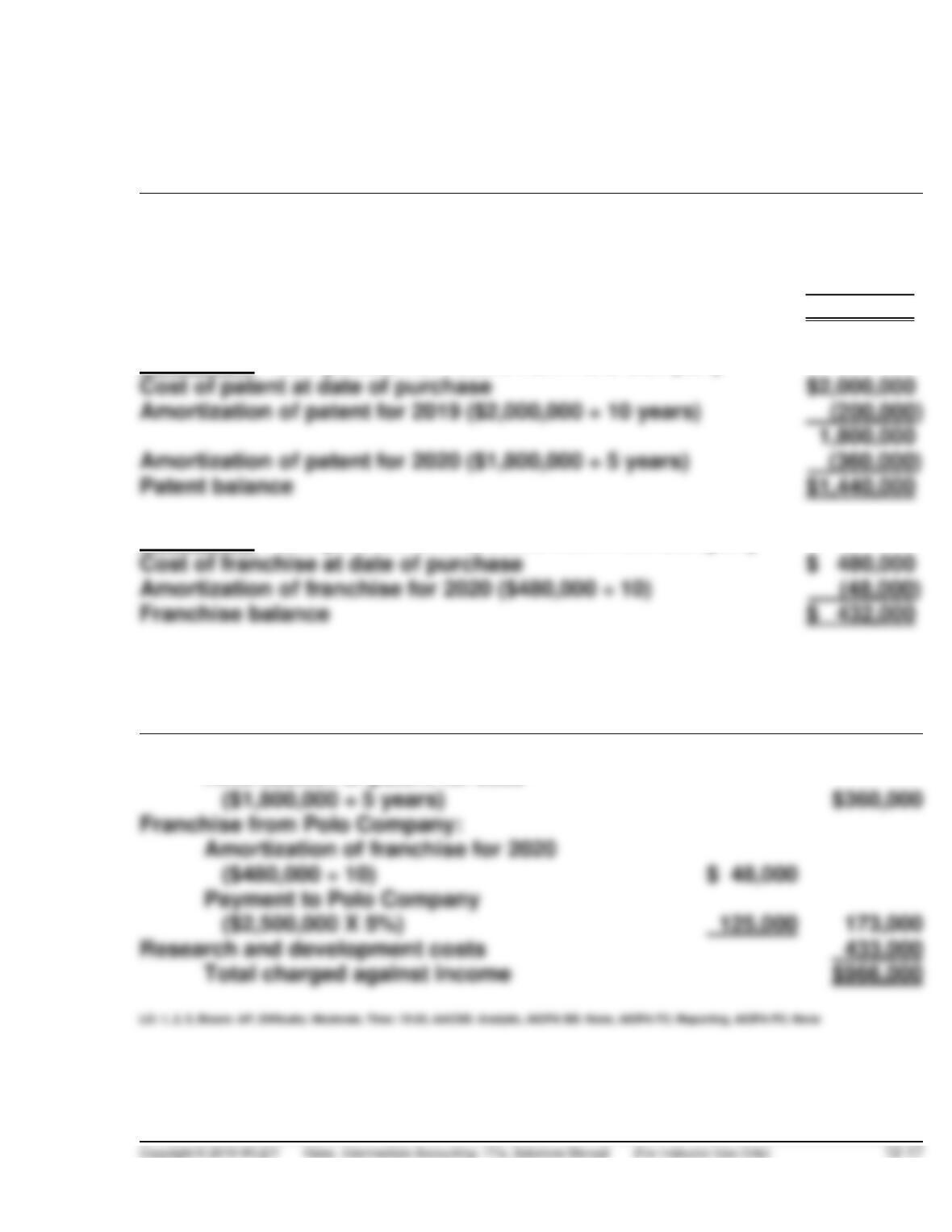
(a) CARTER COMPANY
Intangibles Section of Balance Sheet
December 31, 2020
Patent from Ford Company, net of accumulated
amortization of $560,000 (Schedule 1)
$1,440,000
Franchise from Polo Company, net of accumulated
amortization of $48,000 (Schedule 2)
432,000
Total intangibles
$1,872,000
Schedule 1 Computation of Patent from Ford Company
Amortization of patent for 2019 ($2,000,000 ÷ 10 years)
$1,440,000
Schedule 2 Computation of Franchise from Polo Company
Amortization of franchise for 2020 ($480,000 ÷ 10)
$ 432,000
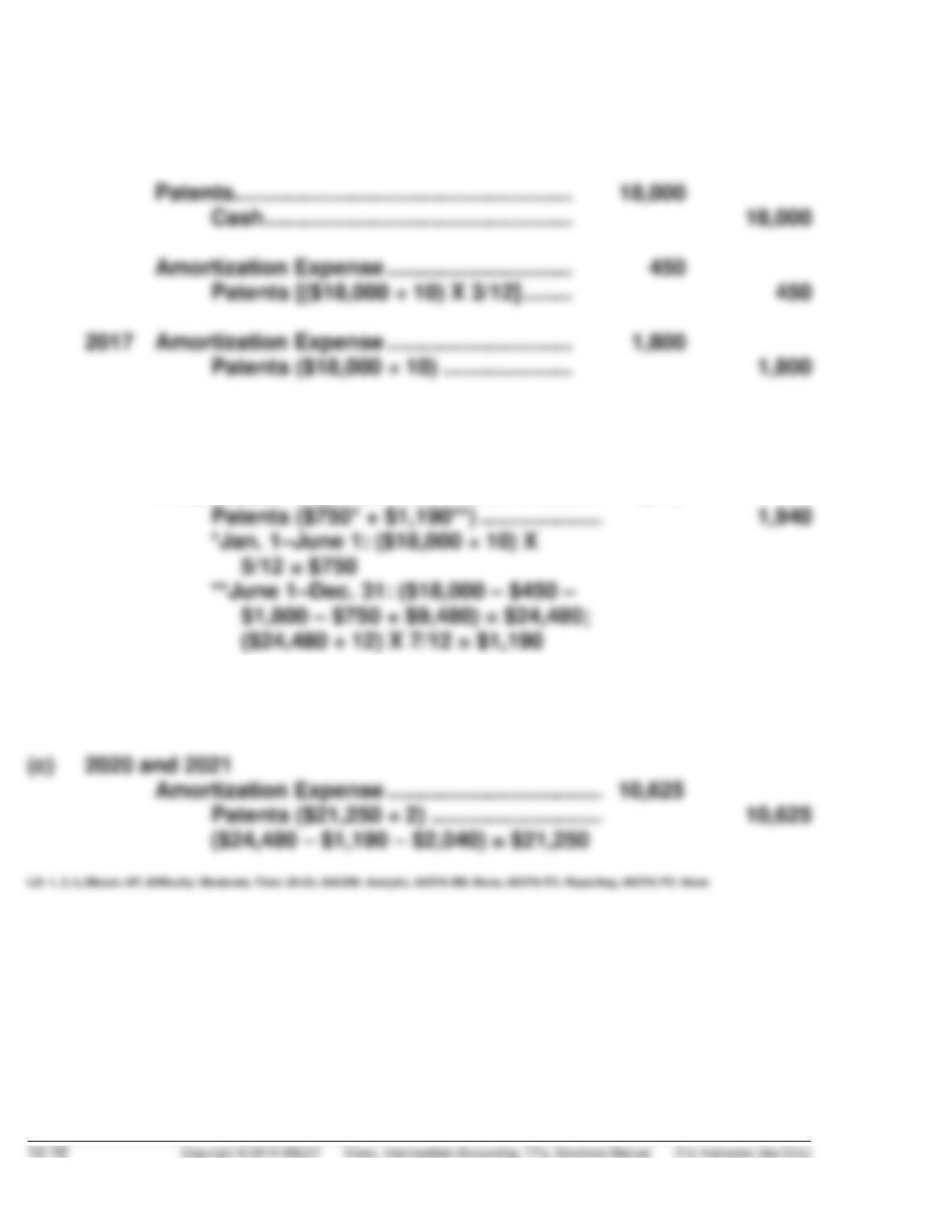
(b) CARTER COMPANY
Income Statement Effect
For the year ended December 31, 2020
Patent from Ford Company:
Amortization of patent for 2020
Amortization of franchise for 2020
($2,500,000 X 5%)
Total charged against income
EXERCISE 12.9 (20–25 minutes)
(a)
2016
Research and Development Expense ……………………….
170,000
Cash ……………………………………………………….
170,000
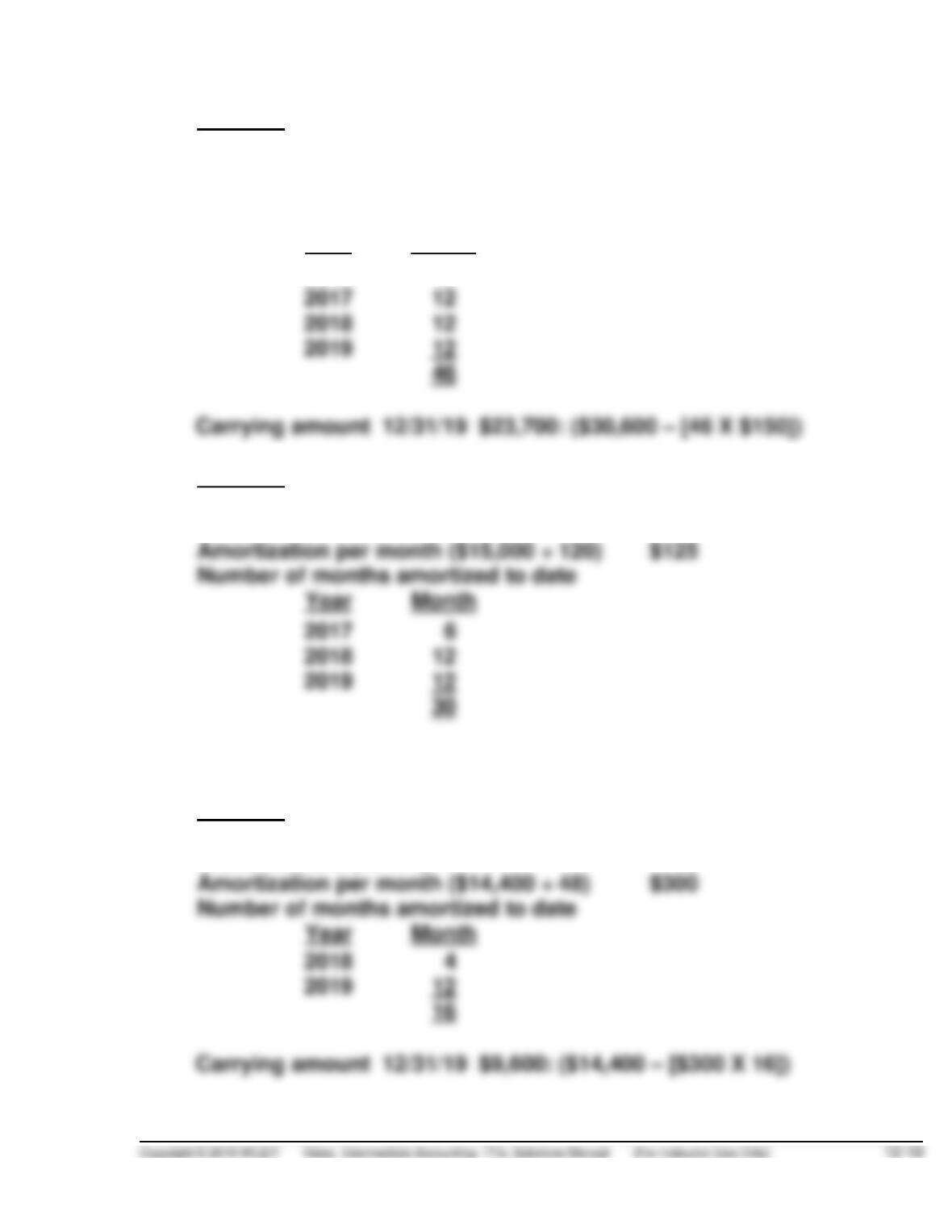
Patents ……………………………………………………….
Cash ……………………………………………………….
Amortization Expense …………………………..
Patents [($18,000 ÷ 10) X 3/12] ………………………….
2017
Amortization Expense …………………………..
Patents ($18,000 ÷ 10) …………………………..
1,800
(b)
2018
Patents ……………………………………………………….
9,480
Cash ……………………………………………………….
9,480
Amortization Expense ……………………………………………..
1,940
Patents ($750* + $1,190**) …………………………..
1,940
*Jan. 1–June 1: ($18,000 ÷ 10) X
5/12 = $750
$1,800 – $750 + $9,480) = $24,480;
($24,480 ÷ 12) X 7/12 = $1,190
2019
Amortization Expense ……………………………………………..
2,040
Patents ($24,480 ÷ 12) …………………………..
2,040
(c)
2020 and 2021
Amortization Expense ……………………………………………..
Patents ($21,250 ÷ 2) …………………………..
($24,480 – $1,190 – $2,040) = $21,250
EXERCISE 12.10 (15–20 minutes)
(a)
Patent A
Life in years
17
Life in months (12 X 17)
204
Amortization per month ($30,600 ÷ 204)
$150
Number of months amortized to date
Year
Month
2016
10
2017
12
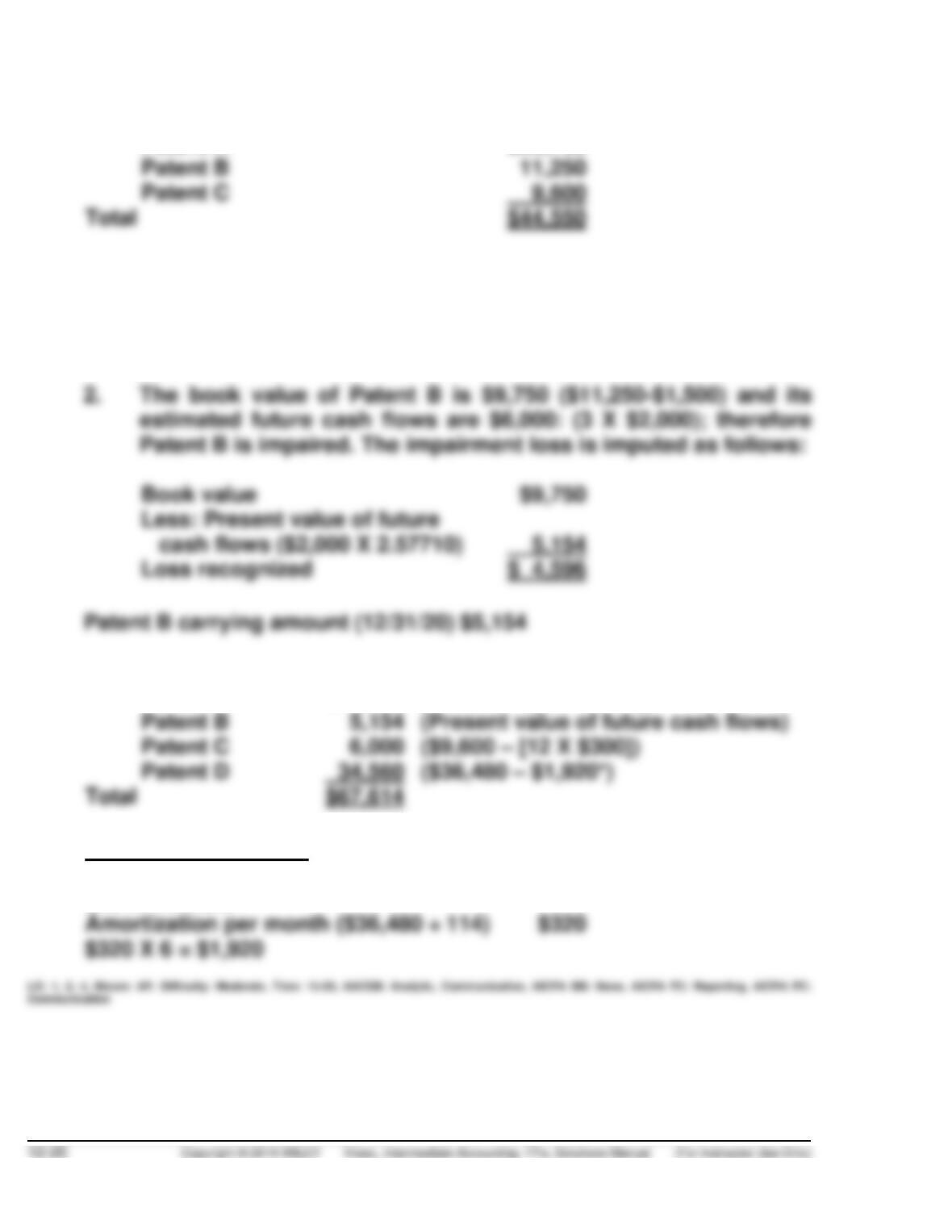
Patent B
Life in years
10
Life in months (12 X 10)
120
Amortization per month ($15,000 ÷ 120)
Number of months amortized to date
Year
Month
2019
12
Carrying amount 12/31/19 $11,250: ($15,000 – [$125 X 30])
Patent C
Life in years
4
Life in months (12 X 4)
48
Amortization per month ($14,400 ÷ 48)
Number of months amortized to date
Year
Month
2018
EXERCISE 12.10 (Continued)
At December 31, 2019
Patent A
$23,700
Patent B
Patent C
9,600
(b) Analysis of 2020 transactions
1. The $245,700 incurred for research and development should be
expensed.
Book value
Less: Present value of future
cash flows ($2,000 X 2.57710)
5,154
At December 31, 2020
Patent A
$21,900
($23,700 – [12 X $150])
Patent B
(Present value of future cash flows)
Patent C
($9,600 – [12 X $300])
Patent D
($36,480 – $1,920*)
Patent D amortization
Life in years
9 1/2
Life in months
114
Amortization per month ($36,480 ÷ 114)
$320 X 6 = $1,920