Financial and Managerial Accounting, 8e
12-1
CHAPTER 12
REPORTING CASH FLOWS
Related Assignment Materials
Student Learning Objectives
Questions
Quick
Studies*
Exercises*
Problems*
AA and
BTN
Conceptual objectives:
investing and financing
activities are disclosed.
C1. Distinguish between
1, 2, 3, 5, 7,
12-1
12-1,
AA 12-3, BTN 12-1,
Analytical objectives:
A1. Analyze the statement
of cash flows and apply the
cash flow on total assets
ratio.
1, 9, 12, 13
12-19
12-11, 12-13
12-3,
GL 12-1
AA 12-1, AA 12-2,
BTN 12-1, BTN 12-3,
BTN 12-4, BTN 12-5,
BTN 12-6
Procedural objectives:
P1. Prepare a statement of cash
flows.
12-2
12-17, 12-20
12-7,
GL12-1,
GL12-3, ES
12-5, 12-6,
12-18
12-12
12-6, SP,
GL 12-2,
GL 12-3
P4.AIllustrate use of a
spreadsheet to prepare a
statement of cash flows.
(Appendix 12A)
12-20
12-14
12-4, 12-7
the direct method.
(Appendix 12B)
4, 5
12-21, 12-22,
12-15, 12-16,
12-2, 12-5,
BTN 12-4
*See additional information on next page that pertains to these quick studies, exercises and problems.
SP refers to the Serial Problem
See Chapter 1 of the Instructor’s Resource Manual for more information on materials for this text available in
Connect.
Connect
Available on the instructor’s course-specific website, Connect:
• All numerical Quick Studies, all Exercises and Problems Set A.
Hints/Guided Examples
Please note that the Guided Examples are labeled as “Hints” in Connect assignments. The animated PowerPoints without
Need-to-Know Videos
LO
Need–to-Know
Title
Time
C1
12-1
Classifying Cash Flows
2:04
12-2
Reporting Operating Cash Flows (Indirect)
3:15
12-3
Reporting Investing Cash Flows
3:02
12-4
Reporting Financing Cash Flows
1:35
Concept Overview Videos
LO
Title
Time
C1
Distinguish between operating, investing, and financing activities, and describe
how noncash investing and financing activities are disclosed.
Purpose of the Statement of Cash Flows
1:20
Measurement of Cash Flows
0:26
Classification of Cash Flows
0:22
0:48
1:03
1:07
1:02
Analyzing Cash Sources and Uses
1:31
Cash Flow on Total Assets
0:40
Cash Flow on Total Assets – Illustration
1:28
Prepare a statement of cash flows.
Format of the Statement of Cash Flows
1:04
Preparing the Statement of Cash Flows
0:37
Analyzing the Cash Account
0:47
Analyzing Noncash Accounts
1:23
Information to Prepare the Statement
0:28
Financial and Managerial Accounting, 8e
12-3
P2
Compute cash flows from operating activities using the indirect method.
Indirect and Direct Methods of Reporting
1:16
Applying the Indirect Method
0:55
Adjustments for Income Statement Items Not Affecting Cash
1:55
Adjustments for Changes in Current Assets
1:38
Adjustments for Changes in Current Liabilities
1:36
Summary Adjustments for Operating Activities – Indirect Method
0:20
P3
Determine cash flows from both investing and financing activities.
Three-Step Analysis – Cash Flows from Investing
0:38
Analyzing Noncurrent Assets – Cash Flows from Investing
2:29
0:52
Analyzing Noncurrent Liabilities and Equity – Cash Flows from Financing
2:12
P4
Illustrate use of a spreadsheet to prepare a statement of cash flows.
(Appendix 12A)
Illustration of Spreadsheet
1:45
P5
Compute cash flows from operating activities using the direct method.
(Appendix 12B)
Direct Method
1:39
Operating Cash Receipts – Customers
1:29
Operating Cash Receipts – Other Cash Receipts
0:32
Operating Cash Payments – Inventory
1:42
Operating Cash Payments – Purchases
0:47
Operating Cash Payments – Operating Expenses and Wages
1:49
Operating Cash Payments – Depreciation, Gains and Losses
1:07
Synopsis of Chapter Revisions
NEW opener—Vera Bradley and entrepreneurial assignment.
New box on Tesla’s cash outflows and growing market value.
Slightly revised infographics on cash flows from operating, investing, and financing.
Streamlined sections on analyzing the cash account and noncash accounts.
Financial and Managerial Accounting, 8e
12-4
Chapter Outline
I. Basics of Cash Flow Reporting
4. Why do income and cash flows differ?
A. Purpose of the Statement of Cash Flows
Reports cash receipts (inflows) and cash payments (outflows) for a period. This report classifies
B. Importance of Cash Flows
Information about cash flows influences decisions. It helps users decide whether a company has
enough cash to pay debts, evaluate a company’s ability to pursue unexpected opportunities, and
helps managers plan day-to–day operations and make long-term investment decisions.
The phrase cash flows refers to both cash and cash equivalents. A cash equivalent must satisfy two
criteria:
2. Be sufficiently close to its maturity date so its market value is unaffected by interest rate
changes.
D. Classification of Cash Flows
Cash receipts and cash payments are classified and reported in one of three categories:
1. Operating Activities—include transactions and events that affect net income (with some
exceptions such as unusual gains and losses). Specific examples:
2. Investing Activities—include transactions and events that come from the purchase or sale of
long-term assets. Specific examples:
3. Financing Activities—include transactions and events that affect long-term liabilities and
equity:
a. Cash inflows from issuing short-term and long-term debt (notes payable and bonds
Financial and Managerial Accounting, 8e
12-5
assets; and purchase of noncash assets by issuing equity or debt.
F. Format of the Statement of Cash Flows
4. Contains a separate schedule or note disclosure of any noncash financing and investing
1. Lists cash flows by categories (operating, financing and investing) and identifies the net cash
inflow or outflow in each category.
G. Preparing the Statement of Cash Flows
1. There are five steps in preparing a statement of cash flows:
a. Compute the net increase or decrease in cash (bottom line or target number).
b. Compute and report net cash provided (used) by operating activities.
2. Sources of information for preparing the statement of cash flows:
3. Alternative approaches to preparing the statement:
a. Analyzing the cash account
b. Analyzing noncash accounts
II. Cash Flows from Operating
and indirect method.
A. Indirect and Direct Methods of Reporting—Two ways of reporting that apply only to the operating
activities section.
1. Direct Method—separately lists operating cash receipts and operating cash payments. Cash
payments are then subtracted from cash receipts.
B. Applying the Indirect Method
1. Reports net income using accrual accounting, and then adjusts net income to get net cash
provided or used by operating activities.
2. The types of adjustments are:
Financial and Managerial Accounting, 8e
activities).
i. Changes in accounts receivable, inventory, prepaid expenses, accounts payable, interest
C. Summary Adjustments for Indirect method—see Exhibit 12.12 in text.
III. Cash Flows from Investing—identical under direct and indirect methods.
A. Three-step process to determine cash provided (used) by investing activities:
1. Identify changes in investing-related accounts (all noncurrent assets, and the current accounts
IV. Cash Flows from Financing— identical under direct and indirect methods.
A. Three-step process to determine cash provided (used) by financing activities:
1. Identify changes in financing-related accounts (all noncurrent liabilities—including current
B. Proving Cash Balances
Last step in preparing the statement is to report the beginning and ending cash balances and provide that
the net change in cash is explained by operating, investing and financing cash flows. Exhibit 12.13 in
text.
V. Decision Analysis—Cash Flow Analysis
A. Analyzing Cash Sources and Uses
1. Managers review cash flows for business decisions.
B. Cash Flow on Total Assets
1. Measures actual cash flows and is not affected by accounting recognition and measurement.
VI. Spreadsheet Preparation of the Statement of Cash Flows (Appendix 12A)
A spreadsheet approach may be used to help us prepare a statement of cash flows.
A. The spreadsheet has four columns containing dollar amounts.
B. Separate sections on the working paper present (a) balance sheet items with debit balances; (b)
balance sheet items with credit balances; (c) cash flows from operating activities, starting with net
C. Information for sections (c)-(f) is developed in four steps in the Analysis of Changes columns:
1. By adjusting net income for the changes in all noncash current asset and current liability account
balances. This reconciles the changes in these accounts.
Financial and Managerial Accounting, 8e
12-7
VII. Direct Method of Reporting Operating Cash Flows
(Appendix 12B)
A. Separately list each major item or class of operating cash receipts and cash payments.
B. Classes of operating cash receipts include cash received from customers, renters, interest, and
dividends.
C. Classes of operating cash payments include cash paid to suppliers, to employees and other operating
expense, interest, and income taxes.
Financial and Managerial Accounting, 8e
12-8
Chapter 12 Alternate Demonstration Problem
The Carpet Company’s 2019 and 2020 balance sheets included the following items:
December 31
2020
2019
Debits
Cash ……………………………………………………………………
$10,500
$ 4,000
Accounts receivable …………………………………………….
8,000
9,000
Merchandise inventory …………………………………………
Equipment ……………………………………………………………
Credits
Accumulated depreciation, equipment ………………….
$ 4,000
$ 3,000
Accounts payable …………………………………………………
7,000
5,000
Taxes payable ………………………………………………………
1,000
2,000
Dividends payable ………………………………………………..
1,500
Common stock, $10 par value ……………………………….
Contributed capital in excess of par, common stock
6,000
5,000
Retained earnings ………………………………………………..
Totals ………………………………………………………….
$57,500
$46,000
The Carpet Company’s income statement was as follows:
CARPET COMPANY
Income Statement
For the Year Ended December 31, 2020
Sales ……………………………………………………………………
$61,000
Cost of goods sold ……………………………………………….
$40,000
Wages and other operating expenses……………………
Depreciation expense …………………………………………..
Net income …………………………………………………………..
$ 9,000
Financial and Managerial Accounting, 8e
12-9
Required:
Prepare the statement of cash flows under both the direct method and the indirect
method for the year ended December 31, 2020. Additional information includes the
following:
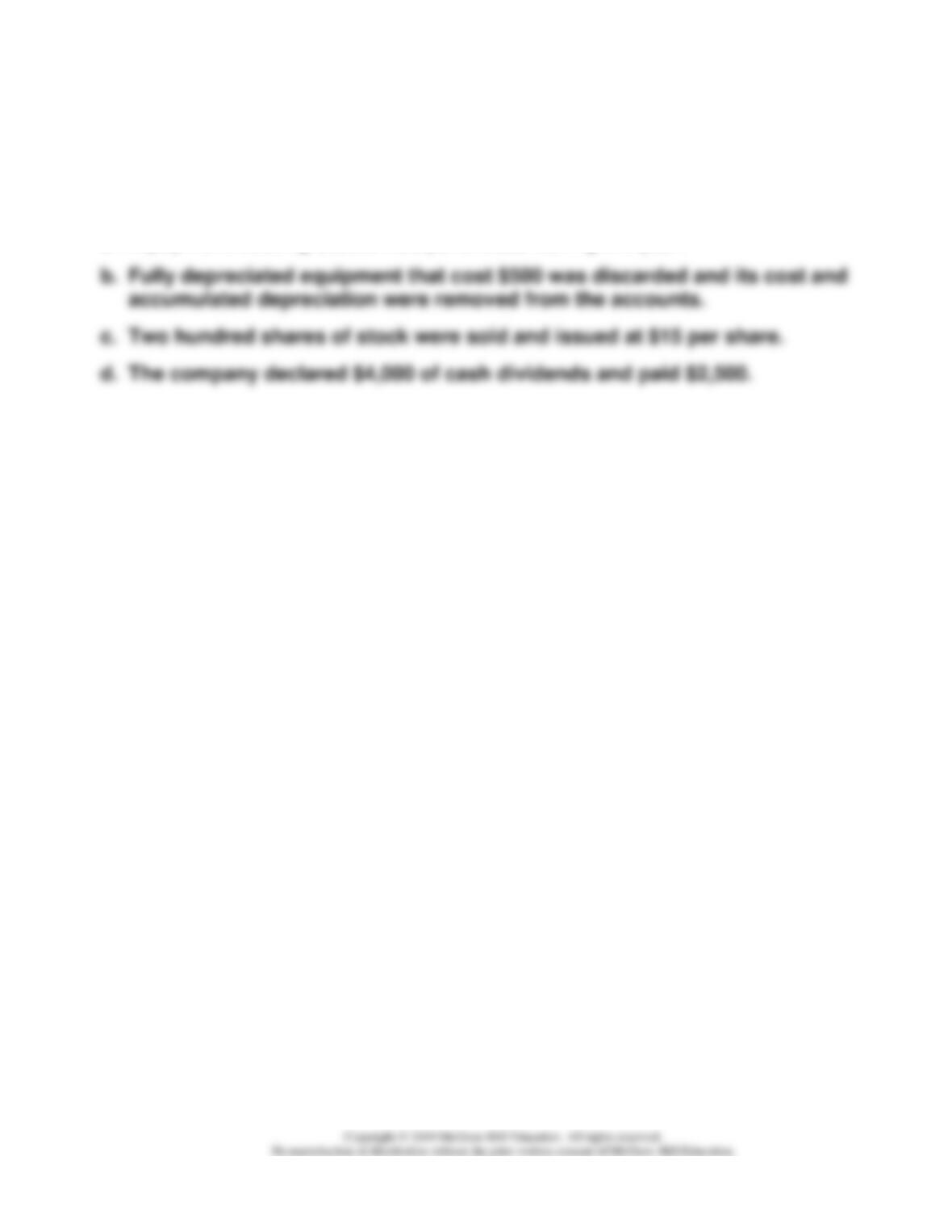
a. Equipment costing $3,500 was purchased during the year.
Financial and Managerial Accounting, 8e
12-10
Chapter 12 Solution: Alternate Demonstration Problem
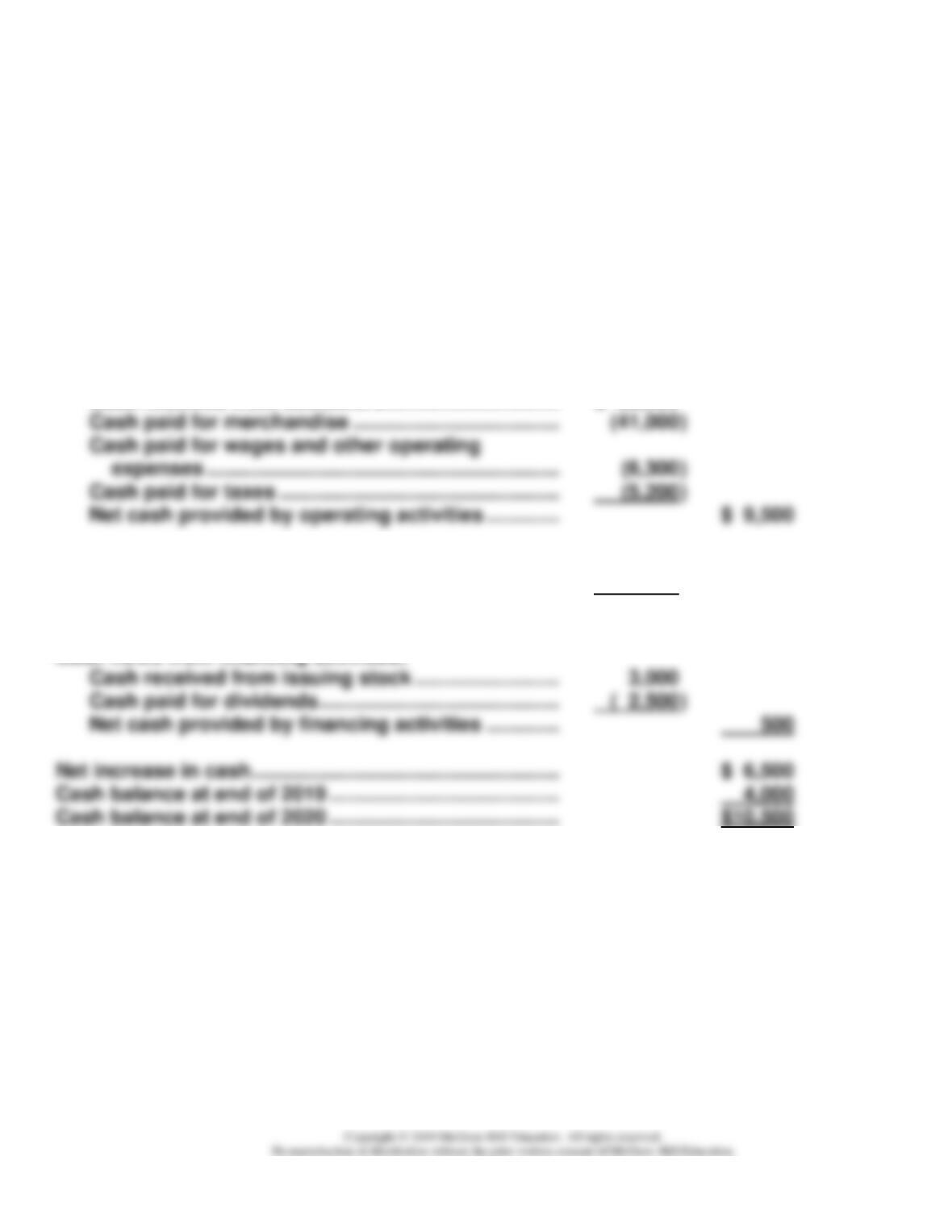
Direct Method:
CARPET COMPANY
Statement of Cash Flows
For Year Ended December 31, 2020
Cash flows from operating activities:
Cash received from customers ………………………….
$ 62,000
Cash paid for merchandise ……………………………….
)
expenses ………………………………………………………
)
Cash paid for taxes …………………………………………..
(5,200
)
Net cash provided by operating activities ………….
Cash flows from investing activities:
Cash paid for purchase of plant assets ……………..
(3,500
)
Net cash used by investing activities ………………..
(3,500
)
Cash flows from financing activities:
Cash received from issuing stock ……………………..
Cash paid for dividends …………………………………….
( 2,500
)
Net cash provided by financing activities ………….
Net increase in cash ……………………………………………….
Cash balance at end of 2019 …………………………………..
Cash balance at end of 2020 …………………………………..
Financial and Managerial Accounting, 8e
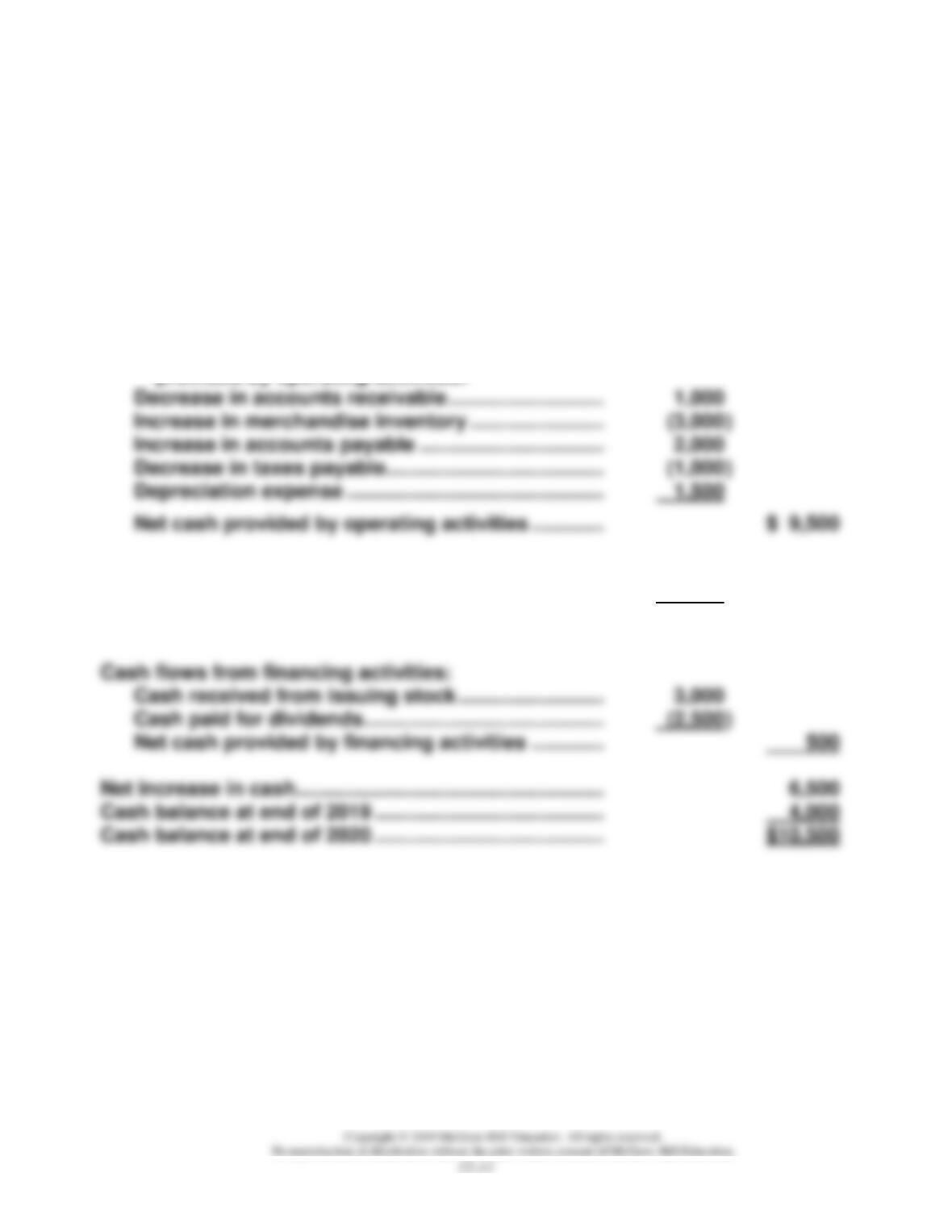
Indirect Method:
CARPET COMPANY
Statement of Cash Flows
For Year Ended December 31, 2020
Cash flows from operating activities:
Net income …………………………………………………………….
$ 9,000
Adjustments to reconcile net income to net cash
provided by operating activities:
Decrease in accounts receivable ……………………….
Increase in merchandise inventory ……………………
)
Increase in accounts payable …………………………...
Decrease in taxes payable …………………………………
)
Depreciation expense ……………………………………….
Net cash provided by operating activities ………….
Cash flows from investing activities:
Cash paid for purchase of plant asset ……………….
(3,500
)
Net cash used by investing activities ………………..
(3,500
)
Cash flows from financing activities:
Cash received from issuing stock ……………………..
Cash paid for dividends …………………………………….
)
Net cash provided by financing activities ………….
Net increase in cash ……………………………………………….
Cash balance at end of 2019 …………………………………..
Cash balance at end of 2020 …………………………………..