CHAPTER 12
SOLUTIONS TO EXERCISES—SET B
EXERCISE 12–1B
(a) The cash payback period is:
$48,000 ÷ $8,000 = 6 years
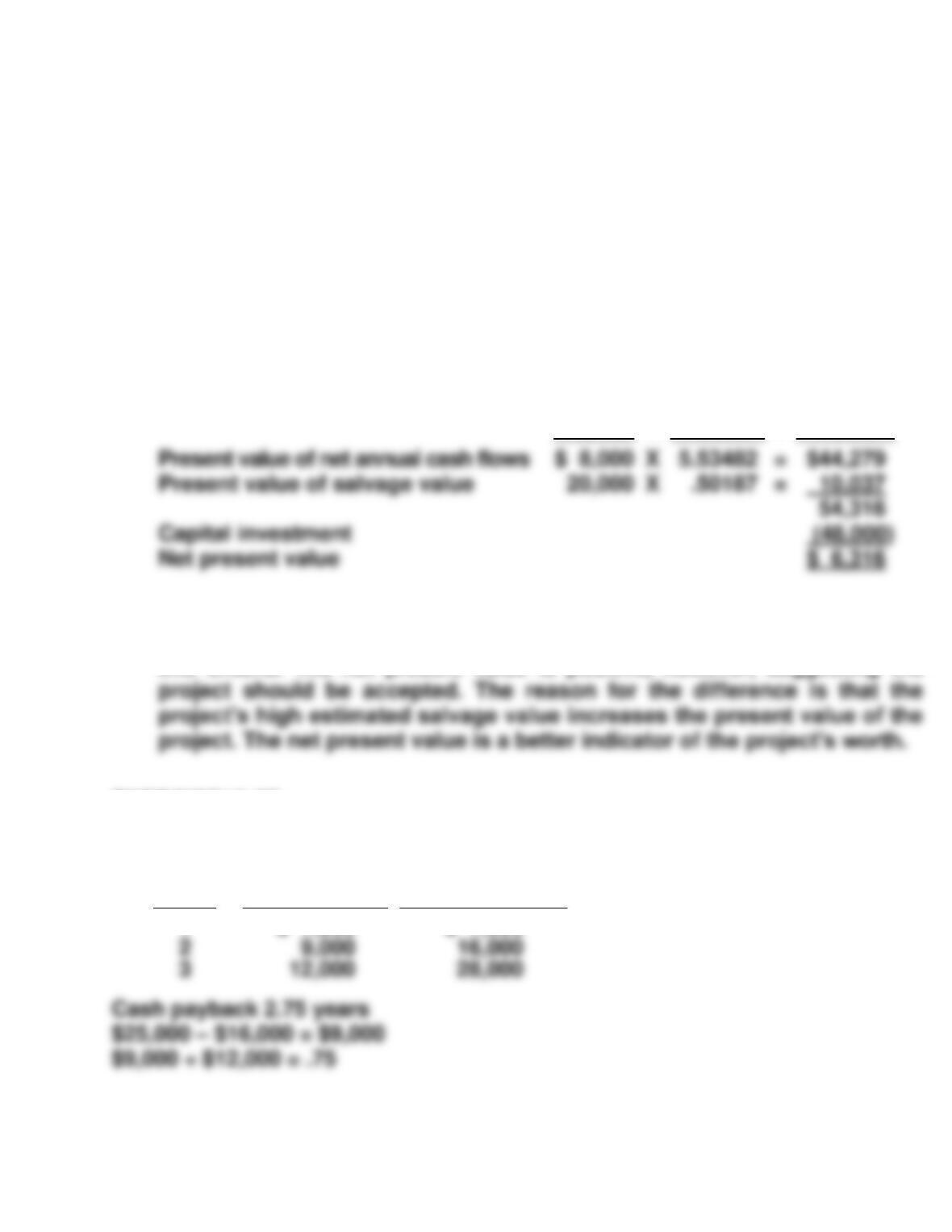
The net present value is:
Cash
Flows
X
9%
Discount
Factor
=
Present
Value
(b) In order to meet the cash payback criteria, the project would have to have
a cash payback period of less than 5.6 years (8 X 70%). It does not meet
this criteria. The net present value is positive, however, suggesting the
EXERCISE12–2B
(a)
AA
Year
Net Annual
Cash Flow
Cumulative Net
Cash Flow
1
$ 7,000
$ 7,000
$ 6,316
EXERCISE 12-2B (Continued)
BB
25,000 ÷ (28,800 ÷ 3) = 2.60 years
CC
Net Annual Cumulative Net
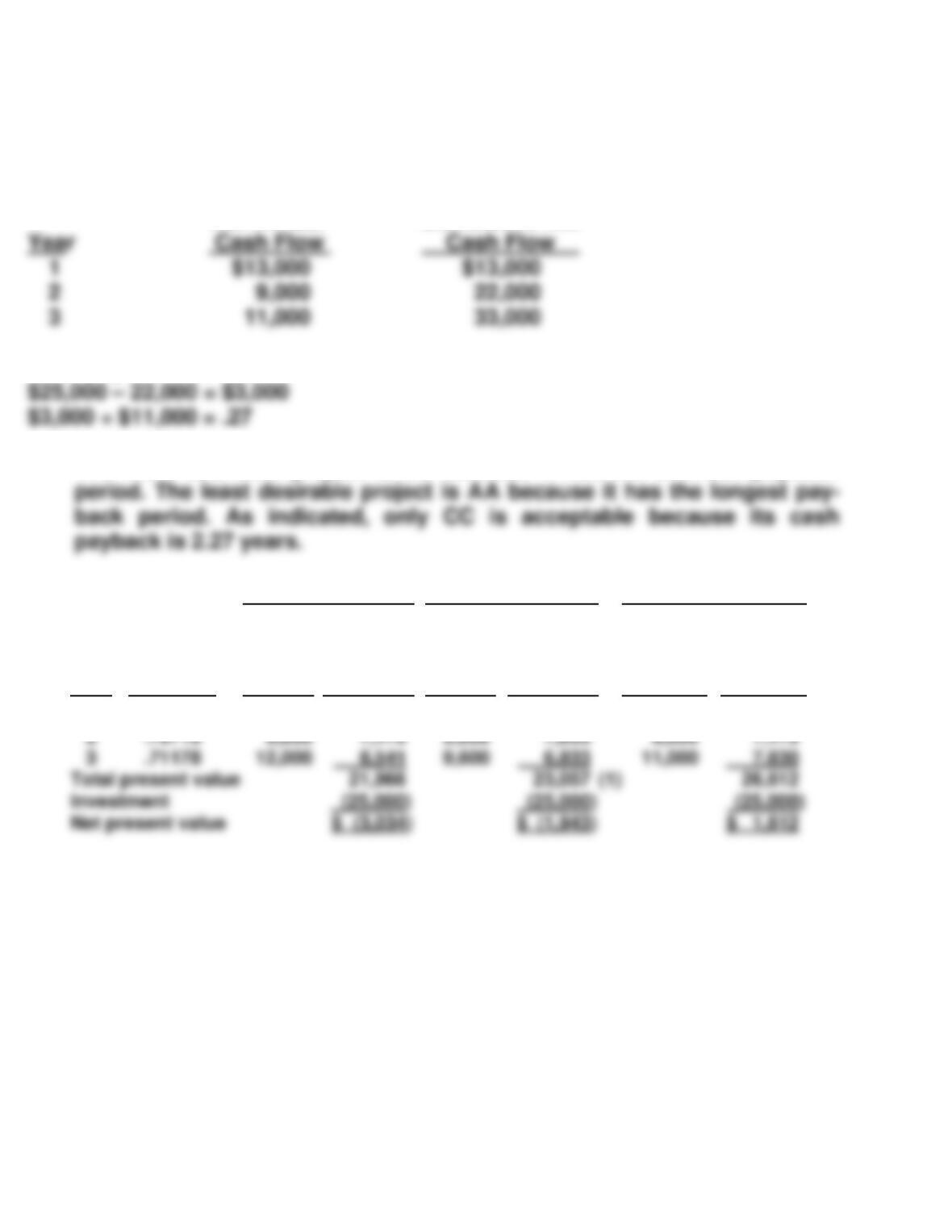
Cash payback 2.27 years
The most desirable project is CC because it has the shortest payback
(b)
AA
BB
CC
Year
Discount
Factor
Net
Annual
Cash
Flow
Present
Value
Net
Annual
Cash
Flow
Present
Value
Net Cash
flow
Present
Value
3
.71178
Total present value
Net present value
21,966
(25,000)
(1)
26,612
1
.89286
$ 7,000
$ 6,250
$9,600
$ 8,571
$13,000
$ 11,607
(1) This total may also be obtained from Table 4: $9,600 X 2.40183 =
$23,058. Project CC is the only acceptable project. Project AA is the
least desirable. There is no change in the projects’ evaluation.
EXERCISE 12–3B
Machine X
Cash
Flows
X
10% Discount
Factor
=
Present
Value
Present value of net annual cash flows
Present value of salvage value
$20,000
0
X
X
5.33493
.46651
=
=
$106,699
0
Machine Y
Cash
Flows
X
10% Discount
Factor
=
Present
Value
Present value of salvage value
Capital investment
0
X
Present value of net annual cash flows
$28,000
X
5.33493
=
($ 149,378
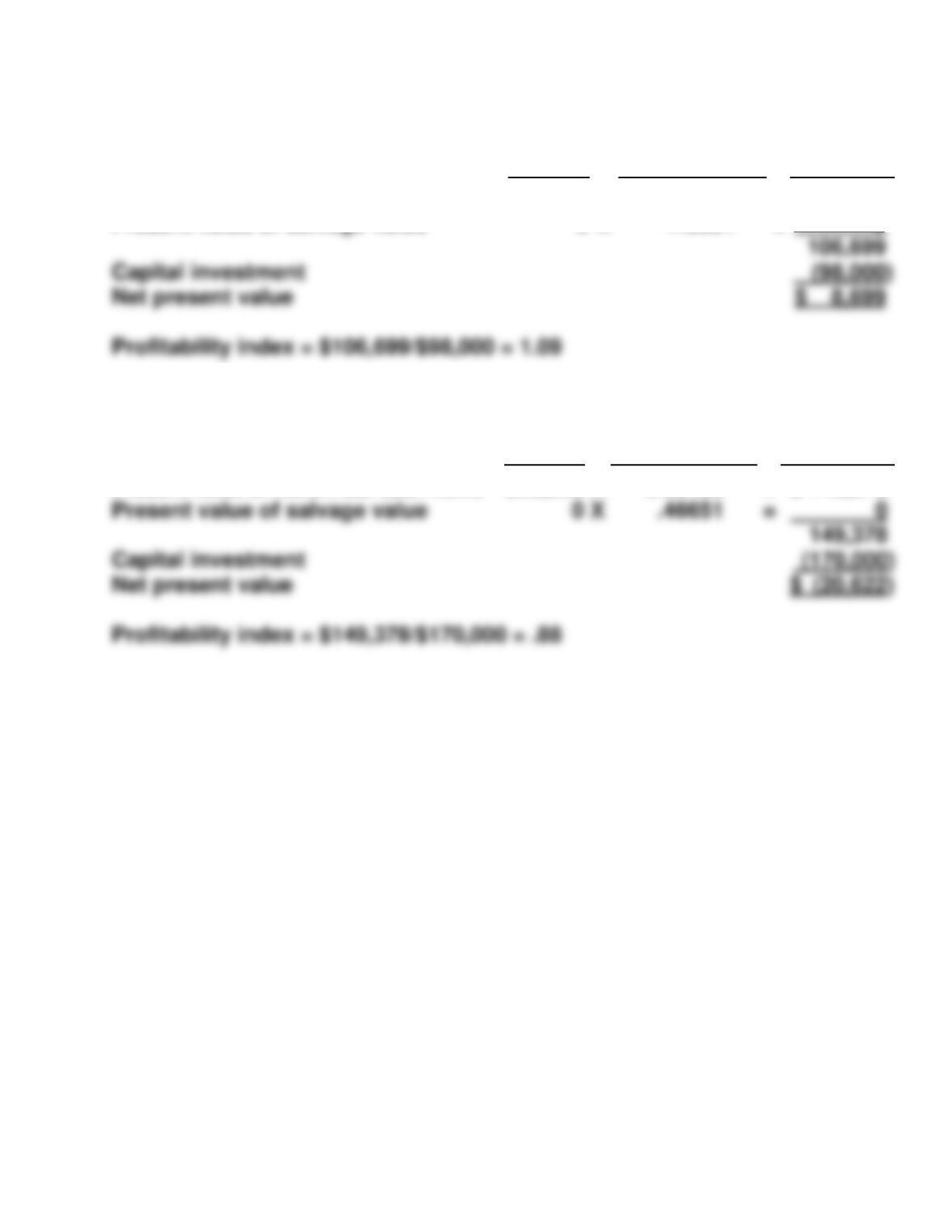
Machine X has a positive net present value, and also a higher profitability
index. Machine X should be purchased.
EXERCISE 12-4B
Investment in new equipment …………. $2,400,000
Disposal of old equipment ………………. (260,000)
Additional training required …………….. 85,000
Net initial investment required ………… $2,225,000
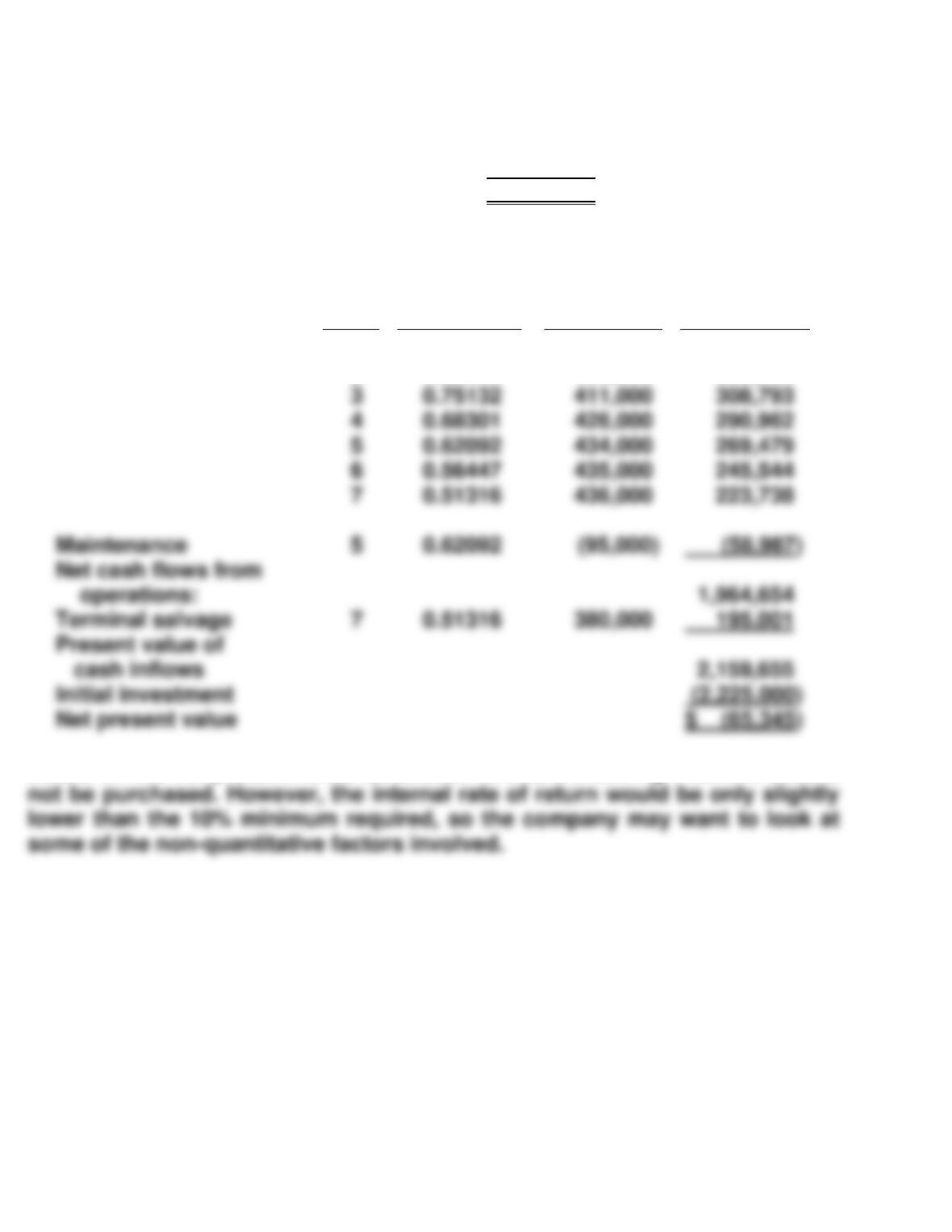
Calculation of net present value:
Year
Discount
Factor, 10%
Amount
Present
Value
Cash flows 1 0.90909 $ 390,000 $ 354,545
2 0.82645 400,000 330,580
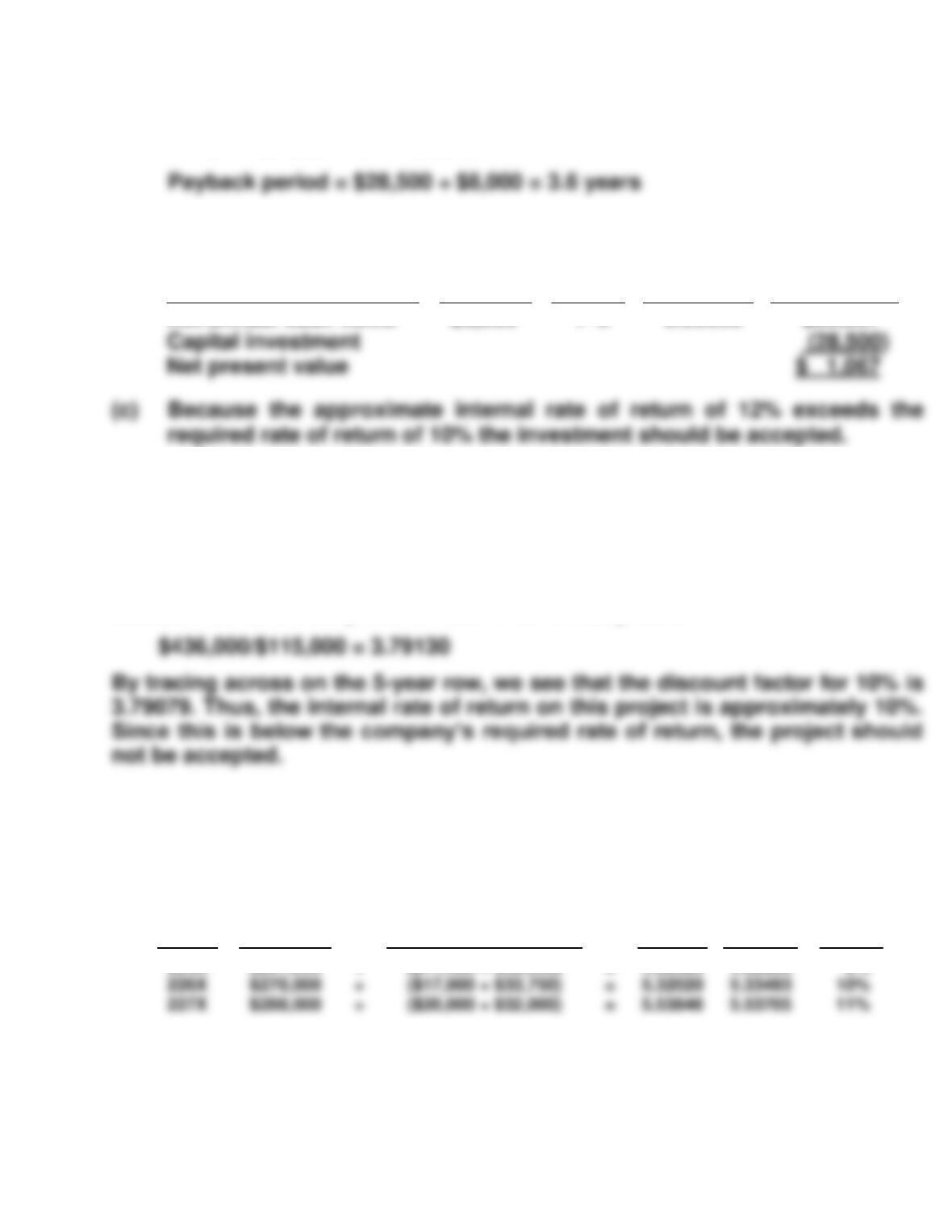
Based on the net present value calculation alone, the sewing machine should
EXERCISE 12–5B
(a) Total net investment = $30,000 + $500 – $2,000 = $28,500
Annual net cash flow = $8,000
(b) Net present value approximates zero when discount rate is 11%.
Item
Amount
Years
PV Factor
Present
Value
Net annual cash flows $8,000 1–5 3.69590 $29,567
EXERCISE 12–6B
When net annual cash flows are expected to be equal, the internal rate of
return can be approximated by dividing the capital investment by the net
annual cash flows to determine the discount factor, and then locating this
discount factor on the present value of an annuity table.
EXERCISE 12–7B
(a)
Project
Investment
÷
(Income + Depreciation)
=
Internal
Rate of
Return
Factor
Closest
Discount
Factor
Internal
Rate of
Return
$288,000
÷
=
5.53846
5.33493
225X
$231,000
÷
($11,400 + $38,500)
=
4.62926
4.62288
8%
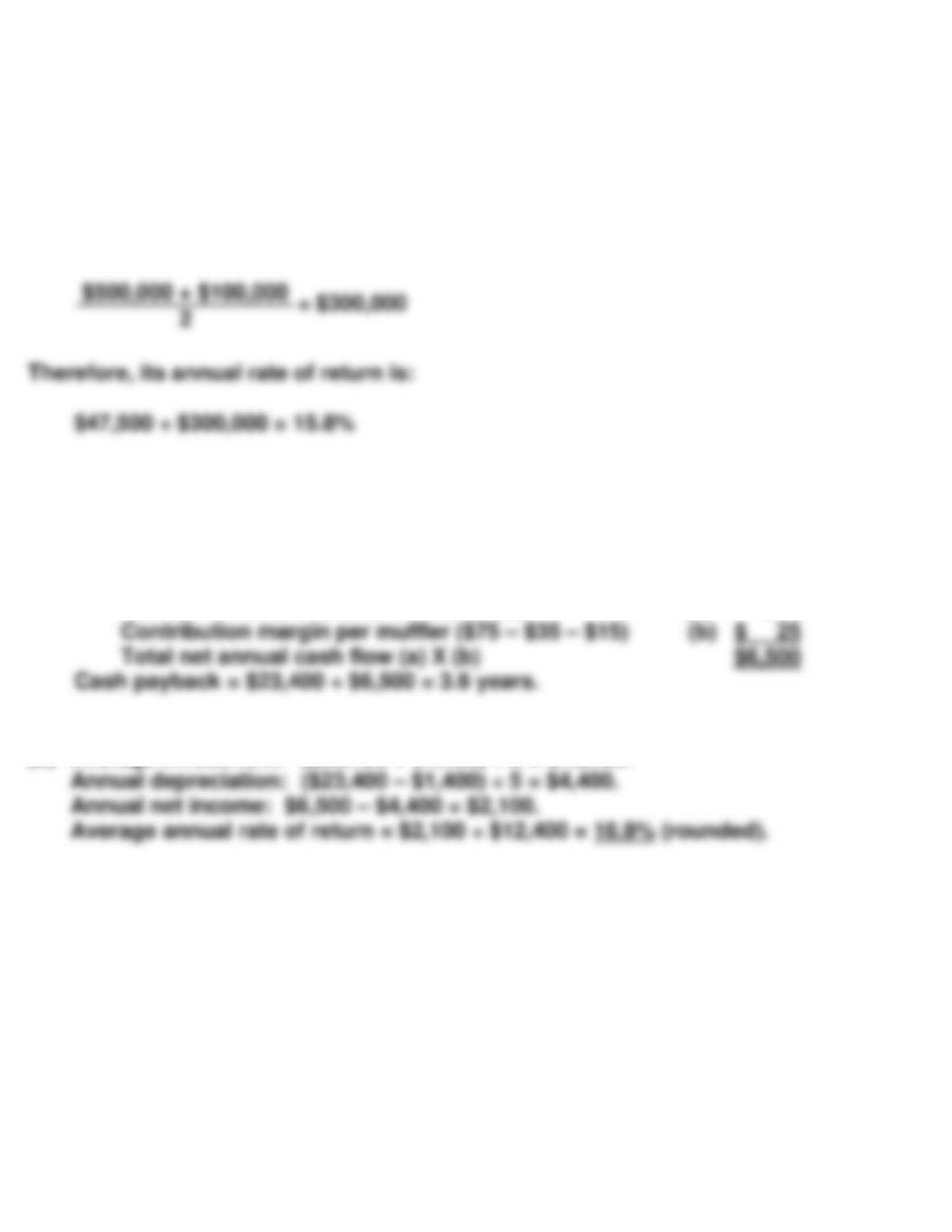
(b) The acceptable projects are 226X and 227X because their rates of return
are greater than the 9% minimum required rate of return.
EXERCISE 12–8B
The annual rate of return is calculated by dividing expected annual income by
the average investment. The company’s expected annual income is:
$87,500 – $40,000 = $47,500
Its average investment is:
EXERCISE12–9B
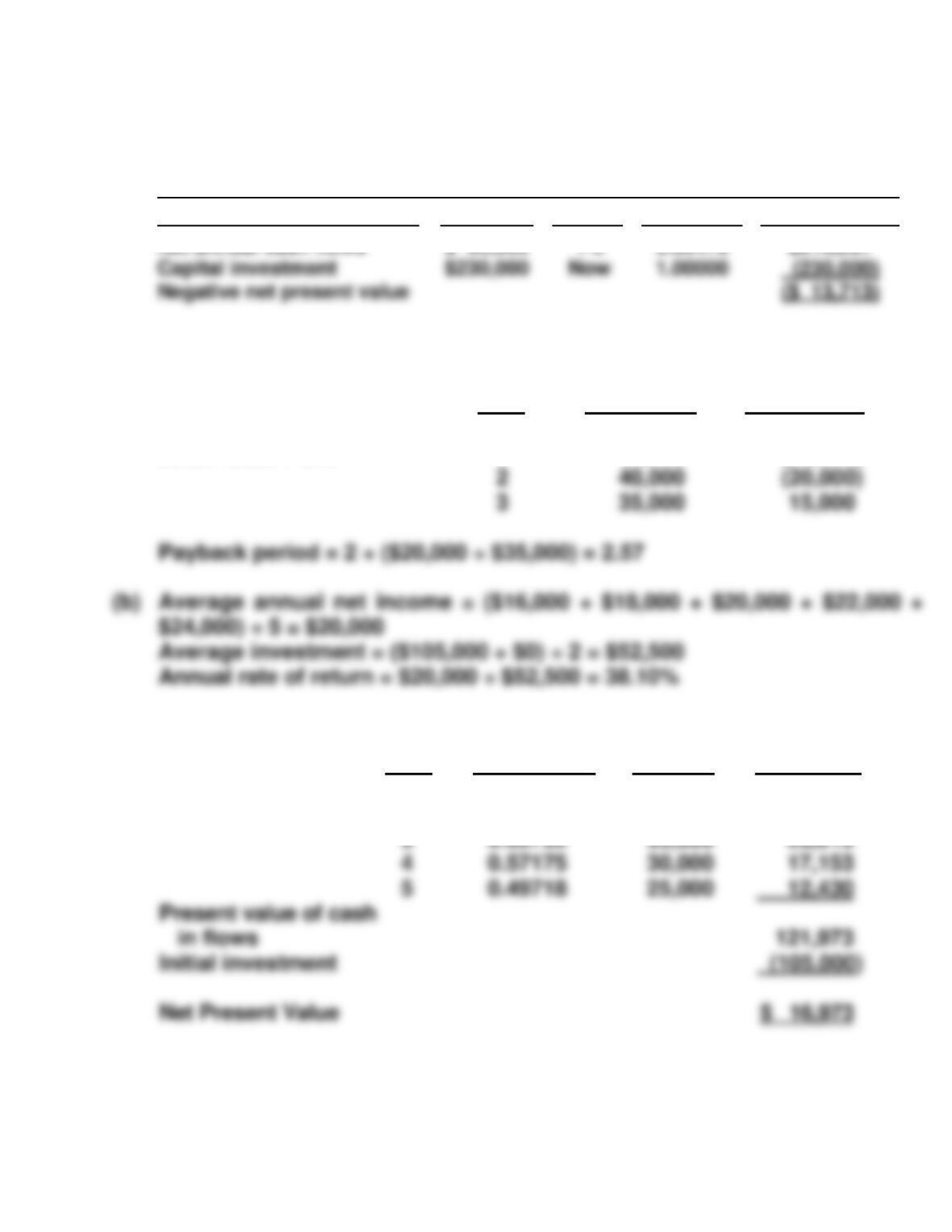
(a) Cost of hoist: $18,600 + $3,900 + $900 = $23,400.
Net annual cash flow:
Number of extra mufflers: 5 X 52 weeks (a) 260
(b) Average investment: ($23,400 + $1,400) ÷ 2 = $12,400.
EXERCISE 12-10B
(a) (1) Cash payback: $230,000 ÷ $60,000 = 3.8 years.
(2) Annual rate of return: $20,000 ÷ [($230,000 + $0) ÷ 2] = 17.4%.
(b)
Item
Amount
Years
PV Factor
Present Value
Net annual cash flows
$ 60,000
1-5
3.60478
$216,287
EXERCISE 12-11B
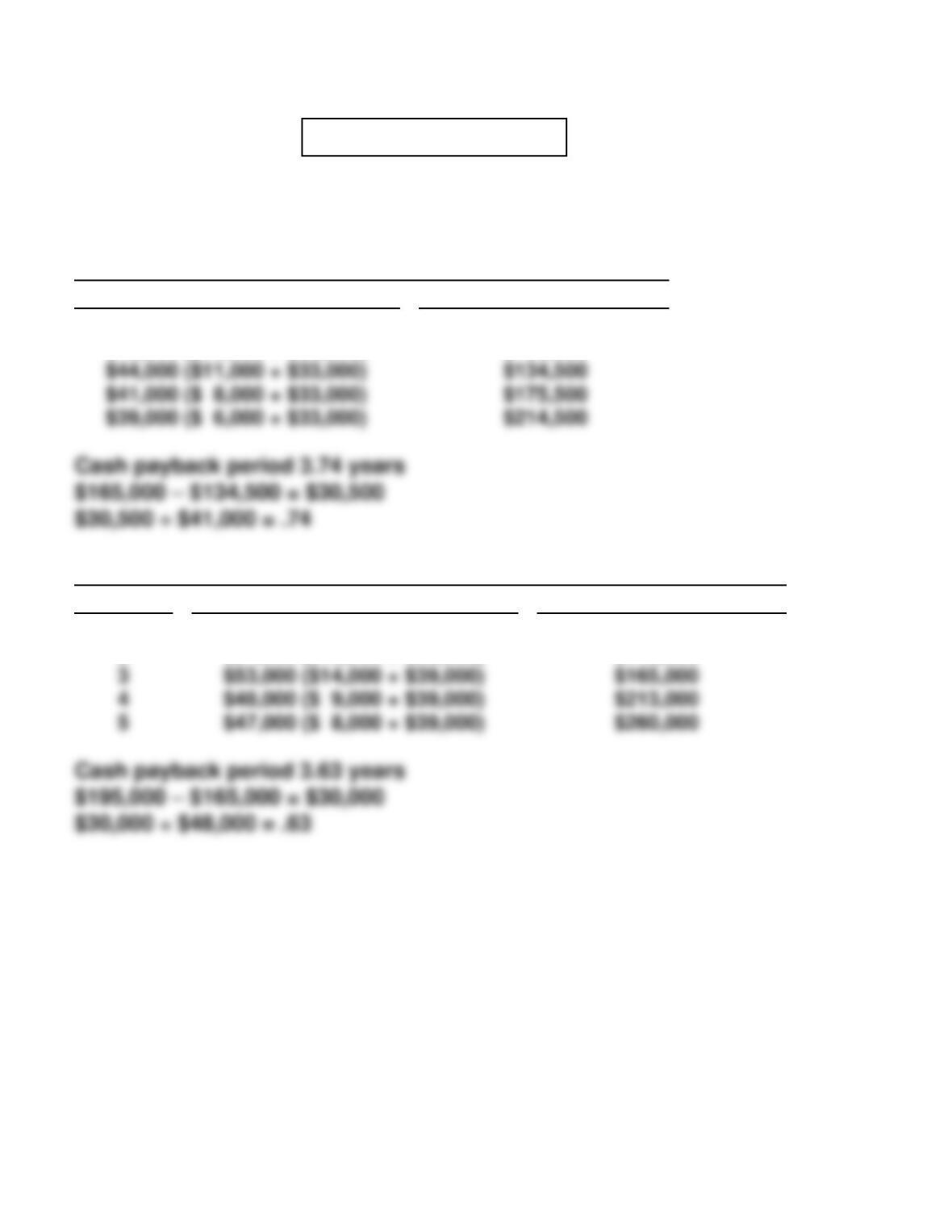
(a) Year Amount Balance
Initial investment 0 $(105,000) $(105,000)
Less: Cash Flow 1 45,000 (60,000)
(c) Discount Present
Year Factor, 15% Amount Value
Net cash flows 1 0.86957 $45,000 $ 39,131
2 0.75614 40,000 30,246
SOLUTIONS TO PROBLEMS—SET C
PROBLEM 12–1C
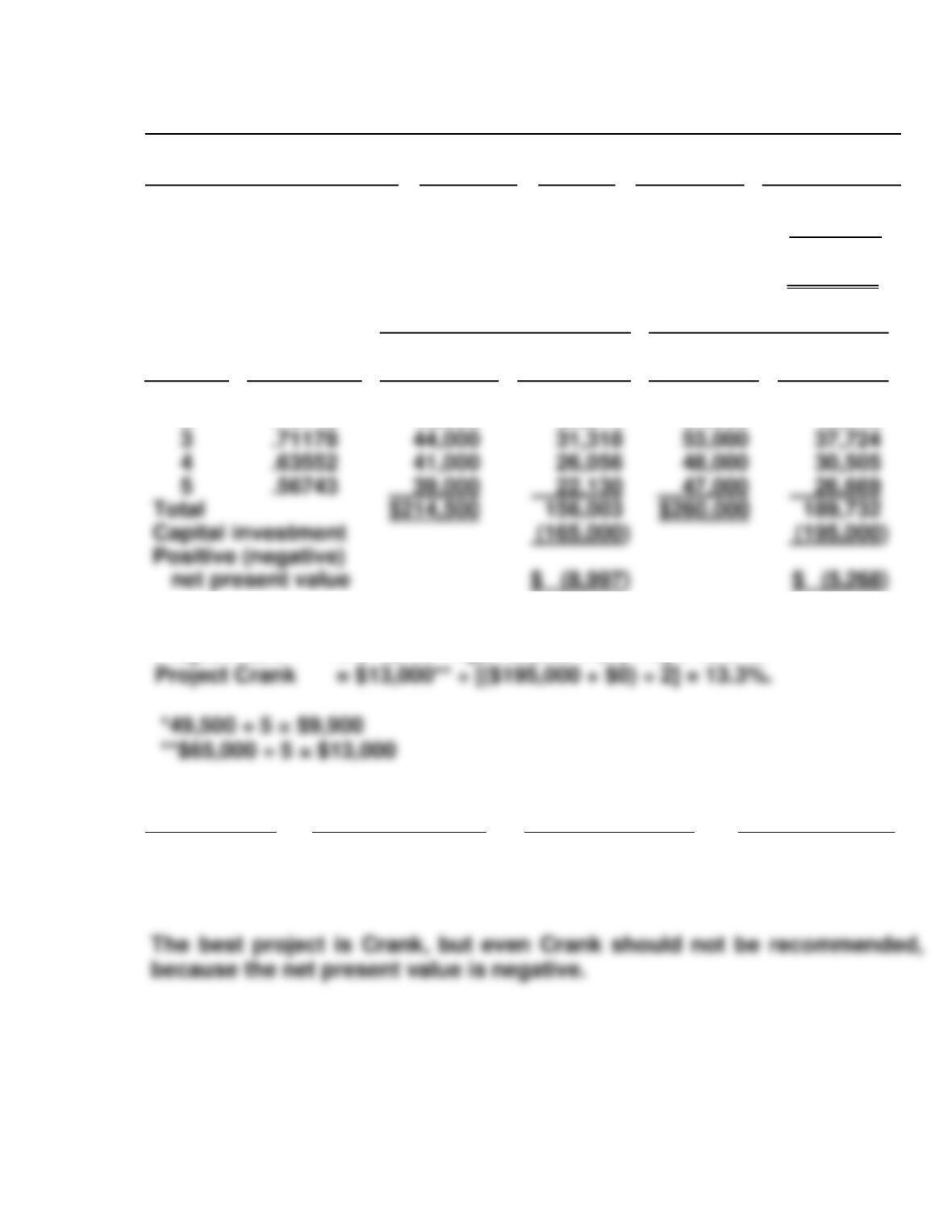
(a) Project Fix $142,500 ÷ [($9,000 + $28,500)] = 3.8 years
Project Mark
Cash Flow
Cumulative Cash Flow
$45,500 ($12,500 + $33,000)
$45,000 ($12,000 + $33,000)
$ 45,500
$ 90,500
Project Crank
Year
Cash Flow
Cumulative Cash Flow
1
2
$58,000 ($19,000 + $39,000)
$54,000 ($15,000 + $39,000)
$ 58,000
$112,000
PROBLEM 12-1C (Continued)
(b) Project Fix
Item
Amount
Years
PV Factor
Present
Value
Net annual cash flows
Capital investment
Negative net present
value
$37,500
1–5
3.60478
$135,179
(142,500)
$ (7,321)
Project Mark
Project Crank
Year
Discount
Factor
Cash
Flow
PV
Cash
Flow
PV
1
2
.89286
.79719
$ 45,500
45,000
$ 40,625
35,874
$ 58,000
54,000
$ 51,786
43,048
(c) Project Fix = $ 9,000 ÷ [($142,500 + $0) ÷ 2] = 12.6%.
Project Mark = $ 9,900* ÷ [($165,000 + $0) ÷ 2] = 12.0%.
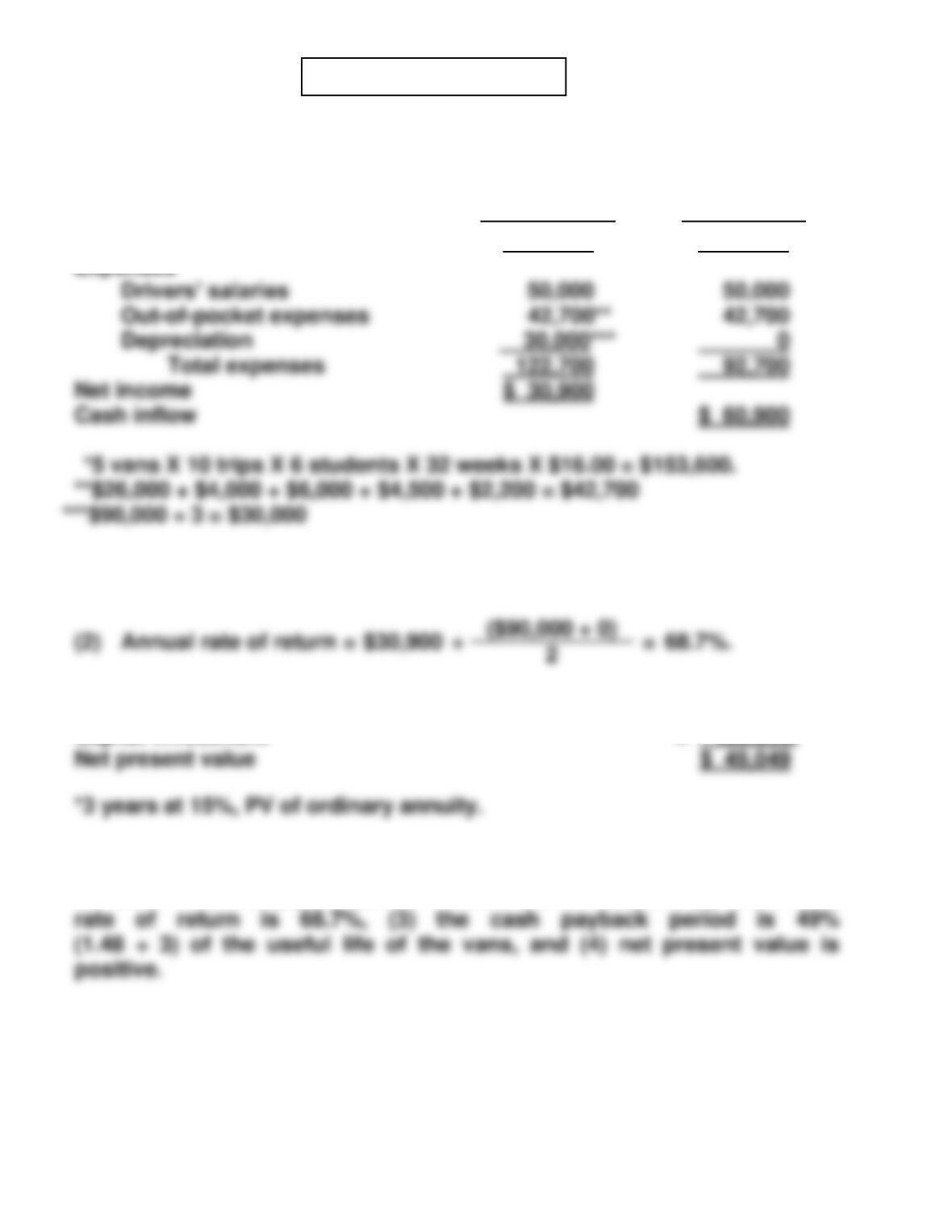
(d)
Project
Cash Payback
Net
Present Value
Annual
Rate of Return
Fix
Mark
Crank
3
2
1
2
3
1
2
3
1
Total
$214,500
48,000
47,000
Capital investment
net present value
PROBLEM 12–2C
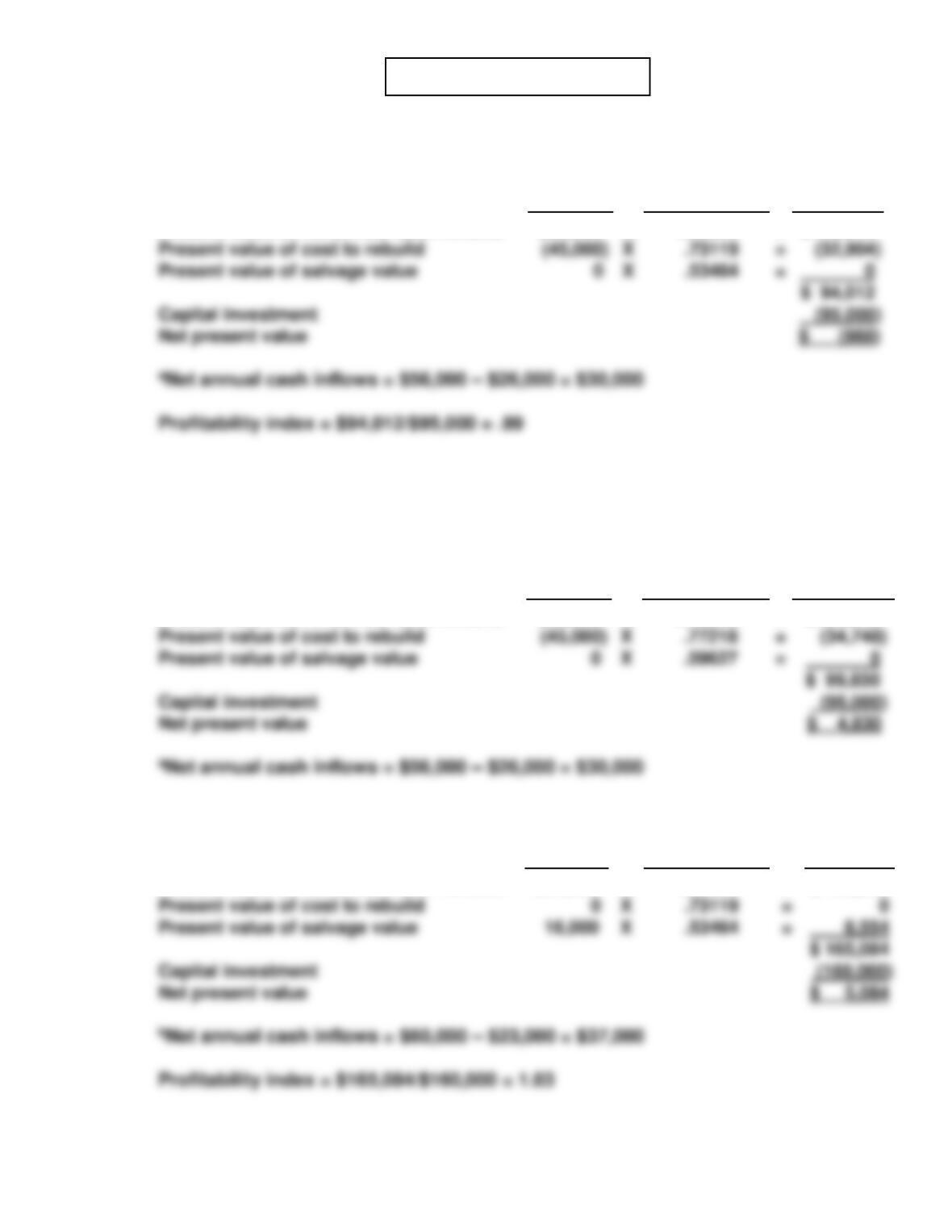
(a)
(1)
Annual
Net Income
(2)
Annual
Cash Inflow
Sales
*$153,600*
$153,600
(b) (1) Cash payback period = $90,000 ÷ $60,900 = 1.48 years.
(c) Present value of annual cash inflows ($60,900 X 2.28323*) = $139,049
Capital investment = (90,000)
(d) The computations show that the commuter service is a good investment
for these reasons: (1) annual net income will be $30,900, (2) the annual
PROBLEM 12–3C
(a) Plan A
Cash
Flows
X
11% Discount
Factor
=
Present
Value
Present value of net annual cash inflows
a$30,000a
X
4.23054
=
($126,916)
The internal rate of return can be approximated by finding the discount
rate that results in a net present value of approximately zero. This is
accomplished with a 9% discount rate.
Cash
Flows
X
9% Discount
Factor
=
Present
Value
Capital investment
Present value of net annual cash inflows
a$30,000a
X
4.48592
=
($134,578)
Plan B
Cash
Flows
X
11% Discount
Factor
=
Present
Value
Capital investment
$ 5,084
Present value of net annual cash inflows
b$37,000b
X
4.23054
=
$ 156,530
Capital investment
PROBLEM 12-3C (Continued)
Internal rate of return on Plan B is 12%, as calculated below:
Cash
Flows
X
12% Discount
Factor
=
Present
Value
Present value of net annual cash inflows
b$37,000b
X
4.11141
=
$ 152,122
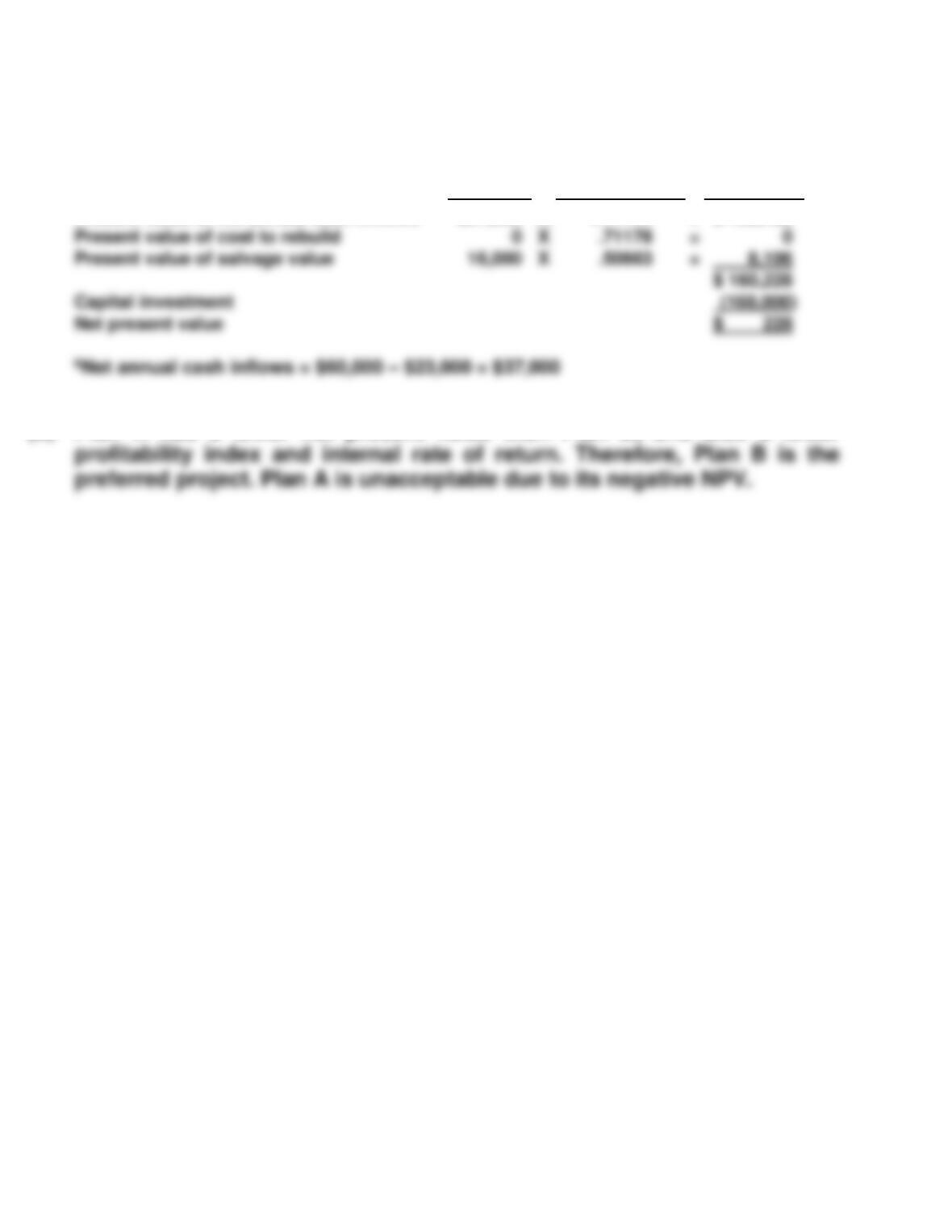
(b) Plan A has a lower net present value than Plan B, and also a lower
Capital investment
PROBLEM 12–4C
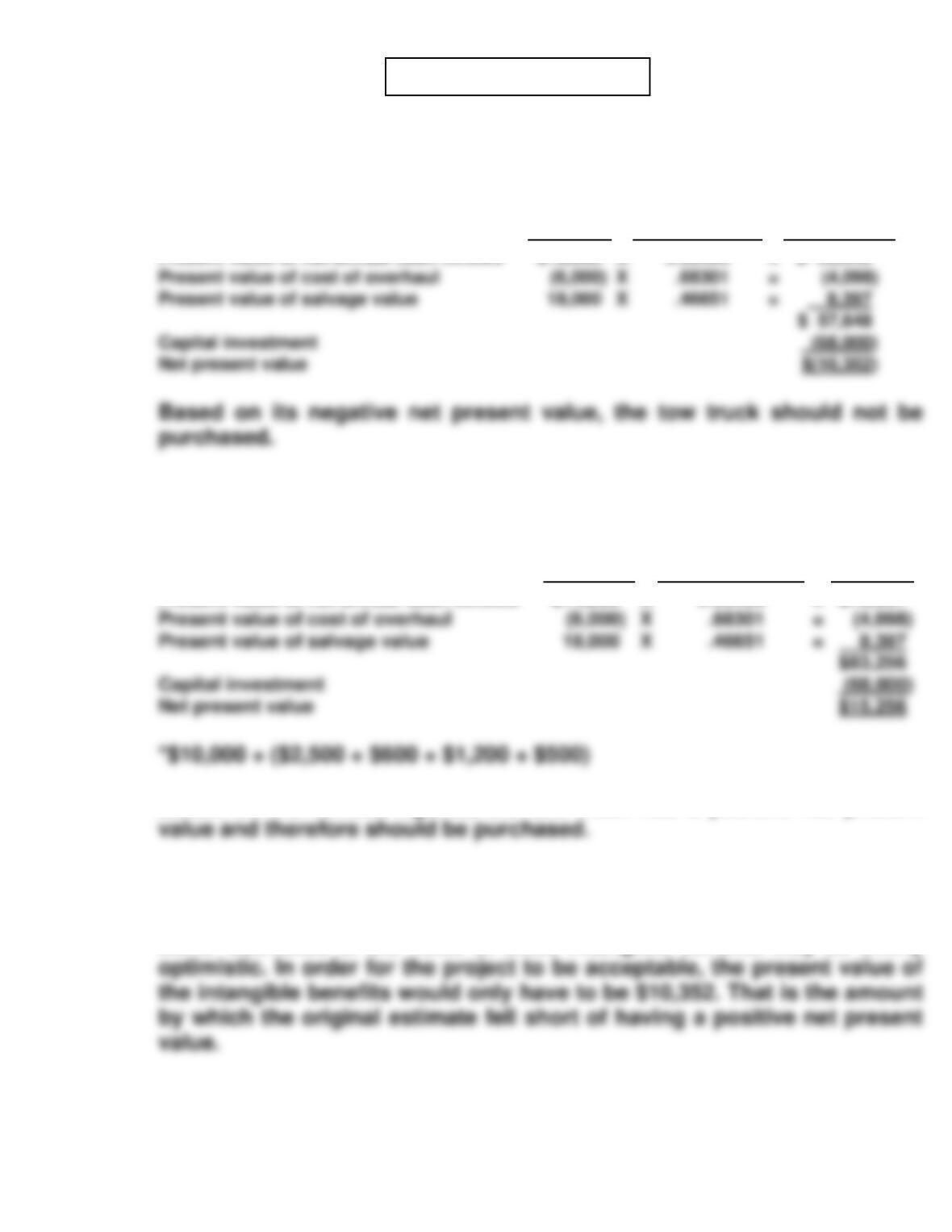
(a) The net present value based on the original estimates is as follows:
Cash
Flows
X
10% Discount
Factor
=
Present
Value
Present value of net annual cash inflows
$10,000
X
5.33493
=
($ 53,349)
(b) The net present value based on the revised estimates is as follows:
Cash
Flows
X
10% Discount
Factor
=
Present
Value
Capital investment
(68,000))
Present value of net annual cash inflows
$14,800*
X
5.33493
=
($78,957)
Based on the revised figures, the tow truck has a positive net present
(c) The present value of the intangible benefits was $25,608 (the increase
in the net present value from a negative $10,352 to a positive $15,256).
Boris’ estimates of the value of these intangible benefits may be overly
Capital investment
PROBLEM 12–5C
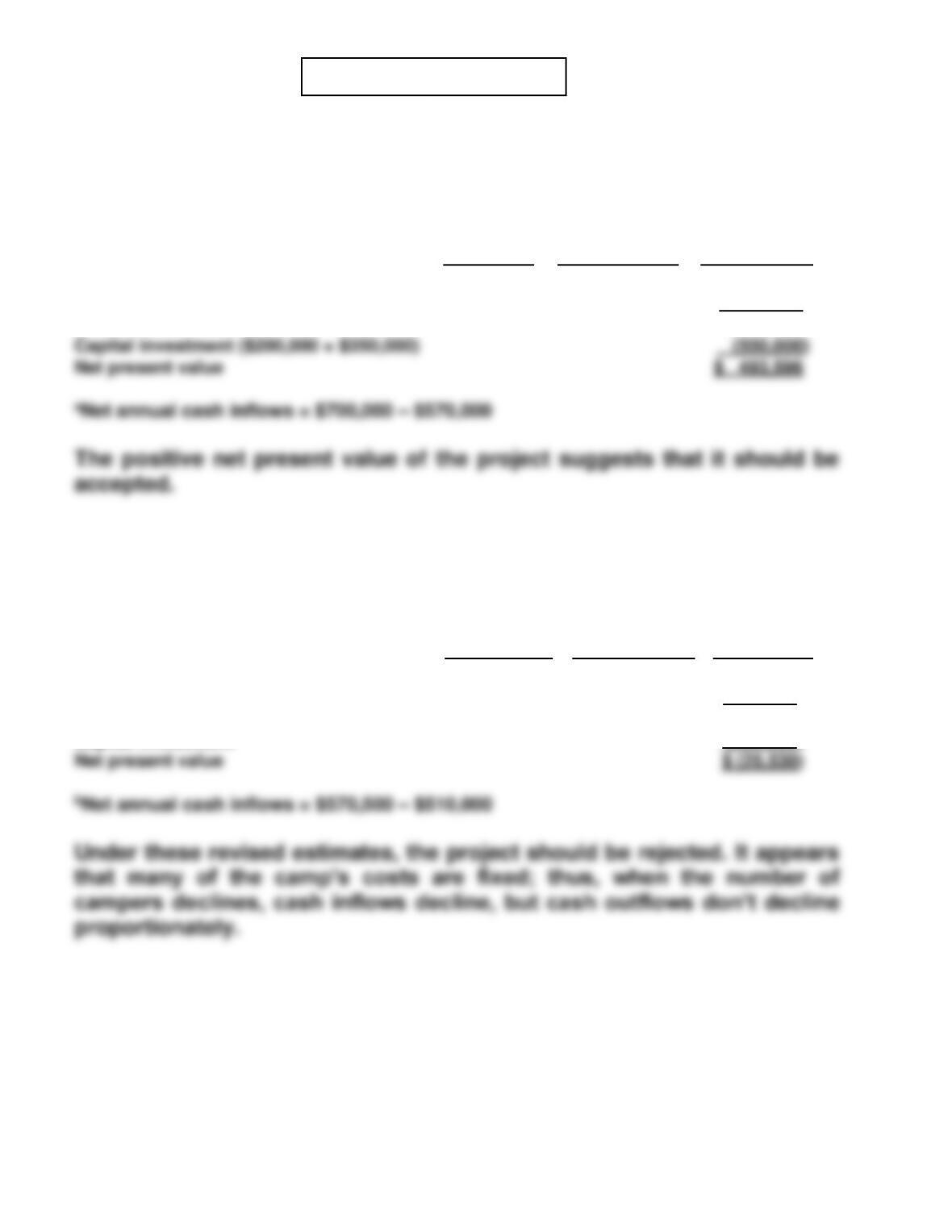
(a) Using the original estimates, the net present value is calculated as
follows:
Cash
Flows
X
12% Discount
Factor
=
Present
Value
Present value of net annual cash inflows
Present value of salvage value
a$130,000a
700,000
X
X
7.46944
.10367
=
=
$ 971,027
72,569
1,043,596
(b) Using the revised estimates, the net present value is calculated as
follows:
Cash
Flows
X
12% Discount
Factor
=
Present
Value
Present value of net annual cash inflows
Present value of salvage value
Capital investment
b$ 60,500b
700,000
X
X
7.46944
.10367
=
=
$451,901)
72,569)
$524,470)
(550,000)
Capital investment ($200,000 + $350,000)
PROBLEM 12-5C (Continued)
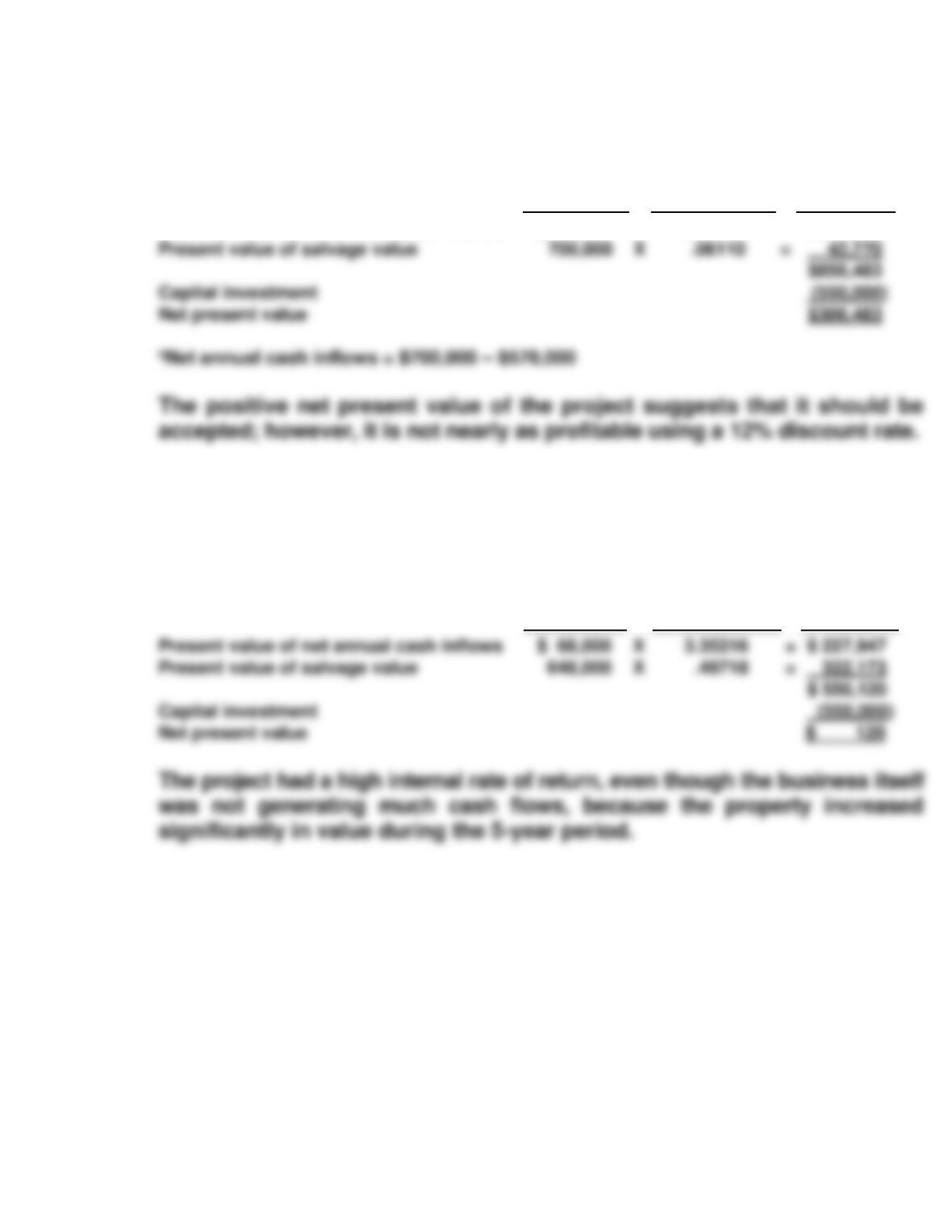
(c) Using the original estimates, but a 15% discount rate, the net present
value is calculated as follows:
Cash
Flows
X
15% Discount
Factor
=
Present
Value
Present value of net annual cash inflows
c$130,000c
X
6.25933
=
$813,713
(d) The internal rate of return can be determined by calculating the discount rate
that results in a net present value of approximately zero. In this case the
internal rate of return was approximately 15%.
Cash
Flows
X
15% Discount
Factor
=
Present
Value
Capital investment
Capital investment