—————————————-———–CHAPTER 12———————————————
REVIEW QUESTIONS
Q12-1 As contrasted with for-profit entities, NFPs : (1) receive significant amounts of resources in the form of
contributions from providers who do not expect to receive monetary benefits in return; (2) operate for
purposes other than to earn profits; and (3) lack defined ownership interests that can be sold, transferred
Q12-2 The financial statements used by all VHWOs and ONPOs are: (1) a statement of financial position,
Q12-3 In accordance with FASB Statement No. 117 (FASB ASC topic 958), NFPOs must classify their net
assets in the financial statements as either unrestricted, temporarily restricted, or permanently restricted:
2. Temporarily restricted net assets result generally from contributions and other asset inflows
3. Permanently restricted net assets result generally from contributions and other asset inflows
Q12-4 The general rule for reporting the receipt of contributions other than services and collections is that they
must be:
Q12-5 Donors may impose temporary or permanent restrictions on the use of donated resources. An example of
a donor-imposed temporary restriction is a donation that must be used for a specific purpose, such as a
Q12-7 A donor-imposed restriction limits the use of the contributed assets beyond the broad limits resulting
from the nature of the organization and the purposes for which it was organized. Contributions with
Q12-8 NFPOs must report the fair value of contributed services as revenues and expenses in the financial
statements provided the services received: (1) create or enhance nonfinancial assets or (2) require
2
Chapter 12
Q12-9 A reclassification of net assets is made when resources classified as restricted have been released from
restrictions. Reclassifications move resources from one classification of net assets to another as a
Q12–10 An NFPO must recognize a contributed work of art as revenue if the contributed work is not part of a
collection. An NFPO has an option not to recognize a contributed work of art as revenue provided the
Q12–11 The fair value of an investment is the price that would be paid to sell it in an orderly transaction between
market participants at the measurement date. One way to measure the fair value of an investment is to use
Q12–12 When fund accounting is used internally by an NFPO, the funds generally used are:
1. The Unrestricted Current Fund. Included in this fund are unrestricted resources that are
available for the general operations of the organization.
2. Restricted Current Funds. Included in these funds are resources available for use in the
3. Land, Buildings and Equipment Fund. This fund is used to account for financial resources to be
used to acquire land, buildings, and equipment. It could also be used to account for capital assets
currently used in the operations of the organization, together with associated depreciation and long-term
debt.
DISCUSSION ISSUES AND SCENARIOS
D12-1 The controversy over whether works of art and similar items should be recorded as assets and
revenues or gains arose over the concern by many museums over whether the cost of measuring
asset values in the existing collections was worth the benefits obtained by financial statement
users from having that information.
An argument that was made for capitalizing these assets is that the museums derive financial
benefits from the assets in the form of admissions fees. Museums argued that this argument was
EXERCISES
E12-1 (5 minutes)
1. temporarily restricted
E12-2 (15 minutes)
1. Cash 50,000
Temporarily restricted support – contributions 50,000
3. Contributions receivable 2,000,000
4. Investments 3,000,000
5. Temporarily restricted net asset reclassifications out –
E12-3 (5 minutes)
1. Temporarily restricted, reclassified to unrestricted
E12-4 (20 minutes)
1. Temporarily restricted net asset reclassifications out –
2. Administrative expenses 2,400
3. No entry is made until the condition is substantially met.
4
Chapter 12
5. Art works held for sale 5,000
E12-5 (20 minutes)
(Using single account for unrealized and realized gains and losses)
2. Investments 1,500
3. Cash 76,000
4. Temporarily restricted net asset reclassifications out –
satisfaction of program restrictions 76,000
2. Investment valuation account 1,500
3. Change in temporarily restricted net unrealized and realized gains
and losses on investments 1,500
E12-6 (20 minutes)
1. False. FASB standards require that financial statements report by net asset classification.
5
Chapter 12
E12-7 (15 minutes)
1. d 6. d
E12-8 (25 minutes)
East End Gold and Tennis Club
Statement of Activities
Year Ended June 30, 2013
___________________________________________
____ ________ Temporarily
Unrestricted Restricted Total
Revenues, Gains, and Other Support:
Dues $600,000 $ 600,000
Expenses:_____ _
Golf and tennis pros 105,000 105,000
________________________________________________________________________________
E12-9 (30 minutes)
1. Contributions receivable 100,000
2. Cash 75,000
4. Cash 875,000
Temporarily restricted support – contributions 875,000
6. Temporarily restricted asset reclassifications out–
satisfaction of program restrictions 875,000
7. Administrative expenses 5,000
8. Investments 2,000
10. Temporarily restricted asset reclassifications out-
satisfaction of program restrictions 35,000
E12-10 (3 minutes)
2. Cash 10,000
Temporarily restricted support – contributions 10,000
4. Collection – pottery (assumes capitalization) 4,000
Cash 4,000
5. Contributions receivable 30,000
6. Expenses – administration 1,000
Unrestricted support – donated services 1,000
8. Donated art held for sale 6,000
PROBLEMS
P12-1 (35 minutes)
1. Cash 150,000
2. Cash 310,000
3. No entry. This is a conditional promise to give.
5. Cash 220,000
6. Temporarily restricted asset reclassifications out –
satisfaction of building acquisition restriction 420,000
7. Cash 20,000
Deferred revenue 20,000
10. Expenses – Food Distribution program 810,000
11. No entry. Food service does not require specialized services.
12. Expenses – Food Distribution program 175,000
P12-2 (75 minutes)
1. Temporarily restricted asset reclassifications out –
2. Fund-raising expense (supplies and other) 3,000
Cash 3,000
3. Cash 37,000
4. Cash 40,000
5. Temporarily restricted asset reclassifications out –
satisfaction of program restrictions 15,000
6. Cash 162,000
Revenues – admissions fees 162,000
Regular events expense (salaries) 150,000
7. Administration expense (supplies and other) 4,000
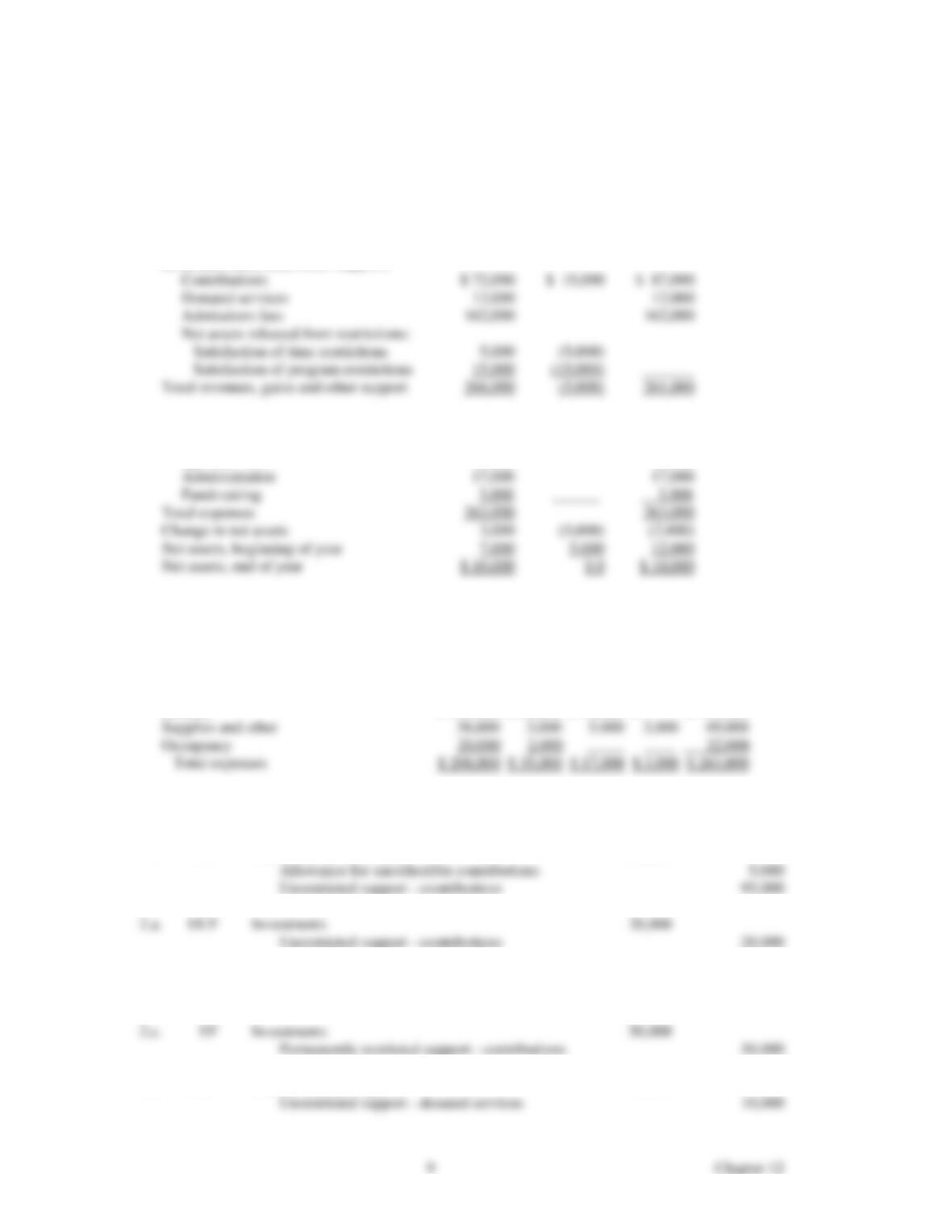
Sing Sing Singers
Statement of Activities
For the Fiscal Year Ended June 30, 2013
Temporarily
Unrestricted Restricted Total
Revenues, Gains and Other Support:
Expenses:
Regular events 208,000 208,000
Special events 35,000 35,000
Sing Sing Singers
Statement of Functional Expenses
For the Fiscal Year Ended June 30, 2013
Regular Special Adminis- Fund
Events Events tration Raising Total
Salaries $ 150,000 $ 30,000 $ 12,000 $ $ 192,000
P12-3 (30 minutes)
1. UCF Contributions receivable 100,000
2.b. RCF Cash 5,000
Temporarily restricted support – contributions 5,000
3.a. UCF Care of animals expense 10,000
10
Chapter 12
3.b. No entry (The services do not require specialized skills.)
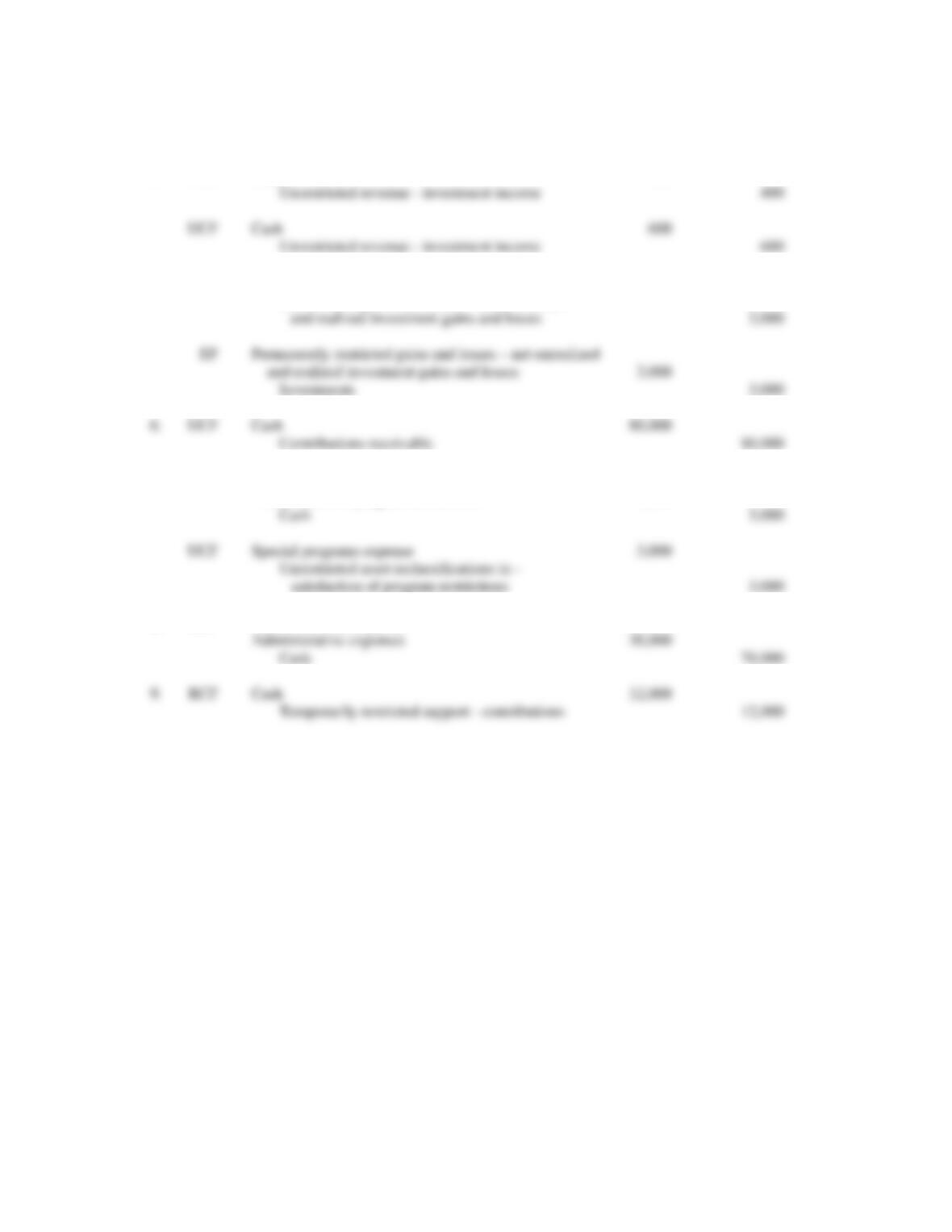
4. UCF Cash 400
5. UCF Investments 2,000
Unrestricted gains and losses – net unrealized
7. RCF Temporarily restricted asset reclassifications out –
satisfaction of program restrictions 3,000
8. UCF Care of animals expense 40,000
P12-4 (40 minutes)
11
Chapter 12
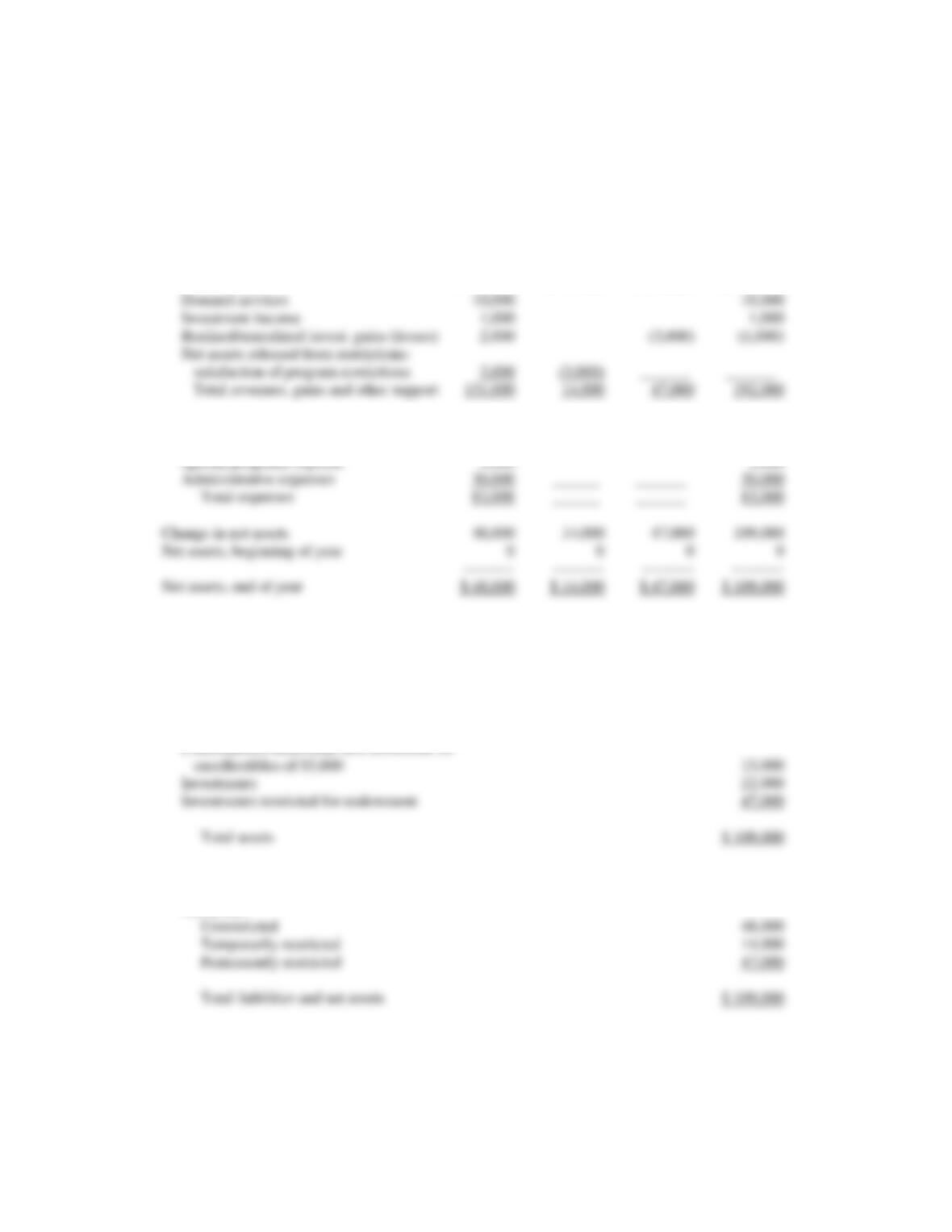
a.
Oliver’s Place
Statement of Activities
For the Year Ended December 31, 2013
Temporarily Permanently
Unrestricted Restricted Restricted Total
Revenues, Gains and Other Support:
Contributions $ 115,000 $ 17,000 $ 50,000 $ 182,000
Expenses:
Care of animals expense 50,000 50,000
b.
Oliver’s Place
Statement of Financial Position
December 31, 2013
Assets:
Cash $ 25,000
Liabilities and Net Assets:
Liabilities $ 0
Net assets:
P12-5 (25 minutes)
12
Chapter 12
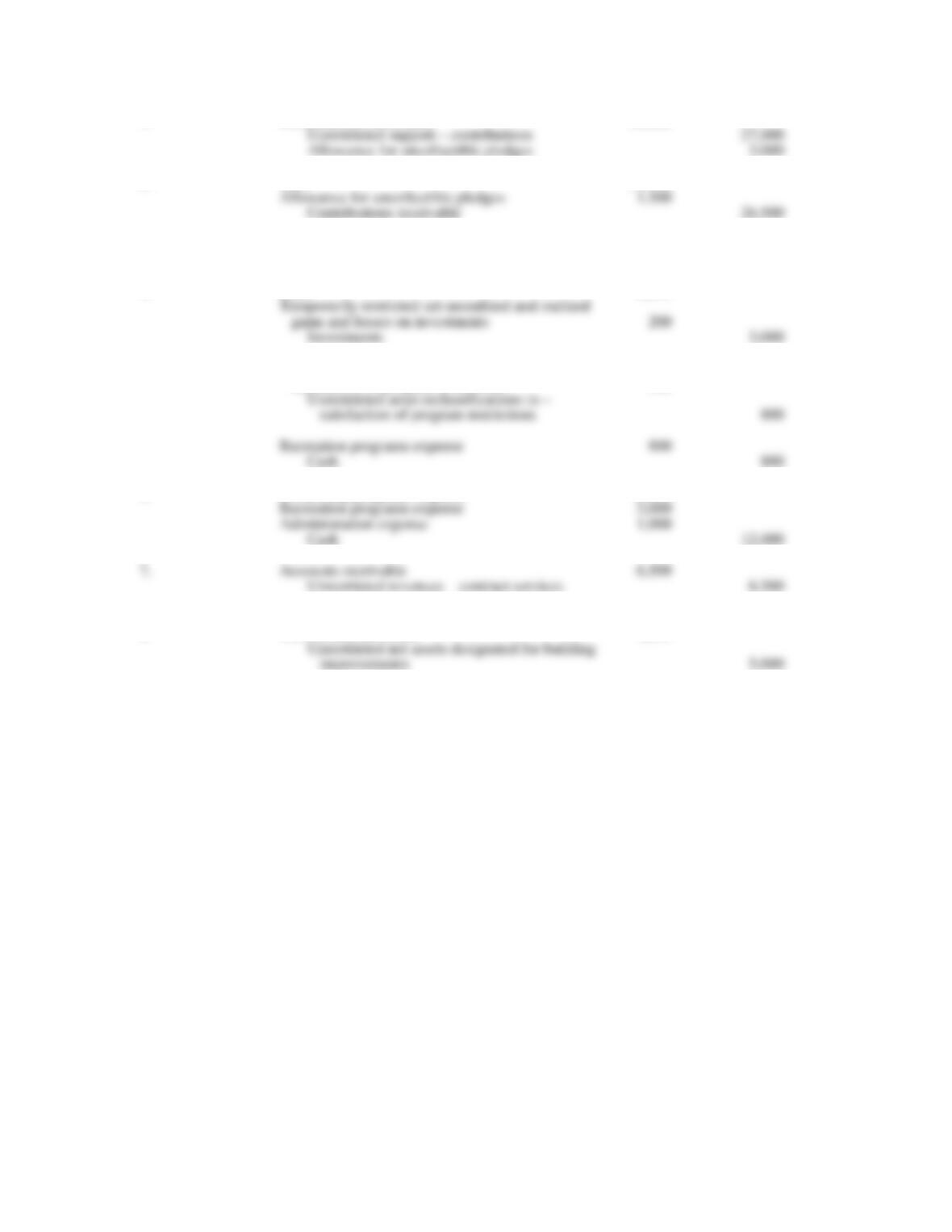
1. Contributions receivable 30,000
2. Cash 25,000
3. Investments 3,000
Temporarily restricted support – contributions 3,000
4. Cash 2,800
5. Temporarily restricted asset reclassifications out –
satisfaction of program restrictions 800
6. Counseling programs expense 8,000
8. Unrestricted net assets 5,000
9. No entry needed because the contribution is conditional.
P12-6 (45 minutes)
13
Chapter 12
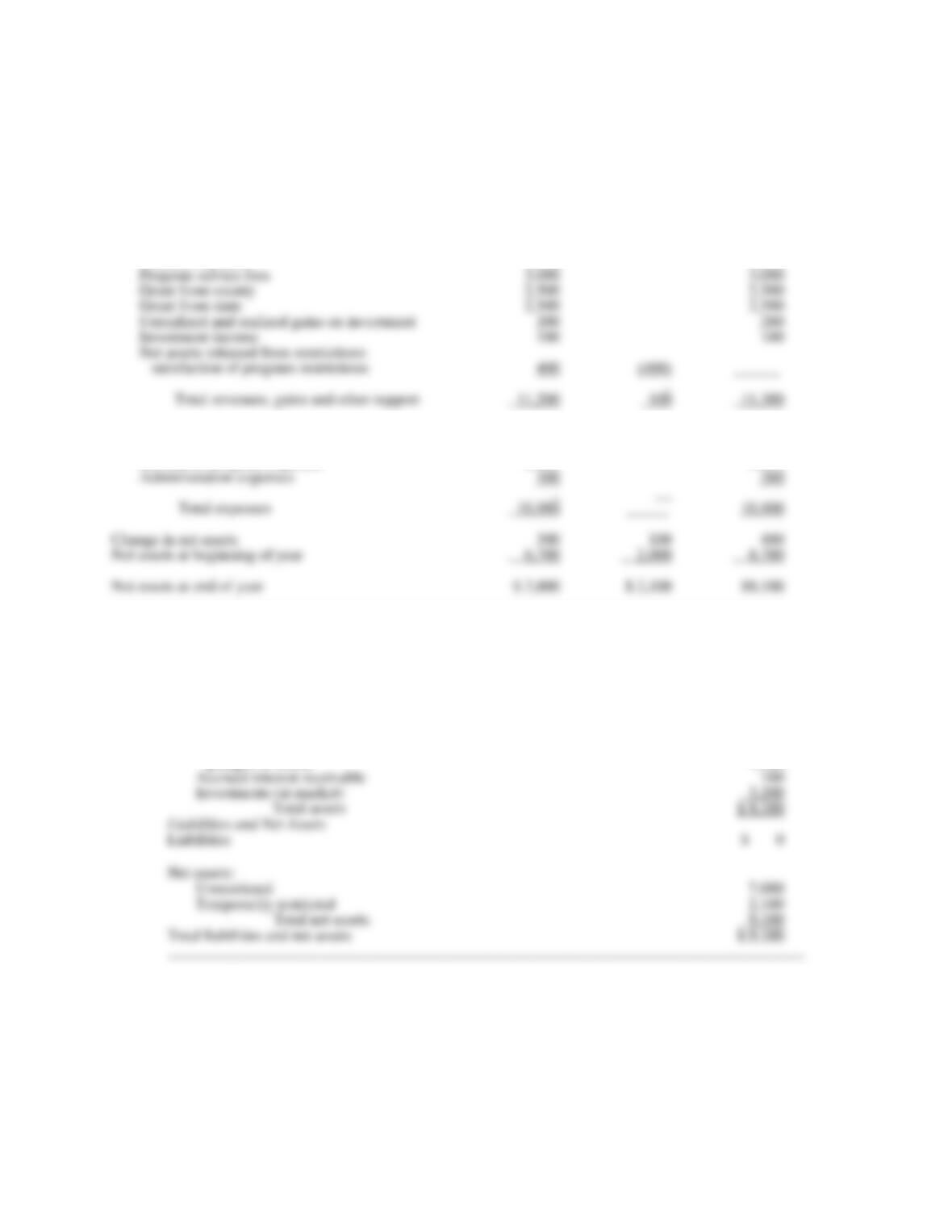
Marilyn Township Senior Citizens Center
Statement of Activities
Year Ended December 31, 2013
_______________________________________________________________________________________
Temporarily
Unrestricted Restricted Total
_______________________________________________________________________________________
Revenues, Gains, and Other Support:
Contributions $ 1,000 $ 500 $ 1,500
Membership dues 1,500 1,500
Expenses:
Luncheon program expenses 7,200 7,200
Recreation program expenses 3,400 3,400
_______________________________________________________________________________________
__________________________________________________________________________________
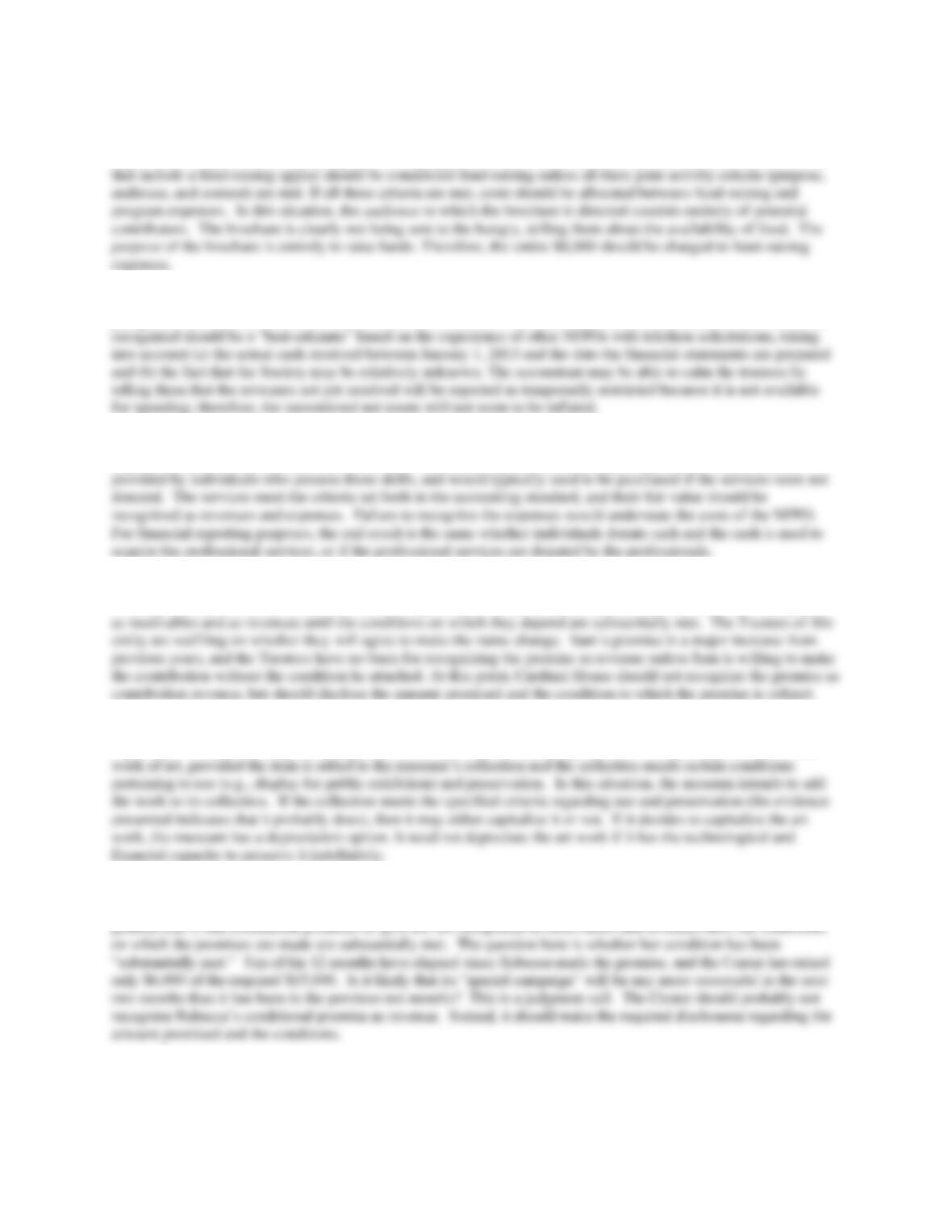
Marilyn Township Senior Citizens Center
Statement of Financial Position
December 31, 2013
Assets
Cash $ 4,600
Pledges receivable (less allowance for uncollectible
pledges of $300) 1,200
P12-7 (35 minutes)
14
Chapter 12
1. Contributors and governmental oversight bodies are concerned with how much of a VHWOs
contributions are devoted to program costs, as compared with the amount used for fund-raising and administrative
expenses. The general rule regarding fund-raising appeals is that all costs of informational materials and activities
2. The accountant should tell the trustees that compliance with accounting standards requires reporting the
pledges as contributions receivable and as revenues in the 2012 financial statements. The amount of revenues to be
3. Accounting standards require that contributed services to NFPOs must be recognized as revenues and
expenses if the services received meet all three of the following criteria: they require specialized skills, and are
4. Sam Rich has made a conditional promise to give. His contribution depends on whether the entity agrees
to change its name to Rich House. The accounting rule here is that conditional promises to give are not recognized
5. There are two issues: (a) whether the art work should be capitalized and (b) whether it should be
depreciated. The accounting standard provides that the museum has the option of not recognizing the contributed
6. Dr. Rebecca has made a conditional promise to give. Whether she will make the contribution depends on
whether Shelley Center raises $15,000 from other sources within 12 months of the date she made the promise. The
P12-8 (25 minutes)
1. No entry needed because LFAC does not capitalize its collection.
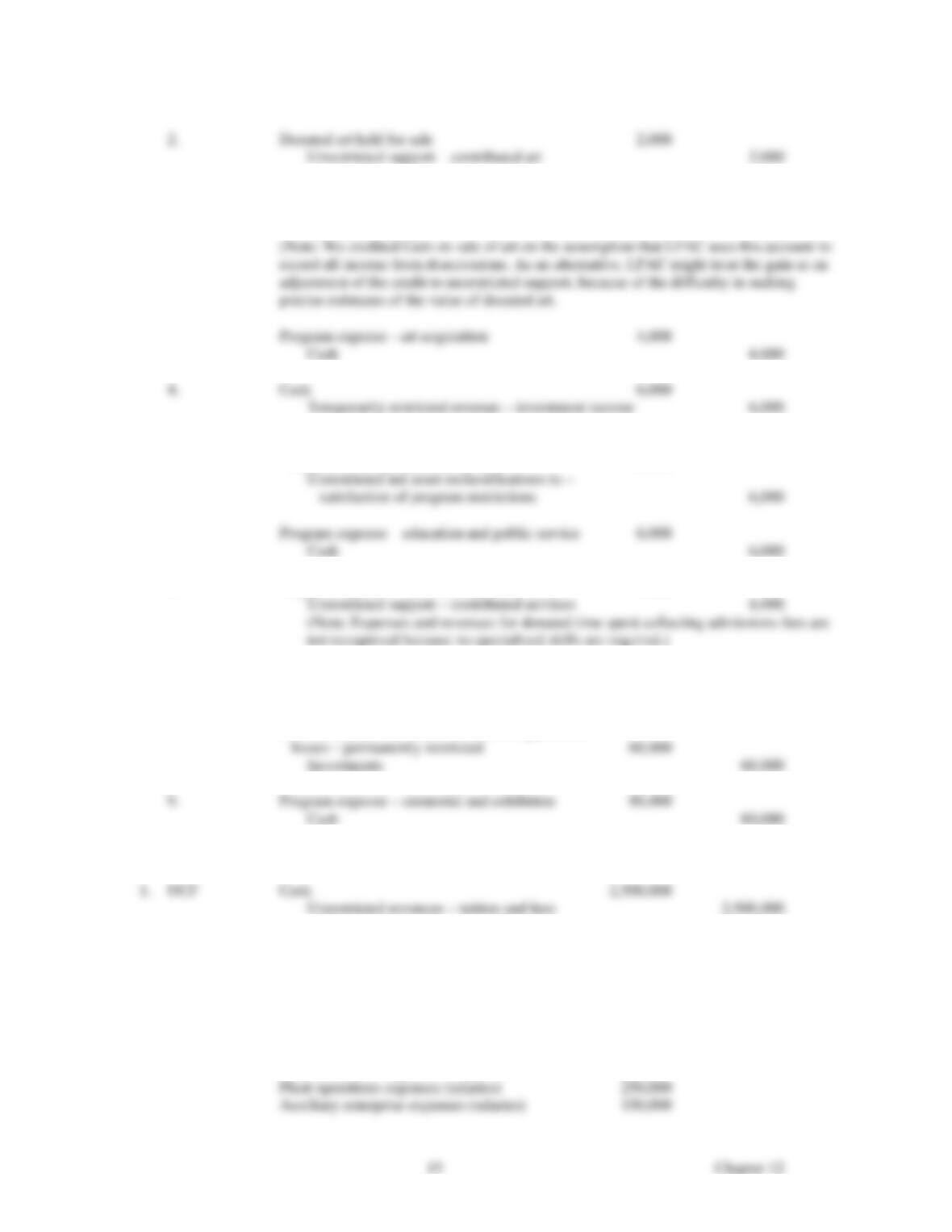
3. Cash 2,100
Donated art held for sale 2,000
Gain on sale of art 100
5. Temporarily restricted net asset reclassifications out –
satisfaction of program restrictions 6,000
6. Program expense – curatorial and exhibition 4,000
7. Cash 30,000
Unrestricted revenue – admissions fees 30,000
8. Net realized and unrealized investment gains and
P12-9 (35 minutes)
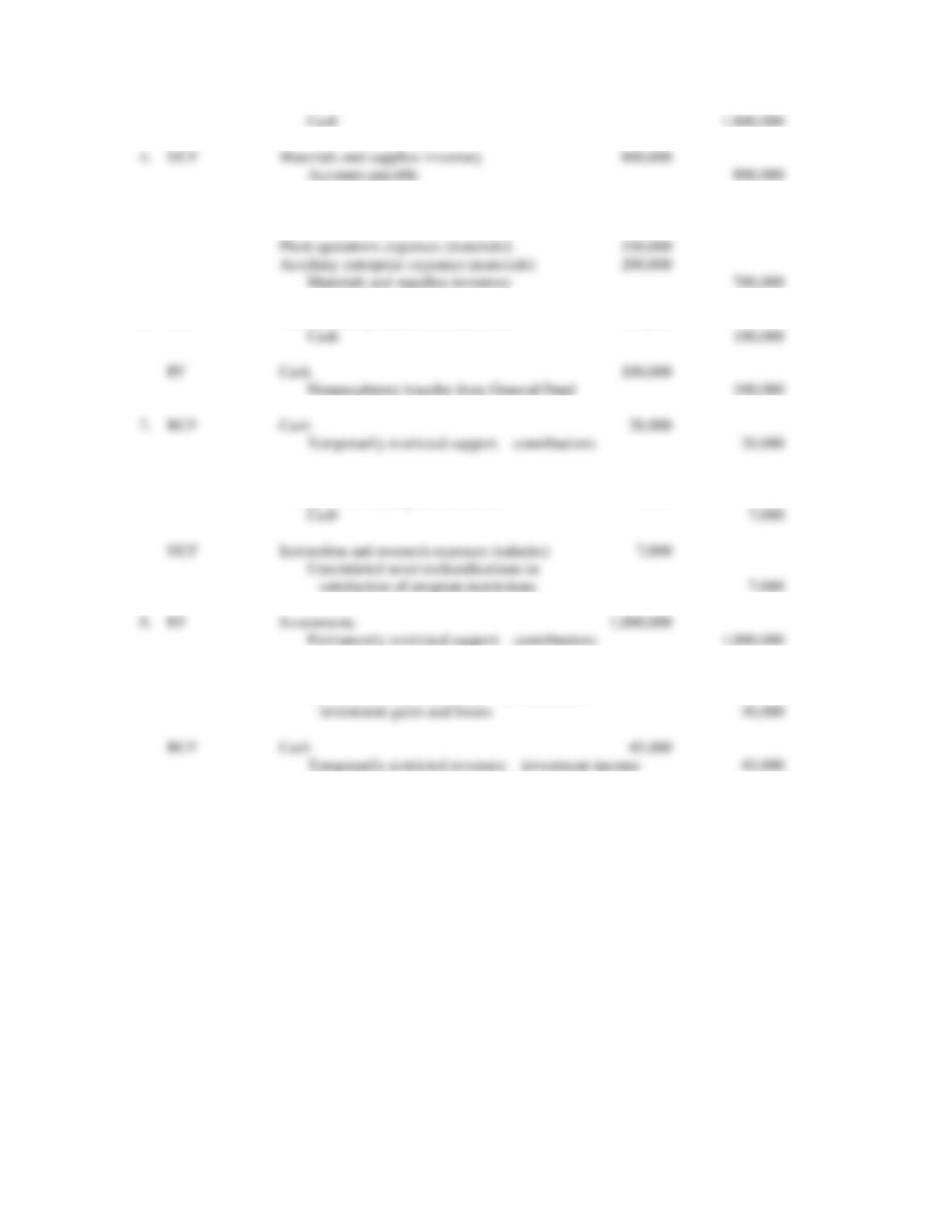
2. UCF Cash 400,000
Unrestricted revenues – auxiliary enterprises 400,000
3. UCF Instruction and research expenses (salaries) 1,200,000
Student services expenses (salaries) 200,000
16
Chapter 12
5. UCF Instruction and research expenses (materials) 300,000
Student services expenses (materials) 50,000
6. UCF Nonmandatory transfer to Plant Fund 100,000
8. RCF Temporarily restricted asset reclassifications out –
satisfaction of program restrictions 7,000
10. EF Investments 30,000
Permanently restricted gains – net unrealized
11. No entry. This is a conditional promise.