Chapter 12
International Taxation and Transfer Pricing
Discussion Questions
1. Tax neutrality means that taxes have no (are neutral in their) effect on business decisions. In
other words, business decisions are driven by economic fundamentals instead of taxes. Such
decisions should result in an optimal allocation of resources. However, taxes have the
potential to divert this allocation of resources. Taxes are seldom neutral.
Governments often use taxes for social purposes. This is not necessarily bad. For example,
2. The types of taxes discussed in the book are:
a. Income tax. Tax bases and tax rates vary from country to country. The effective tax rate is
what is important, not the nominal rate.
b. Withholding tax. These are withholdings on interest, dividend, and royalty payments to
investors.
c. Value-added tax. This is a consumption tax popular in Europe and Canada. The tax is
Philosophies of taxation vary with the types of taxes, because ultimately the question is who
pays and how much. In the case of income taxes, philosophies vary as to whether income
earned outside the country’s borders should be taxed (territorial versus worldwide).
3. National differences in tax rates are indeed the least significant determinants of a company’s
effective tax burden. The key term here is effective. Although statutory tax rates define a
4. Student responses to this question will naturally vary. Some will argue that multinational
operations abroad are merely guests of their national hosts. Given the visibility and political
sensitivity of their positions, therefore, these firms should fully disclose their earnings picture
5. Transfer pricing is a natural consequence of the decentralization of business organizations.
Interactions between units of a decentralized system require the establishment of prices at
which goods or services can be transferred among operating divisions. In a purely domestic
6. (a) Transfer pricing objectives of a multinational company often produce results that directly
conflict with the objectives of a foreign affiliate’s minority shareholders. Although the
minority shareholders want maximum dividends, transfer prices may be designed to minimize
the affiliate’s income and thus its ability to pay dividends.
7. Considerations that complicate the administration of transfer pricing systems internationally
include (but are not limited to) the following:
a. Tax considerations—to minimize its global tax bill, a multinational entity might raise
(lower) the transfer prices of goods shipped from affiliates located in low-tax (high-tax)
countries.
b. Tariff considerations—to minimize foreign tariffs, a firm can lower (raise) transfer prices
8. Transfer prices are generally based on market price or some variant of cost. Among the
advantages of using market prices are that they (a) encourage the efficient allocation of
corporate resources, (b) provide meaningful criteria for performance evaluation, (c) assist in
identifying profitable and unprofitable units, and (d) are easy to defend as arm’s-length prices
to host governments. Cost-based transfer pricing systems also have many advantages in that
they are (a) simple to use, (b) based on readily available data, (c) easy to verify before tax
authorities, and (d) easily routinized.
The overall competitive and financial position of the MNC is a major consideration in
9. An arm’s-length price is one that would have been paid to an unrelated party for the same or
similar goods under identical or similar circumstances. The United States is not alone in
mandating that international transfer prices be based on an arm’s-length price. As the chapter
points out, many countries have enacted legislation giving their tax authorities the right to
reallocate gross income, deductions, credits, or allowances to prevent tax evasion or to more
clearly reflect the proper allocation of income.
Although the notion of an arm’s-length price provides a conceptual foundation on which to
10. Advance pricing agreements (APAs) are a negotiated agreement between a multinational and
a taxing authority on an acceptable transfer pricing methodology. The APA is binding on
Exercises
1. There are no taxes paid on these transactions. China and Australia tax corporate income
(Exhibit 12-2) but the subsidiaries there have no profits. The entire profit is in the Cayman
Islands subsidiary, where there is no corporate income tax.
2.
Subpart F foreign base company income =
$4,000,000
3.
4.
Classical System
Corporate income
SEK1,500,000
– Income tax (28%)
420,000
5.
Country A
Country B
Country C
Country D
Royalty paid
$20.00
Branch earnings
$90.00
Dividend paid
$27.00
$27.00
(10%)
$18.00
$27.00
U.S. income
$20.00
$90.00
$27.00
$27.00
Dividend gross-up
(27.00/54.00 x 36)
______
______
18.00
-0-
Taxable income
$20.00
$90.00
$45.00
$27.00
Paid
-0-
(27.00/54.00 x 36)
_____
_____
(18.00)
_____
Total
(2.00)
(18.00)
(20.70)
-0-
U.S taxes—net
Foreign taxes
18.00
20.70
36.00
Total taxes
15.75
6.
Low Transfer Price (000s omitted)
Country A
Country B
Consolidated
Sales
$1,000
$1,700
$1,700
High Transfer Price (000s omitted)
Country A
Country B
Consolidated
Sales
$1,200
$1,700
$1,700
7. Low Transfer Price (000s omitted)
Country A
Country B
Consolidated
Sales
$1,000
$1,700
$1,700
Cost of sales
600
1,000
600
High Transfer Price (000s omitted)
Country A
Country B
Consolidated
Sales
$1,200
$1,700
$1,700
Operating expenses
100
200
8. a. There are at least three possible transfer prices based on the facts in this exercise. The
first is $120, the uncontrolled selling price in Country A. The second is $100, the
minimum declared value legally allowed in Country B. The third is $103.20, based on
allowing the affiliate in Country A to earn a reasonable (20 percent) profit on cost.
$103.20 is calculated as follows:
Manufacturing cost
$ 60.00
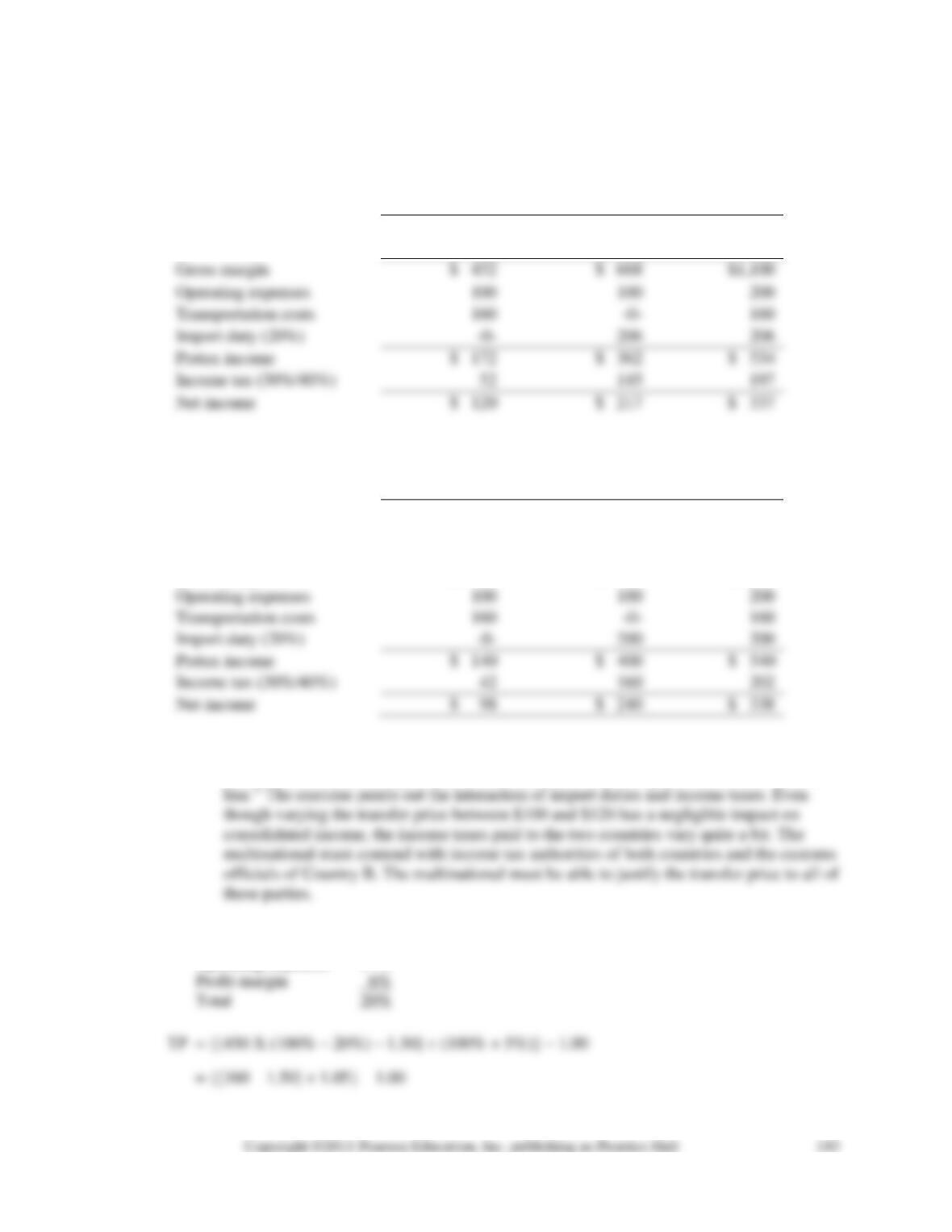
Consolidated income using the three transfer prices is as follows:
$120 Transfer Price (000s omitted)
Country A
Country B
Consolidated
Sales
$1,200
$1,700
$1,700
$103.20 Transfer Price (000s omitted)
Country A
Country B
Consolidated
Sales
$1,032
$1,700
$1,700
Cost of sales
600
1,032
600
Import duty (20%)
$100 Transfer Price (000s omitted)
Country A
Country B
Consolidated
Sales
$1,000
$1,700
$1,700
Cost of sales
600
1,000
600
Gross margin
$ 400
$ 700
$1,100
Operating expenses
100
Transportation costs
160
Import duty (20%)
Pretax income
$ 400
$ 540
Income tax (30%/40%)
Net income
$ 240
$ 338
b. The three transfer prices have a minimal impact on consolidated income overall.
However, it should be emphasized to students that one cannot just focus on the “bottom
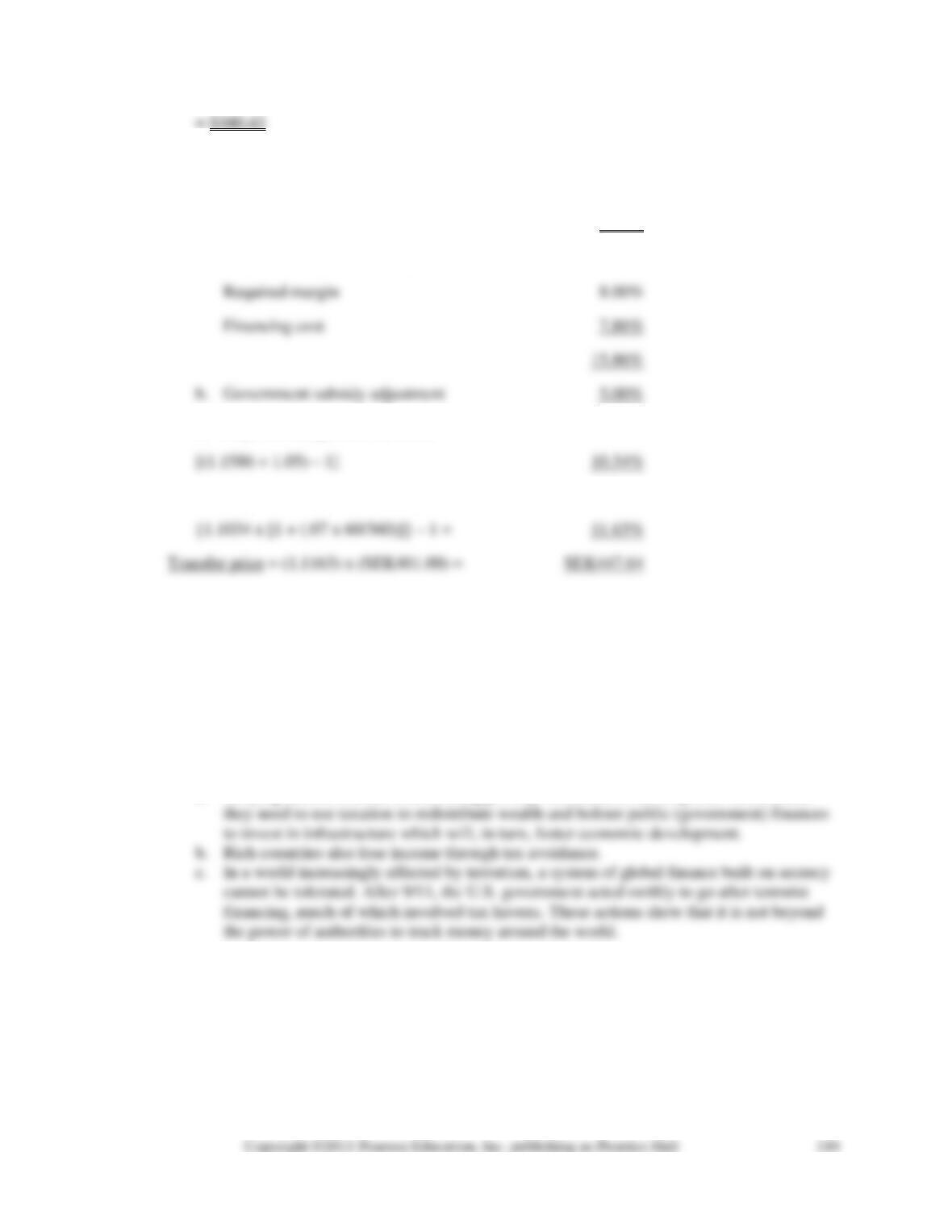
9. Costs as a percentage of sales price:
Operating expenses 14%
10. Total manufacturing cost per unit = SEK 401.00
Financing cost a percentage of total manufacturing cost
[(7% x SEK45,000,000) ÷ SEK40,100,000] 7.86%
a. Required margin before adjustments:
c. Adjusted margin in cash terms
d. Adjusted margin with 60 day terms
Case 12-1 The Shirts off Their Backs
1. We believe that wealthy nations have a moral responsibility to help alleviate poverty in poor
nations. Tax collections in poor countries are part of the solution to alleviating their poverty.
Thus, the question of why wealthy nations should be concerned about seeing that poor ones
collect their “fair share” of taxes is a moral one.
The Christian Aid report lists three reasons why rich countries should be concerned about
“tax justice” and help bring it about:
a. Levying taxes is critical in alleviating poverty. As countries develop their economies,
2. There is no doubt that accountants and accounting firms have played a role in tax avoidance
schemes. Are they behaving ethically or stretching the limits of aggressive tax positions? As
the case notes, Andersen facilitated Enron’s massive tax avoidance, setting up a global
network of 3,500 companies to keep from paying taxes. The case cites a U.S. GAO report
that found that 60 percent of U.S. corporations with at least $250 million in assets reported no
federal tax liability for any year between 1996 and 2000. In 2003, Ernst & Young reached a
$25 million settlement with the IRS over aggressive tax shelters that it marketed. In 2006,
KPMG paid a $465 million settlement after it admitted selling unlawful tax shelter schemes.
The anecdotal evidence, at least, gives accountants and accounting firms a black eye.
How culpable they are in perpetuating poverty is an open issue. As discussed next in response
3. In our view, tax planning is not wrong per se, but a natural behavioral response to tax rules in
place and the enforcement actions of tax administrations systems. One observer writes:
[R]ules always affect behavior and not necessarily in the way expected or desired by the rule
maker. It is idle to suppose that behaviors will not be affected. Ensuring that unintended
consequences are minimized and that the intended consequences are achieved is a difficult
art. I see no reason why regulations should not be immune to this.
I know that the benefits of living in a civilized and well organized society have to be paid for.
4. The first three policy recommendations, taken from the Christian Aid report, involve stronger
international cooperation on the sharing of information.
a. Open up the banking secrecy and confidentiality laws that operate in “uncooperative” tax
havens. As the chapter discusses, the OECD is trying to do this, but further cooperative
international government actions are necessary to provide transparency over the
Case 12-2 Muscle Max: Your Very Own Personal Trainer
This case raises a number of issues and should be a good vehicle to acquaint students with the many
considerations that impact international transfer prices. One issue concerns host government relations,
especially with customs officials. The fact that Muscle Max-Australia is being invoiced at two different
prices for identical equipment could lead to Australian charges of “dumping” with regard to imports from
Malaysia. Invoicing imported machines from Malaysia at the higher Canton price ([A$675 x 1.26] =
A$850) or invoicing imported machines from Canton at the lower Malaysian price (A$675) would
obviously involve trade-offs dealing with taxes, competitive position, and so on. Students should be
encouraged to discuss the costs and benefits associated with such trade-offs.
Another issue relates to who should set transfer pricing policies. Here, affiliate managers appear to have
much discretion in setting their transfer prices. The question is whether and under what circumstances this
is superior to more centralized decision-making. Students will probably be divided on this issue.