Appendix for Chapter 12
Accounting For Merchandise Inventory Using The Periodic Method
Of Inventory Valuation
Chapter Overview
This chapter contains accounts, transactions, and worksheet usage related to use of the Periodic Inventory
System for a merchandising company. The worksheet is prepared, adjusting journal entries are completed,
Learning Objectives
After studying Chapter 12A, your students should gain proficiency in the following:
2. Purchases Transactions, Including Freight.
4. Cash Payments Transactions and Schedules of Accounts Payable.
6. Worksheets for Merchandise Companies Using the Periodic Inventory Method.
8. Adjusting and Closing Entries and the Post-Closing Trial Balance for a Merchandise Company Using
Chapter 12A Assignment Grid
Estimated Level
Learning Time in of
Assignment Topic(s) Objective(s) Minutes Difficulty
Exercises (Set A)
Problems (Set A)
12A-1 Journalizing, Posting, A/R Schedule 1 40 Medium
12A-2 Journalizing & Posting 3 30 Medium
12A-3 Worksheet 6 Medium
Learning Unit 12-1: Discounts, and Sales Returns and Allowances
Summary: Retailers are merchants who buy goods from wholesalers for resale to customers. Gross
Sales are the total amount earned from the cash or credit sale of merchandise to customers. A sales
invoice is the bill sent to customers reflecting a credit sale. The sales returns and allowances account is
a contra-revenue account that records price adjustments and allowances granted on merchandise that is
defective or has been returned. The sales discounts (2/10, n/30 = 2% if paid within 10 days, net or full
Sales Tax Payable is an account in the general ledger that accumulates the amount of sales tax owed, and
the account has a normal credit balance.
Key Concepts: Retailers, merchandise, sales returns and allowances (SRA) account, sales discount,
discount period, credit period, sales discount account, net sales, gross sales, sales tax payable account.
Lecture Outline:
1. Gross Sales: total amount earned from the cash or credit sales to customers.
a. The entry to record the day’s cash sales:
2. Sales Returns and Allowances: A contra-revenue account that record returns and defective
merchandise.
3. Sales Discounts are price reductions granted to customers for payments made within a specific
period of time.
a. The term 2/10, n/30 indicates:
i. 2% discount if paid within 10 days (the discount period) of the invoice date,
4. Sales Tax Payable is a liability account to record the sales tax collected that needs to be paid to
the state, city or locality.
a. State and City sales tax vary from state to state and city to city. In some locations only
certain items may be taxed and in other locations there may not be a sales tax at all.
b. The sales tax is computed by multiplying the sales tax percentage times the sales price of
the item being taxed.
c. The journal entry for sales transactions with sales tax:
Dr. Cash or Accounts Receivable (depending on type of sale) XX
Teaching Tips/Strategy: Students are comfortable with a merchandising industry. Relate the
terminology with a known merchandising business (or store) that your students have visited.
Learning Unit 12-2: Purchases Transactions, Including Freight
Summary: The Purchases account records all merchandise bought for sales. It records the cost of the
merchandise and represents costs that are directly related to bringing merchandise into the store for resale
to customers. All purchases are recorded individually in the accounts payable subsidiary ledger to
properly identify the merchandise and the merchant. Merchandise received as defective results in a
notification to the manufacturer being issued, and the manufacturer issues a credit memorandum
indicating a reduction from the original selling price.
The account that records a decrease to a buyer’s cost is a contra-cost account called Purchases Returns
and Allowances. The account that records the discount is called Purchases Discount. This account is a
contra-cost account because it lowers the cost of purchases, and the normal balance is a credit. Freight
charges are not taken into consideration in calculating net purchases.
Key Concepts: Purchases, purchases returns and allowances, purchases discount, F.O.B. destination,
F.O.B. shipping point.
Lecture Outline:
1. The Purchases account records the cost of inventory purchased for resale. Purchases is a cost and
follows the same rules as expenses
2. Seller records returns and allowances through the Sales Returns and Allowances Account.
3. The purchaser makes similar entries through the Purchases Returns and Allowances Account for
the amount of defective or unacceptable merchandise.
4. Purchases Returns and Allowances is a contra-cost account.
a. The purchaser issues a debit memorandum to the seller indicating that it debited
5. Purchases Discounts is a contra-cost account in the general ledger that records cash discounts
offered by suppliers of merchandise for payment within the discount period.
a. The term 2/10, n/30 indicates:
i. A 2% discount
ii. IF paid within 10 days (the discount period) of the date of the invoice,
iii. OR the full (net) amount must be paid within 30 days (the credit period).
b. The term n/10, EOM indicates:
c. The journal entry for cash payment with a discount:
Dr. Accounts Payable XX
Dr. Purchases Discount XX
Cr. Cash (sales less discount taken) XX
7. Freight charges are a cost of purchasing inventory, but they are not included when computing net
purchases. The business that pays for the freight owns the merchandise.
a. F.O.B. (Free on Board) destination indicates that the seller pays the freight, and legal
ownership (title) passes when the goods reach their destination.
Teaching Tips/Strategy: Start the class discussion by differentiating between a seller and a purchaser.
Compare the journal entries and records necessary from the seller’s and the purchaser’s point of view.
Assign Problems12A-1 and 12A-2 to reinforce the concepts presented on the objective.
Learning Unit 12-3: Journalizing and Recording Transactions and
Posting to the General Ledger Along with a Debit Memorandum
Summary: Accounts payable is the controlling account in the ledger and at the end of the month the sum
of the individual amount owed to the creditors should equal the balance in accounts payable at the end of
the month. An accounts payable subsidiary ledger is a book or file that contains, in alphabetical order,
the name of creditors and amounts owed from purchases on account.
Key Concepts: Debit memorandum.
Lecture Outline:
1. Journal entry for merchandise purchase plus freight cost:
2. Post general ledger accounts to the general ledger by recording the general journal
3. Debit memorandum – piece of paper issued by a customer to a seller indicating that a
return or allowance has occurred.
4. Journal entry for debit memorandum of merchandise returned:
Dr/ Accounts Payable XX
Cr. Purchases Returns and Allowances XX
Teaching Tips/Strategy: Assign Exercise 12A-2 to reinforce the concepts presented in the objective.
Learning Unit 12-4: Cash Payments Transactions and Schedules of
Accounts Payable
Summary: All payments of cash (check) are recorded in the general journal. At the end of the month, the
schedule of accounts payable, a list of ending amounts owed individual creditors, should equal the ending
balance in accounts payable, the controlling account in the general ledger.
Now let’s prove that the sum of the accounts payable subsidiary ledger at the end of the month is equal to
the controlling account, accounts payable, at the end of the month. To do so, creditors with an ending
Key Concepts: Controlling account
Lecture Outline:
1. Controlling account is the account in the general ledger that summarizes or controls a subsidiary
ledger. (Example: The accounts payable account in the general ledger is the controlling account for
2. With cash payment transactions, cash will be credited. Any discount taken will also be credited while
other accounts will be debited. (See Figure 12A.13 for examples of cash payments transactions.)
Teaching Tips/Strategy: Assign Problem 12A-5 to reinforce the concepts presented in this and prior
objectives.
Learning Unit 12-5: Adjustments for Merchandise Inventory,
Unearned Rent, Supplies Used, Insurance Expired, Depreciation
Expense, and Accrued Salaries
Summary: The Merchandise Inventory account shows the goods that a merchandise company has
available to sell to customers. Companies have several ways to keep track of the cost of goods sold (the
total cost of the goods sold to customers) and the quantity of inventory on hand. The two systems are
This chapter appendix discusses the periodic inventory system, in which the balance in inventory is
updated only at the end of the accounting period. This system is used by companies which sell a variety of
merchandise with low unit prices. The amount of inventory that the organization starts the year with is
called beginning merchandise inventory or simply beginning inventory. The balance of beginning
inventory in the merchandise inventory account never changes during the accounting period. Any
purchases of merchandise are recorded in a separate account, the Purchases account. At the end of the
period, the company takes a physical count of the merchandise in stock. This amount is called ending
merchandise inventory or simply ending inventory. The ending merchandise inventory (ending
inventory) is the cost of goods that remain unsold at the end of the accounting period. It is an asset on the
new balance sheet. The ending inventory for this period will become the beginning inventory for the next
period. When the income statement is prepared, the cost of goods sold section requires two distinct
Freight-In is a cost of goods sold account that records the shipping cost to the buyer. Note that net sales
(gross sales less sales returns and allowances and sales discounts) less cost of goods sold equals gross
profit. Subtracting operating expenses from gross profits equals net income. Remember that under
Key Concepts: Cost of goods sold, periodic inventory system, beginning merchandise inventory
(beginning inventory), ending merchandise inventory (ending inventory), freight-in, gross profit.
Lecture Outline:
Adjustments for merchandise inventory: Businesses can choose either to track the cost of goods sold
using a perpetual inventory system or a periodic inventory system:
2. Periodic inventory system updates the balance of inventory on hand only at the end of the
accounting period:
Cost of goods sold computation:
Beginning Inventory
+ Net Purchases
+ Freight-In
3. Closing entries (Periodic inventory system):
a. Remove the value of inventory on hand at the beginning of the period (beginning
inventory) and transfer it to income summary.
Adjusting journal entry:
Dr. Income Summary XX (beginning inventory amount)
b. Enter the value of inventory on hand at the end of the period (ending inventory) and
record it in income summary.
Adjusting journal entry:
Dr. Merchandise Inventory XX (ending inventory amount)
Cr. Income Summary XX (ending inventory amount)
Learning Unit 12-6: Worksheets for Merchandise Companies Using
the Periodic Inventory Method
Summary: In this unit we prepare a worksheet for Art’s Wholesale Clothing Company. For convenience,
we reproduce the company’s chart of accounts in Figure 12A.17, and Figure 12A.18 shows the trial
balance from Art’s Wholesale ledger. In looking at the trial balance, there are many new titles that did not
appear in the trial balance which was completed for a service company previously. Examples are
Key Concepts: Mortgage payable, interest expense, unearned revenue.
Lecture Outline:
A worksheet similar to the one used for service businesses is completed.
1. The initial balances from the general ledger are added to the worksheet.
2. Similar to the adjusting entries for a service business, adjusting entries are computed to represent
the changes during the period.
a. Mortgage payable – a liability account showing the amount owed on a mortgage.
b. Interest expense – the cost of borrowing money. Businesses making loan payments pay a
portion of the amount borrowed (principal) and the interest charged by the institution
from which they borrowed the funds.
c. Unearned revenue – a liability account that records the amount owed for goods and
services in advance of delivery of those services. When cash is received, cash is debited
and the liability “unearned” is credited.
d. The journal entry to adjust supplies account ending balance to actual supplies on hand at
end of period is:
Dr. Supplies expense XX
Cr. Supplies (asset account) XX
e. The journal entry needed when insurance expires during the year is:
f. The adjusting entry to reflect the depreciation for the accounting period is:
Dr. Depreciation expense XX
Cr. Accumulated depreciation XX
g. The adjusting entry for salaries accrued (employees work earned but not paid) since the
last payment of salaries is:
The next step in the worksheet is to fill out the balance sheet and income statement columns. After
adjusting the merchandise inventory accounts, the ending inventory balance is carried to the balance sheet
column in the worksheet.
Learning Unit 12-7: Completion of the Accounting Cycle for a
Merchandise Company Using the Periodic Method of Inventory
Valuation
Summary: The income statement (Figure 12A.20) is prepared from the income statement columns of the
worksheet. On the formal income statement, the inside columns in financial reports are used for
subtotaling, not for debit and credit. The income statement is broken down into several sections: revenue
Statement of owner’s equity is based on the balance sheet column of the worksheet. The capital account
in the ledger should be checked to see whether any additional investments occurred. You add the net
income from the income statement and deduct the withdrawals to calculate the ending figure of capital.
Lecture Outline:
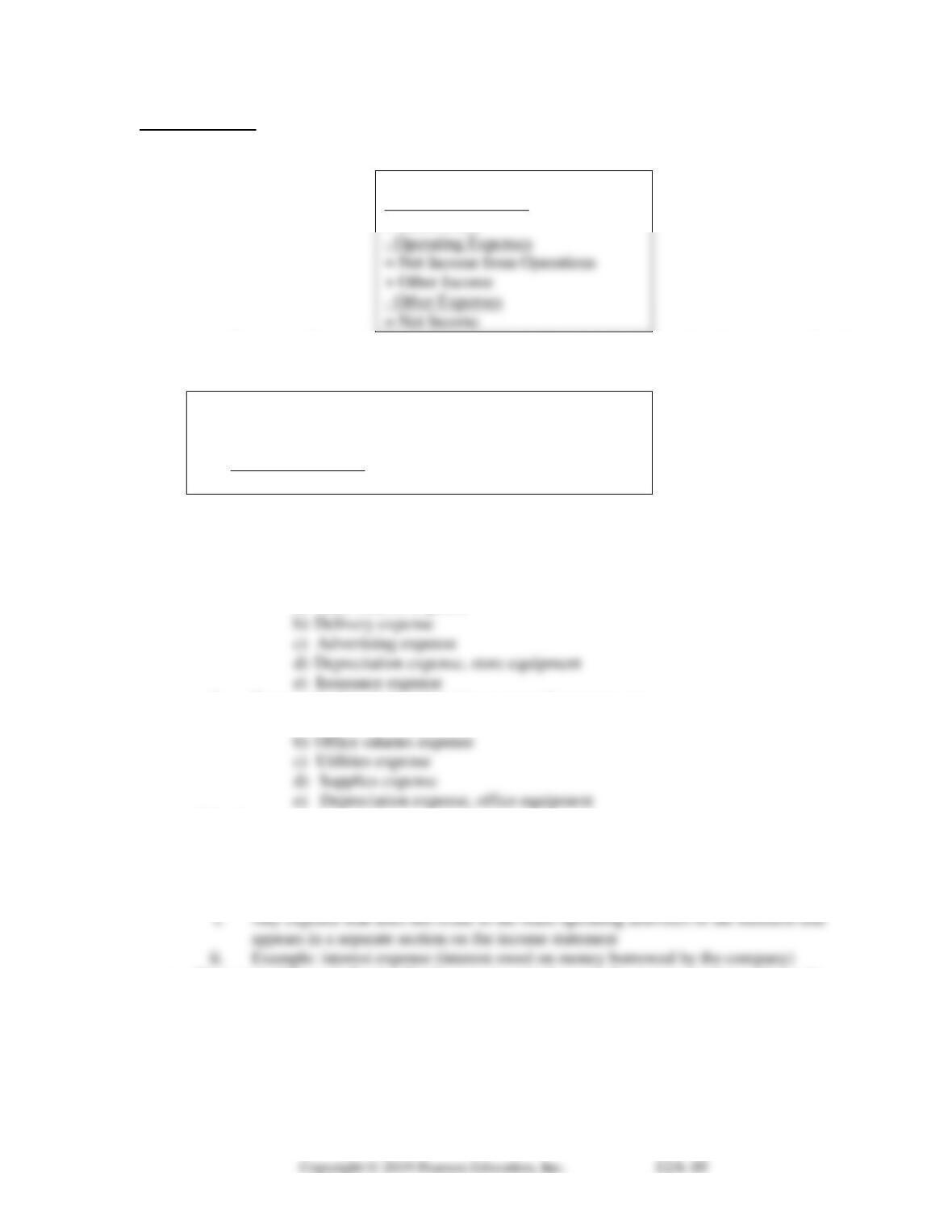
1. The income statement is prepared from information included on the worksheet. The format for the
income statement is: Net Sales
– Cost of Goods Sold
= Gross Profit
a. Revenues: Gross sales less sales returns and allowances and less sales discounts equals net
sales.
b. Cost of Goods Sold Section:
Beginning Inventory
+ Net Purchases
+ Freight-in
+ Ending Inventory
= Cost of Goods Sold
c. Gross Profit: Net Sales – Cost of Goods Sold = Gross Profit
d. Operating Expenses: Many businesses break expenses down into those directly related to the
selling activity of the business (selling expenses) and those related to administrative or
office activity (administrative expenses or general expenses).
i. Some examples of operating expenses are:
a) Sales salaries expense
ii. Some examples of administrative or general expenses are:
a) Rent expense
e. Other Income:
i. Revenue other than revenue from sales or services and appears in a separate section on
the income statement
ii. Examples are: rental income, storage fees, or interest income
f. Other Expenses:
g. Statement of Owner’s Equity: Net Income is carried over to the statement of owner’s equity.
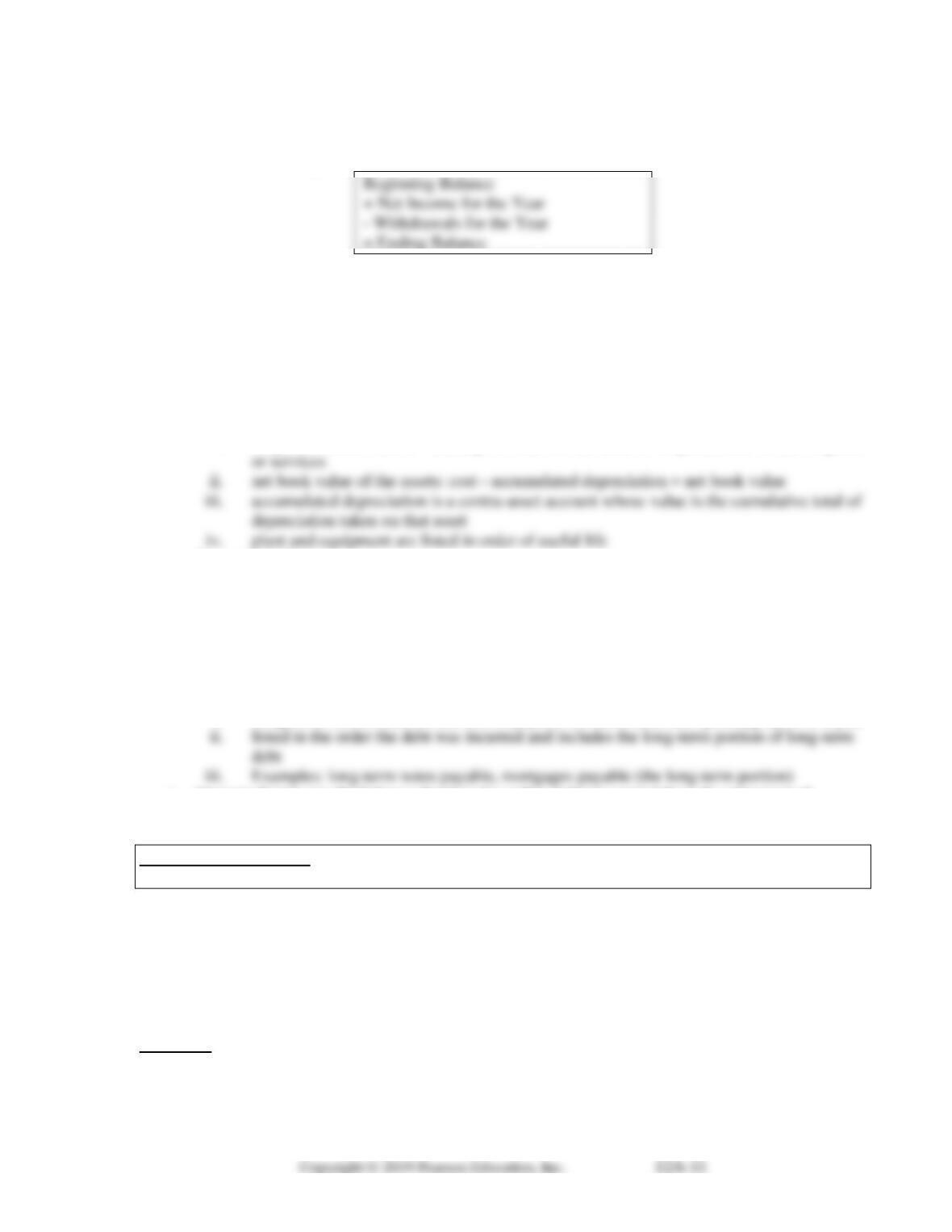
2. Statement of Owner’s Equity is prepared from information on the worksheet and the income
statement. The ending balance is carried to the balance sheet. The statement format is:
3. The Balance Sheet: The classified balance sheet is a balance sheet that categorizes assets as current or
plant and equipment, and groups liabilities as current or long-term.
a. Current Assets are:
i. cash and other assets that will be converted into cash or used up within one year or the
normal operating cycle of the business, whichever is longer
ii. listed in the order of liquidity or ability to be converted to cash
iii. Examples are: cash, accounts receivable, merchandise inventory, supplies, prepaid
insurance, and prepaid rent
b. Plant and equipment (long-term assets):
i. long-lived assets such as buildings or land that are used in the production or sale of goods
c. Current Liabilities:
i. obligations or debts that will come due within one year or within the operating cycle,
whichever is longer
ii. Examples are: current portions of long-term debt (such as mortgage payable), accounts
payable, and accrued liabilities that will come due within the operating cycle
iii. accounts payable are listed first and the remaining liabilities are listed in order as to how
soon they will come due
d. Long-Term Liabilities:
i. obligations (debts) that are not due or payable for more than one operating cycle or a year
e. Owner’s Equity (on the balance sheet) is the ending balance carried from the statement of
owner’s equity
Teaching Tips/Strategy: Ask students to provide examples of service businesses and merchandising
businesses that are familiar to them.
Learning Unit 12-8: Adjusting and Closing Entries and the Post–
Closing Trial Balance for a Merchandise Company Using the
Periodic Method
Summary: The adjusting entries from the adjustments columns of the worksheet (See Figure
12A.23) need to recorded in the journal (See Figure 12A.24) and then posted to the ledger accounts.
Key Concepts: None
Lecture Outline:
1. The adjustments (adjusting entries) shown in the worksheet need to be recorded in the
general journal and then posted to the general ledger accounts.
2. The adjusted trial balance amounts on the worksheet need to be transferred to either the
Teaching Tips/Strategy: Explain the reasons why all entries presented on the worksheet are not
“official” until journalizing and posting has occurred. Clarify why the net income from the worksheet
might not match the financial statements unless you journalize and post all required adjustments.
Learning Unit 12-9: Journalizing and Posting Closing Entries
Summary: Closing entries are prepared to clear all temporary accounts in the ledger to zero and to update
capital in the ledger to its latest balance. The company uses the worksheet to complete the closing
process. Close all balances on the income statement credit column of the worksheet, by debits. Close all
balances on the income statement debit column of the worksheet, by credits. Transfer (or close) the
Key Concepts: None
Lecture Outline:
3. The goals of closing are the same for a merchandise company. The goals are
a. to clear all temporary accounts in the ledger to zero
b. to update capital in the ledger to its latest balance
c. The closing steps are:
a) Close all balances on the income statement credit column (revenues)
of the worksheet
The journal entry to record the closing is:
b) Close all balances on the income statement debit (expenses) column
of the worksheet
The journal entry to record the closing is:
(Remember to list ALL the expense accounts separately)
c) The ending balance of income summary is transferred to the capital
account.
The journal entry is:
(Use when revenues > expenses = net income or the income summary has a
credit balance)
d) The balance of the withdrawals is transferred to the capital account
The journal entry is:
4. After the entries are journalized (Figure 12A.25) and posted:
5. Post-closing trial balance (Figure 12A.26):
a. Is prepared from the general ledger
Teaching Tips/Strategy: Explain the reasons why all entries presented on the worksheet are not
“official” until journalizing and posting has occurred. Clarify why the net income from the worksheet
might not match the financial statements unless you journalize and post all required adjustments.