363
CHAPTER 12
DIFFERENTIAL ANALYSIS AND
PRODUCT PRICING
CLASS DISCUSSION QUESTIONS
1. a. Differential revenue is the amount of
increase or decrease in revenue ex-
pected from a particular course of action
compared with an alternative.
2. This decision is an example of a make-or-buy
decision. Exabyte is focusing on its compara–
tive advantages, which include marketing and
distribution, while building partnerships with
others to actually manufacture key elements
of the product.
3. The differential income and costs of the
lease option should be compared against
selling the building. The differential revenue
4. Assuming there is demand for the premium-
grade product, this would assume the differ-
ential price (premium less commodity) ex-
ceeded the differential cost to process the
product to premium grade.
5. A business should only accept business at a
special price if the lower price will not con-
taminate the regular pricing for other cus-
offering discount business to a customer
that may wish to order in the future.
6. It would be reasonable to purchase from the
the profitability of the store, including all the
revenues, variable costs, and fixed costs
associated with the store, since they would
all be differential to the decision. In addition,
any costs of closing the store and preparing
the store for disposal would need to be con-
sidered (legal costs, demolition costs, em-
ployee severance costs). Lastly, the oppor-
tunity cost of the value of the equipment and
fixed and variable) and provide a reasonable
amount for profit.
9. The use of ideal standards might not allow
for such factors as normal spoilage or nor-
mal periods of idle time, with the result that
these costs might not be covered by the
product price. In such cases, the product
price could be too low to earn a desired prof-
364
12. The target cost concept begins with a price
that can be sustained in the marketplace,
then subtracts a target profit, thus determin-
ing the target cost. The cost is made to con-
14. A production bottleneck is a point in the
production process where demand exceeds
the ability to produce (i.e., the segment is
operating at full capacity). As a result, the
365
EXERCISES
E12–1
a. YAMADA INDUSTRIES
Proposal to Lease or Sell Machinery
Differential revenue from alternatives:
E12–2
a. COLA BEVERAGES INC.
Proposal to Discontinue Kiwi Cola
Differential revenue from annual sales of Kiwi Cola:
Revenue from sales ……………………………………………… $4,000,000
Differential cost of annual sales of Kiwi Cola:
Variable cost of goods sold ………………………………….. $1,905,000*
366
E12–3
a.
DINNER WARE COMPANY
Differential Product Analysis Report
Bowls Plates Cups
Differential revenue from monthly sales:
Revenue from sales …………………………... $ 1,500,000 $ 2,350,000 $ 975,000
Computations:
1$900,000 × (1.0 – 0.40) = $540,000
2$1,400,000 × (1.0 – 0.40) = $840,000
3$780,000 × (1.0 – 0.40) = $468,000
b. The Cups line should be retained. As indicated by the differential analysis in part
(a), the income would decrease by $261,000 (excess of differential revenue over
differential cost) if the Cups line is discontinued.
367
E12–4
Note to Instructors: Many students may be unfamiliar with the financial services in-
dustry. This exercise provides an opportunity to introduce students to some basic
terms and concepts used within the industry.
a. The “Individual Investor” segment serves the retail customer, you and me. These
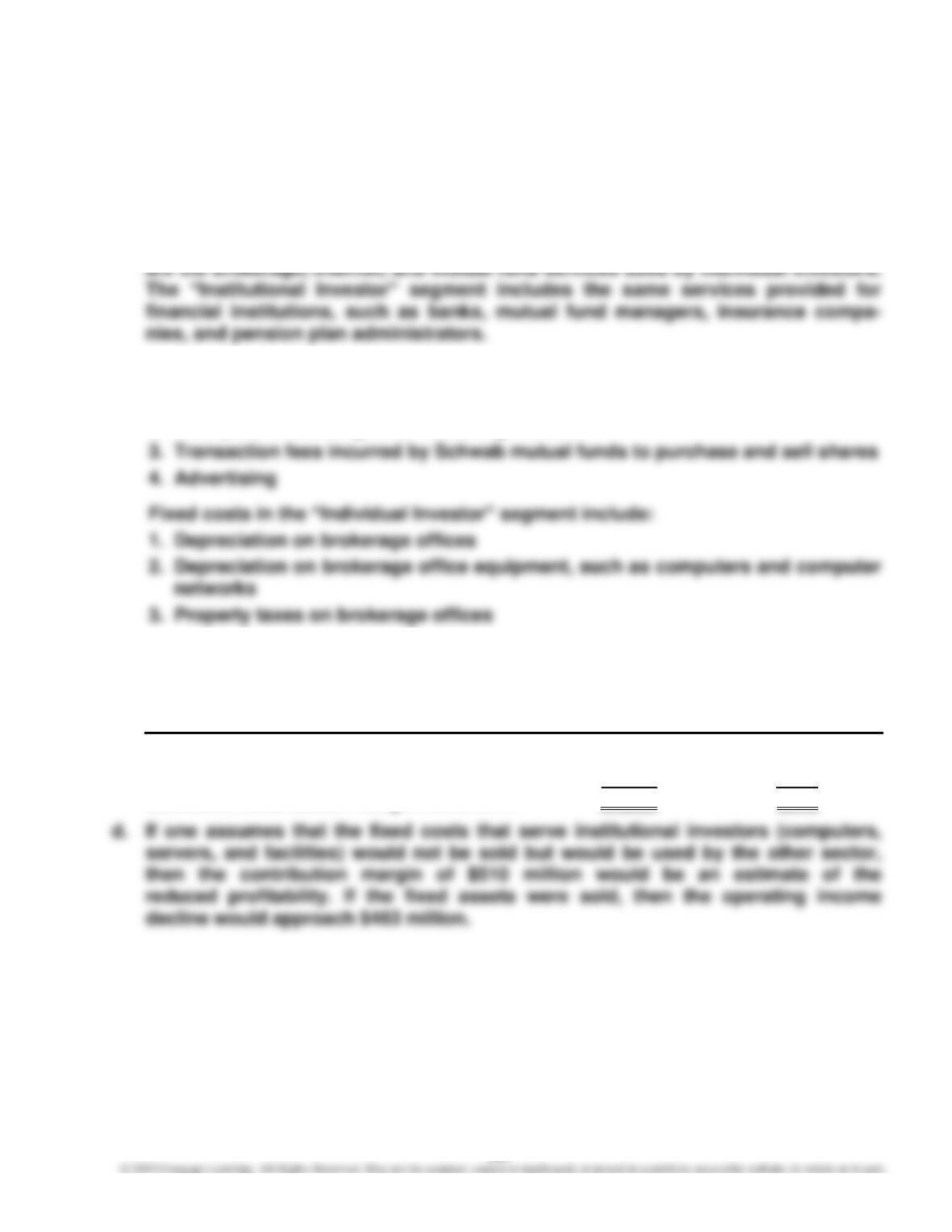
b. Variable costs in the “Individual Investor” segment include:
1. Commissions to brokers
2. Fees paid to exchanges for executing trades
c.
Individual Institutional
Investor Investor
Income from operations before taxes …….. $ 928 $463
Plus depreciation and amortization ……….. 108 47
Estimated contribution margin ………………. $1,036 $510
368
E12–5
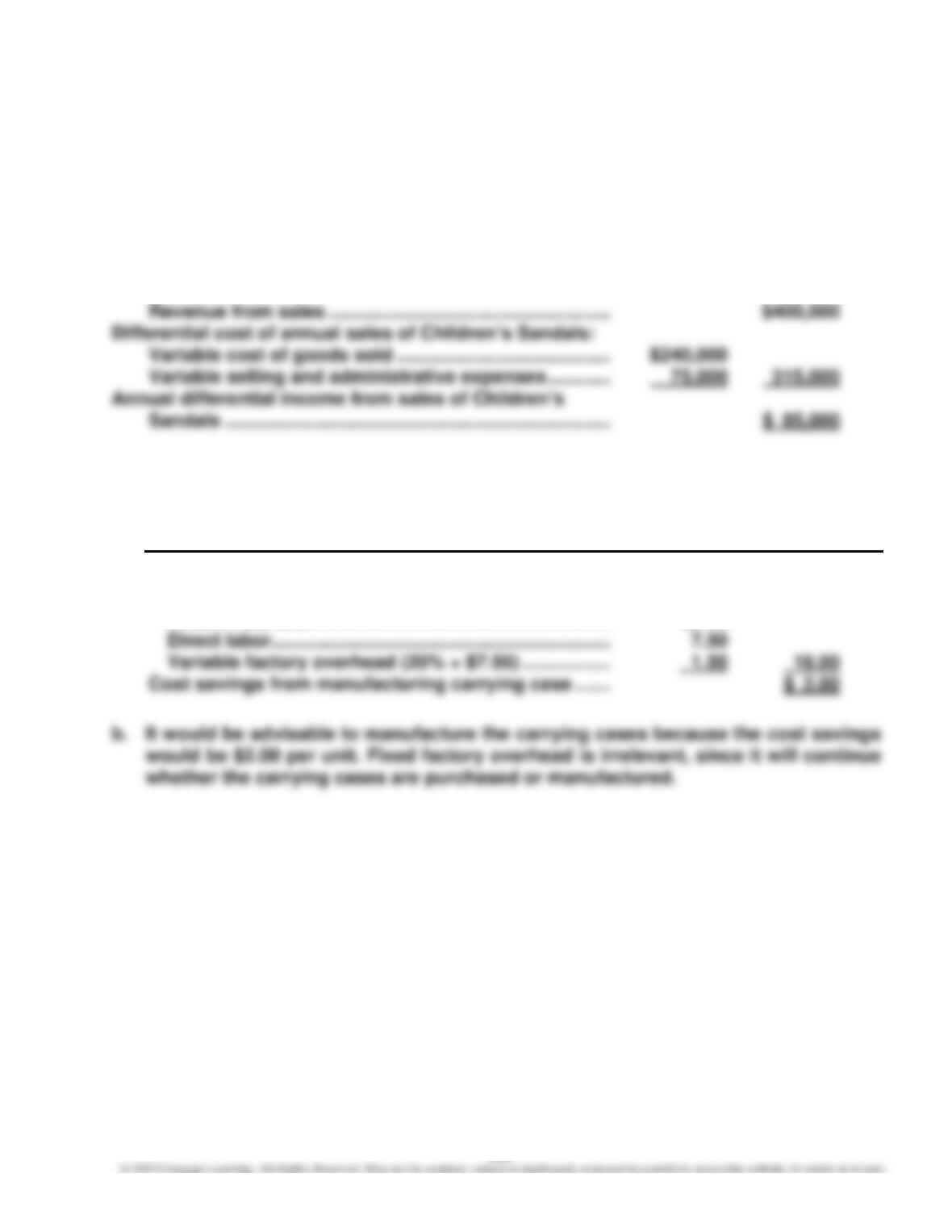
The flaw in the decision was the failure to focus on the differential revenues and costs,
which indicate that operating income would be reduced by $85,000 if Children’s San-
dals is discontinued. This differential income from sales of Children’s Sandals can be
determined as follows:
Differential revenue from annual sales of Children’s
Sandals:
E12–6
a. BALBOA TECHNOLOGIES COMPANY
Proposal to Manufacture Carrying Case
Purchase price of carrying case ……………………………. $20.00
Differential cost to manufacture carrying case:
Direct materials …………………………………………………. $9.00
369
E12–7
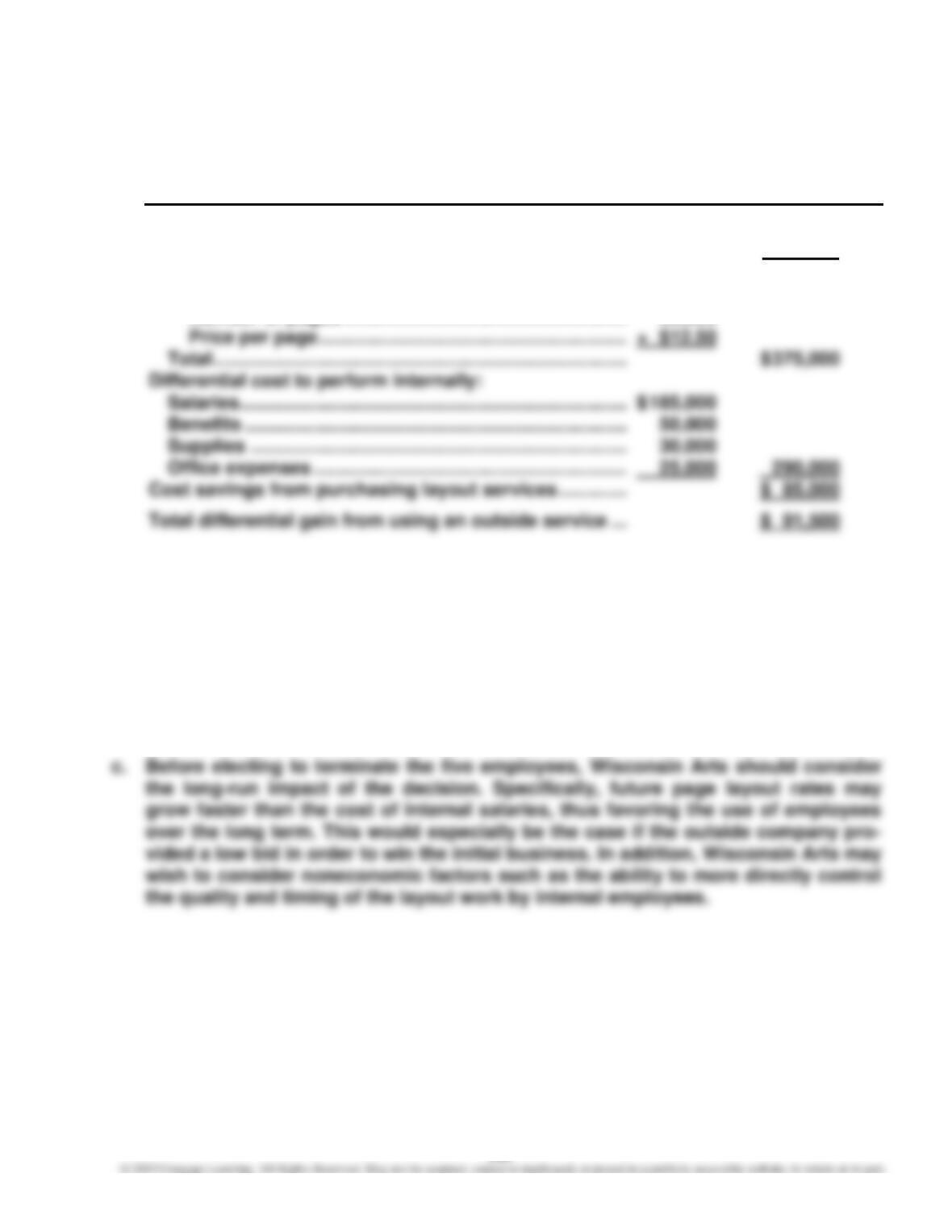
a. WISCONSIN ARTS OF MILWAUKEE
Proposal to Purchase Outside Page Layout Services
Differential revenue:
Salvage of computer equipment …………………………... $ 6,500
Differential expenses:
Purchase price of layout work:
Number of pages ……………………………………………… 30,000
b. The benefit from using an outside service is shown to be $91,500 greater than per-
forming the layout work internally. The fixed costs (depreciation expenses) in the
budget are irrelevant to the decision. Thus, the work should be purchased from
the outside on a strictly financial basis. In addition, the decision to purchase from
the outside would be further favored if the need for administrative expansion
space were great. If more administrative space were needed immediately, then any
avoided lease costs would become a differential benefit to the decision to out-
source.
370
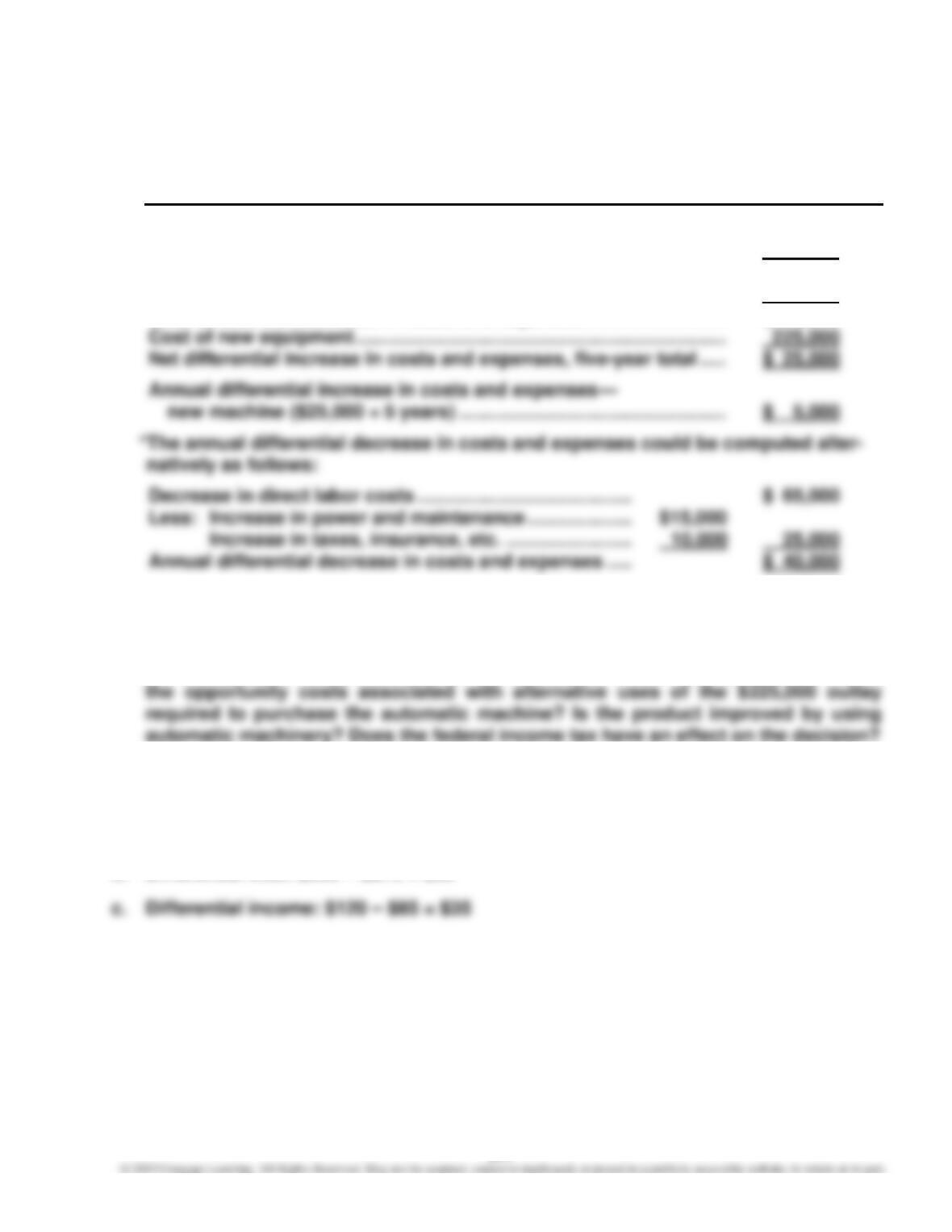
E12–8
a. Annual variable costs—present equipment ……………. $ 75,000
Annual variable costs—new equipment…………………. 39,000
Annual differential decrease in cost ………………………. $ 36,000
b. The sunk cost is the $235,000 book value ($350,000 cost less $115,000 accumulat-
ed depreciation) of the present equipment. The original cost and accumulated de-
preciation were incurred in the past and are irrelevant to the decision to replace
the machine.
371
E12–9
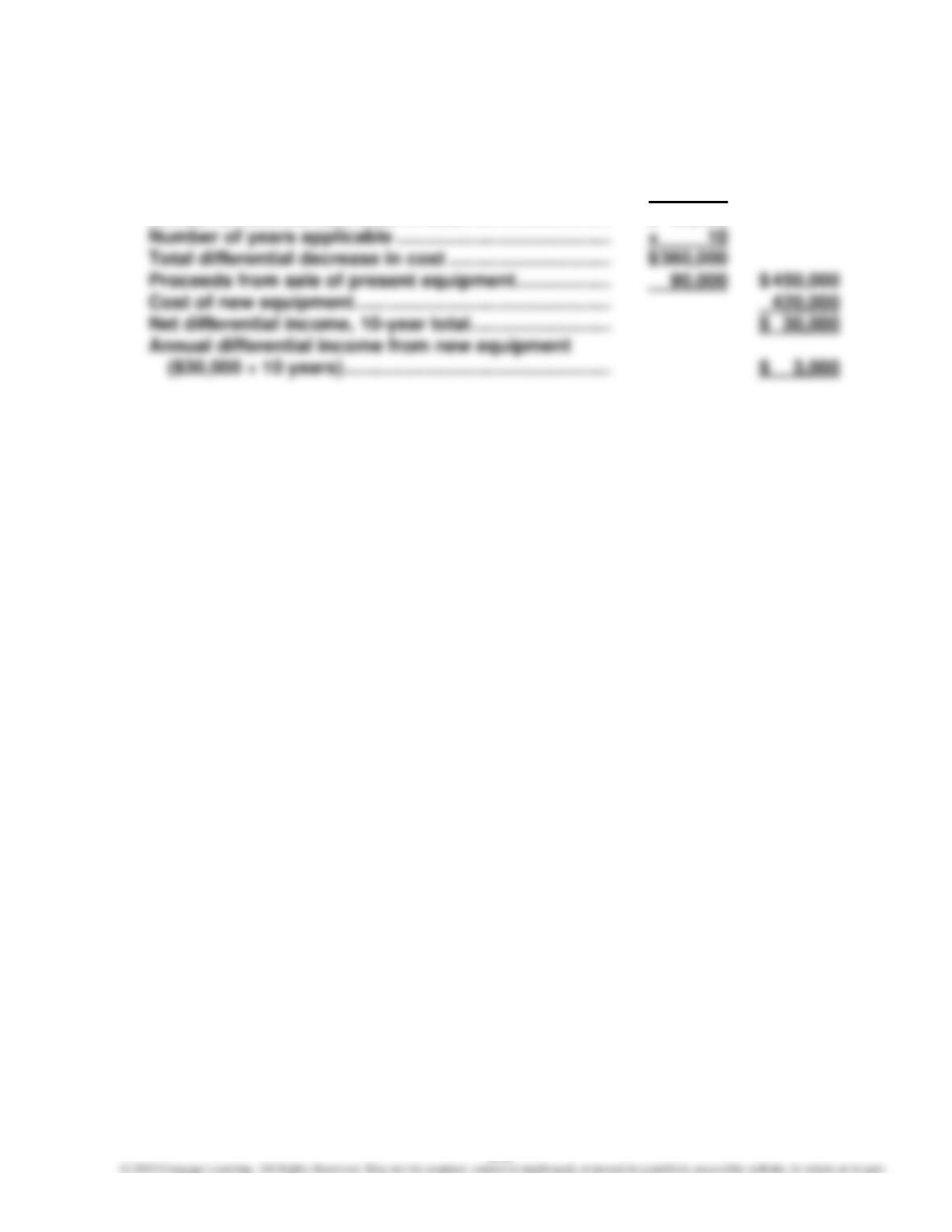
a. SIDNEY TECHNOLOGIES
Proposal to Replace Machine
Annual costs and expenses—present machine …………………………. $267,000
Annual costs and expenses—new machine ………………………………. 227,000
Annual differential decrease in costs and expenses ………………….. $ 40,000*
Number of years applicable ……………………………………………………… × 5
Total differential decrease in costs and expenses ……………………… $200,000
b. The proposal should not be accepted.
c. In addition to the factors given, consideration should be given to such factors as:
Do both present and proposed operations provide the same capacity? What are
E12–10
a. Differential revenue: $520 – $400 = $120
b. Differential cost: $360 – $275 = $85
372
E12–11
a. SPOKANE COFFEE COMPANY
Proposal to Process Columbian Coffee Further
Differential revenue from further processing per batch:
Revenue from sale of Decaf Columbian [(5,000
pounds – 400* pounds evaporation) × $12.50] …………… $ 57,500
b. The differential revenue from processing further to Decaf Columbian is less than
the differential cost of processing further. Thus, Spokane Coffee Company should
sell Columbian coffee and not process further to Decaf Columbian.
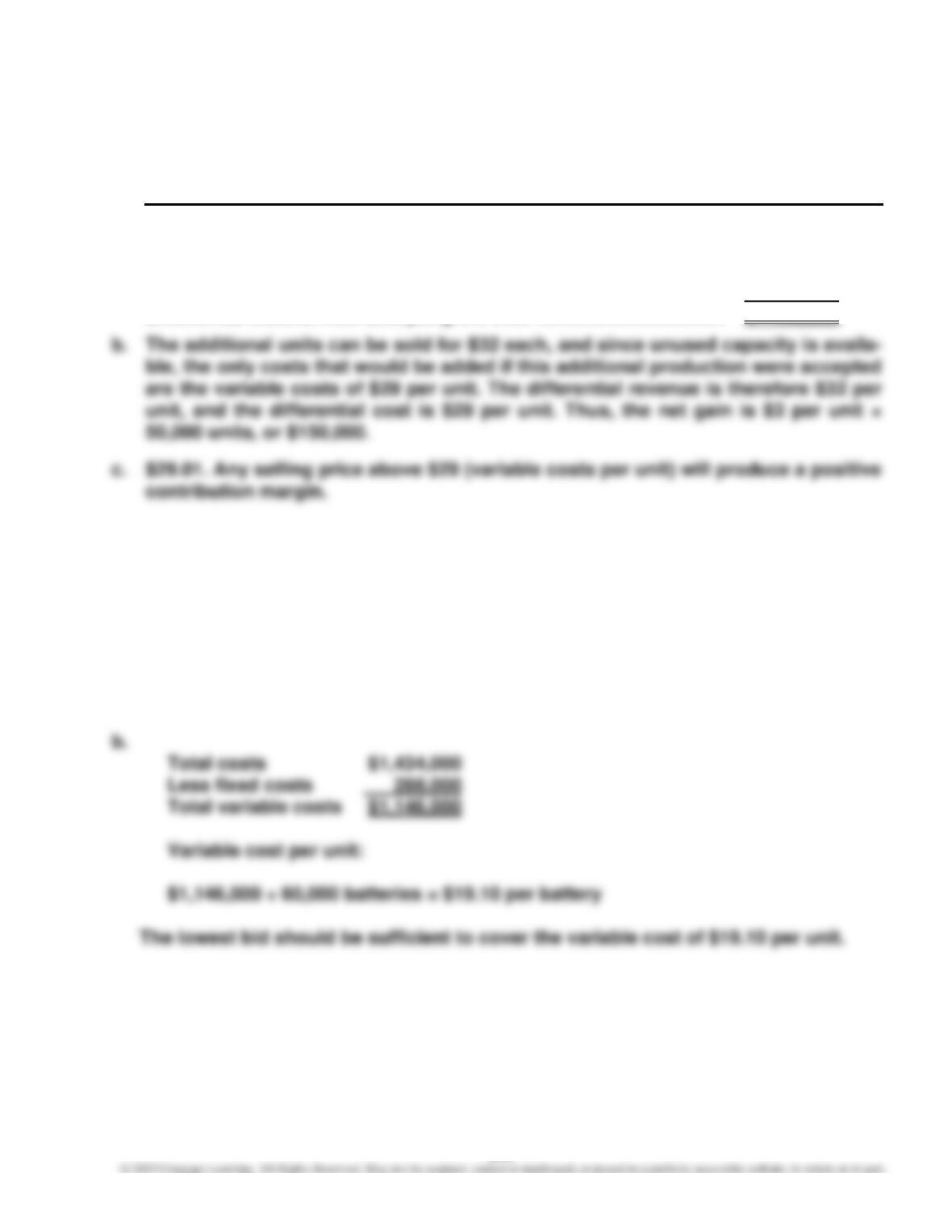
c. The price of Decaf Columbian would need to increase to $12.85 per pound in order
for the differential analysis to yield neither an advantage nor a disadvantage (indif-
ference). This is determined as follows:
(5,000 pounds × $9.00) …………………………………………….. 45,000
Differential revenue ………………………………………………………… $ 14,110
Differential cost per batch:
Additional cost of producing Decaf Columbian …………….. 14,110
Differential income from further processing:
Decaf Columbian per batch …………………………………………. $ 0
373
E12–12
a. TOSCA INDUSTRIES INC.
Proposal to Sell to DynaX Company
Differential revenue from accepting the offer:
Revenue from sale of 50,000 additional units at $32 ……………… $1,600,000
Differential cost of accepting the offer:
Variable costs from sale of 50,000 additional units at $29 ……… 1,450,000
Differential income from accepting the offer ……………………………… $ 150,000
E12–13
a.
Budgeted cost per battery for June = Total manufacturing costs ÷ Budgeted pro-
duction
Budgeted cost per battery for June = $1,434,000 ÷ 60,000 batteries = $23.90 per
battery
374
E12–14
a. MIRAMAR TIRE AND RUBBER COMPANY
Proposal to Sell to Rio Motors
Per Unit Total
Differential revenue from accepting special offer …. $20.00 $800,000*
Differential costs from accepting special offer:
Direct materials ……………………………………………….. $10.00
Direct labor……………………………………………………… 5.00
*$20 × 40,000 tires = $800,000
**4% × $40. The avoided sales commission should not be computed on the basis
of the $20 price to Rio Motors, but on the existing domestic sales price of $40.
***$18.95 × 40,000 tires = $758,000
b.
tires 40,000
$778,000
= $19.45
or
375
E12–15
a. $3,000,000 ($15,000,000 × 20%)
b. Total costs:
Variable ($465 × 100,000 units) …………………………………………….. $46,500,000
Fixed ($2,400,000 + $1,100,000)…………………………………………….. 3,500,000
Total ………………………………………………………………………………………… $50,000,000
Cost amount per unit: $50,000,000 ÷ 100,000 units = $500.00
E12–16
a. Total manufacturing costs:
Variable ($420 × 100,000 units) …………………………………………….. $42,000,000
Fixed factory overhead ………………………………………………………… 2,400,000
Total ………………………………………………………………………………………… $44,400,000
Cost amount per unit: $44,400,000 ÷ 100,000 units = $444.00
c. Cost amount per unit………………………………………………………………… $444
Markup ($444.00 × 19.37%) ……………………………………………………….. 86
Selling price …………………………………………………………………………….. $530
376
E12–17
a. Total variable costs: $465 × 100,000 units …………………………………. $46,500,000
c. Cost amount per unit………………………………………………………………… $465
Markup ($465 × 13.98%) ……………………………………………………………. 65
Selling price …………………………………………………………………………….. $530
E12–18
a. The price will be set at the estimated average market price required to remain
competitive, or $24,000. Under the target cost concept, the market dictates the
price, not the markup on cost.
b. The required profit margin of 20% of the estimated $24,000 price implies a $17,600
target product cost as follows:
377
E12–19
a. Historical markup percentage on product cost:
$160
$160 –– $200
= 25% or
b. Required cost reduction: $160.00 – $145.60 = $14.40
c.
1. Direct labor reduction:
min. 60
min. 6
× $20 =
$ 2.00
2. Additional inspection:
min. 60
min. 9
× $20 =
$(3.00)
378
E12–20
Determine the contribution margin per furnace hour as follows:
Type A1 Type B3 Type E6
Revenue ………………………………………………. $ 400,000 $ 578,000 $ 300,000
Variable cost ………………………………………… 250,000 380,000 270,000
Contribution margin ……………………………… $ 150,000 $ 198,000 $ 30,000