PROBLEM 12-42 (CONTINUED)
3.
A variety of responses are reasonable for this question. Since the data given in the
problem do not include the individual variances over several months, it is not possible
to condition the investigation on trends. The largest variances in the performance
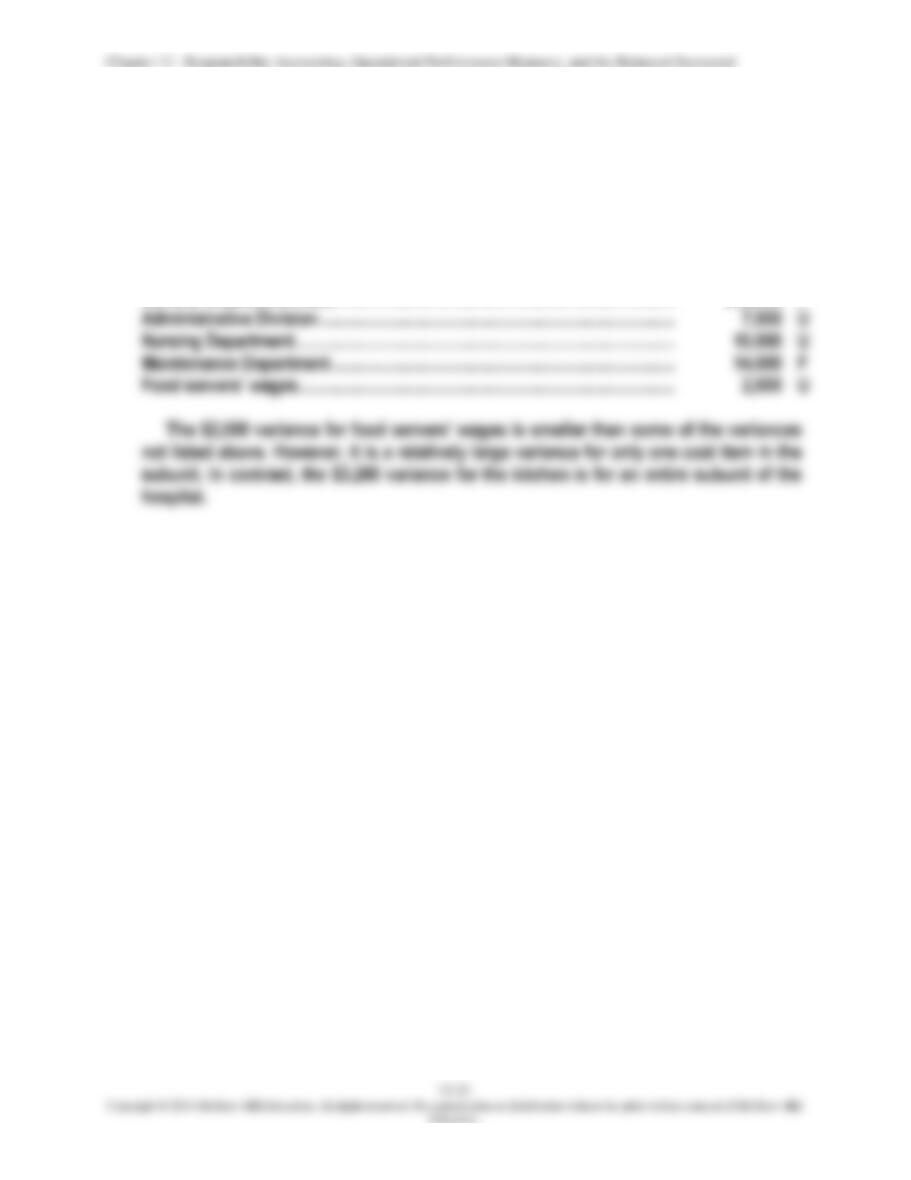
report are the most likely to warrant an investigation. The following variances for
August would likely catch the attention of the hospital administrator:
General Medicine Division ………………………………………………………………..
$12,000
F
Administrative Division …………………………………………………………………….
U
Nursing Department ………………………………………………………………………….
U
Maintenance Department ………………………………………………………………….
F
Food servers’ wages …………………………………………………………………………
U
hospital.
PROBLEM 12-43 (45 MINUTES)
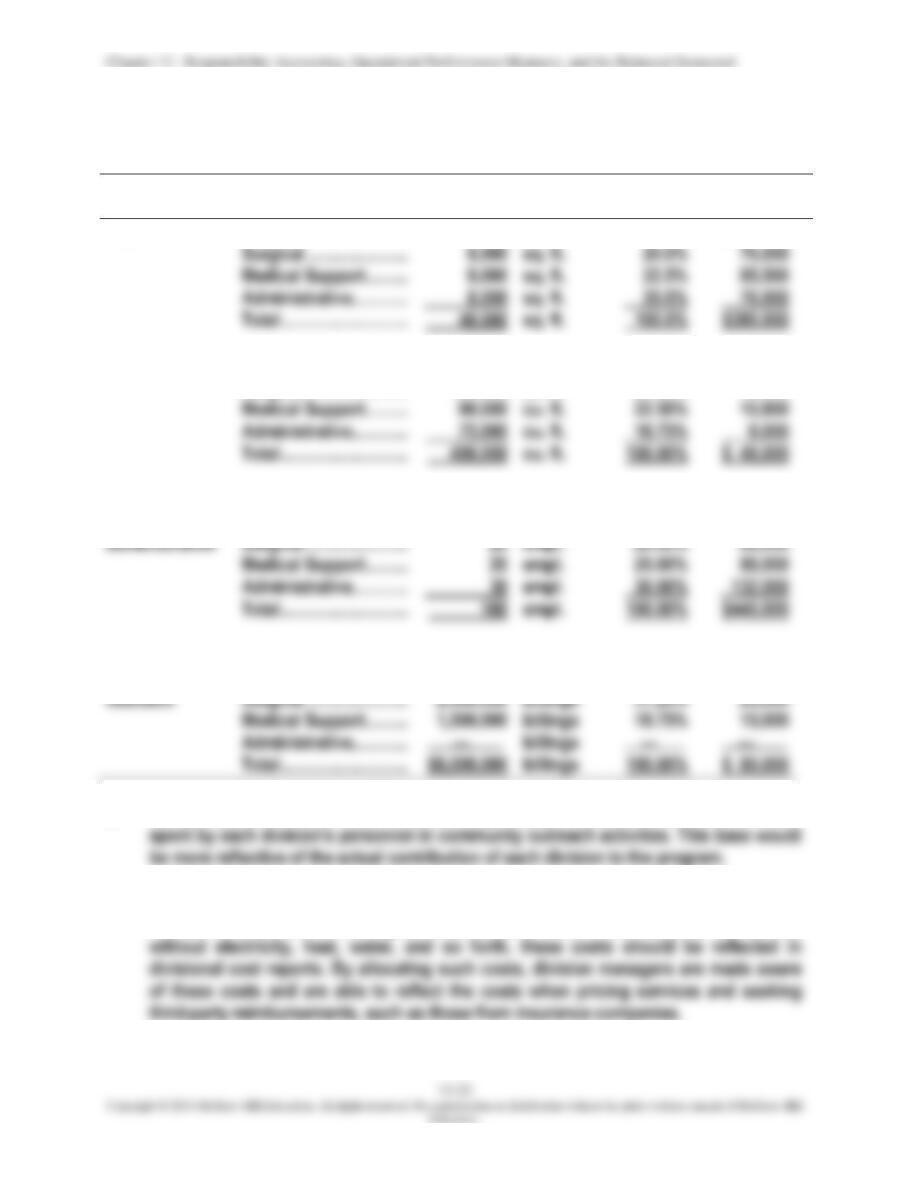
1.
Cost
Pool
Division
Allocation
Base
Percentage
of Total
Costs
Distributed
Facilities
General Medicine ……….
15,000
sq. ft.
37.5%
$142,500
Surgical …………………….
sq. ft.
20.0%
76,000
Medical Support …………
sq. ft.
22.5%
85,500
Administrative ……………
sq. ft.
76,000
Total ………………………….
sq. ft.
$380,000
Utilities
General Medicine ……….
135,000
cu. ft.
33.75%
$ 16,200
Surgical …………………….
100,000
cu. ft.
25.00%
12,000
Medical Support …………
90,000
cu. ft.
22.50%
10,800
Administrative ……………
cu. ft.
9,000
cu. ft.
$ 48,000
General
General Medicine …….
30
empl.
30.00%
$132,000
administration
Surgical …………………….
empl.
20.00%
88,000
Medical Support …………
empl.
20.00%
88,000
Administrative ……………
empl.
Total ………………………….
empl.
$440,000
Community
General Medicine ……….
$4,000,000
billings
50.00%
$ 40,000
outreach
Surgical …………………….
billings
31.25%
25,000
Medical Support …………
billings
18.75%
15,000
Administrative ……………
billings
2.
An alternative allocation base for community outreach costs is the number of hours
3.
The reason for allocating utility costs to the divisions is so that each division’s cost
reflects the total cost of running the division. Since none of the divisions can operate

PROBLEM 12-43 (CONTINUED)
Chapter 12 – Responsibility Accounting, Operational Performance Measures, and the Balanced Scorecard
PROBLEM 12-44 (75 MINUTES)
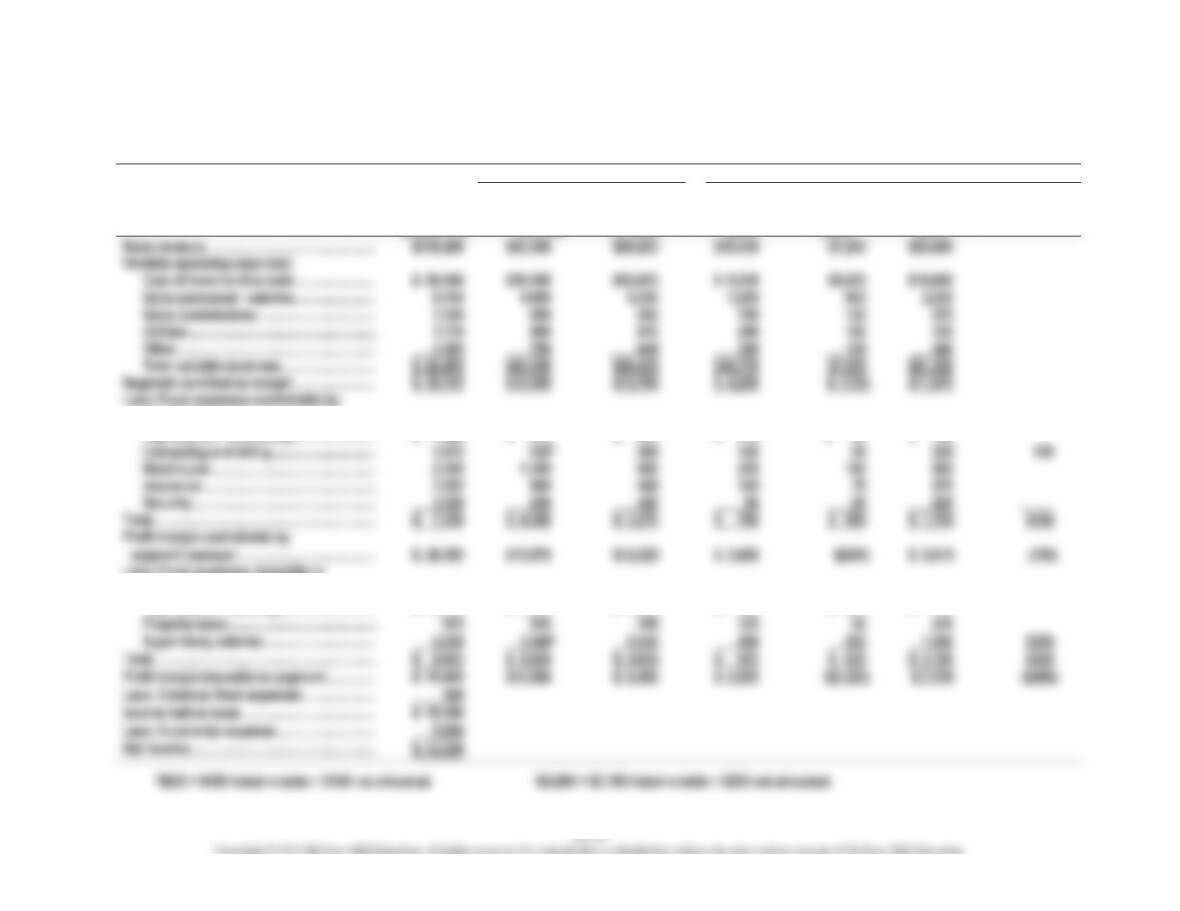
1. SEGMENTED INCOME STATEMENTS: BUCKEYE DEPARTMENT STORES, INC. (IN THOUSANDS)
Segments of Company
Segments of Columbus Division
Buckeye
Department
Stores, Inc.
Cleveland
Division
Columbus
Division
Olentangy
Store
Scioto
Store
Downtown
Store
Not Allocated
Cost of merchandise sold ……………………
$ 69,000
Sales personnel—salaries ……………………
Utilities ……………………………………………….
Other …………………………………………………..
Segment contribution margin ……………………
$ 35,745
$ 4,230
$ (105)
Less: Fixed expenses controllable by
segment manager:
Depreciation—furnishings …………………..
$ 1,680
$ 870
$ 810
$ 240
$ 150
$ 420
Computing and billing …………………………
Insurance ……………………………………………
Security ………………………………………………
Less: Fixed expenses, traceable to
segment, but controllable by others: ……….
Depreciation—buildings ………………………
$ 2,790
$ 1,410
$ 1,380
$ 360
$ 270
$ 750
Property taxes …………………………………….
Supervisory salaries …………………………...
Total …………………………………………………………
$ 8,955
$ 4,920
$ 4,035
$ 915
$ 630
$ 2,190
Profit margin traceable to segment ……………
$ 19,440
$ 8,490
$ 2,535
Less: Common fixed expenses …………………
Income before taxes …………………………………
$ 19,080
Less: Income tax expense …………………………
Chapter 12 – Responsibility Accounting, Operational Performance Measures, and the Balanced Scorecard
PROBLEM 12-44 (CONTINUED)
2.
The segmented income statement would help the president of Buckeye Department
PROBLEM 12-45 (30 MINUTES)
Responsibility-accounting system:
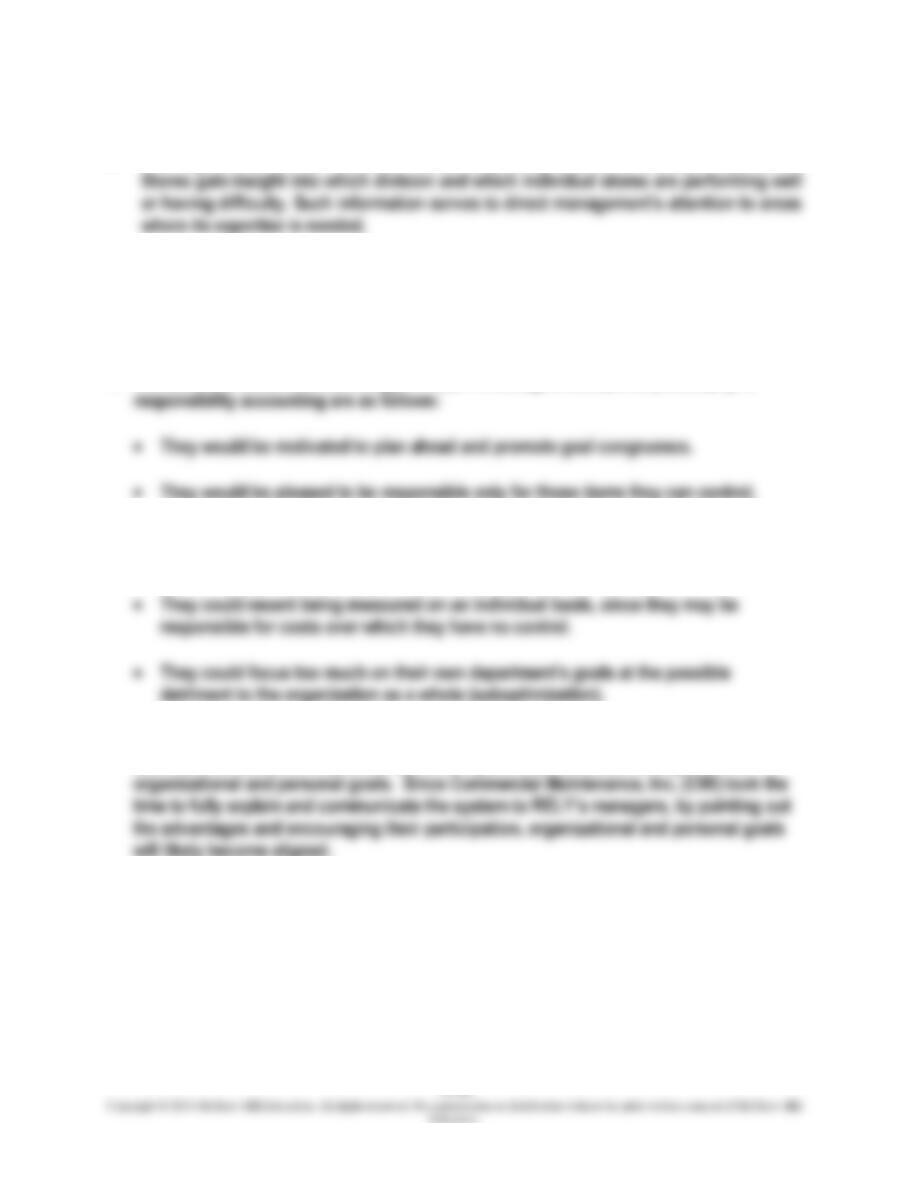
1. Two potential behavioral advantages if RELY’s managers accept the philosophy of
2. Two potential problems that could arise if the managers do not accept the change in
philosophy are as follows:
3. If the managers support the new system, and most of the disadvantages pointed out
above are avoided, the responsibility-center system will enhance the alignment of
PROBLEM 12-45 (CONTINUED)
Participatory budgeting system:
1. Two potential behavioral benefits are the following:
• RELY’s managers are likely to accept the system and be motivated to attain the
2. Two potential problems that could arise are as follows:
• The managers could be motivated to “pad” their budgets, putting slack in the plan to
3. Participatory budgeting can contribute to an organization’s goals by encouraging buy-
PROBLEM 12-46 (35 MINUTES)
1. Segmented income statement:
Piedmont
Novelties
Raleigh
Charlotte
Savannah
Sales revenue……………………………….
$1,998,000
$666,000
$676,500
$655,500
Variable operating expenses:
Cost of goods sold……………………
$1,057,500
$305,250
$338,250
$414,000
Sales commissions……………………
Segment contribution margin…………….
$ 820,620
$320,790
$297,660
$202,170
Less: Fixed expenses controllable by
segment manager:
Local advertising………………………
$ 121,500
$ 16,500
$ 33,000
$ 72,000
Sales manager salary…………………
48,000
—-
48,000
$ 169,500
$ 16,500
$ 33,000
$120,000
Profit margin controllable by segment
Less: Fixed expenses traceable to
segment, but controllable by
others:
Local property taxes…………………..
$ 18,750
$ 6,750
$ 3,000
$ 9,000
Store manager salaries……………….
162,000
46,500
58,500
57,000
$ 223,050
$ 61,950
$ 68,400
$ 92,700
Less: Common fixed expenses………….
Net income……………………………………
$ 139,620
Supporting calculations:
Sales revenue: Raleigh, 37,000 units x $18.00; Charlotte, 41,000 units
PROBLEM 12-46 (CONTINUED)
2. Savannah is the weakest segment because of several factors:
• Despite being the only store that has a sales manager, and spending
3. Piedmont Novelties uses a responsibility accounting system, meaning that managers
and centers are evaluated on the basis of items under their control. Since this is a
PROBLEM 12-47 (45 MINUTES)
Memorandum
Date:
Today
To:
Mathew Basler, President of Ujvari Equipment Company
From:
I. M. Student
Subject:
Ujvari Equipment Company’s critical success factors are as follows:
1.
Cost-efficient production: The firm must meet the market price, which implies
producing in a cost-efficient manner.
Responsibility-Accounting System
2.
High product quality: Stated by the company president as necessary for success.
3.
On-time delivery: Also noted by the company president as critical to the firm’s
success.
Note that the product price is not a critical success factor, since it is largely beyond the
company’s control. The price is determined by the market.
The sales districts should be revenue centers, in which the sales district managers are
Chapter 12 – Responsibility Accounting, Operational Performance Measures, and the Balanced Scorecard
PROBLEM 12-47 (CONTINUED)
In conclusion, I recommend that the plants be designated as profit centers and the
If the plants are profit centers, then each plant manager is encouraged to consider both
the costs and the benefits of a rush order. The cost is increased production cost, and the
PROBLEM 12-48 (45 MINUTES)
1.
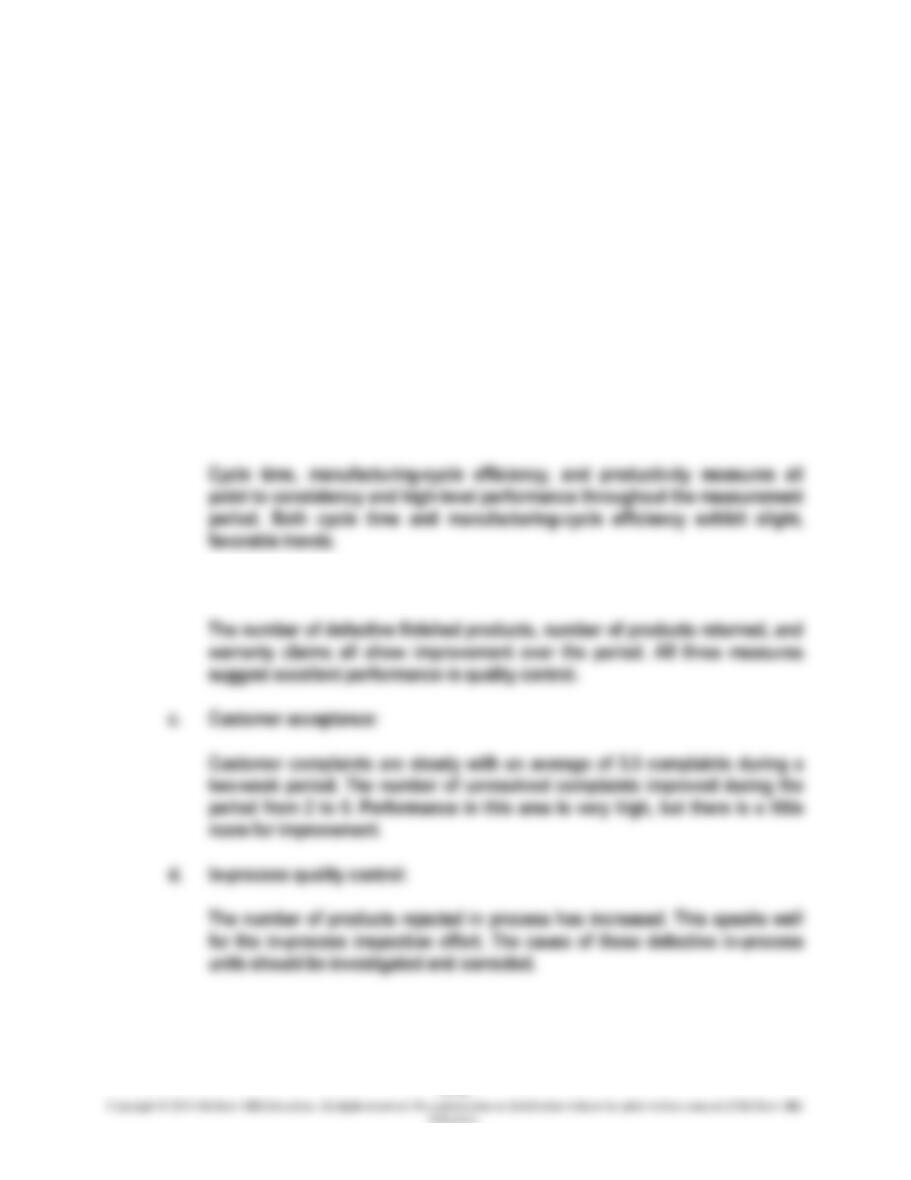
Categories of measures:
Area of Production
Performance
Cycle time (days) ………………………………………………………………
a
Number of defective finished products ………………………………
b
Manufacturing-cycle efficiency ………………………………………….
a
Customer complaints ………………………………………………………..
b,c
Unresolved complaints ……………………………………………………..
c
Products returned …………………………………………………………….
b,c
Warranty claims ……………………………………………………………….
b,c
In-process products rejected …………………………………………….
d
Aggregate productivity ……………………………………………………..
a,e
Number of units produced per day per employee ……………….
a,e
Percentage of on-time deliveries ……………………………………….
Percentage of orders filled ………………………………………………..
Inventory value/sales revenue …………………………………………..
g,h
Machine downtime (minutes) …………………………………………….
Bottleneck machine downtime (minutes) …………………………...
Overtime (minutes) per employee ………………………………………
a,e
Average setup time (minutes) ……………………………………………
a
Chapter 12 – Responsibility Accounting, Operational Performance Measures, and the Balanced Scorecard
PROBLEM 12-48 (CONTINUED)
2.
Memorandum
Date:
Today
To:
Management, Diagnostic Technology, Inc.
From:
I. M. Student
Subject:
Performance of Albany plant during 1st quarter
The performance of the Albany plant is evaluated in nine key areas:
a.
Production processing:
b.
Product quality:
c.
Customer acceptance:
d.
Chapter 12 – Responsibility Accounting, Operational Performance Measures, and the Balanced Scorecard
PROBLEM 12-48 (CONTINUED)
e.
Productivity:
f.
Delivery performance:
Raw material and scrap; inventory:
Machine maintenance:
Overall evaluation:
PROBLEM 12-49 (40 MINUTES)
Memorandum
Date:
Today
To:
President, Southern Plastics Corporation
From:
I. M. Student
Subject:
Performance of Baton Rouge Plant
1.
The Baton Rouge Plant’s performance for the period January through June is
summarized as follows:
a.
Production processing and productivity:
demand late in the period. Power consumption has remained stable.
The plant’s cycle time (or throughput time) has improved over the period
from 19 hours to 16 hours (average of 17.8 hours). This indicates that the
b.
Product quality and customer acceptance:
c.
Delivery performance:
Chapter 12 – Responsibility Accounting, Operational Performance Measures, and the Balanced Scorecard
PROBLEM 12-49 (CONTINUED)
d.
Raw material, scrap and inventory:
e.
Machine maintenance:
2.
Recommended actions:
a.
Investigate the reasons behind the decline in manufacturing-cycle