12-1
CHAPTER 12
Statement of Cash Flows
Learning Objectives
1. Indicate the usefulness of the statement of cash flows.
2. Distinguish among operating, investing, and financing activities.
3. Explain the impact of the product life cycle on a company’s cash flows.
12-2
Chapter Outline
Learning Objective 1 – Indicate the Usefulness of the Statement of Cash Flows
The Statement of Cash Flows: Usefulness and Format—The statement of cash
flows reports the cash receipts and cash payments from the operating, investing,
and financing activities during a period, in a format that reconciles the beginning and
ending cash balances.
▪ The information in a statement of cash flows helps investors, creditors, and
others assess:
o The company’s ability to generate future cash flows. By examining
relationships between items in the statement of cash flows, investors make
predictions of the amounts, timing, and uncertainty of future cash flows.
TEACHING TIP
Use Illustration 1-10 in Chapter 1 to provide an introduction for class discussion on the how
the Statement of Cash Flows is interrelated with the other financial statements. Ask students
why they believe the Statement of Cash Flows is so important.
Learning Objective 2 – Distinguish Among Operating, Investing, and Financing
Activities
Classification of Cash Flows—The statement of cash flows classifies cash
receipts and cash payments as operating, investing, and financing activities.
Transactions within each activity are as follows:
12-3
o The operating activities category is the most important category because it shows
the cash provided by company operations.
▪ Cash provided by operations is generally considered to be the best measure of
whether a company can generate sufficient cash to continue as a going concern.
▪ Types of Cash Inflows and Outflows
o Operating activities – income statement items
• Cash inflows:
❖ From sale of goods or services.
❖ From interest and dividends received.
• Cash outflows:
o Investing activities – changes in investments and long-term assets
• Cash inflows:
❖ From sale of property, plant, and equipment.
❖ From sale of investments in debt or equity securities of other entities.
o Financing activities – changes in long-term liabilities and stockholders’ equity
• Cash inflows:
❖ From sale of common stock.
❖ From issuance of debt (bonds and notes).
• Cash outflows:
▪ As a general rule:
o Operating activities involve income statement items.
o Investing activities involve cash flows resulting from changes in investments and
▪ Some cash flows relating to investing or financing activities are classified as
operating activities because these items are reported in the income statement.
12-4
Significant NonCash Activities—Not all of a company’s significant activities
involve cash. Examples of significant noncash activities are:
▪ Direct issuance of common stock to purchase assets.
▪ Conversion of bonds into common stock.
▪ Direct issuance of debt to purchase assets.
▪ Exchanges of plant assets.
o Significant financing and investing activities that do not affect cash are
not reported in the body of the statement of cash flows. Rather, they are
Format Of The Statement of Cash Flows—The three activities—operating,
investing, and financing—plus the significant noncash investing and financing
activities make up the general format of the statement of cash flows.
▪ The section of cash flows from operating activities always appears first, followed
by the investing activities and the financing activities sections.
Learning Objective 3 – Explain the Impact of the Product Life Cycle on a
Company’s Cash Flows
The Corporate Life Cycle—All products go through a series of phases called the
product
life cycle.
▪ The phases (in order of their occurrence) are the introductory phase, growth
phase, maturity phase, and decline phase.
▪ The phase a company is in affects its cash flows.
o The introductory phase occurs at the beginning of a company’s life, when it is
purchasing fixed assets and beginning to produce and sell products.
• When a company is in the introductory stage, one would expect that the
company will not be generating positive cash from operations.
• It will be spending considerable amounts to purchase productive assets such
o During the growth phase, the company is striving to expand its production and
sales.
• When a company is in the growth phase, one would expect to see the
company start to generate small amounts of cash from operations.
12-5
o In the maturity phase, sales and production level off.
• Cash from operations and net income are approximately the same.
• Cash generated from operations exceeds investing needs.
• In the maturity phase, the company can actually start to pay dividends, retire
debt or buy back stock.
o During the decline phase, sales of the product fall due to a weakening in
consumer demand.
• During this phase, cash from operations decreases.
Preparing the Statement of Cash Flows—The statement of cash flows is prepared
differently from the other basic financial statements.
▪ It is not prepared from an adjusted trial balance.
▪ The statement of cash flows deals with cash receipts and payments, so adjustments
must be made to accrual accounting to determine cash flows.
▪ The information to prepare the statement of cash flows usually comes from three
sources:
o Information in the comparative balance sheets indicates the amount of the
Indirect And Direct Methods—Preparing the statement of cash flows involves three
major
steps:
▪ Step 1 – Determine net cash provided/used by operating activities by converting net
income from an accrual basis to a cash basis.
12-6
▪ This conversion may be done by either of two methods: the indirect method or direct
method.
o Both methods arrive at the same total amount for “Net cash provided by
operating activities.”
o They differ in disclosing the items that make up the total amount. Note that the two
o The indirect method is used extensively in practice. Companies favor the indirect
method for two reasons:
• It is easier and less costly to prepare.
Learning Objective 4 – Prepare a Statement of Cash Flows Using the Indirect
Method
Preparation of the Statement of Cash Flows—Indirect Method—The financial
information from Computer Services is used to explain the preparation of a statement of
cash flows using the indirect method. The three steps are applied to these statements:
▪ Step 1: Operating Activities—Determine net cash provided/used by operating
activities by converting net income from an accrual basis to a cash basis.
o To determine net cash provided by operating activities under the indirect
method, companies adjust net income in numerous ways. A useful starting
point is to understand why net income must be converted to net cash
provided by operating activities.
▪ Therefore, under the indirect method, companies must adjust net income to convert
certain items to the cash basis. The indirect method (or reconciliation method) starts
with net income and converts it to net cash provided by operating activities, by
applying three types of adjustments.
1. Add back (to net income) noncash expenses, such as depreciation expense,
amortization, or depletion.
12-7
2. Deduct gains and add losses that resulted from investing and financing activities.
o Cash received from the sale of plant assets is reported in the investing
activities section, thus the related gain or loss must be eliminated from net
3. Analyze changes to noncash current asset and current liability accounts.
o A final adjustment in reconciling net income to net cash provided by
operating activities involves examining all changes in current asset and
current liability accounts.
o The accrual-accounting process records revenues in the period earned
and expenses in the period incurred. As a result, companies need to
adjust net income for these accruals and prepayments to determine net
TEACHING TIP
Students must understand why an increase in accounts receivable is deducted from net
income under operating activities. Remember that students are going to want to memorize
this. Require students to assume that they are the owners of a small retail business that
grants credit. At the beginning of the year the Accounts Receivable account had a zero
balance. At the end of the year, sales total $50,000 and the balance in Accounts Receivable
is $10,000. How much cash must they have received from the sale of merchandise?
o Add to net income increases in current liability accounts, and deduct from
net income decreases in current liability accounts, to arrive at net cash
provided by operating activities. For example,
12-8
TEACHING TIP
Again have students assume they own a small retail business. At the beginning of the period
the balance in Accounts Payable was zero. At the end of the period, the balance in the
account was $2,000. What does this mean? Assuming you purchased $10,000 worth of
merchandise for resale, you have paid cash for only $8,000 of that merchandise. The other
$2,000 should be added to net income to get back to cash basis income and cash provided
from operations.
▪ Summary Of Conversion To Net Cash Provided By Operating Activities –
Indirect Method.—There are three types of required adjustments:
o Noncash charges such as depreciation, amortization, and depletion.
▪ Step 2: Investing and Financing Activities—Analyze changes in noncurrent
▪ Step 3: Net Change in Cash—Compare the net change in cash on the
TEACHING TIP
Walk through the Statement of Cash Flows—Indirect Method for the year ended December
31, 2012 that is shown in Illustration 12-14 in the text.
12-9
Learning Objective 5 – Use the Statement of Cash Flows to Evaluate a
Company
o Using Cash Flows to Evaluate a Company—Traditionally, the ratios most
commonly used by investors and creditors have been based on accrual accounting.
Cash-based ratios are gaining increased acceptance among analysts. These
measures include:
▪ Free Cash Flow—In the statement of cash flows, cash from operations is intended
to indicate the cash-generating capability of the company.
TEACHING TIP
Walk through the Apple, Inc. example given in the text (Illustrations 12-16 and
12-17). Ask students if they believe more dividends should have been paid to stockholders,
given the large amount of free cash.
o Assessing Liquidity and Solvency Using Cash Flows—Previous chapters
have presented ratios used to analyze a company’s liquidity and solvency using
accrual-based numbers from the income statement and balance sheet.
▪ This chapter introduces ratios that are cash-based rather than accrual-based.
o Rather than using numbers from the income statement, these ratios use numbers
from the statement of cash flows.
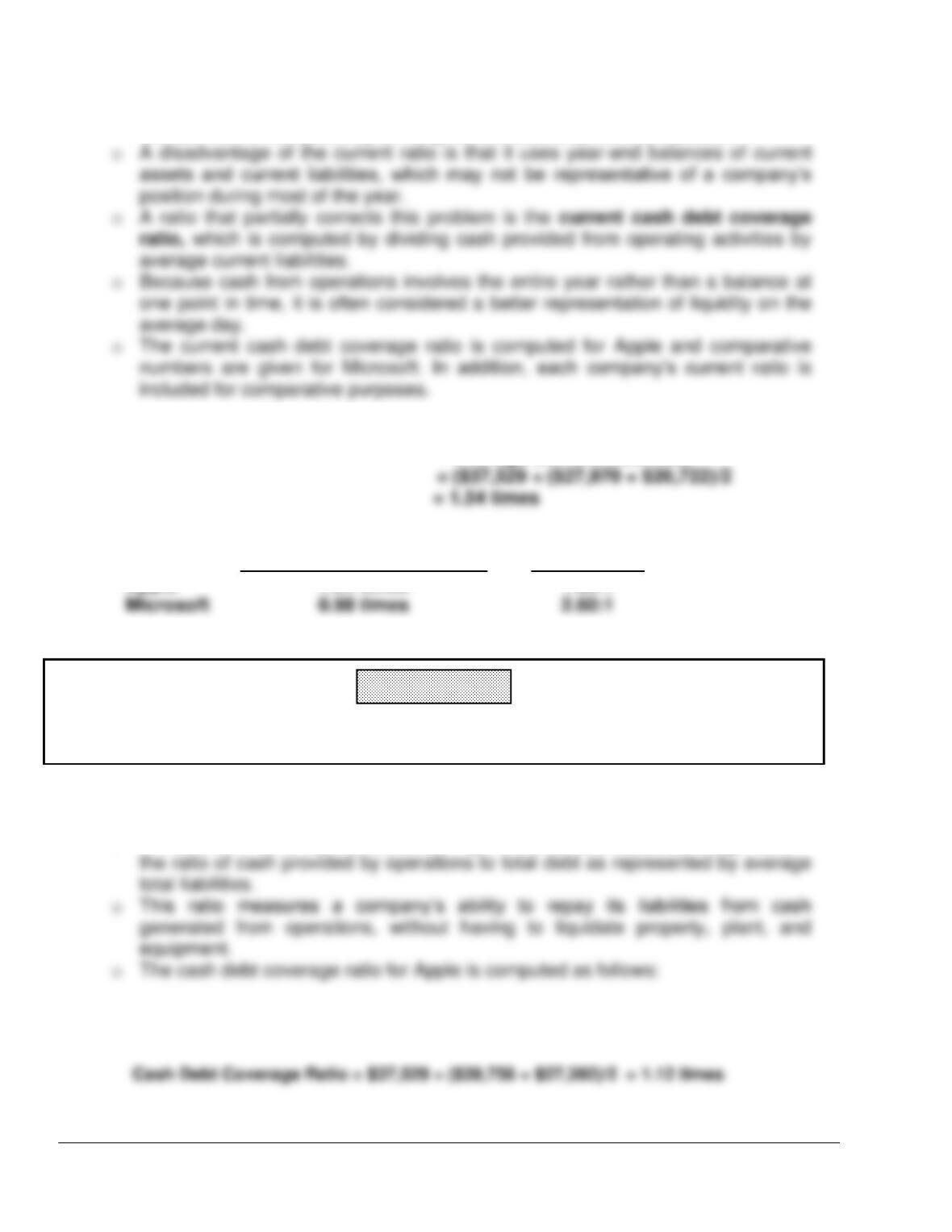
o In computing cash flow-based ratios to analyze Apple, the following information is
needed in addition to the cash flow information provided in Illustration 12-16 of
the text:
($ in millions) 2011 2010
12–10
▪ Liquidity is the ability to pay obligations expected to become due within the next
year.
o Earlier (Chapter 2), we learned that one measure of liquidity is the current ratio.
Current ratio is computed by dividing current assets by current liabilities.
Current Cash Debt Coverage Ratio = Cash Provided by Operations
Average Current Liabilities
Current cash coverage ratio Current ratio
Apple 1.54 times 1.60:1
TEACHING TIP
Explain what these ratios mean with respect to Apple and Microsoft being able to pay their
bills. Why does Microsoft have such a high current ratio?
▪ Solvency is the ability of a firm to survive over the long term.
o One measure of solvency is the debt to total assets ratio.
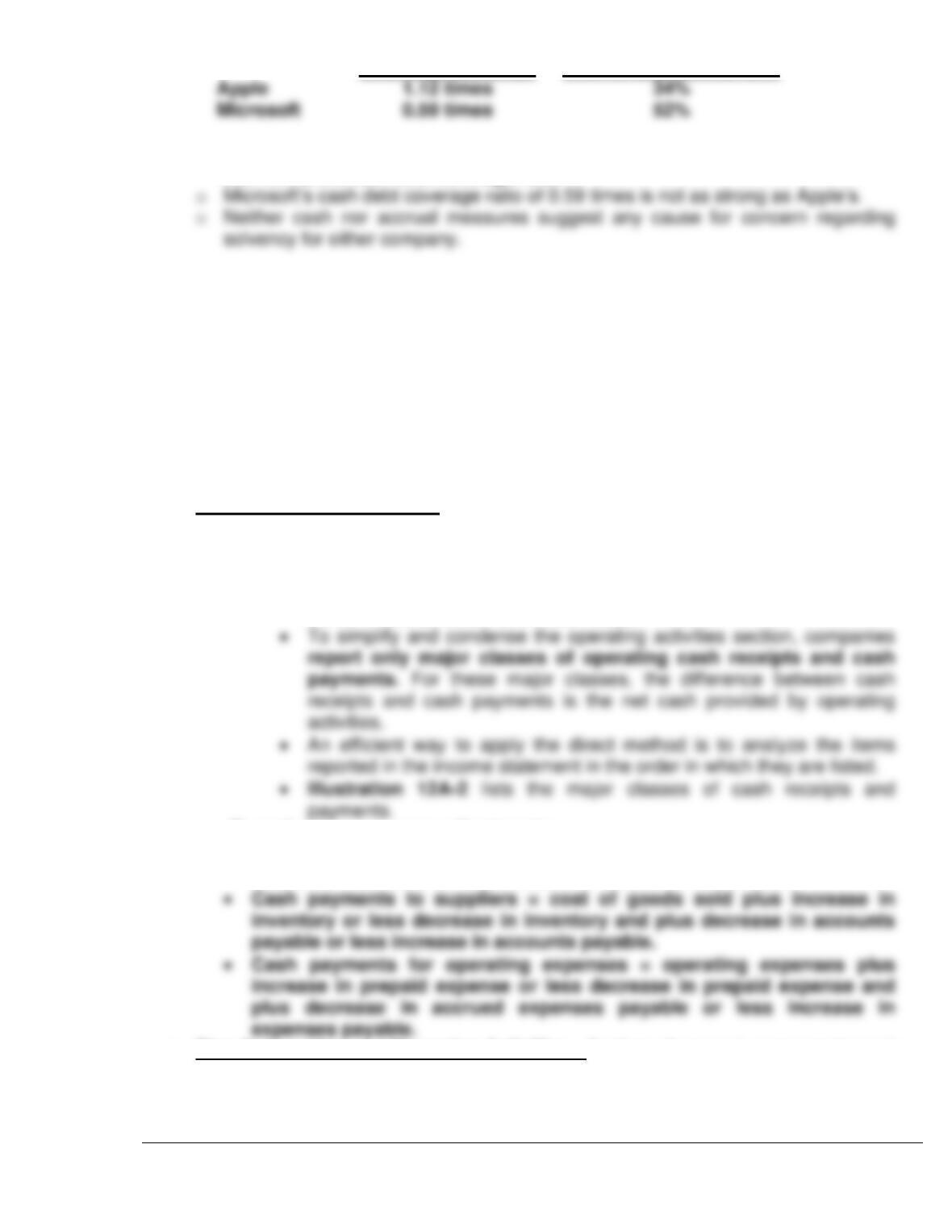
o A measure of solvency that uses cash figures is the cash debt coverage ratio—
Cash Debt Coverage Ratio = Cash Provided by Operations Average Total
Liabilities
12–11
Cash debt coverage Debt to total assets ratio
o Because Apple has long-term obligations, its cash debt coverage ratio is lower
than its current cash debt coverage ratio.
Learning Objective 6 – Appendix – Prepare a Statement of Cash Flows
Using the
Direct Method
Statement of Cash Flows—Direct Method—The transactions of Computer Services
Company for 2014 will be used to prepare a statement of cash flows using the
direct method.
▪ Step 1: Operating Activities
o Determine net cash provided/used by operating activities by converting net
income from an accrual basis to a cash basis.
• Under the direct method, companies compute net cash provided by
operating activities by adjusting each item in the income statement
from the accrual basis to the cash basis.
o To make the necessary adjustments:
• Cash receipts from customers = Revenues from sales plus decrease in
accounts receivable or less increase in accounts receivable.
▪ Step 2: Investing and Financing Activities—Analyze changes in noncurrent asset
and liability accounts and record as investing and financing activities, or disclose as
noncash transactions.
12–12
▪ Step 3: Net Change in Cash—Compare the net change in cash on the statement of
cash flows with the change in the cash account reported on the balance sheet to
Learning Objective – 7 – Use the T-Account Approach to prepare a
statement of cash flows.
To use T-accounts to prepare the statement of cash flows:
(1) prepare a large Cash T-account with sec-tions for operating, investing, and financing
activities;
Learning Objective – 8 – Discuss the accounting procedure for the
statement of cash flows under GAAP and
IFRS.
A Look at IFRS—As in GAAP, the statement of cash flows is a
required statement for IFRS. In addition, the content and
KEY POINTS
▪ Companies preparing financial statements under IFRS must prepare a statement
of cash flows as an integral part of the financial statements.
▪ Both IFRS and GAAP require that the statement of cash flows should have three
12–13
▪ IFRS requires that noncash investing and financing activities be excluded from
the statement of cash flows. Instead, these noncash activities should be reported
elsewhere. This requirement is interpreted to mean that noncash investing and
financing activities should be disclosed in the notes to the financial statements
Item
IFRS
GAAP
Interest paid
Operating or financing
Operating
Interest received
Operating or investing
Operating
Dividends paid
Operating or financing
Financing
Taxes paid
Operating
▪ Under IFRS, some companies present the operating section in a single line item
with a full reconciliation provided in the notes to the financial statements. This
presentation is not seen under GAAP. Similar to GAAP, under IFRS companies
must disclose the amount of taxes and interest paid. Under GAAP, companies
LOOKING TO THE FUTURE
Presently, the FASB and the IASB are involved in a joint project on the presentation and
organization of information in the financial statements. One interesting approach, revealed
in a published proposal from that project, is that in the future the income statement and
balance sheet would adopt headings similar to those of the statement of cash flows. That