
Auditing: A Risk Based Approach to Conducting a Quality Audit, 10e
Solutions for Chapter 12
True/False Questions
12-2 T
12-4 T
12-6 T
12-8 F
12-10 F
12-12 F
12-14 T
12-16 T
Multiple-Choice Questions
12-18 A
12-20 A
12-22 D
12-24 C
12-26 D
12-28 A
12-30 C
12-32 B
12-2
Review and Short Case Questions
12-33
The existence and valuation assertions related to long-lived assets are usually the more relevant
assertions. Organizations may have incentives to overstate their long-lived assets and may do so
by including fictitious long-lived assets on the financial statements. Alternatively, organizations
12-34
Depreciation expense relates to the expensing of a fixed asset over its life. For natural resources,
12-35
The five management assertions relevant to long-lived assets are as follows:
2. Completeness. Long-lived asset account balances include all relevant transactions that
have taken place during the period.
4. Valuation or allocation. The recorded balances reflect the balance that is in accordance
with GAAP (includes appropriate cost allocations and impairments).
5. Presentation and disclosure. The long-lived asset balance is reflected on the balance sheet
12-36
Asset impairment is a term used to describe management’s recognition that a fixed asset is no
longer as productive as had originally been expected. When assets are impaired, the assets should
be written down to their expected economic value.
Much of the inherent risk associated with long-lived assets is due to the importance of
management estimates, such as estimating useful lives and residual values and determining
12-37
Natural resources present unique risks. First, it is often difficult to identify the costs associated
12-38
Intangible assets should be recorded at cost. However, the determination of cost for intangible
12-39
a. Management’s motivation to overstate fixed assets is similar to other circumstances in
which fraud is perpetrated:
• Increase reported earnings
• Boost stock price
b. The auditor should also consider the other two components of the fraud triangle–
opportunity and rationalization–when assessing fraud risk associated with long-lived assets.
12-4
12-40
A skeptical auditor will understand that management can manage earnings in a number of ways,
including:
• Improperly recording repairs and maintenance costs that should be expensed as fixed
assets.
12-41
Potential fraud schemes related to long-lived assets include:
• Sales of assets are not recorded and proceeds are misappropriated.
• Assets that have been sold are not removed from the books.
• Inappropriate residual values or lives are assigned to the assets, resulting in
12-42
Typically, the more relevant assertions (areas of higher risk) for tangible long-lived assets (e.g.,
property, plant, and equipment) include existence and valuation. For these assertions, the
appropriate internal controls could include:
• The use of a computerized property ledger. The property ledger should uniquely identify
each asset. In addition the property ledger should provide detail on the cost of the
property, the acquisition date, depreciation method used for both book and tax, estimated
12-5
12-43
For intangible assets, the client should have controls designed to:
• Provide reasonable assurance that decisions are appropriately made to capitalize
(completeness of assets) or expense (existence of assets) research and development
expenditures
• Develop amortization schedules that reflect the remaining useful life of intangible assets
12-44
Analytical procedures that would be included as part of planning analytical procedures related to
depreciation expense include analysis of the following relationships, in the light the expectations
developed by the auditor:
• Current depreciation expense as a percentage of the previous year’s depreciation expense,
• Fixed assets (by class) as a percentage of previous year’s assets. The relative increase in
this percentage can be compared with the relative increase in depreciation expense as a
12-45
Ratios and expected relationships that auditors can use when performing planning analytical
procedures include:
• Review and analyze gains/losses on disposals of equipment (gains indicate
depreciation lives are too short, losses indicate the opposite).
• Perform an overall estimate of depreciation expense.
• Compare capital expenditures with the client’s capital budget, with an expectation that
capital expenditures would be in line with the capital budget.
Ratios that the auditor should plan to review, after developing independent expectations, include:
• Ratio of depreciation expense to total depreciable long-lived tangible assets. This ratio
should be predictable and comparable over time unless there is a change in depreciation
12-46
Panel B of Exhibit 12.3 illustrates the different levels of assurance that the auditor could obtain
from tests of controls and substantive procedures. The reason for the differing approaches is due
to the different levels of risk of material misstatement associated with each of the clients. Panel
12-47
For many organizations, long-lived assets involve only a few assets of relatively high value. In
12-7
12-48
Control Procedure
Purpose of Control
Procedure (a)
Impact on Substantive Audit
Procedures (b)
1. Periodic physical
inventory of assets.
reflect equipment on-hand
and in use. Relates to
sample from the property ledger
and verifying existence or take a
both procedures.)
Provide reasonable
assurance that records
Auditor should expand
procedures either by taking a
client. Relates to valuation.
2. Policy to classify
equipment and compute
Provide reasonable
assurance of consistent use
Auditor would have to review
each equipment life for
capitalized.
small dollar value items.
property, plant and equipment
ledger would have substantially
expensed.
3. Policy on minimum
amounts that are to be
Promote processing
efficiency by expensing
There is no particular effect on
the audit except that the
4. Method for designating
scrap or idle equipment for
disposal.
Provide reasonable
assurance that the records
are updated for changes in
Auditor would expand
production facilities tour with
special emphasis on identifying
5. Differentiate major
renovations from repair
Provide reasonable
assurance that the proper
Expand review of repairs and
maintenance expense.
6. Self-construction of
assets.
Provide reasonable
assurance of proper
Perform a detailed review of all
self-constructed assets.
12-8
Control Procedure
Purpose of Control
Procedure (a)
Impact on Substantive Audit
Procedures (b)
accounting for self-
constructed assets.
7. Systematic review for
asset impairment.
issues). Company
performing the review on a
eliminates many of the
“big bath” write-offs.
Auditor would be more alert to
declining productivity indicators
Provide reasonable
assurance of proper
accounting for asset
Auditor would have to review
asset productivity each year and
make inquiries of client of the
lives for depreciation
purposes.
8. Management
periodically reviews
Provide reasonable
assurance of asset
Auditor should review asset
disposals for potential impact on
12-49
Test of controls over tangible long-lived assets could include:
• Examine documentation corroborating that a tangible long-lived asset budget is prepared
and used.
• Examine relevant documentation for management’s approval process of the tangible long-
lived asset budget.
• Examine a sample of tangible long-lived asset requisition forms for management’s
approval.
• Inspect copies of the vouchers used to document departmental request for sale,
12-9
• Check for the existence of a written policy which establishes whether a budget request is
to be considered a capital expenditure or a routine maintenance expenditure.
• Confirm the existence of approved vouchers for entries which remove assets from the
tangible long-lived asset ledger.
prices to determine reasonableness.
• Review tangible long-lived asset budget reports and note management’s explanation of
any significant variances.
• Scan the tangible long-lived asset ledger for unusually large or small items.
• Through review of relevant documentation and inquiry of appropriate personnel
determine that tangible long-lived asset records are maintained by persons other than
those who are responsible for custody and use of the assets.
• Agree the identification numbers of a sample of fixed assets to those shown in the
tangible long-lived asset ledger.
12-50
CONTROL
POSSIBLE TESTS OF CONTROLS
Management authorizations are required for
intangible asset transactions.
For selected intangible asset transactions
inquire of management as to the authorization
process and review documentation of the
appropriate authorizations.
should include:
management estimates
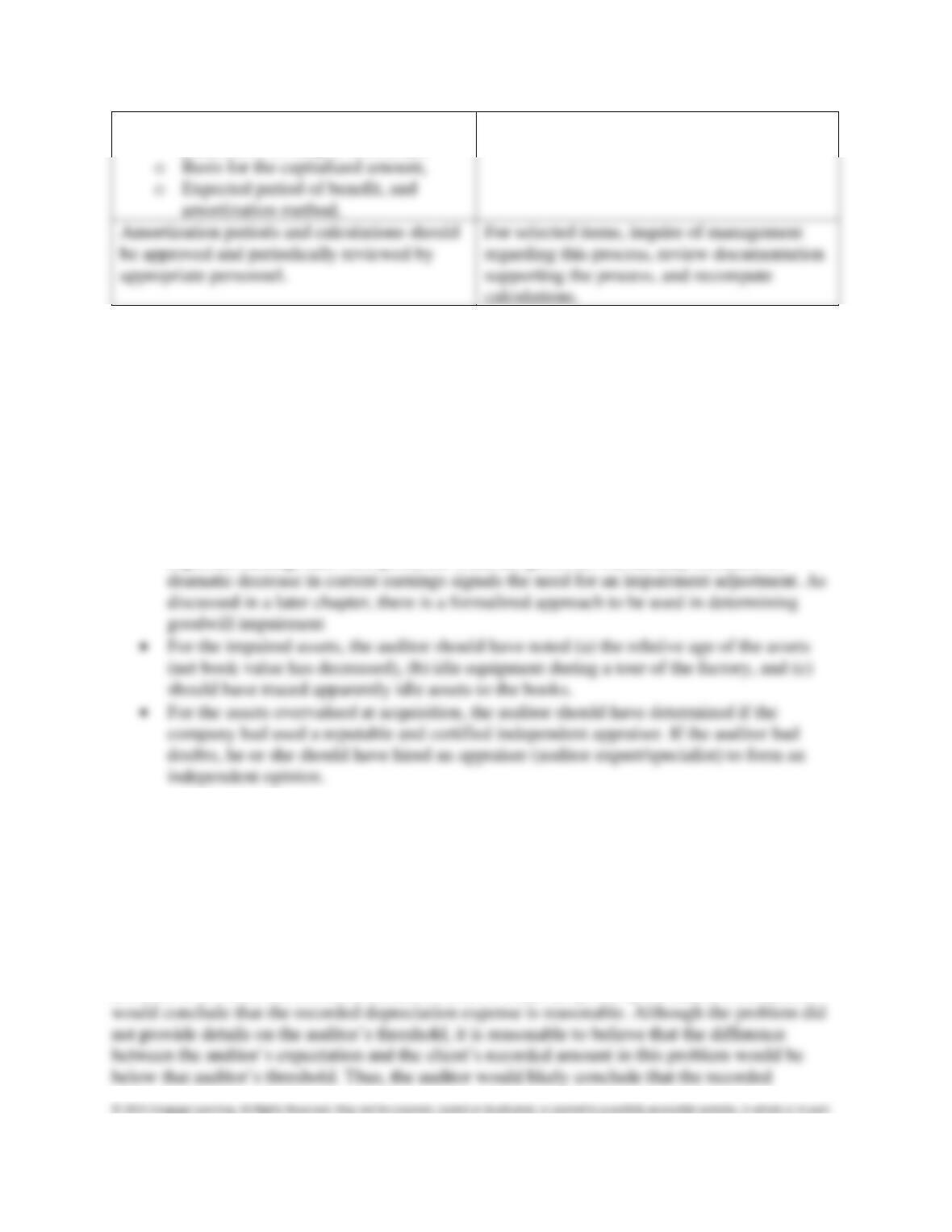
12–10
o Manner of acquisition (e.g.,
purchased, developed internally),
12-51
• To detect fictitious assets, the auditor should have traced recent recorded acquisitions of
long-lived asset accounts to original source documents; doing so would have enabled the
auditor to realize that such documents did not exist.
• For improper depreciation, the auditor should have compared depreciation expense over a
period of time, adjusting for the volume of business and the number of trucks used. The
decrease in depreciation per truck should have led to more detailed investigation,
including tests of depreciation on each truck.
• For the impairment issue, the auditor should have compared current earnings with future
expected earnings that were predicted when the goodwill was initially recorded. A
12-52
Compute the average balance: ($380,500 + $438,900) / 2 = $409,700
Adjust for the salvage value: $409,700 * .9 = $368,730
Compute the annual depreciation expense: $368,730 / 6 = $61,455.
Once the auditor has developed an expectation of the account balance, the auditor will compare
that expectation with the amount recorded by the client. If the difference between the two
amounts is less than the threshold (based on level of materiality) set by the auditor, the auditor
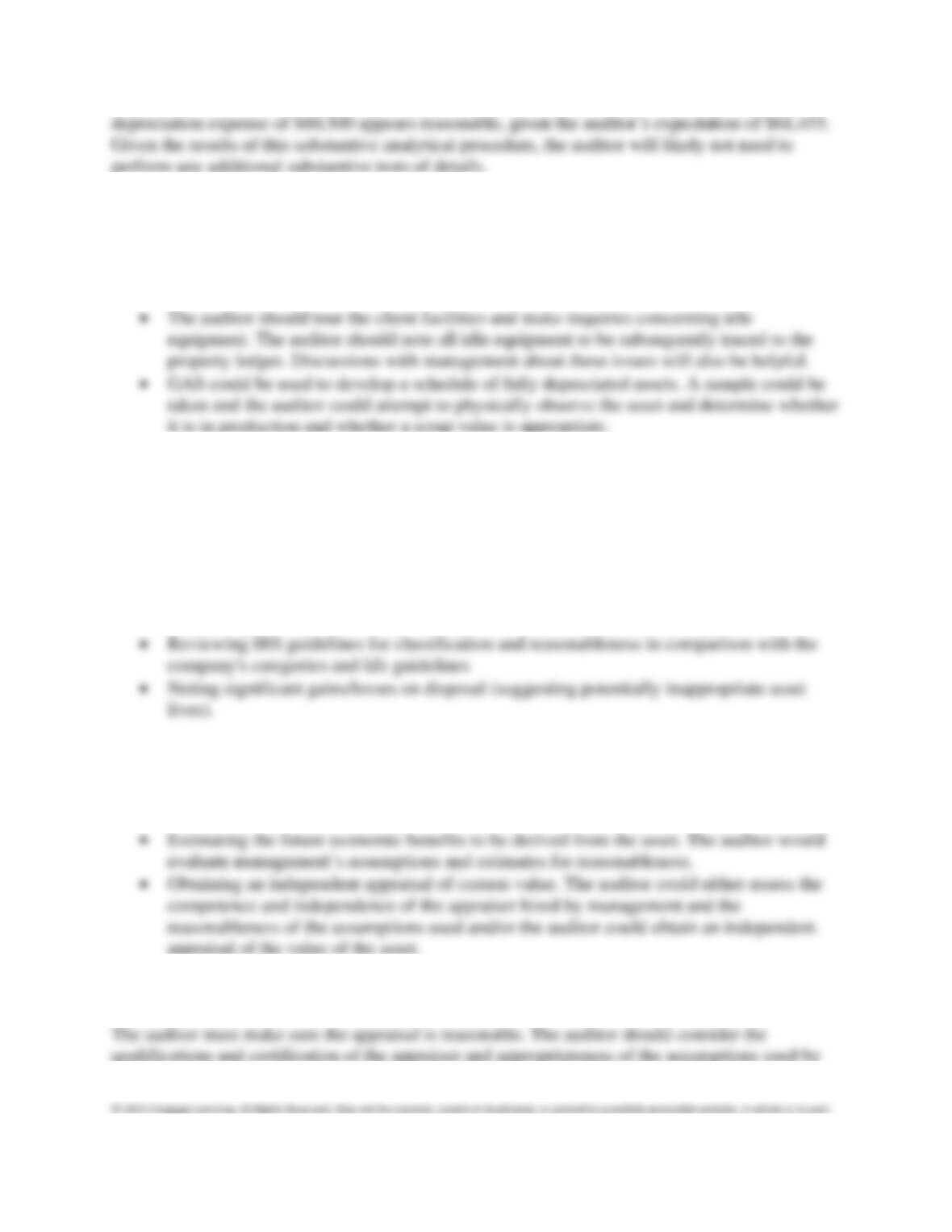
12–11
12-53
The audit approaches applicable to identifying and determining the proper accounting of fully
depreciated or idle facilities would include:
12-54
The client has a policy that apparently has been used for a number of years. Assignment of assets
to classes for depreciation purposes is common and represents an expedient method of dealing
with depreciation issues. The auditor can determine the reasonableness of the classification
schemes by:
• Reviewing previous data on the asset’s productive life (within each category)
12-55
The general concept of valuing impaired assets consists of two major approaches:
12-56
12-57
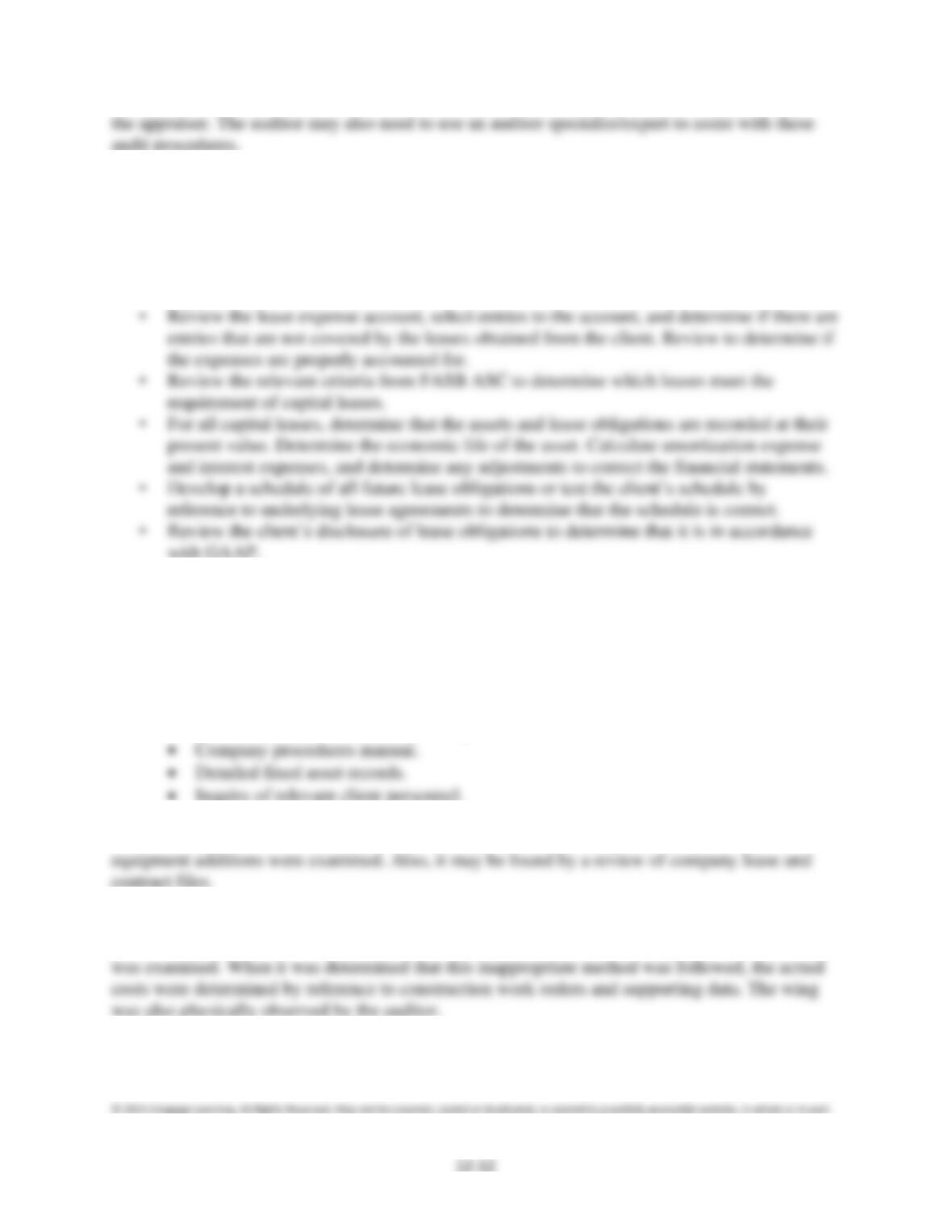
General substantive procedures for leases include:
• Obtain copies of lease agreements, read the agreements, and develop a schedule of lease
expenditures.
12-58
Items 1 through 6 could have been found in the following way:
1. The company’s policies for depreciating equipment are available from several sources:
• The prior-year’s audit working papers and permanent file.
• Footnote disclosure in the annual report and SEC Form 10-K.
2. The ten-year lease contract would be found when supporting data for current year’s
3. The building wing addition would be apparent by the addition to buildings during the
year. The use of the low construction bid amount would be found when support for the addition
4. The paving and fencing was discovered when support was examined for the addition to
land. These costs should be charged to Land Improvements and depreciated.
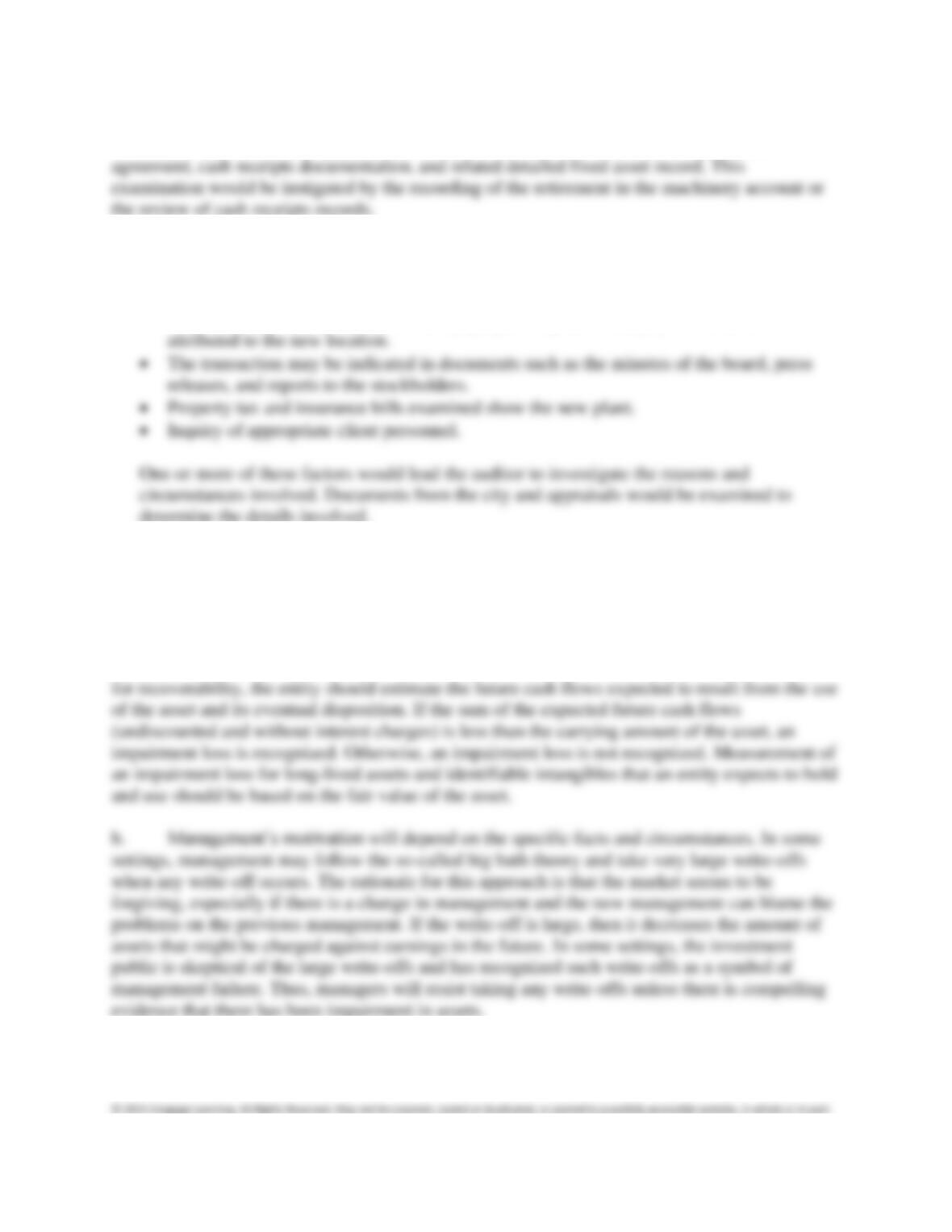
12–13
5. The details of the retirement transactions were determined by examining the sales
6. The auditor would become aware of a new plant in several ways:
• Volume would increase.
• Account details such as cash, inventory, prepaid expenses, and payroll would be
12-59
a. Impairment of assets refers to long-lived tangible assets and certain identifiable
intangibles to be held and used by an entity for which events or changes in circumstances
indicate that the carrying amount of an asset may not be recoverable. In performing the review