12-21
to maintain each year (that is, the number of jobs it can do each year). Software-implementation
support costs do not vary with the actual number of jobs done that year.
Required:
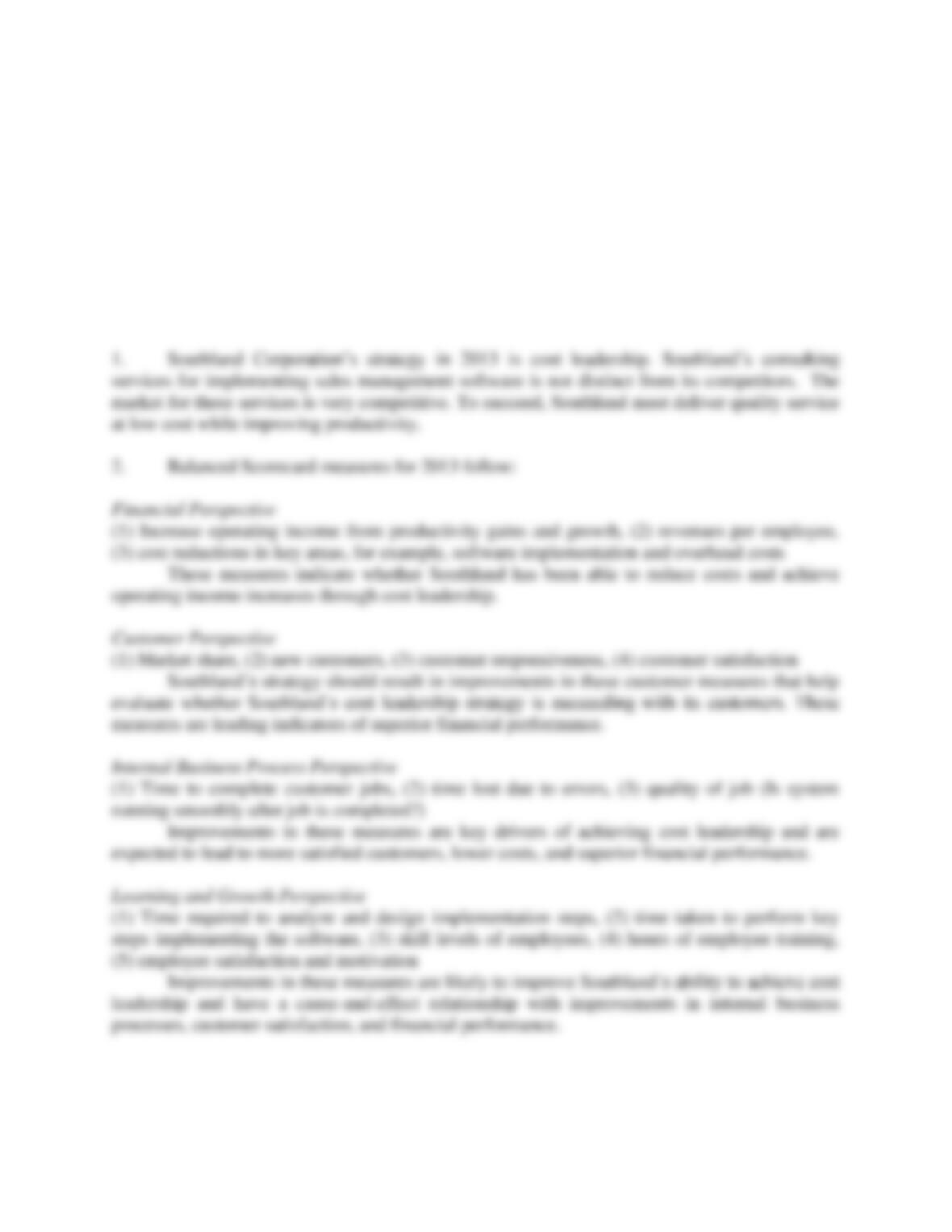
1. Is Southland Corporation’s strategy one of product differentiation or cost leadership? Explain
briefly.
2. Describe key measures you would include in Southland’s balanced scorecard and your
reasons for doing so.
SOLUTION
12-22
12-27 (30 min.) Strategic analysis of operating income (continuation of 12-26).
Refer to Exercise 12-26.
Required:
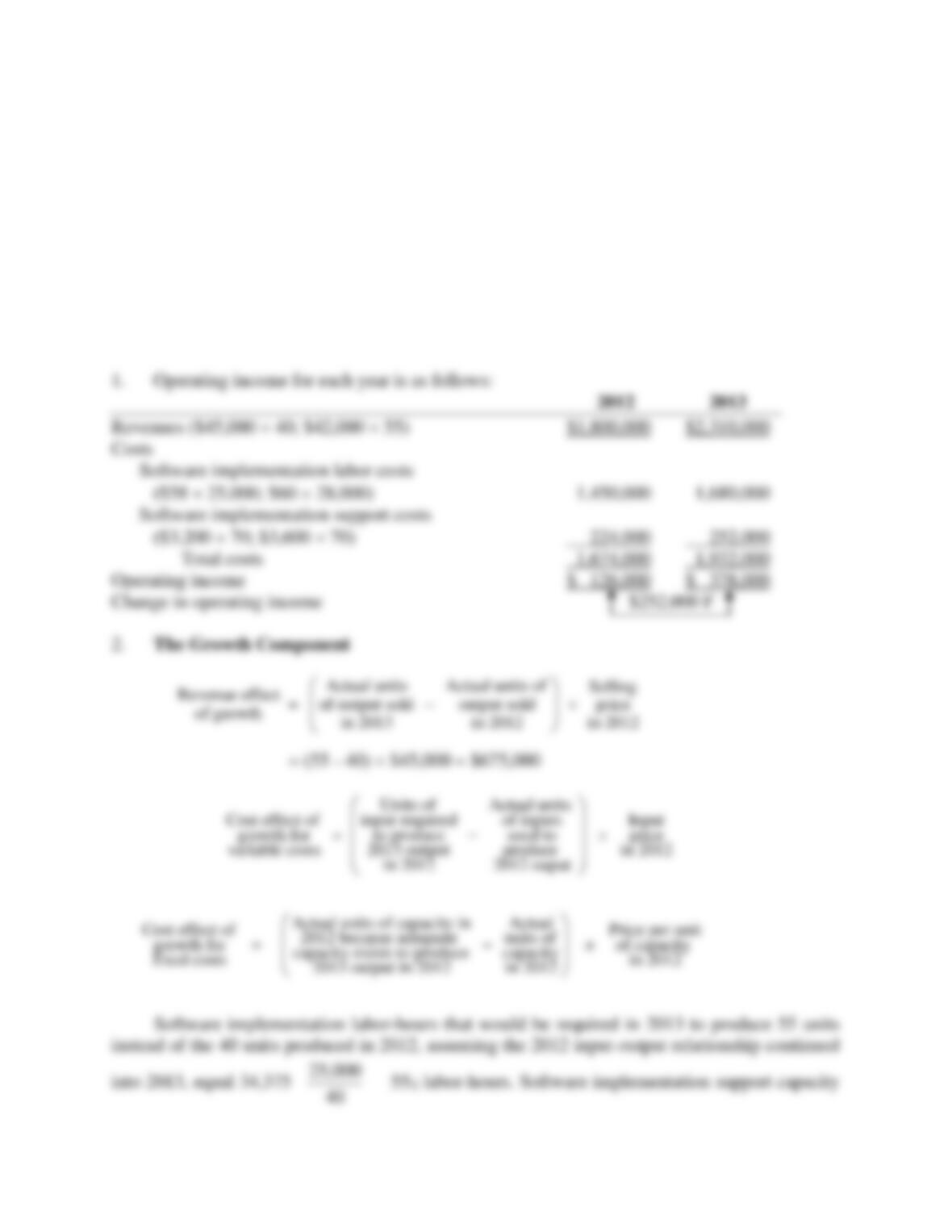
1. Calculate the operating income of Southland Corporation in 2012 and 2013.
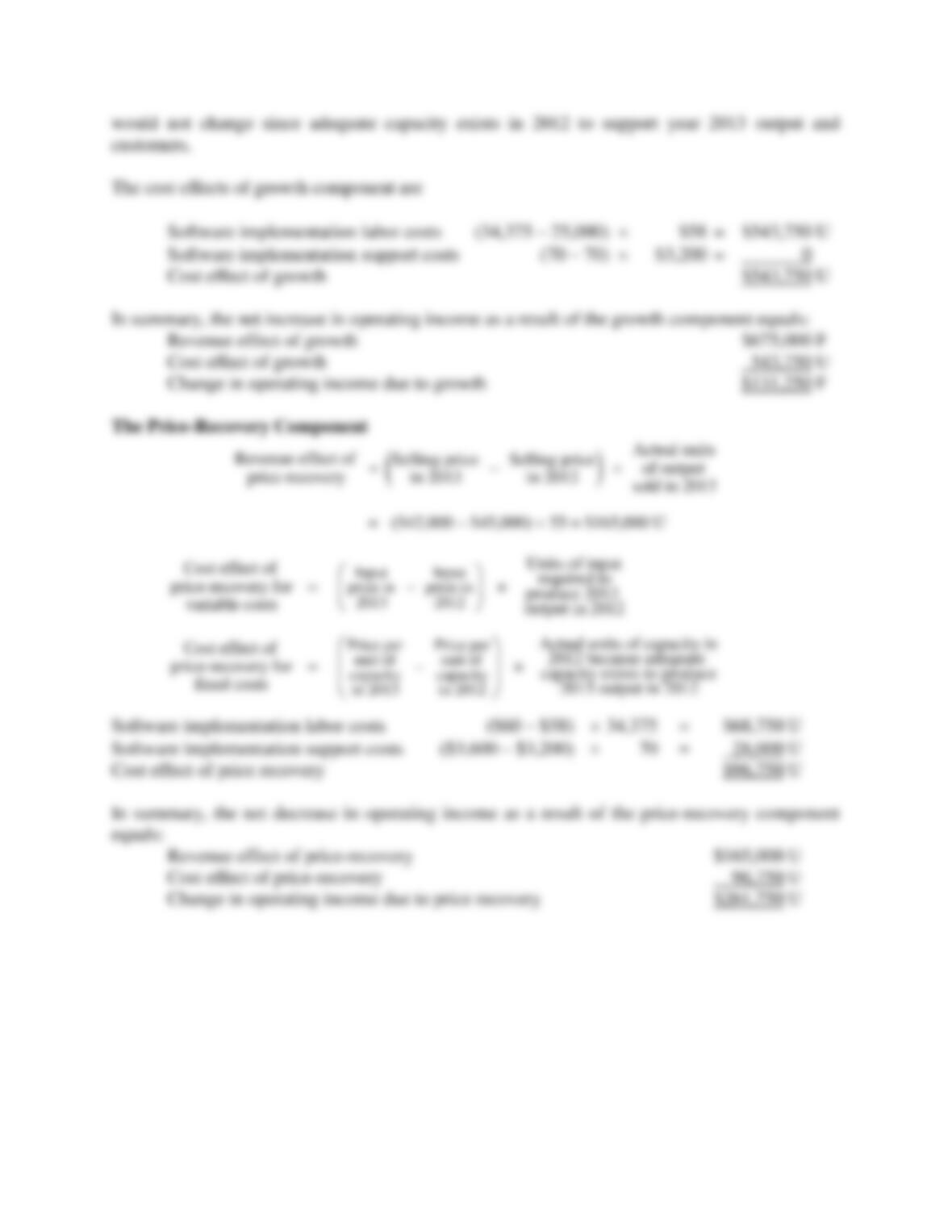
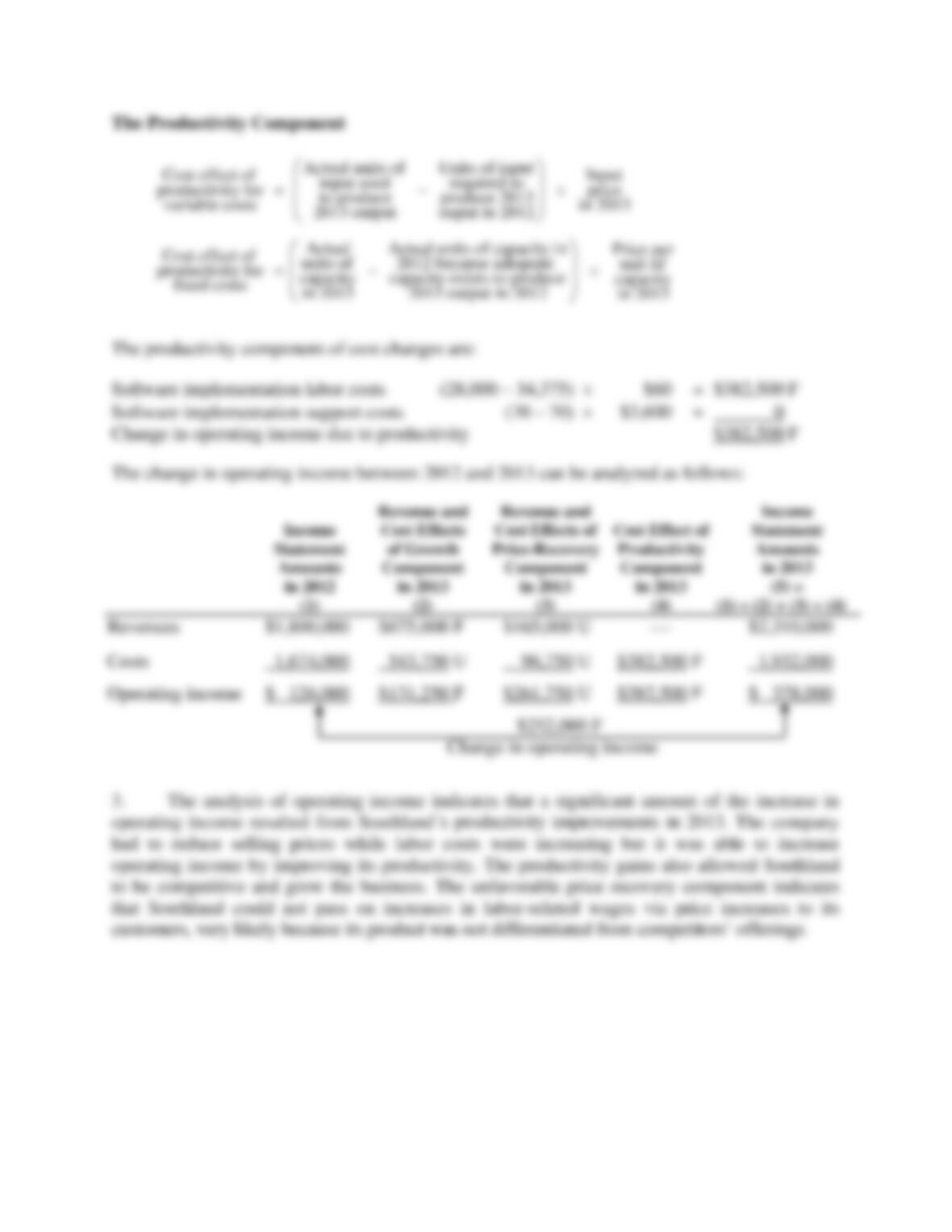
2. Calculate the growth, price-recovery, and productivity components that explain the change in
operating income from 2012 to 2013.
3. Comment on your answer in requirement 2. What do these components indicate?
SOLUTION
12-23
12-24
12-25
12-28 (25 min.) Analysis of growth, price-recovery, and productivity components
(continuation of 12-27).
Suppose that during 2013, the market for implementing sales-management software increases by
10%. Assume that any increase in market share more than 10% and any decrease in selling price
are the result of strategic choices by Southland’s management to implement its strategy.
Calculate how much of the change in operating income from 2012 to 2013 is due to the
industry-market-size factor, product differentiation, and cost leadership. How successful has
Southland been in implementing its strategy? Explain.
SOLUTION
12-26
12-29 (20 min.) Identifying and managing unused capacity (continuation of 12–26).
Refer to Exercise 12-26.
Required:
1. Calculate the amount and cost of unused software-implementation support capacity at the
beginning of 2013, based on the number of jobs actually done in 2013.
2. Suppose Southland can add or reduce its software-implementation support capacity in
increments of 10 units. What is the maximum amount of costs that Southland could save in
2013 by downsizing software-implementation support capacity?
3. Southland, in fact, does not eliminate any of its unused software-implementation support
capacity. Why might Southland not downsize?
SOLUTION
12-30 (20–25 min.) Balanced scorecard and strategy.
Scott Company manufactures a DVD player called the Maxus. The company sells the player to
discount stores throughout the country. This player is significantly less expensive than similar
products sold by Scott’s competitors, but the Maxus offers just DVD playback, compared with
DVD and Blu-ray playback offered by competitor Nomad Manufacturing. Furthermore, the
Maxus has experienced production problems that have resulted in significant rework costs.
Nomad’s model has an excellent reputation for quality.
Required:
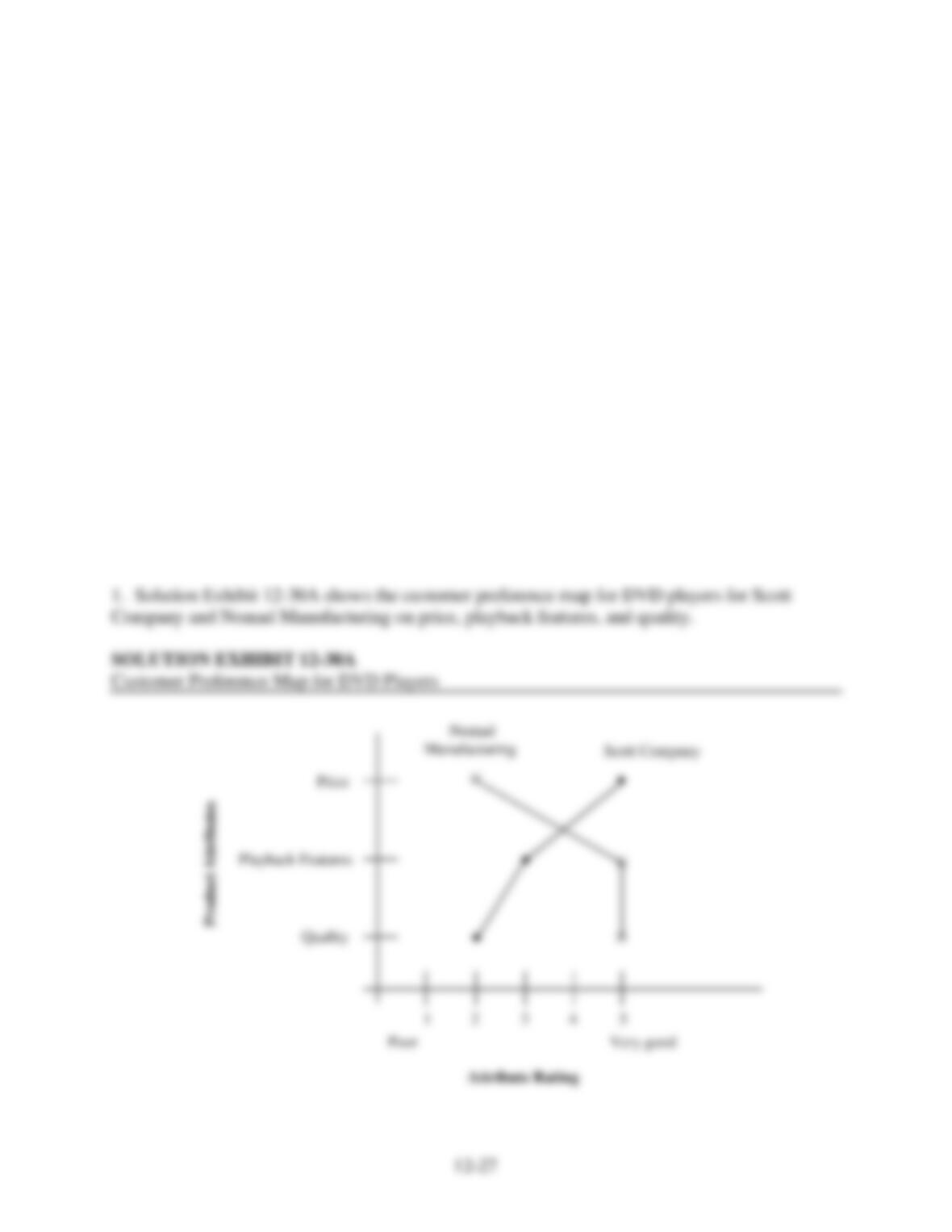
1. Draw a simple customer preference map for Scott and Nomad using the attributes of price,
quality, and playback features. Use the format of Exhibit 12-1.
2. Is Scott’s current strategy that of product differentiation or cost leadership?
3. Scott would like to improve quality and decrease costs by improving processes and training
workers to reduce rework. Scott’s managers believe the increased quality will increase sales.
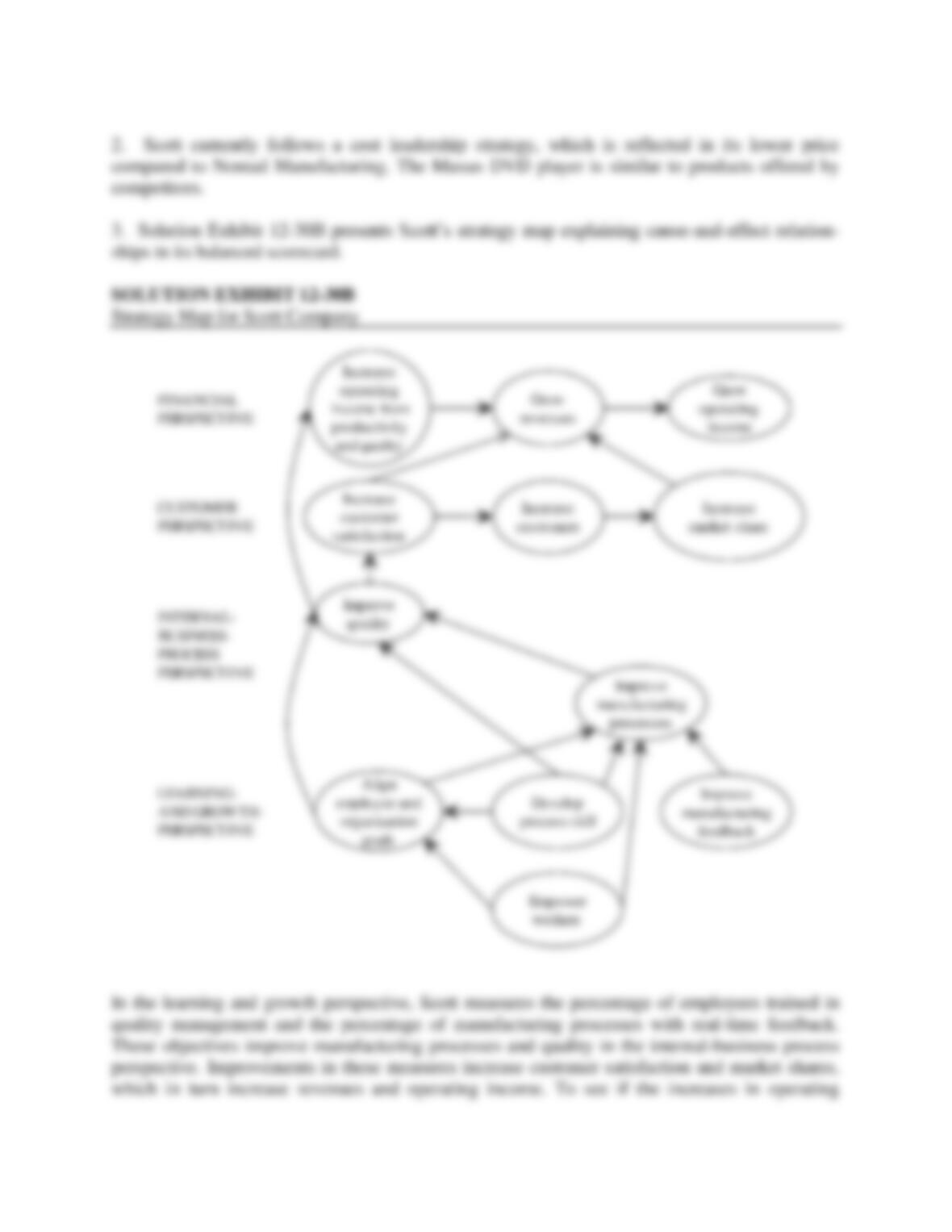
Draw a strategy map as in Exhibit 12-2 describing the cause-and-effect relationships among
the strategic objectives you would expect to see in Scott’s balanced scorecard.
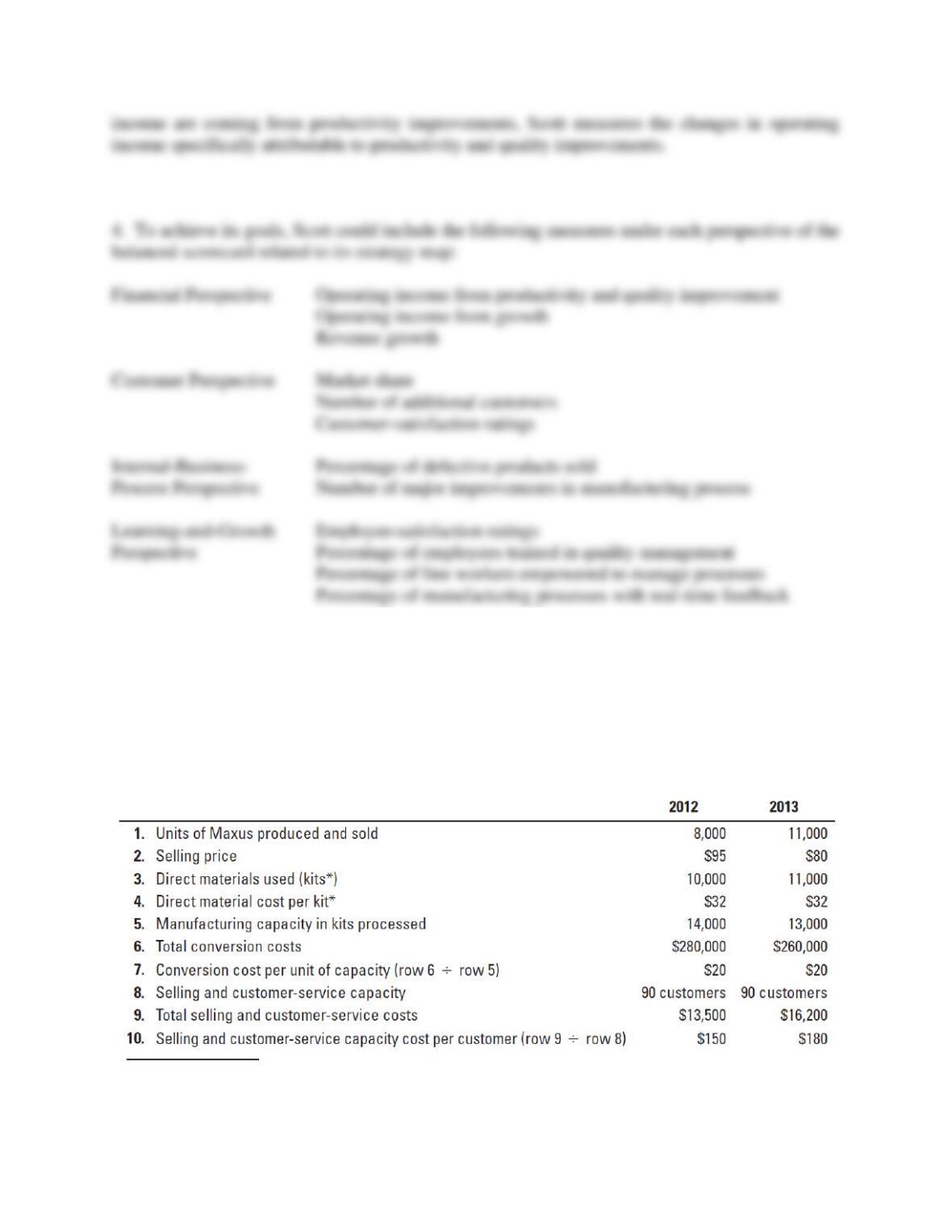
4. For each strategic objective, suggest a measure you would recommend in Scott’s balanced
scorecard.
SOLUTION
12-28
12-29
12-31 (25–30 min.) Strategic analysis of operating income (continuation of 12-30).
Refer to Problem 12-30. As a result of the actions taken, quality has significantly improved in
2013 while rework and unit costs of the Maxus have decreased. Scott has reduced manufacturing
capacity because capacity is no longer needed to support rework. Scott has also lowered the
Maxus’s selling price to gain market share and unit sales have increased. Information about the
current period (2013) and last period (2012) follows.
* A kit is composed of all the major components needed to produce a DVD player.
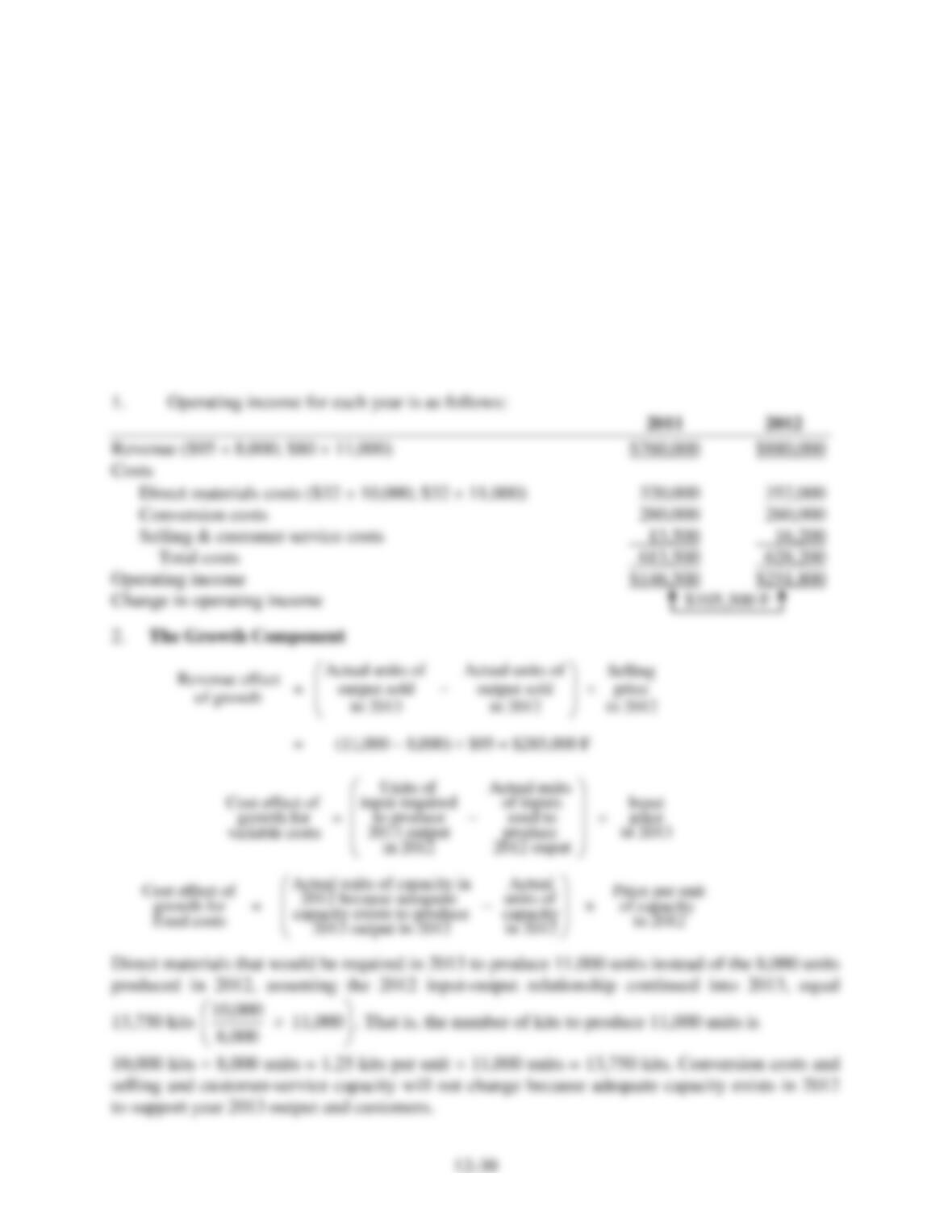
Conversion costs in each year depend on production capacity defined in terms of kits that can be
processed, not the actual kits started. Selling and customer-service costs depend on the number
of customers that Scott can support, not the actual number of customers it serves. Scott has 70
customers in 2012 and 80 customers in 2013.
Required:
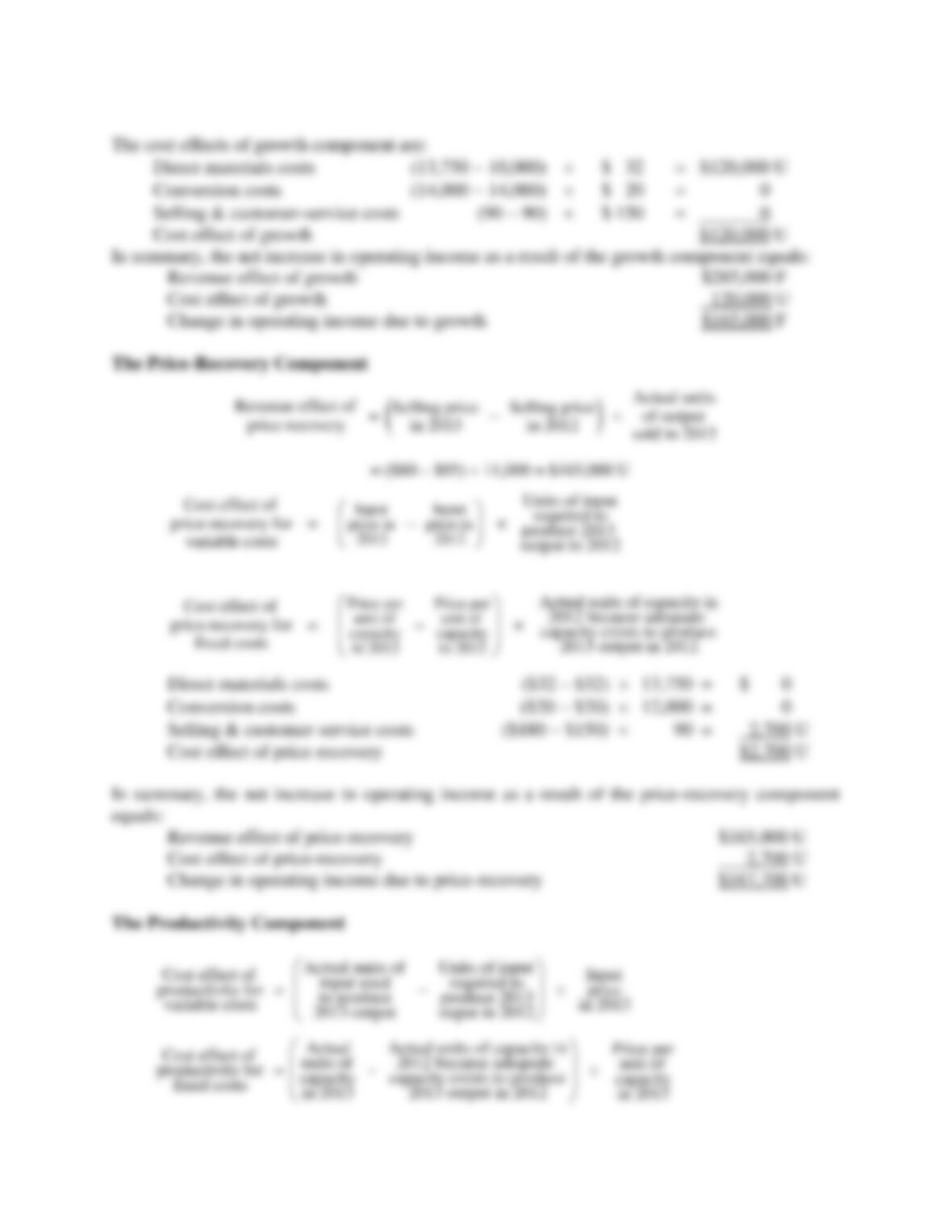
1. Calculate operating income of Scott Company for 2012 and 2013.
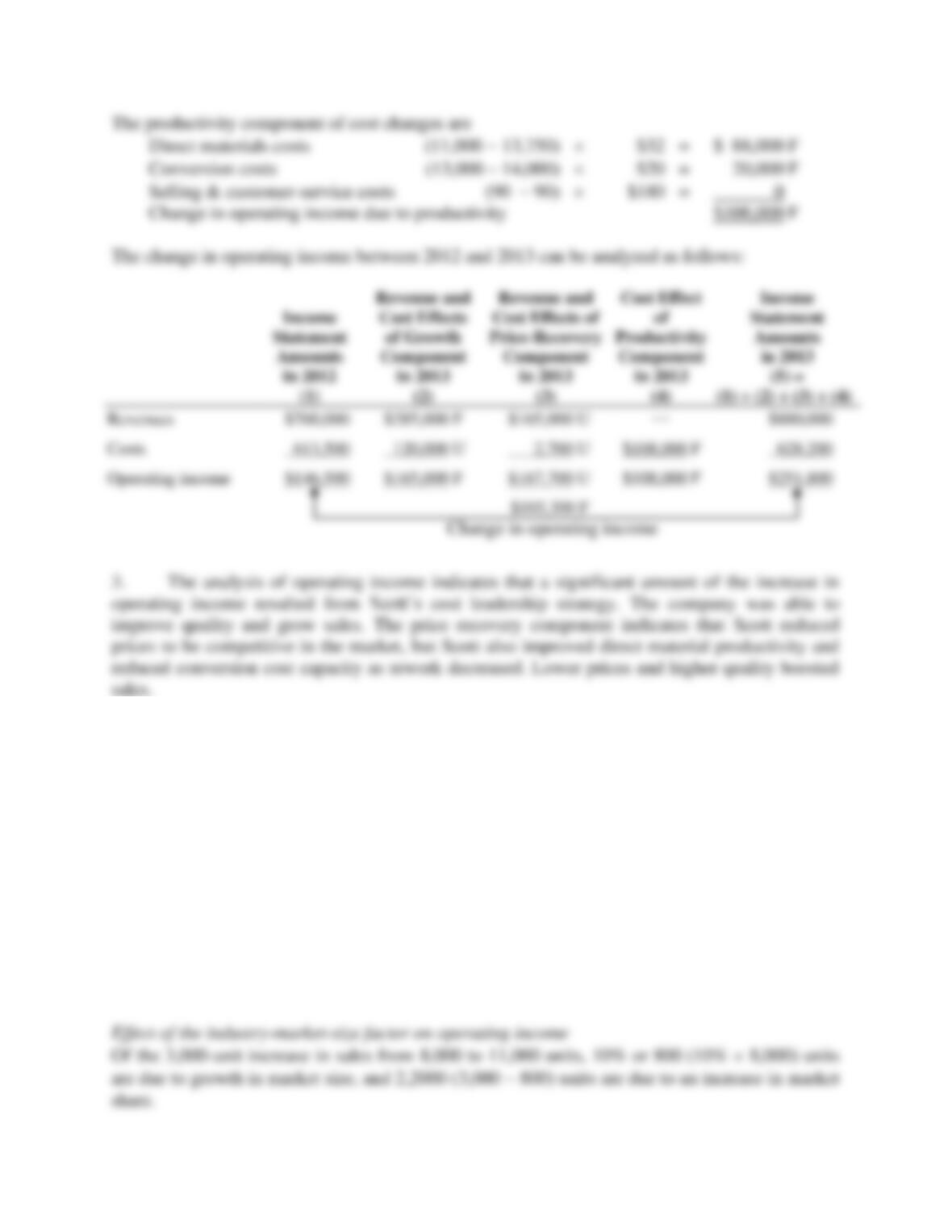
2. Calculate the growth, price-recovery, and productivity components that explain the change in
operating income from 2012 to 2013.
3. Comment on your answer in requirement 2. What do these components indicate?
SOLUTION
12-31
12-32
12-32 (20 min.) Analysis of growth, price-recovery, and productivity components
(continuation of 12-31).
Suppose that during 2013, the market for DVD players grew 10%. All increases in market share
(that is, sales increases greater than 10%) and decreases in the selling price of the Maxus are the
result of Scott’s strategic actions.
Required:
Calculate how much of the change in operating income from 2012 to 2013 is due to the industry–
market-size factor, product differentiation, and cost leadership. How does this relate to Scott’s
strategy and its success in implementation? Explain.
SOLUTION
12-33
12-33 (20 min.) Identifying and managing unused capacity (continuation of 12-31).
Refer to the information for Scott Company in Problem 12-31.
Required:
1. Calculate the amount and cost of (a) unused manufacturing capacity and (b) unused selling
and customer-service capacity at the beginning of 2013 based on actual production and actual
number of customers served in 2013.
2. Suppose Scott can add or reduce its selling and customer-service capacity in increments of
five customers. What is the maximum amount of costs that Scott could save in 2013 by
downsizing selling and customer-service capacity?
3. Scott, in fact, does not eliminate any of its unused selling and customer-service capacity.
Why might Scott not downsize?
12-34
SOLUTION
12-34 (20–30 min.) Balanced scorecard.
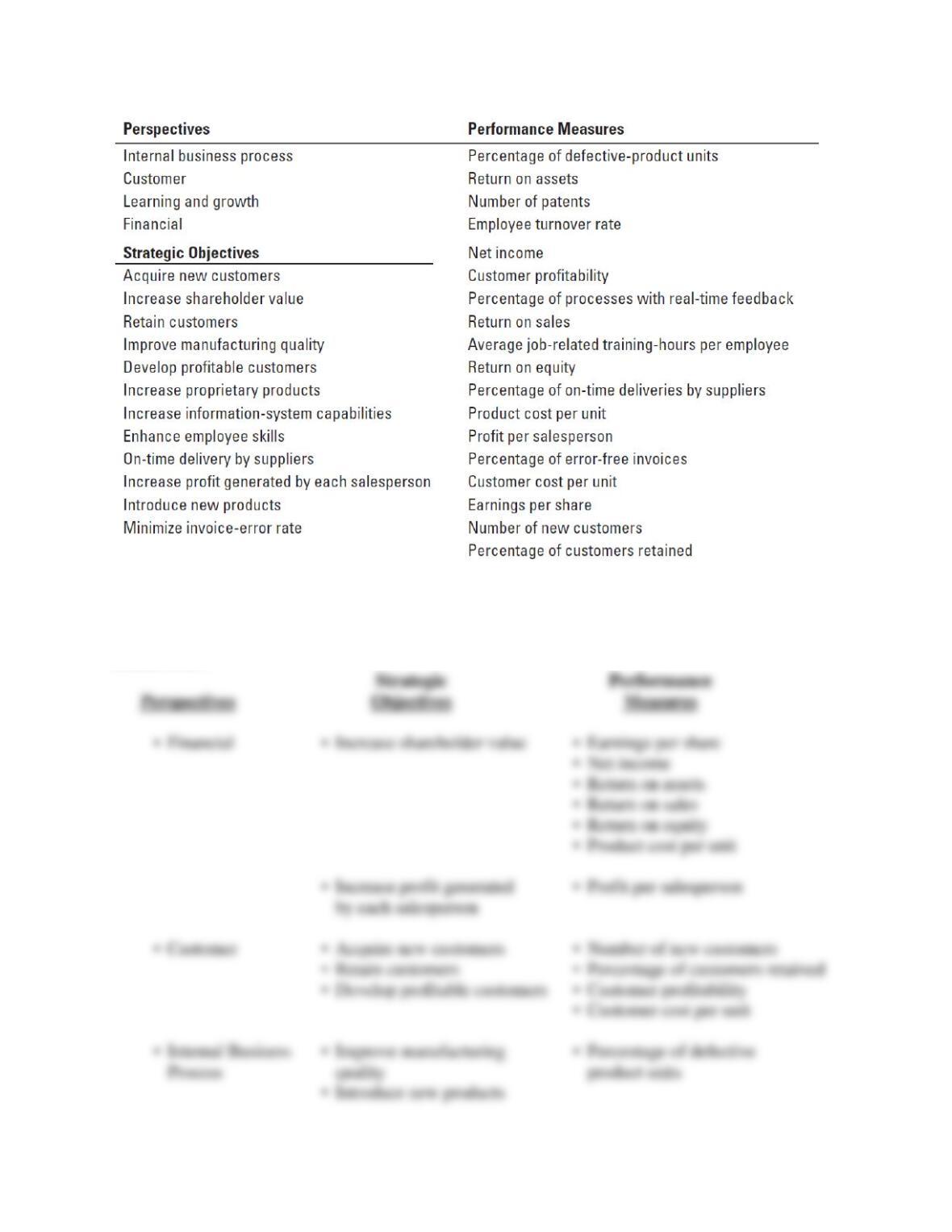
Following is a random-order listing of perspectives, strategic objectives, and performance
measures for the balanced scorecard.
12-35
Required:
For each perspective, select those strategic objectives from the list that best relate to it. For each
strategic objective, select the most appropriate performance measure(s) from the list.
SOLUTION
12-36
12-35 (20 min.) Balanced scorecard.
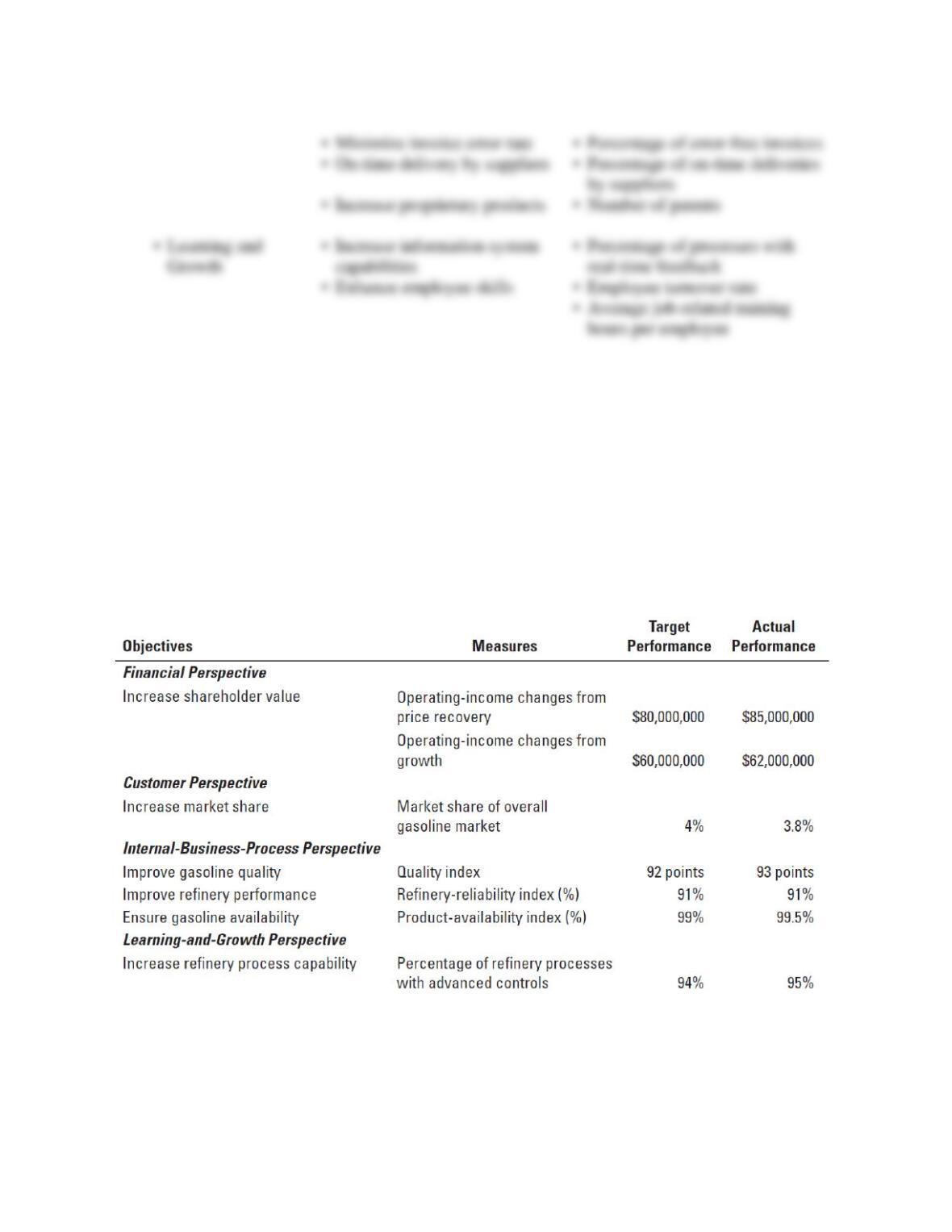
(R. Kaplan, adapted) Petrocal, Inc., refines gasoline and sells it through its own Petrocal gas
stations. On the basis of market research, Petrocal determines that 60% of the overall gasoline
market consists of “service–oriented customers,” medium– to high-income individuals who are
willing to pay a higher price for gas if the gas stations can provide excellent customer service,
such as a clean facility, a convenience store, friendly employees, a quick turnaround, the ability
to pay by credit card, and high-octane premium gasoline. The remaining 40% of the overall
market are “price shoppers” who look to buy the cheapest gasoline available. Petrocal’s strategy
is to focus on the 60% of service-oriented customers. Petrocal’s balanced scorecard for 2013
follows. For brevity, the initiatives taken under each objective are omitted.
Required:
1. Was Petrocal successful in implementing its strategy in 2013? Explain your answer.