12-37
2. Would you have included some measure of employee satisfaction and employee training in
the learning-and-growth perspective? Are these objectives critical to Petrocal for
implementing its strategy? Why or why not? Explain briefly.
3. Explain how Petrocal did not achieve its target market share in the total gasoline market but
still exceeded its financial targets. Is “market share of overall gasoline market” the correct
measure of market share? Explain briefly.
4. Is there a cause-and-effect linkage between improvements in the measures in the internal-
business-process perspective and the measure in the customer perspective? That is, would
you add other measures to the internal-business-process perspective or the customer
perspective? Why or why not? Explain briefly.
5. Do you agree with Petrocal’s decision not to include measures of changes in operating
income from productivity improvements under the financial perspective of the balanced
scorecard? Explain briefly.
SOLUTION
12-38
12-39
12-36 (30 min.) Balanced scorecard.
Vic Corporation manufactures various types of color laser printers in a highly automated facility
with high fixed costs. The market for laser printers is competitive. The various color laser
printers on the market are comparable in terms of features and price. Vic believes that satisfying
customers with products of high quality at low costs is key to achieving its target profitability.
For 2013, Vic plans to achieve higher quality and lower costs by improving yields and reducing
defects in its manufacturing operations. Vic will train workers and encourage and empower them
to take the necessary actions. Currently, a significant amount of Vic’s capacity is used to produce
products that are defective and cannot be sold. Vic expects that higher yields will reduce the
capacity that Vic needs to manufacture products. Vic does not anticipate that improving
manufacturing will automatically lead to lower costs because Vic has high fixed costs. To reduce
fixed costs per unit, Vic could lay off employees and sell equipment, or it could use the capacity
to produce and sell more of its current products or improved models of its current products.
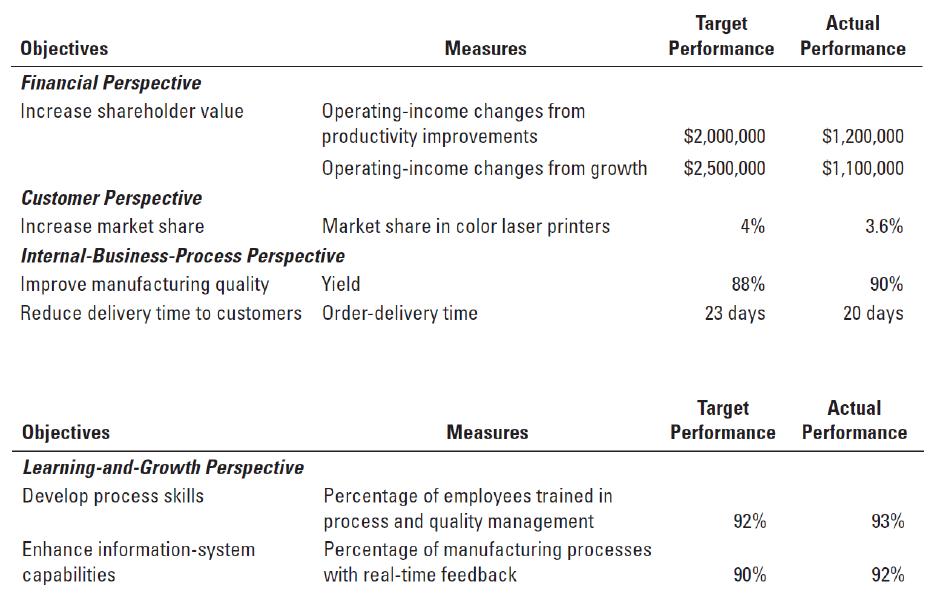
Vic’s balanced scorecard (initiatives omitted) for the just-completed fiscal year 2013 follows.
Required:
1. Was Vic successful in implementing its strategy in 2013? Explain.
2. Is Vic’s balanced scorecard useful in helping the company understand why it did not reach its
target market share in 2013? If it is, explain why. If it is not, explain what other measures
you might want to add under the customer perspective and why.
3. Would you have included some measure of employee satisfaction in the learning-and-growth
perspective and new-product development in the internal-business-process perspective? That
12-40
is, do you think employee satisfaction and development of new products are critical for Vic
to implement its strategy? Why or why not? Explain briefly.
4. What problems, if any, do you see in Vic improving quality and significantly downsizing to
eliminate unused capacity?
SOLUTION
12-41
12-37 (25 min.) Balanced scorecard, environmental and social performance.
Cerebral Chocolates makes custom-labeled, high-quality, specialty candy bars for special events
and advertising purposes. The company employs several chocolatiers who were trained in
Germany. The company offers many varieties of chocolate, including milk, semi-sweet, white,
and dark chocolate. It also offers a variety of ingredients, such as coffee, berries, and fresh mint.
The real appeal for the company’s product, however, is its custom labeling. Customers can order
labels for special occasions (for example, wedding invitation labels) or business purposes (for
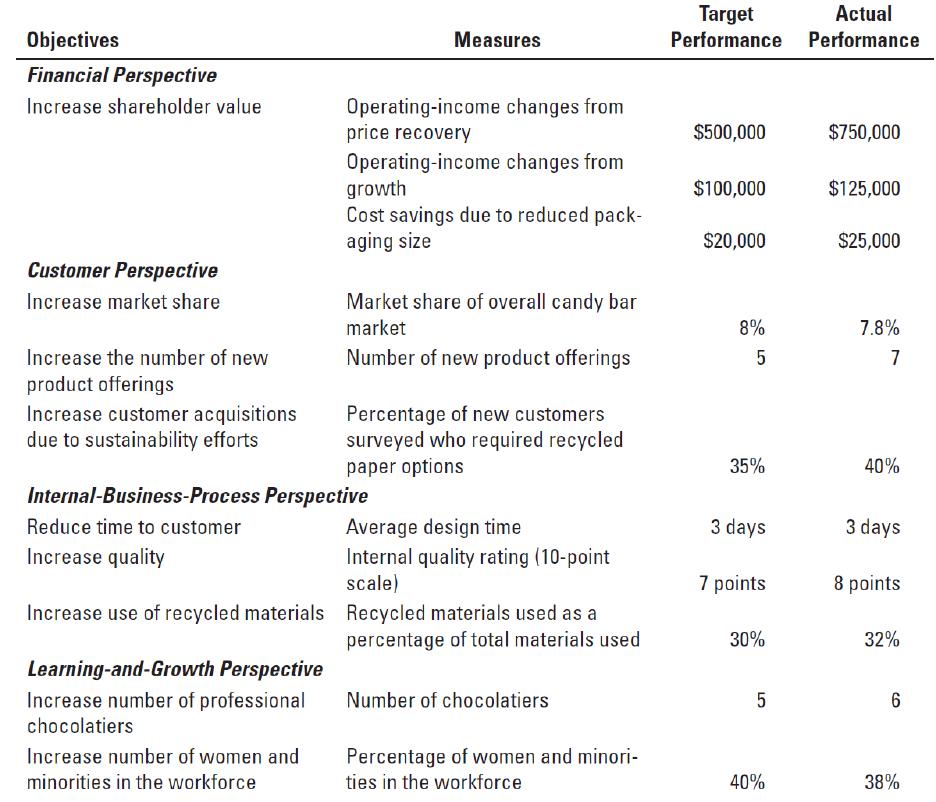
example, business card labels). The company’s balanced scorecard for 2013 follows. For brevity,
the initiatives taken under each objective are omitted.
12-42
Required:
1. Was Cerebral successful in implementing its strategy in 2013? Explain your answer.
2. Would you have included some measure of customer satisfaction in the customer
perspective? Are these objectives critical to Cerebral for implementing its strategy? Why or
why not? Explain briefly.
3. Explain why Cerebral did not achieve its target market share in the candy bar market but still
exceeded its financial targets. Is “market share of overall candy bar market” a good measure
of market share for Cerebral? Explain briefly.
4. Do you agree with Cerebral’s decision not to include measures of changes in operating
income from productivity improvements under the financial perspective of the balanced
scorecard? Explain briefly.
5. Why did Cerebral include balanced scorecard standards relating to environmental and social
performance? Is the company meeting its performance objectives in these areas?
SOLUTION
12-43
12-44
12-38 (25 min.) Balanced Scorecard, social performance.
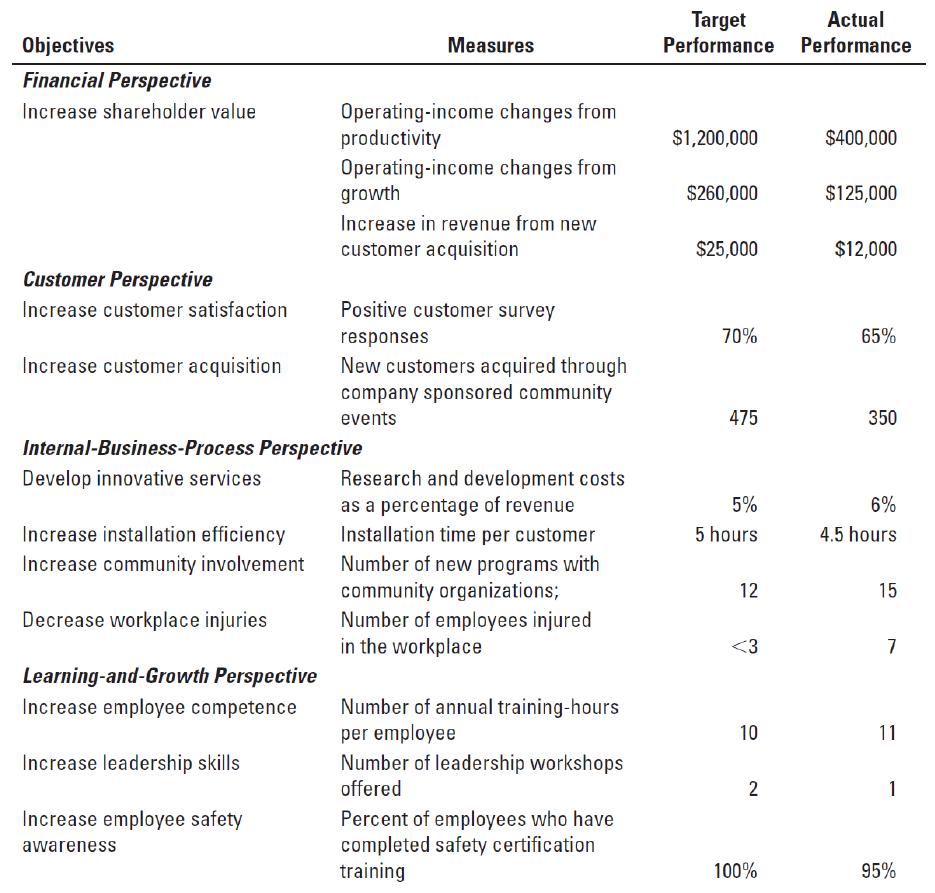
Rocky Plain Company provides cable and Internet services in the greater Denver area. There are
many competitors that provide similar services. Rocky Plain believes that the key to financial
success is to offer a quality service at the lowest cost. Rocky Plain currently spends a significant
amount of hours on installation and post-installation support. This is one area that the company
has targeted for cost reduction. Rocky Plain’s balanced scorecard for 2013 follows.
12-45
Required:
1. Was Rocky Plain successful in implementing its strategy in 2013? Explain.
2. Do you agree with Rocky Plain’s decision to include measures of developing innovative
services (research and development costs) in the internal-business-process perspective of the
balanced score-card? Explain briefly.
3. Is there a cause-and-effect linkage between the measures in the internal-business-process
perspective and the customer perspective? That is, would you add other measures to the
internal-business-process perspective or the customer perspective? Why or why not? Explain
briefly.
4. Why do you think Rocky Plain included balanced scorecard measures relating to employee
safety and community engagement? How well is the company doing on these measures?
SOLUTION
12-46
12-47
12-39 (25 min.) Balanced Scorecard.
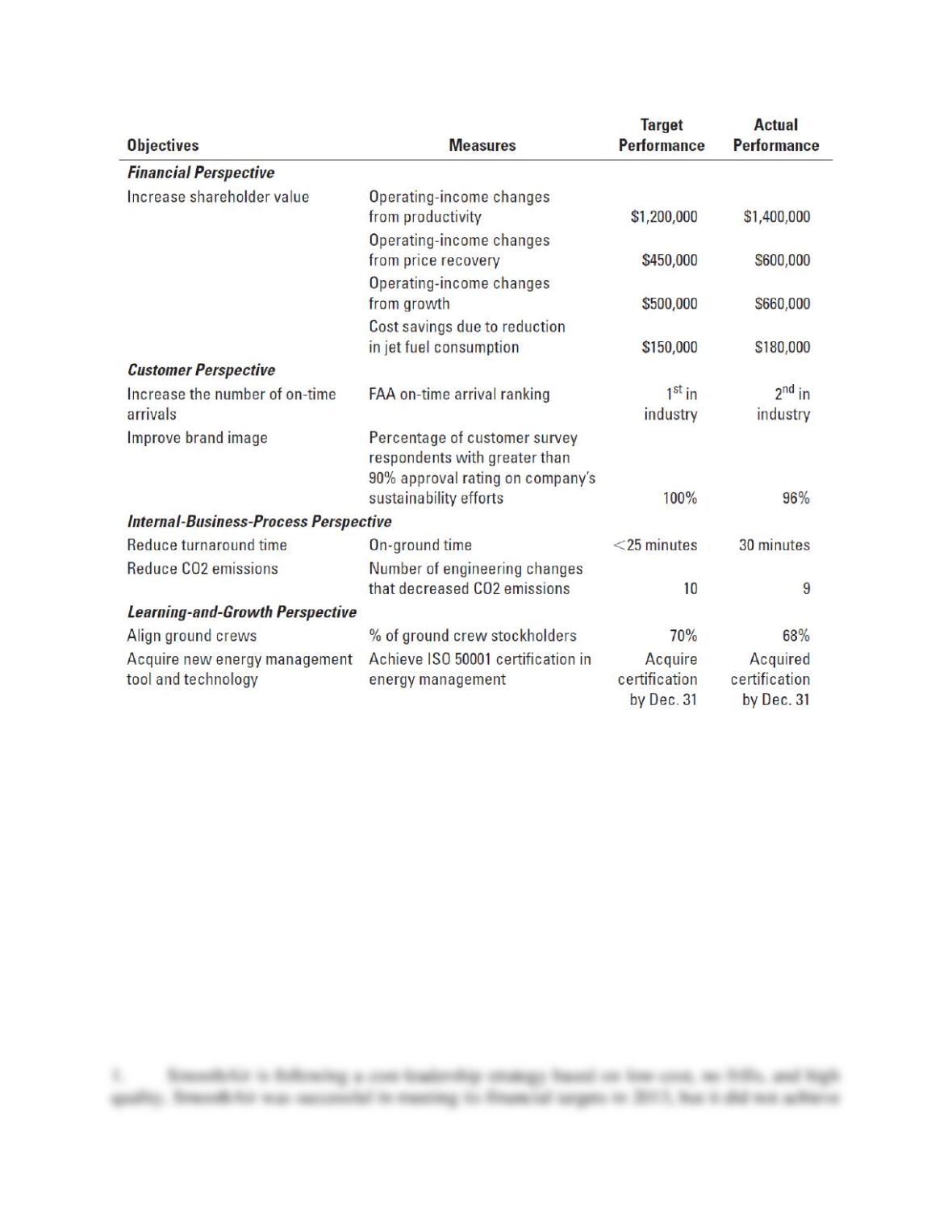
SmoothAir is a no-frills airline that services the Midwest. Its mission is to be the only short-haul,
low-fare, high-frequency, point–to-point carrier in the Midwest. However, there are several large
commercial carriers offering air transportation, and SmoothAir knows that it cannot compete
with them based on the services those carriers provide. SmoothAir has chosen to reduce costs by
not offering many inflight services, such as food and entertainment options. Instead, the
company is dedicated to providing the highest quality transportation at the lowest fare.
SmoothAir’s balanced scorecard measures (and actual results) for 2013 follow:
12-48
Required:
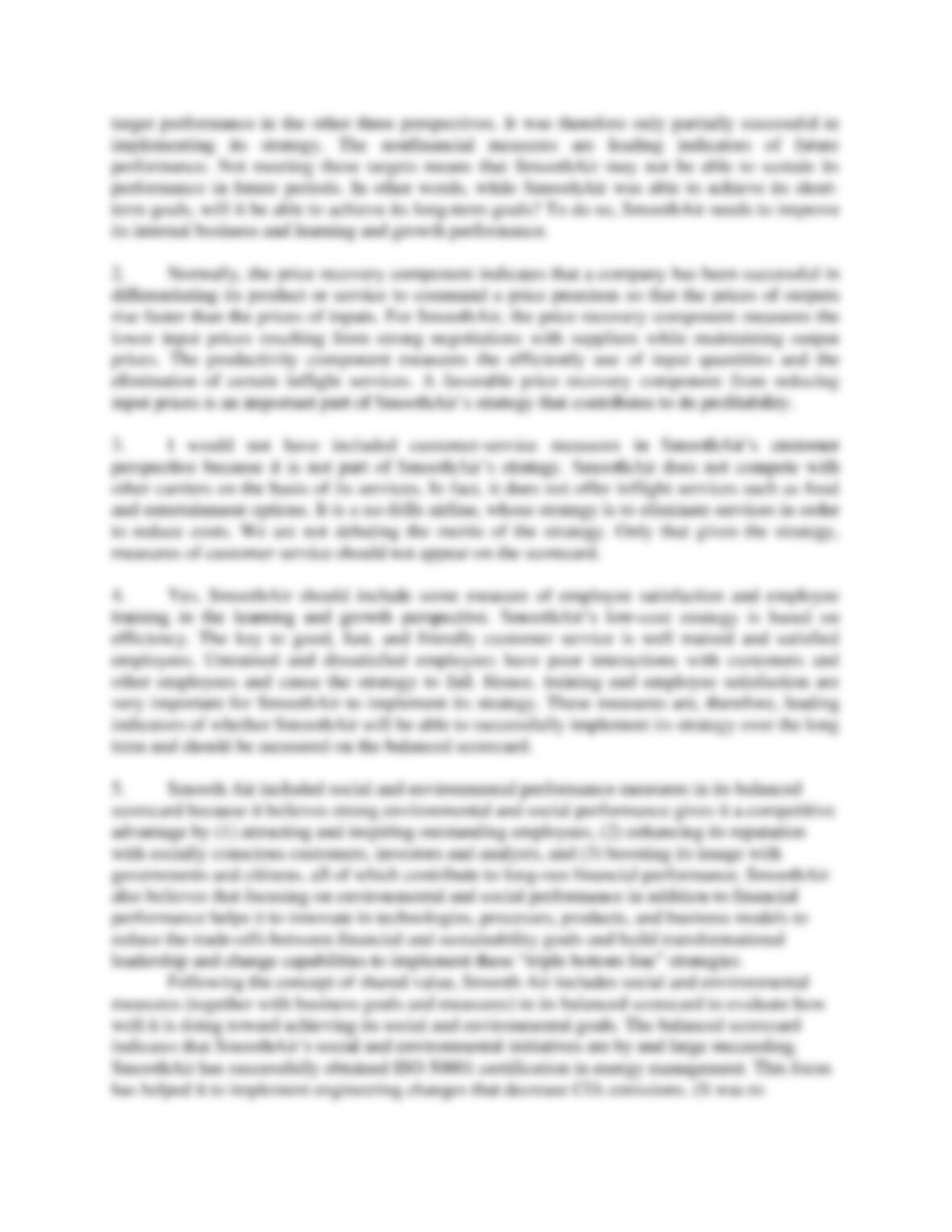
1. What is SmoothAir’s strategy? Was SmoothAir successful in implementing its strategy in
2013? Explain your answer.
2. Based on the strategy identified in requirement 1 above, what role does the price-recovery
component play in explaining the success of SmoothAir?
3. Would you have included customer-service measures in the customer perspective? Why or
why not? Explain briefly.
4. Would you have included some measure of employee satisfaction and employee training in
the learning-and-growth perspective? Would you consider this objective critical to
SmoothAir for implementing its strategy? Why or why not? Explain briefly.
5. Why do you think Smooth Air has introduced environmental measures in its balanced
scorecard? Is the company meeting its performance objectives in this area?
SOLUTION
12-49
12-50
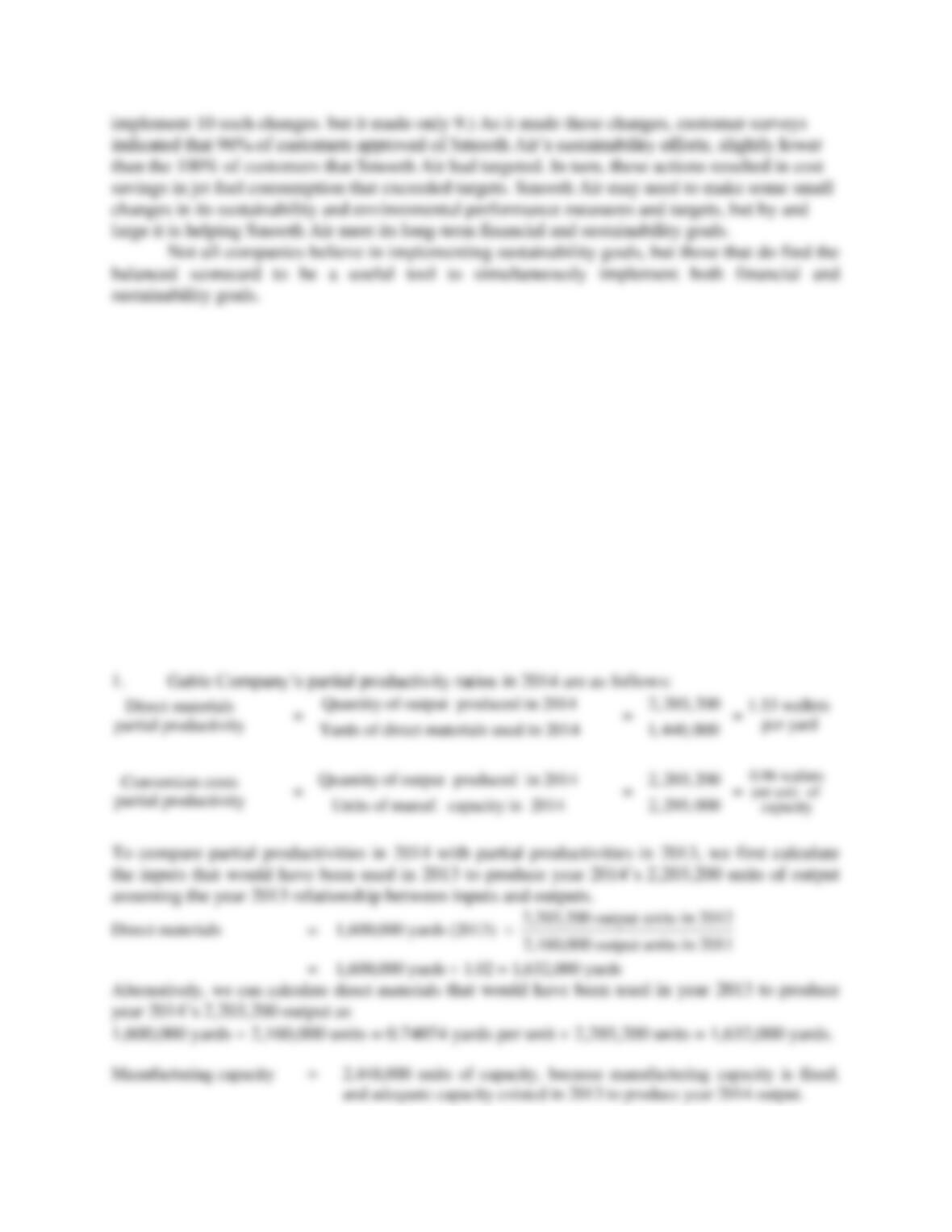
12-40 (20 min.) Partial productivity measurement.
Gable Company manufactures wallets from fabric. In 2013, Gable made 2,160,000 wallets using
1,600,000 yards of fabric. In 2013, Gable has capacity to make 2,448,000 wallets and incurs a
cost of $8,568,000 for this capacity. In 2014, Gable plans to make 2,203,200 wallets, make fabric
use more efficient, and reduce capacity.
Suppose that in 2014 Gable makes 2,203,200 wallets, uses 1,440,000 yards of fabric, and
reduces capacity to 2,295,000 wallets at a cost of $7,803,000.
Required:
1. Calculate the partial-productivity ratios for materials and conversion (capacity costs) for
2014, and compare them to a benchmark for 2013 calculated based on 2014 output.
2. How can Gable Company use the information from the partial-productivity calculations?
SOLUTION
12-51
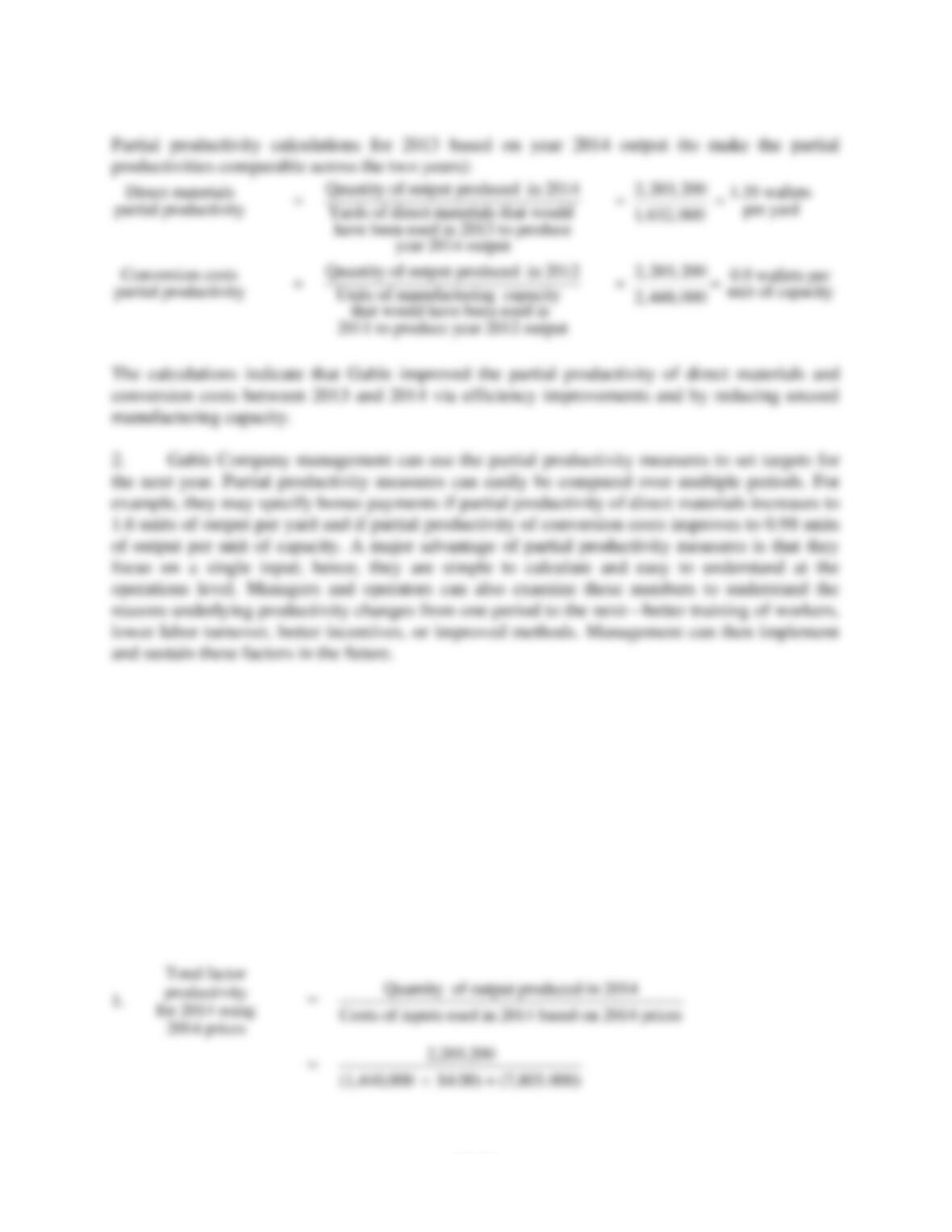
12-41 (25 min.) Total factor productivity (continuation of 12-40).
Refer to the data for Problem 12-40. Assume the fabric costs $4.00 per yard in 2014 and $4.10
per yard in 2013.
Required:
1. Compute Gable Company’s total factor productivity (TFP) for 2014.
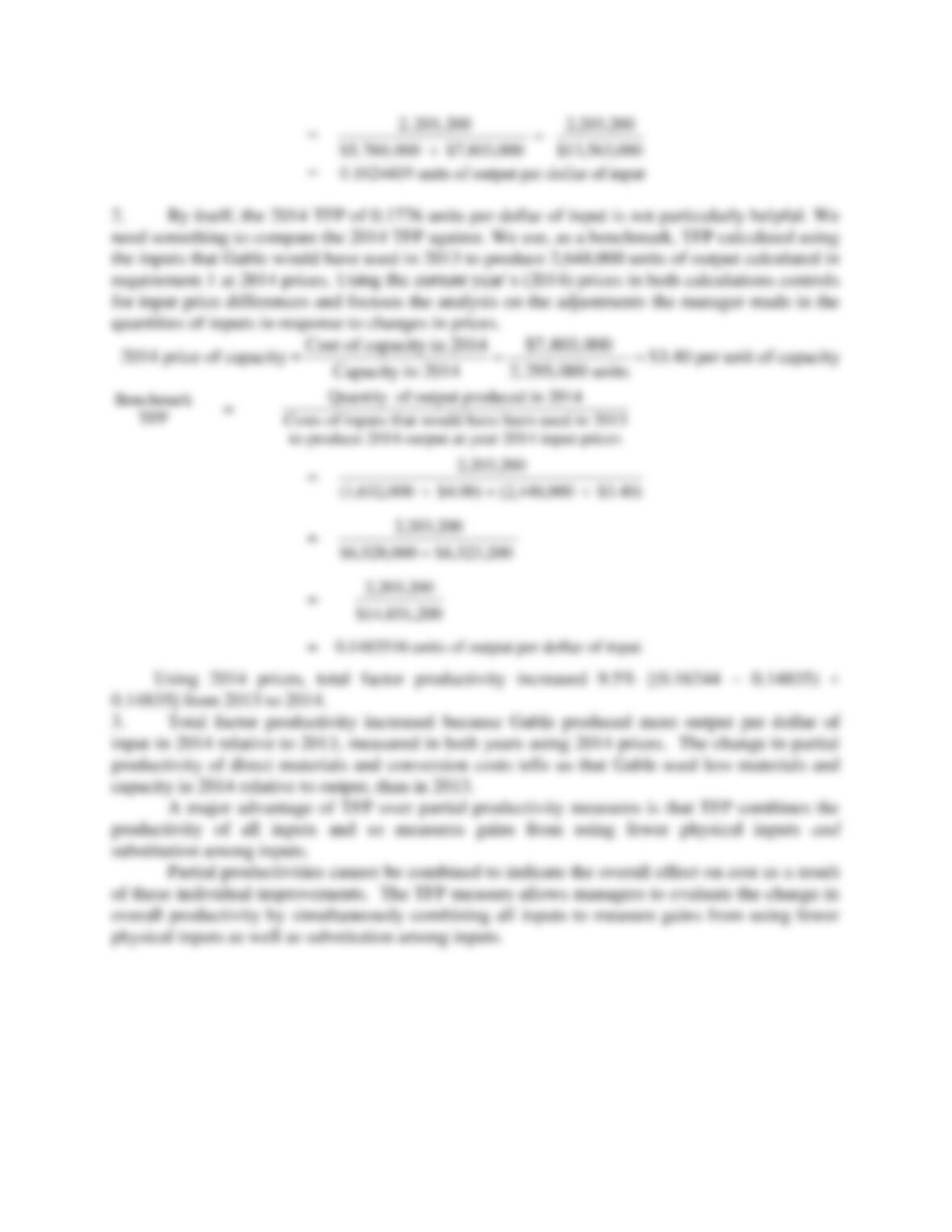
2. Compare TFP for 2014 with a benchmark TFP for 2013 inputs based on 2014 prices and
output.
3. What additional information does TFP provide that partial productivity measures do not?
SOLUTION
12-52