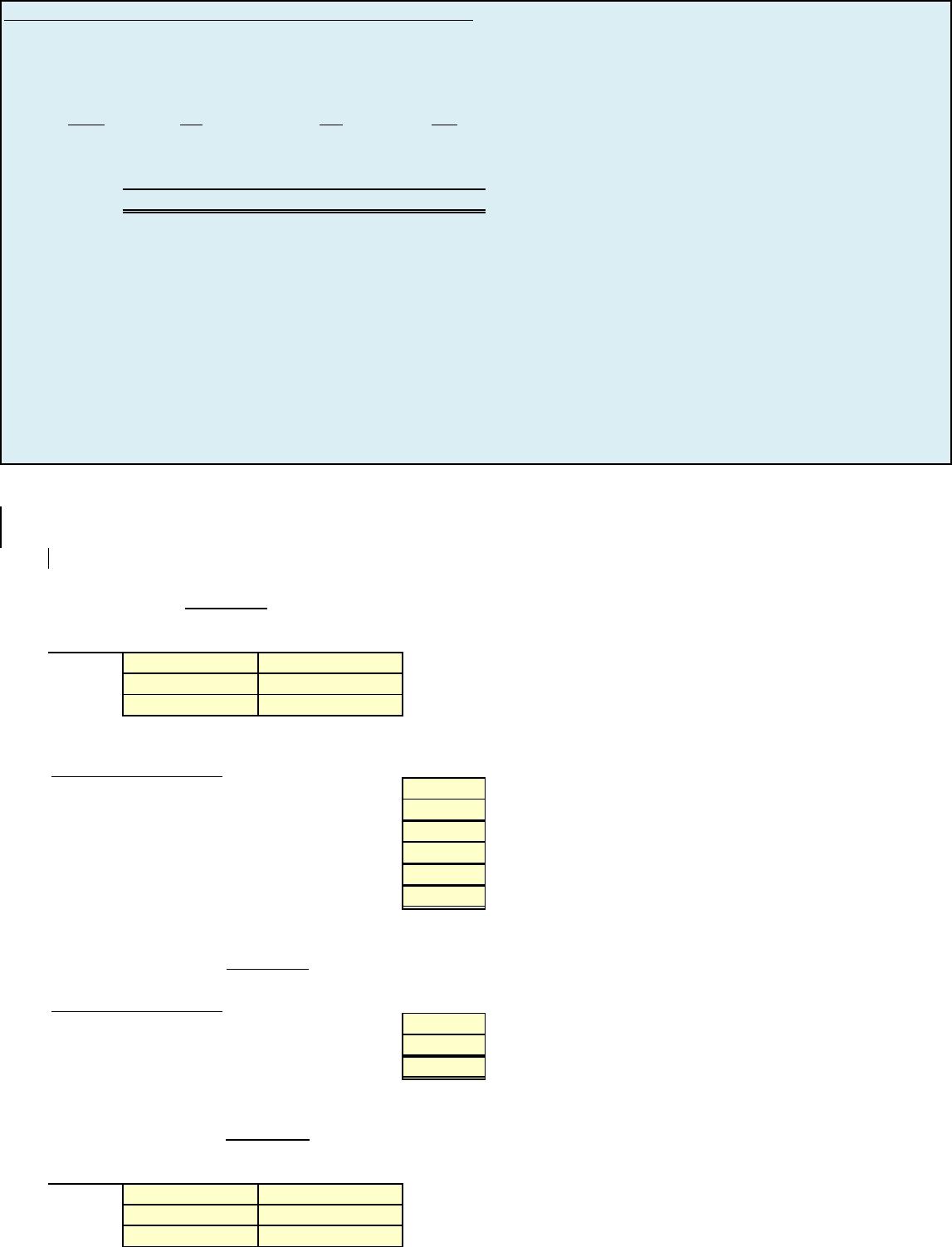
E12 – 2 Compute cash payback period and net present value
Doug’s Custom Construction Company is considering three new projects, each requiring an equipment
investment of $22,000. Each project will last for 3 years and produce the following net annual cash
flows.
Year AA BB CC
1 $7,000 $10,000 $13,000
2 9,000 10,000 12,000
3 12,000 10,000 11,000
Total $28,000 $30,000 $36,000
The equipment’s salvage value is zero, and Doug uses straight-line depreciation. Doug will not
accept any project with a cash payback period over 2 years. Doug’s required rate of return is 12%.
Instructions
(a) Compute each project’s payback period, indicating the most desirable project and the least
desirable project using this method. (Round to two decimals and assume in your computations
that cash flows occur evenly throughout the year.)
(b) Compute the net present value of each project. Does your evaluation change? (Round to
nearest dollar.)
NOTE: Enter a number in cells requesting a value; enter either a number or a formula in cells with a “?” .
(a) Compute each project’s payback period, indicating the most desirable project and the least
desirable project using this method. (Round to two decimals and assume in your computations
that cash flows occur evenly throughout the year.)
Net Annual Cumulative
Year Cash Flow Net Cash Flow
1 Value ?
2 Value ?
3 Value ?
Cash Payback Period:
Cost of capital investment Value
Cumulative net cash flow, year 2 Value
Remaining cost to be recovered (a) ?
Net cash flow, year 3 (b) Value
Payback period, year 3 (a) ÷ (b) Value
Total cash payback period in years ?
Cash Payback Period:
Cost of capital investment (a) Value
Net annual cash flow Value
Total cash payback period in years (a) ÷ (b) ?
Net Annual Cumulative
Year Cash Flow Net Cash Flow
1 Value ?
2 Value ?
3 Value ?
Project AA
Project BB
Project CC
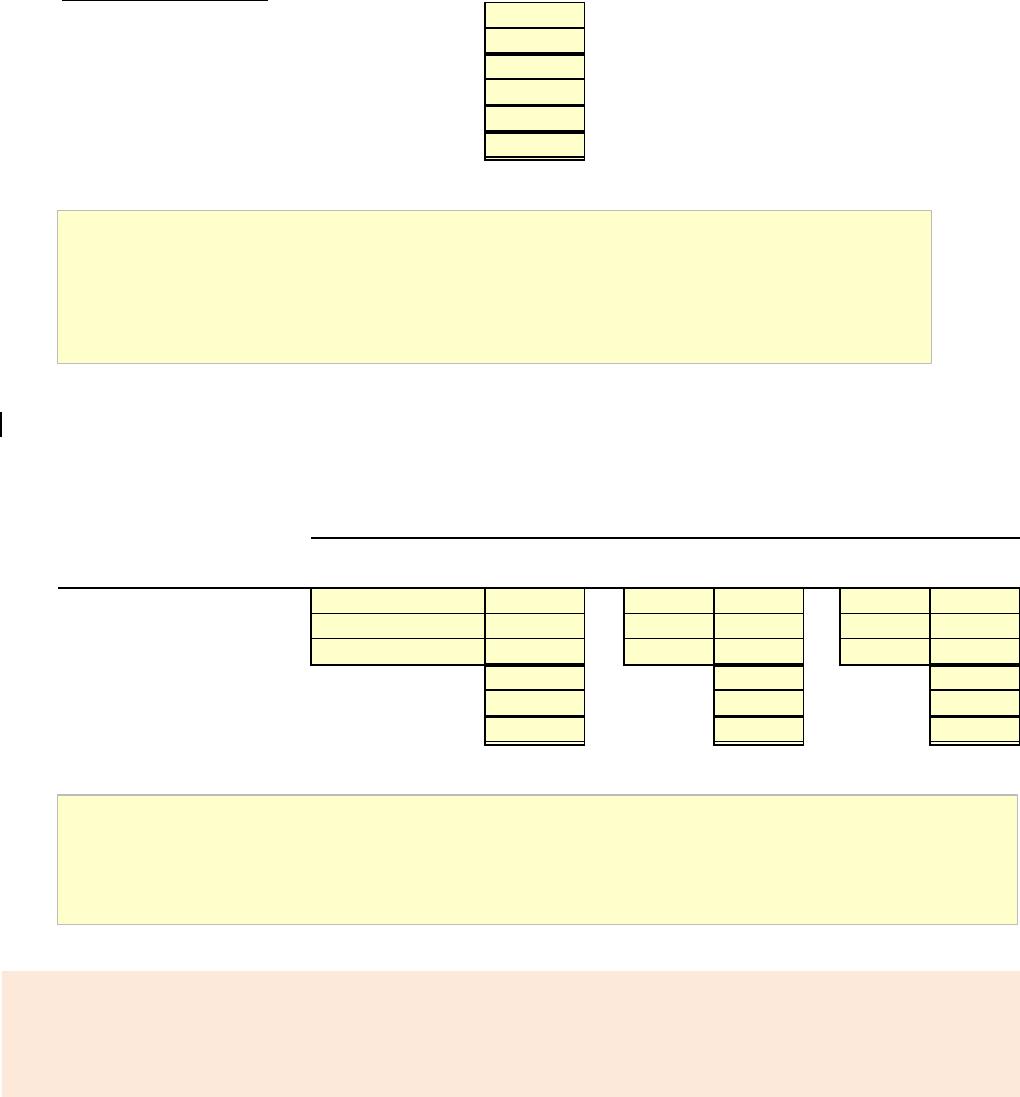
Cash Payback Period:
Cost of capital investment Value
Cumulative net cash flow, year 1 Value
Remaining cost to be recovered (a) ?
Net cash flow, year 2 (b) Value
Payback period, year 2 (a) ÷ (b) Value
Total cash payback period in years ?
(b) Compute the net present value of each project. Does your evaluation change? (Round to
nearest dollar.)
12%
Discount Cash Present Cash Present Cash Present
Year Factor Flow Value Flow Value Flow Value
1 0.89286 Value ? Value ? Value ?
2 0.79719 Value ? Value ? Value ?
3 0.71178 Value ? Value ? Value ?
Total present value ? ? ?
Investment Value Value Value
Net present value ? ? ?
After you have completed the requirements of E12-2, consider these additional questions.
1. Assume that the investment for equipment is $25,000. Recompute for each project’s
payback period and indicate the most desirable and least desirable project.
2. Recompute the net present value for each project. How does this change your evaluation?
Project AA
Project BB
Project CC
Response:
Response:
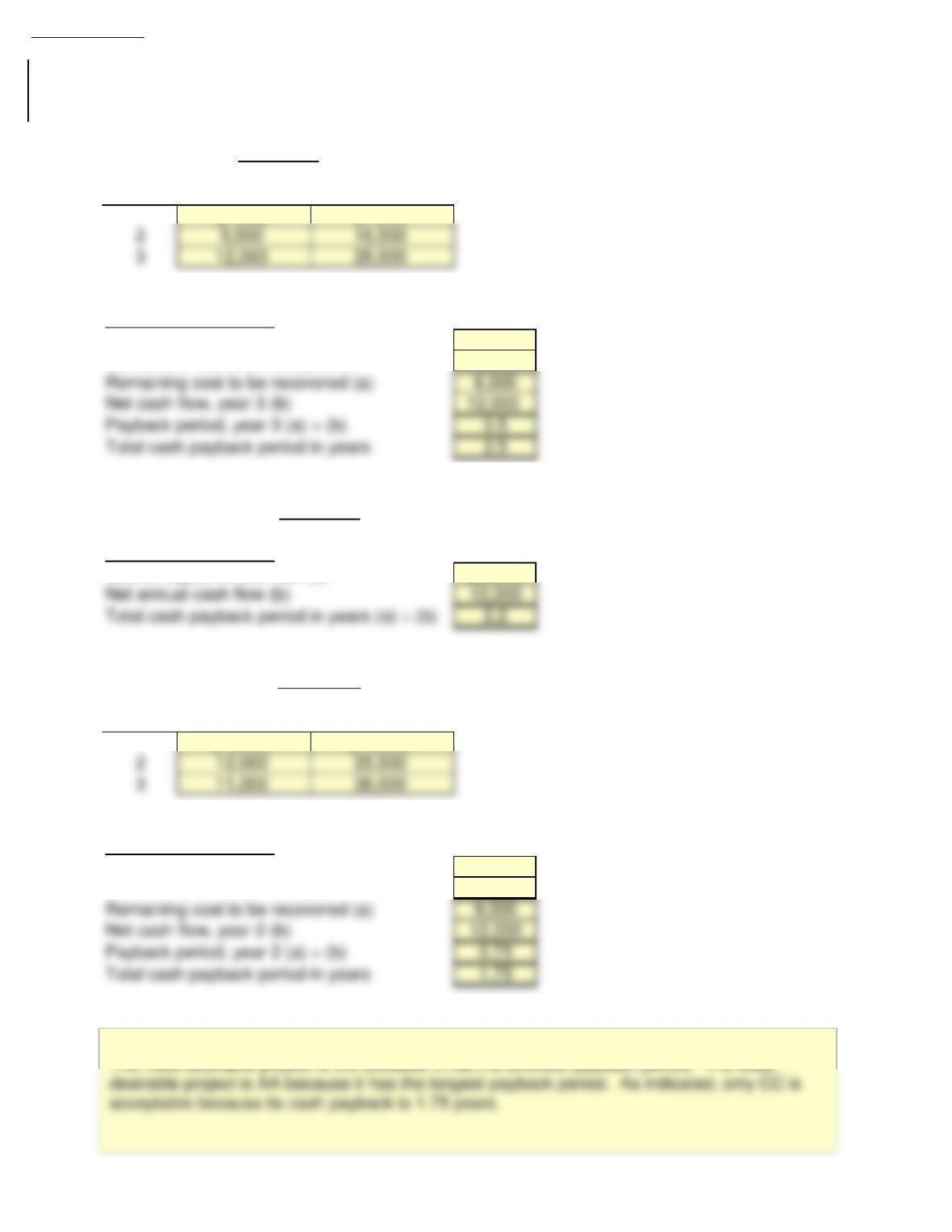
E12-2 Solution
(a) Compute each project’s payback period, indicating the most desirable project and the least
desirable project using this method. (Round to two decimals and assume in your computations
that cash flows occur evenly throughout the year.)
Net Annual Cumulative
Year Cash Flow Net Cash Flow
1 $7,000 $7,000
Cash Payback Period:
Cost of capital investment $22,000
Cumulative net cash flow, year 2 16,000
Cash Payback Period:
Cost of capital investment (a) $22,000
Net Annual Cumulative
Year Cash Flow Net Cash Flow
1 $13,000 $13,000
Cash Payback Period:
Cost of capital investment $22,000
Cumulative net cash flow, year 1 13,000
Project AA
Project BB
Project CC
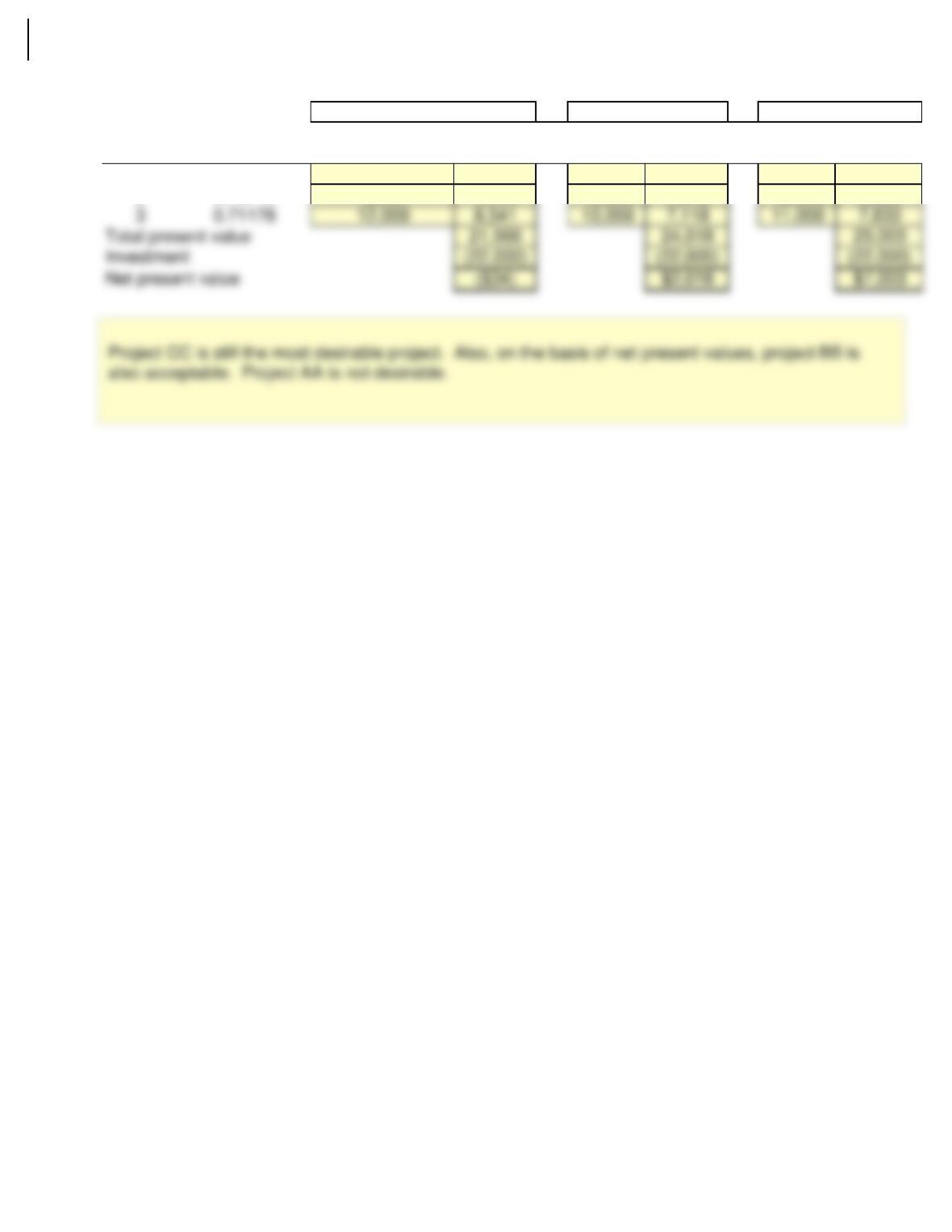
(b) Compute the net present value of each project. Does your evaluation change? (Round to
nearest dollar.)
12%
Discount Cash Present Cash Present Cash Present
Year Factor Flow Value Flow Value Flow Value
1 0.89286 $7,000 $6,250 $10,000 $8,929 $13,000 $11,607
2 0.79719 9,000 7,175 10,000 7,972 12,000 9,566
Project AA
Project BB
Project CC
E12-2 Solution to additional question
1. Assume that the investment for equipment is $25,000. Recompute for each project’s
payback period and indicate the most desirable and least desirable project. (Round to two decimals
and assume in your computations that cash flows occur evenly throughout the year.)
Net Annual Cumulative
Year Cash Flow Net Cash Flow
1 $7,000 $7,000
2 9,000 16,000
3 12,000 28,000
Cash Payback Period:
Cash Payback Period:
Net Annual Cumulative
Year Cash Flow Net Cash Flow
1 $13,000 $13,000
2 12,000 25,000
3 11,000 36,000
Cash Payback Period:
2. Recompute the net present value for each project. How does this change your evaluation?
12%
Project AA
Project BB
Project CC
Project BB
Project AA
Project CC
Discount Cash Present Cash Present Cash Present
Year Factor Flow Value Flow Value Flow Value
1 0.89286 $7,000 $6,250 $10,000 $8,929 $13,000 $11,607
2 0.79719 9,000 7,175 10,000 7,972 12,000 9,566
3 0.71178 12,000 8,541 10,000 7,118 11,000 7,830
E12-4 Compute net present value and profitability index
BAK Corp. is considering purchasing one of two new diagnostic machines. Either machine would
make it possible for the company to bid on jobs that it currently isn’t equipped to do. Estimates
regarding each machine are provided below.
Machine A Machine B
Original cost $75,500 $180,000
Estimated life 8 years 8 years
Salvage value -0- -0-
Estimated annual cash inflows $20,000 $40,000
Estimated annual cash outflows $5,000 $10,000
Instructions
Calculate the net present value and profitability index of each machine. Assume a 9% discount rate.
Which machine should be purchased?
NOTE: Enter a number in cells requesting a value; enter either a number or a formula in cells with a “?” .
Machine A 9% Discount Present
Cash Flows X Factor = Value
Present value of net annual cash flows Value X 5.53482 = ?
Present value of salvage value Value X 0.50187 = ?
?
Less: Capital investment Value
Net present value ?
Profitability Index = Value ?
Value
Machine B 9% Discount Present
Cash Flows X Factor = Value
Present value of net annual cash flows Value X 5.53482 = ?
Present value of salvage value Value X 0.50187 = ?
?
Capital investment Value
Net present value ?
Profitability Index = Value ?
Value
After you have completed E12-4, consider the following additional question.
1. Assume that the original cost of Machine A changed to $85,000 and has a salvage value of $10,000.
Which machine should be purchased?
Response:
E12-4 Solution
Machine A 9% Discount Present
Cash Flows X Factor = Value
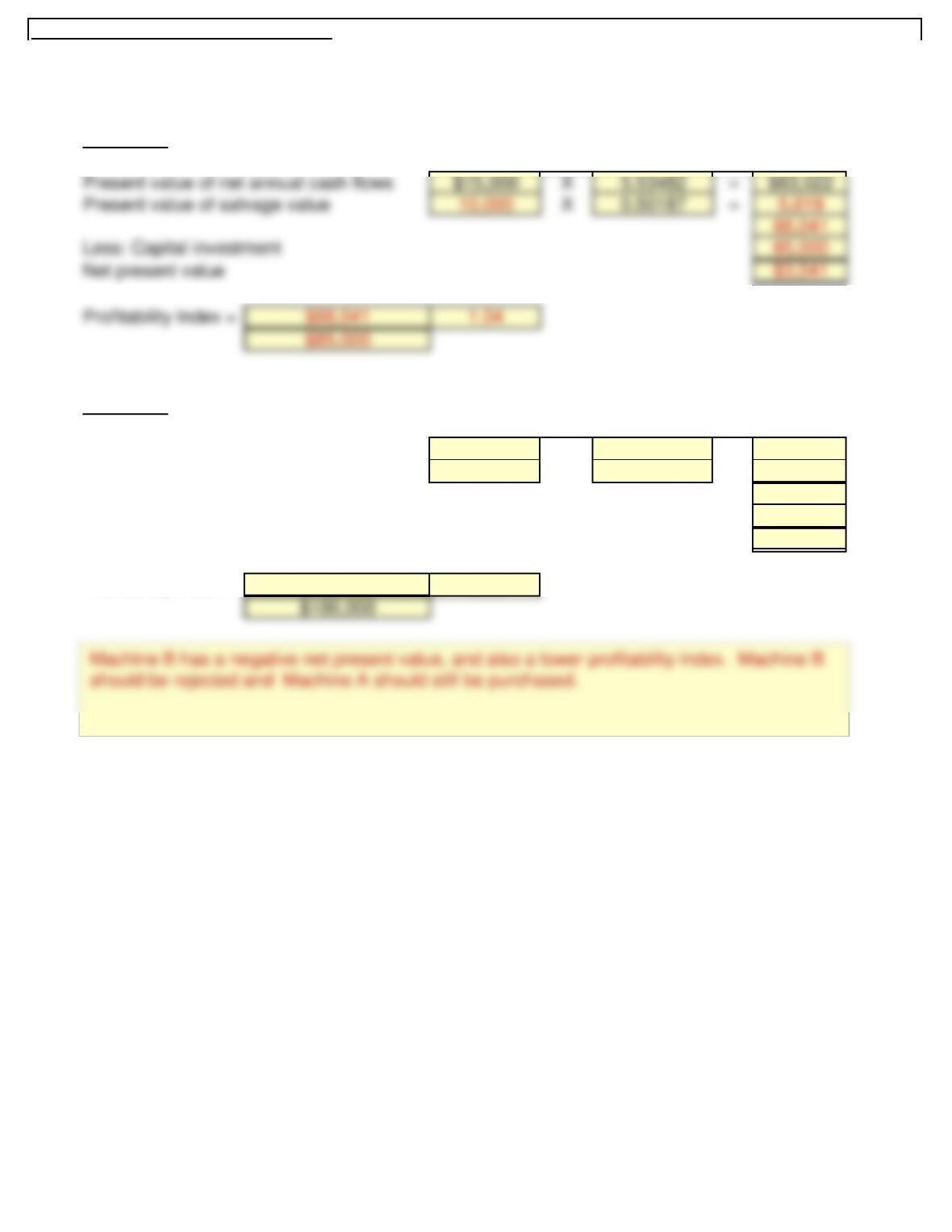
Profitability Index = $83,022 1.10
Machine B 9% Discount Present
Cash Flows X Factor = Value
Present value of net annual cash flows $30,000 X 5.53482 = $166,045
E12-4 Solution to additional question
1. Assume that the original cost of Machine A changed to $85,000 and has a salvage value of $10,000.
Which machine should be purchased?
Machine A 9% Discount Present
Cash Flows X Factor = Value
Machine B 9% Discount Present
Cash Flows X Factor = Value
Present value of net annual cash flows $30,000 X5.53482 =$166,045
Present value of salvage value 0 X 0.50187 = 0
166,045
Capital investment 180,000
Net present value ($13,955)
Profitability Index = $166,045 0.92
P12-1A Compute annual rate of return, cash payback, and net present value
U3 Company is considering three long-term capital investment proposals. Each investment has a useful life
of 5 years. Relevant data on each project are as follows.
Project Bono Project Edge Project Clayton
Capital investment $160,000 $175,000 $200,000
Annual net income:
Year 1 14,000 18,000 27,000
2 14,000 17,000 23,000
3 14,000 16,000 21,000
4 14,000 12,000 13,000
5 14,000 9,000 12,000
Total $70,000 $72,000 $96,000
Depreciation is computed by the straight-line method with no salvage value. The company’s cost of capital is 15%.
(Assume that cash flows occur evenly throughout the year.)
Instructions
(a) Compute the cash payback period for each project. (Round to two decimals.)
(b) Compute the net present value for each project. (Round to nearest dollar.)
(c ) Compute the annual rate of return for each project. (Round to two decimals.)
(Hint: Use average annual net income in your computation.)
(d) Rank the projects on each of the foregoing bases. Which project do you recommend?
NOTE: Enter a number in cells requesting a value; enter either a number or a formula in cells with a “?” .
(a) Net income Value Investment Value
Depreciation ? Annual net cash flows Value
Annual net cash flows ? Payback period in years ?
Net Annual Cumulative
Year Cash Flow Net Cash Flow
1 ? ?
2 ? ?
3 ? ?
4 ? ?
5 ? ?
Cash Payback Period:
Capital investment Value
Cumulative cash flow, year 3 ?
Remaining cost to be recovered (a) ?
Net cash flow, year 4 (b) Value
Payback period, year 4 (a) ÷ (b) ?
Total cash payback period in years ?
Net Annual Cumulative
Year Cash Flow Net Cash Flow
1 ? ?
2 ? ?
3 ? ?
4 ? ?
5 ? ?
Cash Payback Period:
Capital investment Value
Cumulative cash flow, year 3 ?
Remaining cost to be recovered (a) ?
Net cash flow, year 4 (b) Value
Cash payback period, year 4 (a) ÷ (b) Value
Total cash payback period in years Value
Project Bono
Project Edge
Project Clayton
(b) Project Bono 15% Present
Amount Years PV Factor Value
Net annual cash flows Value 1-5 3.35216 ?
Capital investment Value
Negative net present value ?
15%
Discount Cash Present Cash Present
Year Factor Flow Value Flow Value
1 0.86957 Value ? Value ?
2 0.75614 Value ? Value ?
3 0.65752 Value ? Value ?
4 0.57175 Value ? Value ?
5 0.49718 Value ? Value ?
Total Value ? Value ?
Capital Investment Value Value
Net present value ? ?
(c) Project Bono Project Edge Project Clayton
Average net income Value Value Value
Original Investment Value Value Value
Value at end of useful life Value Value Value
Average investment ? ? ?
Average net income (a) Value Value Value
Average investment (b) Value Value Value
Annual rate of return (a) ÷ (b) ? ? ?
Net Annual
(d) Project Cash Payback Present Value Rate of Return
Bono Value Value Value
Edge Value Value Value
Clayton Value Value Value
After you have completed the requirements of P12-1A, consider the additional question.
1. Assume that the investment amount of Project Clayton changed to $190,000.
Recalculate the payback period, net present value and annual return on Project Clayton.
Item
Project Edge
Project Clayton
Response:
P12-1A Solution
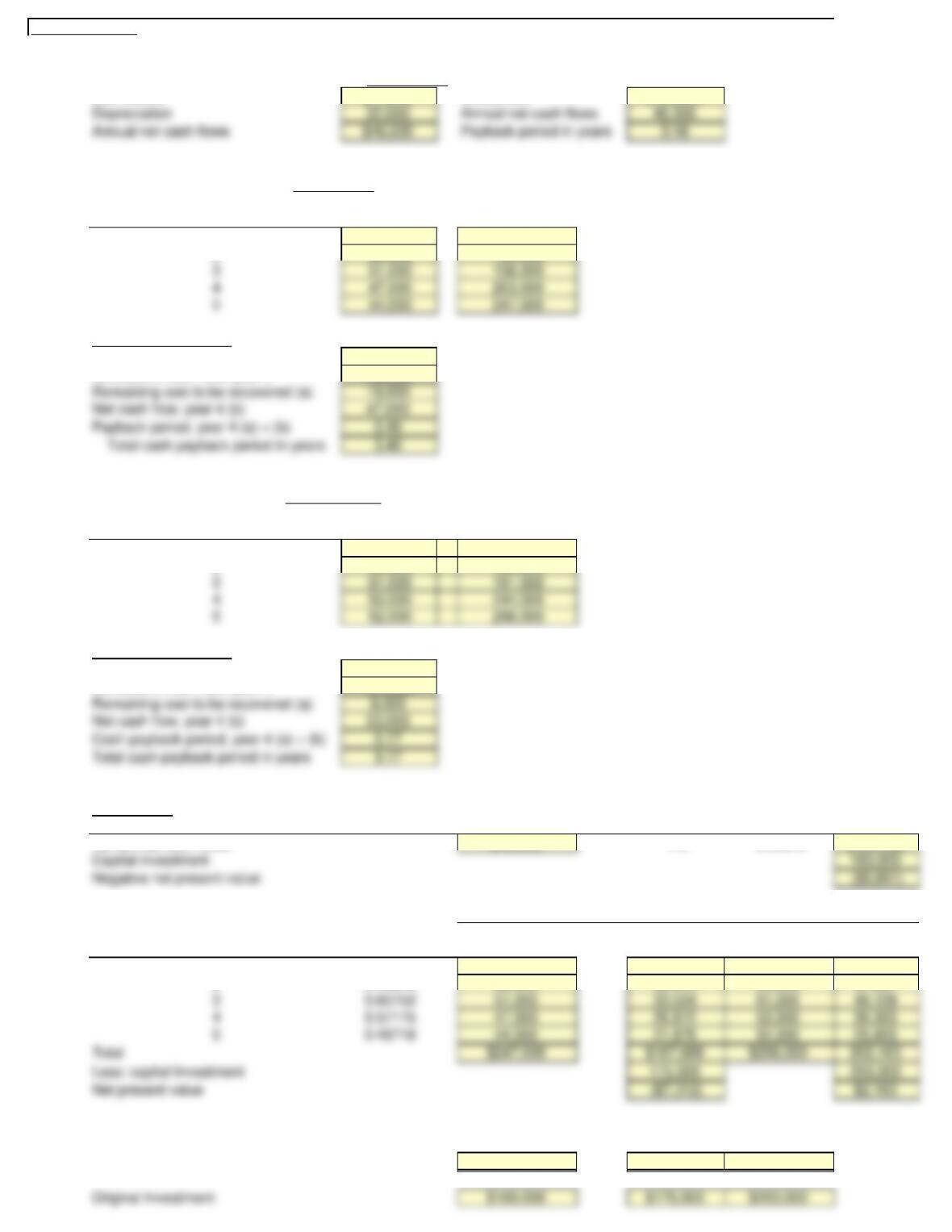
(a) Net income $14,000 Investment $160,000
Net Annual Cumulative
Year Cash Flow Net Cash Flow
1 $53,000 $53,000
2 52,000 105,000
Cash Payback Period:
Capital investment $175,000
Cumulative cash flow, year 3 156,000
Net Annual Cumulative
Year Cash Flow Net Cash Flow
1 $67,000 $67,000
2 63,000 130,000
Cash Payback Period:
Capital investment $200,000
Cumulative cash flow, year 3 191,000
(b) Project Bono 15% Present
Amount Years PV Factor Value
Net annual cash flows $46,000 1-5 3.35216 $154,199
15%
Discount Cash Present Cash Present
Year Factor Flow Value Flow Value
1 0.86957 $53,000 $46,087 $67,000 $58,261
2 0.75614 52,000 39,319 63,000 47,637
(c) Project Bono Project Edge Project Clayton
Average net income $14,000 $14,400 $19,200
Project Bono
Item
Project Edge
Project Clayton
Project Clayton
Project Edge

Value at end of useful life 0 0 0
Average investment $80,000 $87,500 $100,000
Net Annual
(d) Project Cash Payback Present Value Rate of Return
Bono 3 2 2
Edge 2 3 3
Clayton 1 1 1
The best project is Clayton
P12-1A Solution to additional problem
1. Assume that the investment amount of Project Clayton changed to $190,000.
Recalculate the payback period, net present value and annual return on Project Clayton.
Net Annual Cumulative
Year Cash Flow Net Cash Flow
1$65,000 $65,000
261,000 126,000
Cash Payback Period:
Capital investment $190,000
(b) 15% 15%
Discount Cash Present
Year Factor Flow Value
1 0.86957 $65,000 $56,522
2 0.75614 61,000 46,125
(c) Project Clayton
Average net income $19,200
Original Investment $190,000
Net Annual
(d) Project Cash Payback Present Value Rate of Return
Bono 3 2 2
Edge 2 3 3
Clayton 1 1 1
Project Clayton
Project Clayton
P12-4A Compute net present value considering intangible benefits
Jane’s Auto Care is considering the purchase of a new tow truck. The garage doesn’t currently
have a tow truck, and the $60,000 price tag for a new truck would represent a major expenditure.
Jane Austen, owner of the garage, has compiled the estimates shown below in trying to determine
whether the tow truck should be purchased.
Initial cost $60,000
Estimated useful life 8 years
Net annual cash flows from towing $8,000
Overhaul costs (end of year 4) $6,000
Salvage value $12,000
Jane’s good friend, Rick Ryan, stopped by. He is trying to convince Jane that the tow truck will have
other benefits that Jane hasn’t even considered. First, he says, cars that need towing need to be fixed.
Thus, when Jane tows them to her facility, her repair revenues will increase. Second, he notes that the
tow truck could have a plow mounted on it, thus saving Jane the cost of plowing her parking lot. (Rick
will give her a used plow blade for free if Jane will plow Rick’s driveway.) Third, he notes that the truck
will generate goodwill; people who are rescued by Jane’s tow truck will feel grateful and might be more
inclined to use her service station in the future or buy gas there. Fourth, the tow truck will have “Jane’s
Auto Care” on its doors, hood, and back tailgate – a form of free advertising wherever the tow truck
goes. Rick estimates that, at a minimum, these benefits would be worth the following.
Additional annual net cash flows from repair work $3,000
Annual savings from plowing 750
Additional annual net cash flows from customer “goodwill” 1,000
Additional annual net cash flows resulting from free advertising 750
The company’s cost of capital is 9%.
Instructions
(a) Calculate the net present value, ignoring the additional benefits described by Rick. Should the tow
truck be purchased?
(b) Calculate the net present value, incorporating the additional benefits suggested by Rick. Should the
tow truck be purchased?
(c ) Suppose that Rick has been overly optimistic in his assessment of the value of the additional benefits.
At a minimum, how much would the additional benefits have to be worth in order for the project to
be accepted?
NOTE: Enter a number in cells requesting a value; enter either a number or a formula in cells with a “?” .
(a) Calculate the net present value, ignoring the additional benefits described by Rick. Should the tow
truck be purchased?
The net present value based on the original estimates is as follows:
Cash 9% Discount Present
Flows X Factor = Value
Present value of net annual cash flows Value X 5.53482 = Value
Present value of cost of overhaul Value X 0.70843 = Value
Present value of salvage value Value X 0.50187 = Value
Value
Less: capital investment Value
Net present value Value
(b) Calculate the net present value, incorporating the additional benefits suggested by Rick. Should the
tow truck be purchased?
Response:
The net present value base on the revised estimates is as follows:
Cash 9% Discount Present
Flows X Factor = Value
Present value of net annual cash flows Value X 5.53482 = Value
Present value of cost of overhaul Value X 0.70843 = Value
Present value of salvage value Value X 0.50187 = Value
Value
Less: capital investment Value
Net present value Value
(c ) Suppose that Rick has been overly optimistic in his assessment of the value of the additional benefits.
At a minimum, how much would the additional benefits have to be worth in order for the project to
be accepted?
Net present value without intangibles Value
Present value of intangibles ?
Minimum value of intangibles to be Value
acceptable
After you have completed P12-4A, consider the following additional question.
1. Assume that the initial cost of the tow truck and the salvage value changed to $75,000 and
$10,000 respectively. Also assume that the annual cash flows changed to $11,000.
What impact do these changes have on your calculations?
Response:
Response:
P12-4A Solution
(a) Calculate the net present value, ignoring the additional benefits described by Rick. Should the tow
truck be purchased?
The net present value based on the original estimates is as follows:
Cash 9% Discount Present
Flows X Factor = Value
Present value of net annual cash flows $8,000 X 5.53482 = $44,279
Present value of cost of overhaul (6,000) X 0.70843 = (4,251)
(b) Calculate the net present value, incorporating the additional benefits suggested by Rick. Should the
tow truck be purchased?
The net present value based on the revised estimates is as follows:
Cash 9% Discount Present
Flows X Factor = Value
Present value of net annual cash flows $13,500 X 5.53482 = $74,720
(c ) Suppose that Rick has been overly optimistic in his assessment of the value of the additional benefits.
At a minimum, how much would the additional benefits have to be worth in order for the project to
be accepted?
Net present value without intangibles (13,950)
Based on its negative net present value, the tow truck should not be
purchased.
Based on the revised figures, the tow truck has a positive net present
The present value of the intangible benefits was $30,442 (the increase in the net present

The present value of the intangible benefits was $30,442 (the increase in the net present
value from a negative $13,950 to a positive $16,491). Rick’s estimates of the value of
P12-4A Solution to additional question
1. Assume that the initial cost of the tow truck and the salvage value changed to $75,000 and
$10,000 respectively. Also assume that the annual cash flows changed to $11,000.
What impact do these changes have on your calculations?
(a) Calculate the net present value, ignoring the additional benefits described by Rick. Should the tow
truck be purchased?
The net present value based on the original estimates is as follows:
Cash 9% Discount Present
Flows X Factor = Value
(b) Calculate the net present value, incorporating the additional benefits suggested by Rick. Should the
tow truck be purchased?
The net present value base on the revised estimates is as follows:
Cash 9% Discount Present
Flows X Factor = Value
Present value of net annual cash flows $16,500 X5.53482 =$91,325
(c ) Suppose that Rick has been overly optimistic in his assessment of the value of the additional benefits.
At a minimum, how much would the additional benefits have to be worth in order for the project to
be accepted?

acceptable
* Rounding difference
The present value of the intangible benefits was $30,442 (the increase in the net present
CD12 Current Designs
A company that manufactures recreational pedal boats has approached Mike Cichanowski to ask if he would be interested
in using Current Designs’ rotomold expertise and equipment to produce some of the pedal boat components. Mike is intrigued
by the idea and thinks it would be an interesting way of complementing the present product line.
One of Mike’s hesitations about the proposal is that the pedal boats are a different shape than the kayaks that Current
Designs produces. As a result, the company would need to buy an additional rotomold oven in order to produce the pedal boat
components. This project clearly involves risks, and Mike wants to make sure that the returns justify the risks. In this case, since
this is a new venture, Mike thinks that a 15% discount rate is appropriate to evaluate the project.
As an intern at Current Designs, Mike has asked you to prepare an initial evaluation of this proposal. To aid in your analysis,
he has provided the following information and assumptions.
1. The new rotomold oven will have a cost of $256,000, a salvage value of $0, and an 8-year useful life.
Straight-line depreciation will be used.
2. The projected revenues, costs, and results for each of the 8 years of this project are as follows.
Sales $220,000
Less
Manufacturing costs $140,000
Depreciation 32,000
Shipping and administrative costs 22,000 194,000
Income before income taxes $26,000
Income tax expense 10,800
Net income $15,200
Instructions
(a) Compute the annual rate of return. (Round to two decimal places.)
(b) Compute the payback period. (Round to two decimal places.)
(c ) Compute the NPV using a discount rate of 9%. (Round to nearest dollar.)
Should the proposal be accepted using this discount rate?
(d) Compute the NPV using a discount rate of 15%. (Round to nearest dollar).
Should the proposal be accepted using this discount rate?
NOTE: Enter a number in cells requesting a value; enter either a number or a formula in cells with a “?” .
(a) Compute the annual rate of return. (Round to two decimal places.)
Net income Value
Average investment Value
Annual rate of return ?
(b) Compute the payback period. (Round to two decimal places.)
Net income Value
Depreciation Value
Net annual cash flow ?
Cost of investment
Value
Net annual cash flow Value
Payback period in years ?
(c ) Compute the NPV using a discount rate of 9%. (Round to nearest dollar.)
Should the proposal be accepted using this discount rate?
Time
Period
Cash
Flows
9% Discount
Factor
Present
Value
Net annual cash flow 1-8 Value 5.53482 ?
Less: Oven purchase 0Value 1.00000 ?
Net present value ?
Event
Response:
(d) Compute the NPV using a discount rate of 15%. (Round to nearest dollar).
Should the proposal be accepted using this discount rate?
Time
Period
Cash
Flows
15%
Discount
Factor
Present
Value
Net annual cash flow 1-8 Value 4.48732 ?
Less: Oven purchase 0Value 1.00000 ?
Net present value ?
After you have completed CD12, consider the following additional question.
1. Assume that the initial cost of the oven and the salvage value changed to $260,000 and
$5,000 respectively. Also assume that net income changed to $14,700. What impact do
these changes have on your calculations?
Event
Response:
CD 12 Solution
(a) Compute the annual rate of return. (Round to two decimal places.)
Net income $15,200
(b) Compute the payback period. (Round to two decimal places.)
(c ) Compute the NPV using a discount rate of 9%. (Round to nearest dollar.)
Should the proposal be accepted using this discount rate?
Time
Period
Cash
Flows
9% Discount
Factor
Present
Value
Net annual cash flow 1-8 $47,200 5.53482 $261,244
(d) Compute the NPV using a discount rate of 15%. (Round to nearest dollar).
Should the proposal be accepted using this discount rate?
Time
Period
Cash
Flows
15%
Discount
Factor
Present
Value
Net annual cash flow 1-8 $47,200 4.48732 $211,802
Event
Event
CD12 Solution to additional question
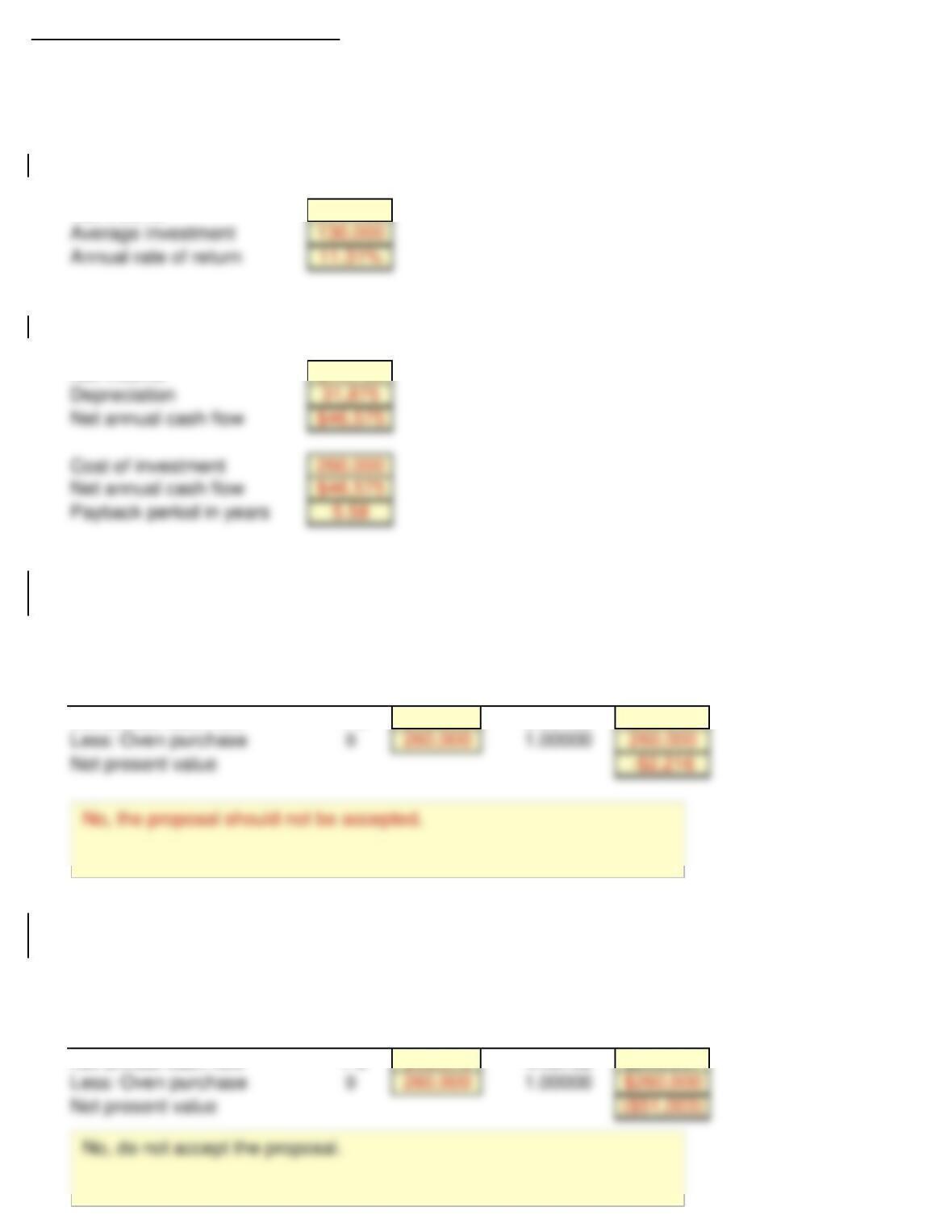
1. Assume that the initial cost of the oven and the salvage value changed to $260,000 and
$5,000 respectively. Also assume that net income changed to $14,700. What impact do
these changes have on your calculations?
(a) Compute the annual rate of return. (Round to two decimal places.)
Net income $14,700
(b) Compute the payback period. (Round to two decimal places.)
Net income $14,700
(c ) Compute the NPV using a discount rate of 9%. (Round to nearest dollar.)
Should the proposal be accepted using this discount rate?
Time
Period
Cash
Flows
9% Discount
Factor
Present
Value
Net annual cash flow 1-8 $46,575 5.53482 $257,784
(d) Compute the NPV using a discount rate of 15%. (Round to nearest dollar).
Should the proposal be accepted using this discount rate?
Time
Period
Cash
Flows
15%
Discount
Factor
Present
Value
Net annual cash flow 1-8 $46,575 4.48732 $208,997
Event
Event