
12-1
CHAPTER 12
ACTIVITY-BASED MANAGEMENT
DISCUSSION QUESTIONS
1. The two dimensions are the cost dimension
and the process dimension. The cost dimen-
sion is concerned with accurate assignment of
costs to cost objects, such as products and
customers. Activity-based costing is the focus
of this dimension. The second dimension—
the process dimension—provides information
about why work is done and how well it is
done. It is concerned with cost driver analysis,
activity analysis, and performance measure-
ment. This dimension offers the connection to
the continuous improvement world found in
the advanced manufacturing environment.
2. Driver analysis is concerned with identifying
the root causes of activity costs. Knowing
the root causes of activity costs is the key to
improvement and innovation. Once a man-
ager understands why costs are being in-
curred, then efforts can be taken to improve
cost efficiency. Driver analysis is a part of
process value analysis —along with activity
analysis and performance measurement.
3 Activity analysis is concerned with identify-
ing activities performed by an organization,
assessing their value to the organization,
and selecting and keeping only those that
are value-added. Selecting and keeping val-
ue-added activities bring about cost reduc-
tion and greater operating efficiency, thus
providing support for the objective of contin-
uous improvement.
4. Value-added activities are necessary
activities. Activities are necessary if they are
mandated or if they are not mandated and
satisfy three conditions: (1) they cause a
change of state, (2) the change of state is not
achievable by preceding activities, and
(3) they enable other activities to be
performed. Value-added costs are costs
caused by activities that are necessary and
efficiently executed.
5. Non-value-added activities are unnecessary
activities or necessary activities that are inef–
ficient and improvable. An example is moving
goods. Non-value-added costs are those
costs caused by non-value-added activities.
An example is the cost of materials handling.
6. (1) Activity elimination: the identification and
elimination of activities that fail to add value.
(2) Activity selection: the process of choos-
ing among different sets of activities caused
by competing strategies. (3) Activity reduc-
tion: the process of decreasing the time and
resources required by an activity. (4) Activity
sharing: increasing the efficiency of neces-
sary activities using economies of scale.
7. A kaizen standard is the planned improvement
for the coming period. The kaizen subcycle im-
plements the improvement, checks it, locks it
in, and then begins a search for additional im-
provements. The maintenance subcycle sets a
standard based on prior improvements, exe-
cutes, and checks the results to make sure that
performance conforms to the new results. If
not, then corrective action is taken.
8. Benchmarking identifies the best practices of
comparable internal and external units. For
internal units, information can be gathered
that reveals how the best unit achieves its re-
sults; these procedures can then be adopted
by other comparable units. For external units,
the performance standard provides an incen-
tive to find ways to match the performance. (It
may sometimes be possible to determine the
ways the performance is achieved.)
9. Activity flexible budgeting differs from unit-
based flexible budgeting by using flexible
budget formulas based on both unit-level
and non-unit-level drivers. Unit-based flexi-
ble budgeting uses only unit-level drivers in
its formulas.
10. Planning should identify the purposes and
objectives of an ABM system, its timeline for
implementation, the assigned responsibilities,
the resources required, the current and de-
sired future competitive position, the business
processes and product mix, and the ability of
the organization to implement the new sys-
tem and learn how to use the new information
produced.

12-2
11. ABM focuses on improving the efficiency of
activities and thus needs detailed descriptions
of what makes up each activity. Knowing the
tasks that define an activity makes it possible
to change the way the activity is done so that
overall activity performance improves.
12. An ABM implementation may lose manage-
ment’s support if it takes too long or if it fails
to produce the expected results. Often, the
expected results do not materialize because
managers do not know how to use the new
information, suggesting a lack of training
and education in the new system’s capabili-
ties. If the advantages of the new ABM sys-
tem are not detailed, then managers are
likely to resist the new system.
13. A lack of integration often means that ABM
is in direct competition or is perceived to be
in direct competition with other continuous
improvement methods and the official ac-
counting system. This state may cause
managers to reject the new ABM approach-
es and rely on continuous improvement
methods and accounting information with
which they are already familiar.
14. A financial-based responsibility accounting
system is characterized by four elements:
(1) a responsibility center, where responsi-
bility is assigned to an individual in charge
(responsibility is usually defined in financial
terms); (2) the setting of budgets and stand-
ards to serve as benchmarks for perfor-
mance measurement; (3) measurement of
performance by comparing actual outcomes
with budgeted outcomes; and (4) individuals
being rewarded or penalized according to
management policies.
15. In an activity-based responsibility accounting
system, the focus of control shifts from re-
sponsibility centers to processes and teams.
Management is concerned with how work is
done, not with where it is done. Process
improvement and process innovation are
emphasized. Standards tend to be optimal,
dynamic, and process oriented. Performance
measurement focuses on processes and ac-
tivities that define the processes. Finally,
there tends to be more emphasis on group
rewards rather than on individual rewards.
12-3
CORNERSTONE EXERCISES
Cornerstone Exercise 12.1
1. Value and Non-Value-Added Cost Report
For the Year Ended 2015
Value-Added Non-Value-Added Total
Activity Costs Costs Costs
Receiving ……………………. $ 252,000 $126,000 $ 378,000
Assembly ……………………. 1,125,000 225,000 1,350,000
2. Both expediting and storing are unnecessary activities. Both use resources
3. For receiving, cost reduction occurs only when the actual demand for receiv-
Cornerstone Exercise 12.2
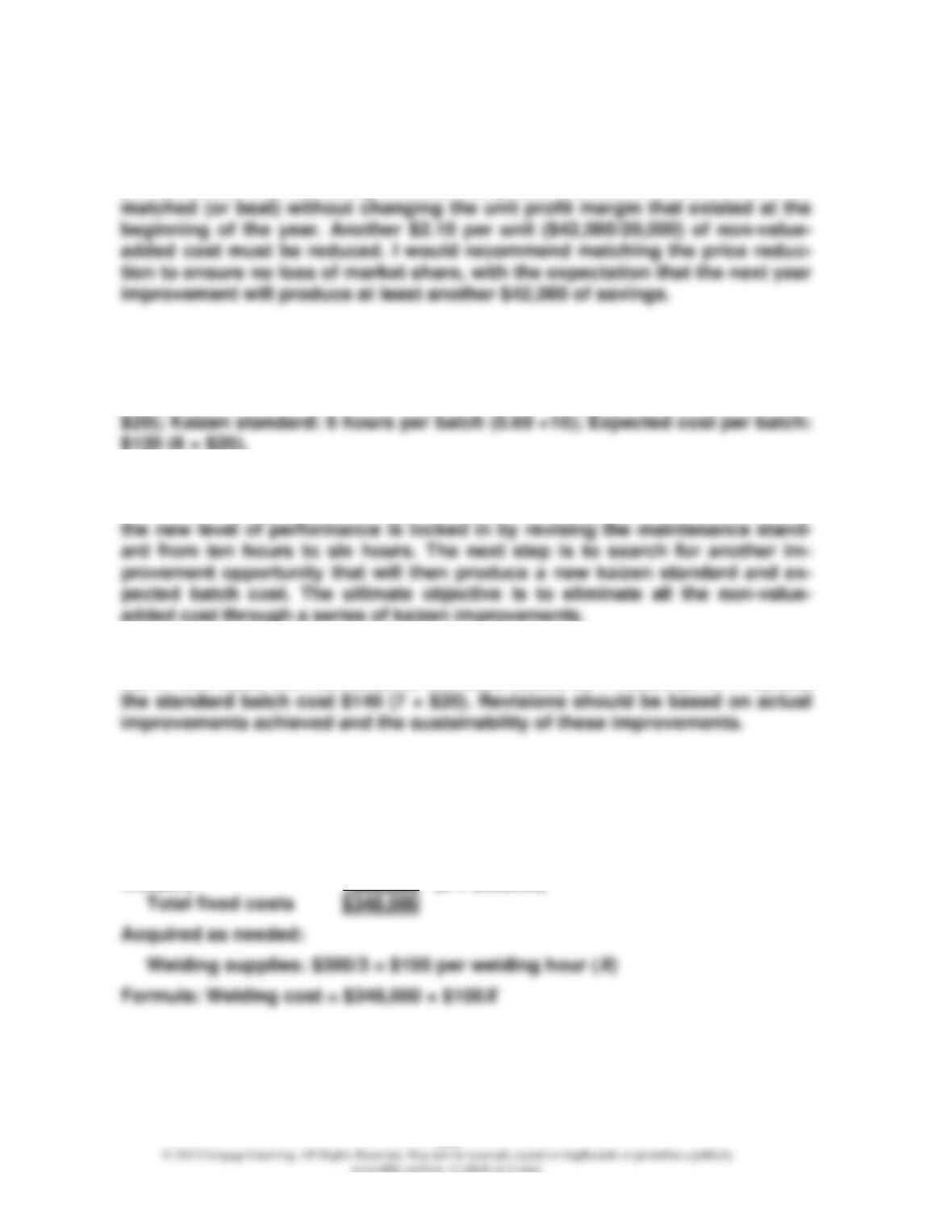
1. Trend Report: Non-Value-Added Costs
Activity 2014 2015 Change
Receiving ………………………………………….. $ 126,000 $ 0 $ 126,000
Assembly ………………………………………….. 225,000 45,000 180,000
12-4
Cornerstone Exercise 12.2 (Concluded)
3. From Requirement 1, the savings per unit of product are $24.90
($498,000/20,000), indicating that the competitor’s price reduction cannot be
Cornerstone Exercise 12.3
1. Setup standard: 10 hours per batch; Expected cost per batch: $200 (10 ×
2. Setup standard: 6 hours per batch; Expected cost per batch: $120 (6 × $20).
After determining that the suggested improvement works and is sustainable,
3. You lock in the level actually achieved by the suggested improvement meth-
od. In this case, the maintenance standard would be 7 hours (0.70 × 10) and
Cornerstone Exercise 12.4
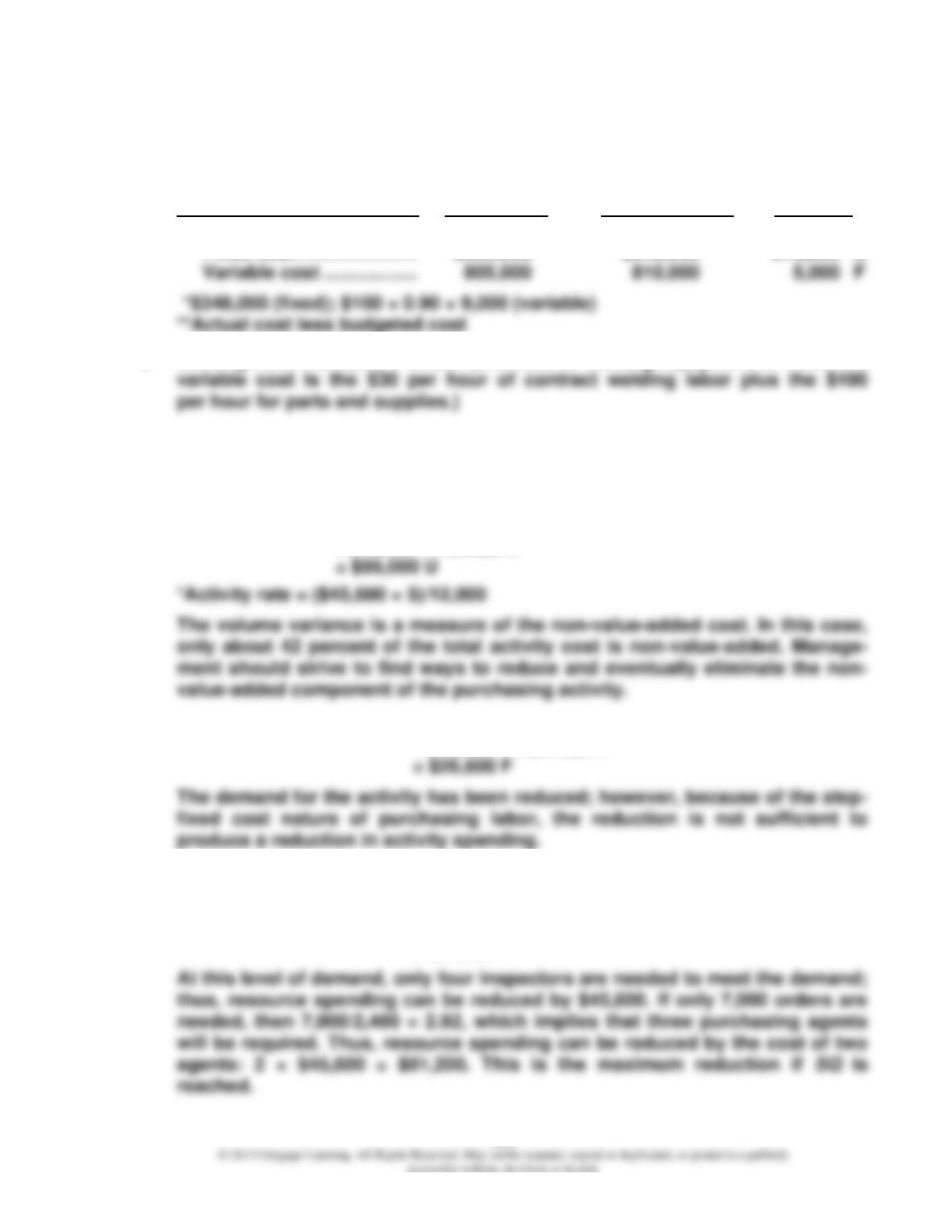
1. Acquired in advance of usage:
Welding equipment $ 48,000 (4 × $12,000)
Welders 300,000 (6 × $50,000)
12-5
Cornerstone Exercise 12.4 (Concluded)
2. Activity-Based Performance Report
Budgeted Cost Budget
Activity Actual Cost (90% level)* Variance**
Welding:
Fixed cost ………………….. $363,000 $348,000 $15,000 U
3. Welding cost = $48,000 + $130X (The cost of welding equipment is fixed; the
Cornerstone Exercise 12.5
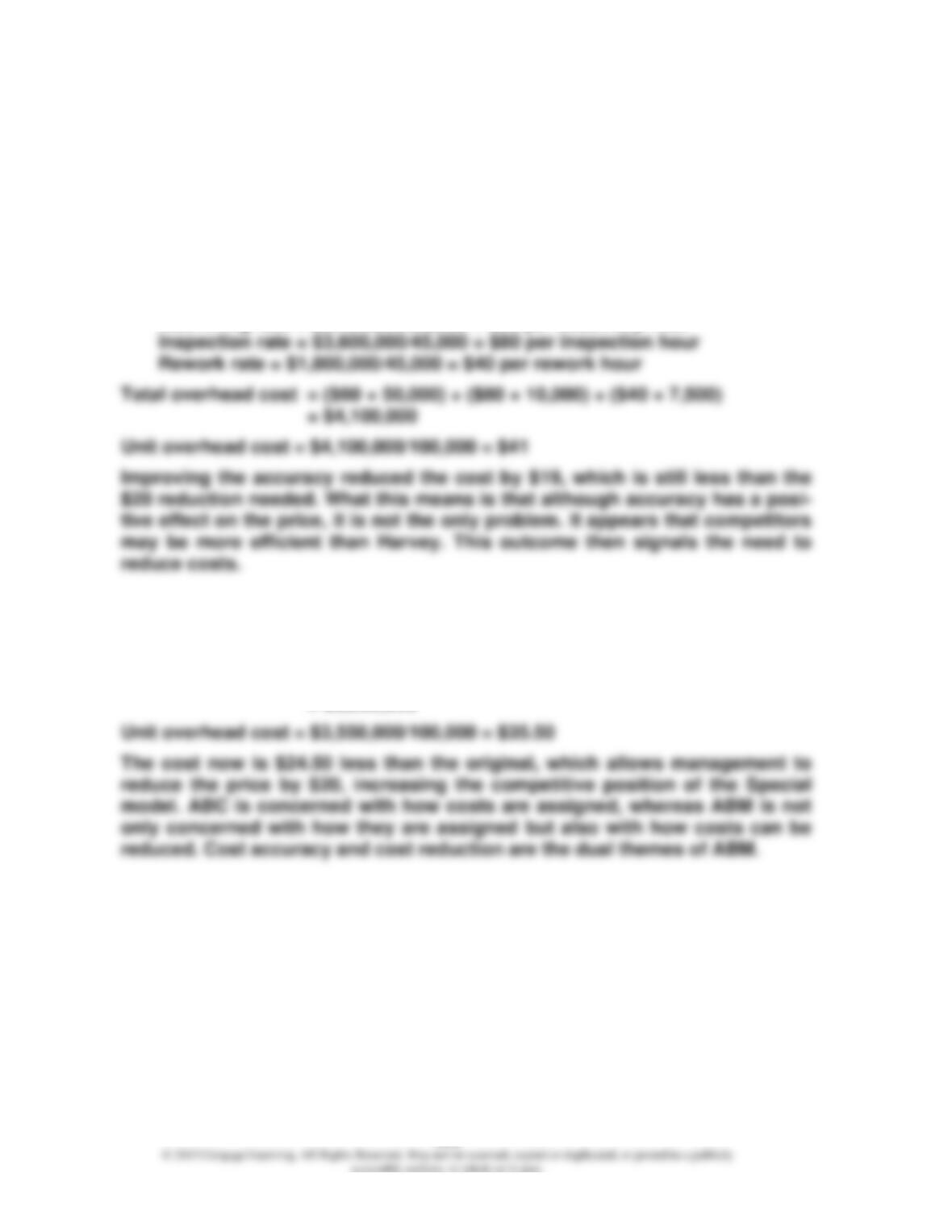
1. Purchasing is a value-added activity with SQ = 7,000. Thus,
Volume variance = (AQ – SQ)SP
= (12,000 – 7,000)$19*
2. Unused capacity variance = (AU – AQ)SP
= (10,600 – 12,000)$19
3. Recalculating the unused capacity variance:
Unused capacity variance = (AU – AQ)SP
= (9,000 – 12,000)$19
= $57,000 F
12-6
EXERCISES
Exercise 12.6
1. Plantwide rate = ($5,400,000 + $3,600,000 + $1,800,000)/90,000
= $120 per machine hour
Unit overhead cost = ($120 × 50,000)/100,000 = $60
Activity rates:
Machining rate = $5,400,000/90,000 = $60 per assembly hour
2. Since inspection and rework costs and their associated time are both re-
duced by 50 percent, the activity rates remain the same, although the amount
of cost assigned to the Special model will change:
Total overhead cost = ($60 × 50,000) + ($80 × 5,000) + ($40 × 3,750)
= $3,550,000
Exercise 12.7
The following are possible sets of questions and answers (provided as examples
of what students may suggest):
Cleaning oil:
Question: Why is the oil puddle cleaned daily?
Answer: Because the production equipment leaks oil every day.
Providing sales allowances:
Question: Why are we giving sales allowances?
Answer: Because the product is not working as it should.
Question: Why is the product not working as it should?
Answer: Usually because it has a defective component.
12-8
Exercise 12.8
Non-value-added:
Comparing documents (state detection) $144,000 (0.12 × $1,200,000)
Resolving discrepancies (rework) $876,000 (0.73 × $1,200,000)
Value-added:
Exercise 12.9
Questions 2–6 represent a possible sequence for the activity of comparing doc-
uments, and Questions 1 and 3–6 represent a possible sequence for resolving
discrepancies. The two activities have a common root cause.
Question 1: Why are we resolving discrepancies?
Answer: Because the purchase order, receiving order, and invoice have been
Question 2: Why are documents being compared?
Question 3: Why would the documents not agree?
Question 4: Why would a document be wrong?
Answer: Because the amount received from the supplier may not correspond
Question 5: Why are the amounts different?
Question 6: How can we avoid clerical error?
Answer: Training for our clerks will reduce the number of discrepancies; for
12-9
Exercise 12.10
1. A process is a collection of activities with a common objective. The common
objective of procurement is to supply bought and paid-for materials to opera-
2. The effect is to reduce the demand for the activity of resolving discrepancies
by 30 percent. By so doing, Thayne will save 21.9 percent (0.30 × 0.73) of its
Exercise 12.11
EDI eliminates the demand for virtually all the activities within the bill-paying pro-
cess. Some demand may be left for payment activities relative to the acquisition
12–10
Exercise 12.12
Case Non-Value-Added Cost Root Cause Cost Reduction
1 $22 per unita Process design Activity selection
2 $2,900 per setupb Product design Activity reduction
3 $80 per unitc Plant layout Activity elimination
Exercise 12.13
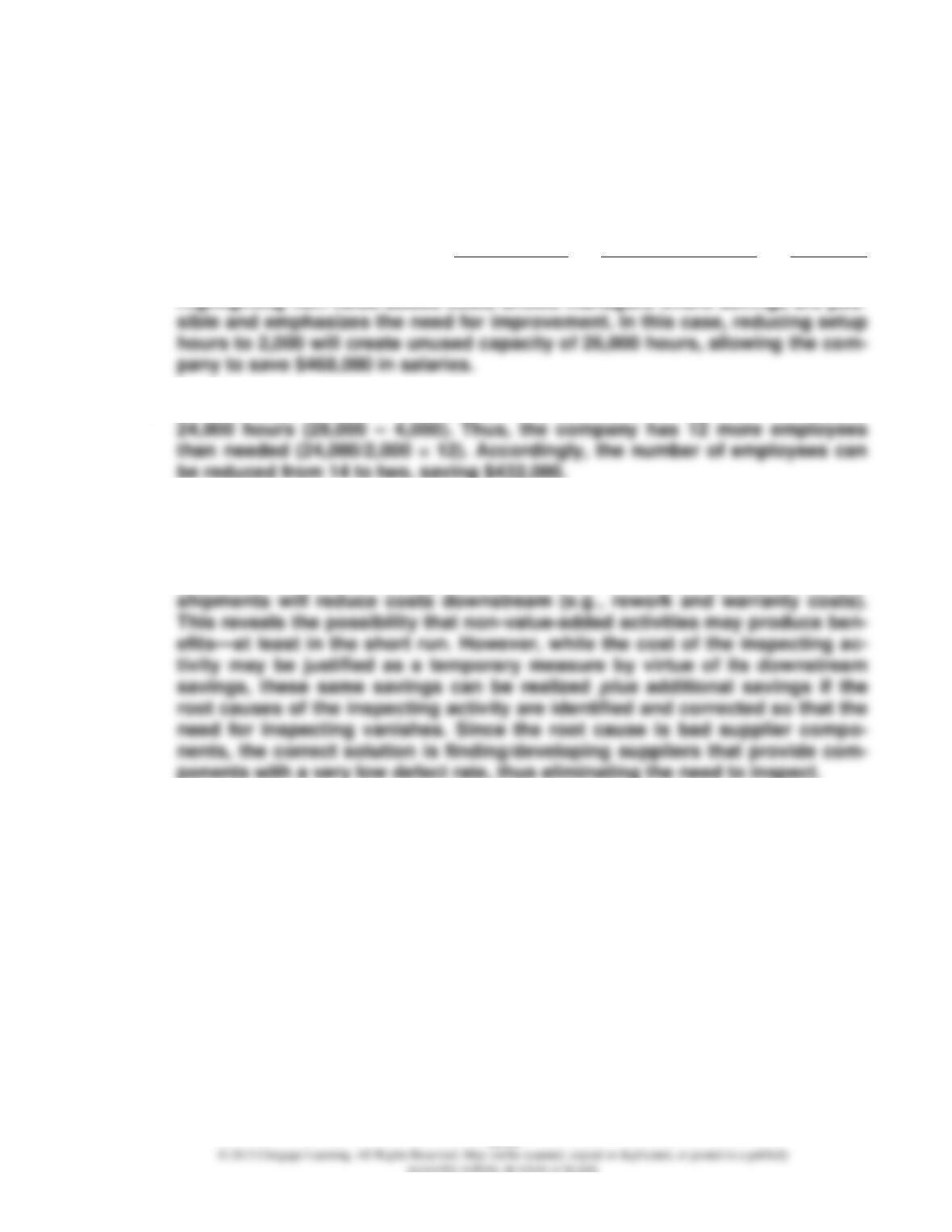
1. Fixed activity rate = SP = $504,000/28,000 = $18 per setup hour
Cost of unused capacity:
SP × SQ
SP × AQ
SP × AU
$18 × 2,000
$18 × 28,000
$18 × 26,200
$36,000
$504,000
$471,600
12–11
Exercise 12.13 (Concluded)
2. Value-added costs = $18 × 2,000 = $36,000
Non-value-added costs = $18 × 26,000 = $468,000
A value-added cost report would be as follows:
Value-Added Non-Value-Added Actual
Setting up …………………………... $36,000 $468,000 $504,000
Highlighting non-value-added costs shows managers where savings are pos-
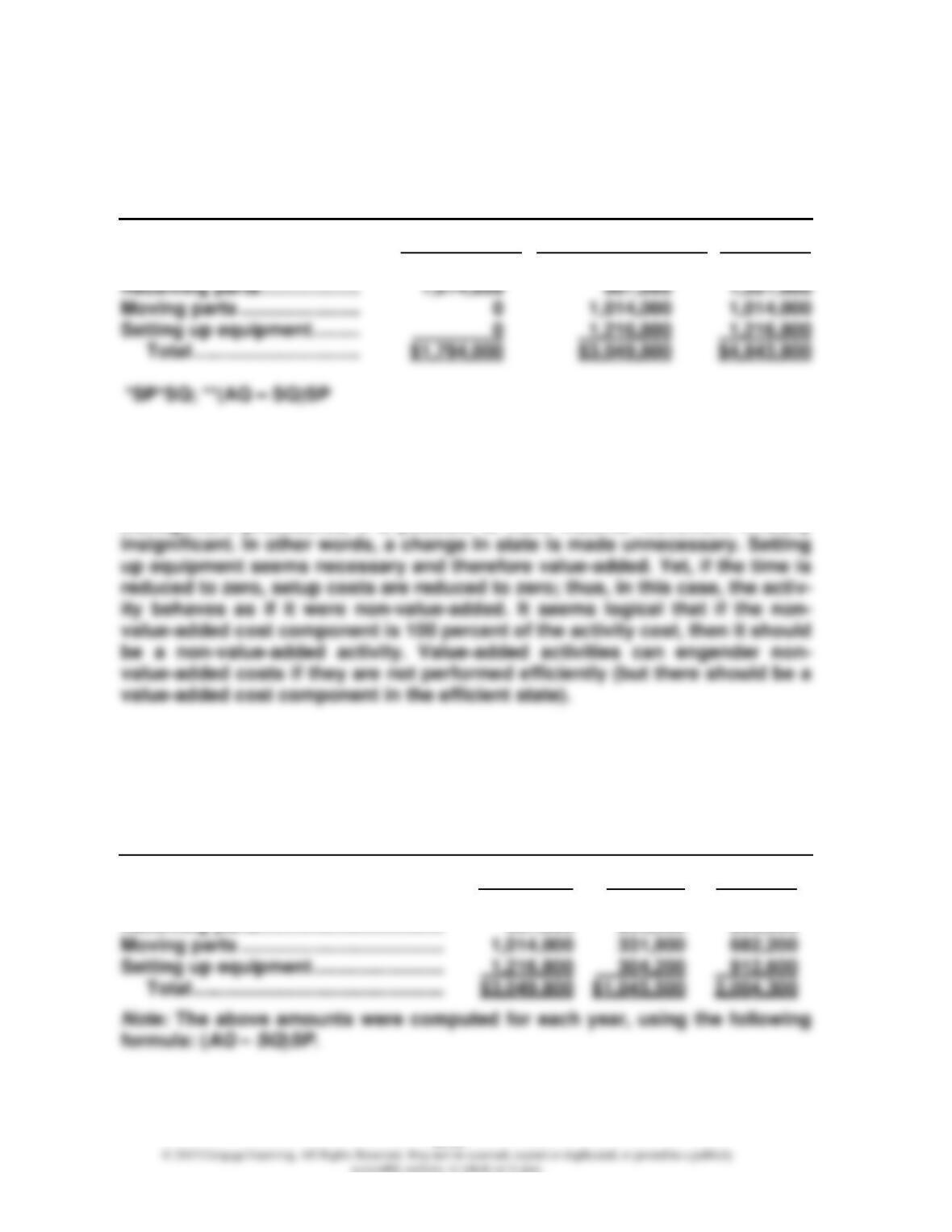
3. By reducing the demand to 4,000 hours, the unused capacity now equals
4. Inspection is a state-detection activity and not state changing and is, there-
fore, non-value-added. It exists because suppliers must be producing a sig-
nificant number of defective materials (components). It does produce bene-
fits in the sense that culling out defective units or rejecting especially bad
12–12
Exercise 12.14
1. Sanford, Inc.
Value- and Non-Value-Added Cost Report
For the Year Ended December 31, 2015
Value-Added* Non-Value-Added** Actual
Purchasing parts ……………. $ 780,000 $ 312,000 $ 1,092,000
2. Moving parts is non-value-added (SQ = 0 is a necessary condition for a non-
value-added activity). Moving parts does produce a change in state (changing
location is a state change as parts must be located where they are needed).
Yet, by proper design of the plant layout and by installing the right inventory
management procedures, it is possible to make material movement virtually
Exercise 12.15
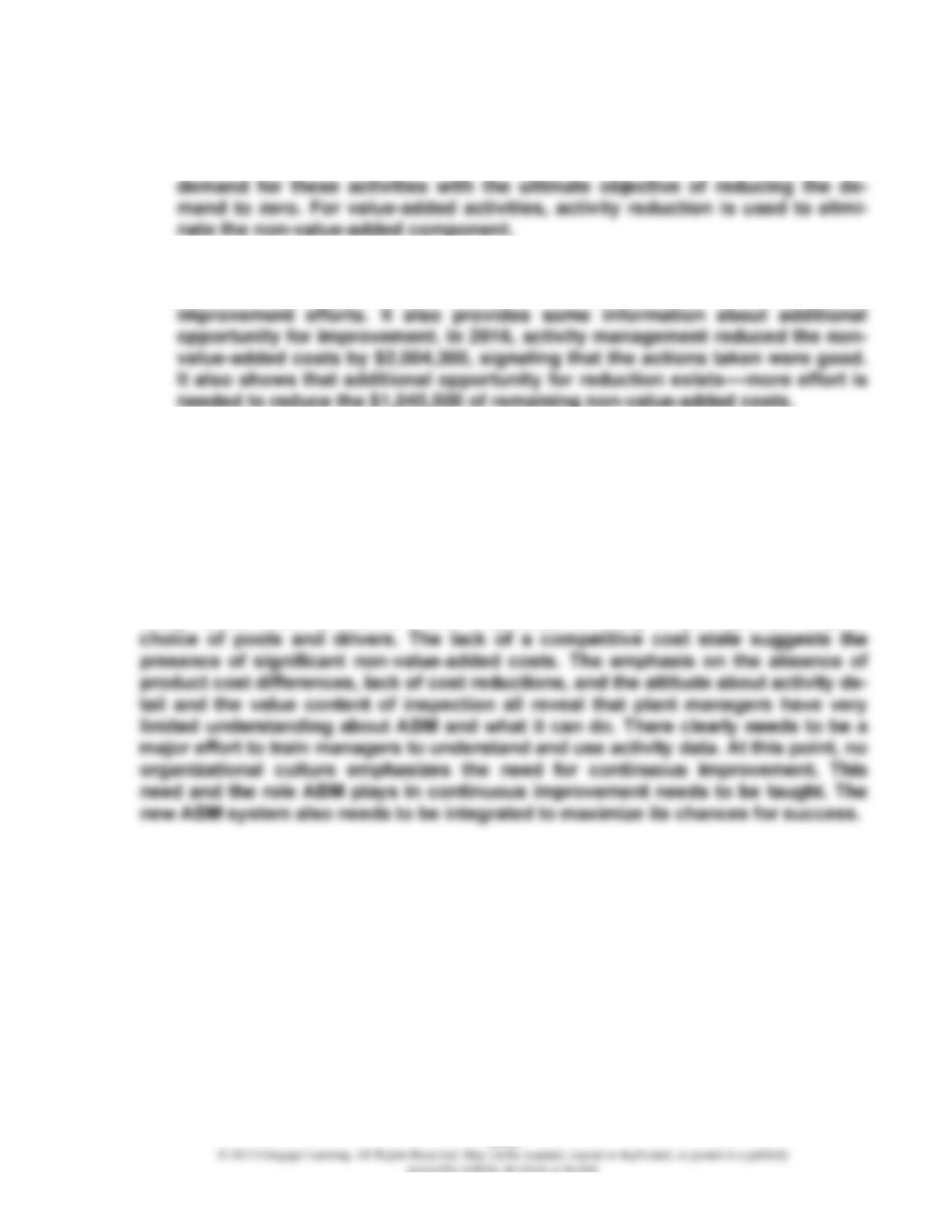
1. Sanford, Inc.
Non-Value-Added Cost Trend Report
For the Year Ended December 31, 2016
2015 2016 Change
Purchasing parts ………………………….. $ 312,000 $ 156,000 $ 156,000
Receiving parts …………………………..… 507,000 253,500 253,500
12–13
Exercise 12.15 (Concluded)
2. For non-value-added activities, activity reduction can serve to reduce the
3. A trend report allows managers to assess the effectiveness of activity man-
agement. It is a critical document that reveals the success of continuous
Exercise 12.16
The ABM implementation is taking too long and is not producing the expected
results. It also appears to not be integrated with the division’s official accounting
system, encouraging managers to continue relying on the old system (as evi-
denced by the continued reliance on traditional materials and labor efficiency
variances). The fact that the ABC product costs are not significantly different in
many cases could be due to a lack of product diversity or perhaps due to poor
12–14
Exercise 12.17
Classification:
Situation Activity-Based Financial-Based
1 A B
2 A B
Comments:
Situation 1: In a financial-based system, individuals are held responsible for the
efficiency of organizational units, such as the Grinding Department. In an activity–
based system, processes are the control points because they are the units of
change; they represent the way things are done in an organization. Improvement
Situation 2: In a financial-based responsibility system, individuals in charge of
responsibility centers are rewarded based on their ability to achieve the financial
goals of the responsibility center. Thus, meeting budget promises the “fat” bonus.
In a continuous improvement environment, process improvement is dependent on
Exercise 12.17 (Concluded)
Situation 4: In a financial-based system, performance of subunits is usually
financial-based and is measured by comparing actual with budgeted outcomes. In
an activity-based system, process performance is emphasized. The objective is to
provide low-cost, high-quality products, delivered on a timely basis. Thus, both
financial and nonfinancial measures are needed.
Situation 5: In a financial-based system, budgets and standards are used to con-
trol costs. In an activity-based responsibility system, the focus is on activities
because activities are the cause of costs. Driver analysis and activity analysis are
fundamental to the control process. Driver analysis recognizes that controlling
Situation 6: A financial-based system uses currently attainable standards that al-
low for a certain amount of inefficiency. Achieving standards is the emphasis,
and there is no effort to improve on the standards themselves. An activity-based
CPA-TYPE EXERCISES
Exercise 12.18
d. Assembling, purchasing, and designing new produces are all necessary activi-
Exercise 12.19
Exercise12.20
Exercise 12.21
a. The other answers are features of activity-based costing.
Exercise 12.22
c. The total activity capacity is 20,000 moves (4 × 5,000). Thus, the unused capaci-