(continued) P 12-75B
Req. 1
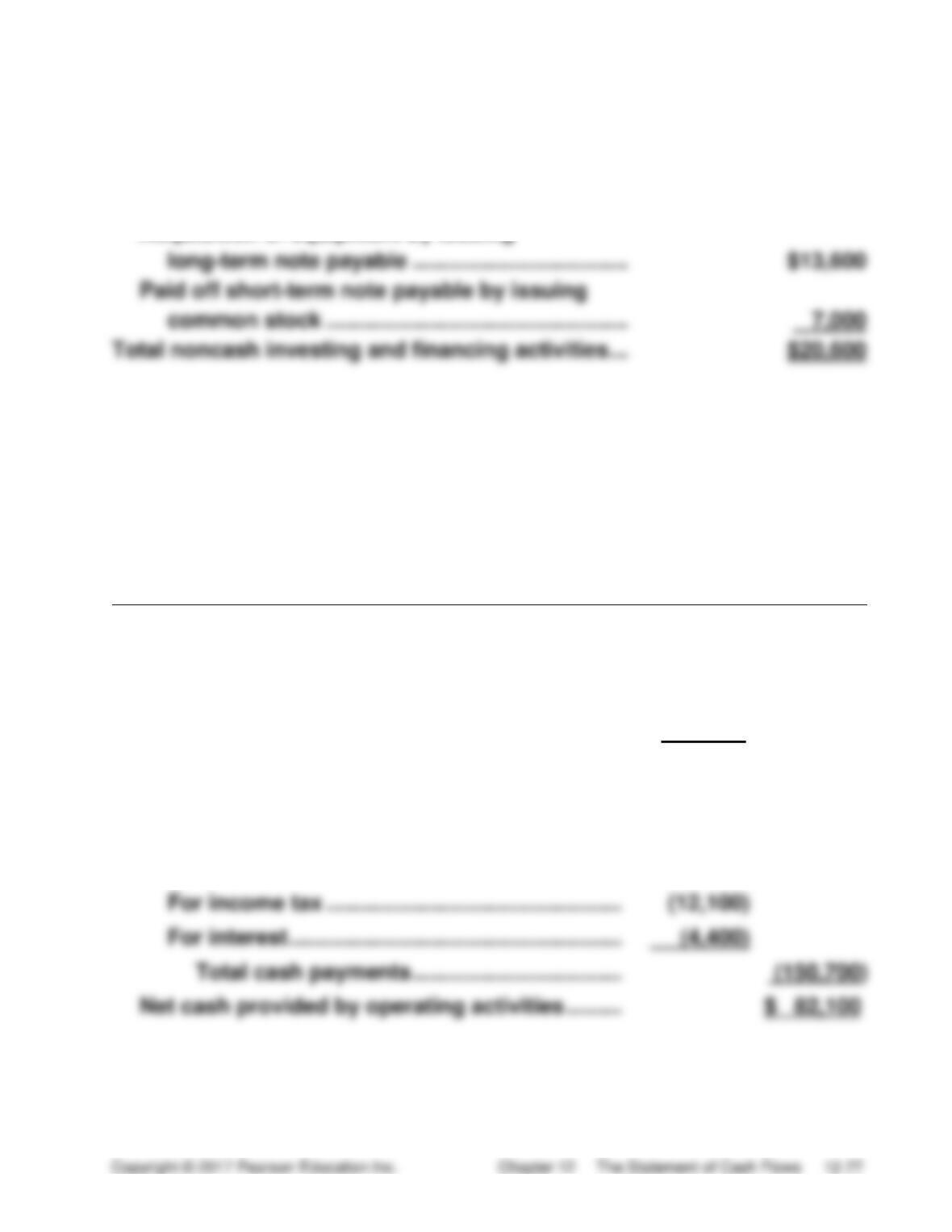
Noncash investing and financing activities:
Acquisition of equipment by issuing
long-term note payable ……………………………..
Req. 2
Sally Fagan Design Studio, Inc.
Statement of Cash Flows
Year Ended June 30, 2016
Cash flows from operating activities:
Receipts:
Collections from customers ……………………..
$ 231,600
Interest received ………………………………………
1,200
Total cash receipts ……………………………….
$ 232,800
Payments:
To suppliers …………………………………………….
$(95,100)
To employees …………………………………………..
(39,100)
For interest ………………………………………………
Total cash payments …………………………….
Net cash provided by operating activities ………
Challenge Exercises and Problem
(20-30 min.) E 12-76
(All amounts in thousands)
Decrease in
Sales
+
Accounts Receivable
a.
Collections
=
$23,996
=
$23,984
+
($609 − $597)
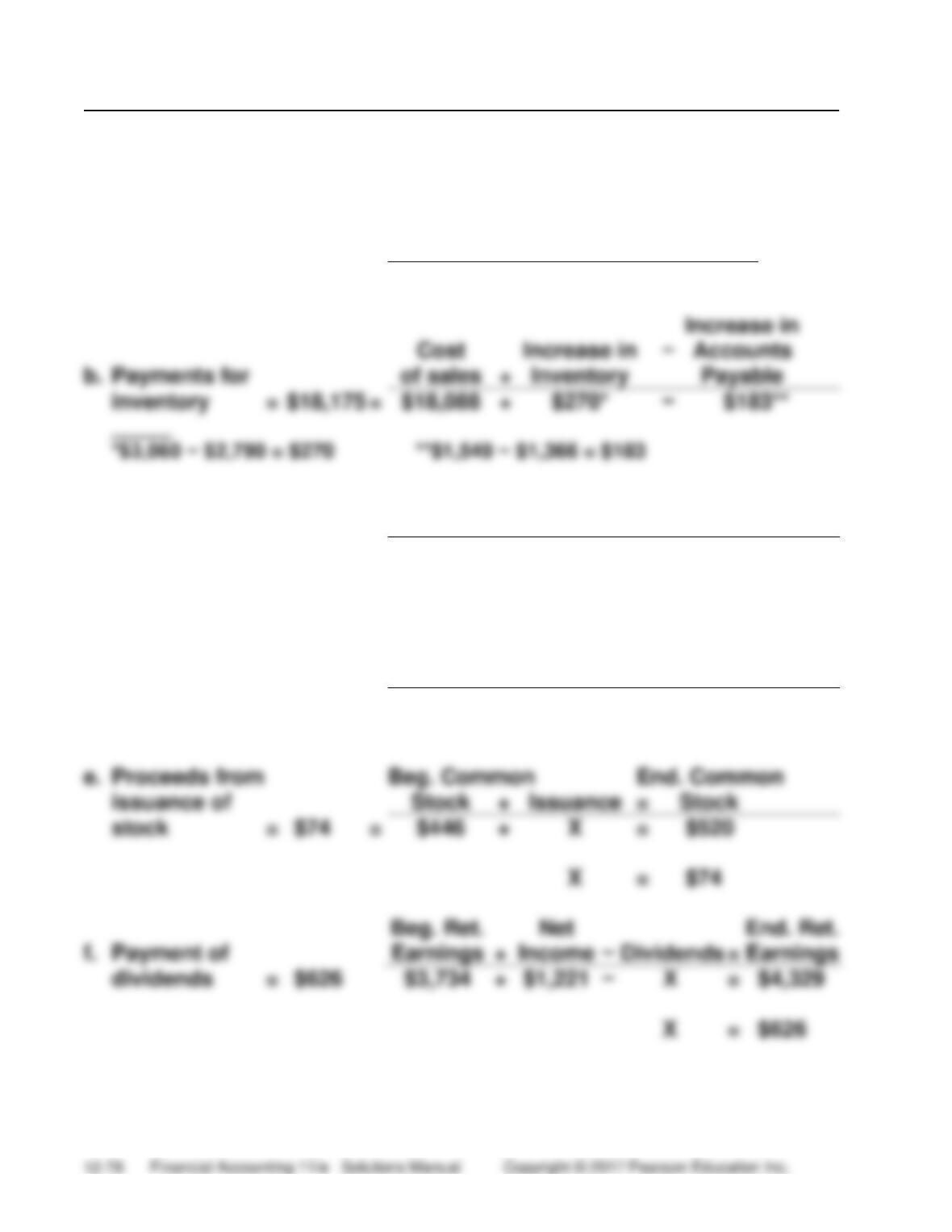
Payments for
inventory
=
$18,175
=
$18,088
+
−
$183**
Other Operating
Increase in
c.
Payments for
Expenses
− Accrued Liabilities
other
operating
=
$3,577
=
$3,880
− ($942 − $639)
expenses
Increase in
d.
Payment of
Tax Expense −
Income Tax Payable
income tax
=
$525
=
$536 −
($201 − $190)
e.
Proceeds from
Beg. Common
End. Common
issuance of
= Stock
stock
=
$74
=
X
= $520
= $74
Beg. Ret.
End. Ret.
Payment of
− Dividends
= Earnings
dividends
=
= $4,329
X
= $626
(20 min.) E 12-77
a.
(All in thousands)
Loss on sale of
Book value of
assets sold
Proceeds from
sale of assets
property and
=
−
=
−
Property & Equipment, Net
Bal., 12/31/15
9,640
Capital
Depreciation exp.
1,890
expenditures
4,130
Book value of
property and
equipment sold
X
= 880
Bal., 12/31/16
11,000
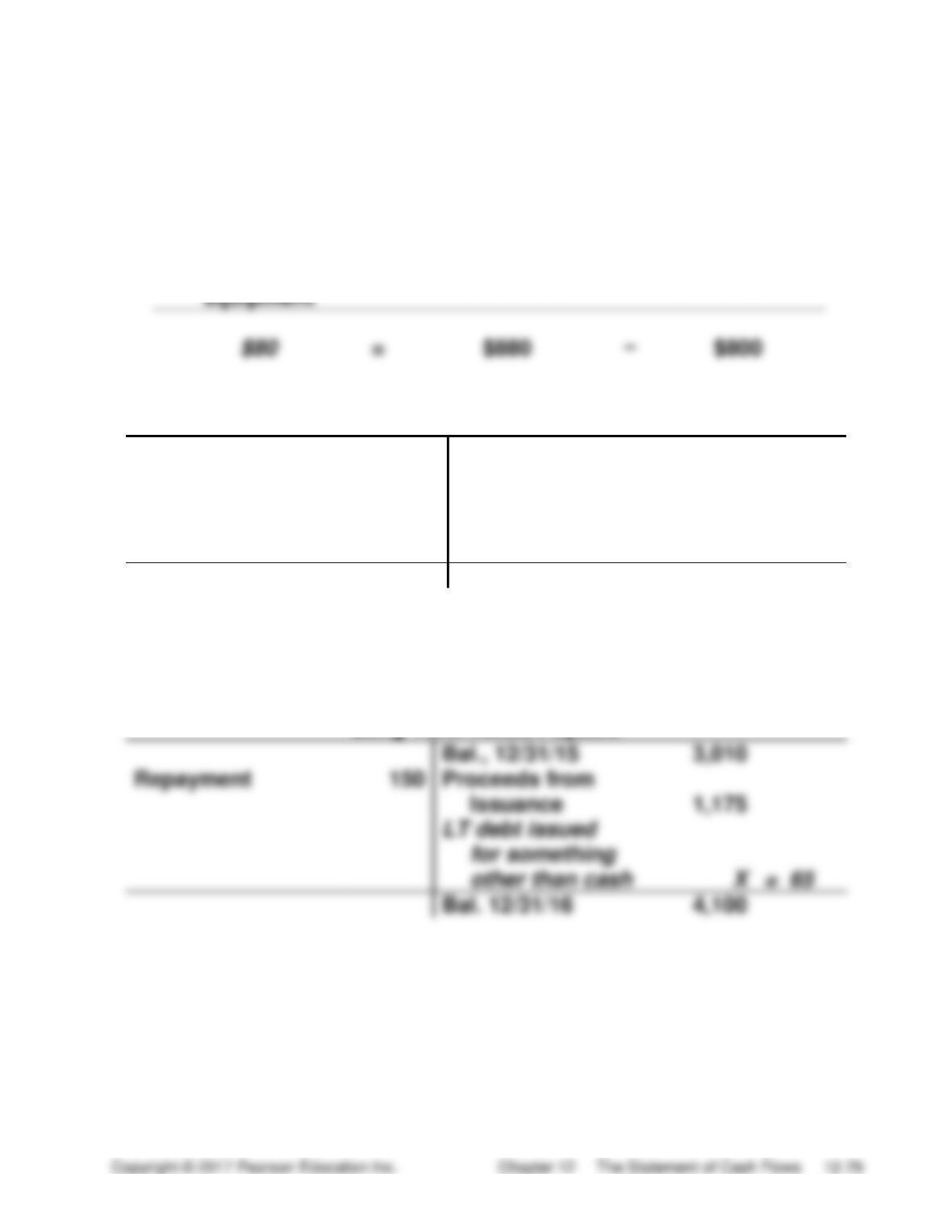
b.
Repayment
Proceeds from
Issuance
LT debt issued
for something
other than cash
= 65
P 12–78
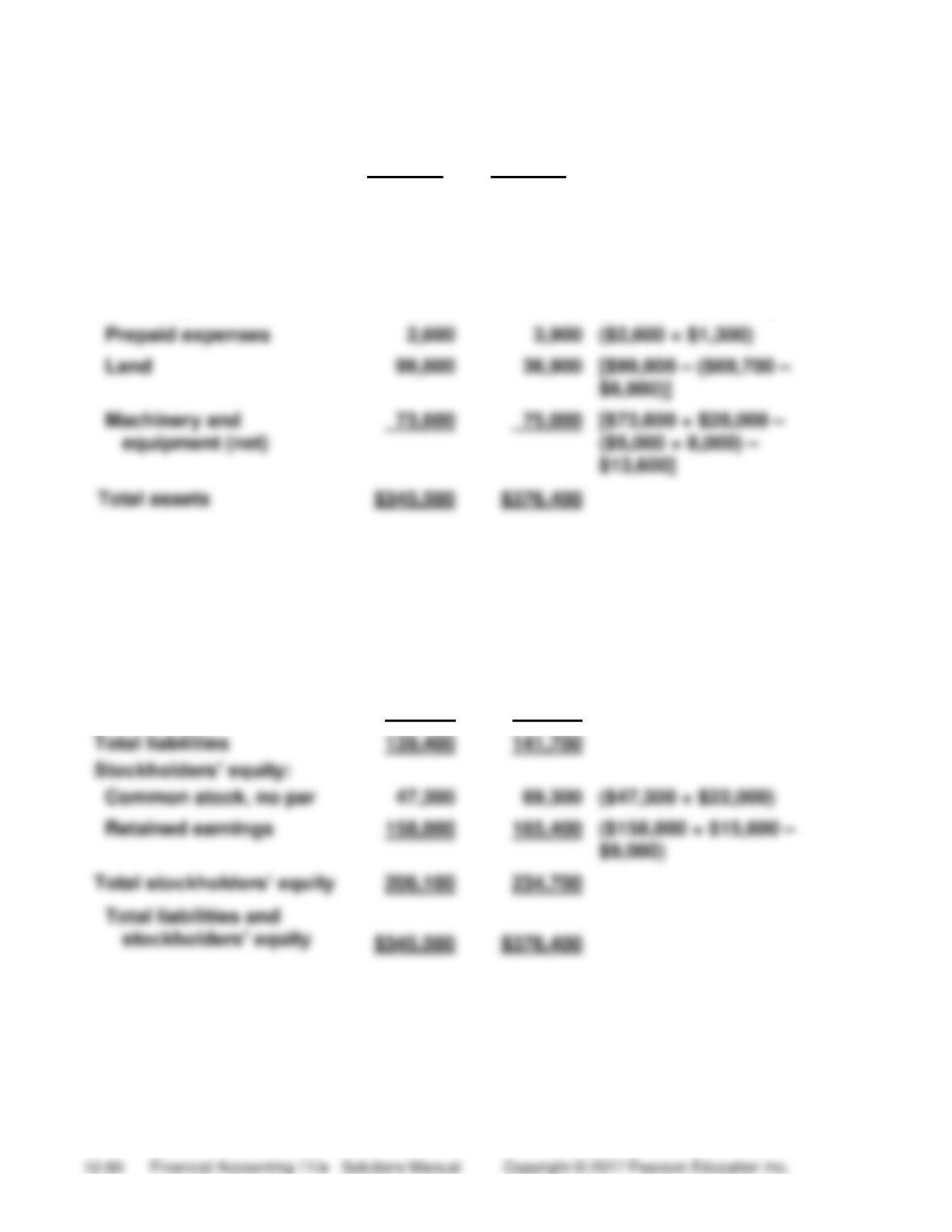
Assets:
December
31, 2015
December
31, 2016
Cash and cash
equivalents
$14,000
$153,500
Given
Accounts receivable
(net)
95,000
28,700
($95,000 – $66,300)
Inventory
60,500
78,400
($60,500 + $17,900)
Prepaid expenses
3,900
($2,600 + $1,300)
Liabilities:
Accounts payable
$40,300
$41,300
($40,300 + $1,000)
Unearned revenue
9,000
24,000
($9,000 + $15,000)
Dividends payable
-0-
6,000
($9,000 – $3,000)
Income taxes payable
6,000
1,300
($6,000 – $4,700)
Long-term debt
84,100
69,100
($84,100 – $15,000)
Total liabilities
139,400
141,700
Common stock, no par
Retained earnings
Total liabilities and
Decision Cases
(45-60 min.) Decision Case 1
Req. 1 (indirect method for operating activities)
T-Bar-M Camp, Inc.
Statement of Cash Flows
Year Ended December 31, 2016
Cash flows from operating activities:
(Thousands)
Net income ……………………………………………………………
$ 97
Adjustments to reconcile net income to
net cash provided by operating activities:
Depreciation expense ………………………………………
$ 46
Amortization of patents ……………………………………
Increase in accounts receivable ($72 − $61) ………
Increase in inventories ($194 − $181) ………………..
Increase in accounts payable ($63 − $56) ………….
Decrease in accrued liabilities ($17 − $12) ………..
35
Net cash provided by operating activities …………….
Cash flows from investing activities:
Purchase of property, plant, and
equipment ($369 − $259) ……………………………………..
$(110)
Purchase of long-term investments ($31 − $0) …………
(31)
Net cash used for investing activities ………………….
(141)
Cash flows from financing activities:
Issuance of common stock ($149 − $61) …………………
$ 88
Payment of cash dividends ($156 + $97 − $213) ………
Payment of long-term notes payable ($264 − $179) ….
(85)
Net cash used for financing activities ………………….
(37)
Cash balance, December 31, 2015 ……………………………..
Cash balance, December 31, 2016 ……………………………..
$ 17
(continued) Decision Case 1
Req. 2
The cash balance at the end of 2016 is low because:
• The camp paid $110,000 to buy new property, plant, and
equipment.
• The camp paid off $85,000 of notes payable.
Req. 3
Year 2016 was a good year. Net income was $97,000, and operations
were the largest source of cash. Also, the company increased its
property, plant, and equipment by $110,000 and paid off $85,000 of debt.
(15-25 min.) Decision Case 2
Four-Star Catering looks like the better investment because:
1. Operations provide far more cash for Four-Star than for Applied
Technology. Operations should be the main source of cash for a
healthy company.
2. Four-Star is investing more in long-term plant assets than Applied is.
Four-Star is laying a more solid foundation in revenue-producing
assets than Applied is.
Ethical Issue
Req. 1
Cash flows from operating
activities:
Without
Reclassification
With
Reclassification
Net income ………………………
$ 37,000
$37,000
Increase in accounts
receivable ………………………..
Net cash (used for) provided
by operating activities …………..
$37,000
cash flow from operations is positive.
Req. 2
The issue is whether or not it is ethical to reclassify accounts receivable
from current assets to long-term assets.
Req. 3 and Req. 4
The stakeholders are Columbia, its officers, directors and employees, as
well as their present and future creditors and stockholders.
(continued) Ethical case
Legal analysis: To reclassify receivables when, in fact, they are not truly
collectible, even in the long run, might leave the company open later to a
lawsuit for damages suffered by creditors who loan Columbia money
based on false information.
Req. 5
The receivables should be classified in the way that best describes their
collectability. In reality, most bank loan officers who know financial
accounting (and most do) will closely examine these receivables and
classify them as short-term for their own lender analysis.
Req. 6
Focus on Financials: Apple Inc.
(40-50 min.)
Req. 1
Req. 2
The main source of cash is operating activities ($59,713 million). This
indicates that Apple Inc.’s basic operations are generating significant
cash for the company to finance current operations.
Apple is a healthy company. Its net decrease in cash is $415 million but
Apple still has enough cash and cash equivalents to cover its operating,
investing, and financing activities in the future.
(continued) Apple Inc.
Req. 3
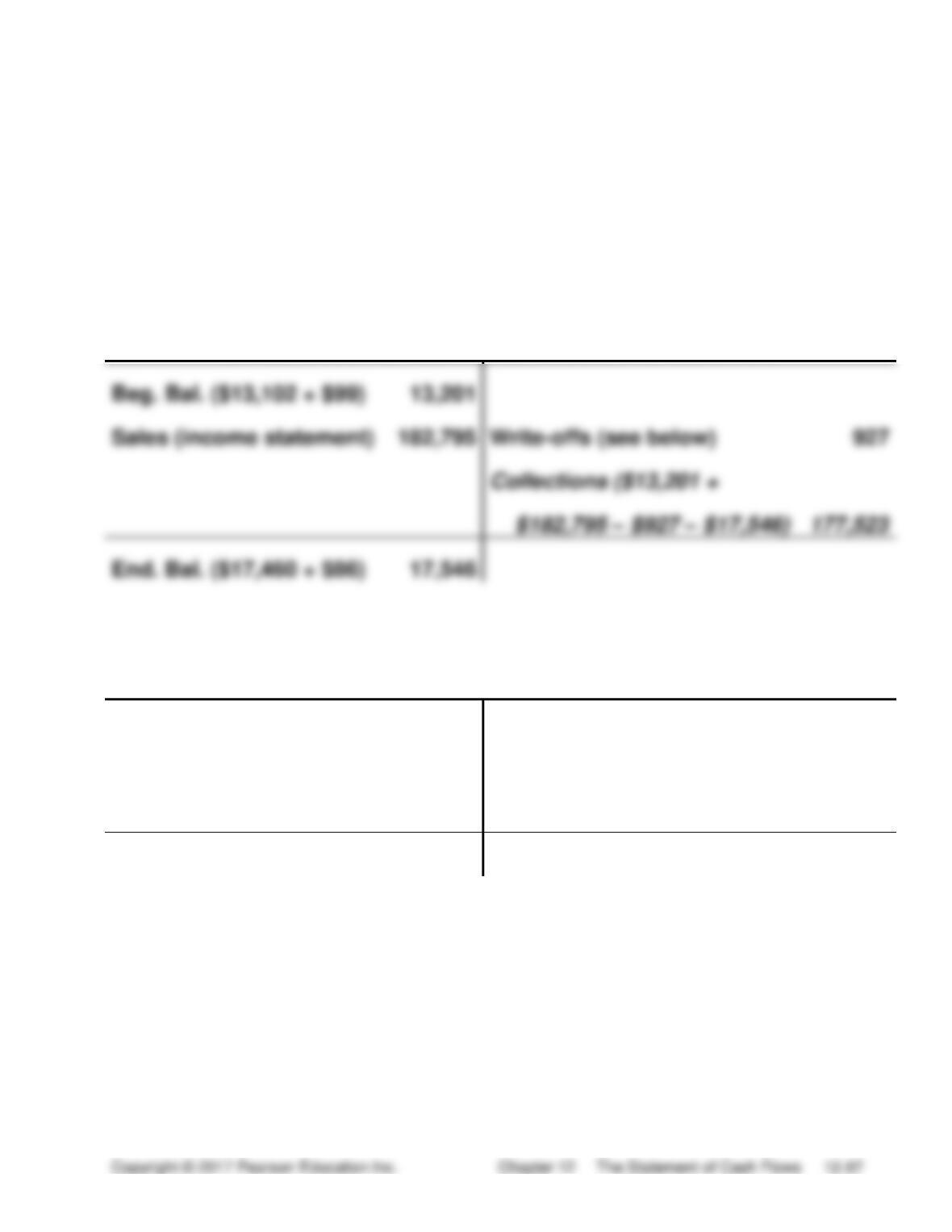
a. The Balance Sheet provides the balance of Allowance for Doubtful
accounts.
Gross Accounts Receivable, Vendors and Customers
Beg. Bal. ($13,102 + $99)
Sales (income statement)
Write-offs (see below)
177,523
End. Bal. ($17,460 + $86)
Allowance for Doubtful Accounts
Beg. Bal.
99
Write-offs ($99 + $914 –
Doubtful accounts expense
$86)
927
($182,795 x .005)
914
End. Bal.
86
(continued) Apple Inc.
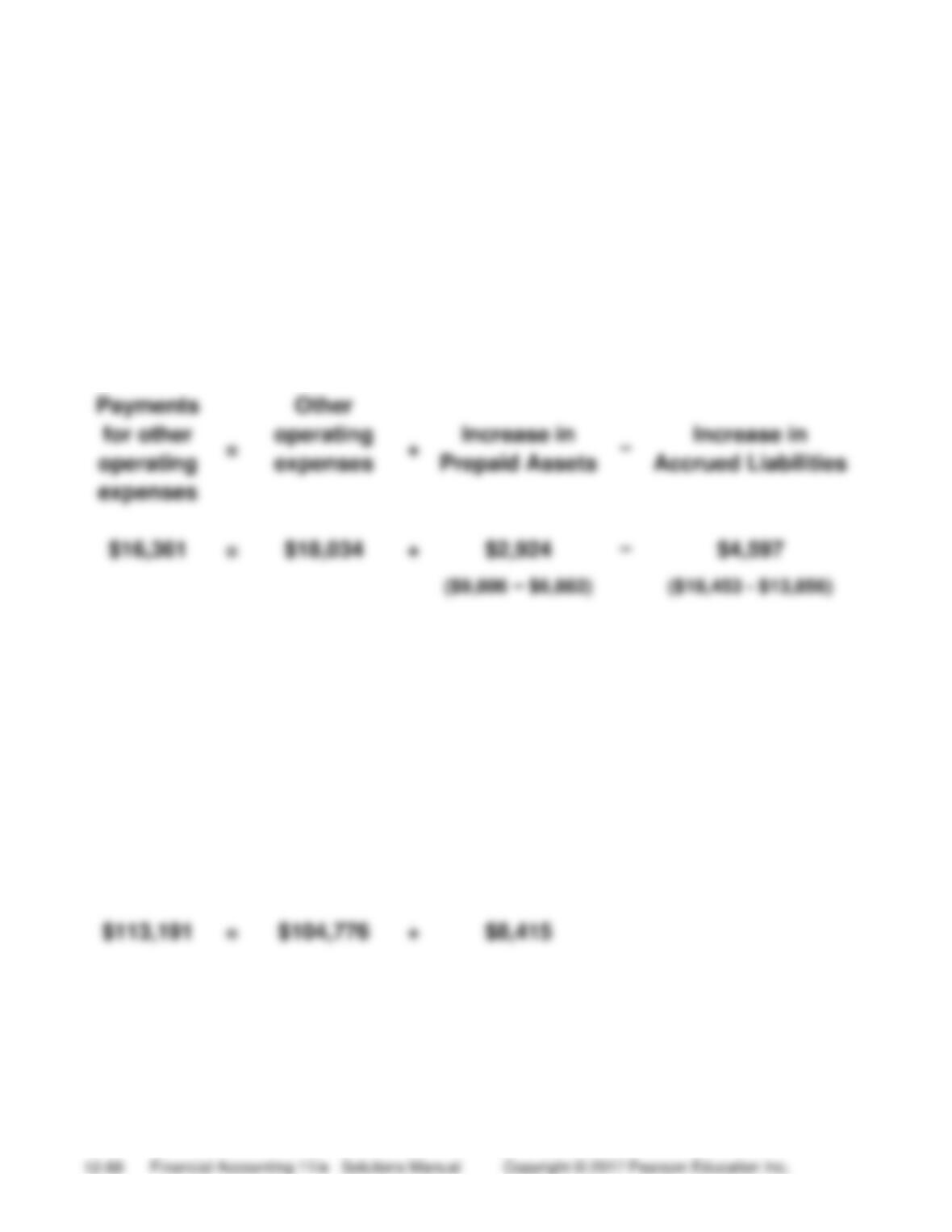
b. Using the format provided in Exhibit 12-15: (Amounts in millions)
Payments for
=
Cost of
+
Increase in
−
Increase in
inventory
sales
Inventory
Accounts Payable
$104,776
=
$112,258
+
$347
−
$7,829
($2,111 − $1,764)
($30,196 – $22,367)
expenses
$4,597
Other operating expenses include Depreciation and Amortization
Expense of $7,946 million, so these expenses should be deducted.
Payments for other operating expenses = $16,361 million – $7,946 million
= $8,415 million.
Total
payments
to Suppliers
Payments for
inventory
+
Payments for
other operating
expenses
=
$104,776
+
(continued) Apple Inc.
c. In 2014, for Apple Inc.,
• Net income increased from 2013 by $2,473 million.
($39,510 − $37,037)
• Total assets increased from 2013 by $24,839 million.
($231,839 − $207,000)
Overall, 2014 was a good year for Apple Inc.
Focus on Analysis: Under Armour, Inc.
(20-30 min.)
(All amounts are in millions)
Req. 1
Req. 2
The three most significant differences between net income and net cash
provided by operations are:
1. Change in accounts receivable of $101 million.
2. Change in inventories of $85 million.
(continued) Under Armour, Inc.
Req. 3
In 2014, Under Armour’s additions to property, plant, and equipment
were more than previous years’ additions. This is evident in the
Req. 4
The largest item in Under Armour’ financing section of their
consolidated statement of cash flows is the proceeds from its term loan.
This reveals that the company strategy is to expand through additional
Req. 5
Under Armour appears to have healthy cash flows indicating good
performance. Net cash flows from operations have increased overall
from 2012 – 2014. Additionally, they are able to spend cash on capital

Group Projects
(2-3 hours)
Student responses will vary on this assignment.