
CHAPTER 12
Planning for Capital Investments
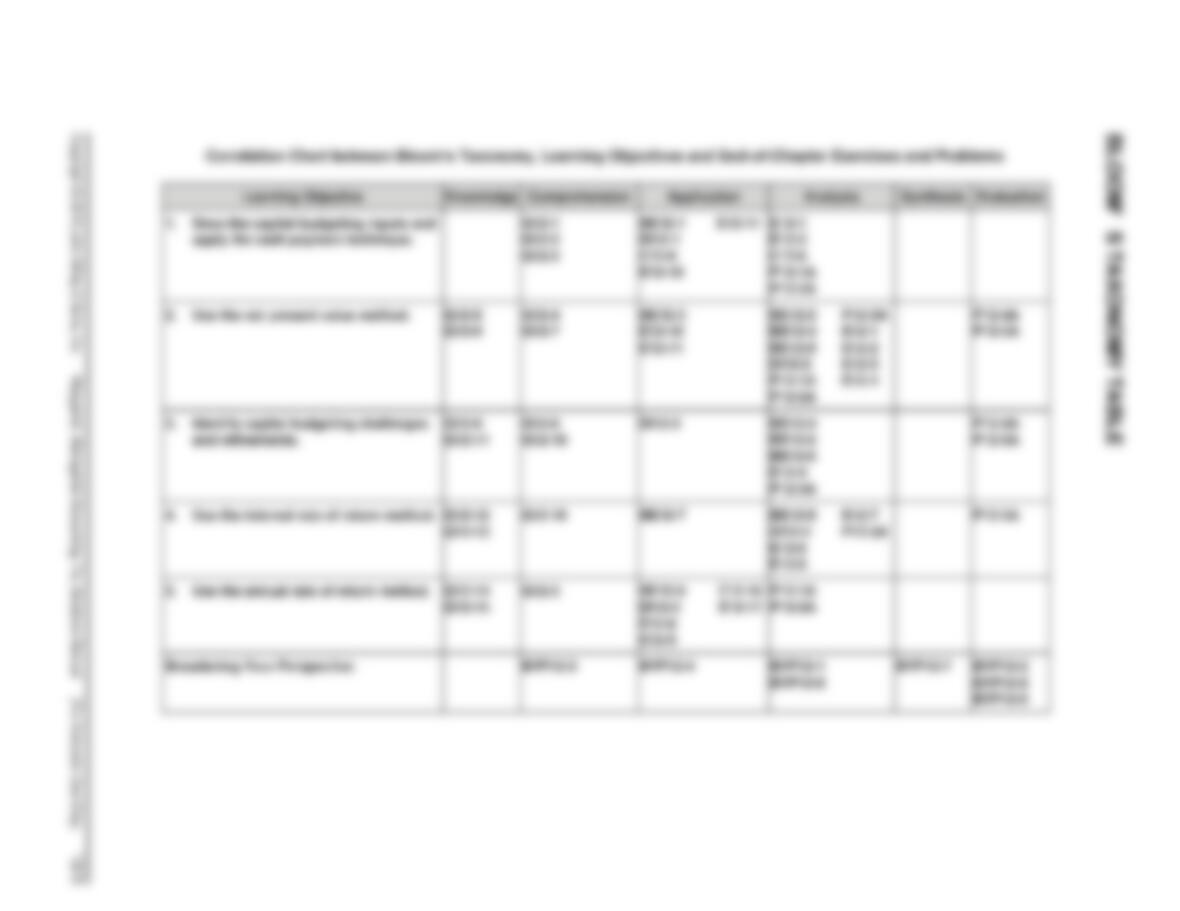
ASSIGNMENT CLASSIFICATION TABLE
Learning Objectives
Questions
Brief
Exercises
Do It!
Exercises
A
Problems
1. Describe capital budgeting
inputs and apply the cash
payback technique.
1, 2, 3
1
1
1, 2, 6, 9,
10, 11
1A, 2A
2. Use the net present value
method.
4, 5, 6, 7
2, 3, 4, 5
2
1, 2, 3, 4
10, 11
1A, 2A, 3A,
4A, 5A
3. Identify capital budgeting
challenges and
refinements.
8, 9, 10, 11
4, 5, 6
3
4
3A , 4A, 5A
4. Use the internal rate of
return method.
12, 13, 16
7, 8
4
5, 6, 7
3A, 5A
5. Use the annual rate of
return method.
3, 14, 15
9
5
8, 9, 10, 11
1A, 2A

ASSIGNMENT CHARACTERISTICS TABLE
Problem
Number
Description
Difficulty
Level
Time
Allotted (min.)
1A
Compute annual rate of return, cash payback, and net
present value.
Moderate
30–40
2A
Compute annual rate of return, cash payback, and net
present value.
Complex
30–40
3A
Compute net present value, profitability index, and
internal rate of return.
Moderate
20–30
4A
Compute net present value considering intangible
benefits.
Moderate
20–30
5A
Compute net present value and internal rate of return
with sensitivity analysis.
Moderate
30–40
ANSWERS TO QUESTIONS
1. The screening of proposed capital expenditures may be done by a capital budgeting committee
which submits its findings to the officers of the company. The officers, in turn, select the
projects they believe to be the most worthy of funding and submit them to the board of directors.
The directors ultimately approve the capital expenditure budget for the year.
2. The cash payback technique is relatively easy to compute and understand. However, it should
4. The two tables are:
(1) The present value of a single future amount (Table 3 in Appendix A). This table is used
when a project has uneven cash payments over its useful life and to compute the present
value of the salvage value of the project.
5. The decision rule is: Accept the project when net present value is zero or positive; reject the
project when net present value is negative.
6. The discount rate has two elements, a cost of capital element and a risk element. Many times
companies set the risk element equal to zero; thus, they are setting the discount rate equal to the
8. Examples of intangible benefits of investment projects would be increased product quality,
improved safety, and enhanced employee loyalty. Intangible benefits often complicate the capital
budgeting process because their value can be difficult to quantify. Ignoring intangible benefits
may result in rejecting projects that would be financially beneficial to the company.
Questions Chapter 12 (Continued)
10. When trying to choose between competing proposals, simply comparing the net present value of
the competing proposals ignores the fact that one proposal may require a considerably larger
investment. The profitability index is useful because it incorporates the required initial investment
into the evaluation.
11. A post-audit is a thorough evaluation of how well a project’s actual performance matches the
original projections. Performing post-audits can be valuable because:
(1) managers are more likely to submit reasonable and accurate data if they know that their
13. Under the internal rate of return method, the objective is to find the rate that will make the present
value of the expected net annual cash flows equal the present value of the proposed capital
expenditure. The decision rule under the internal rate of return method is: Accept the project
when the internal rate of return is equal to or greater than the required rate of return, and reject
the project when the internal rate of return is less than the required rate.
SOLUTIONS TO BRIEF EXERCISES
BRIEF EXERCISE 12-1
$450,000 ÷ $60,000 = 7.5 years
BRIEF EXERCISE 12-2
Present Value
Less: Capital investment
Net annual cash flows – $40,000 X 5.65
$226,000
BRIEF EXERCISE 12-3
Cash
Flows
X
10% Discount
Factor
=
Present
Value
Less: Capital investment
Present value of net annual cash flows
$25,000
X
3.79079
=
$ 94,770
BRIEF EXERCISE 12-4
Cash
Flows
X
9% Discount
Factor
=
Present
Value
Less: Capital investment
Net present value
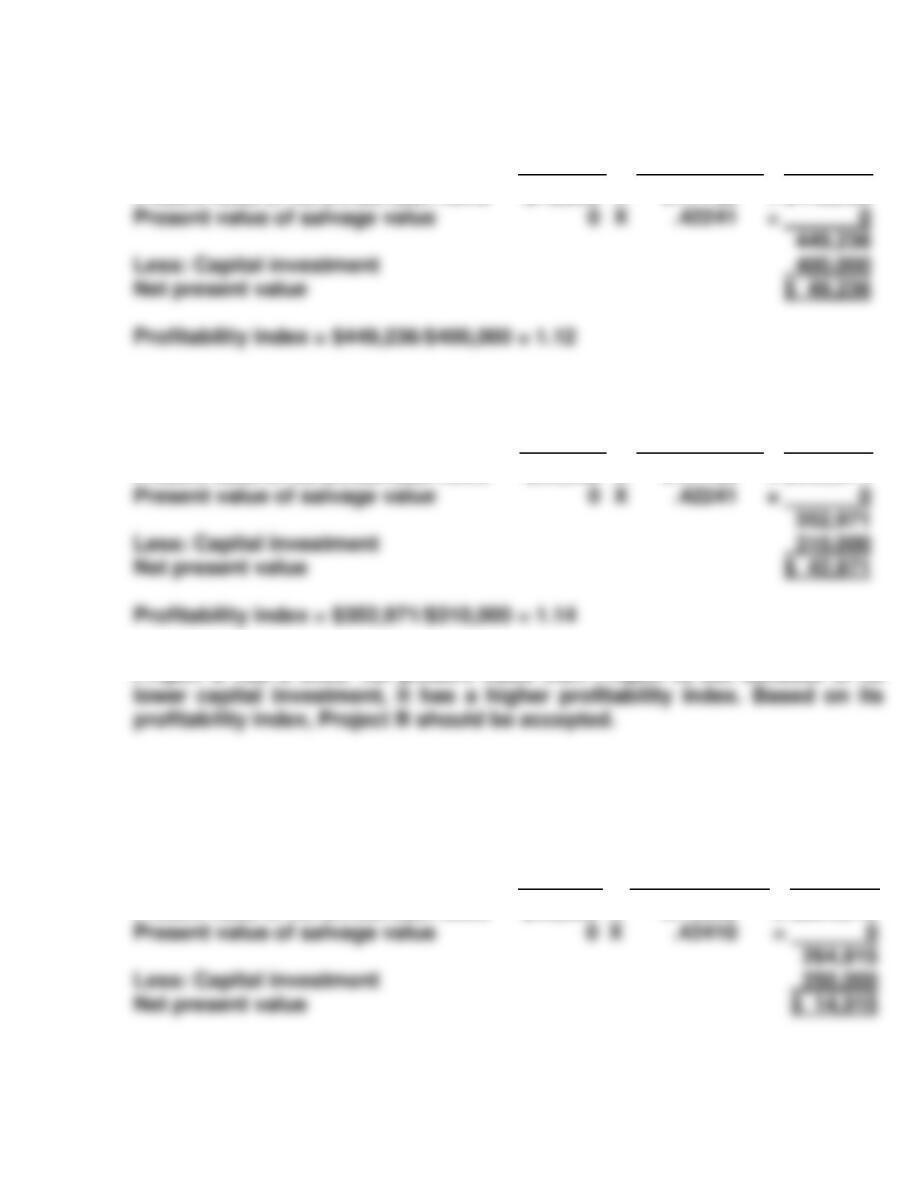
BRIEF EXERCISE 12-5
Project A
Cash
Flows
X
9% Discount
Factor
=
Present
Value
Present value of net annual cash flows
$70,000
X
6.41766
=
$449,236
Project B
Cash
Flows
X
9% Discount
Factor
=
Present
Value
Less: Capital investment
Present value of net annual cash flows
$55,000
X
6.41766
=
$352,971
Project B has a lower net present value than Project A, but because of its
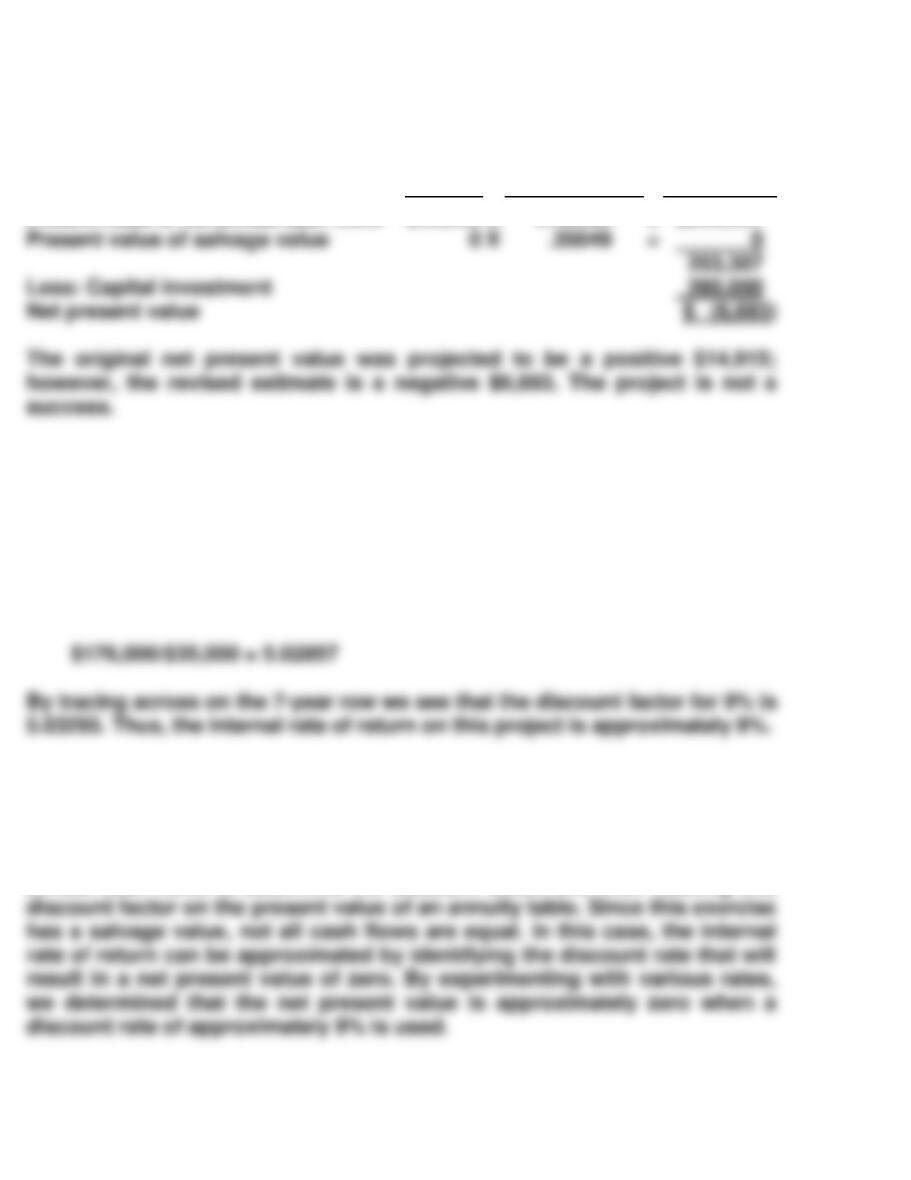
BRIEF EXERCISE 12-6
Original estimate
Cash
Flows
X
10% Discount
Factor
=
Present
Value
Less: Capital investment
250,000
Present value of net annual cash flows
$46,000
X
5.75902
=
$264,915
Less: Capital investment
400,000
BRIEF EXERCISE 12-6 (Continued)
Revised estimate
Cash
Flows
X
10% Discount
Factor
=
Present
Value
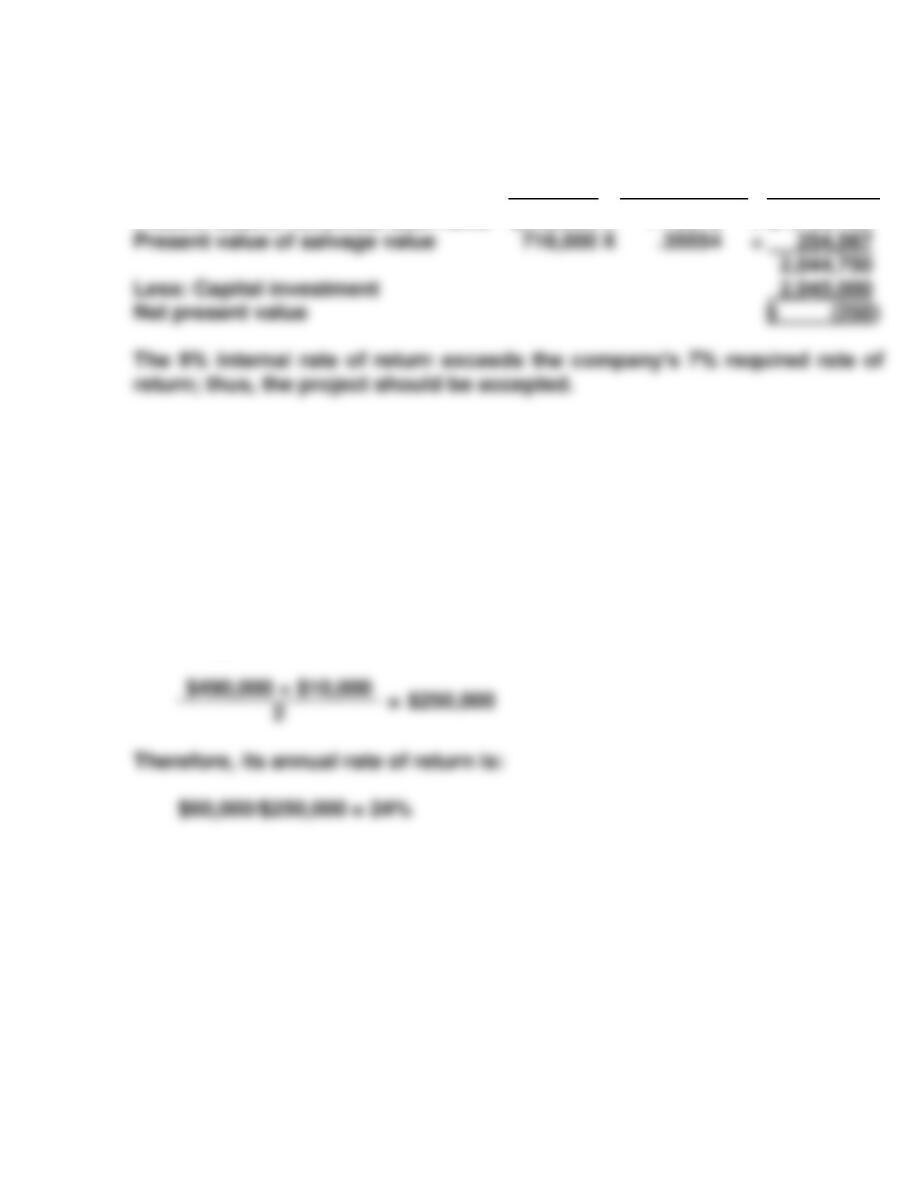
Present value of net annual cash flows
$39,000
X
6.49506
=
($253,307)
BRIEF EXERCISE 12-7
When net annual cash flows are expected to be equal, the internal rate of
return can be approximated by dividing the capital investment by the net
annual cash flows to determine the discount factor, and then locating this
discount factor on the present value of an annuity table.
BRIEF EXERCISE 12-8
When net annual cash flows are expected to be equal, the internal rate of
return can be approximated by dividing the capital investment by the net
annual cash flows to determine the discount factor, and then locating this
BRIEF EXERCISE 12-8 (Continued)
Net annual cash flows = $400,000 – $150,000 = $250,000
Cash
Flows
X
9% Discount
Factor
=
Present
Value
Present value of net annual cash flows
$250,000
X
7.16073
=
$1,790,183
BRIEF EXERCISE 12-9
The annual rate of return is calculated by dividing expected annual income
by the average investment. The company’s expected annual income is:
$130,000 – $70,000 = $60,000
Its average investment is:
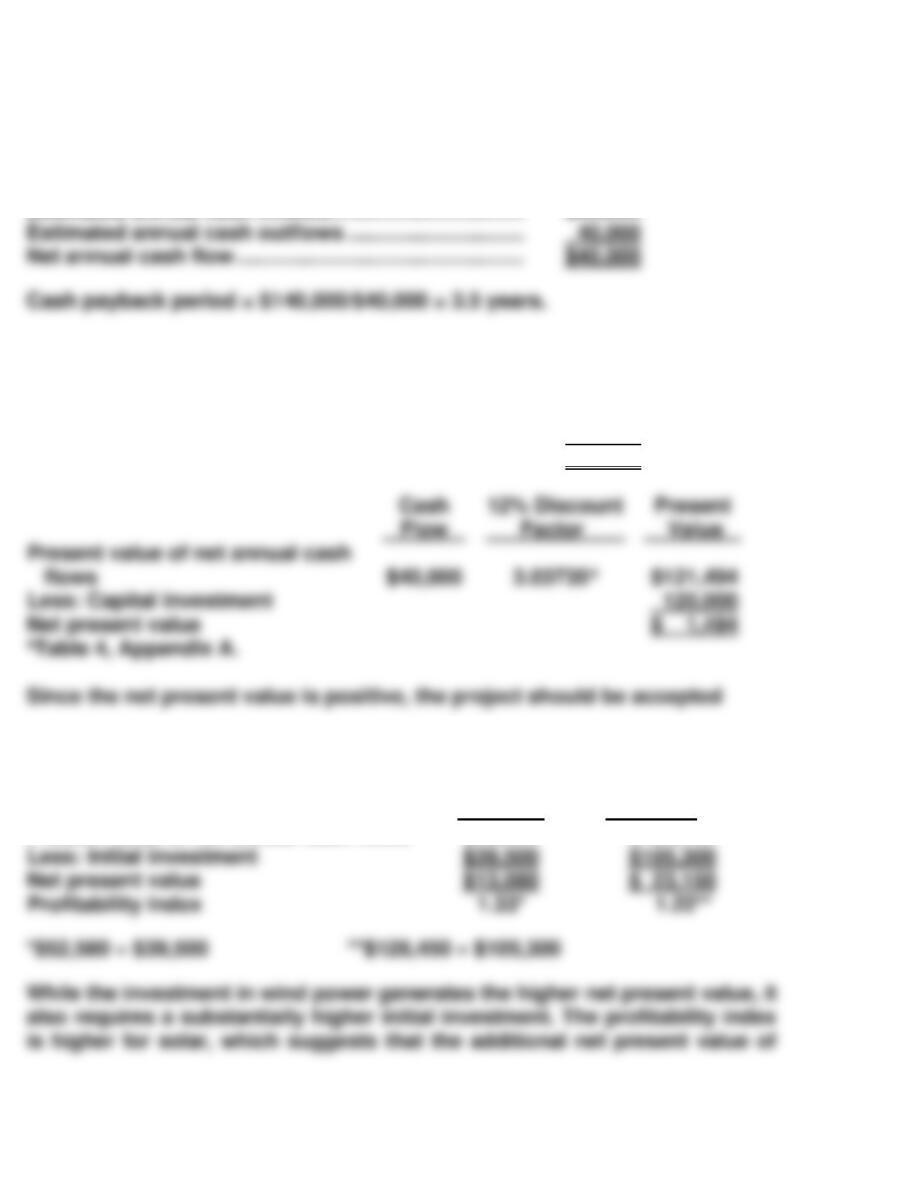
flows
Less: Capital investment
SOLUTIONS FOR DO IT! REVIEW EXERCISES
DO IT! 12-1
Estimated annual cash inflows…………………………... $80,000
DO IT! 12-2
Estimated annual cash inflows…………………………... $80,000
Estimated annual cash outflows ………………………… 40,000
Net annual cash flow …………………………………………. $40,000
DO IT! 12-3
Solar
Wind
Present value of net annual cash flows
$52,580
$128,450
Less: Initial investment
$39,500
$105,300
Profitability index
wind is outweighed by the cost of the initial investment. The company should
choose solar.
DO IT! 12-4
Estimated annual cash inflows…………………………... $80,000
Estimated annual cash outflows ………………………… 40,000
DO IT! 12-5
Revenues ………………………………………………………….. $80,000
Less:
Expenses (excluding depreciation) ………………… $41,000
SOLUTIONS TO EXERCISES
EXERCISE 12-1
(a) The cash payback period is:
$56,000 ÷ $8,000 = 7 years
The net present value is:
8%
(b) In order to meet the cash payback criteria, the project would have to
have a cash payback period of less than 4 years (8 ÷ 2). It does not
EXERCISE 12-2
(a)
AA
Year
Net Annual Cash Flow
Cumulative Net Cash Flow
1
2
$ 7,000
9,000
$ 7,000
16,000
EXERCISE 12-2 (Continued)
BB
22,000 ÷ 10,000 = 2.2 years
CC
Year
Net Annual Cash Flow
Cumulative Net Cash Flow
1
$13,000
$13,000
The most desirable project is CC because it has the shortest payback
period. The least desirable project is AA because it has the longest
payback period. As indicated, only CC is acceptable because its cash
payback is 1.75 years.
(b)
AA
BB
CC
Year
Discount
Factor
Cash
Flow
Present
Value
Cash
Flow
Present
Value
Cash
Flow
Present
Value
.71178
12,000
10,000
11,000
Total present value
Less: Investment
Net present value
21,966
(22,000
)
24,019
(1)
29,003
(22,000
1
2
.89286
.79719
$ 7,000
9,000
$ 6,250
7,175
$10,000
10,000
$ 8,929
7,972
$13,000
12,000
$11,607
9,566
EXERCISE 12-3
Investment in new equipment …………. $2,450,000
Disposal of old equipment ………………. (250,000)
Calculation of net present value:
Year
Discount
Factor, 9%
Amount
Present
Value
Cash flows 1 0.91743 $ 390,000 $ 357,798
2 0.84168 400,000 336,672
3 0.77218 411,000 317,366
Maintenance 5 0.64993 (100,000) (64,993)
Net cash flows from
operations: 2,028,586
EXERCISE 12-4
Machine A
Cash
Flows
X
9% Discount
Factor
=
Present
Value
Present value of net annual cash flows
Present value of salvage value
$15,000
0
X
X
5.53482
.50187
=
=
$83,022
0
Machine B
Cash
Flows
X
9%
Discount
Factor
=
Present
Value
Present value of net annual cash flows
Present value of salvage value
$30,000
0
X
X
5.53482
.50187
=
=
($166,045)
( 0)
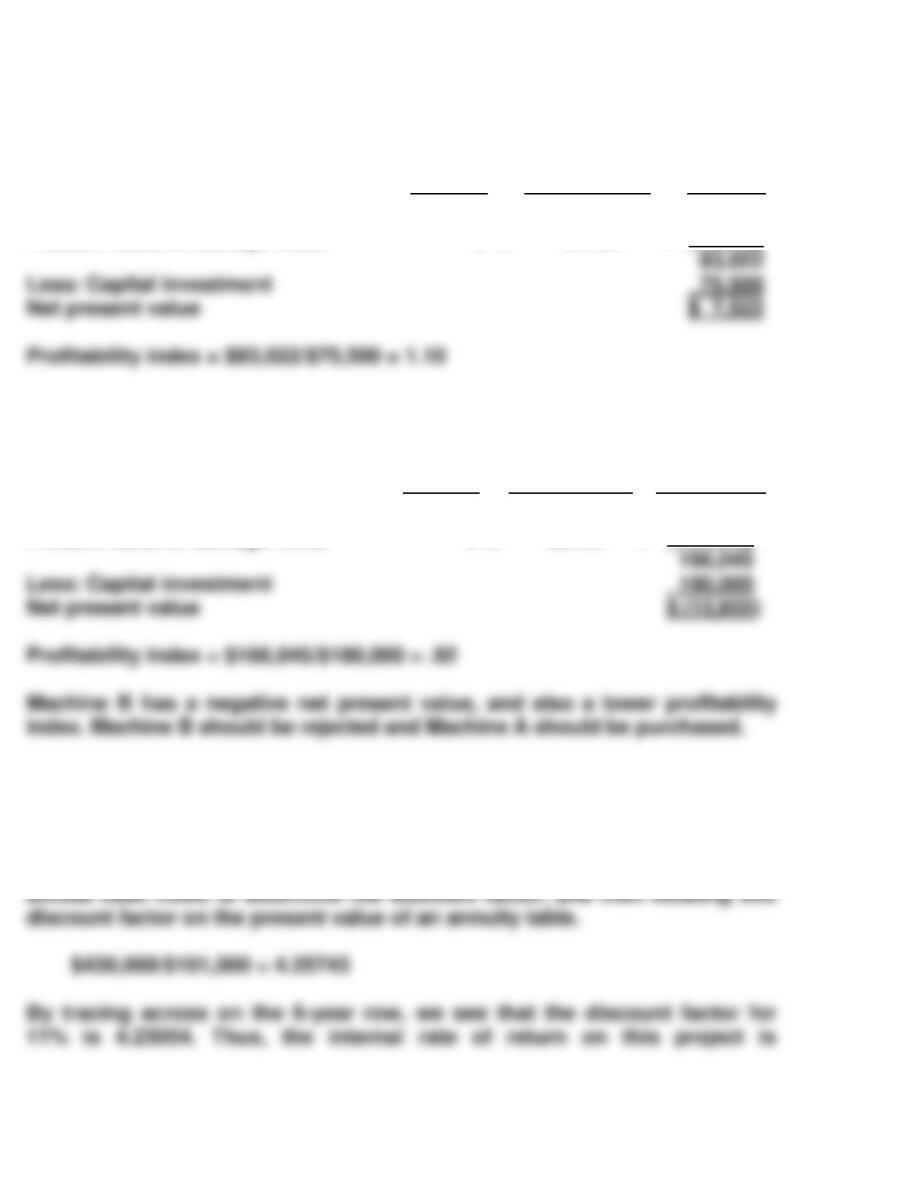
EXERCISE 12-5
When net annual cash flows are expected to be equal, the internal rate of
return can be approximated by dividing the capital investment by the net
83,022

EXERCISE 12-6
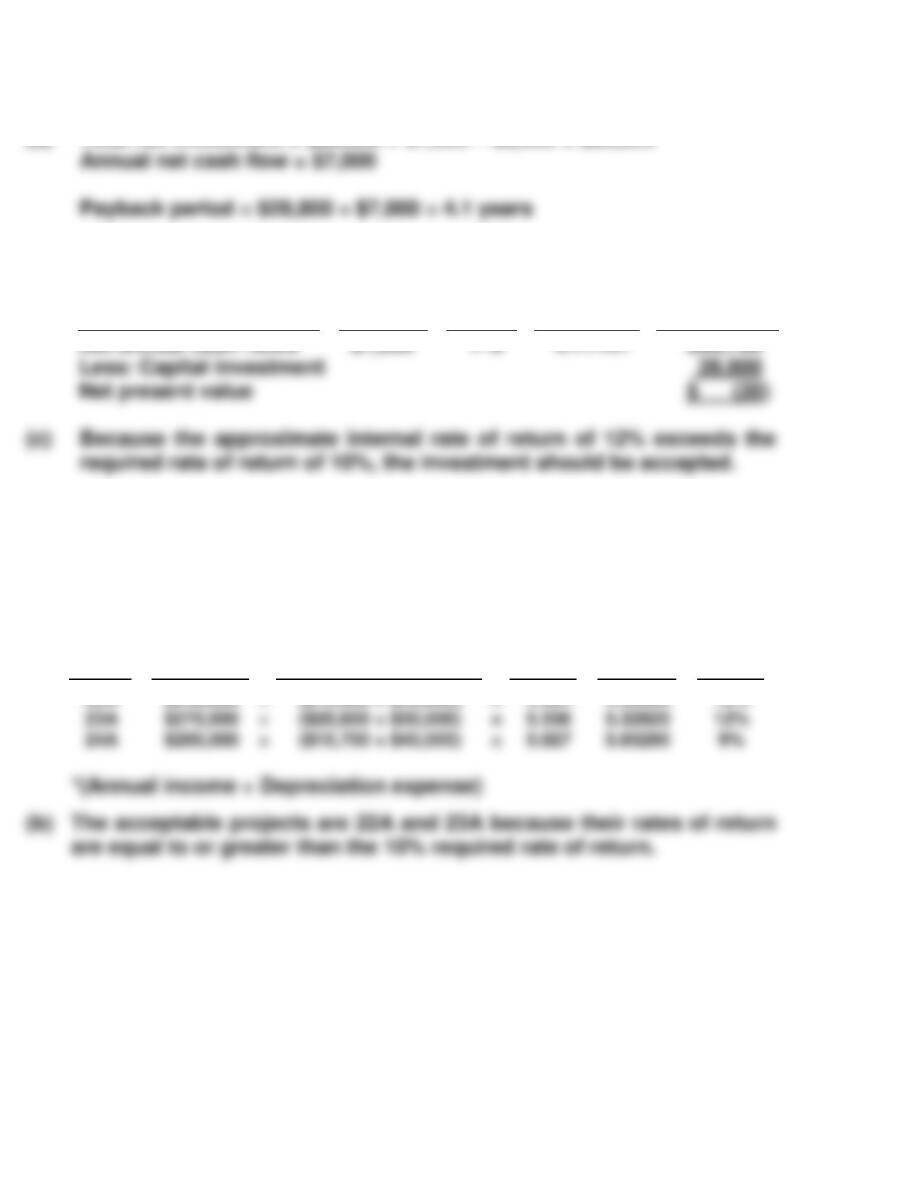
(a) Total net investment = $29,300 + $1,500 – $2,000 = $28,800
(b) Net present value approximates zero when discount rate is 12%.
Item
Amount
Years
PV Factor
Present
Value
EXERCISE 12-7
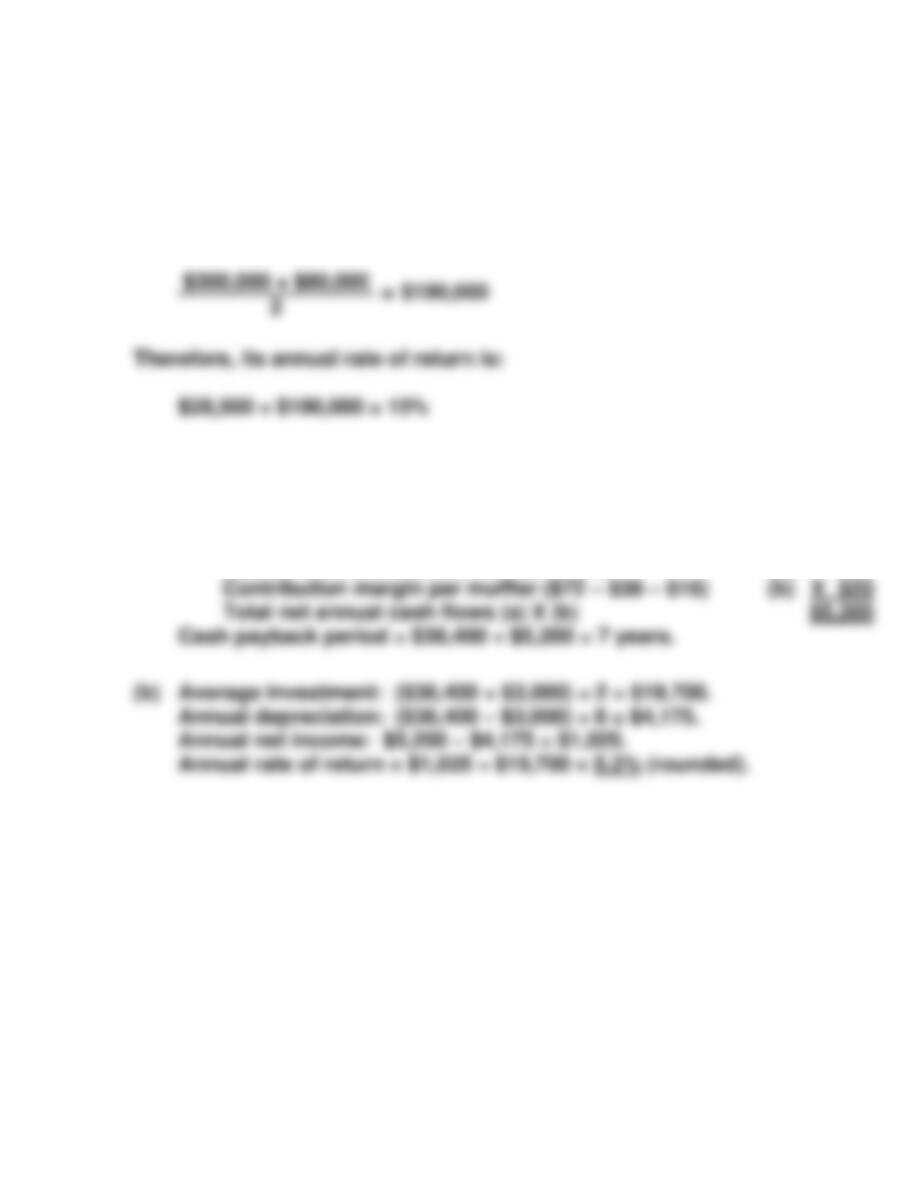
(a)
Project
Capital
Investment
÷
Net Annual Cash
Flows*
=
Internal
Rate of
Return
Factor
Closest
Discount
Factor
Internal
Rate of
Return
÷
=
EXERCISE 12-8
The annual rate of return is calculated by dividing expected annual income
by the average investment. The company’s expected annual income is:
$70,000 – $41,500 = $28,500
Its average investment is:
EXERCISE 12-9
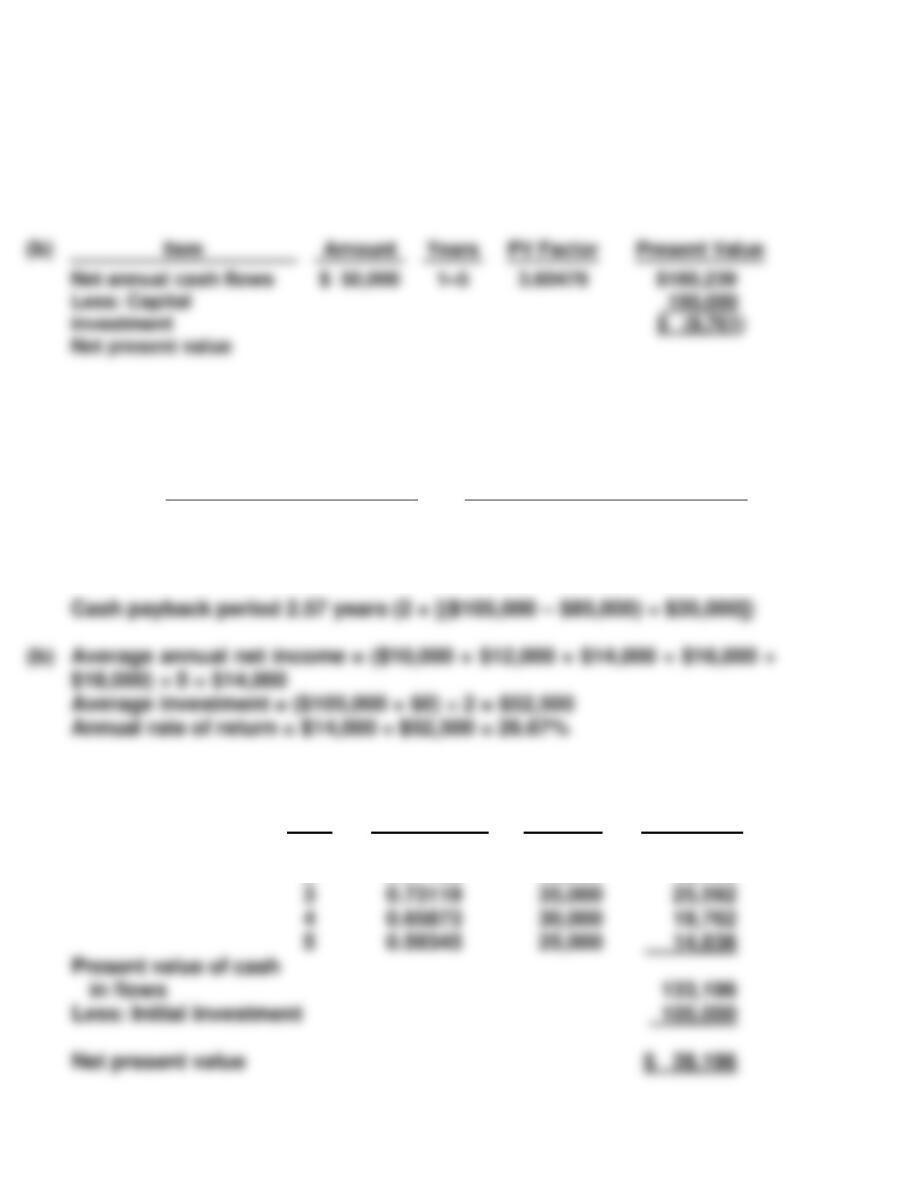
(a) Cost of hoist: $32,400 + $3,300 + $700 = $36,400.
Net annual cash flows:
Number of extra mufflers 5 X 52 weeks (a) 260
EXERCISE 12-10
(a) 1. Cash payback period: $190,000 ÷ $50,000 = 3.8 years.
2. Annual rate of return: $12,000 ÷ [($190,000 + $0) ÷ 2] = 12.63%.
EXERCISE 12-11
(a)
Year
Net Annual Cash Flow
Cumulative Net Cash Flow
1
2
3
$45,000
40,000
35,000
$ 45,000
85,000
120,000
(c) Discount Present
Year Factor, 11% Amount Value
Net cash flows 1 0.90090 $45,000 $ 40,541
2 0.81162 40,000 32,465
SOLUTIONS TO PROBLEMS
PROBLEM 12-1A
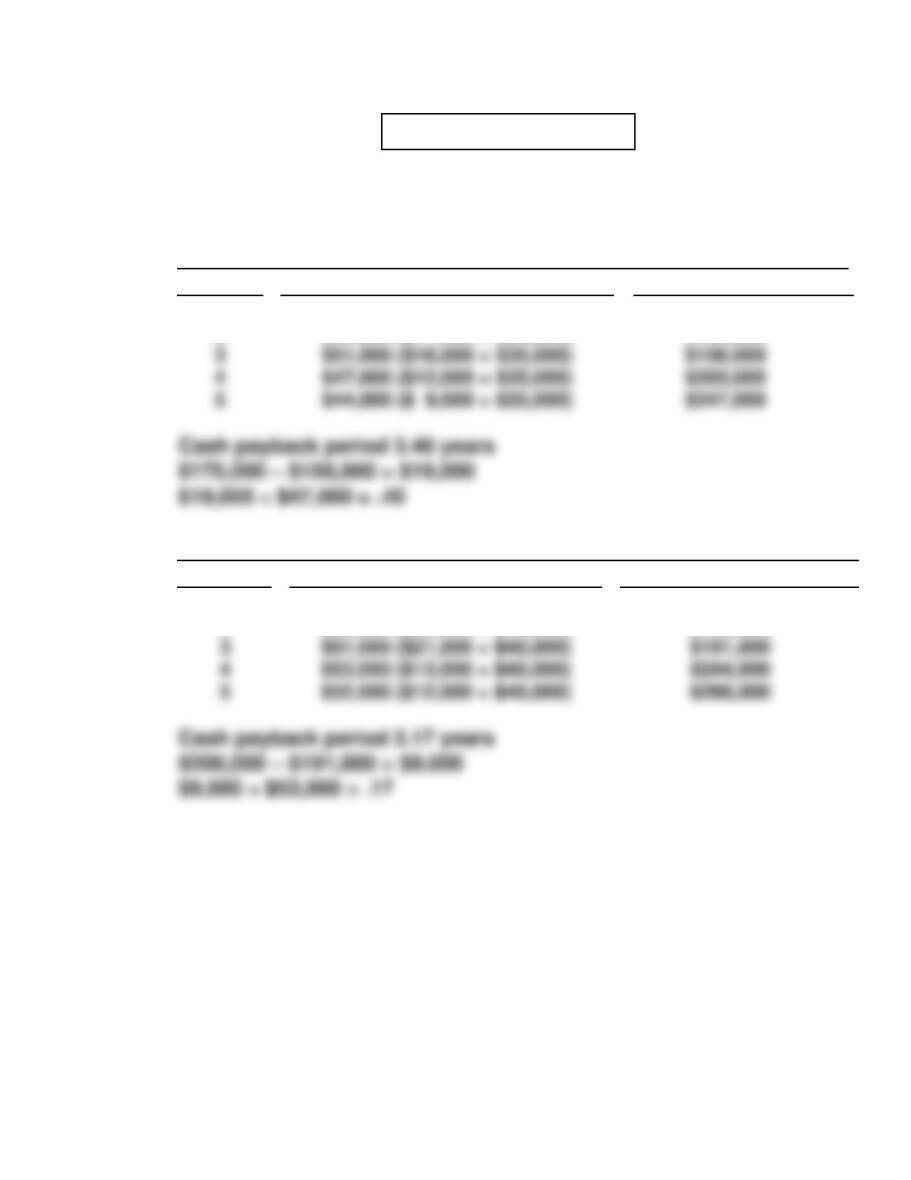
(a) Project Bono $160,000 ÷ ($14,000 + $32,000) = 3.48 years
Project Edge
Year
Cash Flow
Cumulative Cash Flow
1
2
$53,000 ($18,000 + $35,000)
$52,000 ($17,000 + $35,000)
$ 53,000
$105,000
Project Clayton
Year
Cash Flow
Cumulative Cash Flow
1
2
$67,000 ($27,000 + $40,000)
$63,000 ($23,000 + $40,000)
$ 67,000
$130,000
PROBLEM 12-1A (Continued)
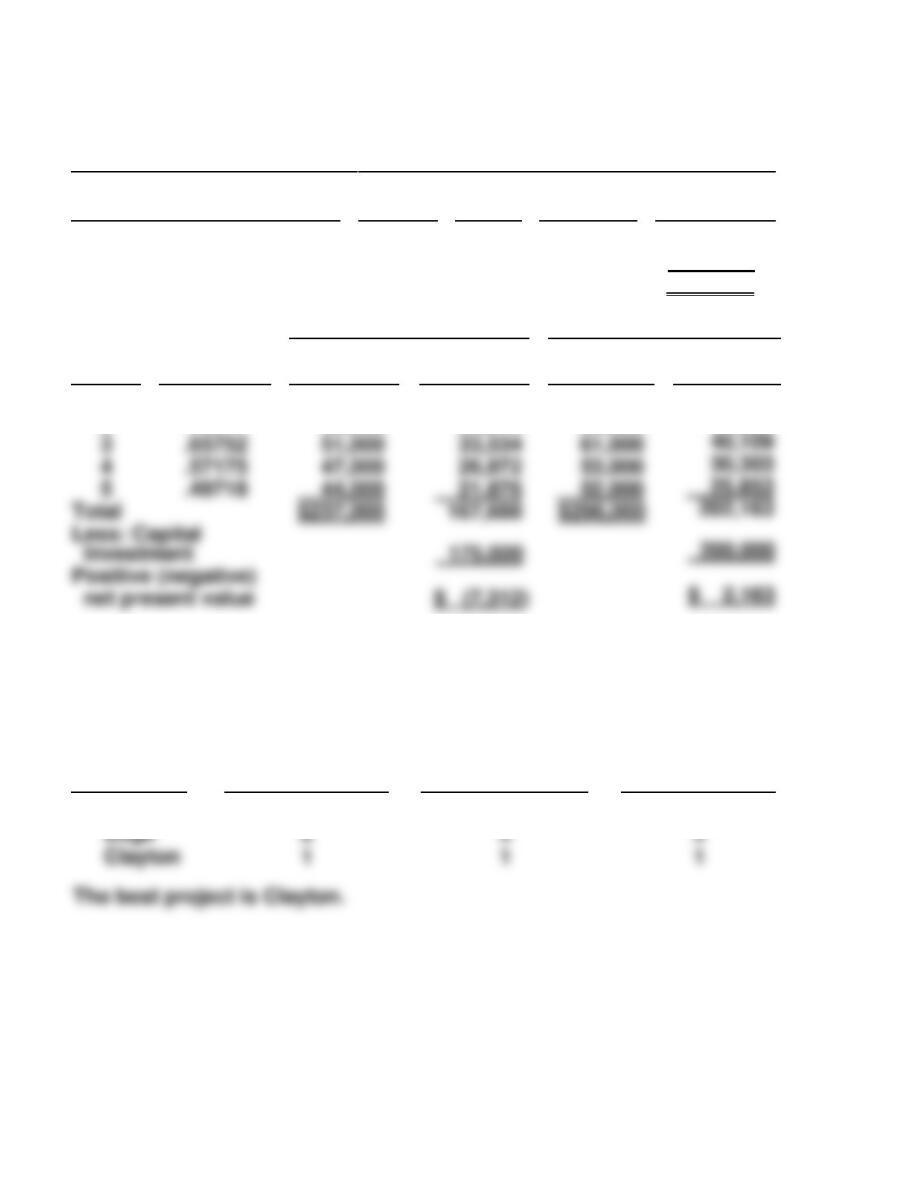
(b) Project Bono
Item
Amount
Years
PV Factor
Present
Value
Net annual cash flows
Less: Capital investment
Negative net present value
$46,000
1–5
3.35216
$154,199
160,000
$ (5,801)
Project Edge
Project Clayton
Year
Discount
Factor
Cash
Flow
PV
Cash
Flow
PV
1
2
.86957
.75614
$ 53,000
52,000
$ 46,087
39,319
$ 67,000
63,000
$ 58,261
47,637
(c) Project Bono = $14,000 ÷ [($160,000 + $0) ÷ 2] = 17.5%.
Project Edge = $14,400 ÷ [($175,000 + $0) ÷ 2] = 16.5%.
Project Clayton = $19,200 ÷ [($200,000 + $0) ÷ 2] = 19.2%.
(d)
Project
Cash Payback
Net
Present Value
Annual
Rate of Return
Clayton
Bono
3
2
2
$237,000
PROBLEM 12-2A
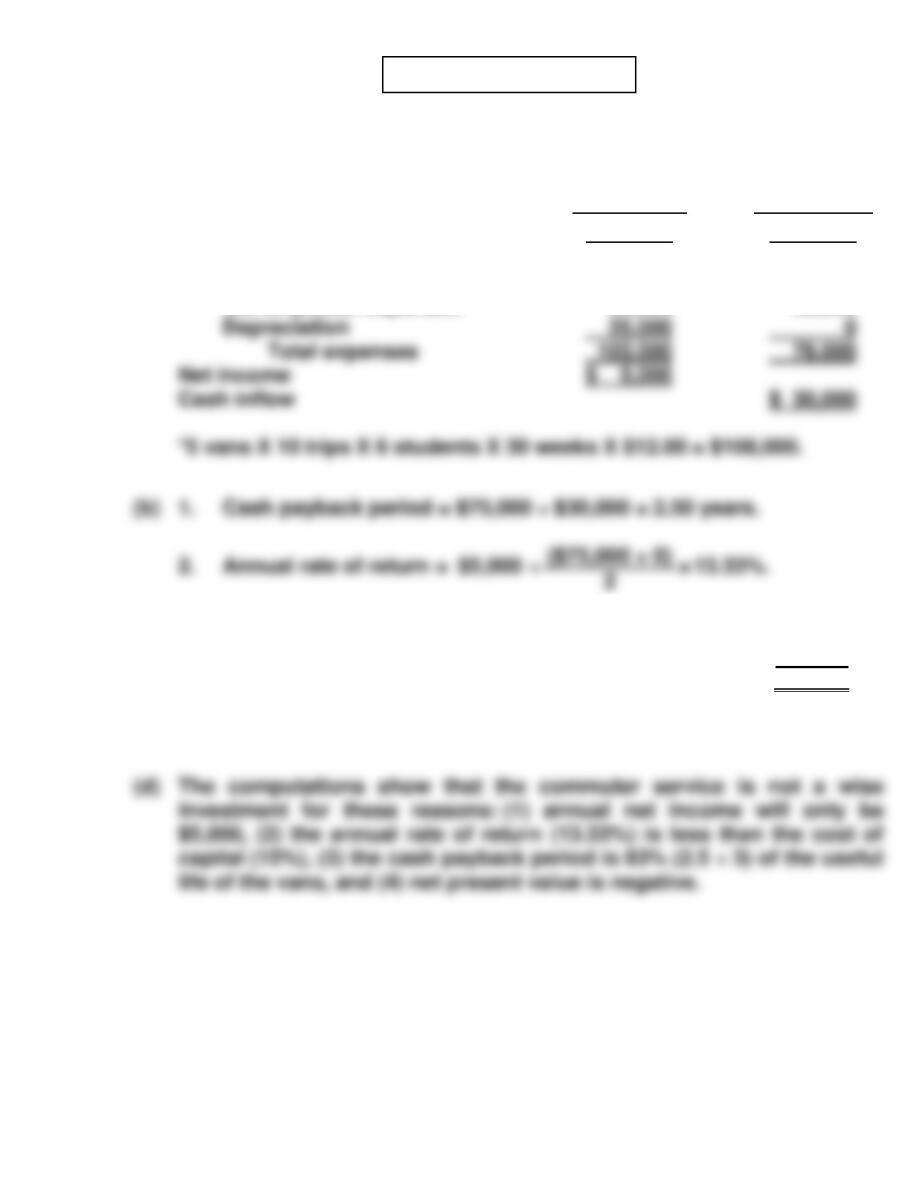
(a)
(1)
Annual
Net Income
(2)
Annual
Cash Inflow
Sales
Expenses
Drivers’ salaries
Out-of-pocket expenses
*$108,000*
* 48,000*
* 30,000*
$108,000
48,000
30,000
(c) Present value of annual cash inflows ($30,000 X 2.28323*) = $68,497
Less: Capital investment = 75,000
Net present value = $ (6,503 )
*3 years at 15%, PV of annuity of 1.
PROBLEM 12-3A
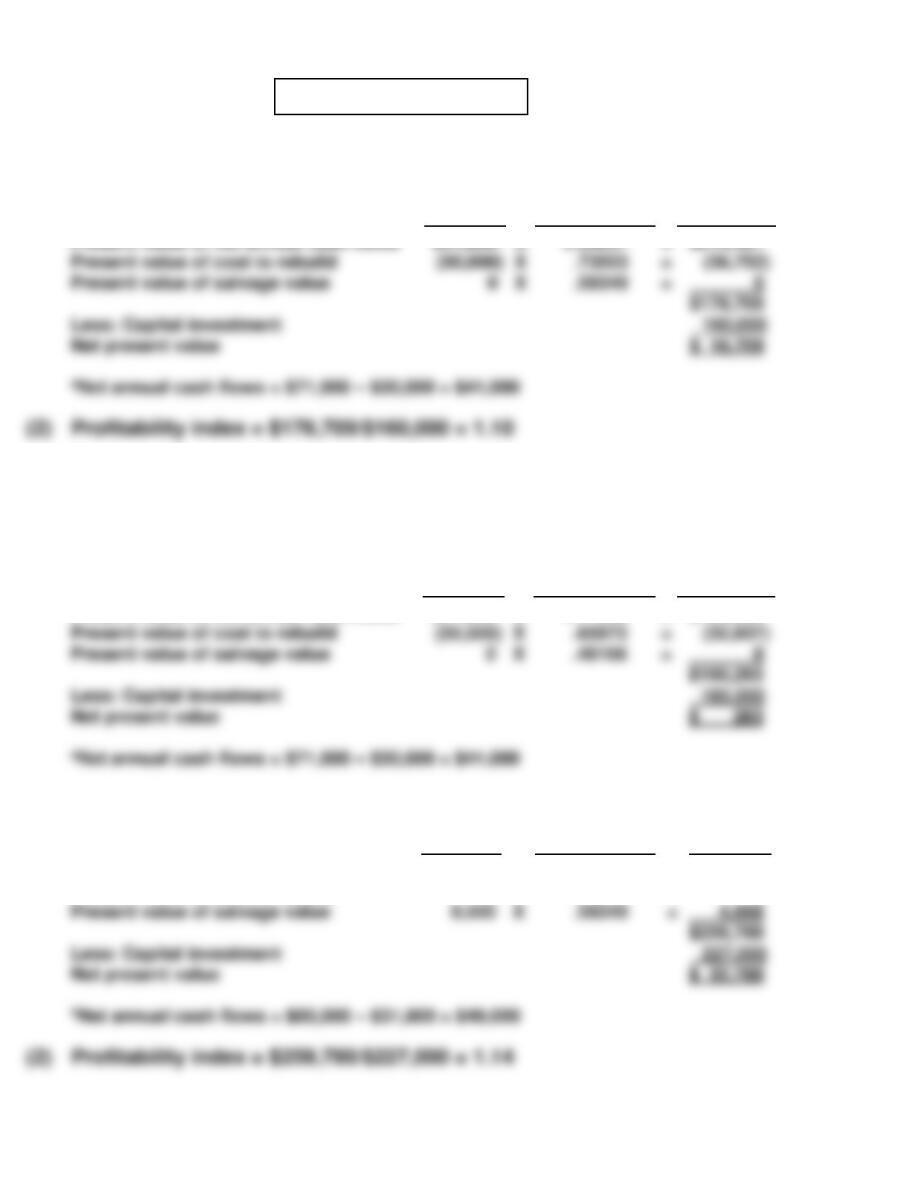
(a)
(1) Option A
Cash
Flows
X
8% Discount
Factor
=
Present
Value
Less: Capital investment
a$41,000a
(3) The internal rate of return can be approximated by finding the discount
rate that results in a net present value of approximately zero. This is
accomplished with a 11% discount rate.
Cash
Flows
X
11% Discount
Factor
=
Present
Value
Less: Capital investment
Present value of net annual cash flows
a$41,000a
X
4.71220
=
($193,200)
(1) Option B
Cash
Flows
X
8% Discount
Factor
=
Present
Value
Present value of net annual cash flows
Present value of cost to rebuild
b$49,000b
0
X
X
5.20637
.73503
=
=
$255,112
0
Less: Capital investment
PROBLEM 12-3A (Continued)
(3) Internal rate of return on Option B is 12%, as calculated below:
Cash
Flows
X
12% Discount
Factor
=
Present
Value
Present value of net annual cash flows
Present value of cost to rebuild
Present value of salvage value
b$49,000b
0
8,000
X
X
X
4.56376
.63552
.45235
=
=
=
$223,624
0
3,619
Less: Capital investment
PROBLEM 12-4A
(a) The net present value based on the original estimates is as follows:
Cash
Flows
X
9% Discount
Factor
=
Present
Value
Present value of net annual cash flows
$ 8,000
X
5.53482
=
($ 44,279
(b) The net present value based on the revised estimates is as follows:
Cash
Flows
X
9% Discount
Factor
=
Present
Value
Less: Capital investment
Present value of net annual cash flows
$13,500*
X
5.53482
=
($74,720)
(c) The present value of the intangible benefits was $30,441 (the increase
in the net present value from a negative $13,950 to a positive $16,491).
Rick’s estimates of the value of these intangible benefits may be overly
PROBLEM 12-5A
(a) Using the original estimates, the net present value is calculated as
follows:
Cash
Flows
X
8% Discount
Factor
=
Present
Value
Present value of net annual cash flows
Present value of salvage value
a$ 80,000a
1,500,000
X
X
9.81815
.21455
=
=
$ 785,452
321,825
1,107,277
(b) Using the revised estimates, the net present value is calculated as
follows:
Cash
Flows
X
8% Discount
Factor
=
Present
Value
Less: Capital investment
Present value of net annual cash flows
Present value of salvage value
b$ 55,000b
1,500,000
X
X
9.81815
.21455
=
=
$(539,998)
(321,825)
$(861,823)
$ 207,277
PROBLEM 12-5A (Continued)
(c) Using the original estimates, but an 10% discount rate, the net present
value is calculated as follows:
Cash
Flows
X
10% Discount
Factor
=
Present
Value
Present value of net annual cash flows
Present value of salvage value
Less: Capital investment
c$ 80,000c
1,500,000
X
X
8.51356
.14864
=
=
$ 681,085
222,960
$ 904,045
900,000
(d) The internal rate of return can be determined by calculating the discount
rate that results in a net present value of approximately zero. In this
case the internal rate of return was approximately 12%.
Cash
Flows
X
12% Discount
Factor
=
Present
Value
Less: Capital investment
Present value of net annual cash flows
Present value of salvage value
$ 40,000
1,332,000
X
X
3.60478
.56743
=
=
$144,191
755,817
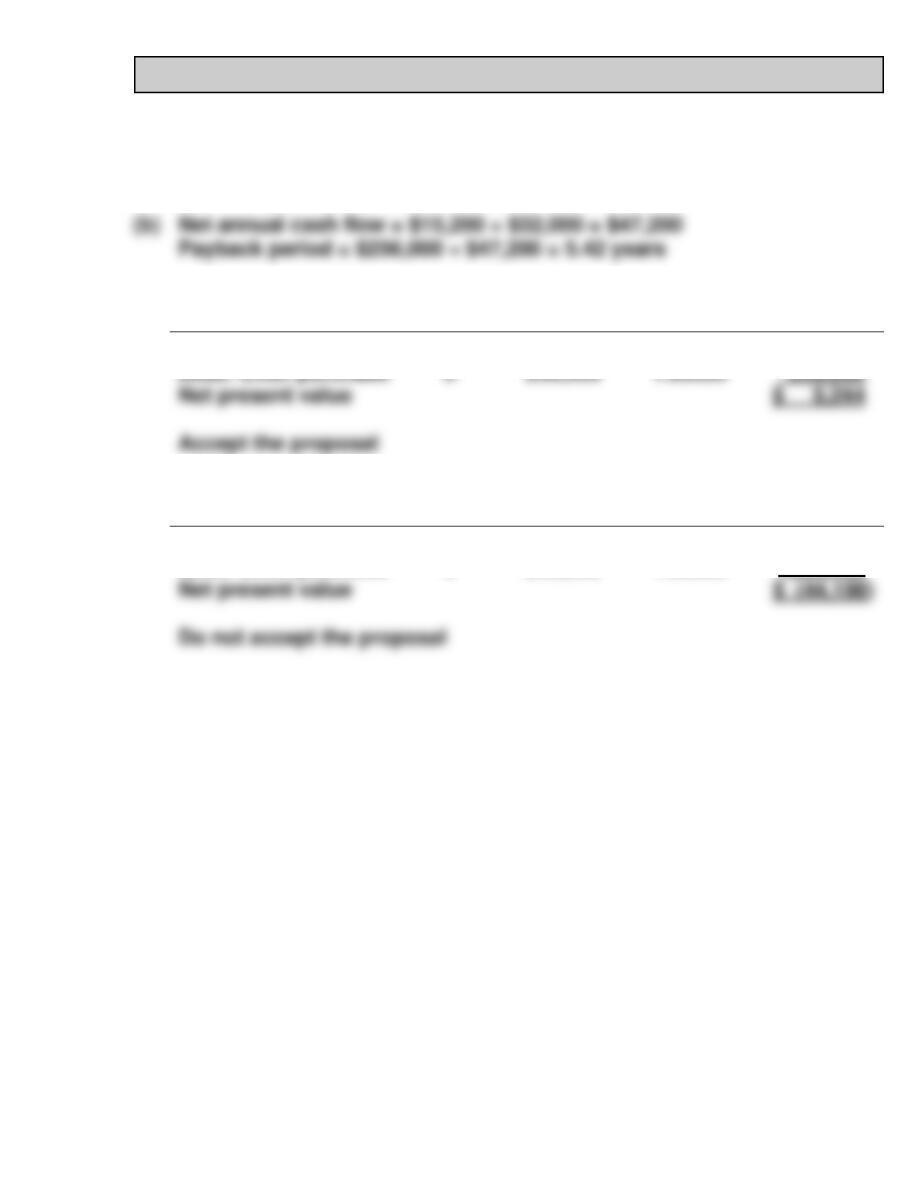
CD12 CURRENT DESIGNS
(a) Average investment = ($256,000 + 0) ÷ 2 = $128,000
Annual rate of return = $15,200 ÷ $128,000 = 11.88%
(c)
Event
Time
Period
Cash
Flows
9% Discount
Factor
Present
Value
Net annual cash flow
1-8
$ 47,200
5.53482
$ 261,244
Less: Oven purchase
0
256,000
1.00000
256,000
Net present value
$ 5,244
(d)
Event
Time
Period
Cash
Flows
15% Discount
Factor
Present
Value
Net annual cash flow
1-8
$ 47,200
4.48732
$ 211,802
Less: Oven purchase
0
256,000
1.00000
256,000
Net present value
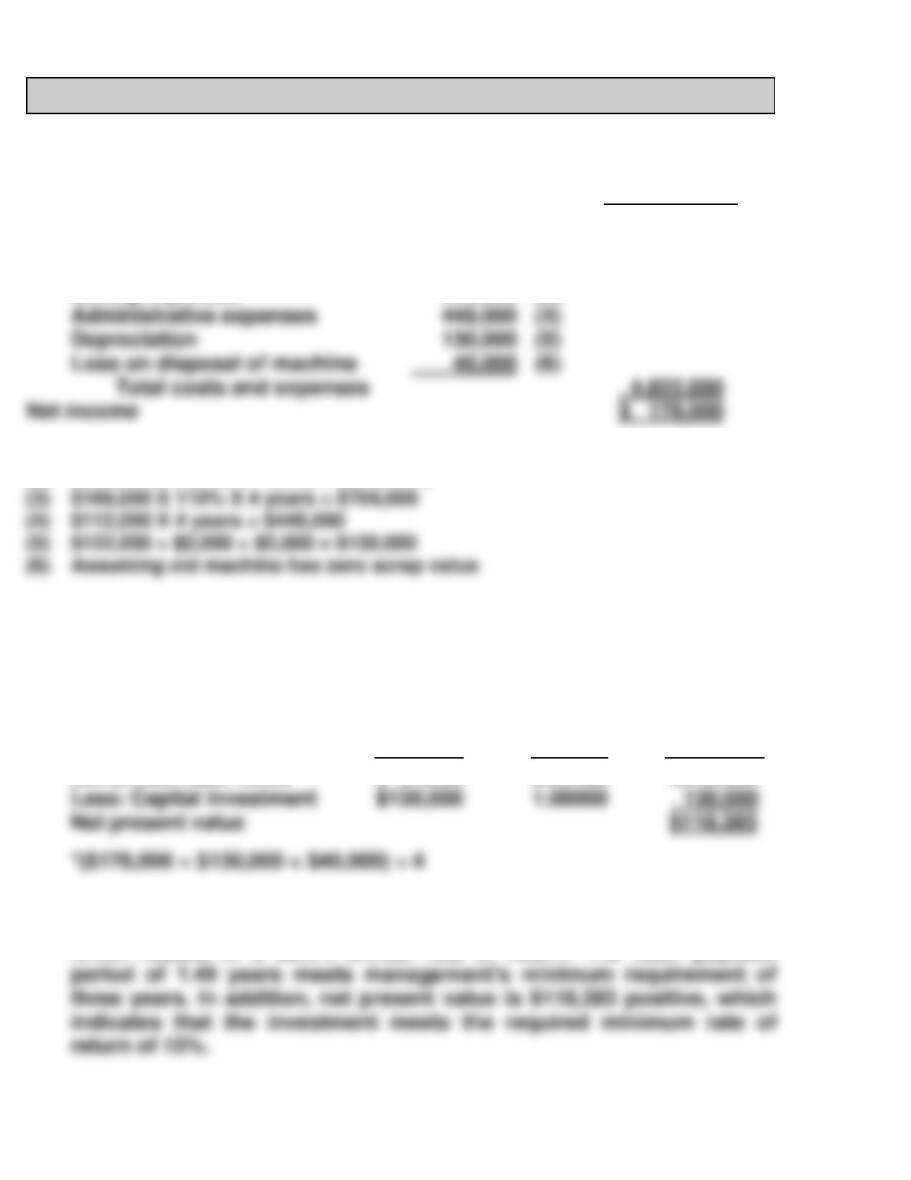
BYP 12-1 DECISION-MAKING ACROSS THE ORGANIZATION
Purchase
New Machine
Sales
Costs and expenses
Cost of goods sold
Selling expenses
$3,500,000
704,000
(2)
(3)
$5,000,000
(1)
(1) 10,000 X $100 X 4 years = $4,000,000 X 125% = $5,000,000
(2) $5,000,000 X (100% – 30%) = $3,500,000
(a) Annual rate of return = 68.5%; ($178,000 ÷ 4) ÷ [($130,000 + $0) ÷ 2]
(b) Cash payback period = 1.49 yrs.; $130,000 ÷ [($178,000 + $130,000 +
$40,000) ÷ 4]
(c)
Net present value =
Amount
Factor
Present
Value
Net annual cash flows
$ 87,000
*
2.85498
$248,383
(d) The new machine should be purchased. The analysis shows that net
income will be $178,000 over the four years with the new machine,
which results in a 68.5% annual rate of return. The cash payback
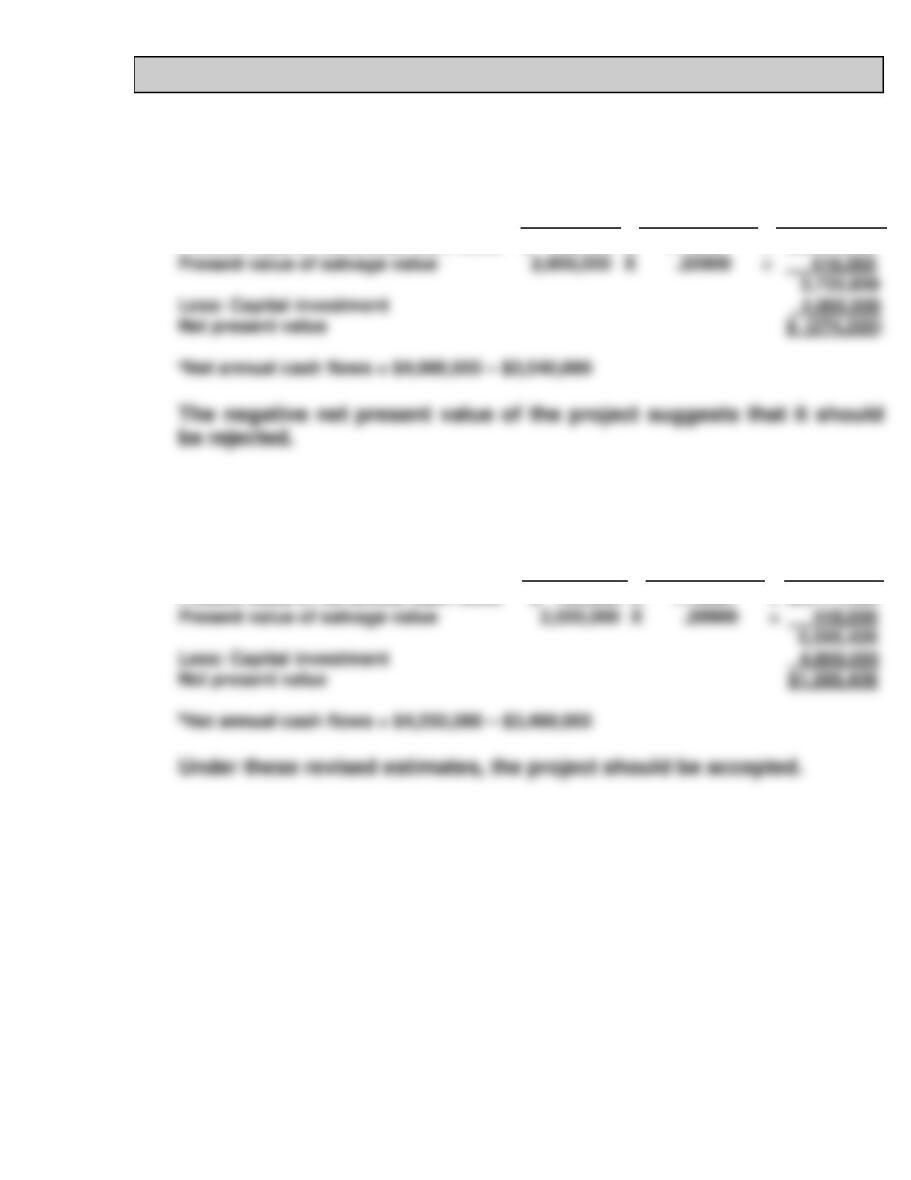
BYP 12-2 MANAGERIAL ANALYSIS
(a) Using the original estimates, the present value is calculated as follows:
Cash
Flows
X
11% Discount
Factor
=
Present
Value
Present value of net annual cash flows
$ 460,000a
X
7.19087
=
($3,307,800)
(b) Using the revised estimates, the net present value is calculated as
follows:
Cash
Flows
X
11% Discount
Factor
=
Present
Value
Present value of net annual cash flows
b$ 720,000b
X
7.19087
=
$5,177,426
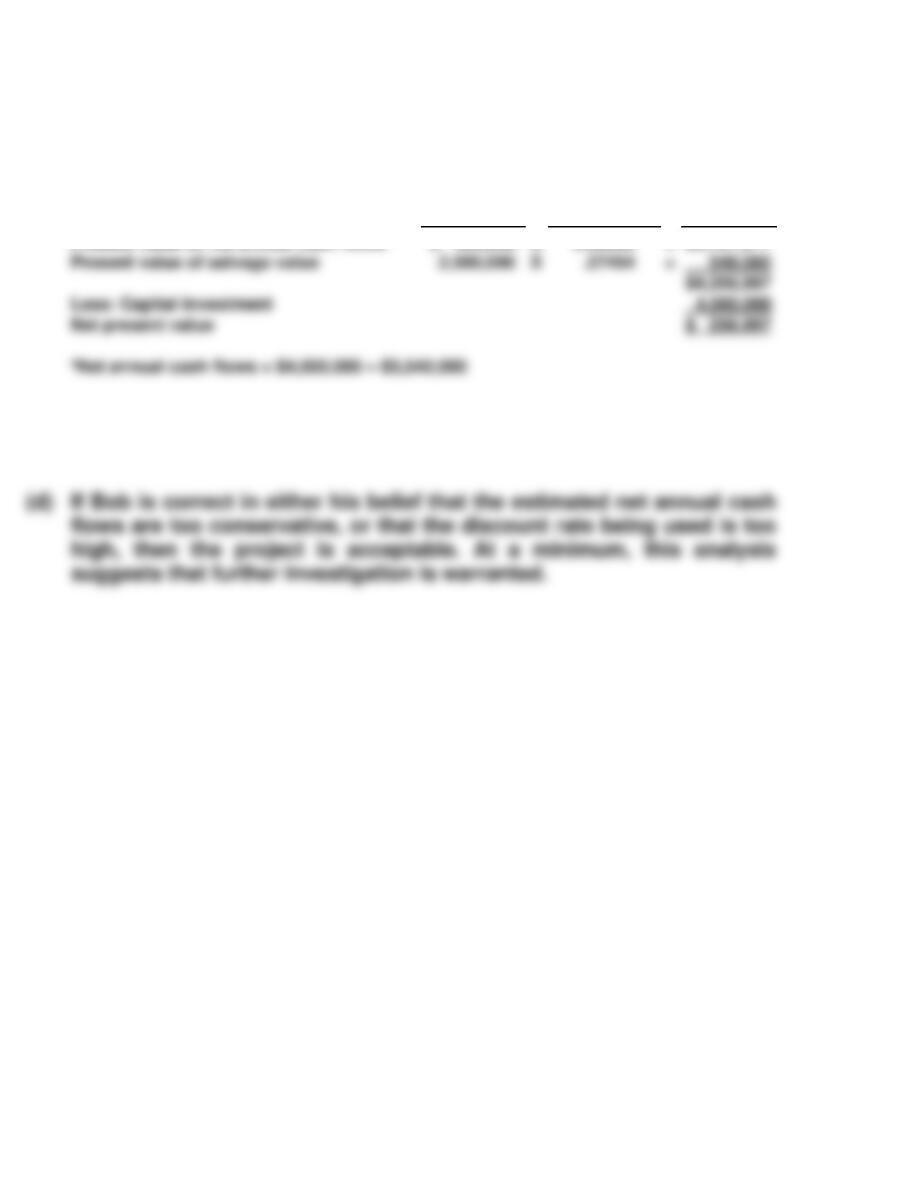
BYP 12-2 (Continued)
(c) Using the original estimates, but a 9% discount rate, the net present
value is calculated as follows:
Cash
Flows
X
9% Discount
Factor
=
Present
Value
Present value of net annual cash flows
c$ 460,000c
X
8.06069
=
$3,707,917
Using the original estimates, but the lower discount rate, the net present
value is positive, suggesting the project should be accepted.
Less: Capital investment
$ 256,997
BYP 12-3 REAL-WORLD FOCUS
This disclosure, provided by the company’s management in its annual
report, suggests that the scroll compressor project has not achieved the
goals originally hoped for. In deciding whether to continue with this project,
management should undertake a post-audit. This would involve collecting
data on results obtained thus far and comparing those results with original
BYP 12-4 REAL-WORLD FOCUS
Answers to this problem will vary depending on the year chosen by the
student. The following solution is provided for the year ended July 28, 2013.
(a) The statement of cash flows indicates that capital expenditures
(purchase of plant assets) were $336 million in 2013, an increase of $13
million from the prior year.
BYP 12-5 COMMUNICATION ACTIVITY
To: Maria Fierro, Supervisor
From: , Assistant Chief Accountant
Subject: Recommendation for New Hoist
The quantitative analysis pertaining to this management decision is as
follows:
Cost of hoist: $32,400 + $3,300 + $700 = $36,400.
Net annual cash flows:
Average investment: ($36,400 + $3,000) ÷ 2 = $19,700.
Annual depreciation: ($36,400 – $3,000) ÷ 8 = $4,175.
Annual net income: $5,200 – $4,175 = $1,025.
Annual rate of return = $1,025 ÷ $19,700 = 5.2% (rounded).
BYP 12-6 ETHICS CASE
(a) The stakeholders are:
• Yourself.
• Your spouse and children.
• Employees of NuComp Company.
• Citizens of the town where the company is presently located.
• The stockholders of NuComp Company.
(b) The ethical issue is:

BYP 12-7 ALL ABOUT YOU
Results will vary depending on article selected by the student. Some
common signals identified in articles are: bills more than two months in
BYP 12-8 CONSIDERING YOUR COSTS AND BENEFITS
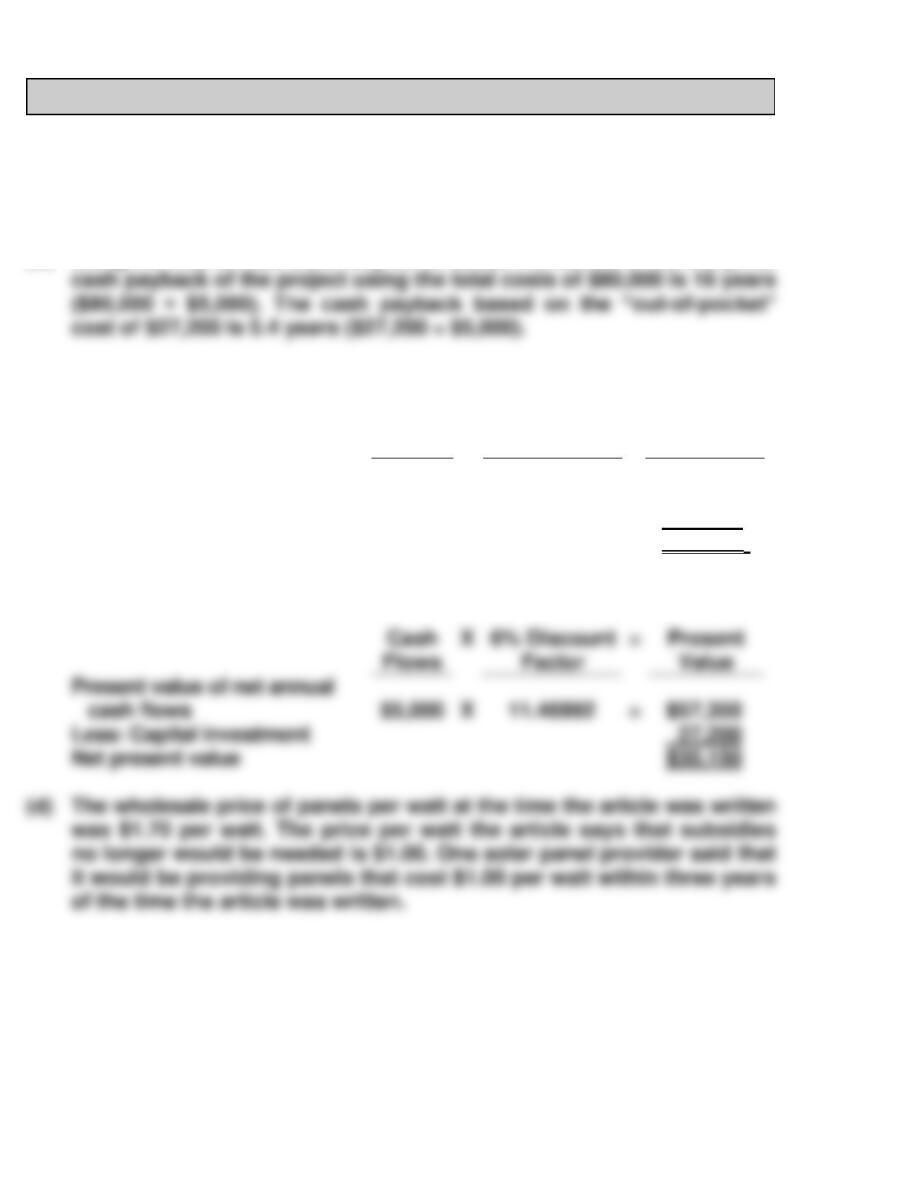
(a) The total cost of the installed solar panels was $80,000. The “out–of–
pocket” cost to the couple was $27,200.
(b) Using the total annual electricity bill of $5,000 mentioned in the story, the
(c) The net present value of the project using the total cost is:
Cash
Flows
X
6% Discount
Factor
=
Present
Value
Present value of net annual
cash flows
$5,000
X
11.46992
=
$ 57,350
Less: Capital investment
80,000
Net present value
$(22,650)
X
6% Discount
=
Present value of net annual
cash flows
$5,000
X
11.46992
=
Less: Capital investment
Net present value
The net present value of the project using the out–of–pocket cost is: