Chapter 12
Completion of the Accounting Cycle for a Merchandise Company
Using the Perpetual Inventory Method
Chapter Overview
This chapter contains a review of the worksheet and how it is used to prepare financial statements for a
merchandising company. The income statement for a merchandising company is expanded to include:
cost of goods sold, gross profit, operating expenses, and other income and/or expenses in arriving at net
income. The amount of net income or loss is carried to the statement of owner’s equity and the ending
balance in owner’s equity is carried to the balance sheet. The balance sheet is also expanded to include
several classifications: current assets, plant and equipment, and current liabilities.
Learning Objectives
After studying Chapter 12, your students should gain proficiency in the following:
2. Complete Adjusting Entries, Closing Entries, and a Post-Closing Trial Balance for a Merchandise
Company.
3. Complete Reversing Entries.
Chapter 12 Assignment Grid
Estimated Level
Learning Time in of
Assignment Topic(s) Objective(s) Minutes Difficulty
Discussion, Questions and Critical Thinking/Ethical Case
1 Worksheet 1 5 Easy
2 Cost of Goods Sold 1 5 Easy
3 Operating Expense Categories 1 5 Easy
Concept Checks
1 Calculate Net Sales 1 5 Easy
2 Calculate Gross Profit & Net Income 1 10 Easy
3 Classification of Accounts 1 15 Easy
4 Reversing Entries 3 10 Easy
Exercises (Set A)
Exercises (Set B)
12B-1 Account Classification 1 10 Easy
12B-2 Closing Entries 2 10 Easy
12B-3 Balance Sheet 1 15 Easy
12B-4 Adjusting/Reversing Entries 2, 3 30 Medium
12B-5 Adjusting/Reversing Entries 2, 3 30 Medium
Problems (Set A)
12A-1 Income Statement 1 40 Medium
12A-2 Statement of Owners’ Equity/Balance Sheet 1 90 Medium
12A-3 Worksheet & Financial Statements 1, 2 90 Medium
12A-4 Worksheet, Financial Statements, &
Reversing Entries 1, 2, 3 150 Hard
Problems (Set B)
12B-1 Income Statement 1 40 Medium
12B-2 Statement of Owners’ Equity/Balance Sheet 1 40 Medium
Financial Report Problem
Reading Amazon’s Annual Report 1 5 Easy
Keeping It Real
Suarez Computer Center 1, 2 60 Medium
Mini Practice Set
The Elegant Dress Shop
Computerized Accounting Application
Learning Unit 12–Af1: Financial Statements for Merchandise
Companies Using the Perpetual Inventory Method
Summary: The income statement (Figure 12.1) is prepared from the income statement columns of the
worksheet. On the formal income statement, the inside columns in financial reports are used for
subtotaling, not for debit and credit. The income statement is broken down into several sections: revenue,
cost of goods sold, gross profit, operating expenses, other income and other expenses. Net sales are
the gross amount received less sales returns and allowances and sales discounts. The Cost of goods
sold amount represents the cost of those goods (inventory) that were sold in the period. Gross profit is
Statement of owner’s equity is based on the balance sheet column of the worksheet. The capital account
in the ledger should be checked to see whether any additional investments occurred. You add the net
income from the income statement and deduct the withdrawals to calculate the ending figure for capital.
This ending capital amount is carried over to the balance sheet. A classified balance sheet classifies
assets as current assets or plant and equipment, and groups liabilities as current or long-term liabilities.
The operating cycle is the average time it takes to buy and sell merchandise and then collect accounts
Lecture Outline:
1. The income statement is prepared from information included on the worksheet. The format for the
income statement is: Net Sales
– Less: Cost of Goods Sold
= Equals: Gross Profit
– Less: Operating Expenses
= Equals Net Income from
Operations
+ Plus: Other Income
– Less: Other Expenses
= Equals: Net Income
a. Revenues: Gross sales less sales returns and allowances and less sales discounts equals Net
Sales.
i. Some examples of operating expenses are:
a) Sales salaries expense
b) Delivery expense
ii. Some examples of administrative or general expenses are:
a) Rent expense
b) Office salaries expense
e. Other Income (or Other Revenue):
i. Revenue other than revenue from sales or services and appears in a separate section on
the income statement
ii. Examples are: rental income, storage fees, or interest income
f. Other Expenses:
i. Any expense that does not relate to the main operating activities of the business and
2. Statement of Owner’s Equity is prepared from information on the worksheet and the income
statement. The ending balance is carried to the balance sheet. The statement format is:
3. The Balance Sheet: The classified balance sheet is a balance sheet that categorizes assets as current or
plant and equipment, and groups liabilities as current or long-term.
a. Current Assets are:
i. cash and other assets that will be converted into cash or used up during a normal
operating cycle (generally, one year)
c. Current Liabilities:
i. obligations or debts that will come due within one year or within the operating cycle,
whichever is longer
ii. Examples are: current portions of long-term debt (such as the portion of a mortgage
payable which must be paid in the next year), accounts payable, and accrued liabilities
d. Long-Term Liabilities:
i. obligations (debts) that are not due or payable for more than one operating cycle or a year
whichever is longer
ii. listed in the order the debt was incurred and includes the long-term portion of long-term
debt
iii. Examples: long-term notes payable, long-term portion of a mortgage payable
e. Owner’s Equity (on the balance sheet) is the ending balance carried from the statement of
owner’s equity
Teaching Tips/Strategy: Ask students to provide examples of merchandising businesses that are familiar
to them. Use the Success Coach LU 12-1 to reinforce the concept. The Concept Checks #1, #2, and #3 are
useful for class demonstration to practice section calculations. Practice account classification and
financial statement placement utilizing Exercises 12A-1 or 12B-1. As a final review, assign Problem 12A–
Learning Unit 12-2: Journalizing and Posting Adjusting and Closing
Entries: Preparing the Post-Closing Trial Balance
Summary: Closing entries are prepared to clear all temporary accounts in the ledger to zero and to update
capital in the ledger to its latest balance. The company uses the worksheet to complete the closing
process. Close all balances on the income statement credit column of the worksheet, by debits. Close all
The post-closing trial balance (Figure 12.7) is prepared from the general ledger after all adjusting
and closing entries are posted. All temporary accounts have been closed and are not shown, and the
capital account has been adjusted to the updated balance as of the end of the period.
Key Concepts: None
Lecture Outline:
1. The goals of closing are the same for a merchandise company as they are for a service
company. The goals are
a. to clear all temporary accounts in the ledger to zero
b. to update capital in the ledger to its latest balance
c. The closing steps are:
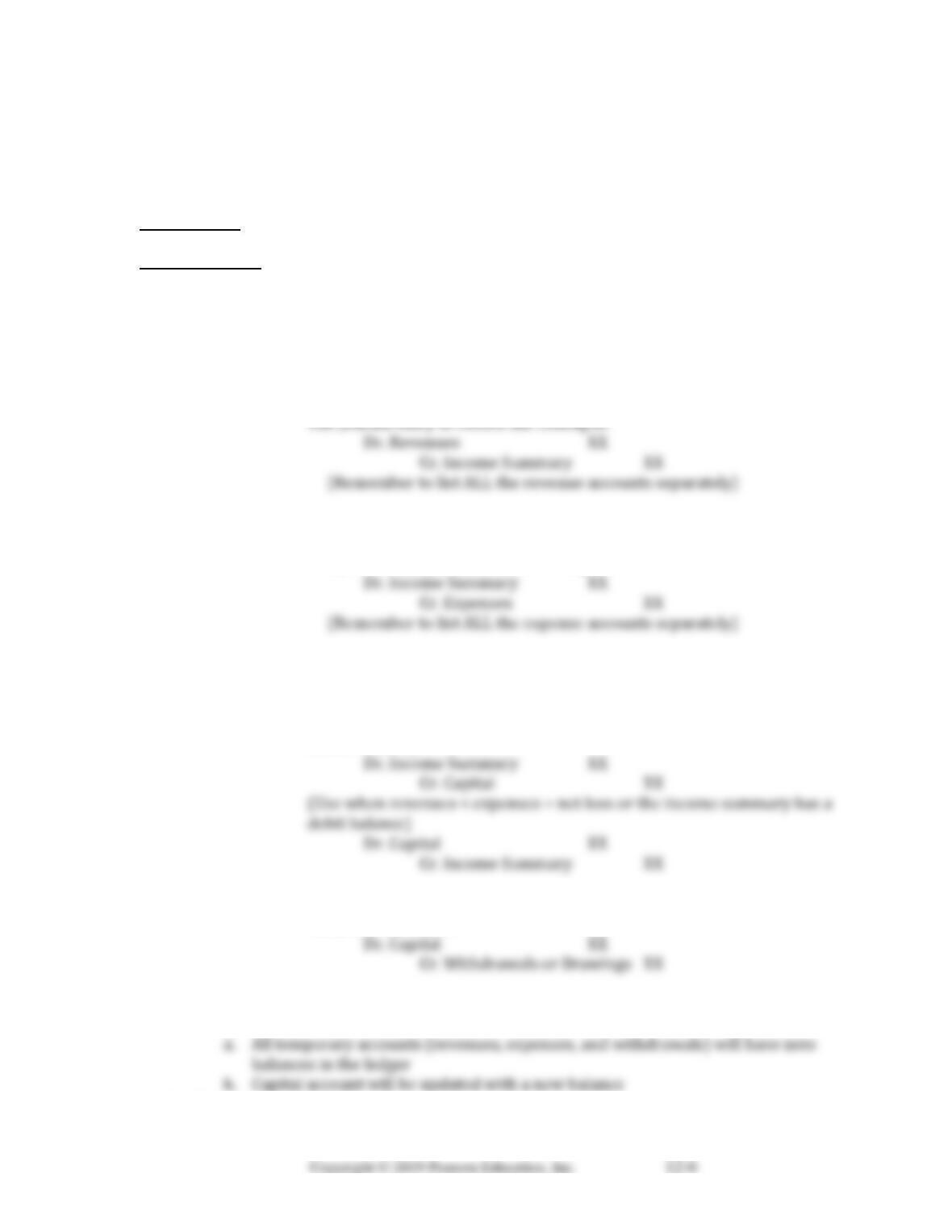
a) Close all balances on the income statement credit column (revenues)
of the worksheet
b) Close all balances on the income statement debit (expenses) column
of the worksheet
The journal entry to record the closing is:
c) The ending balance of income summary is transferred to the capital
account.
The journal entry is:
(Use when revenues > expenses = net income or the income summary has a
credit balance)
d) The balance of the withdrawals is transferred to the capital account
The journal entry is:
2. After all the adjusting entries (Figure 12.5) and closing entries (Figure 12.6) are journalized
and posted:
3. Post-closing trial balance:
Teaching Tips/Strategy:
After the class discussion, utilize the Accounting Coach LU 12-2 to assess the level of retention of the
material presented in this section. Explain the reasons why all entries presented on the worksheet are not
“official” until journalizing and posting has occurred. Clarify why the net income from the worksheet
might not match the financial statements unless you journalize and post all required adjustments.
Use the “Ten–Minute Quiz” questions #6 and #8 to reinforce learning these concepts.
Learning Unit 12-3: Reversing Entries (Optional Section)
Summary: Reversing entries are an optional bookkeeping technique in which certain adjusting entries
are reversed or switched on the first day of the new accounting period so that transactions in the new
period can be recorded without referring back to prior adjusting entries. Reversing entries are general
journal entries that are the opposite of adjusting entries. Reversing entries help reduce potential errors and
simplify the recordkeeping process.
Key Concepts: Reversing entries
Lecture Outline:
1. Reversing entries:
a. adjusting journal entries are reversed, on the first day of the new accounting period, so
that transactions in the new period can be recorded without referring back to prior
adjusting entries
b. reversing journal entries are general journal entries that are the opposite of adjusting
entries
c. Comparison of the system without the entries
i. Journal entries for the accrual of salaries without using a reversing entry:
If the December entry was:
Salaries Expense (December portion) XX
Salaries Payable XX
ii. Journal entries for the accrual of salaries with reversing entries:
If the December entry was:
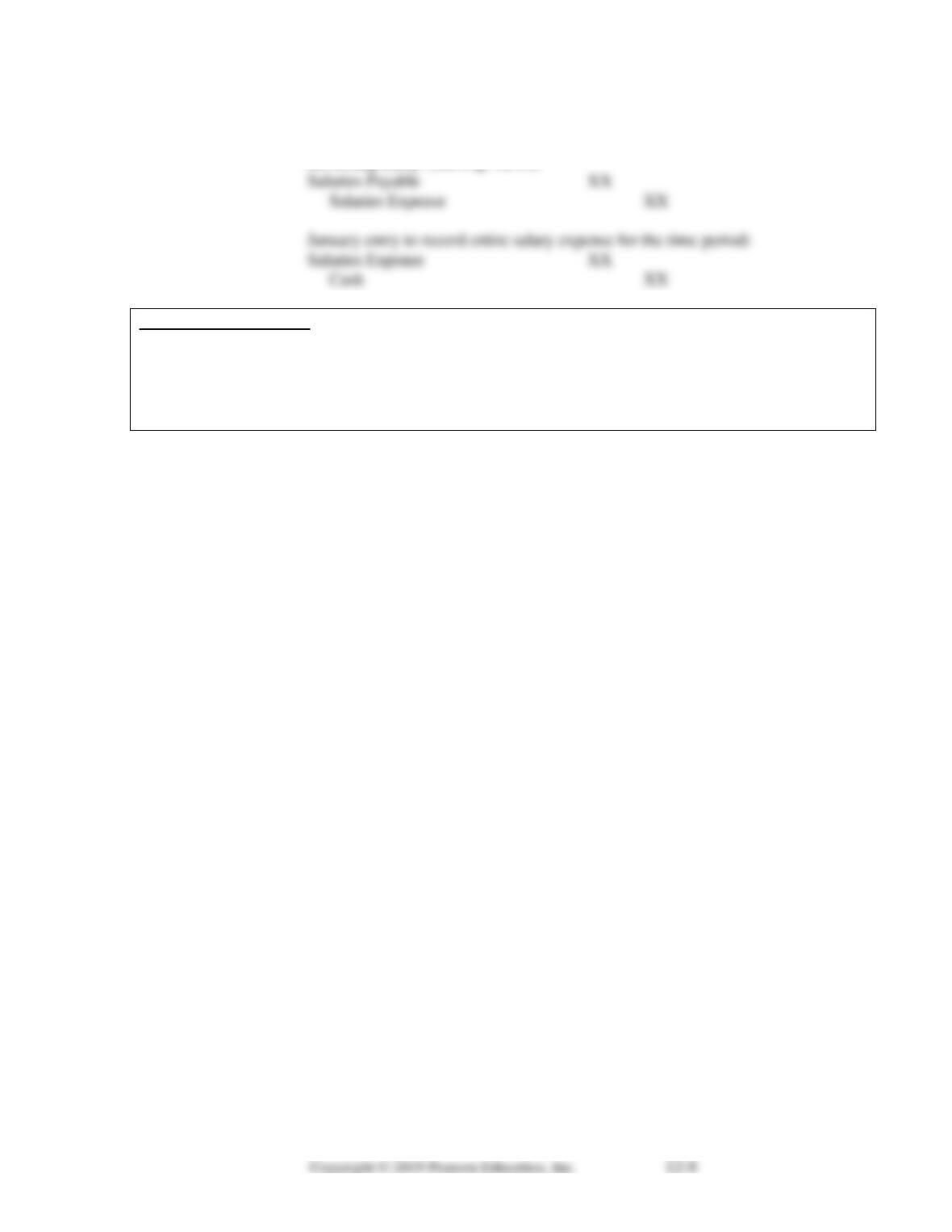
Salaries Expense XX
Reversing Entry: (See Fig. 12.10)
Teaching Tips/Strategy: Explain to students that reversing entries are optional. The purpose of
reversing entries is to simplify the adjustment and recording process. To introduce the students to this
topic, use the Concept Checks #4 as a demonstration exercise. At the end of the chapter, you can assign
either problem 12A-4 or 12B-4 that covers and details all the chapter’s objectives.
Use the “Ten-Minute Quiz” questions #9 and #10 to reinforce the concepts.

Name Date Section
CHAPTER 12
TEN-MINUTE QUIZ
Circle the letter of the best response.
1. Current assets include all of the following except:
a. cash b. accounts receivable
c. land d. merchandise inventory
2. Gross profit less operating expenses equals
a. cost of goods available for sale b. net income
c. gross profit d. net income from operations
3. Net sales less cost of goods sold equals
a. cost of goods available for sale b. net income
c. gross profit d. net income from operations
4. A company breaks expenses into selling expenses and administrative expenses. Which of the
following is not a selling expense?
a. advertising expenses b. delivery expense
c. depreciation expense, office equipment d. commission expense
5. A company’s net sales is $120,000; cost of goods sold is $37,000; selling expenses are $25,000;
administrative expenses are $29,000; and interest income is $3,000. How much is net income?
a. $29,000 b. $32,000
c. $83,000 d. $123,000
6. Closing entries are prepared to
a. reduce all permanent account balances to zero
b. reduce all temporary account balances to zero
c. reduce all permanent and temporary account balances to zero
d. reduce net income to zero
7. A company’s net sales is $120,000; cost of goods sold is $37,000; selling expenses are $25,000;
administrative expenses are $29,000; and interest income is $3,000. How much is net income
from operations?
a. $29,000 b. $32,000
c. $83,000 d. $123,000
8. A post-closing trial balance is best prepared from
a. the general ledger b. the general journal
c. the financial statements d. the worksheet
9. If an adjusting entry was made to record the December unpaid portion of salaries expense of
$770, the reversing entry would be
a. debit salaries expense and credit salaries payable
b. debit salaries expense and credit income summary
c. debit salaries payable and credit salaries expense
d. debit income summary and credit salaries expense

10. A reversing entry could be used for
a. adjusting entries for salaries payable b. adjusting entries for prepaid insurance
c. adjusting entries for unrecorded revenue d. adjusting entries for unearned revenue
Answer Key to Chapter 12 Quiz
1. c