CHAPTER 12 Accounting for Partnerships and Limited Liability Companies
Prob. 12-6A (Concluded)
1. b.
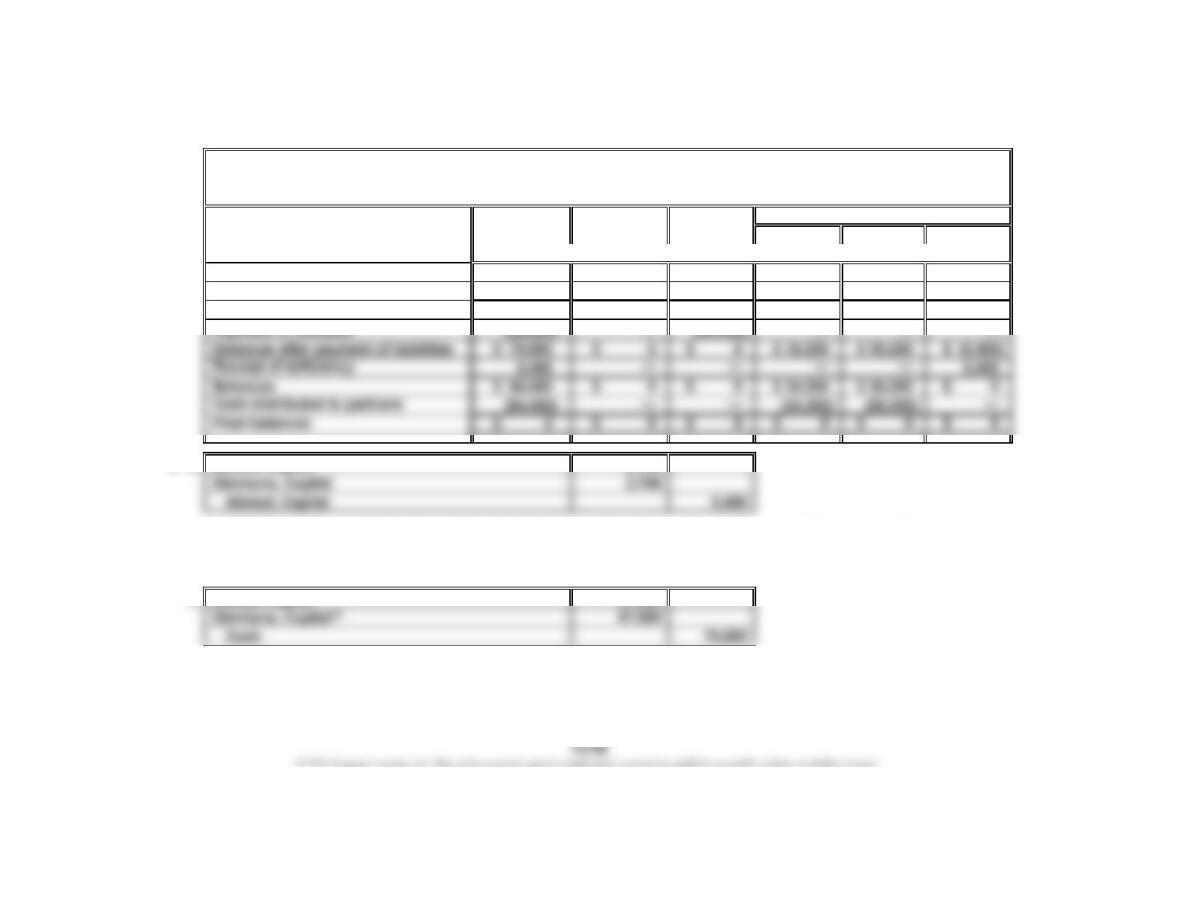
Noncash Bowes Simmons Ahmed
Cash Assets Liabilities (2/5) (2/5) (1/5)
Balances before realization $ 38,000 $ 152,000 $ 24,000 $ 69,000 $ 85,000 $ 12,000
Sale of assets and division of loss 65,000 (152,000) —(34,800) (34,800) (17,400)
Balances after realization $103,000 $0
$ 24,000 $ 34,200 $ 50,200 $ (5,400)
The $5,400 deficiency of Ahmed would be divided between the other partners, Bowes and Simmons, in their income-
sharing ratio (1:1, respectively). Therefore, Bowes would absorb one-half of the $5,400 deficiency, or $2,700, and
Simmons would absorb one-half of the $5,400 deficiency, or $2,700.
* $34,200 – $2,700
** $50,200 – $2,700
Bowes, Simmons, and Ahmed
Statement of Partnership Liquidation
Capital
For Period November 1–30
++
+
=+
CHAPTER 12 Accounting for Partnerships and Limited Liability Companies
Prob. 12-1B
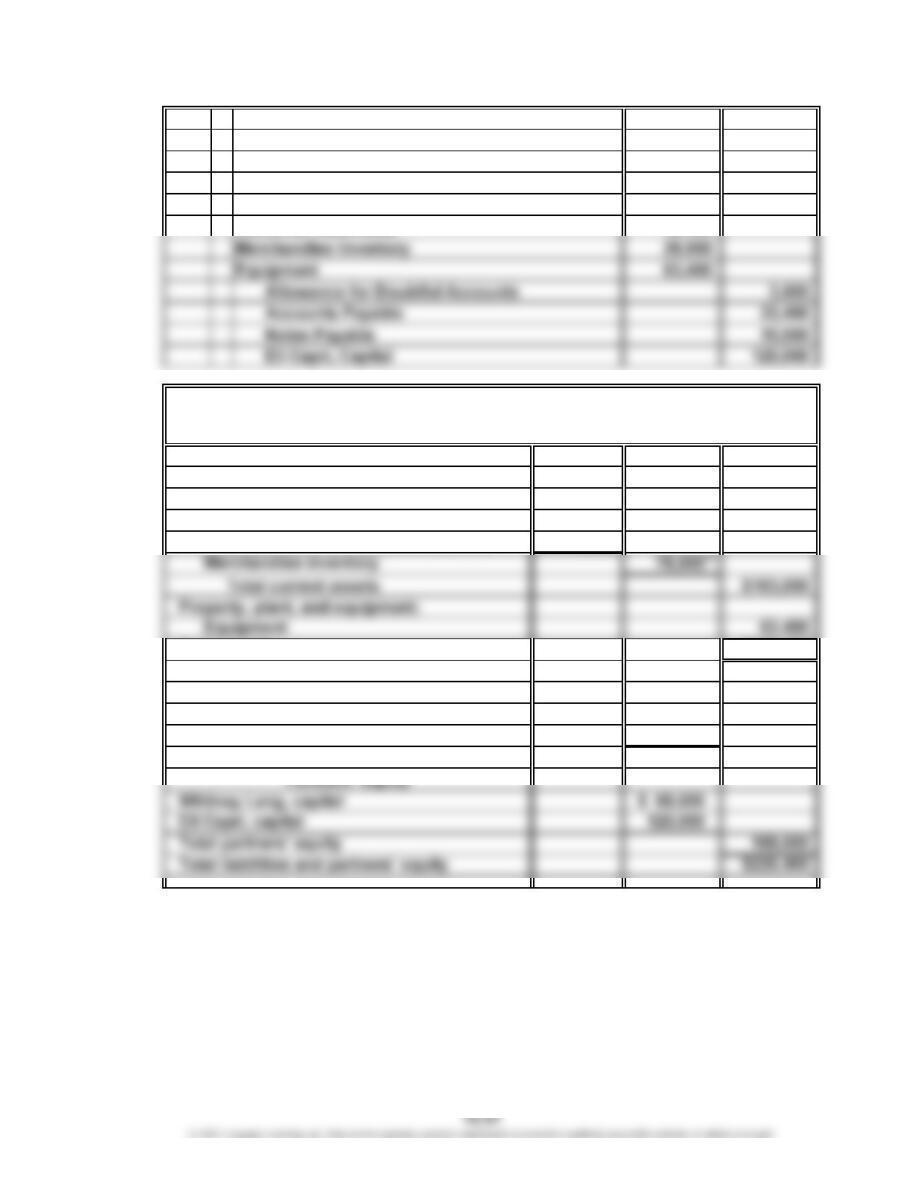
1. Apr. 1 Cash 18,000
Merchandise Inventory 50,000
Whitney Lang, Capital 68,000
1 Cash 26,200
2.
Current assets:
Cash $ 44,200
Accounts receivable $43,400
Less allowance for doubtful accounts 3,500 39,900
Total assets $226,400
Current liabilities:
Accounts payable $ 23,400
Notes payable 15,000
Total liabilities $ 38,400
*
$18,000 + $26,200
**
$28,900 + $50,000
Liabilities
Lang and Capri
Balance Sheet
April 1, 20Y1
Assets
*
CHAPTER 12 Accounting for Partnerships and Limited Liability Companies
Prob. 12-1B (Concluded)
31 Whitney Lang, Capital 40,000
Eli Capri, Capital 30,000
Whitney Lang, Drawing 40,000
Eli Capri, Drawing 30,000
* Computations:
Total
Interest allowance…………………………
…
$ 6,800 $12,000 $ 18,800
Salary allowance……………………………
…
36,000 22,000 58,000
Lang Capri
12

CHAPTER 12 Accounting for Partnerships and Limited Liability Companies
Prob. 12-2B
Plan Howell Nickles Howell Nickles
a. …………………………………
…
$210,000 $210,000 $ 75,000 $75,000
b. …………………………………
…
168,000 252,000 60,000 90,000
Details:
Nickles
a. Net income (1:1)……………
…
$210,000 $210,000 $ 75,000 $75,000
b. Net income (2:3)……………
…
$168,000 $252,000 $ 60,000 $90,000
…
…
…
…
…
…
…
…
f. Interest allowance…………
…
$ 5,000 $ 7,500 $ 5,000 $ 7,500
Salary allowance……………
…
38,000 19,000 38,000 19,000
Bonus allowance……………
…
72,600 18,600
Remaining income (1:1)……
…
138,950 138,950 30,950 30,950
Net income……………………
…
$254,550 $165,450 $ 92,550 $57,450
(1) (2)
$420,000 $150,000
Nickles HowellHowell
$420,000 $150,000
23
…
…
…
…
CHAPTER 12 Accounting for Partnerships and Limited Liability Companies
Prob. 12-3B
1.
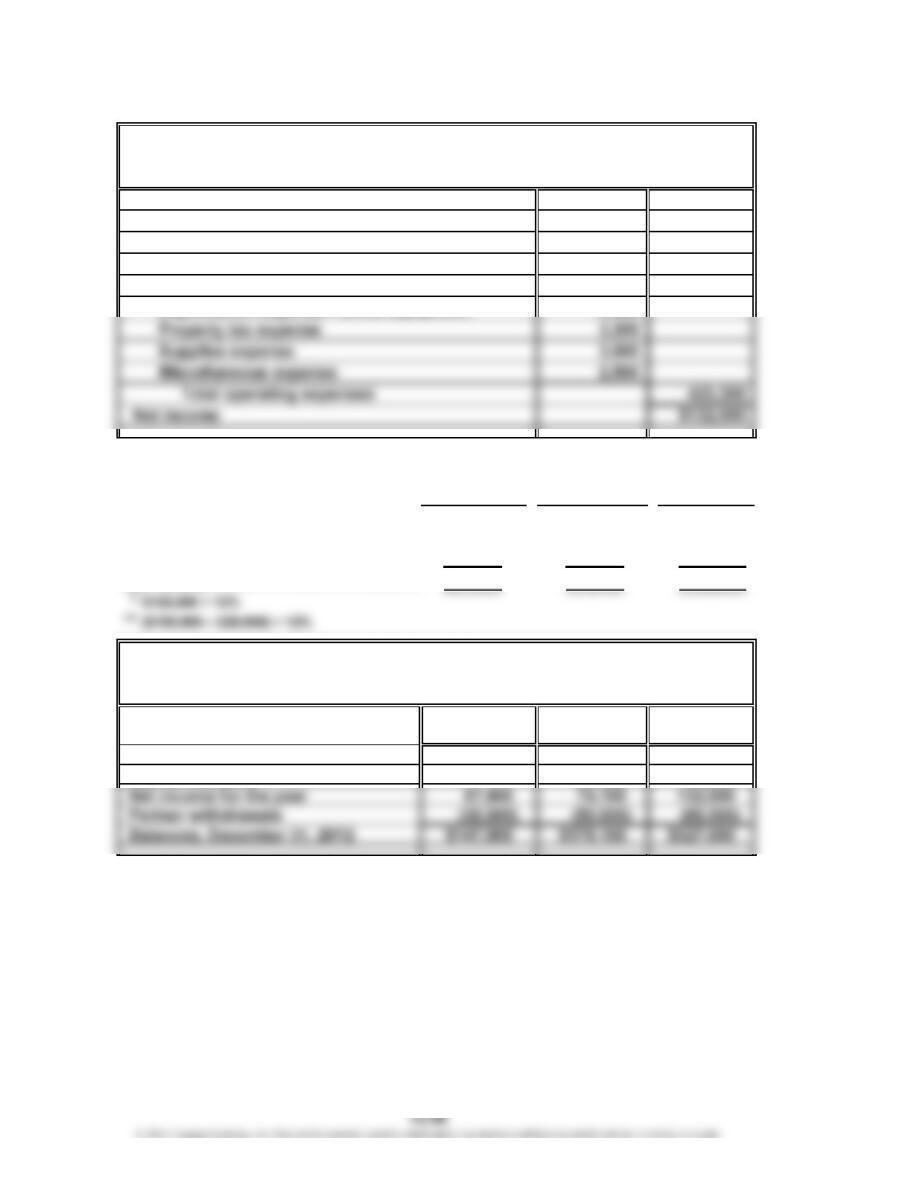
Professional fees
Operating expenses:
Salary expense
Depreciation expense—building
Heating and lighting expense
Division of net income:
Total
Salary allowance…………………………
…
$50,000 $65,000 $115,000
Interest allowance………………………… 15,000 16,200 31,200
Remaining income (loss) (1:1)…………
…
(7,100) (7,100) (14,200)
$57,900 $74,100 $132,000
2.
Total
Balances, Januar
y
1, 20Y2
Ca
p
ital additions
20,000
$125,000
—20,000
Xue
$135,000
Ramirez
Ping
Ramirez and Xue
Camila
$260,000
Camila
Ramirez Xue
Ping
Statement of Partnership Equity
For the Year Ended December 31, 20Y2
10,500
Ramirez and Xue
Income Statement
For the Year Ended December 31, 20Y2
$555,300
$384,900
12,900
**
*
CHAPTER 12 Accounting for Partnerships and Limited Liability Companies
Prob. 12-3B (Concluded)
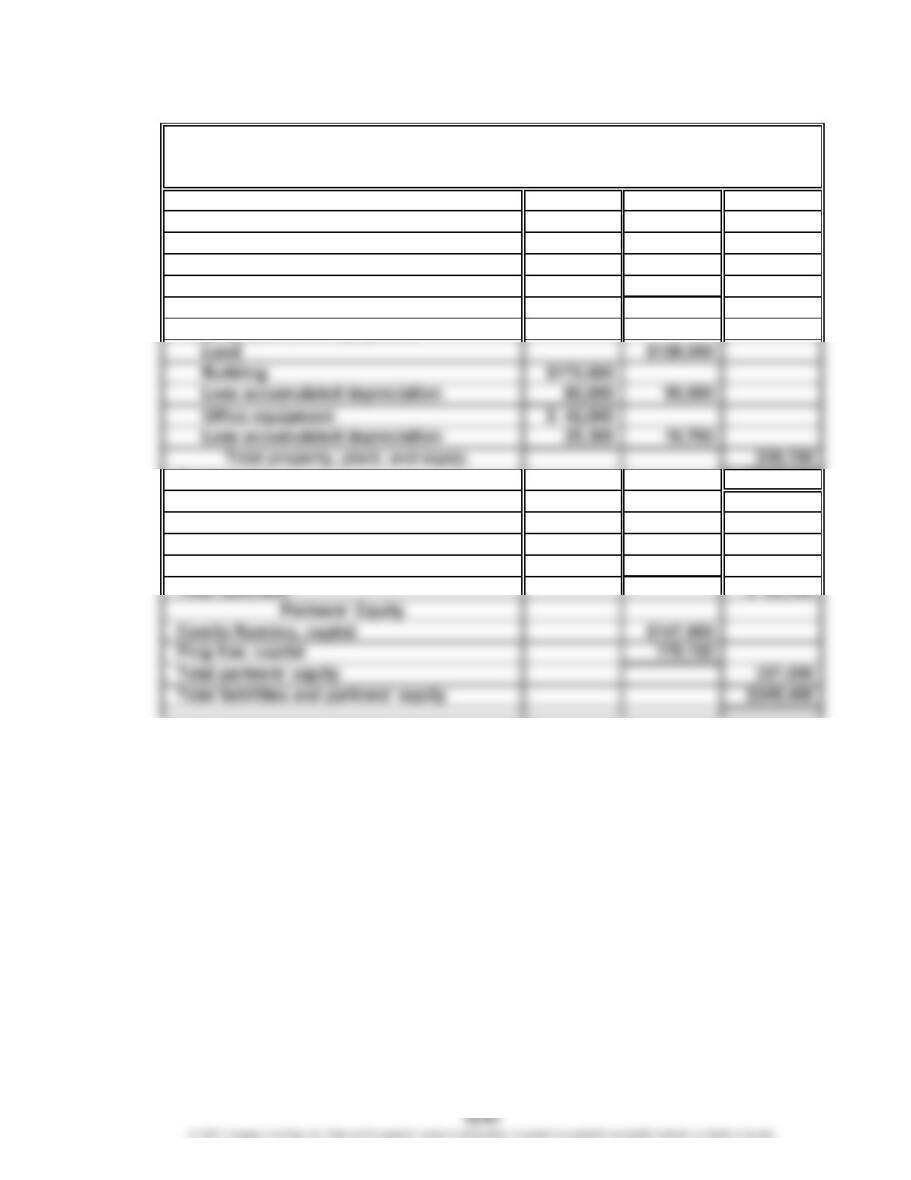
3.
Current assets:
Cash $ 70,300
Accounts receivable 33,600
Supplies 5,800
Total current assets $109,700
Property, plant, and equipment:
Total assets $349,400
Current liabilities:
Accounts payable $ 12,400
Salaries payable 10,000
Ramirez and Xue
Balance Sheet
December 31, 20Y2
Assets
Liabilities
CHAPTER 12 Accounting for Partnerships and Limited Liability Companies
Prob. 12-4B
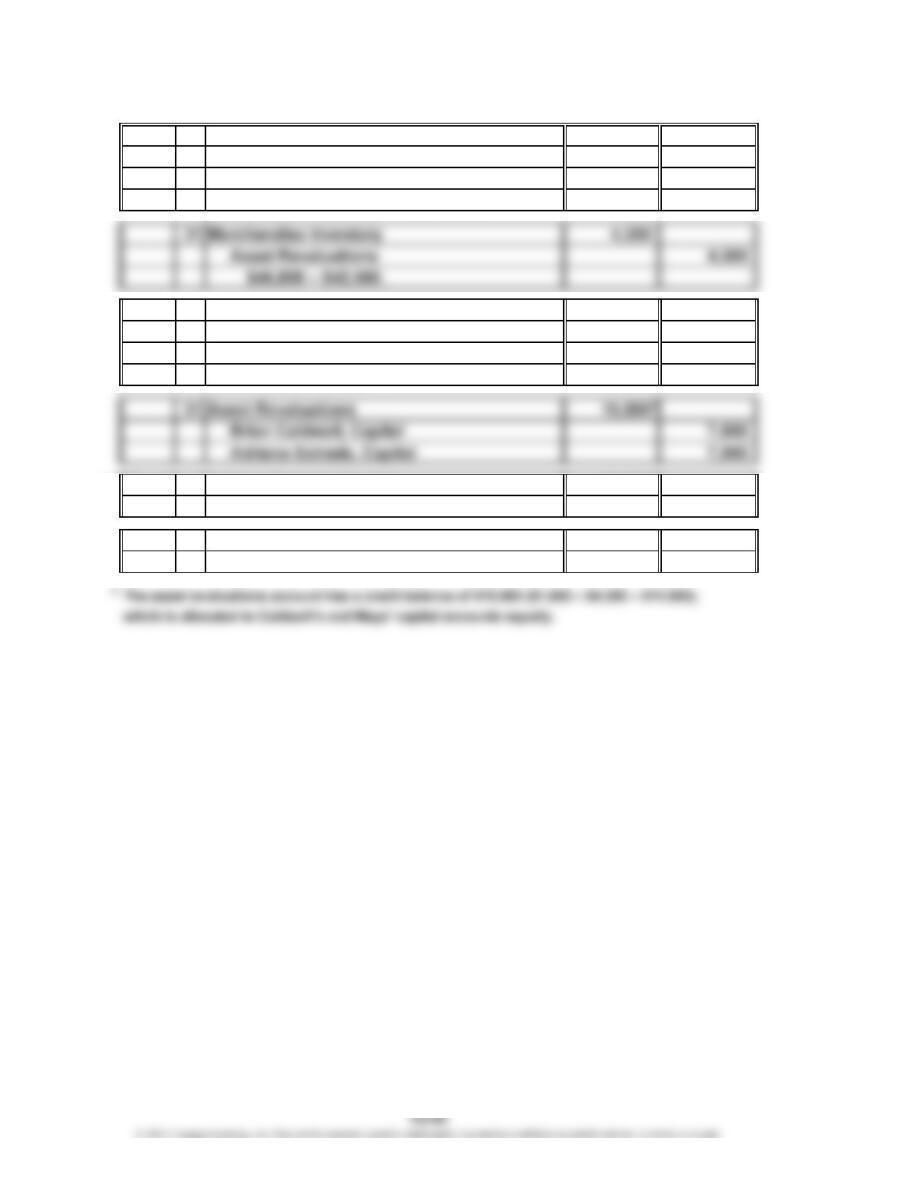
1. Aug. 31 Asset Revaluations 1,800
Accounts Receivable 1,500
Allowance for Doubtful Accounts 300
[($19,500 – $1,500) × 5%] – $600.
31 Accumulated Depreciation—Equipment 15,500
Equipment 3,000
Asset Revaluations 12,500
$64,500 – $67,500.
2. Sept. 1 Adriana Estrada, Capital 26,000
Kris Mays, Capital 26,000
1 Cash 32,000
Kris Mays, Capital 32,000
CHAPTER 12 Accounting for Partnerships and Limited Liability Companies
Prob. 12-4B (Concluded)
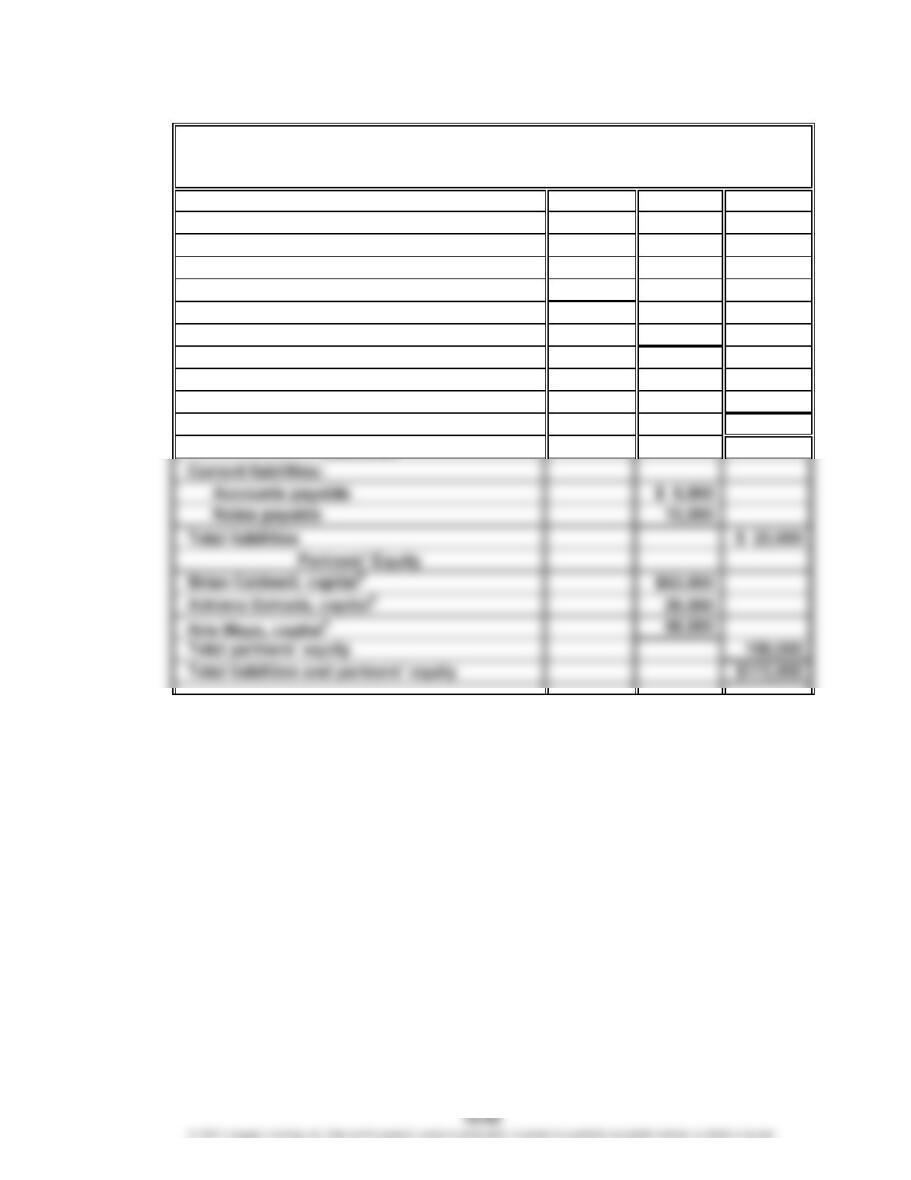
3.
Current assets:
Cash1$44,300
Accounts receivable $18,000
Less allowance for doubtful accounts 900 17,100
Merchandise inventory 46,800
Prepaid insurance 1,200
Total current assets $109,400
Property, plant, and equipment:
Equipment 64,500
Total assets $173,900
1$12,300 + $32,000
2$55,000 + $7,500
3$48,000 + $7,500 – $26,000
4$26,000 + $32,000
Caldwell, Estrada, and Mays
Balance Sheet
September 1, 20Y9
Assets
CHAPTER 12 Accounting for Partnerships and Limited Liability Companies
Prob. 12-5B
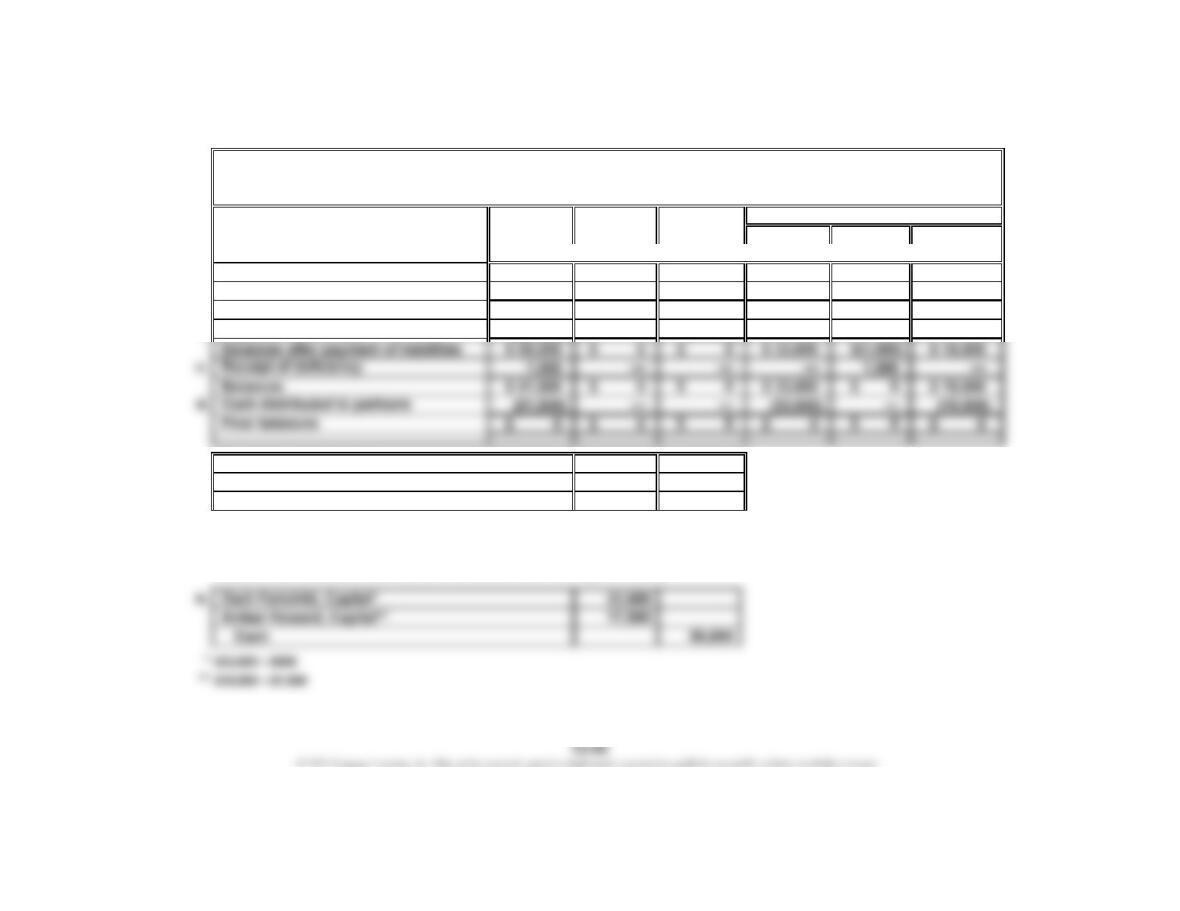
1.
Noncash Fairchild Lowes Howard
Cash Assets Liabilities (1/4) (1/4) (2/4)
Balances before realization $ 23,500 $ 84,500 $ 22,000 $ 42,000 $ 7,500 $ 36,500
a. Sale of assets and division of loss 48,500 (84,500) — (9,000) (9,000) (18,000)
Balances after realization $ 72,000 $ 0 $ 22,000 $ 33,000 $(1,500) $ 18,500
b. Payment of liabilities (22,000) — (22,000) — — —
2. a. Zach Fairchild, Capital
Amber Howard, Capital
Austin Lowes, Capital
The $1,500 deficiency of Lowes would be divided between the other partners, Fairchild and Howard, in their income-
sharing ratio (1:2, respectively). Therefore, Fairchild would absorb one-third of the $1,500 deficiency, or $500, and
Howard would absorb two-thirds of the $1,500 deficiency, or $1,000.
+++
Fairchild, Lowes, and Howard
Statement of Partnership Liquidation
For Period April 10–30
Capital
+=
1,500
500
1,000
CHAPTER 12 Accounting for Partnerships and Limited Liability Companies
Prob. 12-6B
1. a.
Noncash Chapelle Rock Pryor
Cash Assets Liabilities (1/5) (2/5) (2/5)
Balances before realization $ 65,000 $ 167,000 $ 30,000 $ 14,000 $ 102,000 $ 86,000
Sale of assets and division of gain 217,000 (167,000) — 10,000 20,000 20,000
Balances after realization $ 282,000 $ 0 $ 30,000 $ 24,000 $ 122,000 $ 106,000
++=++
Chapelle, Rock, and Pryor
Statement of Partnership Liquidation
For Period August 3–29
Capital
CHAPTER 12 Accounting for Partnerships and Limited Liability Companies
Prob. 12-6B (Concluded)
1. b.
Noncash Chapelle Rock Pryor
Cash Assets Liabilities (1/5) (2/5) (2/5)
Balances before realization $ 65,000 $ 167,000 $ 30,000 $ 14,000 $102,000 $ 86,000
Sale of assets and division of loss 72,000 (167,000) —(19,000) (38,000) (38,000)
Balances after realization $ 137,000 $ 0 $ 30,000 $ (5,000) $ 64,000 $ 48,000
2. a. Rock, Capital
Pryor, Capital
Chapelle, Capital
The $5,000 deficiency of Chapelle would be divided between the other partners, Rock and Pryor, in their income-
sharing ratio (1:1, respectively). Therefore, Rock would absorb one-half of the $5,000 deficiency, or $2,500, and Pryor
would absorb one-half of the $5,000 deficiency, or $2,500.
Chapelle, Rock, and Pryor
Statement of Partnership Liquidation
Capital
For Period August 3–29
2,500
2,500
+=+++
5,000
CHAPTER 12 Accounting for Partnerships and Limited Liability Companies
CP 12-1
This scenario highlights one of the problems that arises in partnerships:
attempting to align contribution with income division. Often, disagreements
are based on honest differences of opinion. However, in this scenario, there is
evidence that Robbins was acting unethically. Robbins apparently made no
mention of his plans to “scale back” once the partnership was consummated.
As a result, Barrow agreed to an equal division of income based on the
that way.
Barrow could respond to this situation by either withdrawing from the
partnership or changing the partnership agreement. One possible change
would be to provide a partner salary based on the amount of patient billings.
CASES & PROJECTS

CHAPTER 12 Accounting for Partnerships and Limited Liability Companies
CP 12-2
a. and b.
This table is from the 2018 “Accounting Today Top 100 Firms.”
Total Revenues Revenues
(in millions) per Partner*
Deloitte & Touche………………… $18,551 $5,917,384
PwC…………………………………
…
15,620 4,694,920
Ernst & Young……………………
…
13,000 4,062,500
KPMG………………………………
…
8,960 4,113,866
c.
Percent of
Revenue per Deloitte &
Partner Touche
Deloitte & Touche…………………
…
$5,917,384 100%
PwC…………………………………… 4,694,920 79%
KPMG…………………………………
…
4,113,866 70%
Ernst & Young………………………
…
4,062,500 69%
*
$4,694,920 ÷ $5,917,384
d. As can be seen, Deloitte & Touche has the highest revenue per partner relative to
Partners
3,135
3,327
3,200
2,178
Total
**
CHAPTER 12 Accounting for Partnerships and Limited Liability Companies
CP 12-3
When developing an LLC (or partnership), the operating (or partnership)
agreement is a critical part of establishing a business. Each party must consider
the various incentives of each individual in the LLC. For example, in this case,
one party, Lindsey Wilson, is providing all of the funding, while the other two
parties are providing expertise and talent. This type of arrangement can create
some natural conflicts because the interests of an investor might not be
the same as those operating the LLC. Specifically, you would want to advise
A second issue is the division of partnership income. The suggested agreement
is for all the partners to share the remaining income, after the 10% preferred return,
equally. Wilson should be counseled to consider all aspects of the LLC contribution
to determine whether this division is equitable. There are many considerations,
including the amount of investment, risk of the venture, degree of expertise of
noninvesting partners, and degree of exclusivity of noninvesting members’ effort
contribution (unique skills or business connections, for example). Often, the simple
assumption of equal division is not appropriate.
CP 12-4
A good solution to this problem would be to divide income into three steps:
1. Provide interest on each partner’s capital balance.
2. Provide a monthly salary for each partner.
3. Divide the remainder according to a partnership formula.
With this approach, the return on capital and effort will be calculated
separately in the income division formula before applying the percentage
formula. Thus, Willard will receive a large interest distribution based on the