12–17
PROBLEMS
Problem 12.23
1. An activity driver measures the amount of an activity consumed by a cost
object. It is a measure of activity output. Activity drivers are used to assign
2. Value content and driver analysis:
Setting up equipment: At first glance, this appears to be a value-added activi-
ty because (1) it causes a change in the state of nature: improperly config-
ured equipment to properly configured equipment, (2) there is no prior
activity that should have caused the state change, and (3) it is necessary to
enable other activities to be performed. However, setting up equipment often
takes more time than needed and so has a non-value-added component. Most
companies strive for zero setup time, suggesting that the time and
associated cost are non-value-added because the activity is performed ineffi-
ciently. (A zero setup time suggests a non-value-added activity.) Means
12–18
Problem 12.23 (Continued)
Welding subassemblies: This is a value-added activity. It causes a desired
state change that could not have been done by preceding activities and
enables other activities to be performed. If inefficient, then means should be
sought to improve efficiency. The goal is to optimize value-added activity per-
formance. Possible root causes of inefficiency include product design, pro-
cess design, and production technology. Changing either product or process
design could decrease the demand for the welding activity while producing
the same or more output. A change in technology—buying more advanced
technology, for example—may also increase the efficiency of the activity.
12–19
Problem 12.23 (Concluded)
3. Behavioral analysis:
Setting up equipment: Using the number of setups as a driver may cause a
buildup of inventories. Since reducing the number of setups will reduce set-
up costs, there will be an incentive to have fewer setups. Reducing the num-
ber of setups will result in larger lots and could create finished goods inven-
ing the efficiency of a non-value-added activity has some short-run merit, but
it should not be the focus. Of the two drivers, defective units is the most
compatible with eventual elimination of the non-value-added activity.
Welding subassemblies: Using welding hours should encourage management
to find ways of reducing the welding hours required per product. This would
Inspecting components: Hours of inspection can be reduced by working with
suppliers so that greater incoming quality is ensured. Similarly, the number
of defective parts can be reduced by working with suppliers so that incoming
quality is increased. Hours of inspection, however, can be reduced without
increasing quality. This is not true for the number of defective parts. Using
12–20
Problem 12.24
1. First quarter: Setup time standard = 9 hours (based on the planned
2. Kaizen subcycle:
• Plan (3-hour reduction from process redesign.)
• Do (Try out setup with new design.)
• Check (Time required was seven hours, a 5-hour reduction.)
3. Maintenance subcycle for setups:
First quarter (12-hour standard at the beginning of the quarter):
• Establish standard (Seven hours based on actual improved process de-
12–21
Problem 12.24 (Concluded)
4. Non-value-added cost saved (eliminated) with 9 hours of reduced setup-time:
5. Kaizen costing emphasizes constantly searching for process improvements
with the standard changing with each improvement. This search involves all
Problem 12.25
1. Formula
Resource Fixed Variable
Salaries ………. $1,250,000 —
Lease …………. 144,000 —
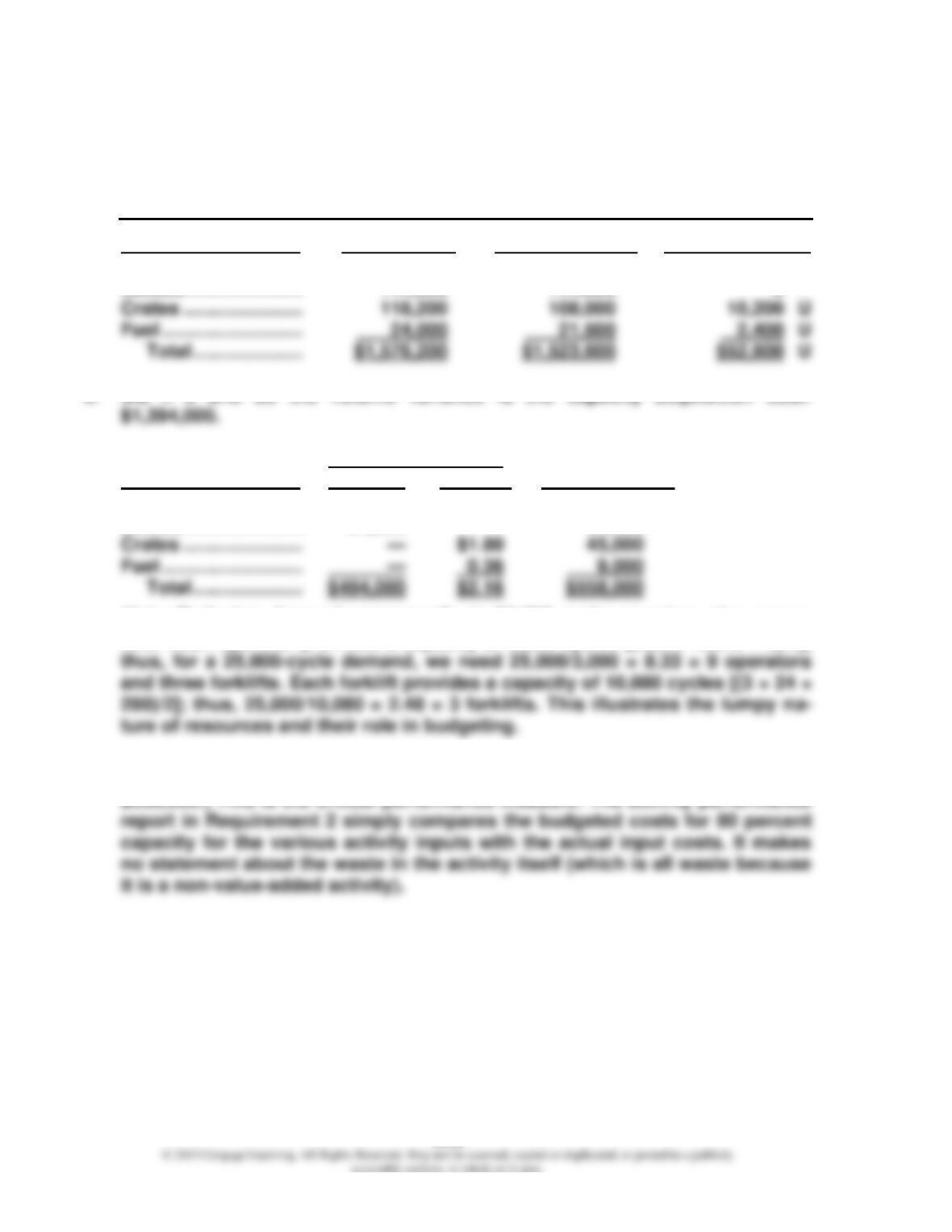
2. Capacity is determined by the minimum of forklift capacity and operator ca-
pacity. Forklift capacity is 3 × 24 × 280 × 8 = 161,280 moves, or 80,640 cycles.
Budget:
Formula 60,000 Cycles
Resource Fixed Variable (Activity Output)
Salaries ………… $1,250,000 — $ 1,250,000
12–22
Problem 12.25 (Concluded)
Novo, Inc.
Performance Report
For the Year 20XX
Resource Actual Costs Budgeted Costs Budget Variance
Salaries ………………… $1,290,000 $1,250,000 $40,000 U
Leases …………………. 144,000 144,000 0
3. SQ = 0 and so the volume variance is the capacity acquisition cost:
4. Formula 25,000 Cycles
Resource Fixed Variable (Activity Output)
Salaries ………………… $450,000 — $450,000
Leases …………………. 54,000 — 54,000
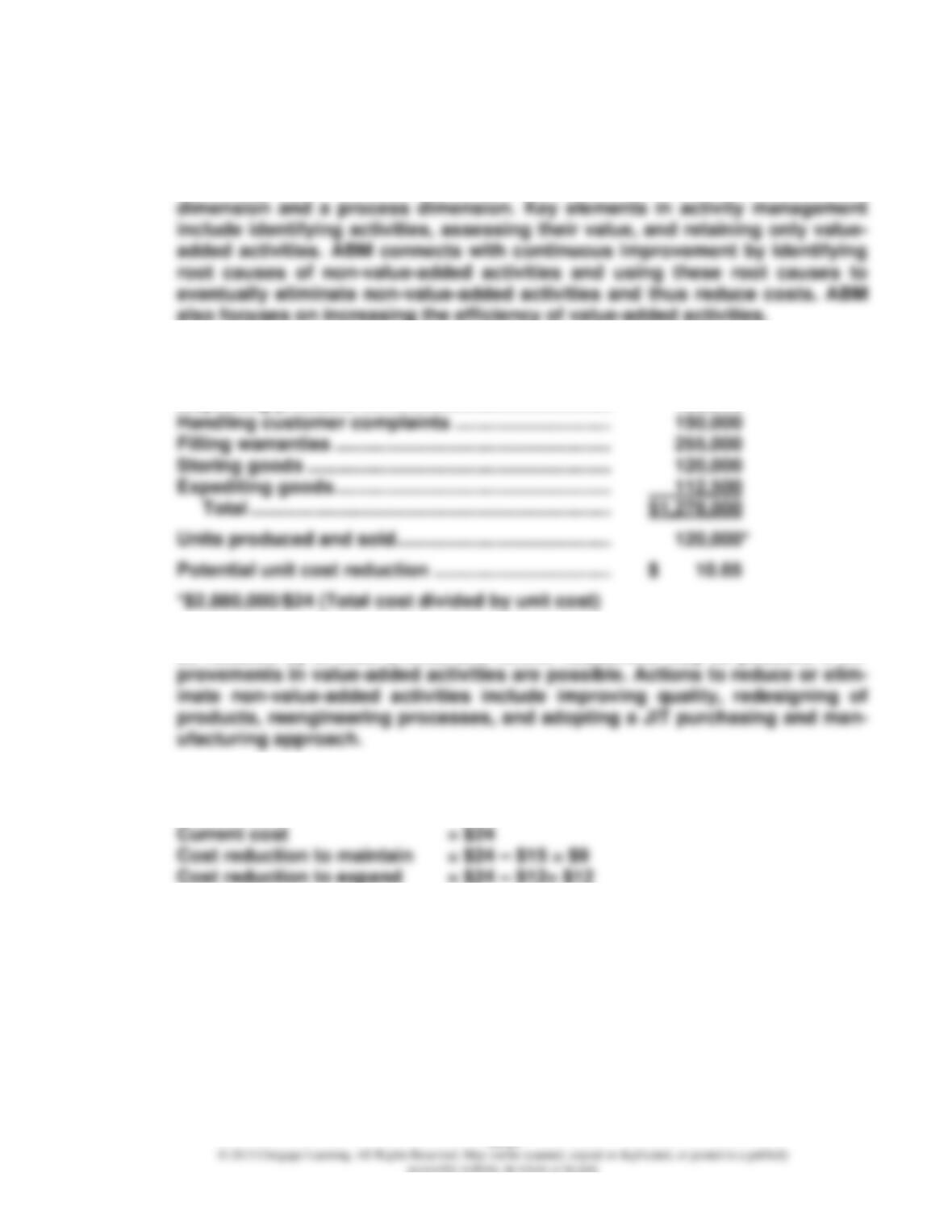
Note: Reducing demand permanently to 25,000 cycles requires nine opera-
tors. Each operator provides a capacity of 3,000 cycles [(2,000 hours × 3)/2];
Clearly, the cost of performing this activity has been dramatically reduced.
(Compare the budgeted cost of the 80 percent capacity, $1,718,600, with the
12–23
Problem 12.26
1. Activity-based management is a systemwide, integrated approach that focus-
es management’s attention on activities. It involves two dimensions: a cost
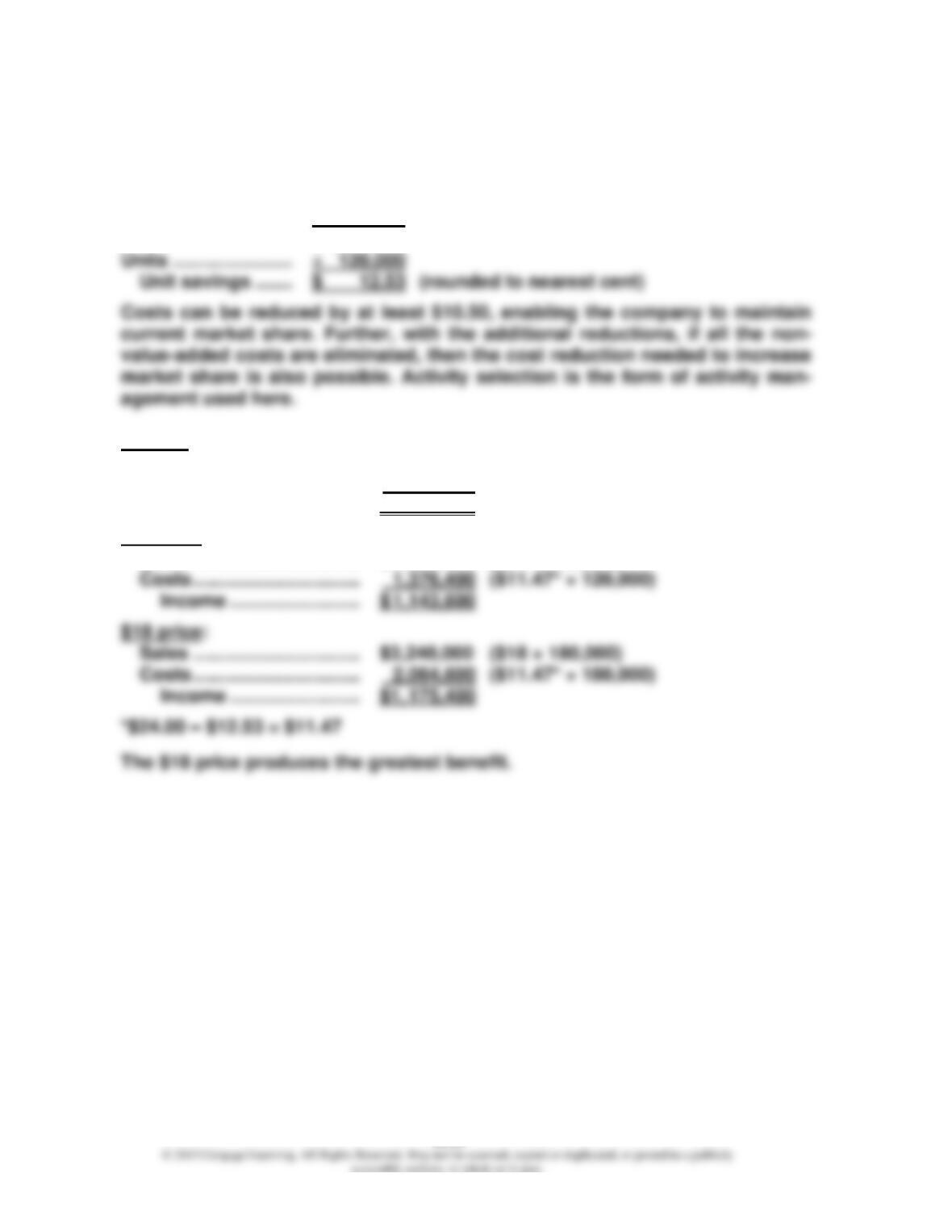
2. Setting up equipment ………………………………………. $ 187,500
Materials handling …………………………………………… 270,000
Inspecting products ………………………………………… 183,000
The consultant’s estimate of cost reduction was on target. Per-unit costs can
be reduced by at least $10.50, and further reductions may be possible if im-
3. Target cost to maintain sales = $21 – $6 = $15
Target cost to expand sales = $18 – $6 = $12
12–24
Problem 12.26 (Concluded)
4. Total potential reduction:
$1,278,000 (from Requirement 2)
225,000 (by automating)
$1,503,000
5. Current:
Sales ………………………….. $3,240,000 ($27 × 120,000 units)
Costs ………………………….. 2,880,000
Income ……………………. $ 360,000
$21 price (assumes that current market share is maintained):
Sales ………………………….. $1,680,000 ($21 × 120,000)
12–25
Problem 12.27
1. Non-value-added usage and costs (first year):
Non-Value-Added Non-Value-Added
Usage Cost
AQ* SQ** AQ – SQ (AQ – SQ)SP
Molding …………. 2,700,000 2,160,000 540,000 $ 8,100,000
Note: SP for materials is $15; SP for engineering is $35 ($70,000/2,000). There
are no price variances because SP = AP.
Unused capacity for engineering:
SP × AQ
SP × AU
$35 × 144,000
$35 × 138,000
2. Kaizen standards for the coming year (second year):
12–26
Problem 12.27 (Concluded)
3. AU* SQ AU – SQ SP(AU – SQ)
Materials ………………. 2,600,000 2,538,000 62,000 $930,000 U
The company failed to meet the molding kaizen standard but beat the engi-
neering standard. The engineering outcome is of particular interest. The ac-
tual usage of the engineering resource is 120,000 hours, and activity availa-
bility is 144,000 hours. Thus, the company has created 24,000 hours of
12–27
Problem 12.28
1. Current cost per unit = $28,800,000/20,000 = $1,440
Current profit per unit = $1,620 – $1,440
2. Non-value-added costs:
Materials (900,000 – 855,000)$21 ………………………. $ 945,000
Labor (216,000 – 205,200)$12.50 ……………………….. 135,000
Setups (14,400 – 0)$75 …………………………………….. 1,080,000
Materials handling (36,000 – 0)$70 ……………………. 2,520,000
3. Benchmarking played a major role. The Kansas City plant set the standard and
offered to share information on how it achieved the cost reductions that ena-
12–28
Problem 12.29
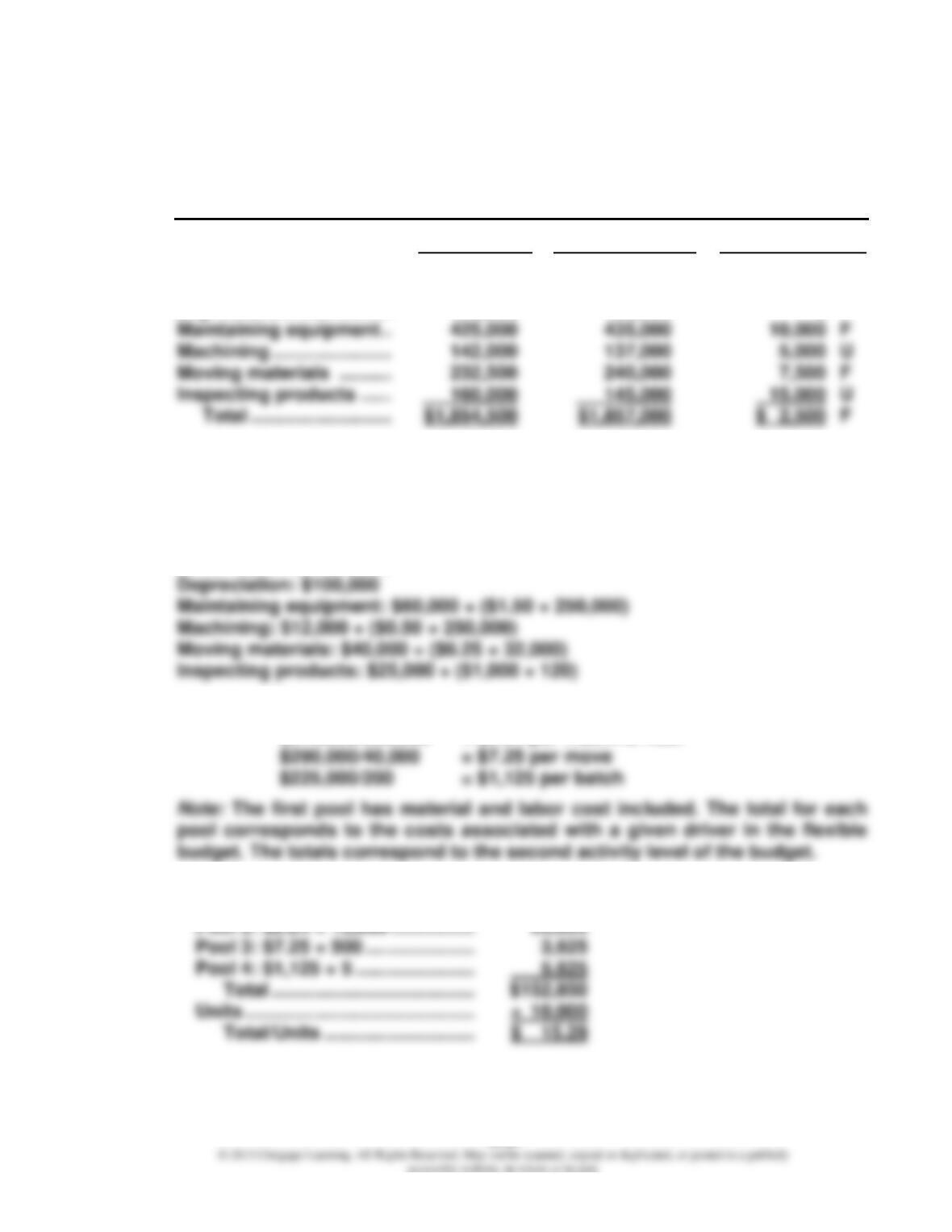
1. Actual Costs Budgeted Costs Budget Variance
Direct labor ……………….. $210,000 $200,000 $ 10,000 U
2. Actual Costs Budgeted Costs Budget Variance
Direct labor ……………….. $210,000 $200,000 $10,000 U
Power ………………………… 135,000 149,000 14,000 F
3. The multiple cost driver approach captures the cause-and-effect cost rela-
4. Agree. Non-value-added cost trend reports emphasize cost reduction and
12–29
Problem 12.30
1. Marston, Inc.
Performance Report
For the Year 2015
Actual Costs Budgeted Costs* Budget Variance
Direct materials ………….. $ 440,000 $ 480,000 $40,000 F
Direct labor ………………… 355,000 320,000 35,000 U
Depreciation ………………. 100,000 100,000 0
*Budget formulas for each item can be computed by using the high-low
method (using the appropriate cost driver for each method). Using this ap-
proach, the budgeted costs for the actual activity levels are computed as fol-
lows:
Direct materials: $6.00 × 80,000
Direct labor: $4 × 80,000
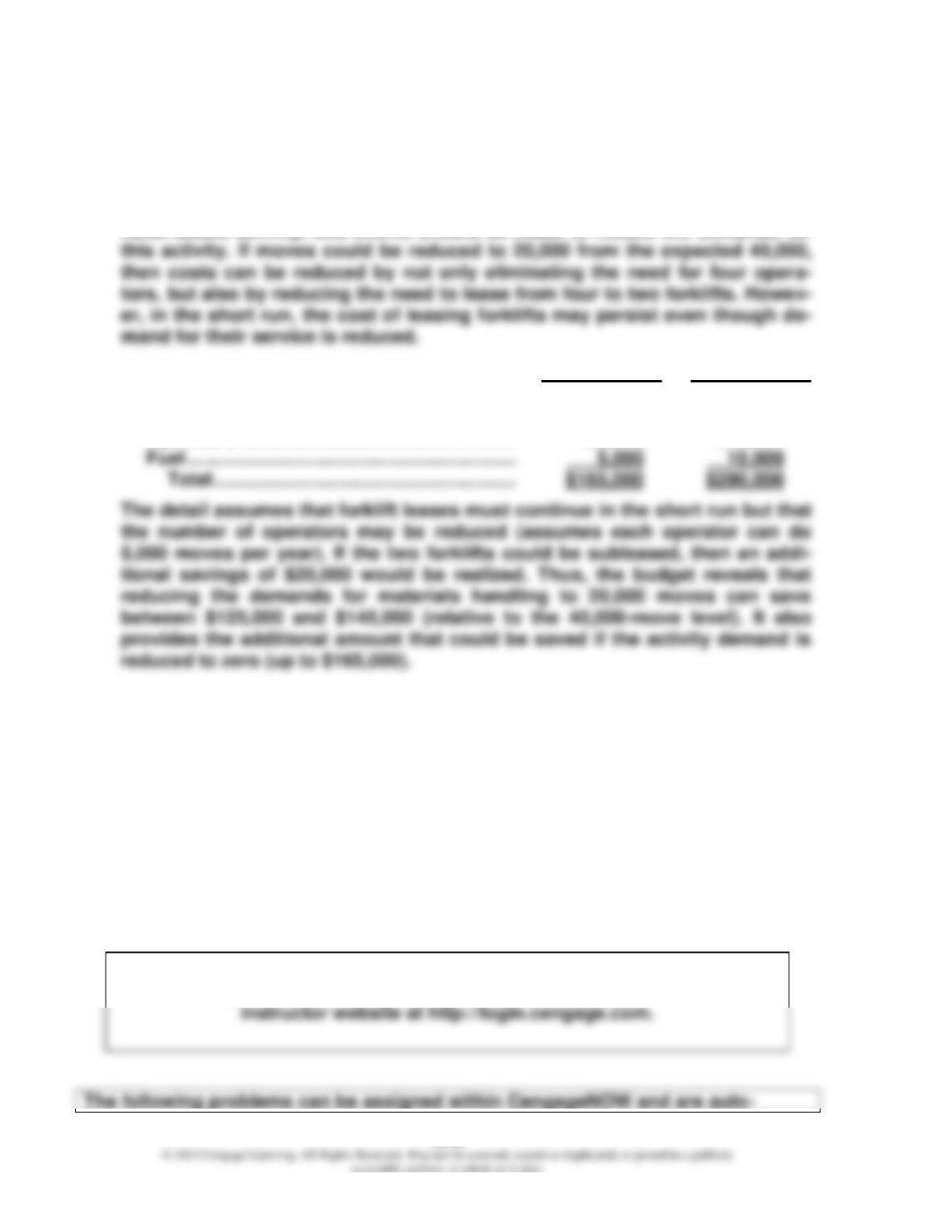
2. Pool rates: $1,100,000/100,000 = $11 per direct labor hour
$672,000/300,000 = $2.24 per machine hour
Unit cost:
Pool 1: $11 × 10,000 ………………. $110,000
12–30
Problem 12.30 (Concluded)
3. Knowing the resources consumed by activities and how the resource costs
change with the activity driver should provide more insight into managing the
activity and its associated costs. For example, moving materials is a non–
value-added activity, and efforts should be made to reduce the demands for
20,000 Moves 40,000 Moves
Materials handling:
Forklifts ……………………………………………….. $ 40,000 $ 40,000
Operators …………………………..………………… 120,000 240,000
CYBER RESEARCH CASE
12.31
Answers will vary.
The Collaborative Learning Exercise Solutions can be found on the
12–31
graded. See the last page of each chapter for descriptions of these new assign-
ments.
• Integrative Problem—Activity Based Costing, Strategic Cost Management, Ac-
tivity Based Management (Covers chapters 4, 11 and 12)
• Blueprint Problem—Process Value Analysis and Reporting of Value– and Non-
value-Added Costs