1. Independent projects are such that the acceptance of one does not preclude the acceptance of
another. With mutually exclusive projects, acceptance of one precludes the acceptance of others.
2. The timing and quantity of cash flows determine the present value of a project. The present value
is critical for assessing whether a project is acceptable or not.
5. (a)
A
measure of risk. Roughly, projects with shorter paybacks are less risky.
(b) Obsolescence. If the risk of obsolescence is high, firms will want to recover funds quickly.
(c) Self-interest. Managers want quick paybacks so that short-run performance measures are
affected positively, enhancing chances for bonuses and promotion.
6. The accounting rate of return is the average income divided by original investment.
A
RR = $100,000/$300,000 = 33.33%
7.
A
gree. Essentially, NPV is a measure of the return in excess of the investment and its
cost of capital.
8. NPV measures the increase in firm value from a project.
11. If NPV > 0, then the investment is acceptable. If NPV < 0, then the investment should be rejected.
12. Disagree. Only if the funds received each period from the investment are reinvested to earn the
IRR will the IRR be the actual rate of return.
12 CAPITAL INVESTMENT DECISIONS
DISCUSSION QUESTIONS
CHAPTER 12 Capital Investment Decisions
14. NPV signals which investment maximizes firm value. IRR may provide misleading signals. IRR
may be popular because it provides the correct signal most of the time and managers are
accustomed to working with rates of return.
12-1. c
12-2. e
12-3. d
–
12-6. d
12-7. e
12-8. c $400/$2,000
12-11. a
12-12. b
12-13. c $4,200
–
$3,000
12-14. c (0.8 × $1,000) = $800; $800
–
$1,000
12-15. e
12-16. b
12-17. e
MULTIPLE-CHOICE QUESTIONS
CHAPTER 12 Capital Investment Decisions
BE 12-21
= 4.0 years
b. Payback period:
1.0 yea
r
BE 12-22
=
BE 12-23
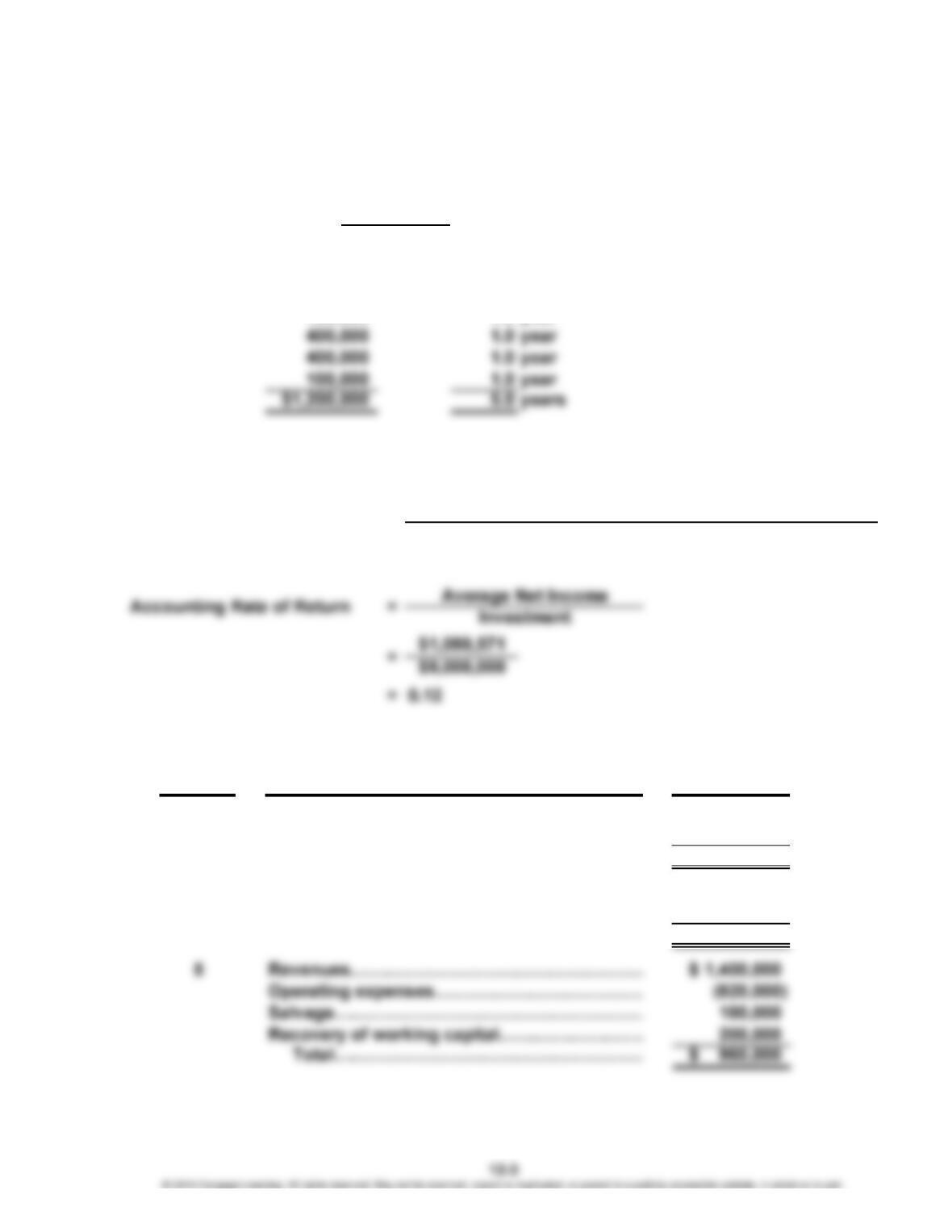
1. Year Cash Flow
0 Equipment…………………………………………
…
$(1,500,000)
Working capital……………………………………
…
(200,000)
Total……………………………………………
…
$(1,700,000)
1–4 Revenues…………………………………………
…
$ 1,400,000
Operating expenses……………………………… (820,000)
Total……………………………………………
…
$ 580,000
…
…
Item
Payback Period =a.
BRIEF EXERCISES: SET A
$1,080,571
$1,200,000
$300,000
+ $1,200,000 + $2,520,000 + $1,444,000
7
$ 150,000
$360,000 + $360,000 + $600,000 + $1,080,000
=
Average Net Income
r
r
r
r
CHAPTER 12 Capital Investment Decisions
BE 12-23 (Concluded)
2. Calculation of NPV:
Y
ea
r
Cash Flow* Discount Factor** Present Value
0$(1,700,000) 1.00000 $(1,700,000)
1580,000 0.92593 537,039
2580,000 0.85734 497,257
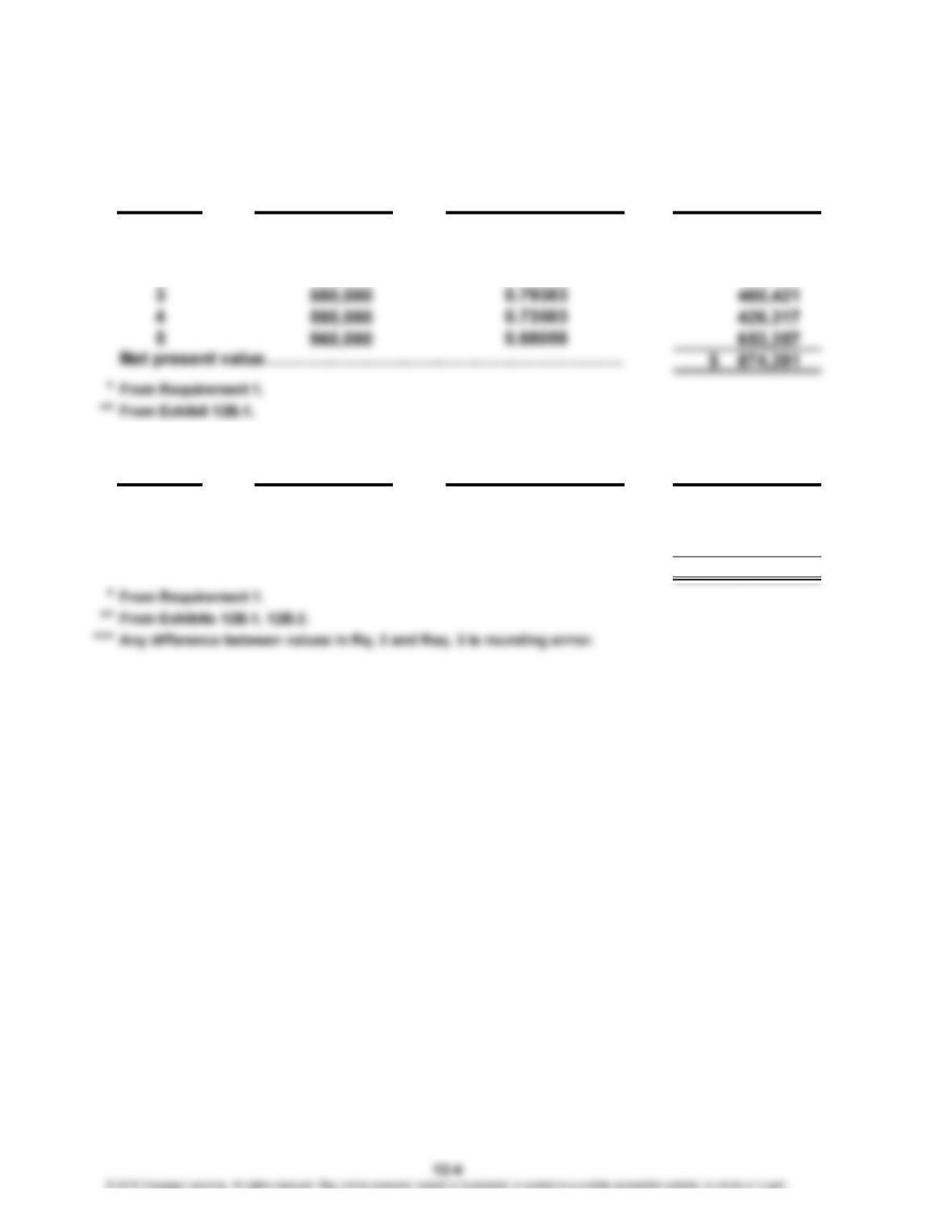
3. Calculation of NPV:
Y
ea
r
Cash Flow* Discount Factor** Present Value***
0$(1,700,000) 1.00000 $(1,700,000)
1–4 580,000 3.31213 1,921,035
5960,000 0.68058 653,357
Net present value……………………………………………………
…
$ 874,392
BE 12-24
df = I/CF = $4,607,200/$800,000 = 5.75900
From Exhibit 12B.2, 9 years and a discount factor of 5.75900 yields an IRR ≈ 10%.
…
CHAPTER 12 Capital Investment Decisions
BE 12-25
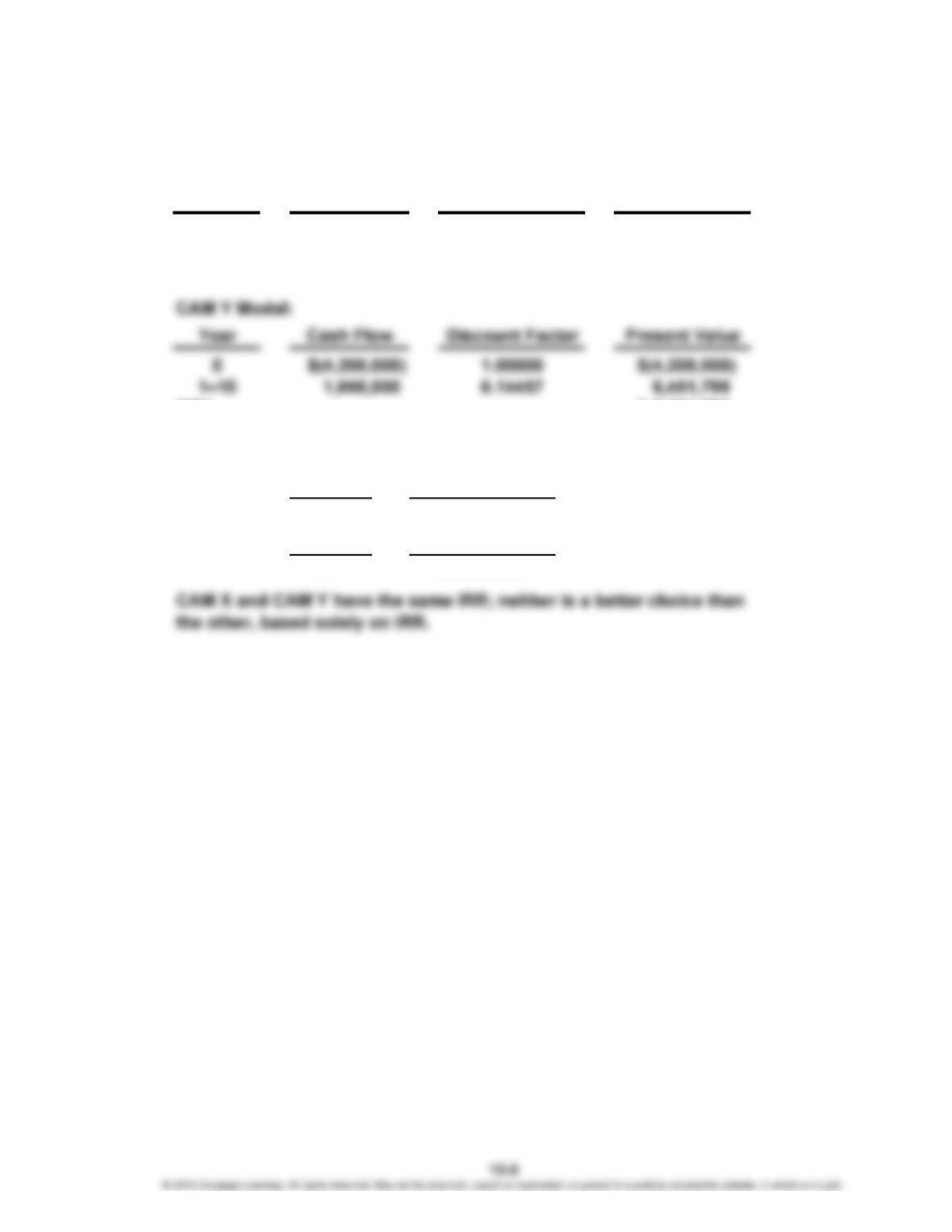
1. CAM X Model:
Y
ea
r
0
1–10
NPV………………………………………………………
…
NPV………………………………………………………
…
CAM Y is the better choice (it has the higher NPV).
I
CF
I
CF
=
=
4.00000
4.00000
$(3,600,000)
5,530,113
$ 1,930,113
$ 2,251,799
df (CAM X) =2.
df (CAM Y) =
=
=
Present Value
Cash Flow Discount Facto
r
1.00000$(3,600,000)
$1,050,000
$3,600,000
$900,000
$4,200,000
6.14457
900,000
Y
r
r
CHAPTER 12 Capital Investment Decisions
BE 12-26
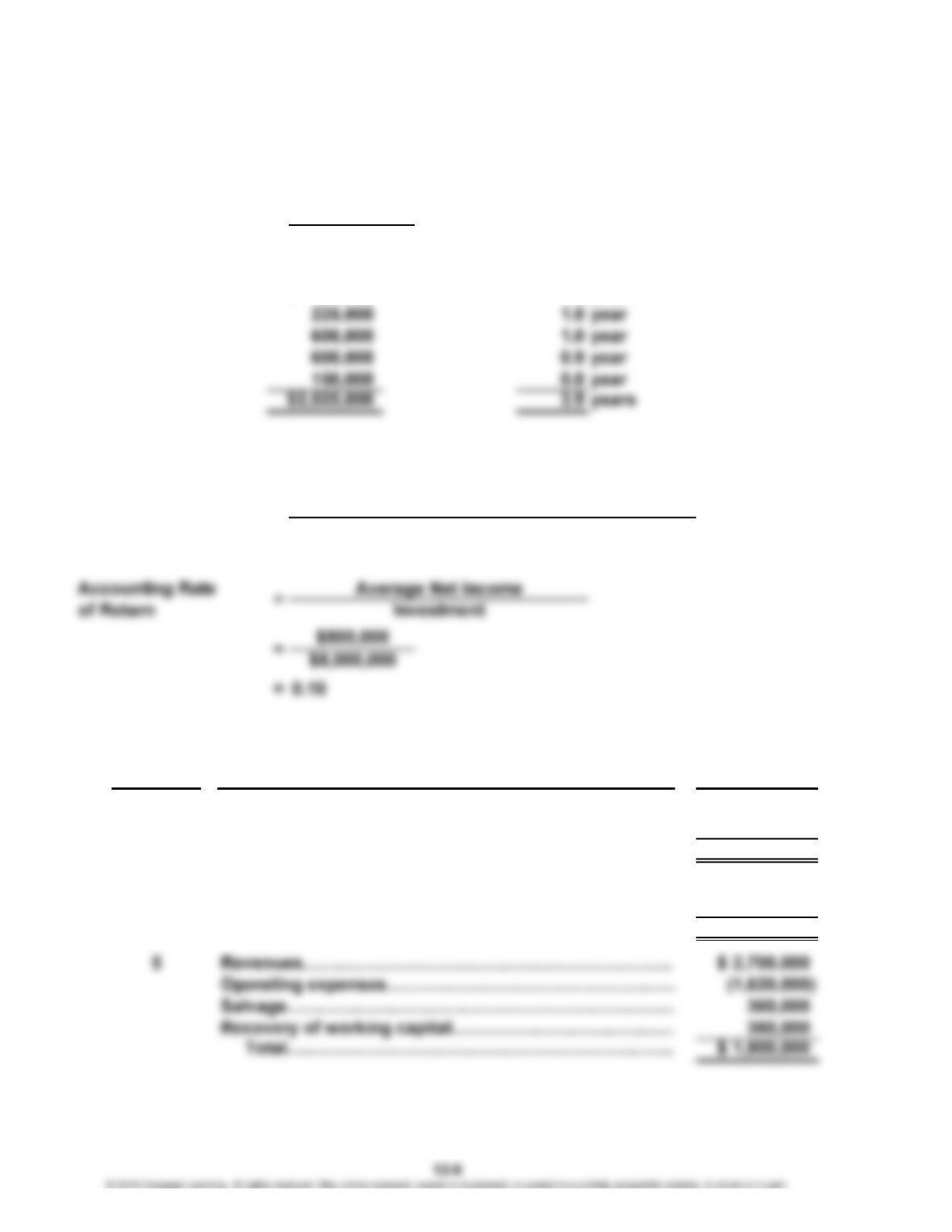
b. Payback period:
1.0 yea
r
BE 12-27
= $800,000
BE 12-28
1. Year Item Cash Flow
0 Equipment……………………………………………………… $(2,880,000)
Working capital………………………………………………
…
(360,000)
Total…………………………………………………………
…
$(3,240,000)
1–4 Revenues………………………………………………………
…
$ 2,700,000
Operating expenses…………………………………………
…
(1,620,000)
Total…………………………………………………………
…
$ 1,080,000
…
…
…
Average Net Income =
BRIEF EXERCISES: SET B
Payback Period a.
$400,000 + $300,000 + $700,000 + $800,000
+ $1,100,000 + $2,000,000 + $1,100,000
8
$750,000 = 2.4 years=
$ 450,000
$1,800,000
r
r
r
r
CHAPTER 12 Capital Investment Decisions
BE 12-28 (Concluded)
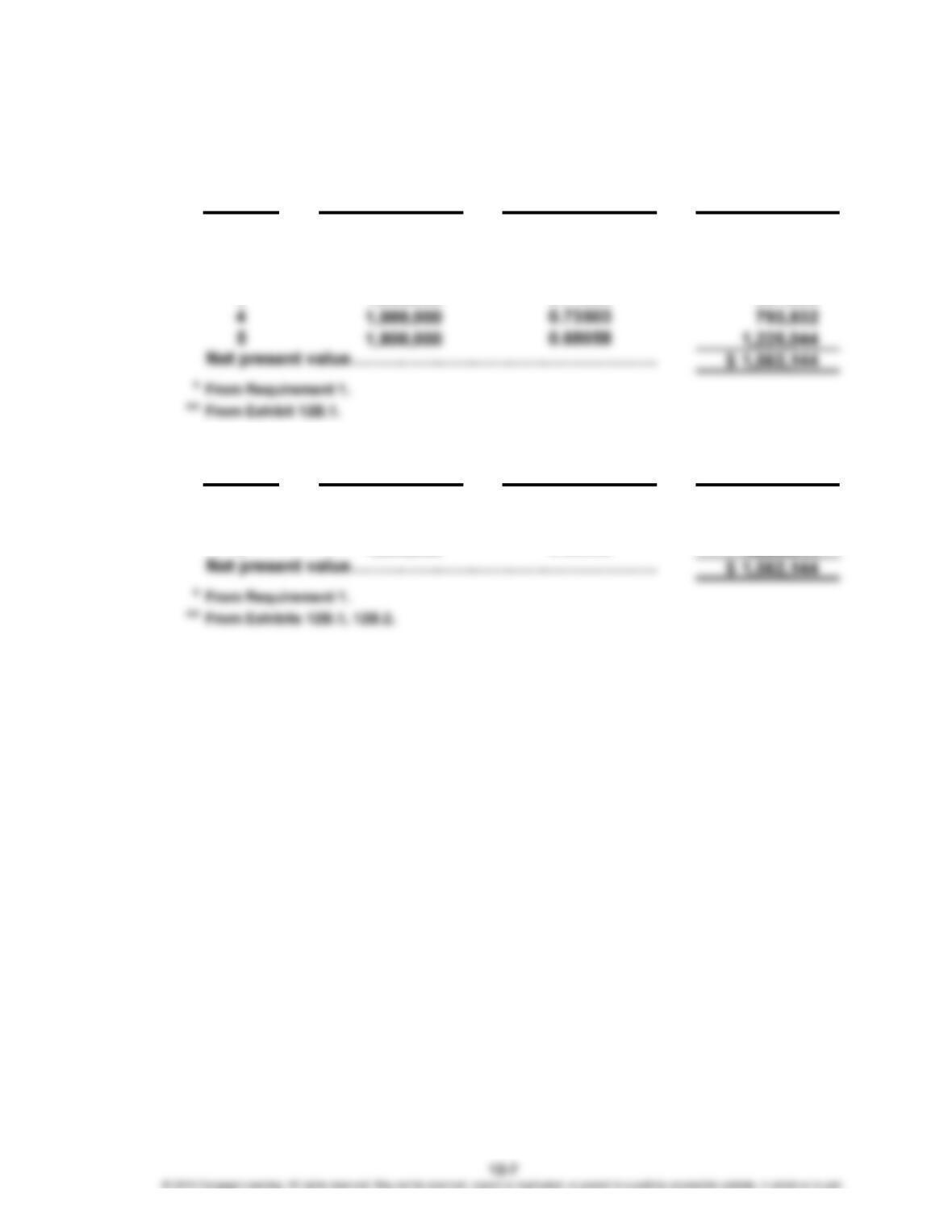
2. Calculation of NPV:
Y
ea
r
Cash Flow* Discount Factor** Present Value
0$(3,240,000) 1.00000 $(3,240,000)
11,080,000 0.92593 1,000,004
21,080,000 0.85734 925,927
31,080,000 0.79383 857,336
3. Calculation of NPV:
Y
ea
r
Cash Flow* Discount Factor** Present Value
0$(3,240,000) 1.00000 $(3,240,000)
1–4 1,080,000 3.31213 3,577,100
51,800,000 0.68058 1,225,044
BE 12-29
df = I/CF = $11,551,968/$1,800,000 = 6.41776
From Exhibit 12B.2, 10 years and a discount factor of 6.41776 yields an IRR ≈ 9%.
CHAPTER 12 Capital Investment Decisions
BE 12-30
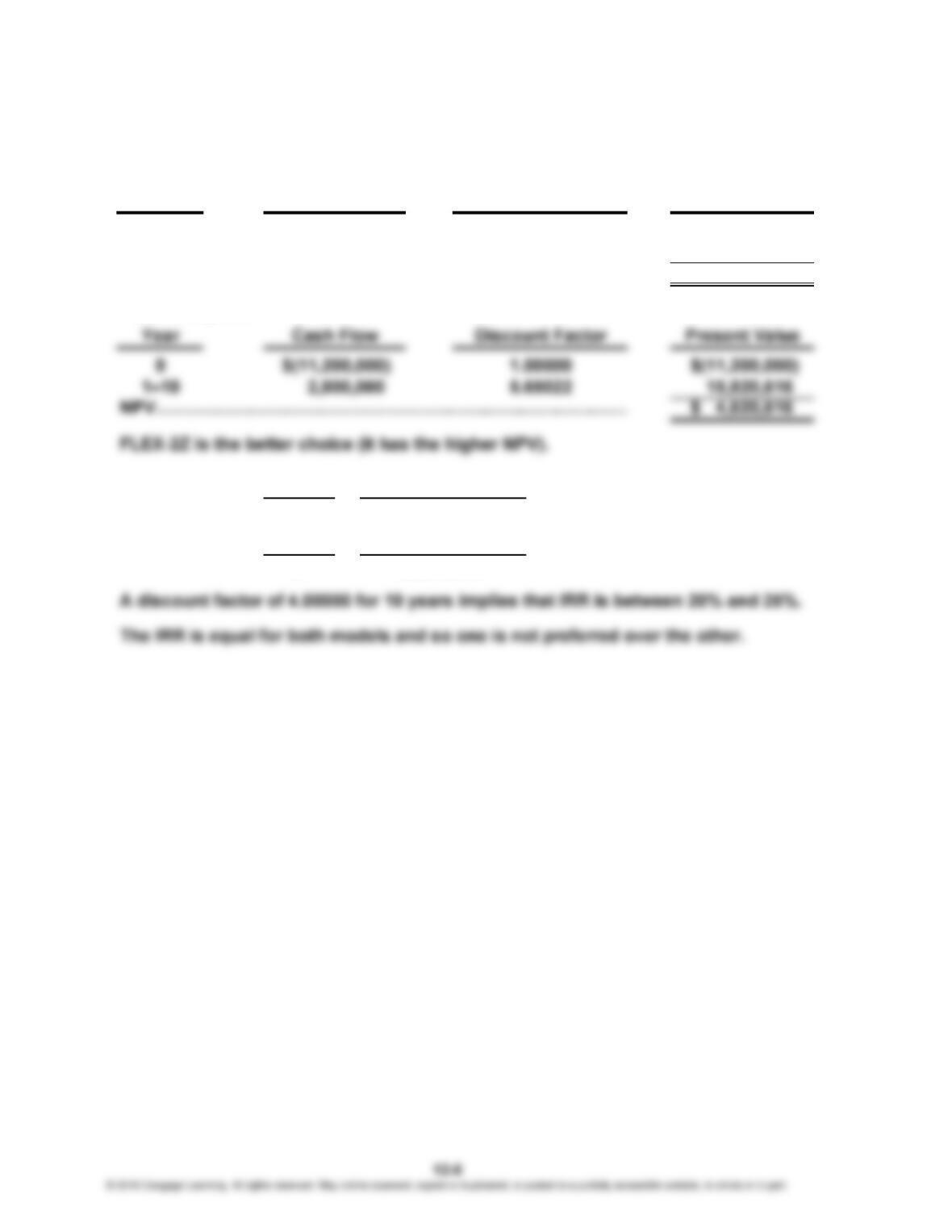
1. FLEX-1K System:
Y
ea
r
Present Value
0 $ (9,600,000)
1–10 13,560,528
NPV………………………………………………………………………
…
$ 3,960,528
FLEX-2Z System:
Y
r
…
r
I
CF
I
CF
df (FLEX-1K) =
df (FLEX-2Z) =
2. =
=
Cash Flow Discount Facto
r
$(9,600,000) 1.00000
2,400,000 5.65022
=
$11,200,000
$2,800,000 4.00000
=
$9,600,000
$2,400,000 4.00000
CHAPTER 12 Capital Investment Decisions
E 12-31
3. Investment = Annual Cash Flow × Payback Period
= $960,000 × 4
=
E 12-32
1. Initial investment (Average Depreciation = $720,000):
=
2. Accounting rate of return (ARR):
=
=
Project A: ARR
Project B: ARR
Accounting Rate of Return
1. = 3.33 years
=Payback Period
$75,000
$28,500 – $15,000
$49,500 – $15,000
$75,000
=
=
= 46%
= 18%
EXERCISES
13.3%
Average Net Income
($6,000,000 – $4,800,000 – $720,000)
$3,600,000
Investment
$3,840,000
$400,000
$120,000
CHAPTER 12 Capital Investment Decisions
E 12-32 (Concluded)
=
4.
E 12-33
1. NPV = P – I
= (5.65022 × $480,000) – $2,700,000 = $12,106
Y
es, the company should make the investment.
2. NPV = P
–
I
= (4.62288 × $52,500) – $270,000 = ($27,299)
The shop should not be purchased.
3. NPV = P
–
I
I=P
–
NPV
I= (5.33493 × $135,000) – $63,900
= $656,316
3.
0.30 =
Average Net Income
Initial Investment
Initial Investment
$120,000
Initial Investment =
ARR =
=ARR
$120,000
0.30
$400,000
Average Net Income
Initial Investment
CHAPTER 12 Capital Investment Decisions
E 12-34
1. = I for the IRR, thus,
For 5 years and a discount factor of 3.60000, the IRR is very close to 12%.
The equipment should not be purchased.
2. = I for the IRR, thus,
$1,248,000
$240,000
= 5.20000
For 10 years and a discount factor of 5.20000, the IRR is very close to 14%.
Y
es, she should acquire the new system.
3. CF(df) = I for the IRR, thus,
P = CF(df)
=df
P = CF(df)
E 12-35
1. Puro equipment:
Present Value
0 $(560,000)
1 285,715
2 223,213
3 170,827
4 101,683
5 68,092
NPV……………………………………………………………
…
$ 289,530
…
Y
r
r
2. CF(df) –I= NPV
CF(3.60478) – $560,000 = $374,453
(3.60478)CF = $934,453
$934,453
3.60478
=CF
Discount Facto
r
0.63552
Y
ea
r
0.89286
0.79719
0.71178
0.56743
Cash Flow
160,000
120,000
1.00000$(560,000)
320,000
280,000
240,000
CHAPTER 12 Capital Investment Decisions
E 12-36
2. Initial investment (Average Depreciation = $76,800):
3. NPV = (3.79079 × $150,000) – $384,000 = $184,619
4. = I for the IRR, thus,
1.
=
=
Accounting Rate of Return
Original Investment
Annual Cash Inflow
=Payback Period
$150,000 – $76,800
$384,000
Average Accounting Income
Investment
P = CF(df)
=Investment
Annual Cash Flow
df
CHAPTER 12 Capital Investment Decisions
E 12-37
1. Payback period:
Project A:
1.00 yea
r
1.00 yea
r
0.60 yea
r
2.60 years
2. Accounting rate of return (ARR):
3. P = 11.46992 × $30,000 = $344,098
Wilma should take the lump sum.
4. NPV = P
–
I
= (4.62288 × $9,000) – $30,000 = $11,606
Y
es, he should make the investment.
Y
Project B: ARR =
$8,800 – $4,000
$20,000
Project A: ARR =
$ 6,000
8,000
6,000
$20,000
10%=
= 24%
$20,000
$6,000 – $4,000
r
r
r
CHAPTER 12 Capital Investment Decisions
E 12-38
1. a. Return of the original investment………………
…
$600,000
b. Cost of capital ($600,000 × 0.10)…………………
…
60,000
c. Profit earned on the investment
($693,000 – $660,000)………………………………
…
33,000
2. Cash Flow Discount Facto
r
$(600,000) 1.00000
693,000 0.90909
E 12-39
1. P = I =df × CF
2.91371* × CF =
CF = $41,185
*From Exhibit 12B.2, 14% for 4 years.
2. For IRR (discount factors from Exhibit 12B.2):
I=df × CF
= 2.40183 × CF (Equation 1)
$120,000
Present Value
$(600,000)
629,999
0
1
Y
ea
r
E 12-39 (Concluded)
Substituting Equation 1 into Equation 2:
NPV = (2.57710 × CF ) – (2.40183 × CF )
$1,750 = 0.17527 × CF
$1,750
0.17527
3. For IRR:
I=
$60,096 =
4. X = Cash Flow in Year 4
Investment = 2X
Y
ea
r
0
1
2
–
*Rounded to nearest dollar
Cash Flow in Year 4 = X = $20,009
Cost of Project = 2X = $40,018
Present Value
$10,000
12,000
Cash Flow
df × $12,000
df × CF
$60,096
$12,000
Discount Facto
r
$9,091
9,917
0.90909
=CF
=df
1.00000
(2X)
0.82645
(2X)
CHAPTER 12 Capital Investment Decisions
E 12-40
1. NPV:
Project I
Y
ea
r
Cash Flow Discount Facto
r
Present Value
0 $(100,000) 1.00000 $(100,000)
1 — 0.90909 —
2 134,560 0.82645 111,207
NPV…………………………………………………………
…
$ 11,207
Project II
Y
r
r
…
IRR:
Project I
I=df × CF
$134,560
(1 + i)2
$134,560
$100,000
= 1.34560
(1 + i)= 1.16
IRR = 16%
Project II
I
CP
$100,000
$63,857
= 1.56600
=
=$100,000
=
(1 + i)2
=df