▪ The evaluation of a manager is not necessarily the same as the evaluation of the
responsibility center in which the manager is in charge. As a general rule, managers
are evaluated based on a comparison of actual results to performance targets.
COMPENSATION SYSTEMS
• An effective management control system provides the appropriate incentives for the manager
to make decisions in the organization’s interest.
o The compensation system has to reward the manager for measured performance to
provide sufficient incentives to influence the manager’s decisions. (See Business
Application box “Performance Measures and Incentives—Veterans Affairs Hospitals”)
o Compensation can be classified into two categories:
• An important design feature of the management control system is the mix of fixed and
contingent compensation. (See Business Application box “Beware of the ‘Kink.’”)
o If the proportion of contingent compensation is too small, its incentive effect will not be
sufficient to motivate the manager to make the decisions intended by the control system.
o Example: A compensation system for a salesperson that includes both the fixed and the
contingent components may be represented by the following formula.
Total Compensation = Salary + Commission
= Salary + p
(Actual sales achieved – Target sales volume)
The first part, salary, is the fixed component of the compensation package. The second
part, commissions earned, represents the contingent component. The profit-sharing factor,
p, is a number between 0 and 1. In general, the salesperson is encouraged to outperform
the target sales volume; otherwise, she is penalized with a reduced salary.
If salary > 0 and p = 0, the salesperson’s total compensation is a fixed one and she has
little incentive to work hard and reach high sales target.
which the salesperson can choose, thereby revealing her “type” to the company.
LO 12-6 Analyze the effect of dual- versus single-rate allocation systems.
ILLUSTRATION: CORPORATE COST ALLOCATION
• If cost allocations are used in part to measure performance, the cost accountant has to
consider the role of cost allocation in the management control system.
• Incentive Problems with Allocated Costs
• Effective Corporate Cost Allocation System
o An effective cost allocation system ensures that the performance of managers who have
decision-making authority over factors that affect the costs will be measured by the costs.
o The dual-rate method is the cost allocation method that separates a common cost into
fixed and variable components and then allocates each component using a different
allocation base.
▪ Under a dual-rate method, fixed and variable costs are allocated using different
allocation bases.
▪ Important points ab out the dual-rate method include:
• First, the fixed costs could be allocated in any way as long as it is done the same
way for the target and for the actual computation of operating profit. The system
allocates only the target, and not the actual, corporate fixed costs.
See Demonstration Problem
LO 12-7 Understand the potential link between incentives and illegal or
unethical behavior.
DO PERFORMANCE EVALUATION SYSTEMS CREATE INCENTIVES TO COMMIT
FRAUD?
• If high-pressure performance evaluation systems are adopted, the pressure motivates
employees to perform. The pressure may also drive employees to commit fraud, taking
actions that not only are not in the interest of the company financially, but also illegal or
unethical.
o The pressure to perform will permeate the whole organization, from employees, middle
managers all the way to top executives.
o In 1987, the Treadway Commission issued “Report of the National Commission on
Fraudulent Financial Reporting” that linked incentives and fraud.
▪ Examples of pressures that may lead to financial fraud include:
• Unrealistic budget pressures, particularly for short-term results. These pressures
occur when headquarters arbitrarily determines profit objectives and budgets
without considering actual conditions.
• Financial pressure resulting from bonus plans that depend on short-term
economic performance. This pressure is particularly acute when the bonus is a
significant component of the individual’s total compensation.
LO 12-8 Understand how internal controls can help protect assets.
INTERNAL CONTROLS TO PROTECT ASSETS AND PROVIDE QUALITY
INFORMATION
• At a general level, internal controls provide management with reasonable assurances that
their company’s assets are protected and that the company’s accounting is reliable.
o Internal control is a process designed to provide reasonable assurance that an
organization will achieve its objectives in the following categories:
o The top management and the board of directors are responsible for providing an adequate
system of internal controls.
o The Sarbanes-Oxley Act of 2002 requires that management of publicly traded companies
report on the adequacy of their internal controls over financial reporting. It also requires
the company’s external auditors attest to the effectiveness of the internal controls in place.
▪ One key control is separation of duties, which means that no one person has control
over an entire transaction (e.g., one person should not make the sale, prepare the
invoice, deposit the cash payment, and reconcile the bank statement to the company’s
books).
• Employees can collude to beat the internal control systems.
▪ Companies use many types of internal controls besides separation of duties, such as
o Internal controls are not just good business practice but also are legally required for
publicly traded companies.

• Internal Auditing
Matching
A.
Behavioral congruence
N.
Goal congruence
B.
Centralized
O.
Internal control
C.
Compensation and reward system
P.
Investment center
D.
Contingent compensation
Q.
Local knowledge
E.
Controllability concept
R.
Management control system
Cost center
S.
Performance evaluation system
G.
Decentralization
T.
Principal-agent relationship
H.
Decentralized
U.
Profit center
Delegated decision authority
V.
Relative performance evaluation
Discretionary cost center
Responsibility accounting
L.
Dysfunctional decision making
Y.
Separation of duties
Fixed compensation
Z.
Standard cost center
_____ 1. Delegation of decision-making authority to a subordinate.
_____ 2. Information about local conditions, markets, regulations, and so on.
_____ 3. Decisions made in the interests of local managers that are not in the interests of the
organization.
_____ 7. Cost allocation method that separates a common cost into fixed and variable
components and then allocates each component using a different allocation base.
_____ 8. Compensation that is based on measured performance.
_____ 12. Organization subunit whose managers are held responsible for costs where the
relationship between costs and outputs is not well established.
_____ 13. Describes those organizations in which decisions are made by a relatively few
individuals in the high ranks of the organization.
_____ 18. System to influence subordinates to act in the organization’s interests.
_____ 19. Specification of the authority to make decisions in the organization’s name.
_____ 20. Agreement by all members of a group on a common set of objectives.
_____ 21. System and specification of how the subordinate will be evaluated.
_____ 22. Organization subunit whose managers are held responsible for costs and in which the
relationship between costs and output is well defined.

Matching Answers
1. G
3. L
5. F
7. K
9. O
11. P
13. B
14. E
15. C
17. M
19. I
21. S
23. W
24. T
25. X
Multiple Choice
1. Which of the following represent a principal-agent relationship?
a. Patient and dentist
b. Worker A and worker B
c. Client and lawyer
d. Both a and c.
2. The management control system includes:
a. delegation of decision rights.
3. An advantage of decentralization is that it:
a. pays attention to the company as a whole.
4. Decentralization:
a. takes advantage of local knowledge.
b. delays response to local problems.
c. reduces dysfunctional decision-making.
d. gives top management more control.
5. Delegation of decision authority:
a. is the essence of decentralization.
b. is followed by performance evaluation and compensation.
c. is part of management control system.
d. All of the above.
6. A manager in charge of research and development is likely to be heading a:
a. revenue center.
7. The manager of a profit center is responsible for all of the following except:
a. sales revenue.
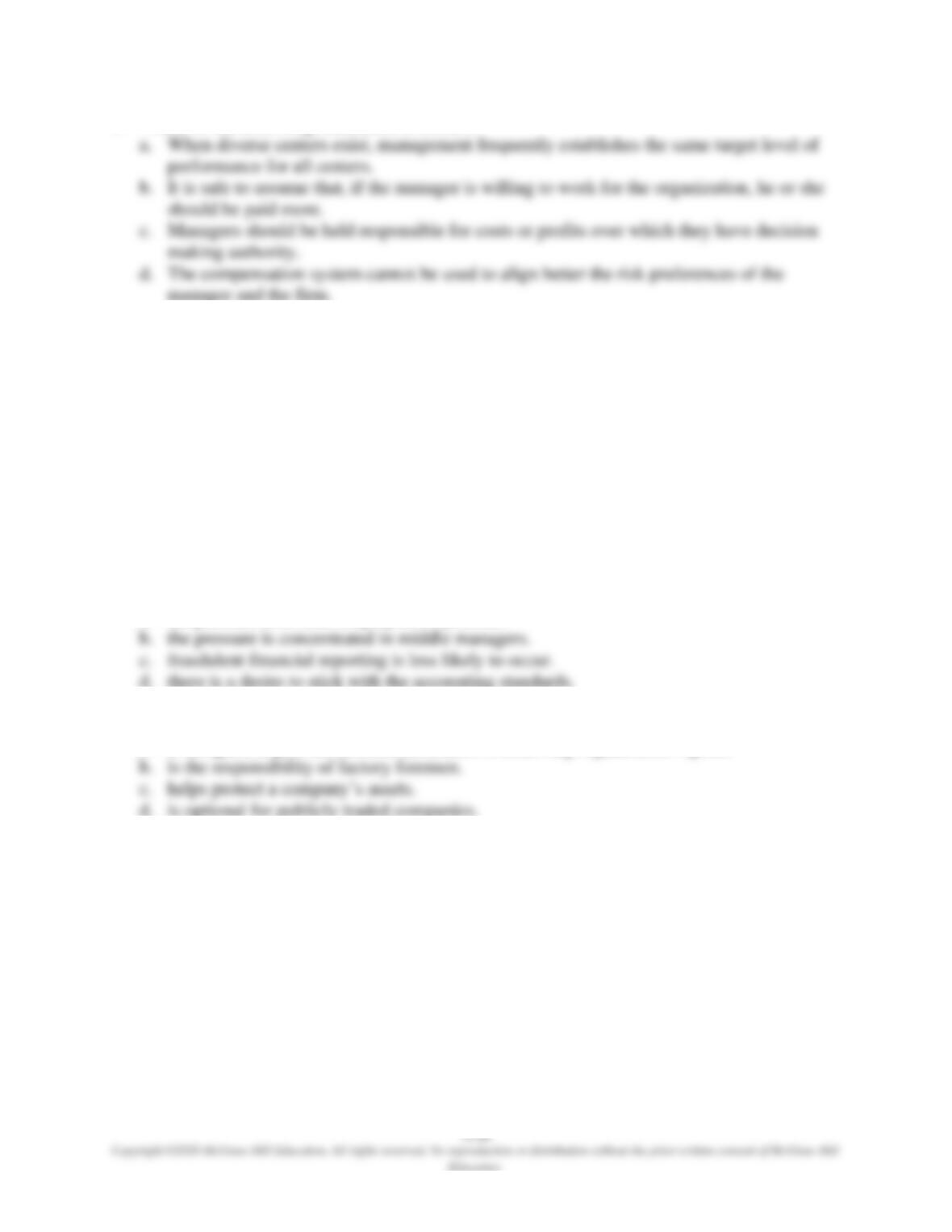
8. Which of the following statements is correct?
9. Which of the following represents an example of relative performance evaluation?
a. Actual vs. budgeted divisional income
b. Division A income vs. Division B income
c. This year’s income vs. last year’s income
d. Actual vs. standard costs
10. A dual-rate method:
a. allocates costs by separating a common cost into fixed and variable components.
b. each cost component has a different allocation base and an allocation rate.
c. transforms variable cost into fixed cost for decision making purpose.
d. Both a and b.
11. If high-pressure performance evaluation systems are adopted:
a. the pressure motivates employees to perform.
12. Internal control:
a. is designed to provide absolute assurance of achieving organization’s goals.

Multiple Choice Answers
2. a (LO1, LO3)
4. a (LO2)
6. d (LO4)
7. b (LO4)
8. c (LO5)
9. b (LO5)
10. d (LO6)
12. c (LO8)
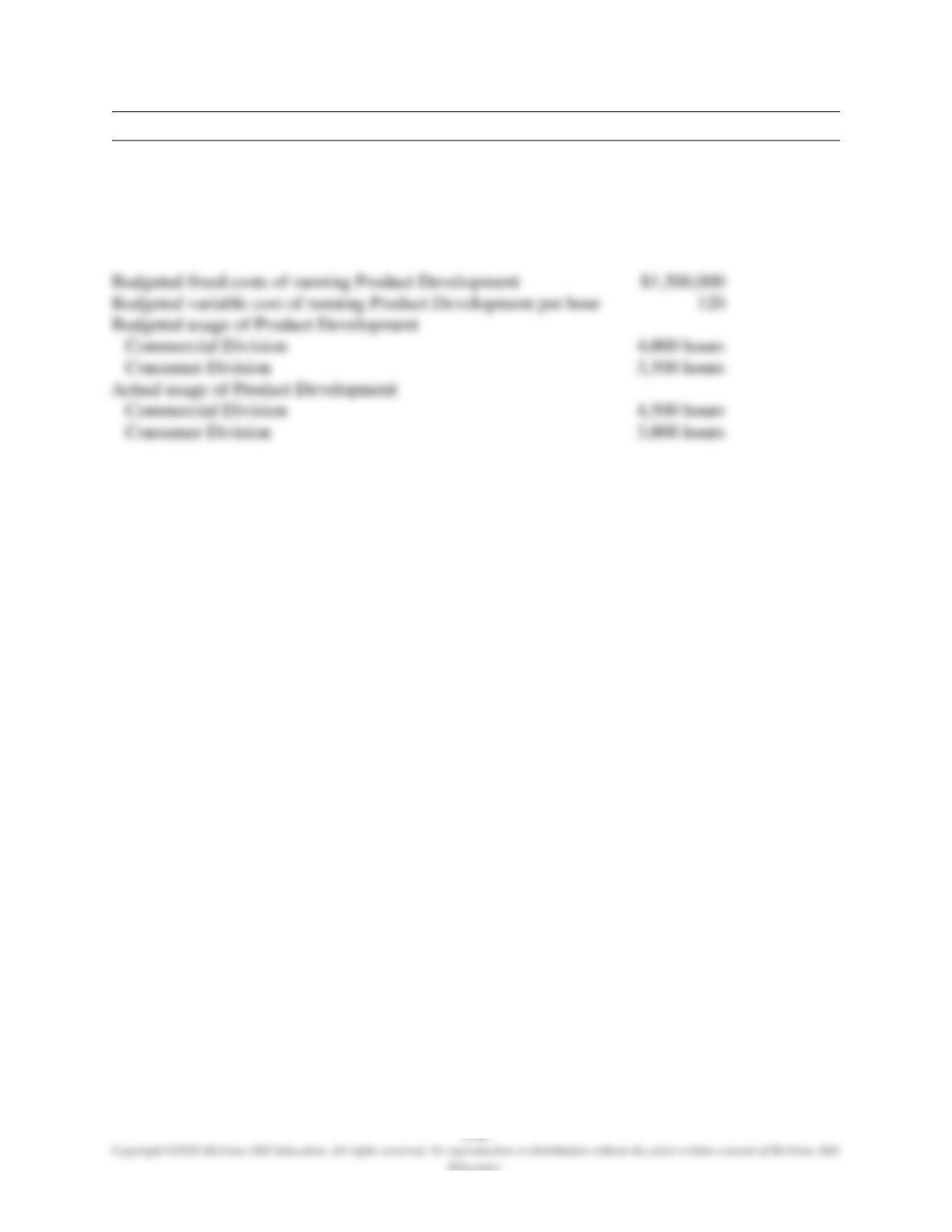
Demonstration Problem
Archery Equipment Corporation (AEC) manufactures lawn mowers in two divisions:
Commercial and Consumer. Both divisions require the support of Product Development, an
engineering service department that designs new products based on marketing data. The
following annual information is available:
Required:
1. Determine the allocation of Product Development costs to the two divisions using the single
rate method where the actual hours of usage will be the allocation base.
2. Determine the allocation of Product Development costs to the two divisions using the dual
rate method, assuming fixed costs use budgeted hours while variable costs use actual hours
of usage as allocation bases.
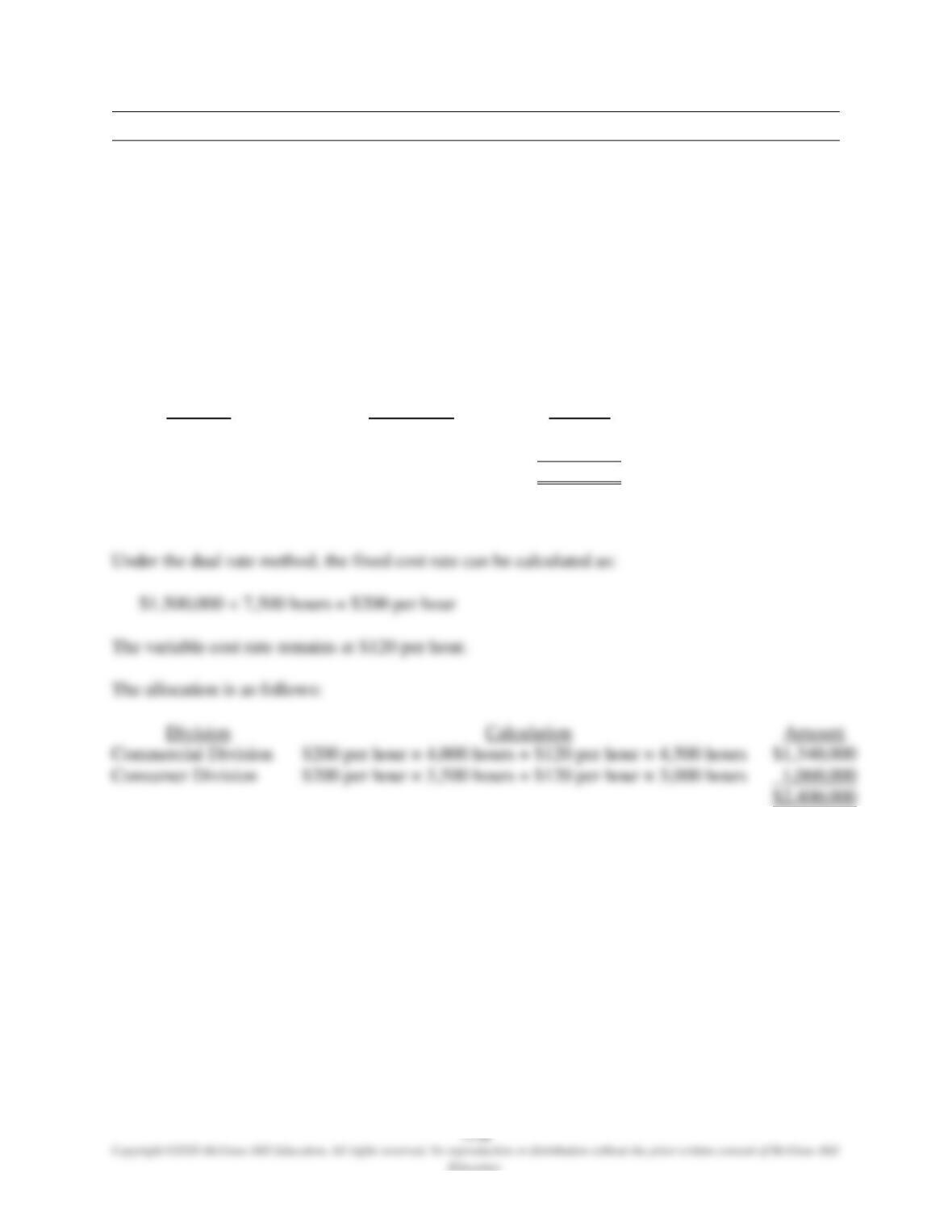
Demonstration Problem – Solution
Part 1
The budgeted total costs of running Product Develop can be calculated as:
$1,500,000 + $120 × (4,000 + 3,500) = $2,400,000
The single rate of allocation will be $320 per hour (= $2,400,000 ÷ 7,500 hours) that includes
fixed cost of $200 per hour ($1,500,000 ÷ 7,500 hours) and variable cost of $120 per hour.
The allocation becomes:
Division
Calculation
Amount
Commercial Division
$320 per hour × 4,500 hours
$1,440,000
Consumer Division
$320 per hour × 3,000 hours
960,000
$2,400,000
Part 2
Division
Amount
Commercial Division
$200 per hour × 4,000 hours + $120 per hour × 4,500 hours
$1,340,000
Consumer Division
$200 per hour × 3,500 hours + $120 per hour × 3,000 hours
1,060,000
$2,400,000